

Bharat Bhavan 2020: A Vernacular Cultural Campus on Madurai's Waterfront
Abstracted gopuram roofs and stepped plazas reinterpret Tamil Nadu's temple architecture as a living cultural landscape beside Vandiur Lake.


A gopuram does not need to crown a temple to hold cultural weight. At Bharat Bhavan 2020, the triangular roof profiles that punctuate the Madurai waterfront are deliberate abstractions of Tamil Nadu's most recognizable architectural form, translated into a contemporary campus that weaves together art, agriculture, literature, and public gathering. The result is not a monument but a porous landscape, one that treats tradition as something to inhabit rather than observe from behind a velvet rope.
Designed by Lijo Lukose, Gopika R, and Besto Thomas, the project is sited near Vandiur Lake in Madurai, a city whose identity has been shaped for millennia by the Tamil Sangam literary tradition, ritual water systems, and civic gathering spaces. Rather than proposing an isolated cultural institution, the designers conceived Bharat Bhavan as an interconnected series of pavilions, stepped plazas, and landscaped corridors that open directly to the lake edge, positioning architecture as a mediator between landscape, culture, and everyday public life.
Triangular Roof Profiles Against the Madurai Skyline


The angular roof geometries are the project's most immediate gesture. Derived from the gopuram silhouette but stripped of ornamental layering, these triangular sail roofs rise above brick volumes to create a skyline that reads as both modern and deeply regional. At ground level, the brick masses anchor the campus with tactile warmth, while the white roof forms catch light and signal public entry points. The interplay between heavy base and light canopy generates a spatial rhythm that guides visitors through the complex without relying on conventional wayfinding.
The wide stepped plaza visible in these views extends the logic of historic temple tanks and stepwells. Descending toward the water, these terraces function simultaneously as amphitheater seating, social gathering space, and a transitional zone between the built campus and the lake. Mature trees are retained and integrated, reinforcing the designers' commitment to treating the site as landscape rather than cleared ground.
A Waterfront Campus Organized by Cultural Programme


Seen from above, Bharat Bhavan reveals its organizational clarity. The campus is arranged as a series of interconnected blocks, each dedicated to a specific cultural function: an Admin and Agriculture Information Center that houses workshops, AV halls, and vertical farming areas; a Literature Hub containing library, seminar, and lecture spaces; museums, galleries, and concert venues; and community and commercial zones including food courts, training areas, and multipurpose halls. A curving pedestrian bridge stitches these programmatic clusters together along the waterfront, ensuring that movement through the campus is itself a curated sequence of spatial experiences.
The inclusion of agriculture is a notable programmatic choice. Tamil Nadu's economy and cultural identity are inseparable from its agrarian roots, and the designers acknowledge this by embedding farming knowledge directly into the institutional fabric. Similarly, the Literature Hub features a dedicated façade wall displaying Tamil literature, asserting language as a legible architectural element along the main elevation. These decisions push Bharat Bhavan beyond a generic cultural center toward something more specific and grounded in place.
Brick, Shade, and Orientation as Climate Strategy
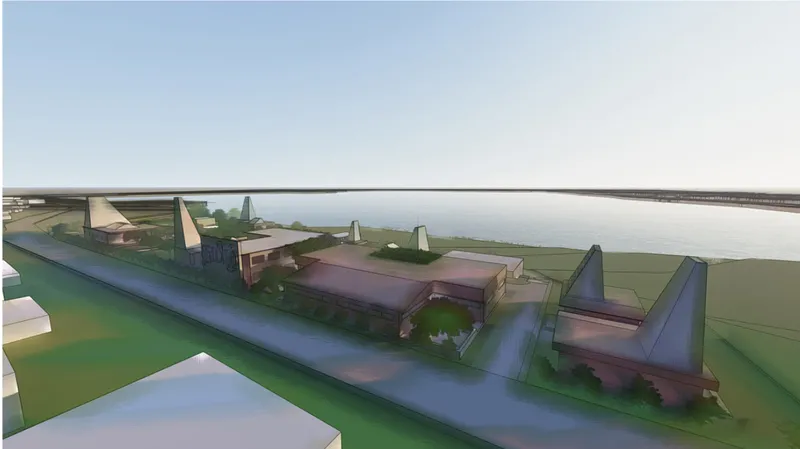

Climate responsiveness shapes the campus at every scale. Building orientation favors the north to minimize heat gain, a straightforward but critical move in Madurai's hot climate. The pillared halls and deep courtyards that appear throughout the complex are not stylistic flourishes; they are environmental devices that encourage cross-ventilation, shaded gathering, and visual continuity between interior and exterior realms. Brick volumes absorb and release heat slowly, moderating interior temperatures, while the elevated triangular roofs create stack ventilation effects that draw warm air upward.
The oblique views of the clustered pavilions reveal how the architects calibrated density and openness across the site. Tighter groupings of volumes create shaded streets and courtyards, while gaps between buildings frame views to the water body and allow landscape to penetrate the built footprint. The effect is of a settlement that grew in dialogue with its environment, not a singular object dropped onto a cleared site.
Why This Project Matters
Bharat Bhavan 2020 makes a case that vernacular architecture is a design methodology, not a decorative vocabulary. By abstracting the gopuram, the stepwell, and the pillared mandapa into spatial strategies rather than surface treatments, Lukose, Gopika, and Thomas demonstrate how regional identity can inform contemporary institutional design without lapsing into nostalgia. The stepped plazas that descend to Vandiur Lake are not replicas of temple tanks; they are public spaces that inherit the social logic of those precedents while serving entirely modern programmatic needs.
The project's ambition to integrate agriculture, literature, performance, and commerce into a single campus reflects a broader understanding of culture as an ecosystem rather than a collection of isolated disciplines. In a city like Madurai, where language, water, and ritual have shaped urban form for centuries, that holistic framing feels appropriate. Bharat Bhavan does not attempt to freeze Tamil Nadu's heritage in amber; it builds a framework where heritage can continue to evolve, argue, and breathe.
View the Full Project
About the Designers
Designers: Lijo Lukose, Gopika R, Besto Thomas
Enter a Design Competition on uni.xyz
uni.xyz runs architecture and design competitions year-round that reward proposals with spatial conviction and real site intelligence.
Project credits: Bharat Bhavan 2020 by Lijo Lukose, Gopika R, Besto Thomas.


Popular Articles
Popular articles from the community


Tsunami Convergenics: Turning Catastrophic Ocean Forces into Underwater Housing Infrastructure
A speculative underwater settlement off the coast of Onagawa, Japan, treats tsunamis and typhoons as energy sources rather than threats.

The Amber Palace Opera: A Geological Fiction Surfaces on Tallinn's Baltic Waterfront
Pierre Brillard reimagines a Baltic legend as a public landscape, opera house, and waterfront promenade rooted in Tallinn's coastal identity.
Cloaked Colonization: A Mobile Underwater Habitat That Moves Like a Fish
Micah Abaya's shortlisted EHC Pacific entry reimagines ocean settlement as a dispersed network of self-sustaining architectural organisms.

Singing Woman: Contemporary Architecture Inspired by Estonia’s Voice and the Sea
Singing Woman turns Estonia’s song culture into flowing opera house architecture, blending public life, landscape, sea, and national memory.

Similar Reads
You might also enjoy these articles
The Amber Palace Opera: A Geological Fiction Surfaces on Tallinn's Baltic Waterfront
Pierre Brillard reimagines a Baltic legend as a public landscape, opera house, and waterfront promenade rooted in Tallinn's coastal identity.
Dynamic Modules Shelter: A Telescopic Ring for Mountain Pilgrimage
A circular modular framework of steel, bamboo, and fabric grows vertically with demand, wrapping communal ground in adaptable shelter.
Singing Woman: Contemporary Architecture Inspired by Estonia’s Voice and the Sea
Singing Woman turns Estonia’s song culture into flowing opera house architecture, blending public life, landscape, sea, and national memory.
HYPERBLOCK: Flexible Urban Design for Barcelona’s Future City
HYPERBLOCK reimagines Barcelona as flexible urban design, layering density, daylight, public space and adaptable housing above Cerdà’s grid.


Comments (0)
Please login or sign up to add comments
No comments yet. Be the first to comment!