

Bio integrated conservation and research centre, Sharma - NEOM, Saudi Ara
A climate-responsive hub in NEOM merging marine and desert ecosystems with research, conservation, education, and tourism to pioneer sustainable futures in extreme arid environments.

Introduction
The rapid pace of climate change and urban expansion has placed delicate ecosystems under unprecedented pressure. Nowhere is this more visible than in arid desert regions, where biodiversity struggles to coexist with extreme conditions and ambitious development agendas. Saudi Arabia’s NEOM project in Sharma is one such frontier—an area of ecological importance and climatic challenges, but also one of opportunity. The Bio-Integrated Research and Conservation Centre emerges as a response to these conditions, offering a model where research, conservation, and sustainable tourism converge. Designed as a living laboratory, the project redefines how architecture can operate in synergy with both marine and desert ecosystems while ensuring resilience against extreme climates.
Context and Site
The project is located in Sharma, on the Red Sea coast of northwestern Saudi Arabia. This site lies within NEOM, the futuristic megacity envisioned as a hub for innovation, ecology, and sustainable living. Sharma holds ecological significance, positioned just 1.5 kilometers away from coral reef ecosystems and roughly two hours from the Prince Mohammed bin Salman Royal Reserve, home to diverse desert flora and fauna.
The challenge is twofold: to preserve and regenerate fragile ecosystems while creating a development model that allows human interaction through research, conservation, and carefully managed tourism. The hot arid desert climate, characterized by extreme temperatures, scarce water resources, and high solar exposure, demanded solutions rooted in climate-responsive architecture. The site’s existing ecological layers, such as mangrove habitats and unique plant distributions, informed a design strategy that respects natural systems while projecting future resilience.
Concept and Vision
The central design philosophy of the Bio-Integrated Research and Conservation Centre is bio-integration—the seamless merging of architecture, ecology, and human activity. The project’s vision extends beyond providing functional spaces for research; it aims to become an ecological landmark where conservation efforts, public education, and sustainable tourism intersect.
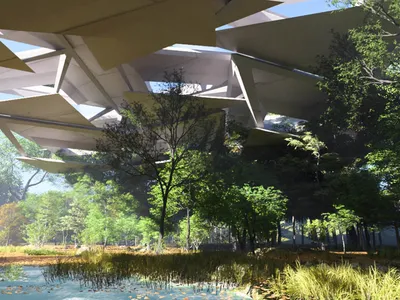
The master plan adopts a pentagon-based parametric geometry, evolving into a sloped configuration that mirrors both desert landforms and coral reef structures. This form not only enhances the aesthetic and symbolic identity of the centre but also supports climatic adaptation by maximizing shade, optimizing wind flow, and integrating natural topography.
The program is divided into three main zones: a Marine Research Hub for coral reef and coastal studies, a Desert Research Centre focusing on arid biodiversity and conservation strategies, and a Museum and Public Education Zone that communicates ecological knowledge to visitors. Complementary zones include residences for researchers, public open spaces, and interactive landscapes designed to foster a culture of ecological stewardship.
Design Strategies
Sustainability lies at the heart of the design, expressed through a multi-layered strategy that addresses climate, materials, and ecological processes.
Passive Design Principles: The building orientation minimizes solar heat gain while maximizing natural ventilation. Courtyards and shaded arcades create microclimates that reduce the cooling load. Wind towers and ventilated atriums echo traditional desert strategies, adapted into contemporary high-tech solutions.
Building Envelope: The facade employs adaptive biomimetic skins inspired by desert flora. Kinetic shading devices mimic the opening and closing of desert plants, responding dynamically to sun angles and thermal conditions. The material palette blends high-performance composites with locally sourced stone and earth, ensuring thermal stability while maintaining cultural resonance.
Water and Energy Systems: Given the scarcity of freshwater, the project integrates on-site desalination plants and greywater recycling systems for landscape irrigation. Renewable energy—particularly solar photovoltaic arrays and concentrated solar power—provides the majority of the centre’s energy needs. Energy storage systems balance the fluctuating demand, ensuring year-round resilience.
Landscape Integration: The open spaces are not ornamental but ecological. Mangrove reforestation projects help stabilize the coastline while serving as carbon sinks. Coral reef research facilities extend conservation efforts into the marine environment. Desert restoration zones cultivate native drought-resistant species, enhancing biodiversity while reducing reliance on artificial irrigation.
Programmatic Zoning: The master plan organizes spaces to balance research needs with public engagement. While the Museum and visitor facilities offer immersive experiences, the Marine and Desert Research Zones remain semi-restricted, accessible to scientists and conservationists. Residential and recreational zones foster community, while public promenades and eco-trails connect visitors with the living ecosystems surrounding the site.
Sustainability and Future Potential
The Bio-Integrated Research and Conservation Centre is designed to align with NEOM’s broader ambition of becoming a model for eco-urbanism and sustainable innovation. By merging advanced technologies with vernacular climate strategies, the project demonstrates how architecture can serve as both an environmental mediator and a social catalyst.
Its adaptive approach to extreme climates is not limited to the Saudi Arabian desert. The design’s principles—resilient materials, biomimetic facades, regenerative landscapes, and integrated renewable energy—can be replicated in other vulnerable ecosystems worldwide. Moreover, by framing conservation as both a scientific and public pursuit, the project highlights the necessity of public engagement in ecological preservation.
Conclusion
The Bio-Integrated Research and Conservation Centre represents a new paradigm in architecture, where the built environment evolves into a platform for research, education, and ecological restoration. By bridging marine and desert ecosystems within a climate-responsive framework, the project becomes more than an architectural proposal—it becomes a call for sustainable coexistence.


Popular Articles
Popular articles from the community


Extended Shell: Retrofitting Kolkata's Balconies as Living Urban Thresholds
A modular retrofit system recovers the social and environmental intelligence of Kolkata's historic verandas for contemporary Park Street residents.
Opera by the Sea Estonia: Three Shells Dissolving Architecture into Tallinn's Coastline
A winning opera house proposal replaces monumental form with interconnected shells that blur the boundary between building, park and Baltic Sea.

The Amber Palace Opera: A Geological Fiction Surfaces on Tallinn's Baltic Waterfront
Pierre Brillard reimagines a Baltic legend as a public landscape, opera house, and waterfront promenade rooted in Tallinn's coastal identity.
Cloaked Colonization: A Mobile Underwater Habitat That Moves Like a Fish
Micah Abaya's shortlisted EHC Pacific entry reimagines ocean settlement as a dispersed network of self-sustaining architectural organisms.

Similar Reads
You might also enjoy these articles

The Rhythm of Seasons
A Farmers' Market Connecting Nature and the City

More Than a Building-Designing a Living System
More Than a Building-Designing a Living System
Base Beyond
DESERT COMPOUND ARID: TOURISM OF ABSENCE AND ABUNDANCE

Explore Architecture Competitions
Discover active competitions in this discipline


Challenge to reimagine the Iron Throne

Photograph architecture without architects

Illustrate the lost glory of Angkor Wat - Render Challenge

Design challenge to reuse E-waste
Comments (0)
Please login or sign up to add comments
No comments yet. Be the first to comment!