
BIOMA Carves a Wave-Roofed House into the Hillsides of Balcarce, Argentina
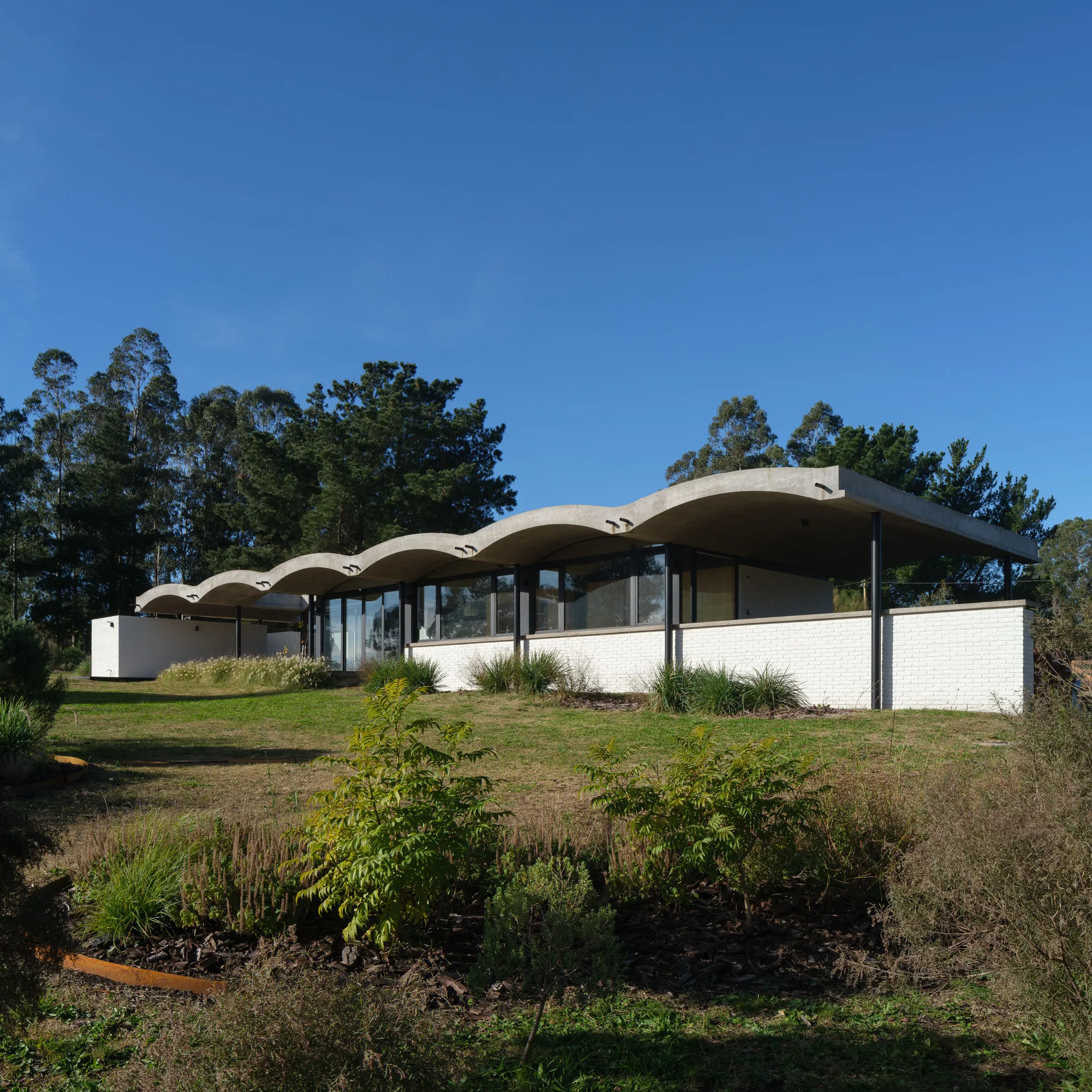
A sequence of concrete barrel vaults settles into a mountain clearing outside Balcarce, framing the landscape as domestic space.


On the outskirts of Balcarce, where the pampas begin to buckle into the Tandilia mountain range, BIOMA has placed a house that reads less like an object and more like a geological event. The Bite House, designed by lead architects Felipe Carrizo and Tomás Randrup, takes its name from the idea of a missing piece carved out of the slope: a precise void that the building then occupies with a rippling concrete canopy. At 120 square meters, it is modest in footprint, but the ambition of its roof form gives it a presence far beyond its size.
What makes this project compelling is the tension between its two primary gestures. Below, the house is a clean, rectilinear pavilion of white brick and glass, almost reticent. Above, a sequence of barrel vaults rolls across the plan like a frozen wave, casting deep shadows and collecting rainwater and plantings along its ridges. The roof is the protagonist, and the rooms beneath it are curated encounters with the landscape it frames.
A Roof That Moves Like Terrain
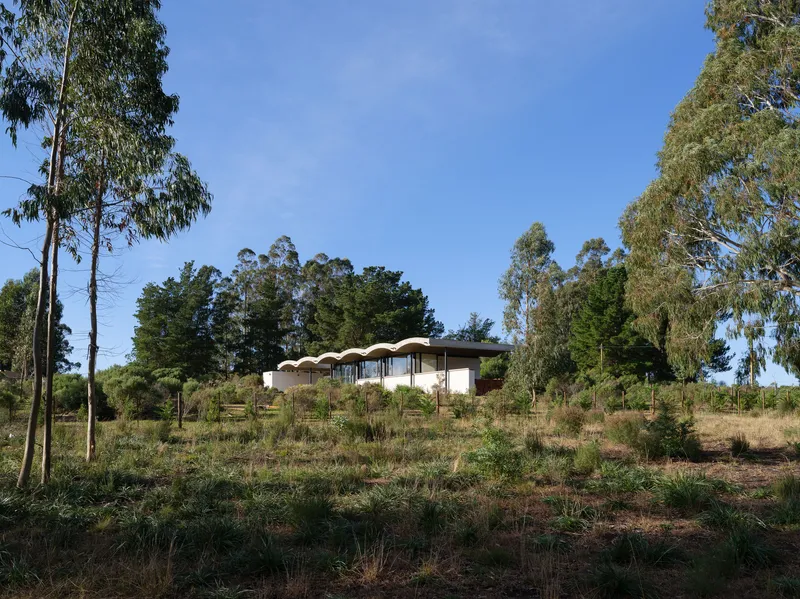
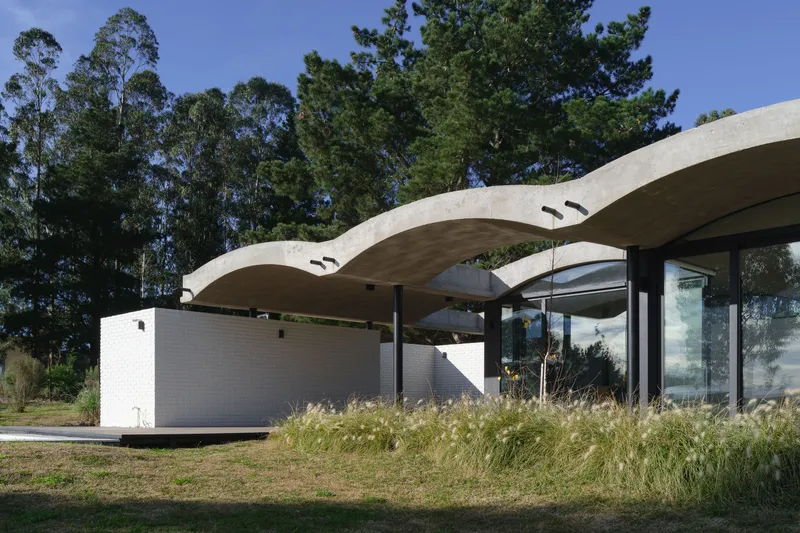
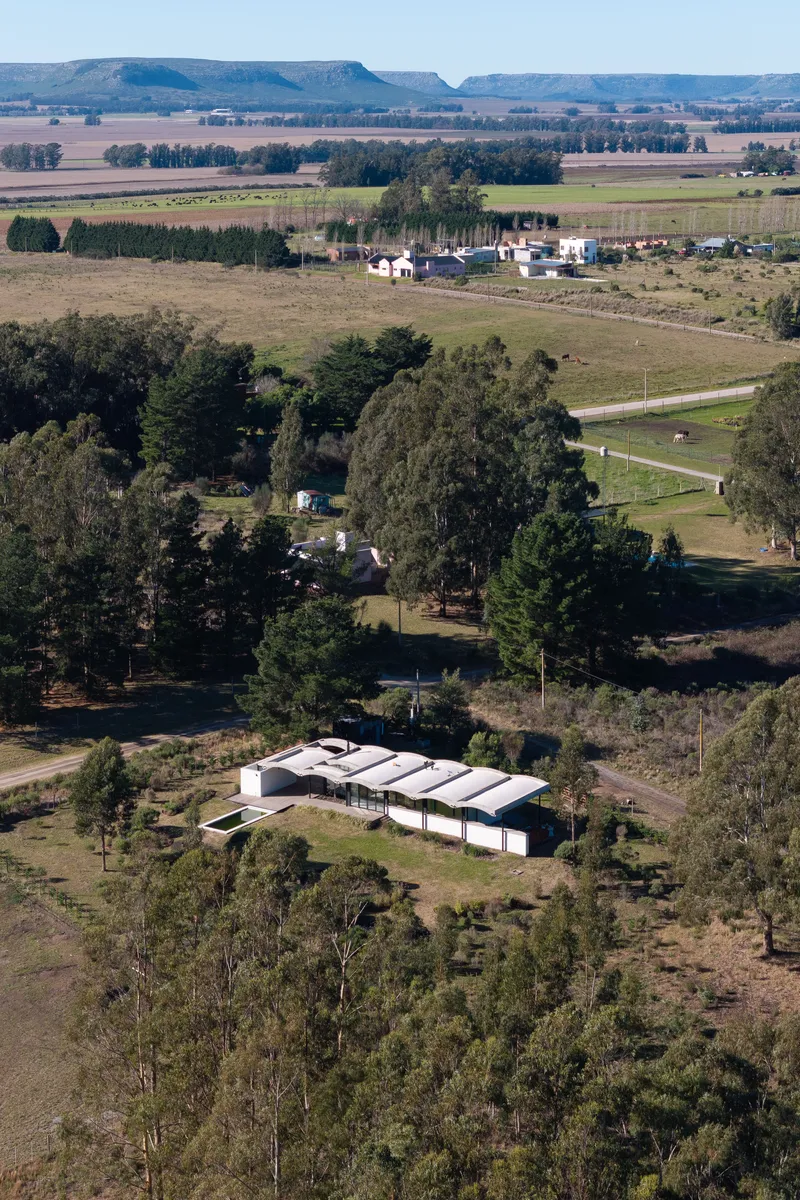
Seen from a distance, the house barely registers as architecture. Its scalloped concrete canopy mimics the surrounding topography so convincingly that it reads as a mineral outcrop colonized by grasses. The aerial view confirms the strategy: multiple barrel vaults, each slightly offset, create a continuous but rhythmically varied roofscape that avoids the monotony a single large span would produce. Planted with native vegetation, the roof is designed to dissolve back into its context over time.
From the side elevation, the structural logic becomes clearer. The vaults float above the white brick walls with a visible gap, a thin shadow line that keeps the heavy roof feeling buoyant. A metal flue pipe punches through at one end, anchoring the composition and signaling the hearth below. The relationship between the organic roof and the orthogonal base is the core architectural idea, and BIOMA holds that contrast with discipline.
Living Under Concrete Arches
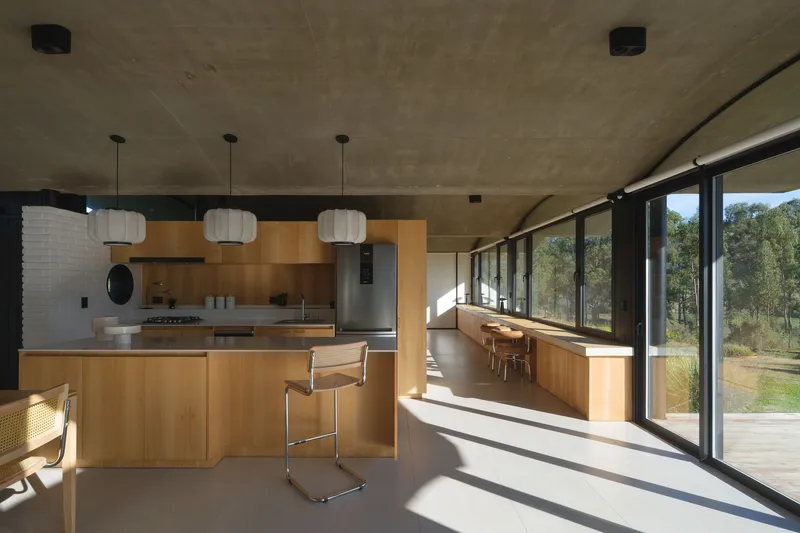
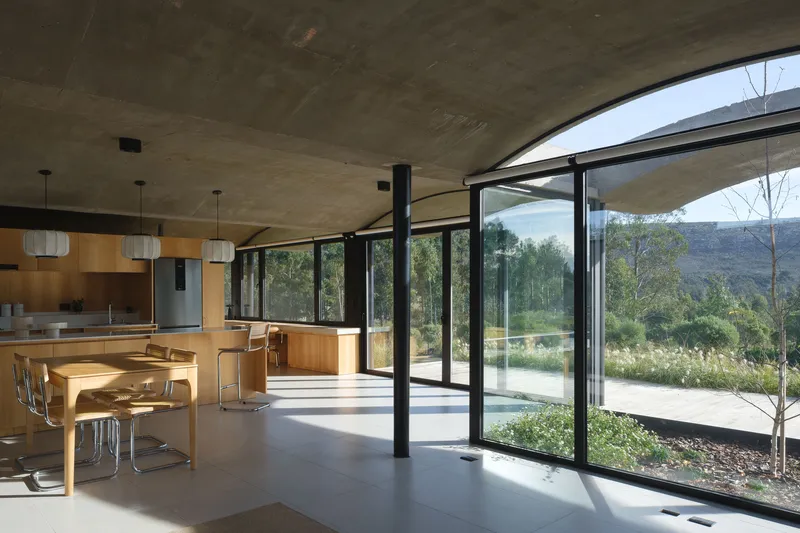
Inside, the barrel vaults compress and expand the ceiling in a slow rhythm that shapes the experience of each room without walls needing to do the work. The open-plan kitchen and dining area is the clearest expression of this: the curved soffit sweeps overhead while floor-to-ceiling glazing pulls the mountain panorama into the room. The palette is restrained. Exposed concrete above, timber and white surfaces below, and then the landscape doing the rest.
There is no attempt to hide the structure. The concrete is left raw, and the vaults' formwork grain remains visible, giving the ceilings a directional texture that draws the eye toward the windows. It is a smart move because it turns a purely structural decision into a spatial tool, guiding movement and focus without signage or obvious planning tricks.
Courtyards and the Mediation of Light
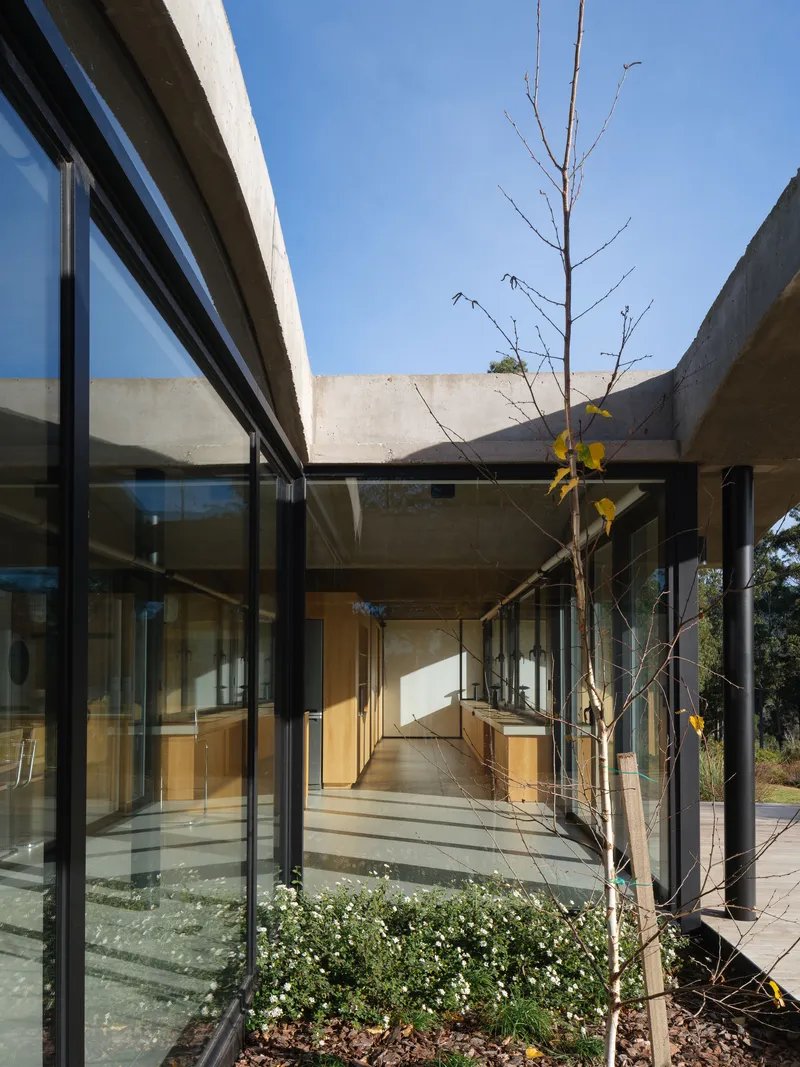
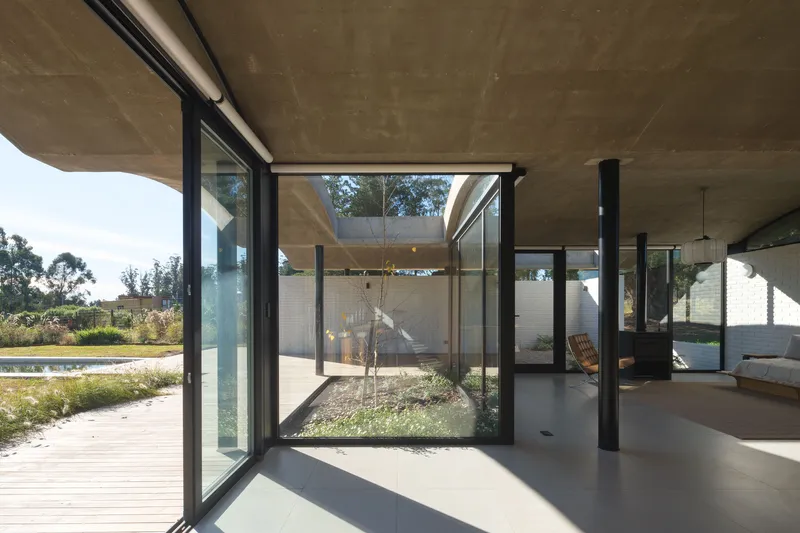
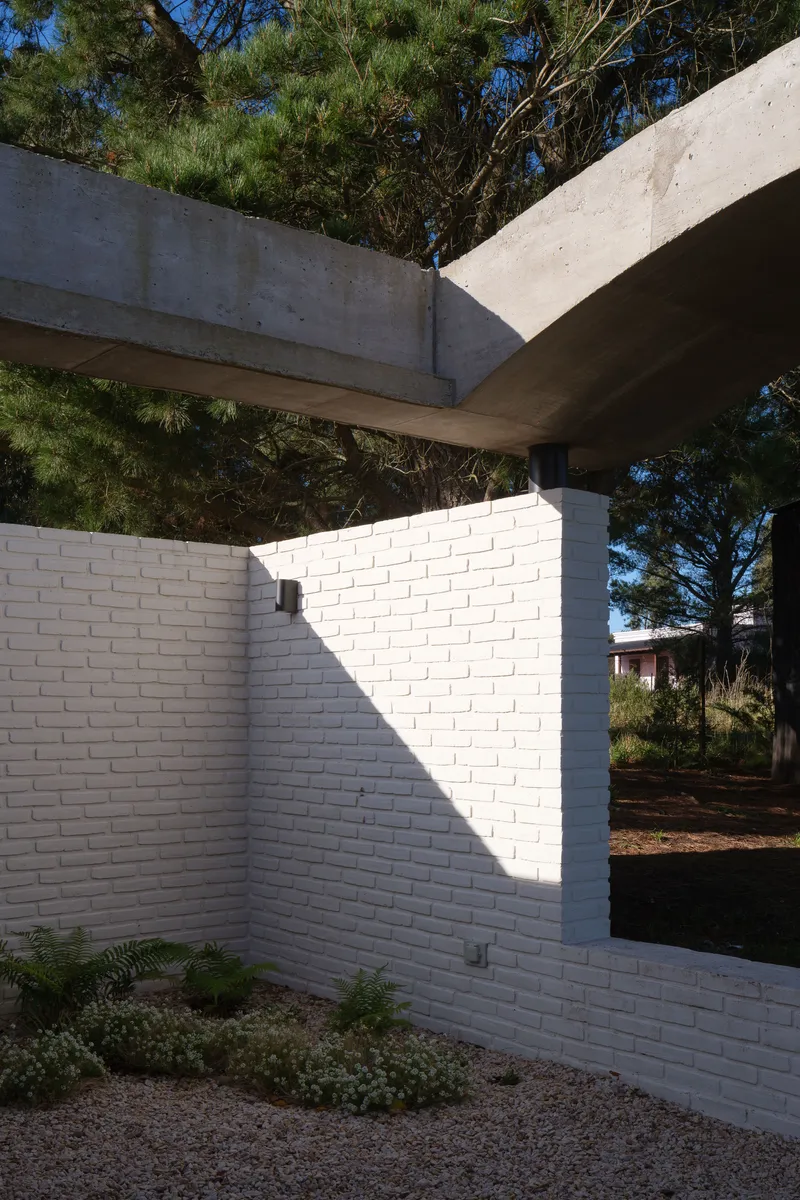
The linear plan is punctuated by courtyards that break the volume into discrete episodes. A glass-walled garden with a single deciduous tree acts as a hinge between the public and private zones, offering cross-ventilation and a change of light quality. Pivoting glass doors allow the courtyard to be absorbed into the interior or sealed off, depending on season and mood.
The white brick courtyard walls serve a double role. They reflect light deep into the plan, countering the shadow cast by the heavy roof, and they provide a neutral backdrop that makes the planting and sky the focal points. Where the concrete beams land on these walls, the junction is left deliberately legible: two materials, two logics, meeting without disguise.
Timber Interiors and the Domestic Scale
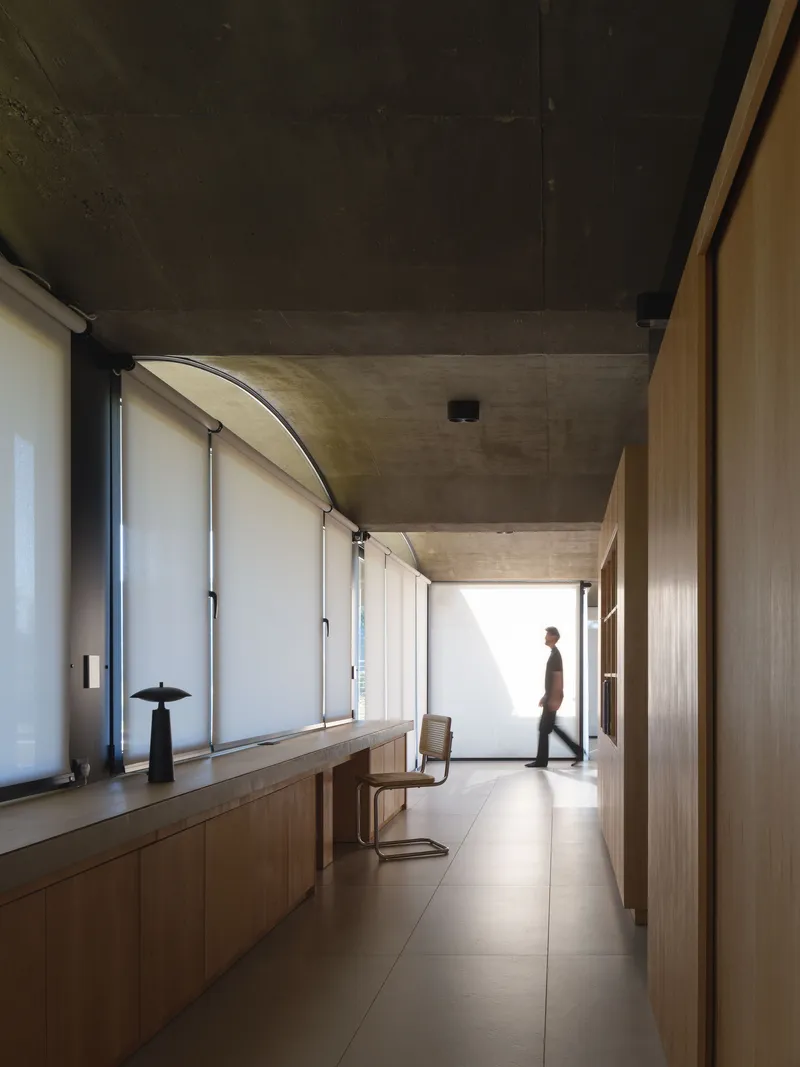
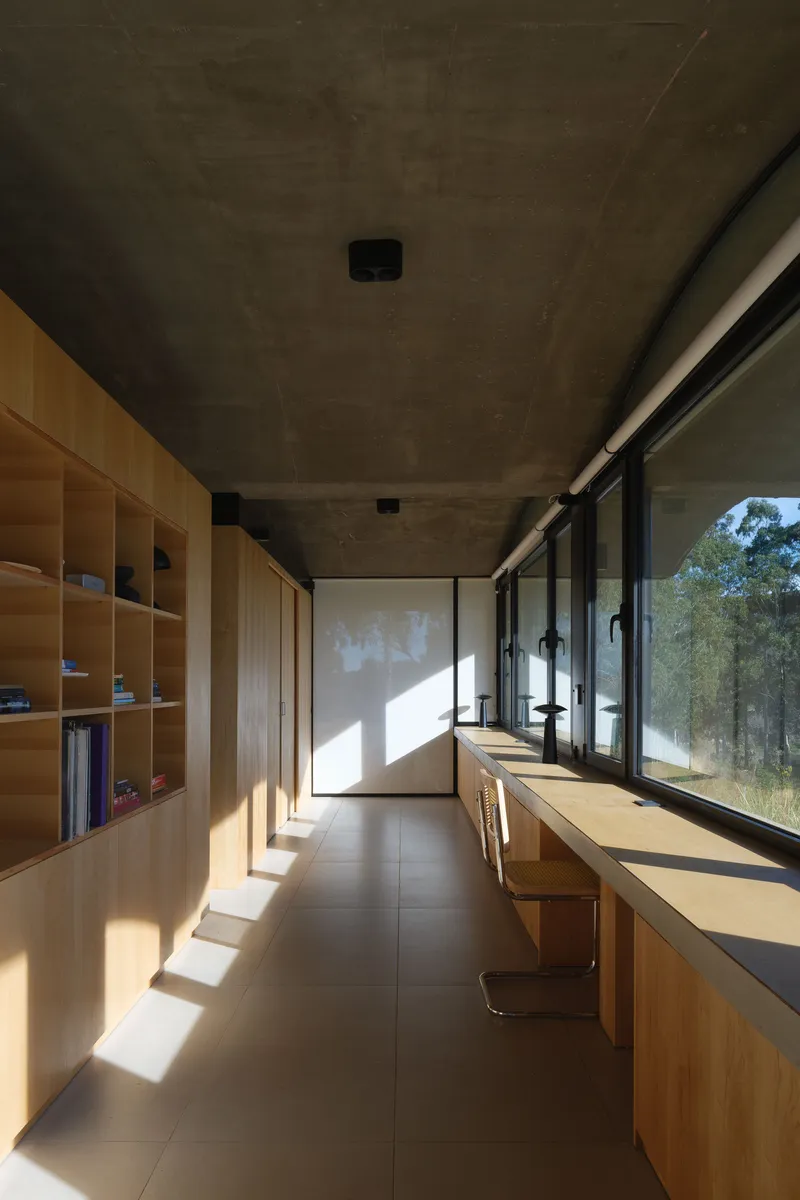
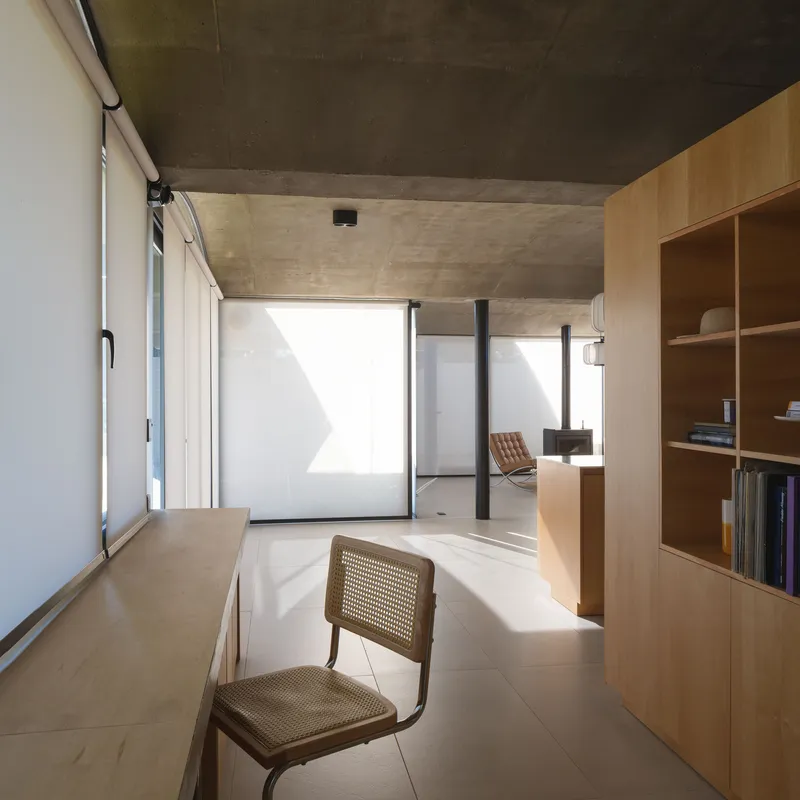
The corridors and private rooms dial back the drama of the main living spaces. Built-in plywood shelving and desks line the circulation spine, turning what could be dead space into a working study. Afternoon sun rakes across the timber surfaces, warming a palette that might otherwise feel austere under all that concrete. The joinery is simple and well-executed, with clean shadow gaps and a consistent material language that avoids competing with the architecture.
A figure walking toward the light at the end of the corridor confirms the proportions: these are compact, human-scaled passages that create necessary compression before the release of the glazed living areas. BIOMA understands that good domestic architecture needs rhythm, and the alternation between tight and open, dark and bright, is handled here with confidence.
The Landscape as Room
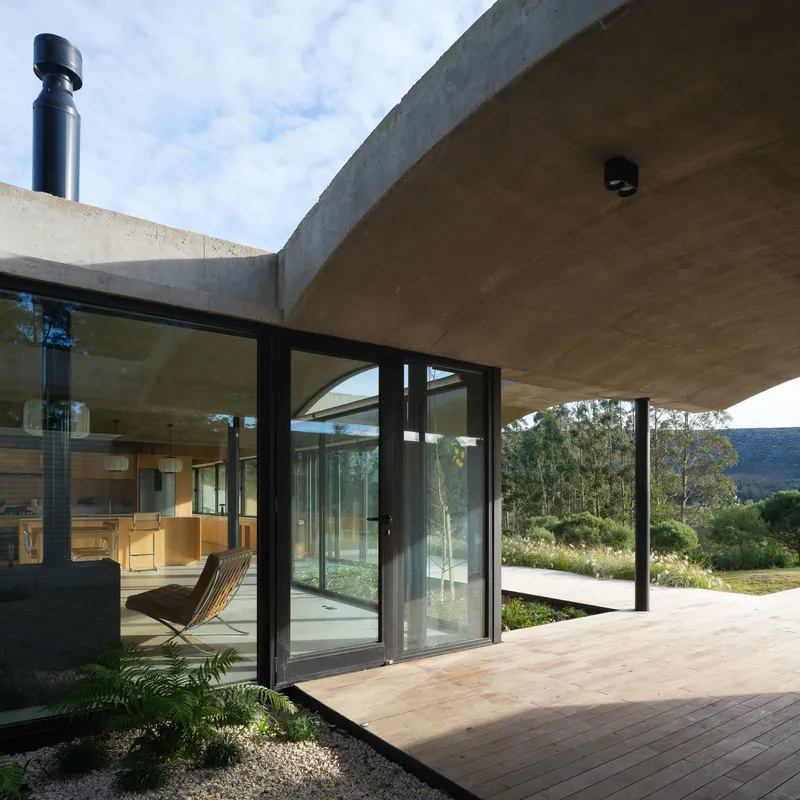
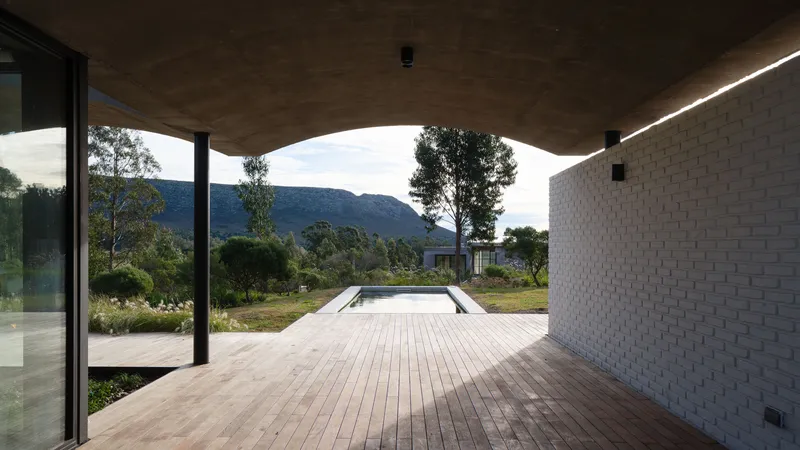
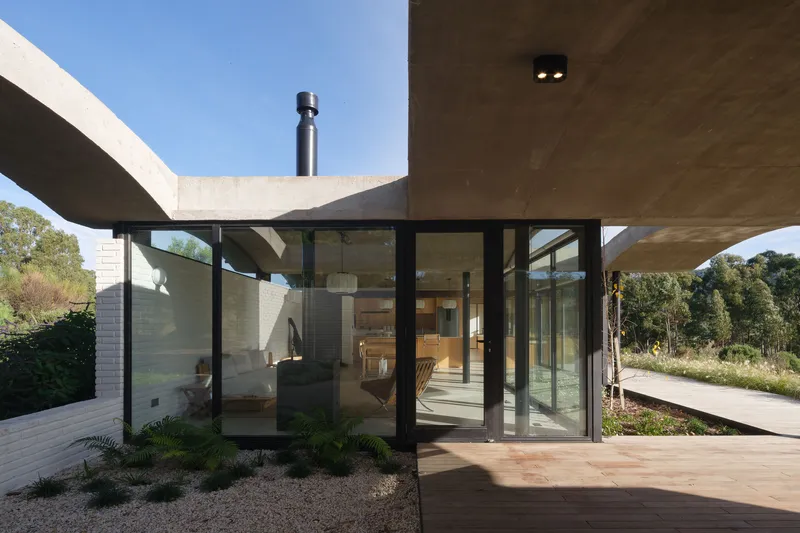
The timber deck and pool terrace extend the interior plan into the landscape with a directness that feels earned rather than gratuitous. Sliding glass doors disappear into wall pockets, collapsing the boundary between inside and out. From the covered deck, the arched concrete soffit frames a panorama of distant hills and a rectangular pool that reflects the sky back at the roof, creating a visual loop between natural and constructed horizons.
The pool itself is positioned not as a luxury amenity but as a compositional element: a flat plane of water that stabilizes the rolling forms above it. Surrounded by native grasses and eucalyptus, the outdoor spaces feel continuous with the terrain rather than imposed on it.
Dusk and the Reveal


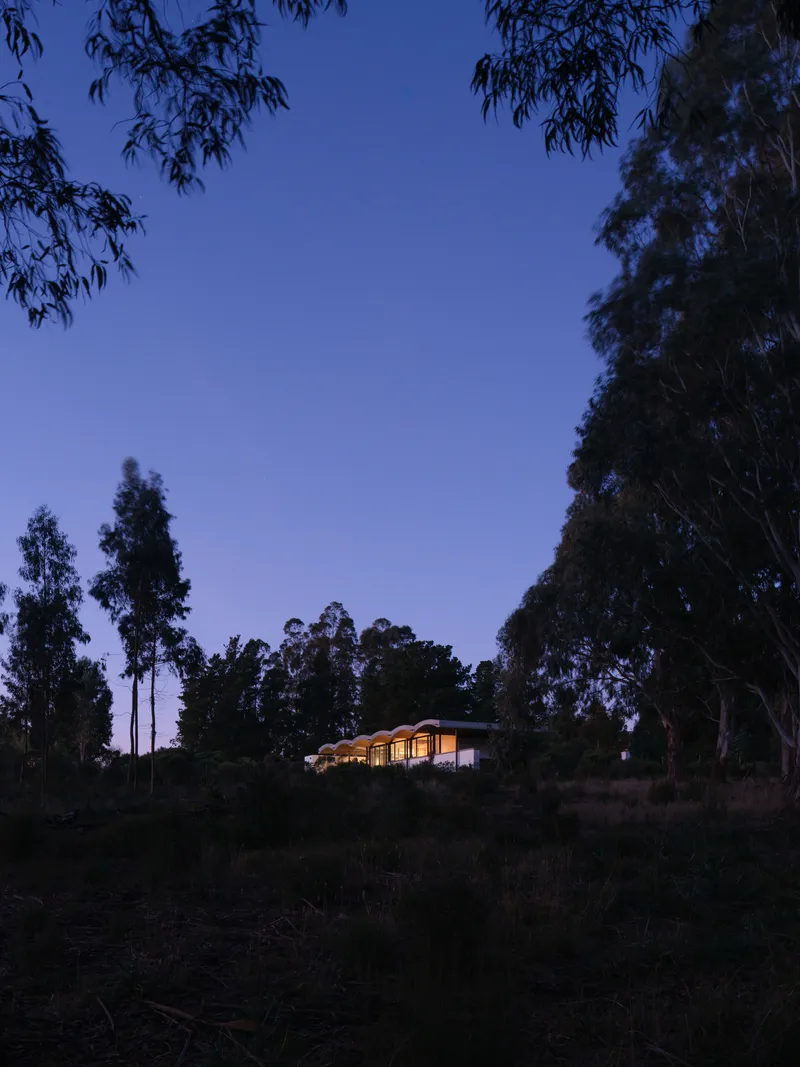
At twilight, the house reveals its second identity. Interior lights transform the glass walls into lanterns, and the undulating roof becomes a dark silhouette against the sky. The interplay between the glowing interior volumes and the heavy canopy overhead creates a legible section even from a distance: you can read the vaults, the gaps, the living spaces, all in one glance. It is architecture that gains rather than loses legibility as light diminishes.
Framed by eucalyptus branches at night, the house recalls the campfire logic of a clearing in the woods: a lit refuge within a dark surround. The images by Javier Agustín Rojas capture this condition precisely, with the warm interior tones set against the deep blues of the Argentine dusk.
Plans and Drawings
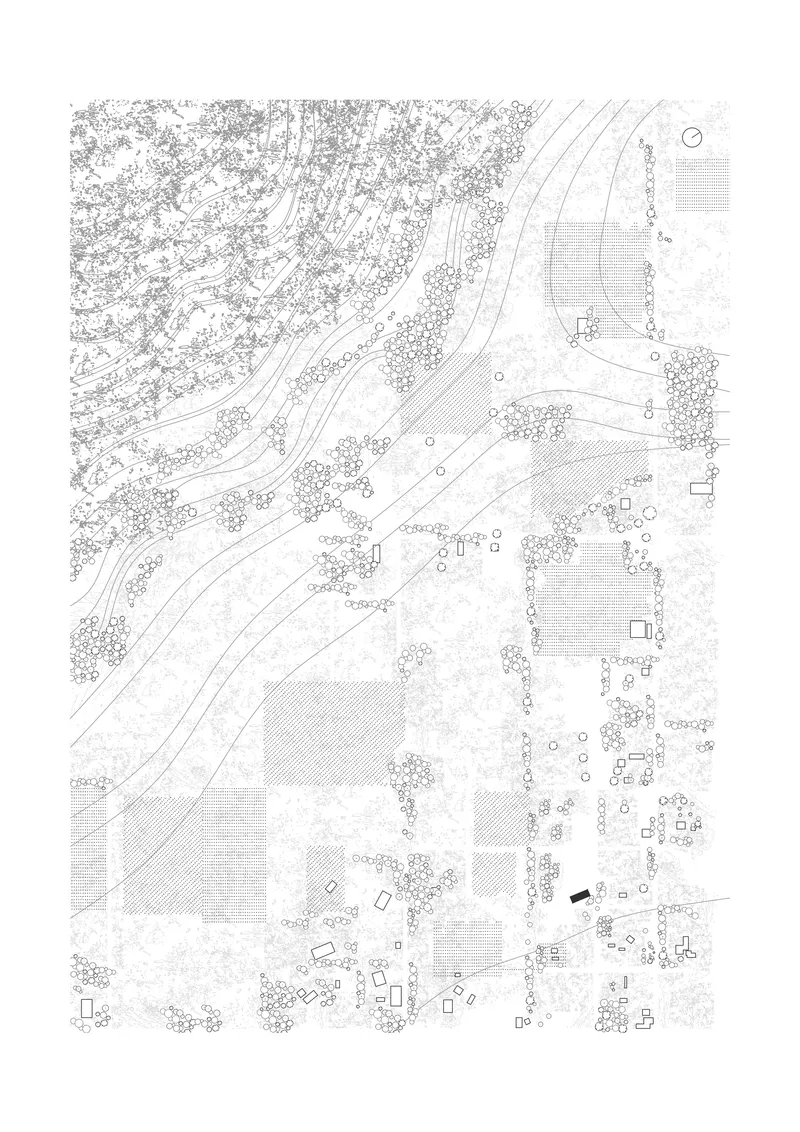
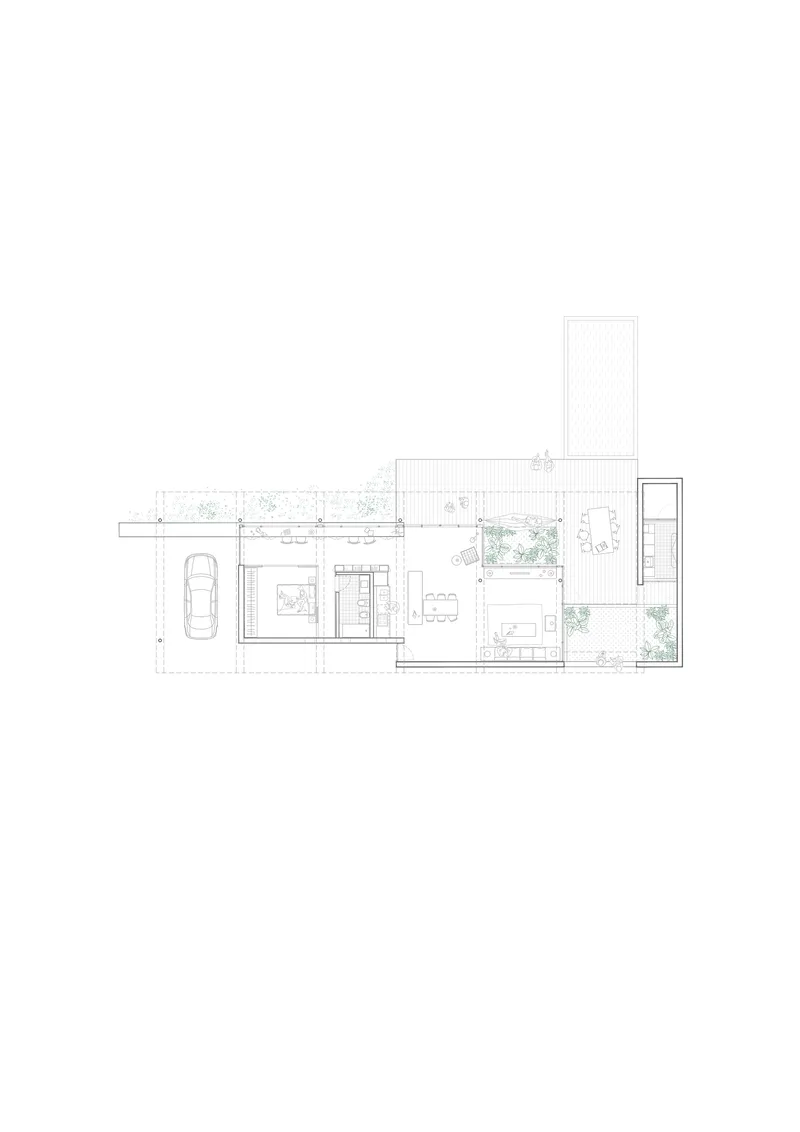
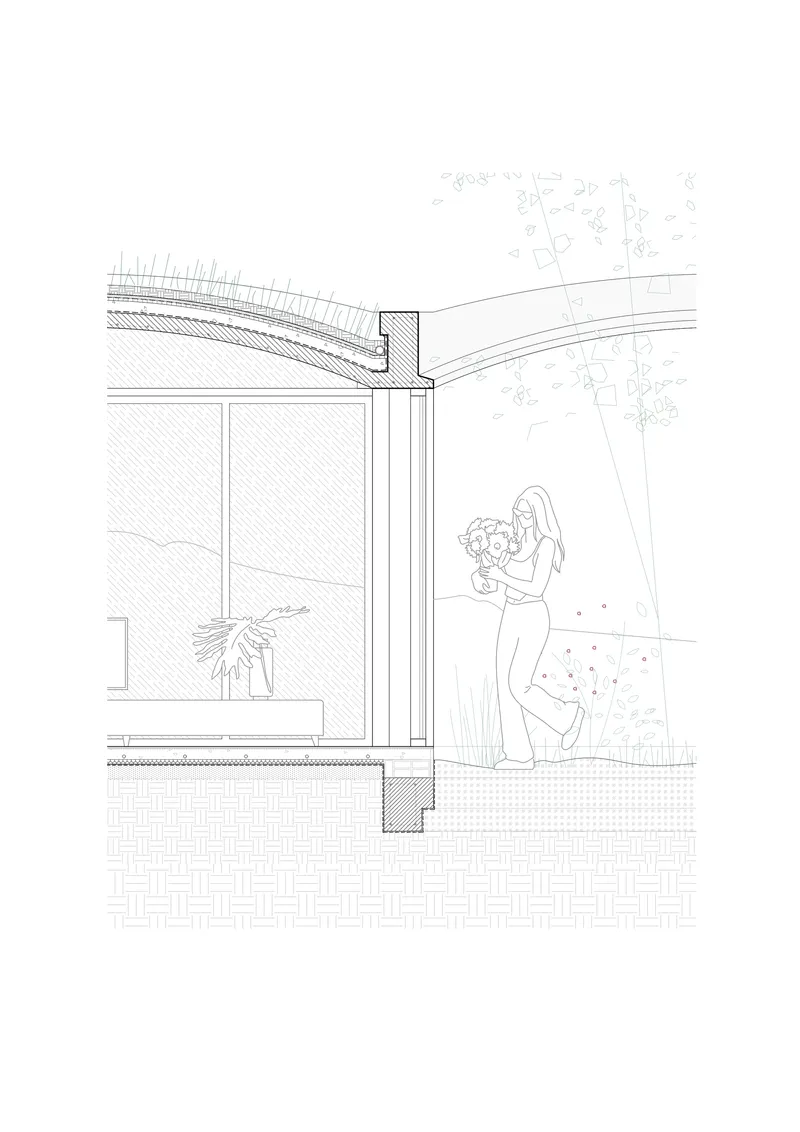
The site plan reveals a deliberately loose arrangement of buildings scattered among dense tree clusters and curving pathways, resisting the temptation to clear the land for a single grand gesture. The floor plan confirms the linear organization: carport, courtyard gardens, and a vertical tower element stacked along a single axis, with lateral glazing opening to the best views.
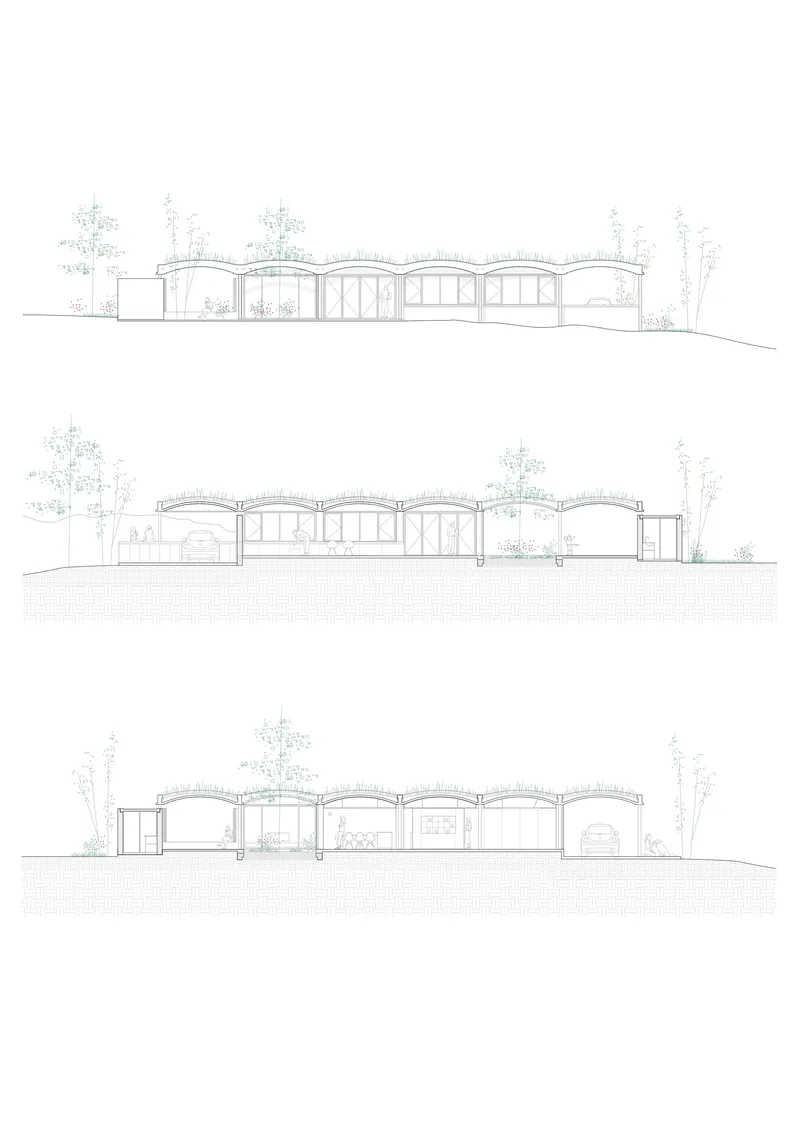
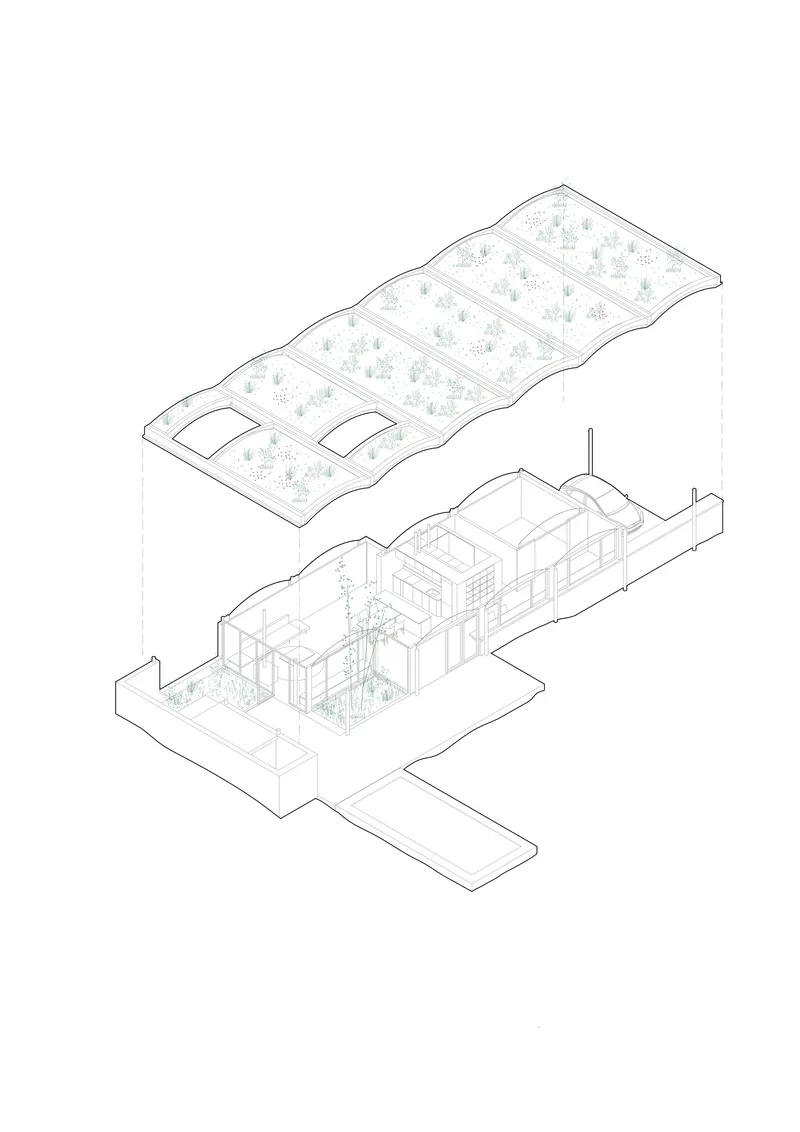
The elevation drawings make the vault sequence legible as a repeating module, while the axonometric peels back the planted roof to expose the spatial relationships beneath. A section detail at the roof edge shows how the concrete canopy meets the glazing line with a minimal drip edge, a small moment that reveals the care taken at every junction. These drawings collectively demonstrate that the formal ambition of the roof is supported by a rigorous structural and environmental logic.
Why This Project Matters
The Bite House belongs to a growing lineage of Argentine residential projects that refuse to treat the landscape as backdrop and instead make it a co-author. BIOMA's decision to invest nearly all of the project's formal energy in the roof, while keeping the plan and materiality disciplined, produces a house that is simultaneously bold and restrained. It is not a sculptural object dropped onto a hillside; it is a topographic intervention that earns its place.
At 120 square meters, the project also challenges the assumption that expressive structure requires large budgets or expansive programs. The barrel vault is one of the oldest and most efficient structural forms in architecture, and its deployment here as both spatial device and landscape strategy is a reminder that invention does not require novelty. Sometimes the most interesting move is to take a known idea and press it into a specific site until something new emerges.
Bite House by BIOMA (Felipe Carrizo, Tomás Randrup), Balcarce, Argentina. 120 m², completed 2023. Photography by Javier Agustín Rojas.
About the Studio
Share Your Own Work on uni.xyz
If projects like this are the kind of work you want to make, uni.xyz is a place to publish your own, find collaborators, and enter design competitions.




Popular Articles
Popular articles from the community


The Ocean Hive: Sustainable Architecture for a Self-Sufficient Civilization at Sea
The Ocean Hive imagines sustainable architecture at sea, where modular habitats, algae, wave power and ocean waste sustain a growing colony.

AL-JANNAH: Sustainable Architecture and Permaculture for Afghan Widows
AL-JANNAH uses sustainable architecture and permaculture to create resilient oasis of housing, learning, work and renewal for Afghan widows.

The Earth Pod: 3D Printed Homes for Resilient Refugee Communities
The Earth Pod reimagines refugee housing through 3D printed homes made from clay, combining resilience, self-sufficiency, and rapid shelter.

Co-Life: Senior Housing Design That Reconnects Older Adults With the City
Co-Life reimagines senior housing design through healing gardens, shared streets, workshops, and a sustainable community across generations.
Similar Reads
You might also enjoy these articles

Bao Huynh Watercolor Atelier: A Serene Art Retreat in Hội An
Bao Huynh Watercolor Atelier in Hội An blends multifunctional art spaces, sustainable design, local materials, and family-friendly living in a serene environment.

Atelier Macri Concept Store Interior Design by CASE-REAL
Atelier Macri store features a "ko" counter, walnut wood details, cork displays, blending retail, gallery, and seamless customer experiences.

Manuel Vargas Izquierdo Stadium and High-Performance Sports Center: Architectural Excellence in Jalpa de Méndez
The Manuel Vargas Izquierdo Stadium blends sustainable design, inclusive sports facilities, and cultural-inspired architecture, revitalizing Jalpa de Méndez’s public spaces.

KAKR Buluh Awar Hall: Revitalizing Community and Ecology Through Bamboo Architecture
Community built bamboo hall revitalizes Buluh Awar village, empowering youth, restoring ecology, celebrating vernacular craftsmanship through sustainable architecture and culture.

Explore Ai Generated Competitions
Discover active competitions in this discipline


Challenge to design a portable theatre


Challenge to design a portable music platform


Challenge to design an open learning module for the elderly


Challenge to design mud housing for contemporary communities
Comments (0)
Please login or sign up to add comments
No comments yet. Be the first to comment!