

Blatman Cohen Splits a Sculptor's House into Two Opposing Temperaments on an Israeli Hillside
A home of heavy brick intimacy and weightless glass openness steps down a sloped site in Israel, shaped by its owner's artistic sensibility.


When your client sculpts expressive figurative forms for a living, a neutral box will not do. BD House, designed by Blatman Cohen architecture design and completed in 2021 on a continuously descending slope in Israel, takes the tension between mass and void that defines sculpture and turns it into a residential strategy. The 450 square meter house is split into two fundamentally different volumes: one heavy, enclosed, and built of plastered brick under a Brutalist concrete cornice; the other light, transparent, and wrapped in floor-to-ceiling glass beneath a floating roof. They occupy the same living floor but speak entirely different languages.
What makes this project worth studying is the conviction with which it refuses compromise. Rather than blending the two dispositions into a single hybrid aesthetic, lead architect Vered Blatman Cohen lets them coexist in sharp contrast, connected by weathered steel windows and a steel-lined corridor that acts as a threshold between private and communal life. The house does not sit on its hillside so much as cascade through it, its lower volumes merging with the topography until built form and landscape become difficult to separate.
Two Languages, One House
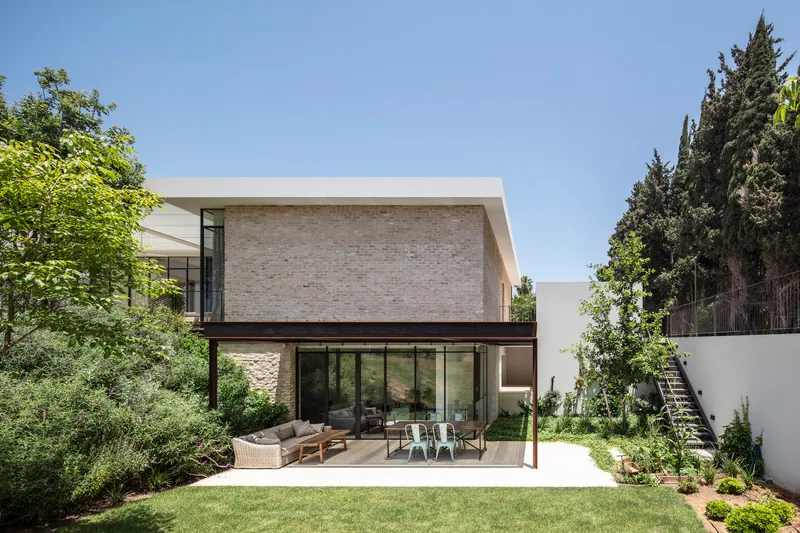


The bedroom section reads as a closed, weighty object: plastered brick walls, controlled openings, and a concrete cornice that bears down on the volume with deliberate gravity. The living area and kitchen, by contrast, dissolve into glass, opening the interior to the garden, pool, and distant agricultural landscape. These are not subtle variations on a theme. They are opposing architectural dispositions held together by a shared material thread of rust-finished steel window frames.
The duality mirrors the sculptor-client's own practice. Figurative work oscillates between mass and gesture, between the dense clay body and the expressive surface. Blatman Cohen has translated that oscillation into architecture without resorting to literal sculptural form. The house does not look like a sculpture; it behaves like the process of making one.
Descent and Terrain


The entry pathway, flanked by white walls and vertical metal slats, gives no indication of the house's true scale. The approach is deliberately compressed, directing attention forward and downward toward the living floor. Because the site slopes continuously, the entrance level blends with the surrounding topography, and the lower portions of the house disappear into the grade. You do not descend into the house so much as the landscape absorbs you.
Low-slung pavilions arranged around planted courtyards with limestone boulders reinforce the sense that the architecture is an extension of the terrain rather than an imposition on it. Board-formed concrete retaining walls anchor the volumes to the slope, their rough texture a deliberate echo of the earth they hold back.
The Glass Pavilion and the Pool

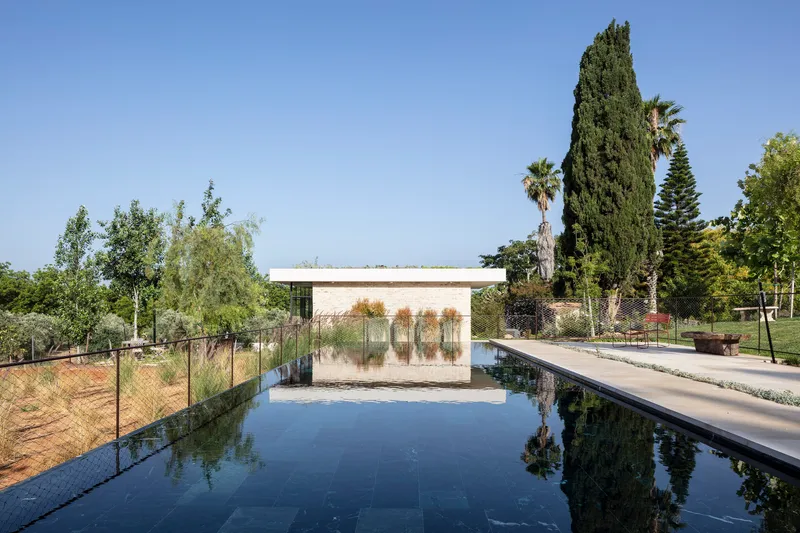
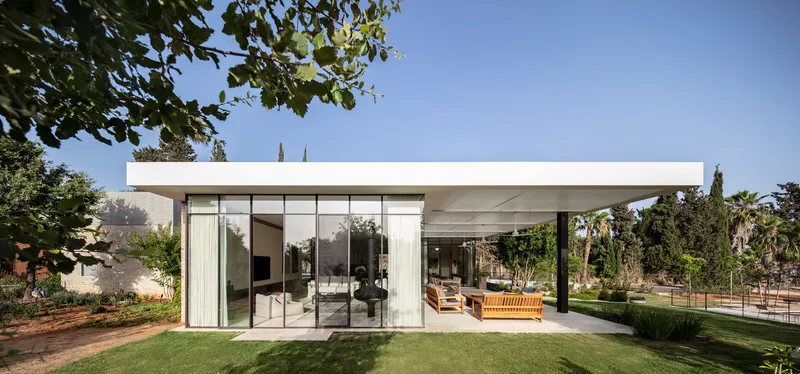
At the bottom of the composition, a freestanding glazed pavilion sits at the pool's edge, its flat roof extending just far enough to cast a thin shadow line on the water. At dusk, the structure and its reflection merge into a single luminous plane. The stone pool pavilion nearby, with its planted roof, grounds this transparency with mass, completing the house's central dialectic one final time at the landscape scale.
The pool itself acts as a spatial datum: a dark, still surface that separates the garden's cultivated lawn from the open agricultural landscape beyond a wire fence. Standing at the glass balustrade, you look across the water toward a horizon that belongs to a completely different register of space, one agricultural and expansive rather than domestic and curated. The transition is abrupt and effective.
Interior Courtyards as Rooms


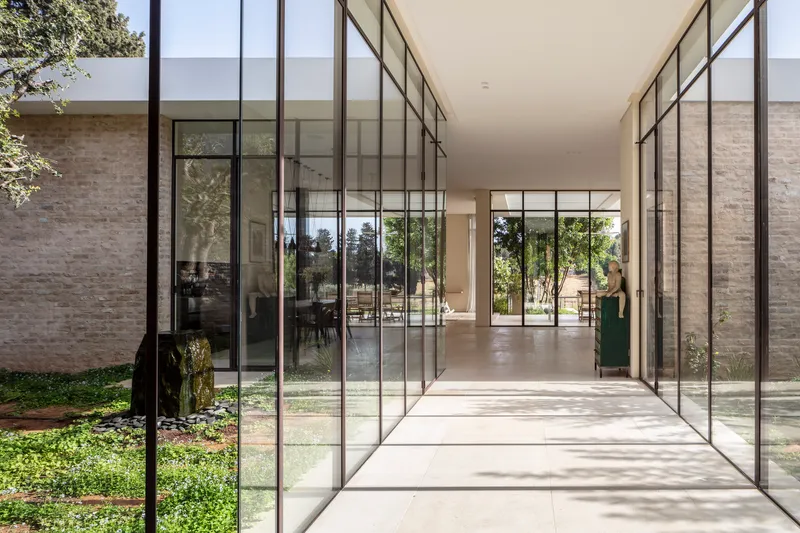
A patio penetrates the house, allowing views into and through the plan. Preserved mature trees occupy these courtyards, their canopies filtered by the glass walls surrounding them. At dusk, sunlight passes through the branches and projects moving patterns onto interior surfaces, turning the courtyard into a kind of natural chandelier. These are not leftover voids between volumes; they are fully designed rooms without roofs, each with its own planting palette and spatial character.
The glass-walled corridor connecting interior spaces uses one of these courtyards as its primary outlook, so that moving through the house always involves peripheral awareness of sky and foliage. The effect is cinematic without being theatrical: each frame shift is quiet, registered through a change in light quality rather than a dramatic reveal.
Material Palette and Craft
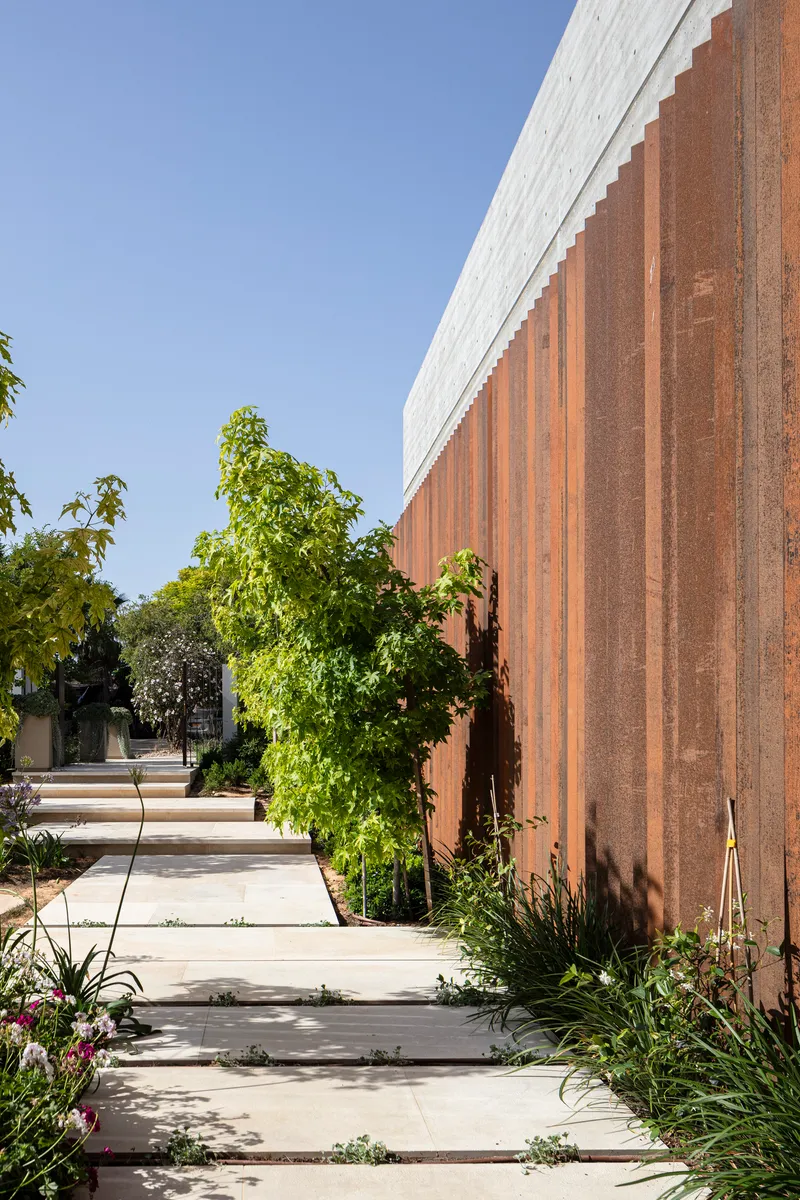


Weathered steel runs through the project like a binding stitch. It appears as vertical cladding along exterior pathways, as window frames throughout every room, and as the steel library shelving that lines the corridor leading to the bedrooms. The rust finish ages the house from the outset, situating it closer to the earth tones of the landscape than the clean whites of typical Israeli residential architecture. Timber slat screens filter light and partially conceal concrete lintels, softening the Brutalist gestures without diluting them.
Inside, the steel shelving corridor doubles as a gallery of sorts, its dark metal surfaces providing a neutral backdrop for objects and books. The narrowness of the passage is deliberate: it compresses the spatial experience before releasing it into the bedrooms beyond, each of which opens to a private courtyard through a carefully placed corner window.
Living with Openness

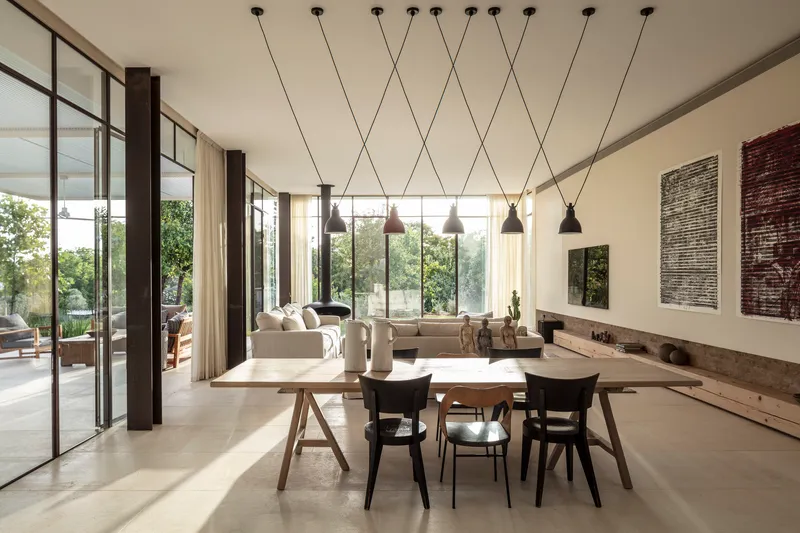

The open living and dining area is defined by a suspended black fireplace, pendant lights on crossed cables, and an almost total absence of opaque walls. Floor-to-ceiling glazing on multiple sides places the room within the tree canopy rather than beside it. The kitchen, with its black cabinetry and timber-topped island, occupies the same spatial zone but turns inward toward a planted courtyard visible through steel-framed glass doors, offering a quieter counterpoint to the panoramic living room.
The floating roof over this area is the structural move that makes the openness possible. Without load-bearing walls at the perimeter, the living volume achieves a transparency that the brick bedroom section deliberately refuses. This is not an open plan by default; it is openness earned through a specific structural commitment.
Private Quarters and the Bath

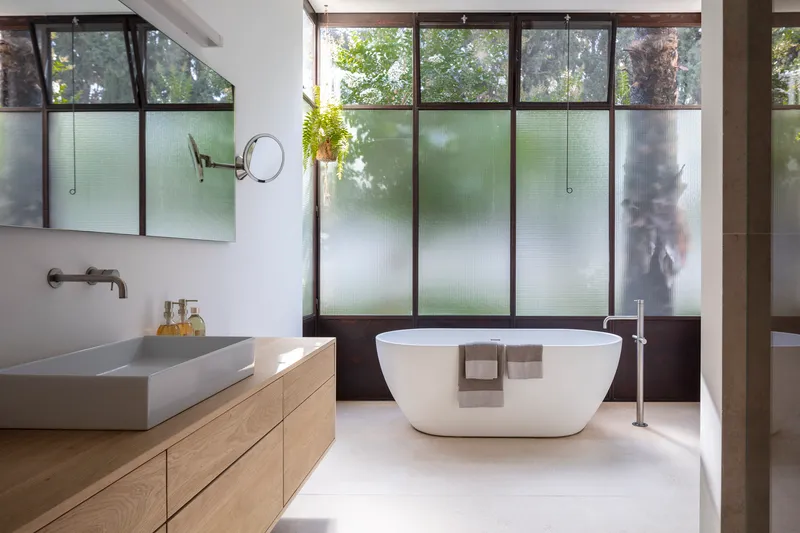

The bedrooms inhabit the heavier, brick-clad section of the house, where controlled openings replace floor-to-ceiling glass. Corner windows frame white-walled garden courtyards planted with shrubs and small trees, composing each view as a still life rather than a panorama. The bathroom, with its freestanding tub beneath tall windows with translucent lower panels, occupies a threshold between exposure and enclosure, daylight flooding in from above while the lower view is softened into abstraction.
The intimacy of these rooms is achieved through material weight as much as spatial compression. Heavier finishes, smaller apertures, and more restrained proportions create a domestic atmosphere fundamentally different from the living wing. The house does not ask its inhabitants to live in a single emotional register; it provides two, and lets you choose.
The Outdoor Room

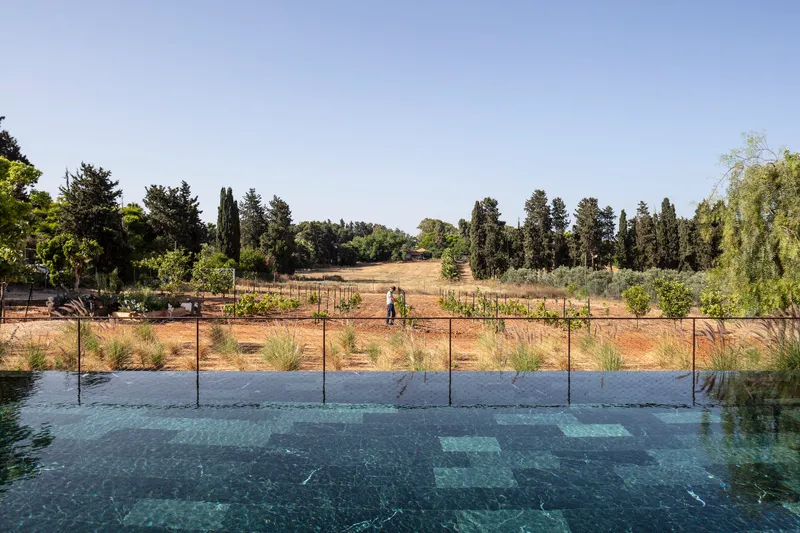
A covered terrace with a slatted ceiling and ceiling fans extends the living floor into the garden, mediating between the conditioned interior and the open lawn beyond. Mature trees shade the transition, and the pool lies just past them, visible but not dominant. This is the house's most informal space, the place where the two architectural temperaments relax into something more casual and unified. From here, the glass pavilion, the stone pool house, and the brick bedrooms all register as fragments of a larger composition, each visible but none insistent.
Plans and Drawings
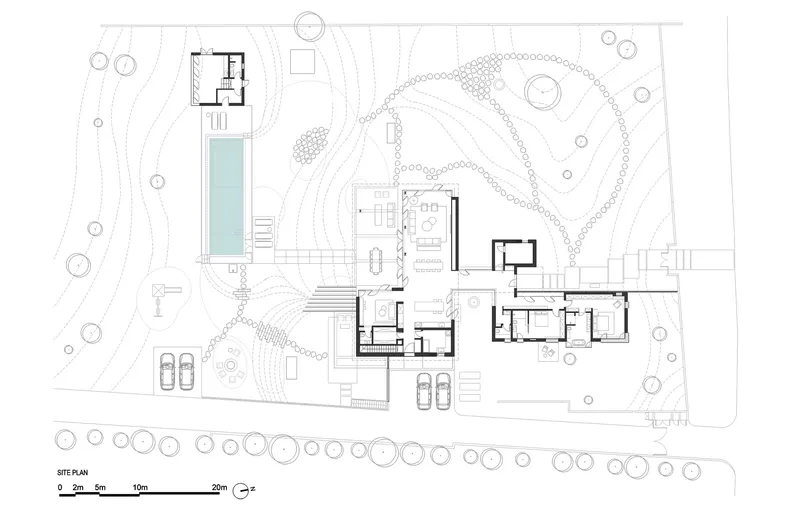


The site plan reveals just how dispersed the building volumes are: rather than a single footprint, BD House is a constellation of pavilions organized around the pool and the sloping contours. The ground and first floor plans show how the living areas and bedrooms interconnect through the steel corridor, while the section drawings make the split-level stepping strategy legible, each volume landing at a different elevation as the terrain drops away. Elevations confirm the horizontal emphasis and the restrained palette of concrete, brick, and steel.
Why This Project Matters
BD House matters because it takes a client's creative identity seriously without turning the architecture into a metaphor. A sculptor lives here, and the house engages with the tensions of sculptural practice, mass versus transparency, weight versus gesture, without ever mimicking a sculpture. That restraint is harder than it sounds. Most houses designed for artists end up performing the client's art back at them. This one provides a spatial framework for the same instincts that drive the work, then lets the inhabitant fill it.
The project also demonstrates that a dual-language house need not feel fractured. By committing fully to each mode, closing the bedrooms down and opening the living areas up, Blatman Cohen avoids the muddled middle ground where neither gesture registers. The result is a house with genuine range, capable of intimacy and expansiveness within a single floor plan, held together by weathered steel and a landscape strategy that treats the hillside as a collaborator rather than a platform.
BD House by Blatman Cohen architecture design, lead architect Vered Blatman Cohen. Located in Israel. 450 m². Completed in 2021. Photography by Amit Geron.
About the Studio
Share Your Own Work on uni.xyz
If projects like this are the kind of work you want to make, uni.xyz is a place to publish your own, find collaborators, and enter design competitions.


Popular Articles
Popular articles from the community


Cube Design Draws an Ecological Corridor Between Two Shenzhen Hills with the Nankai Building
Beside Shenzhen's container docks, the Nankai Building pairs stacked balconies with a climbing green screen to connect two hillsides across its height.

FCC Arquitectura Expands a Portuguese Granite House with a Board-Marked Concrete Wing
In Portugal, JV House pairs a cleaned-up whitewashed and granite dwelling with a timber-shuttered concrete extension, courtyards and a garden pool.


The Amber Palace Opera: A Geological Fiction Surfaces on Tallinn's Baltic Waterfront
Pierre Brillard reimagines a Baltic legend as a public landscape, opera house, and waterfront promenade rooted in Tallinn's coastal identity.

David Ortega Stacks a Two-Story Mexico City Penthouse Around a Steel Stair and a Pergola-Shaded Roof Terrace
In Colonia Roma, a 300 m² penthouse uses oak joinery, a planted steel stair and a slatted roof pergola to make a new-build apartment feel like a house.

Similar Reads
You might also enjoy these articles

LAVA Architecten Gives Vocational Education a Sawtooth-Roofed Face on a Mechelen School Campus
In Mechelen, Belgium, a 2,053 m² STEM school on a 6×6 m grid turns workshops and classrooms into rooms that can be rearranged as teaching changes.

KEMA Studio Turns a Derelict Marvila Attic into a 60 m² Lighthouse Apartment Above Lisbon
In Lisbon's Marvila district, a rebuilt roof, four skylights and two plywood volumes turn an unlivable attic into a bright home facing the Tagus.

Pixel Gardens: One Repeated Module Stacked Into a Terraced Social Housing Tower for Famagusta
Salem Bader's shortlisted housing tower builds a vertical neighbourhood from one repeated module, offsetting units to carve terraces, light and air.

Bao Huynh Watercolor Atelier: A Serene Art Retreat in Hội An
Bao Huynh Watercolor Atelier in Hội An blends multifunctional art spaces, sustainable design, local materials, and family-friendly living in a serene environment.


Comments (0)
Please login or sign up to add comments
No comments yet. Be the first to comment!