
BLOCO Arquitetos Splits the Roof Open to Light a Brasília Home from Within
In Brazil's capital, a 500-square-meter concrete house uses misaligned beams and slabs to harvest daylight through deliberate structural gaps.


Most houses in Brasília deal with the city's intense sun by hiding from it. BLOCO Arquitetos, led by Daniel Mangabeira, Henrique Coutinho, and Matheus Seco, took a different approach with Naves House: they designed a roof that deliberately fails to seal. A sequence of parallel concrete beams and slabs sits slightly out of alignment, opening crevices that let both direct and diffused light into every major room. The result is a house that glows from the inside, modulated by the sun's angle and softened by the tropical planting that fills its courtyards.
Completed in 2021 after a design and construction process spanning from 2017 to 2020, the 500-square-meter house organizes itself around a clear logic: heavy concrete overhead, white brick at the perimeter, and a ground plane that dissolves whenever possible into gardens, pool terraces, and covered passages. The living room, veranda, and garage can merge into a single continuous space through large folding glass panels, a move that turns the house into an open pavilion when Brasília's climate cooperates. What makes it worth studying is not any single gesture but the disciplined interplay between structure, light, and vegetation that runs through every room.
A Facade That Belongs to the Street
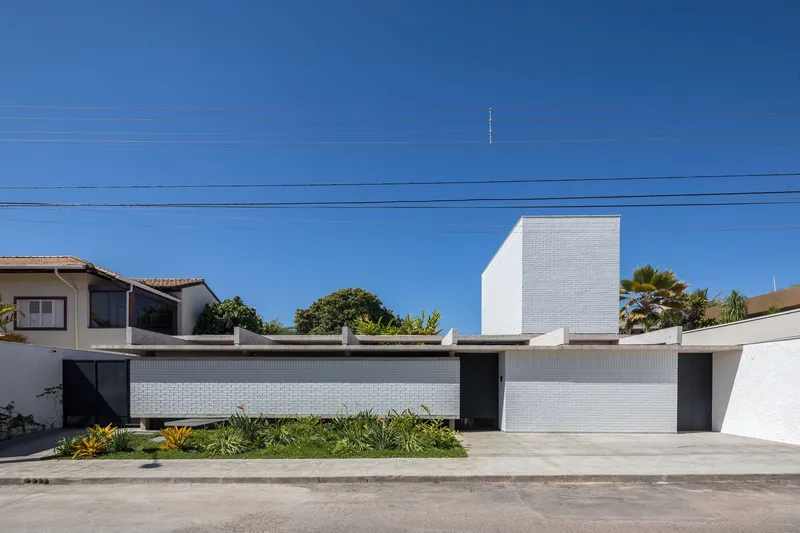
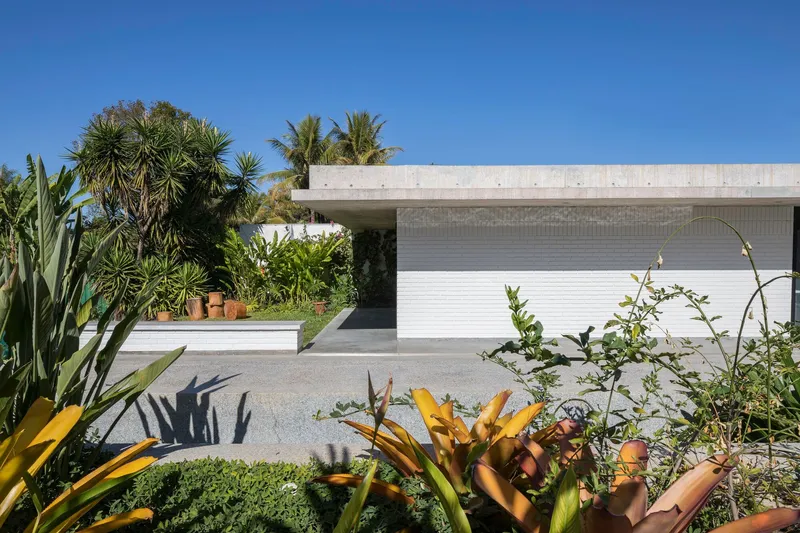
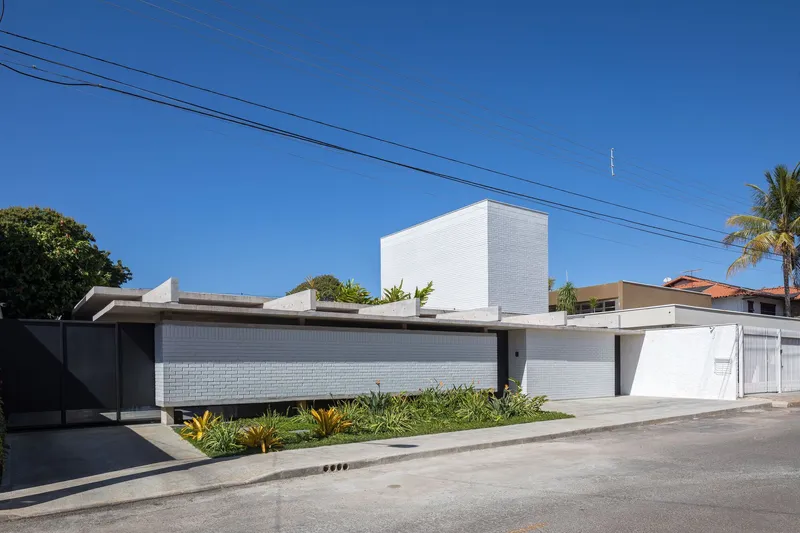
From the street, Naves House reads as a series of stacked planes: white brick walls, a cantilevered concrete volume, and a low horizontal metal fence that keeps the planted bed visible to passersby. The palette is deliberately restrained. The white block finish, which the architects intend to weather and patina over time, gives the facade a matte, mineral quality that sits comfortably among the tropical palms. There is no attempt at formal spectacle. The house earns its presence through proportion and material honesty.
The cantilever signals weight and shelter without feeling oppressive, and the planted beds along the fence blur the boundary between domestic garden and public sidewalk. It is a generous urban gesture in a city that often walls itself off from pedestrians.
Entering Through the Crevice
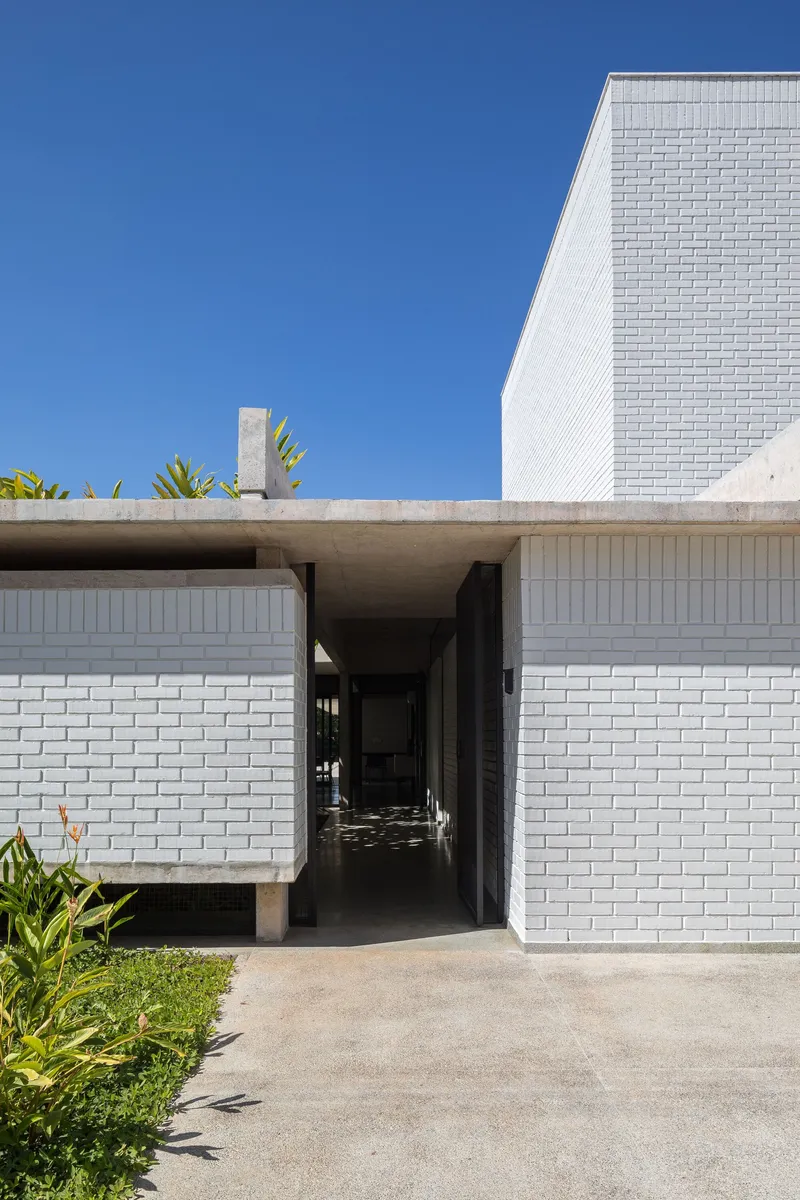
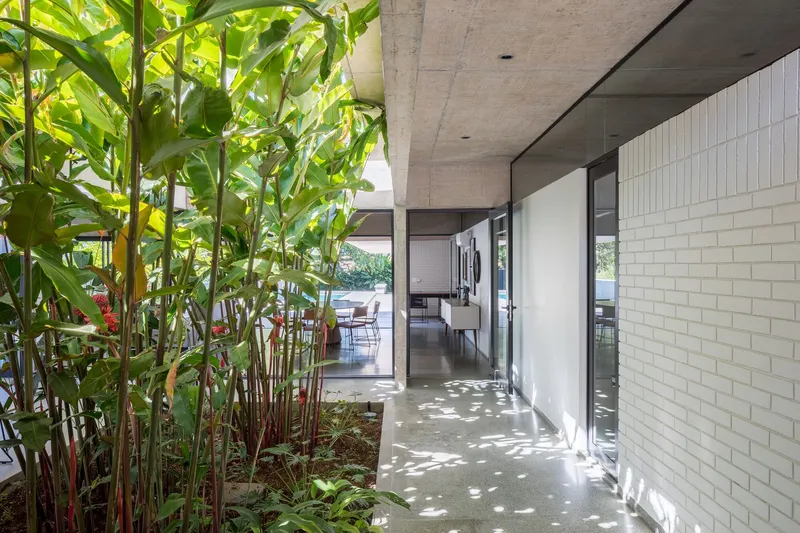
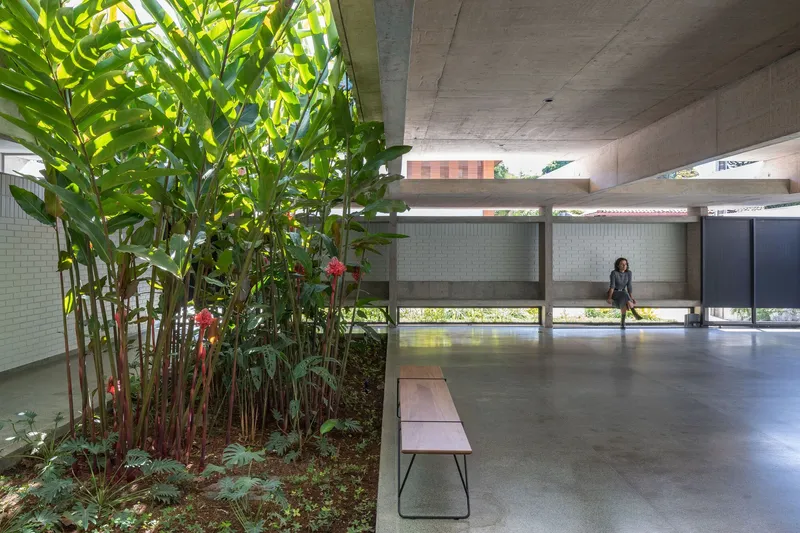
The arrival sequence compresses you beneath an angled concrete soffit before releasing you into a planted corridor dense with heliconias and tropical greenery. Dappled sunlight filters through the leaves onto polished concrete floors, and screened openings let air circulate freely. The effect is less threshold than decompression chamber: a slow transition from the dry heat of the street to the tempered microclimate inside.
This is where the roof's misalignment strategy first becomes legible. Overhead, beams and slabs overlap without quite touching, and the resulting gaps throw stripes of light across walls and planting beds. You understand the structural idea before you reach the living spaces, which is exactly the right kind of architectural storytelling.
Concrete Planes and Interior Gardens
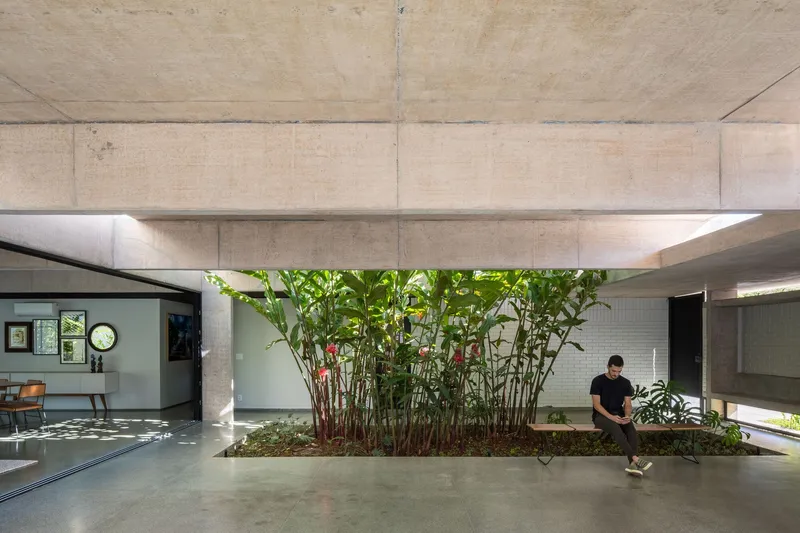
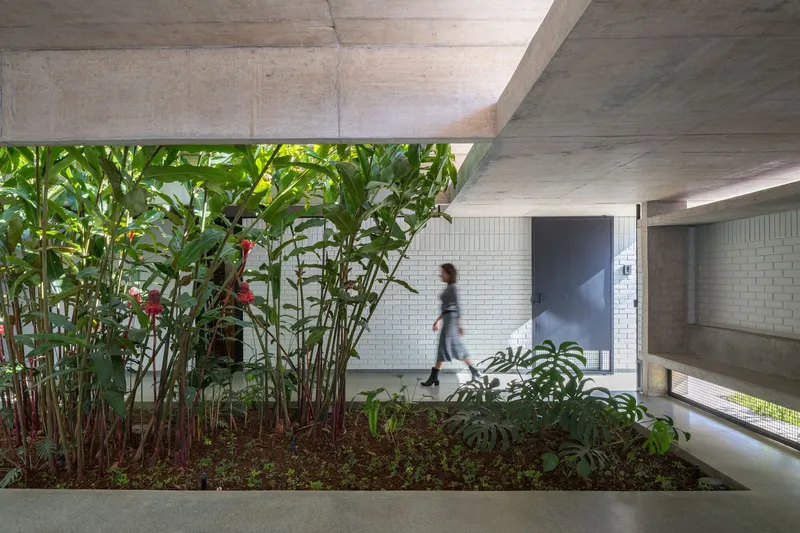
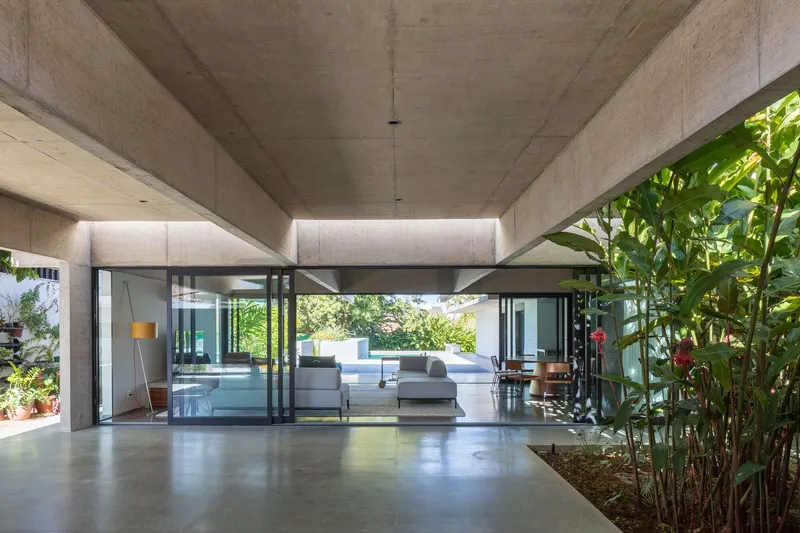
Inside, the house organizes around a series of courtyards and planted beds that sit beneath intersecting concrete roof planes. Traveler's palms push upward toward the clerestory gaps, and their fronds catch the light that spills in from above. The interplay is reciprocal: the vegetation softens the concrete's brutality, while the concrete frames the vegetation into precise compositions.
Board-formed textures on the beams give the concrete a tactile grain that reads well at close range. White block walls and glazed sliding doors enclose the courtyards on multiple sides, creating an ambiguity between inside and outside that is more experiential than diagrammatic. You feel it in the humidity, the sound, and the way light quality shifts as clouds pass overhead.
The Living Room as Open Pavilion
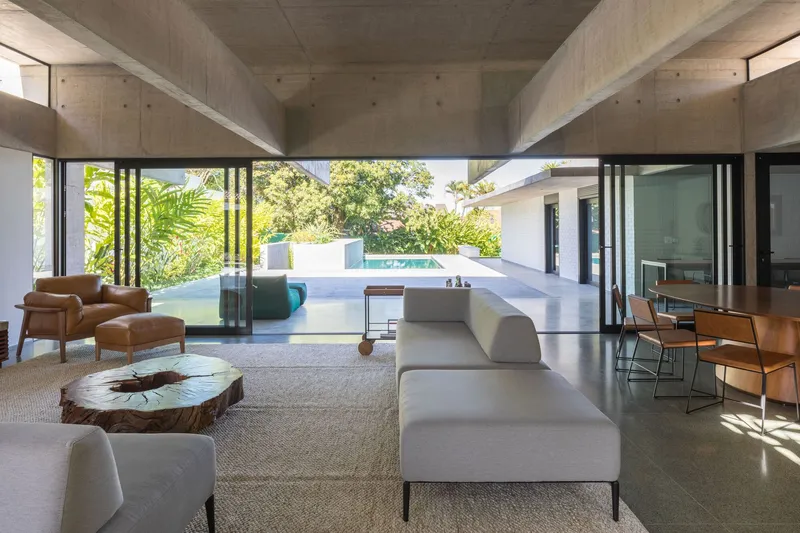
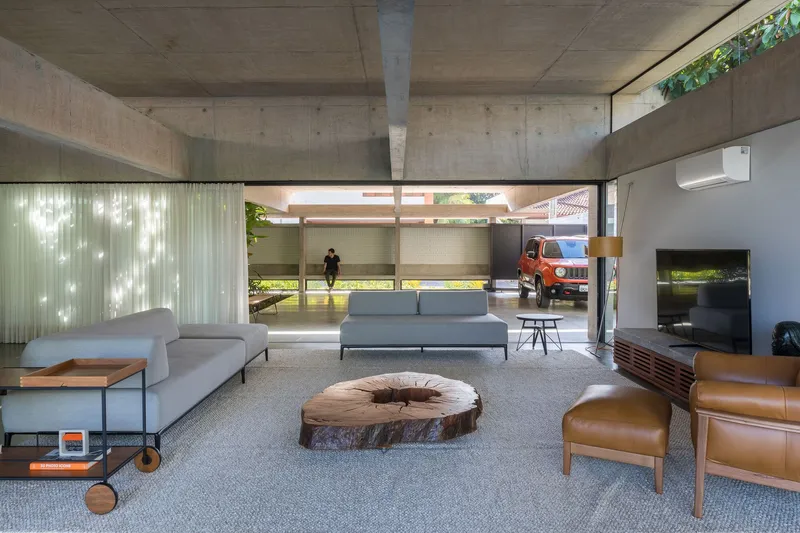
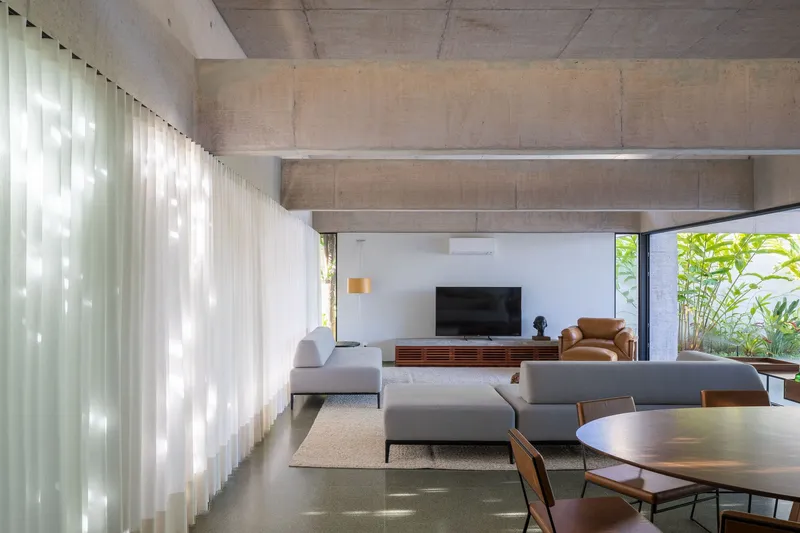
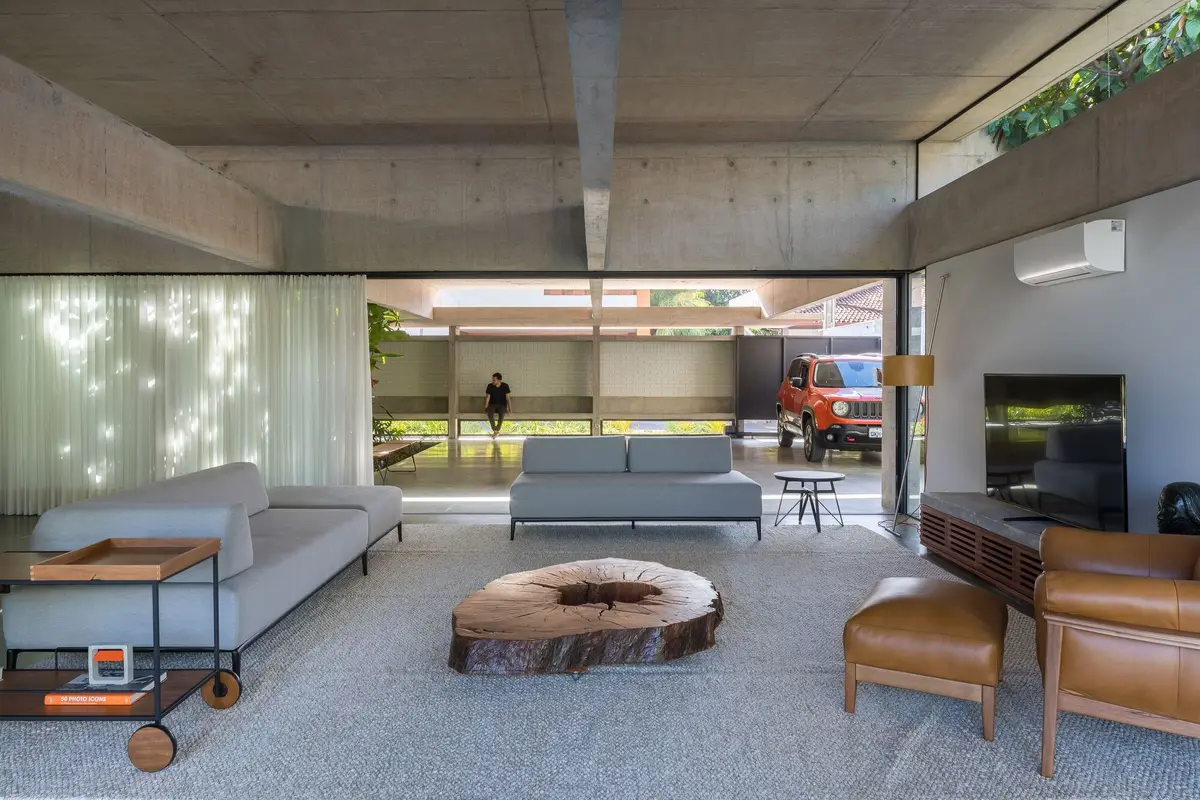
The main living area demonstrates the house's most ambitious spatial move. Folding glass doors on two sides open the room to both the pool terrace and a planted courtyard, erasing the wall plane entirely. Overhead, clerestory windows between misaligned beams cast shifting bands of sunlight across the floor throughout the day. The room becomes a covered outdoor space when open and a luminous interior when closed.
Furniture is kept low and spare, letting the concrete ceiling and its light patterns dominate. Sheer curtains catch the afternoon sun in gauzy pools. A live-edge wood slab coffee table anchors one corner, its organic form a deliberate counterpoint to the grid of beams above. The room demonstrates that thermal comfort in Brasília does not require mechanical complexity; it requires thoughtful section design.
Pool Terrace and Outdoor Rooms
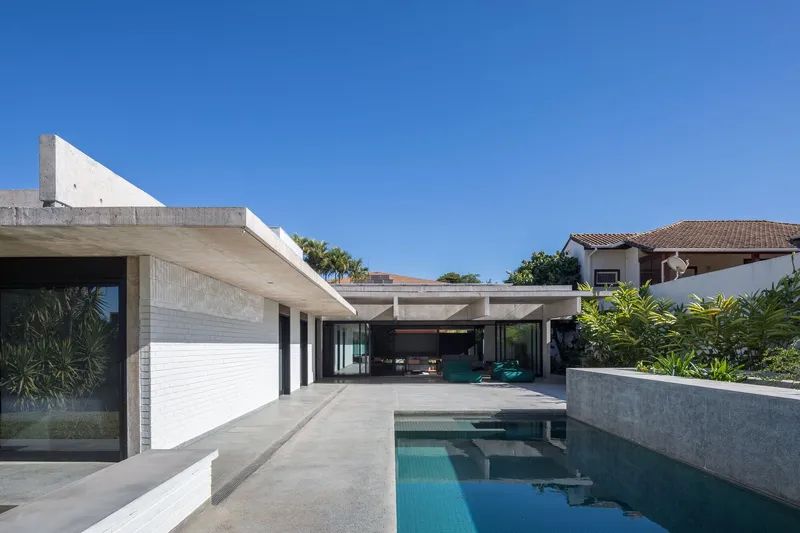
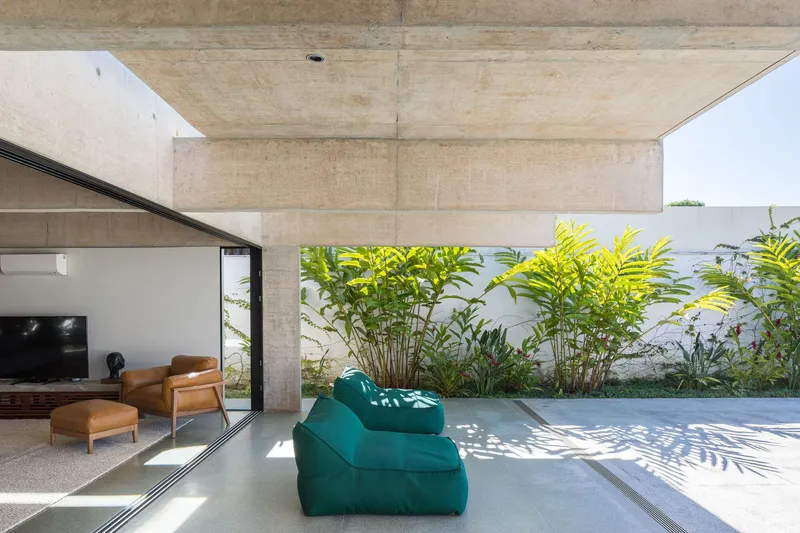
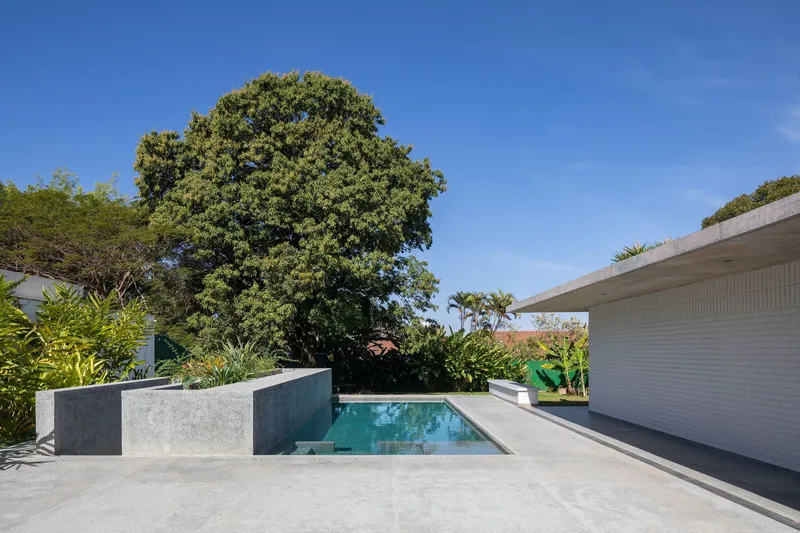
The pool terrace extends the concrete canopy outward, creating a shaded zone between the living spaces and the rectangular swimming pool. Concrete retaining walls step down with the terrain, and a mature tree canopy provides additional shade at the garden's edge. The spatial sequence from living room to veranda to pool deck is seamless, aided by consistent floor levels and the continuity of the overhead beams.
A teal lounge chair on the poolside terrace catches shadows from a single beam overhead, a small vignette that captures the house's larger strategy in miniature. Every outdoor space is calibrated for sun and shade, treated with the same architectural precision as the interior rooms.
Private Rooms and Material Detail
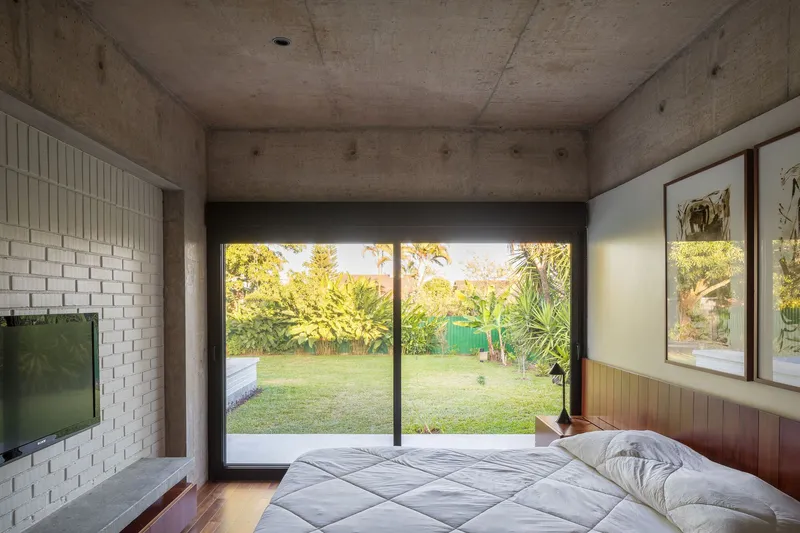
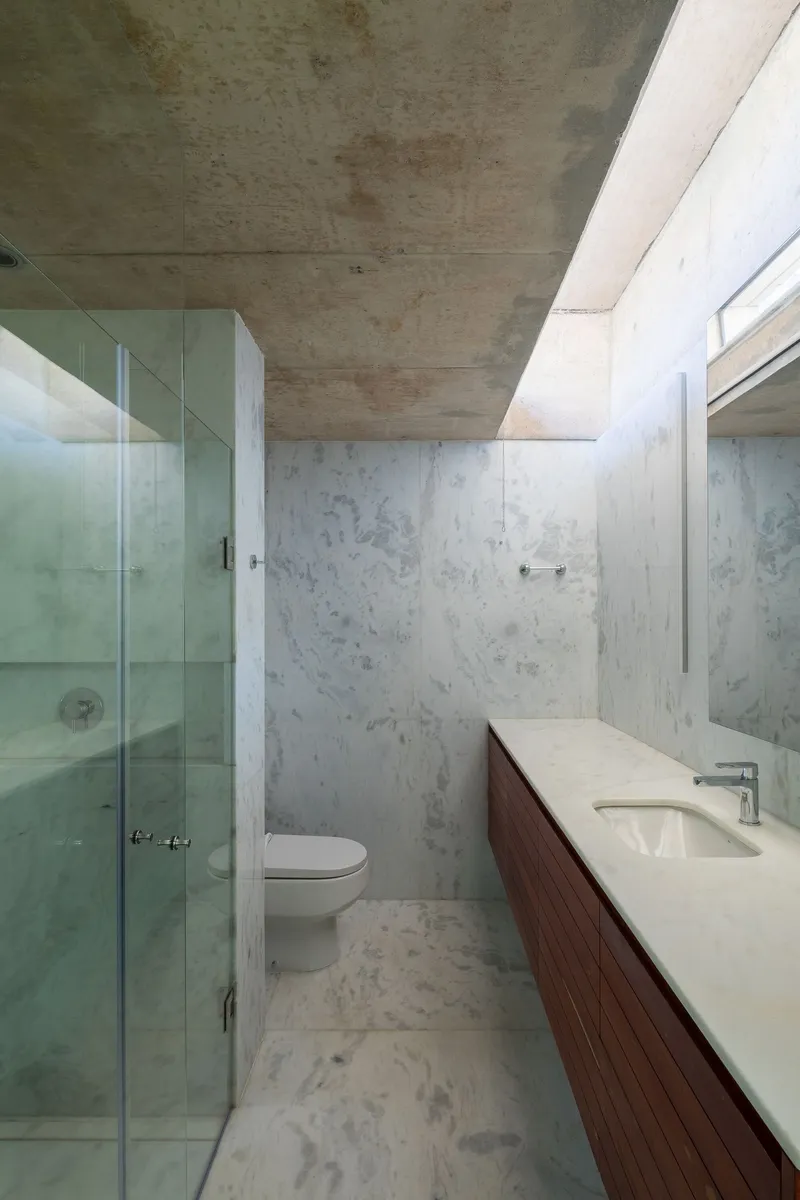
The bedrooms and bathrooms maintain the house's material vocabulary without repeating its public gestures. A white brick accent wall in the master bedroom anchors the room with texture, while sliding glass doors open to a backyard lawn lit by the warm glow of sunset. The bathrooms are more assertive: exposed concrete on ceiling, walls, and floor creates a monolithic enclosure softened only by a walnut vanity cabinet and the narrow window that frames exterior planting.
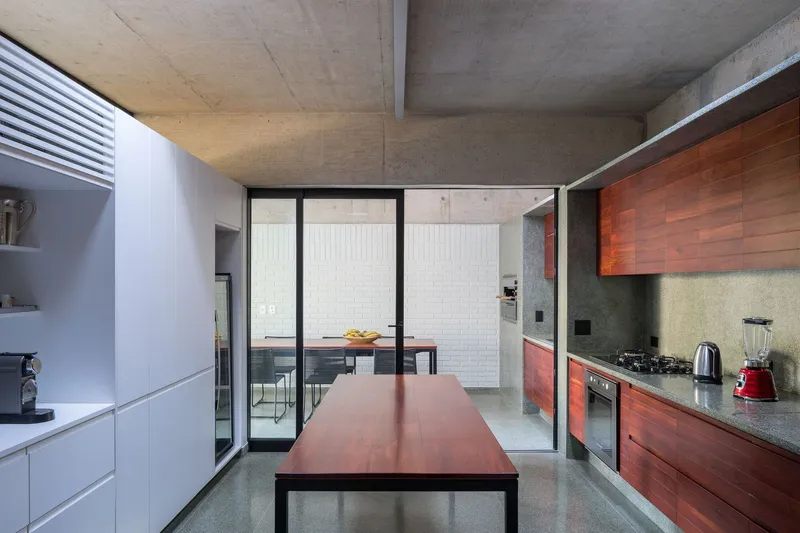
The kitchen deploys timber cabinetry beneath the same board-formed concrete ceiling, grounding the room in warmth. Glazed doors open to yet another courtyard, reinforcing the house's strategy of connecting every room to outdoor air and vegetation. These private spaces are quieter than the living areas but no less considered.
Corridors as Light Instruments
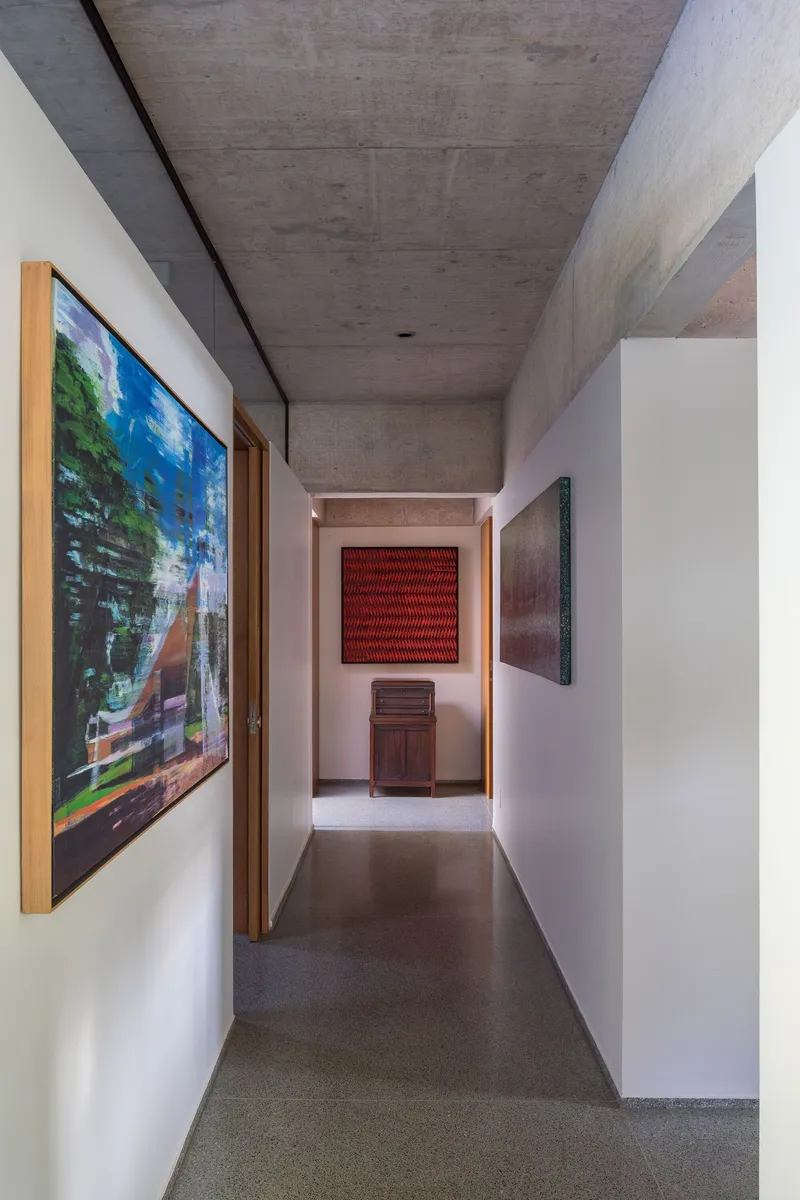
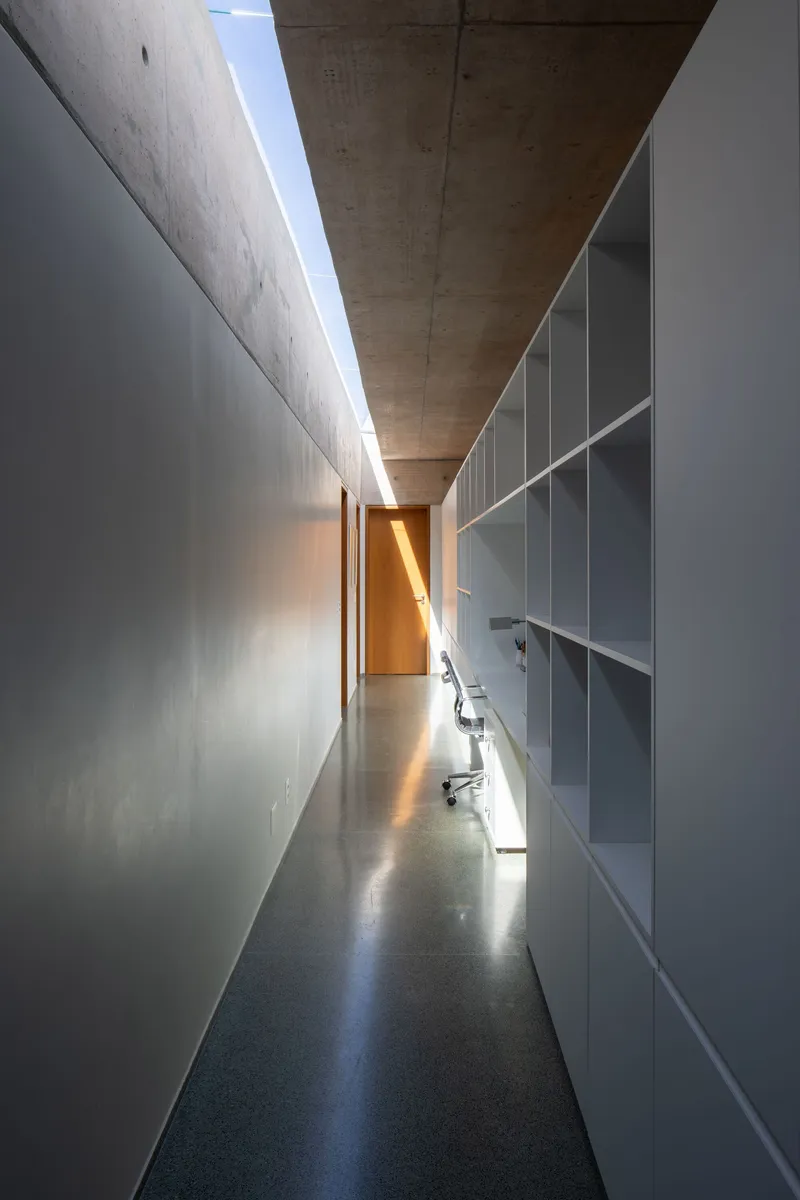
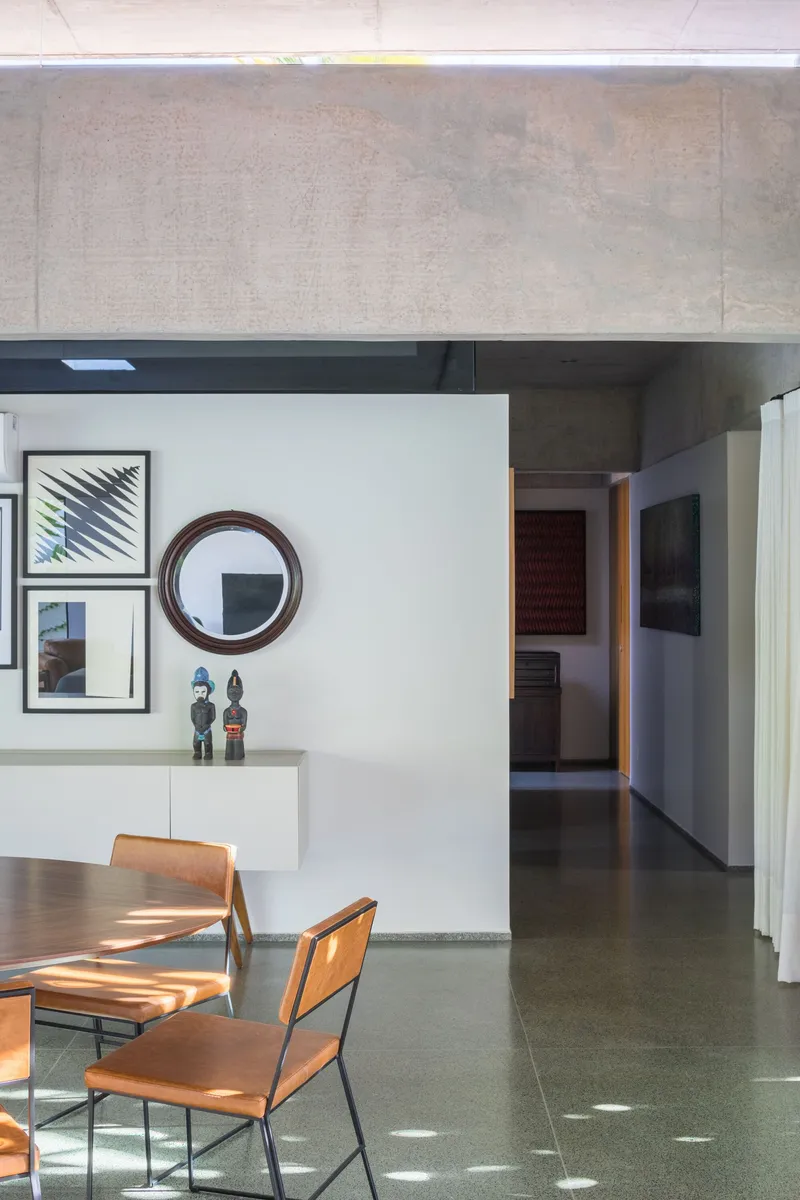
The corridors in Naves House are not residual spaces. They are some of the most carefully designed rooms. A hallway with board-formed concrete overhead displays artwork on white walls, while terrazzo flooring picks up the warm tones of the surrounding materials. Another corridor features a continuous clerestory skylight that washes built-in shelving with even, indirect light.
These circulation spaces demonstrate how the roof's misalignments work at a domestic scale. The clerestory gaps are not decorative; they are the primary mechanism for distributing daylight deep into the plan. By the time you reach the innermost rooms, you realize that no space in the house depends on artificial light during the day.
Plans and Drawings
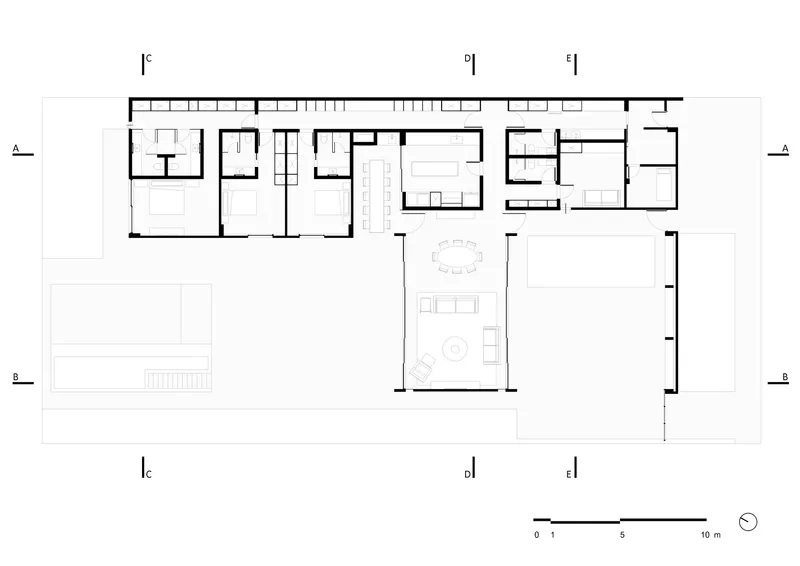
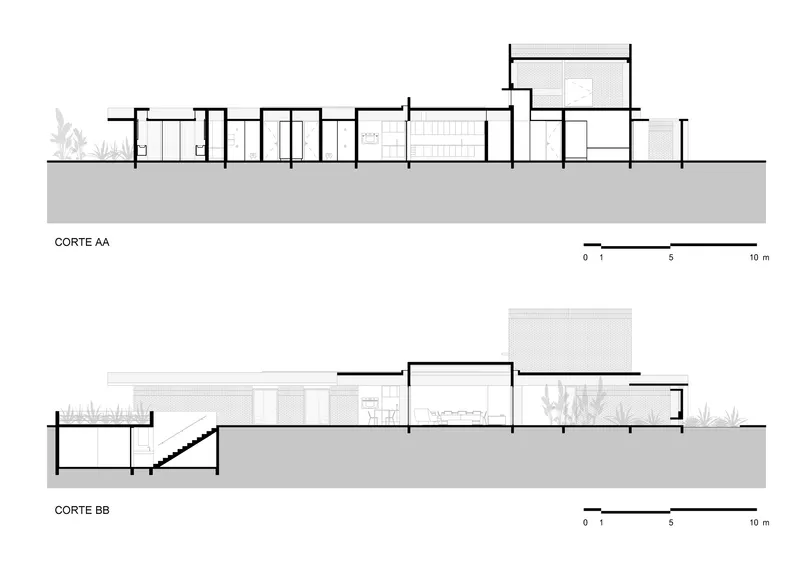
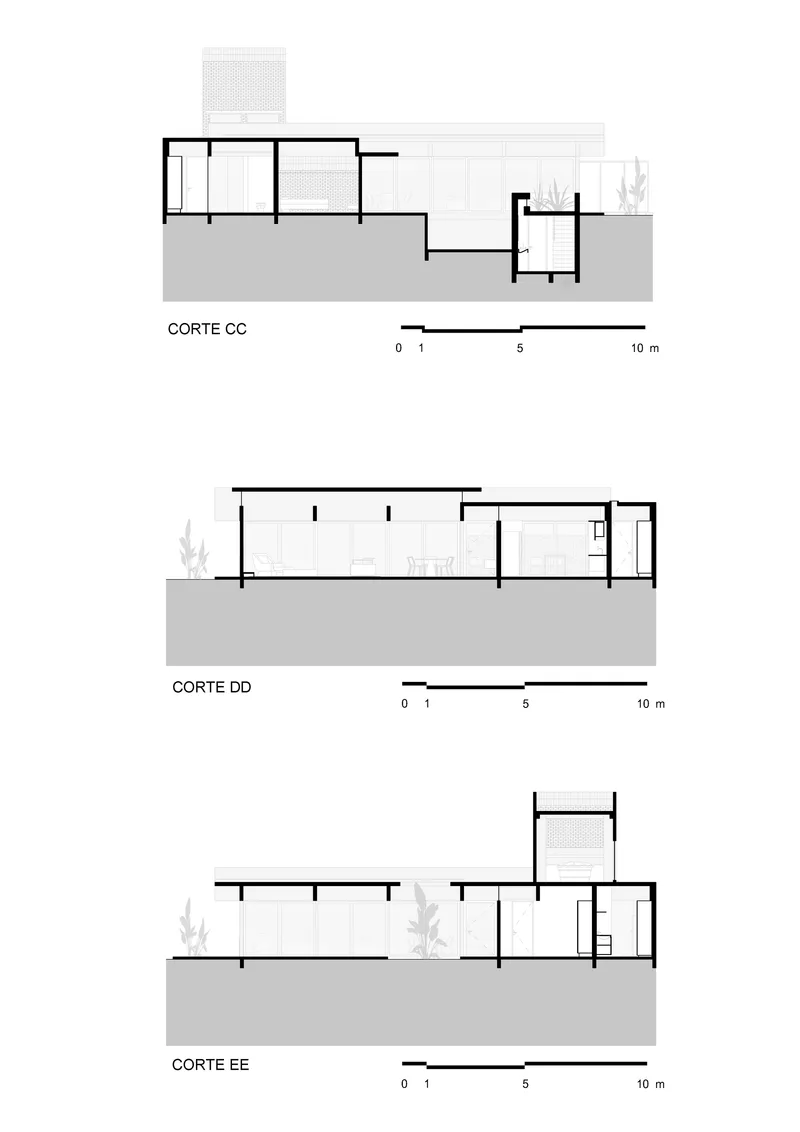
The floor plan reveals an L-shaped layout with a service wing, a central living area, and the pool terrace arranged along the site's natural grade. The sections are where the design's intelligence becomes most legible: split-level interior volumes step with the sloping terrain, and the vertical tower element that appears in the street view gains explanation in cross-section. The relationship between roof planes, interior floor levels, and the surrounding landscape is carefully calibrated, with vegetation silhouettes indicating the degree of enclosure each room receives from the garden.
Why This Project Matters
Naves House is a convincing argument that structure and environmental performance can be the same thing. Rather than adding louvers, brise-soleils, or mechanical shading systems, BLOCO Arquitetos made the primary structure itself the light-control device. The misaligned beams and slabs are not a formal conceit; they are a passive strategy for harvesting, filtering, and distributing daylight across a 500-square-meter plan. It is an economical idea that generates spatial richness without ornamental excess.
The house also offers a thoughtful model for how concrete architecture in the tropics can engage with vegetation as an equal partner rather than a decorative afterthought. Every courtyard, planted bed, and clerestory gap is designed so that plant growth actively modifies the house's light quality and microclimate over time. As the white brick weathers and the gardens mature, Naves House will only improve. That kind of long-term thinking is rare in residential design, and it elevates this project well beyond its type.
Naves House by BLOCO Arquitetos (Daniel Mangabeira, Henrique Coutinho, Matheus Seco), Brasília, Brazil. 500 m², completed 2021. Photography by Haruo Mikami.
About the Studio
Share Your Own Work on uni.xyz
If projects like this are the kind of work you want to make, uni.xyz is a place to publish your own, find collaborators, and enter design competitions.


Popular Articles
Popular articles from the community


ALGAL REALM: A Bio-Integrated Lunar Habitat Design for Life Beyond Earth
ALGAL REALM reimagines lunar habitat design with algae-powered life support, 3D-printed regolith, and vertical living for a lunar future.

Lunar Spiral: Space Architecture Shaped by the Mathematics of the Universe
Lunar Spiral reimagines space architecture through Fibonacci geometry, lunar regolith, levitating habitats, and self-sustaining Moon living.

Play: Fragments of Their World
Familiar architecture becomes modular playground design, creating safe spaces where displaced children can learn, connect, imagine and play.

Hill & Cross Opera: Sculptural Opera House Architecture Shaped by Tallinn’s Landscape and Identity
Hill & Cross Opera reimagines opera house architecture in Tallinn through its sculptural hill, civic plaza, glass wave and a luminous cross.

Similar Reads
You might also enjoy these articles

Bao Huynh Watercolor Atelier: A Serene Art Retreat in Hội An
Bao Huynh Watercolor Atelier in Hội An blends multifunctional art spaces, sustainable design, local materials, and family-friendly living in a serene environment.

Atelier Macri Concept Store Interior Design by CASE-REAL
Atelier Macri store features a "ko" counter, walnut wood details, cork displays, blending retail, gallery, and seamless customer experiences.

Manuel Vargas Izquierdo Stadium and High-Performance Sports Center: Architectural Excellence in Jalpa de Méndez
The Manuel Vargas Izquierdo Stadium blends sustainable design, inclusive sports facilities, and cultural-inspired architecture, revitalizing Jalpa de Méndez’s public spaces.

KAKR Buluh Awar Hall: Revitalizing Community and Ecology Through Bamboo Architecture
Community built bamboo hall revitalizes Buluh Awar village, empowering youth, restoring ecology, celebrating vernacular craftsmanship through sustainable architecture and culture.


Comments (0)
Please login or sign up to add comments
No comments yet. Be the first to comment!