

blrm Architekt*innen Wraps a Hamburg Block in Clinker Brick and Round Arches
A 16,600 m² residential complex in Hamburg's Pergolenviertel channels allotment garden memory through a precise brick grid and communal courtyards.


Hamburg has always known what to do with brick. The city's warehouse district, its postwar housing estates, and its Kontorhaus tradition all speak a common language of fired clay. So when blrm Architekt*innen set out to design a 16,600 m² residential complex on the site of a former allotment garden settlement between City Nord and Barmbek, the material was never really in question. What was in question was how to make a large urban block feel neither monolithic nor generic, and the answer turned out to be a matter of geometry, relief, and carefully orchestrated color.
The Pergolenviertel Residential Complex, completed in 2023, is organized as a perimeter block enclosing a communal courtyard, but its four volumes are not identical. Building sections on the east, south, and west are held to three full stories, while the north side rises to six, creating a deliberate asymmetry that mediates between the tower slabs of City Nord and the lower residential fabric of Barmbek. Round arched passageways punch through the mass at ground level, turning what could be a fortress into a sequence of framed views, a move that ties the project back to the pergola structures that give the wider quarter its name.
Brick as Gradient
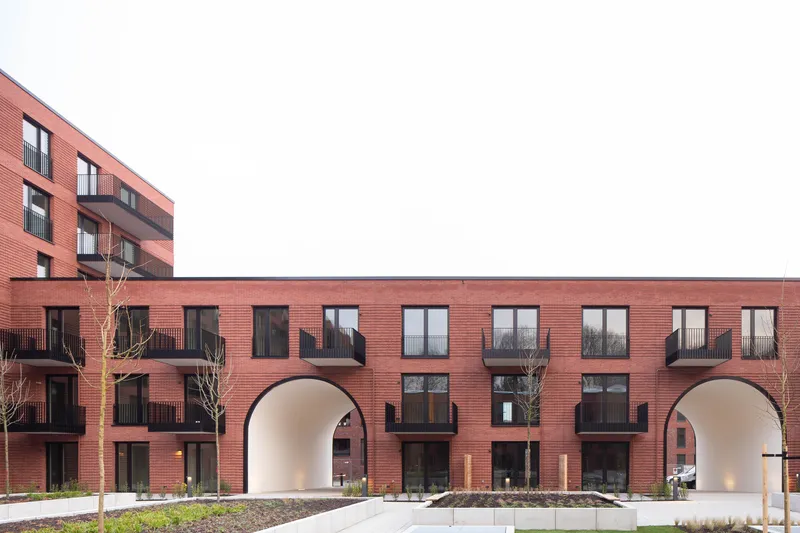
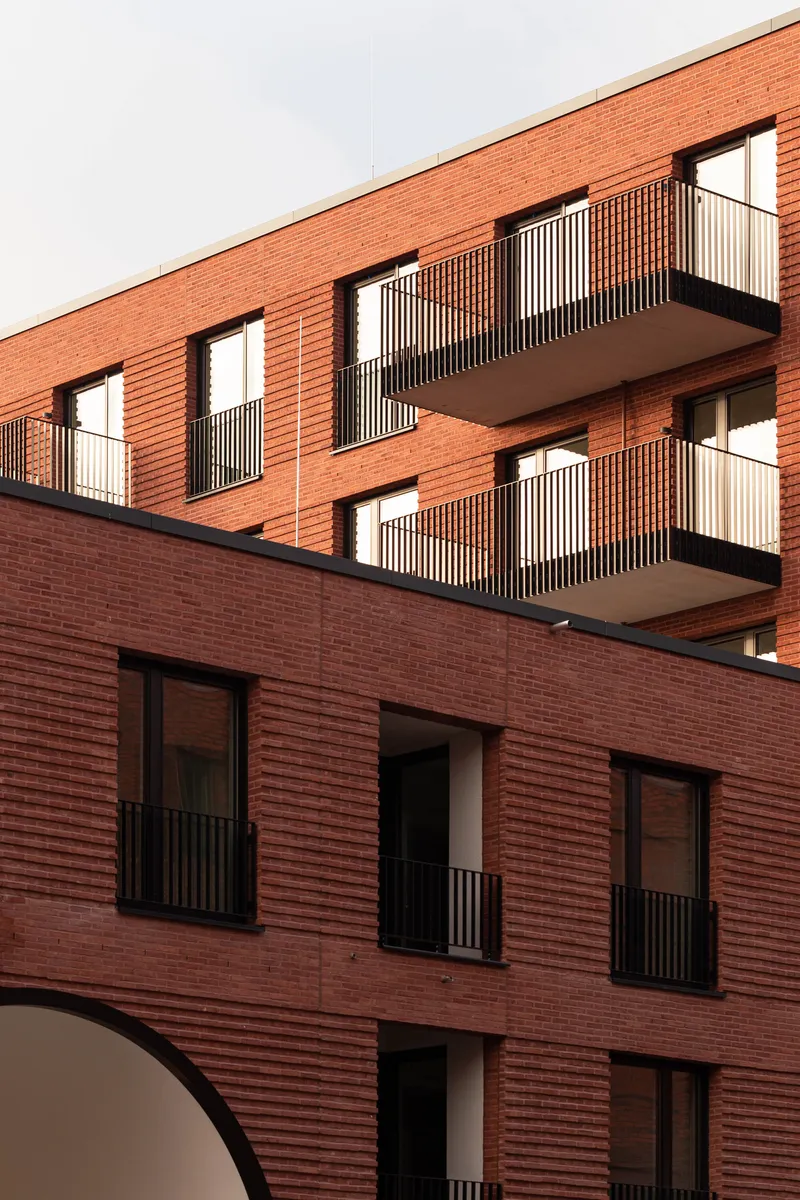
The facades are clad in reddish-brown clinker brick laid in semi-bond, a technique that allows blrm to introduce a subtle relief at every floor level: every second row of bricks steps back, giving the surface a corrugated plasticity that catches light differently through the day. Look closely at the corner balconies and you see vertical louvered screens that break up the planar repetition without abandoning the grid.
More interesting than any single facade, though, is the color strategy across the entire quarter. A gradient runs from north to south: the northern buildings echo the cooler, greyer tones of neighboring City Nord, while the southern volumes deepen into the warm reds of adjacent Barmbek. It is a contextual move executed at the scale of urban planning, not decoration, and it means the complex registers differently depending on which direction you approach from.
Arches That Connect
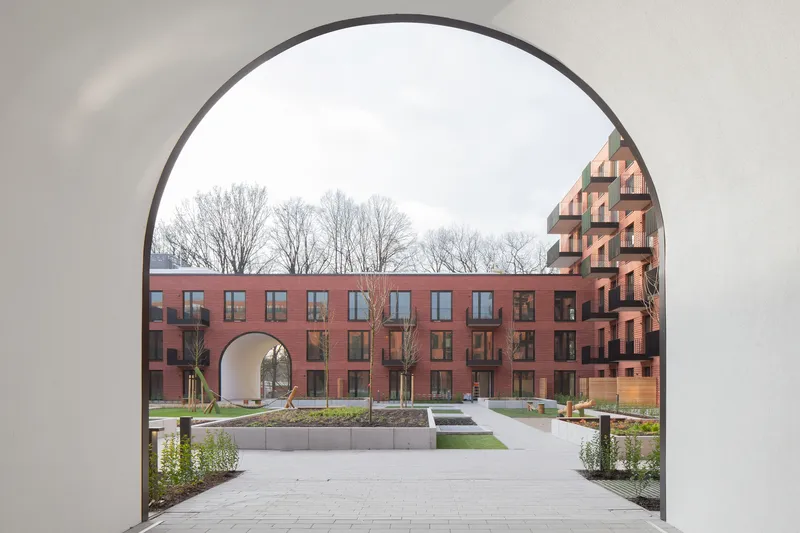
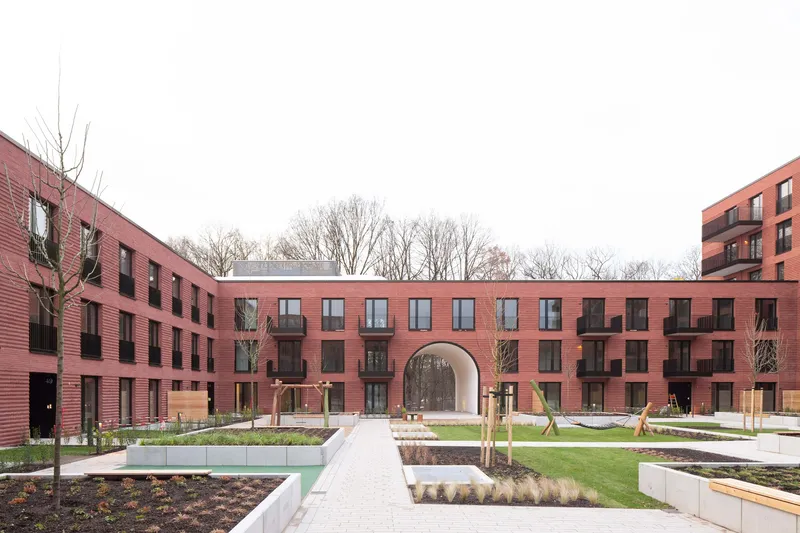
The round arched openings are the project's most photogenic gesture, but they also do real spatial work. Each passageway connects the surrounding green spaces and pathways to the internal courtyard, ensuring that residents enter their homes almost exclusively through the shared landscape rather than from the street. The arches frame views in sequence: step through one and you see the next, with bare winter trees and landscaped beds layered behind each opening.
This porosity is critical. A block of this size could easily read as exclusionary, a wall of brick separating inside from outside. Instead, the structural interruptions dissolve the perimeter into a series of thresholds. The positioning and rotation of the residential volumes also generate plaza-like street spaces with shifting geometries on the southern side, giving the public realm a variety that rigid master plans rarely achieve.
The Courtyard as Common Ground

Viewed from within, the courtyard reveals the project's debt to the allotment gardens that once occupied this site. The open space is organized as a patchwork of planted beds, paved pathways, and communal areas, all laid out on the same design grid that governs the facades. It is a deliberate echo: where individual garden plots once divided the land into personal territories, the courtyard now recombines those fragments into shared ground.
The symmetry of the inner facades, with their repetitive window rhythm and rooftop pavilion, gives the courtyard a civic quality that distinguishes it from a typical backyard. blrm treats the interior elevation with the same care as the street-facing one, acknowledging that for most residents this is the view that matters most.
Calibrating Scale
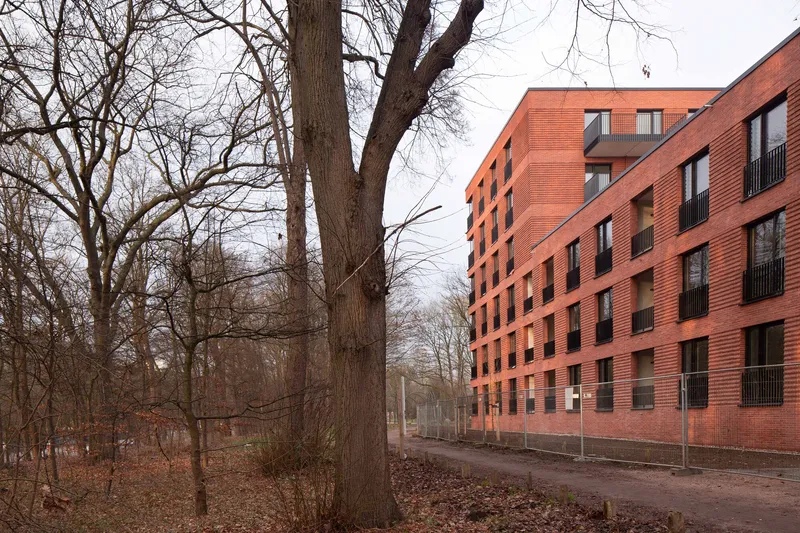
From the adjacent woodland, the building's three-story wings read as remarkably modest. Bare trees in late autumn nearly match the eave line, and the reddish-brown brick recedes into the landscape rather than competing with it. Only the six-story north wing asserts itself, and even there the clinker relief and recessed balconies break the mass into readable increments.
The decision to hold the side lengths identical while varying the heights is a disciplined one. It means the grid remains legible across all four elevations, while the volumetric difference responds honestly to context: taller where the neighbors are taller, lower where the green space demands deference. It is the kind of calibration that disappears when done well, and that is exactly the point.
Plans and Drawings
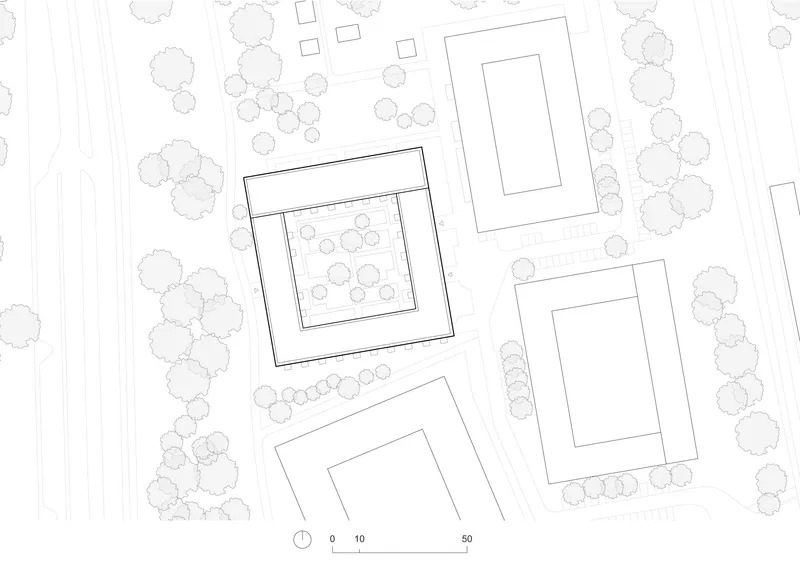


The site plan confirms what the photographs suggest: four rectangular volumes are arranged among existing trees and pathways, preserving the green character of the former allotment settlement rather than erasing it. The ground floor plan shows units wrapping continuously around the central courtyard, with circulation concentrated at the archway thresholds. On upper floors, planted areas within the courtyard are clearly delineated by tree circles, reinforcing the patchwork concept at the level of landscape.
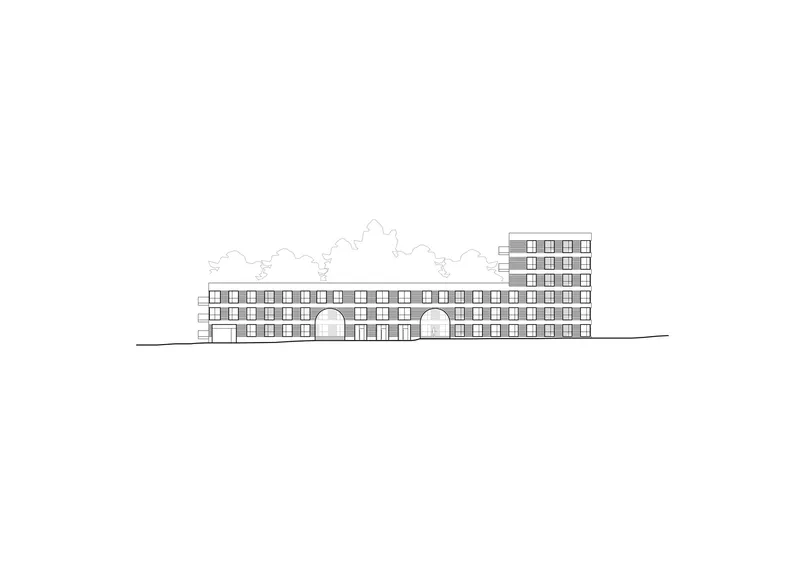
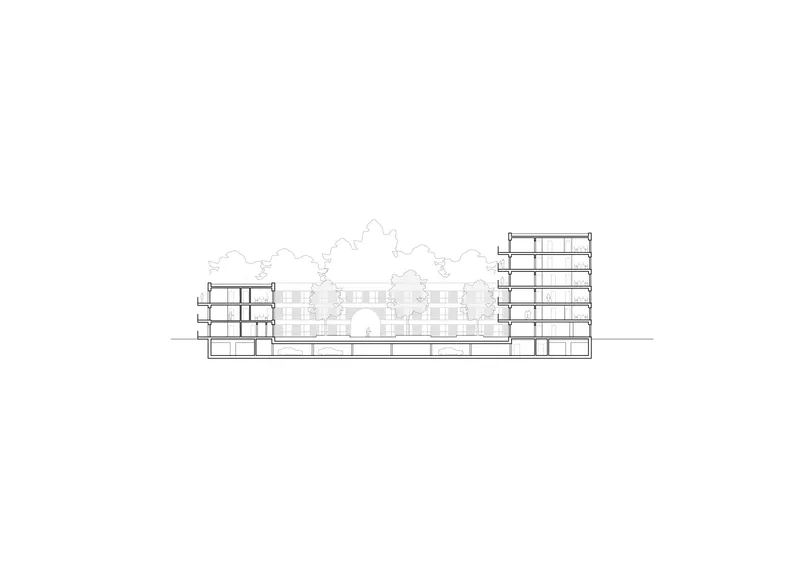
The elevation drawing makes the twin arched openings and the taller tower element legible as a single composition, while the section reveals how the internal floors of the two tower blocks flank a lower central volume. The height differential is not arbitrary: it controls daylight access to the courtyard and prevents the northern wing from casting the entire interior into shadow. Read together, these drawings show a project where the urban planning principle and the architectural detail are generated from the same grid.
Why This Project Matters
Hamburg does not lack for large residential blocks, and many of them default to either nostalgic historicism or slick neutrality. Pergolenviertel does neither. It takes the city's clinker brick tradition seriously enough to push it toward something expressive: the relief courses, the color gradient, the arched passages all belong to a contemporary vocabulary rooted in local material culture. The project proves that contextual design does not require timidity.
More broadly, blrm's strategy of routing daily life through the courtyard rather than the street is a bet on collective domesticity, a bet that the spaces between buildings matter as much as the units themselves. In a housing market that increasingly treats apartments as investment vehicles, a project that foregrounds communal landscape and public porosity feels like a quiet act of resistance. It deserves attention for that alone.
Pergolenviertel Residential Complex by blrm Architekt*innen. Hamburg, Germany. 16,600 m². Completed 2023. Photography by Joshua Delissen.
About the Studio
Share Your Own Work on uni.xyz
If projects like this are the kind of work you want to make, uni.xyz is a place to publish your own, find collaborators, and enter design competitions.


Popular Articles
Popular articles from the community


The Amber Palace Opera: A Geological Fiction Surfaces on Tallinn's Baltic Waterfront
Pierre Brillard reimagines a Baltic legend as a public landscape, opera house, and waterfront promenade rooted in Tallinn's coastal identity.

Extended Shell: Retrofitting Kolkata's Balconies as Living Urban Thresholds
A modular retrofit system recovers the social and environmental intelligence of Kolkata's historic verandas for contemporary Park Street residents.

Manzana Morphosis: Stretching Barcelona's Grid into a Living Landscape for 2050
A radical reworking of the Eixample manzana turns density into a tool for generous public space, vertical ecology, and environmental performance.

Opera on the Sea: Driftwood Logic Shapes a Timber Opera House on Estonia's Coast
Trevor Orgill's opera house translates the entangled drift of floating timber into a civic building where wood, water, and music converge.

Similar Reads
You might also enjoy these articles

Pixel Gardens: One Repeated Module Stacked Into a Terraced Social Housing Tower for Famagusta
Salem Bader's shortlisted housing tower builds a vertical neighbourhood from one repeated module, offsetting units to carve terraces, light and air.

Bao Huynh Watercolor Atelier: A Serene Art Retreat in Hội An
Bao Huynh Watercolor Atelier in Hội An blends multifunctional art spaces, sustainable design, local materials, and family-friendly living in a serene environment.

Atelier Macri Concept Store Interior Design by CASE-REAL
Atelier Macri store features a "ko" counter, walnut wood details, cork displays, blending retail, gallery, and seamless customer experiences.

Manuel Vargas Izquierdo Stadium and High-Performance Sports Center: Architectural Excellence in Jalpa de Méndez
The Manuel Vargas Izquierdo Stadium blends sustainable design, inclusive sports facilities, and cultural-inspired architecture, revitalizing Jalpa de Méndez’s public spaces.

Explore Residential Complex Competitions
Discover active competitions in this discipline

Challenge to design a portable theatre

Challenge to design a portable music platform

Challenge to design an open learning module for the elderly
Comments (0)
Please login or sign up to add comments
No comments yet. Be the first to comment!