

Blurring the Line: A Special Mention Proposal That Turns Dhaka's Slum Edges into Shared Marketplaces
Taorem Sananu stitches Sattola into Dhaka through three modular typologies, bazar, commercial and community, raised on reclaimed steel scaffolding.


Most slum upgrading schemes treat the edge of an informal settlement as a problem to be erased or walled off. Blurring the Line starts from the opposite instinct. It reads the boundary between Dhaka's poorest residents and the formal city as the most valuable ground available, the place where economic exchange already wants to happen. Rather than cleaning up that seam, the project builds on it, placing markets, shopfronts and schools exactly where the two worlds meet.
The proposal by Taorem Sananu received a Special Mention in UnIATA '24. Its site is Sattola, a slum wedged between Mahakhali, Neketon, Hatijheel and the Tejgaon Industrial zone. Thousands of migrants arrive in Dhaka each year, and many end up in places like this, providing services the city relies on while staying shut out of its markets and infrastructure. Sananu sees significant entrepreneurial energy in Sattola. The design answers with three interlinked modules, Entrepreneur (Bazar), Urban (Commercial) and Community, tied together by a continuous pathway.
A Bazar Placed on the Fault Line Between Two Economies

The opening image presents the Entrepreneur module as a mirrored street. Red stilted market buildings flank an orange central path, and pedestrians, drones and birds share the frame. The symmetry makes the argument: neither side of the boundary is front or back. The module moves existing markets off congested roads and into the boundary zone between communities of different economic classes. Traffic eases, and both slum residents and urban dwellers get an organised place to trade.
The orange path is the most important line in the drawing. It works as circulation and as a social contract, a shared floor that both communities have reason to walk. Here the project's ambition comes through most clearly. The physical boundary dissolves because buyers and sellers on either side come to depend on one another, not because anything is demolished.
Building in Two Stages: Scaffolding Below, Lightweight Living Above


The section shows how the bazar grows. Two rows of raised dwellings sit on red steel stilts, with a rickshaw and figures moving freely at street level beneath them. Stage one builds the ground floor from reclaimed materials such as steel scaffolding. Stage two adds lightweight upper structures for working and living. The phasing is realistic. It lets construction track the incomes of the people who will occupy it, and the ground plane stays open for trade from the first day.
The rendered row of gabled units gives the system a domestic scale. A kite flier and shoppers in the foreground suggest a street that is used, not just passed through. Open spaces, flexible furniture and rooftop facilities for drone delivery mix vernacular texture with an unexpected link to contemporary logistics. The drone pads are the bolder bet. They imply that a slum vendor's reach could go well beyond the foot traffic outside the stall.
Roadside Frames That Give Hawkers a Permanent Address
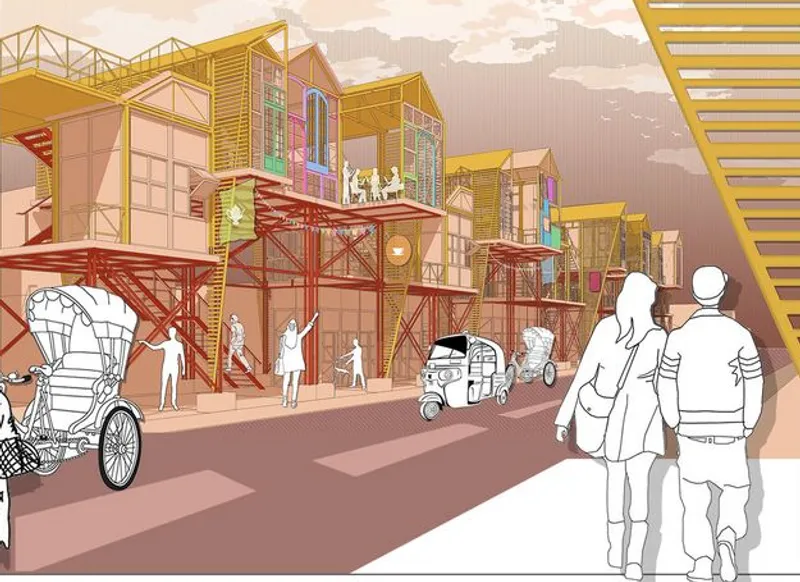
The Urban (Commercial) module moves to the primary roadside, the territory hawkers already occupy informally and often at the expense of traffic. The street perspective shows yellow-framed stilted houses with coloured panels. Rickshaws and an auto-rickshaw pass on the road, and a couple walks along the edge. The frames give vendors a fixed place to display goods without spilling into the carriageway, and refurbished materials keep the structures within what their users can afford.
Rooftop gathering spaces add a second layer to the module. At street level the frames turn a precarious trade into a legible storefront. Above, they offer common ground where slum entrepreneurs and urban residents can meet as neighbours as well as buyers and sellers. The bright palette also matters: it claims visibility for a population the city usually prefers not to see.
Reclaiming Dumped Water Bodies for Schools and Play
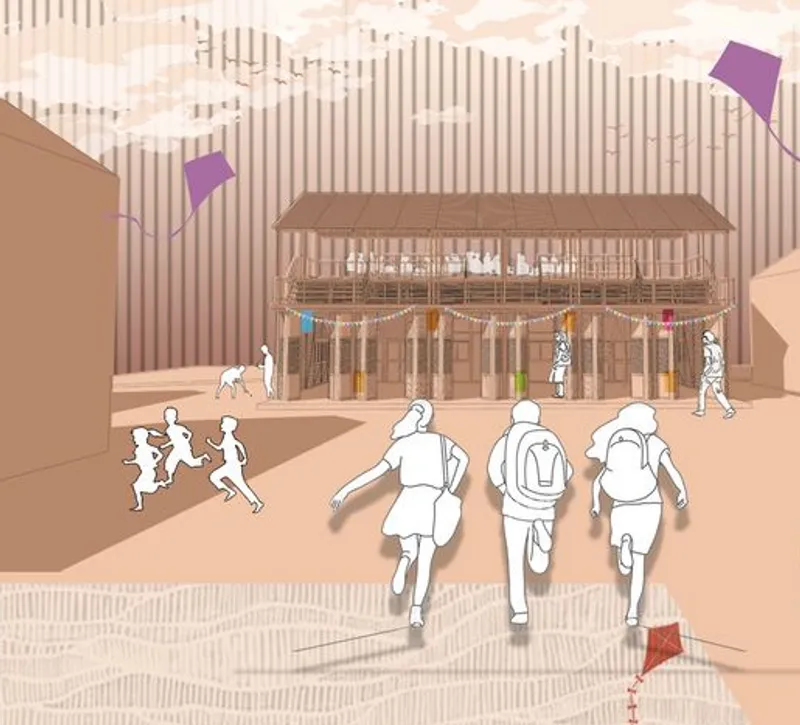
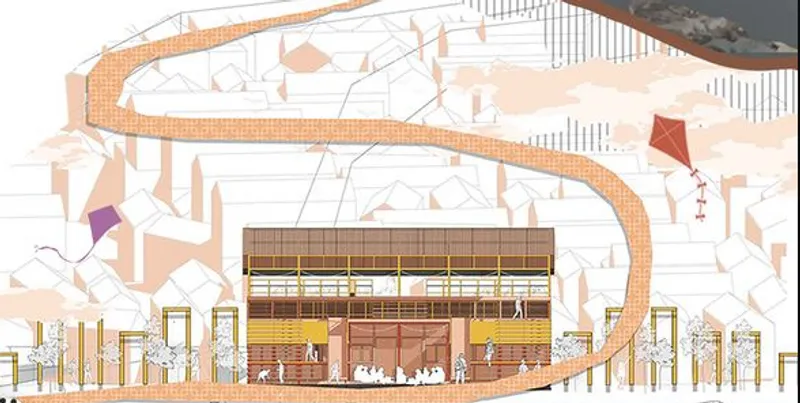
The Community module goes to Sattola's most neglected land: unused water bodies that have become dumping grounds. The illustration of three schoolchildren running toward a two-storey timber pavilion strung with bunting sets the tone of the intervention. Waste ground becomes a place for education, training and safe play, and the project's long-term thinking shows most clearly here. Markets build income now, while schools and training centres build it for the next generation.
The elevation adds a looping orange path that winds over a field of small houses, with kites in the air. The continuous pathway from the bazar reaches this module too, so the school is woven into the settlement's daily circulation. The pavilion becomes a destination on a route, and cleaning up these sites addresses hygiene and environmental concerns that have long been part of life in Sattola.
An Open Frame Built for Light, Air and Crowds
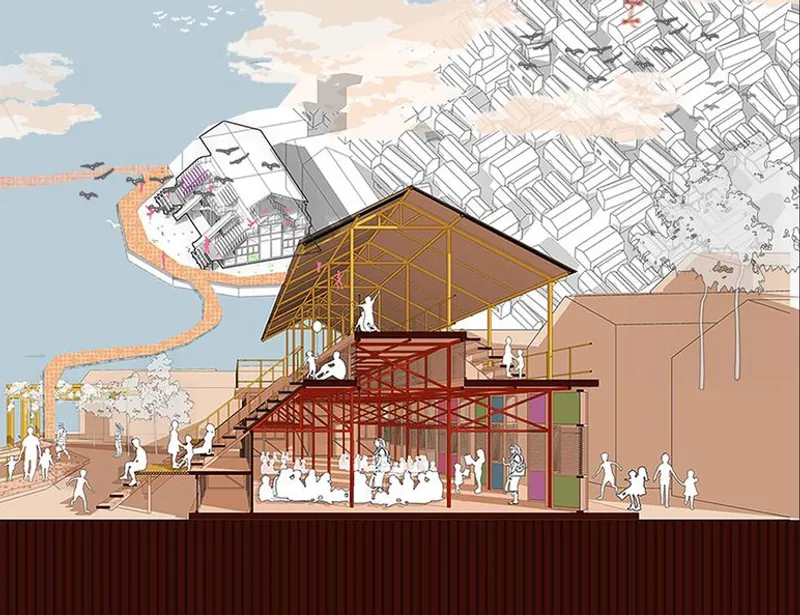
The coloured section of a two-storey timber and steel building explains the community module's environmental logic. An open stair, a pitched roof and porous edges let natural light and ventilation pass through spaces packed with people, set above a dense field of rooftops. The structure reads as a frame, not an enclosure. That fits the project's broader claim that modular, recycled and locally sourced construction can be adapted to each specific pocket of the settlement.
Why This Project Matters
Blurring the Line is valuable because it puts its architecture where the social problem actually sits. Sananu does not design a model village inside the slum or a beautification screen along its perimeter. The proposal occupies the contested edges, roadsides and abandoned water bodies, and gives each a programme that makes crossing over worthwhile. Treating economic interdependence as the main tool for integration is a more honest premise than many top-down upgrading schemes start from.
The proposal leaves some questions open, including land tenure, who manages the bazar, and how the drone infrastructure would be financed. Its core moves hold up all the same: phased construction from reclaimed scaffolding, a single continuous path linking market to school, and a material strategy matched to what residents can afford. For students working on informal settlements, it is a useful reminder that a boundary can be read as an opportunity for a building to occupy, not only as a line to remove.
View the Full Project
About the Designers
Designer: Taorem Sananu
Enter a Design Competition on uni.xyz
uni.xyz runs architecture and design competitions year-round that reward proposals with spatial conviction and real site intelligence.
Project credits: Blurring The Line by Taorem Sananu UnIATA '24 (uni.xyz).


Popular Articles
Popular articles from the community


longwave studio Reorganizes a 112 m² Tainan Apartment Around the Daily Routines of a Family and Two Cats
In Tainan, Taiwan, birch plywood, rust-red furniture and a freestanding plaster wall link arrival, storage, work and family life in one apartment.

GROUP A Strips a 1969 Rotterdam Harbor Headquarters to Its Frame and Wraps It in Timber Louvers
In Rotterdam's M4H harbor district, Ferro Offices reuses a 1969 frame, adds one timber storey and reaches BREEAM-NL Outstanding.

Juan García Correa, John González and Claudia Rueda Sink a Circular Amphitheater into a Manizales Engineering Building
On the La Nubia campus in Manizales, Colombia, the S1 Building folds labs and offices into a hillside of ramped lawns that double as a campus route.

Cube Design Draws an Ecological Corridor Between Two Shenzhen Hills with the Nankai Building
Beside Shenzhen's container docks, the Nankai Building pairs stacked balconies with a climbing green screen to connect two hillsides across its height.

Similar Reads
You might also enjoy these articles


Hodi-Mandai Geram
Project Function: Preservation and revitalization of the Intangible heritage and socio-spatial identity of the Hodi by Housing, Cultural Memory Center, Sacred Grove, landscape, local tourism economy


Olio Towers: A Mid-Rise for Performers That Fuses Housing, Rehearsal, and Stage
Located blocks from Houston's Theater District, this modular tower stacks living units around a central performance atrium.

Oasis: Modular Green Housing Carved into Dhaka's Urban Fabric
A shortlisted Plugin Housing entry reclaims unauthorized settlements in Dhaka with stepped concrete volumes, green roofs, and ventilation-driven design.

Black Hole: A Floating Megastructure for the Post-Physical Era
Emiliano Mazzarotto envisions a spherical, self-scaling arena where e-sports, digital hotels, and holographic stadiums replace traditional public space.

Explore Urban Development Competitions
Discover active competitions in this discipline


Comments (0)
Please login or sign up to add comments
No comments yet. Be the first to comment!