

C.Kairouz Architects Carves a Brick Family Home Around a Central Light Well in Melbourne
Bonded House in Northcote stacks perforated brickwork and strategic voids to flood a 252-square-metre corner site with daylight.


Corner lots in Melbourne's inner suburbs pose a familiar tension: the site reads as public on two sides, yet the brief demands domestic intimacy. At Bonded House in Northcote, C.Kairouz Architects resolved that tension by treating brick not as cladding but as the project's organizational logic. Stacked volumes of pale masonry step up from the street, split by a central light well that pulls sun and air deep into a 252-square-metre plan. The result is a three-bedroom home that feels carved from a single block of stone, then carefully opened where privacy permits.
What makes the project worth studying is the way one material decision cascades through every scale. Brick wraps the exterior, lines the courtyard walls, and reappears inside the kitchen and stairwell. That continuity eliminates the usual threshold between "outside" and "in," replacing it with a gradient of enclosure controlled by glass, perforated metal, and the void of the light well itself. Led by Chahid Kairouz and Giuseppe Passuello, the design team deployed a deceptively simple palette to produce spaces that shift character as the sun moves overhead.
Street Presence Without Spectacle
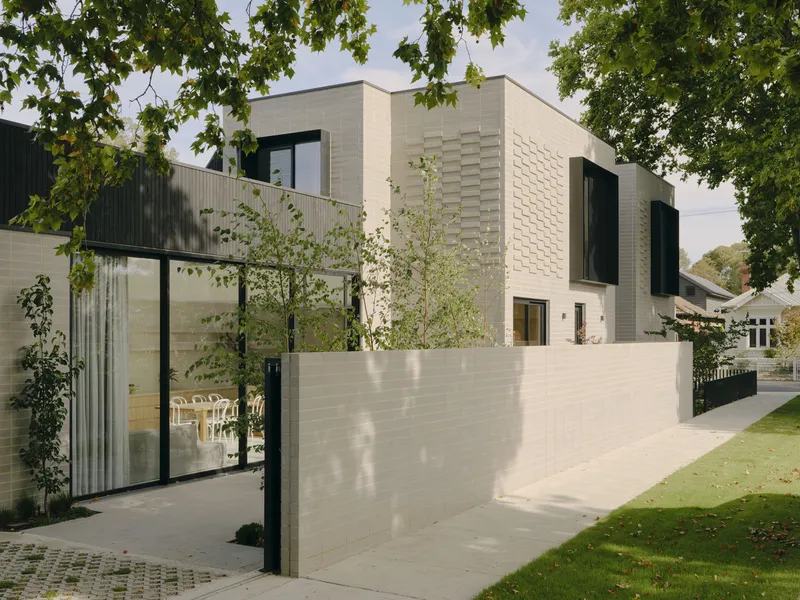
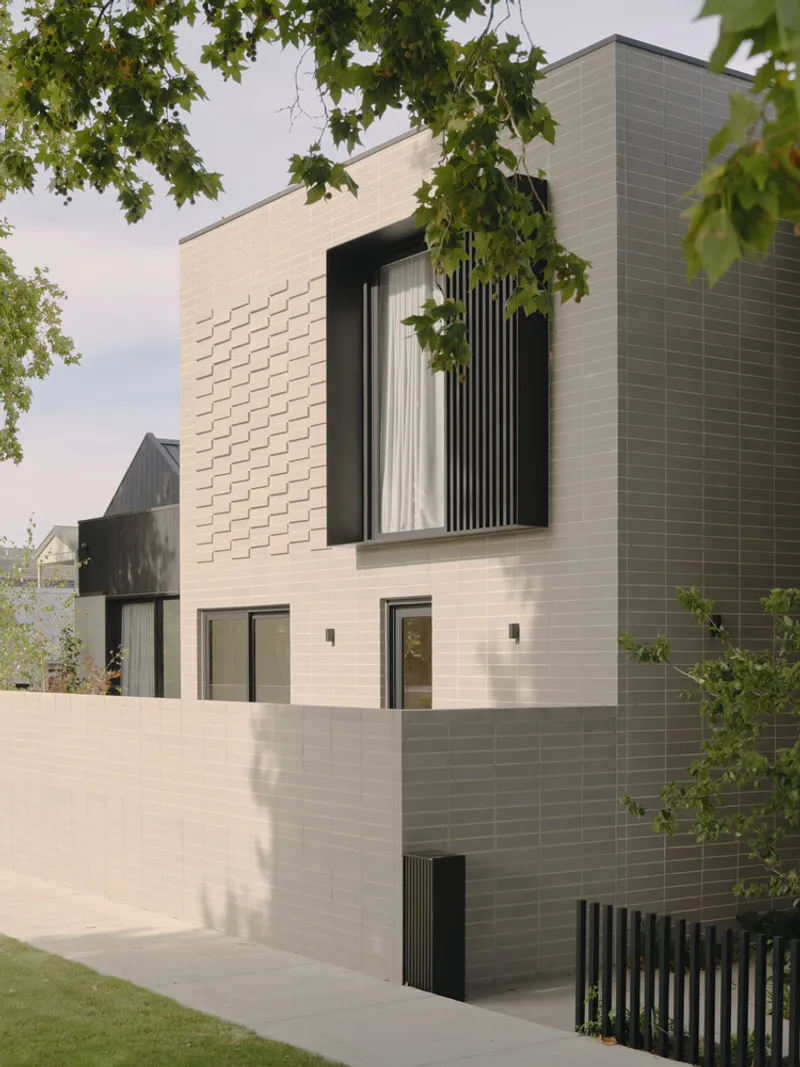
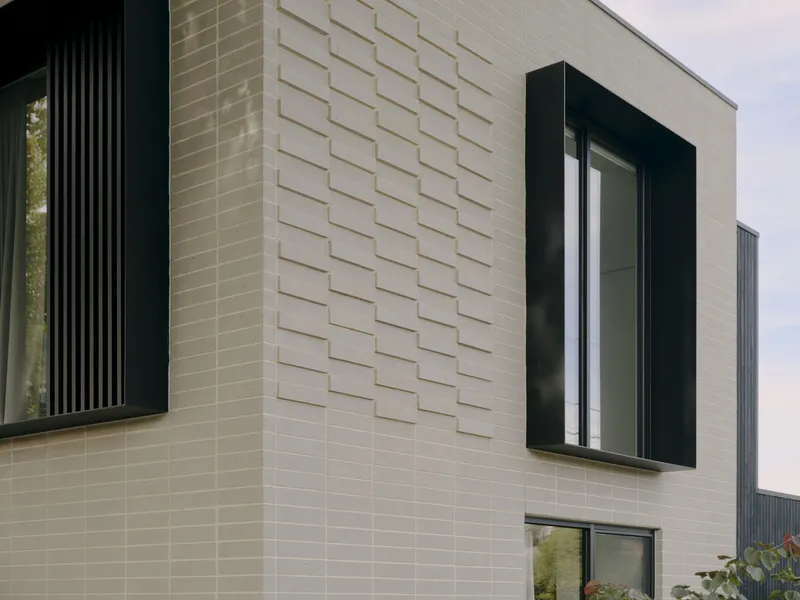
From the street, Bonded House reads as a tiered composition of cream and grey masonry with recessed black-framed windows. The facade avoids the flat plane that so many contemporary infill projects default to. Instead, it steps in section, creating depth that catches shadow and telegraphs the interior's split-level logic. Textured panels and a strip of dark vertical cladding break the mass without resorting to gratuitous formal gymnastics.
Overhanging street trees soften the edges, and the palette of muted tones allows the house to hold its ground on the corner without shouting. It is a facade designed to age gracefully alongside its neighbourhood, not to photograph well for a single afternoon. The recessed glazing keeps bedrooms private from the footpath while still reading as generous openings in the brick surface.
The Entry Sequence as Threshold
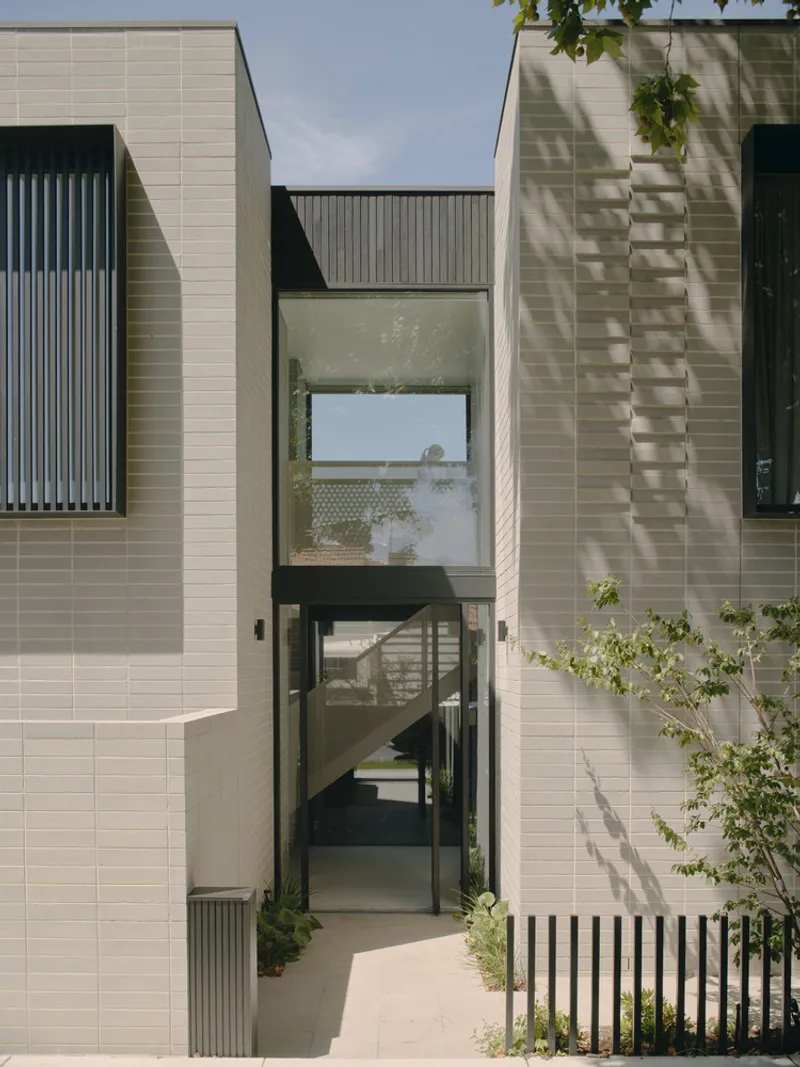

Arrival is compressed between two brick walls that funnel visitors into a glazed doorway beneath a dark timber soffit. Vertical black screening at the entry courtyard filters views without blocking them, so the transition from public sidewalk to private interior happens in stages rather than at a single door. Dappled light through the canopy overhead makes this interstitial space feel almost garden-like, setting the mood before you cross the threshold.
The sequence is worth noting because it solves two problems at once. It gives the house a legible address on a corner lot, and it buffers the interior acoustically and visually from the street. The timber soffit lowers the ceiling plane just enough to create a sense of compression that makes the double-height living space beyond feel like a release.
Light Well and Living Spaces
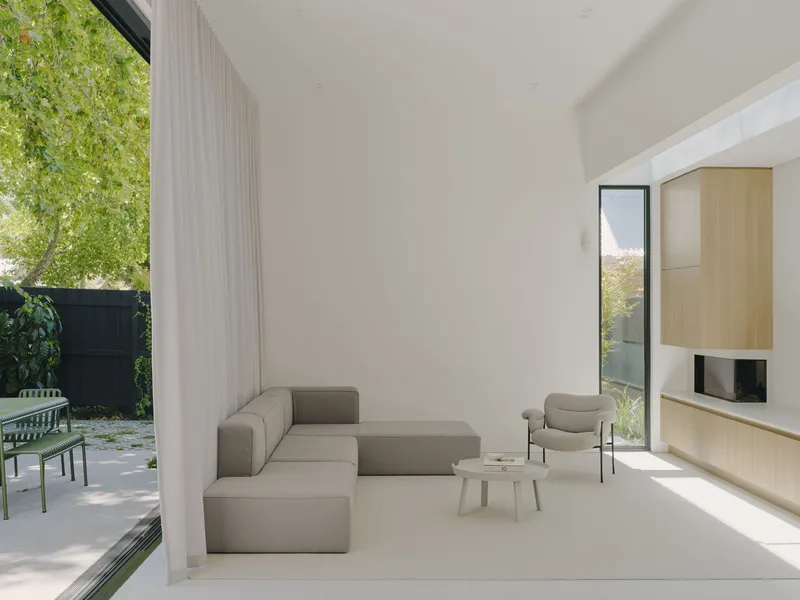
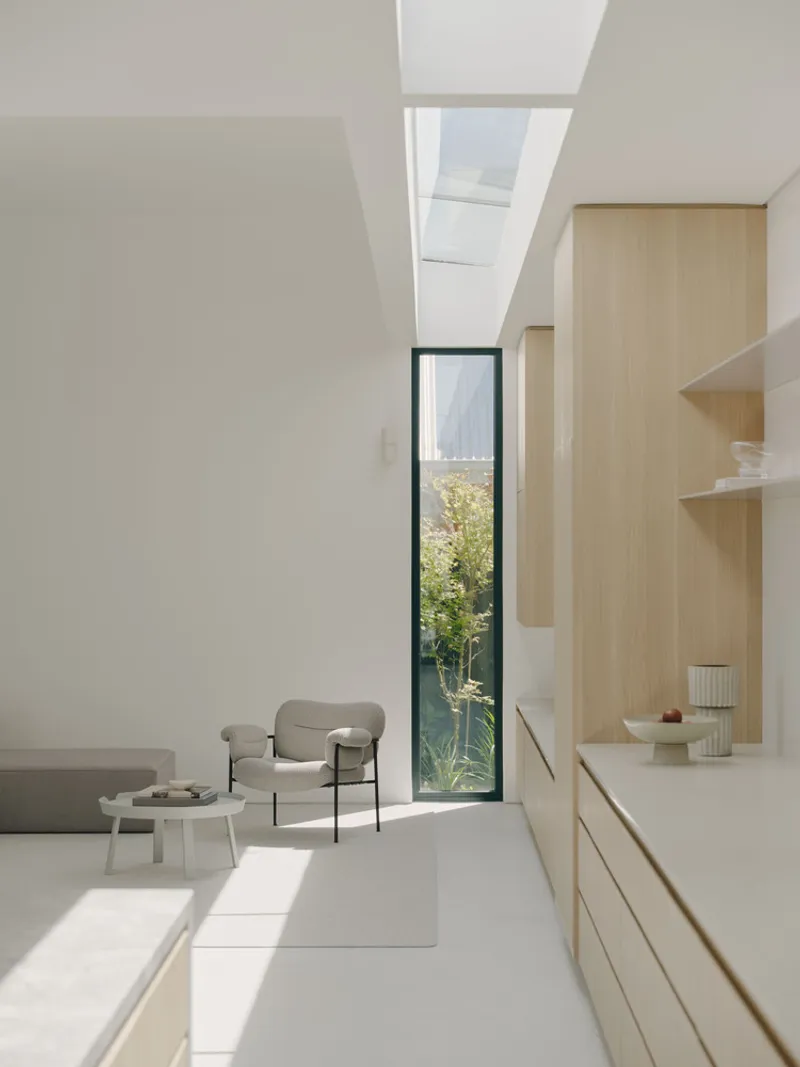

The central light well is the engine of the plan. It sits between the primary suite and the children's bedrooms on the upper floor, providing separation that feels spatial rather than merely walled. At ground level, it washes the open-plan living area with shifting daylight. A narrow vertical window paired with a skylight (visible in image 2) proves how precisely calibrated the openings are: the slot catches low-angle morning sun and throws it across pale floors in a blade of light that moves through the room as the day progresses.
Floor-to-ceiling curtains and sliding glass doors allow the double-height living space to fully merge with the paved courtyard beyond. When the glass panels retract, the distinction between room and garden effectively disappears. Ribbed brick walls in the courtyard echo the exterior, reinforcing the idea that you are still inside the building's material envelope even when you are technically outdoors. It is a simple trick, but it makes 252 square metres feel substantially larger.
Kitchen as Material Showcase
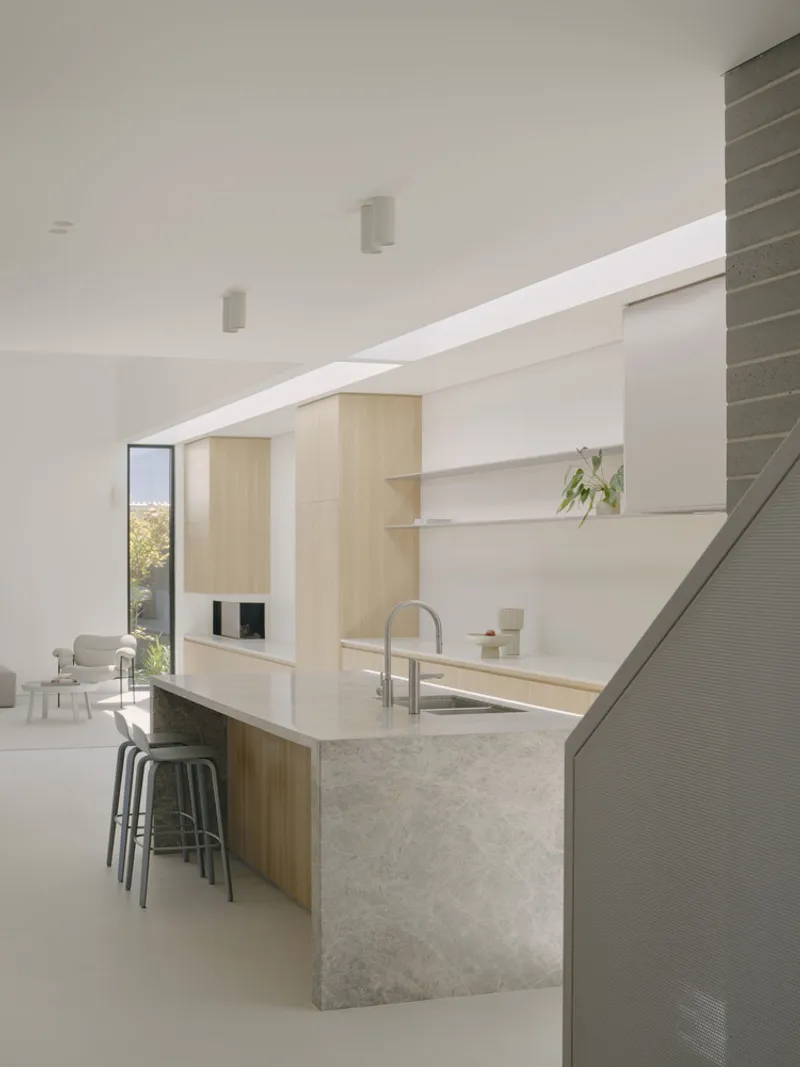
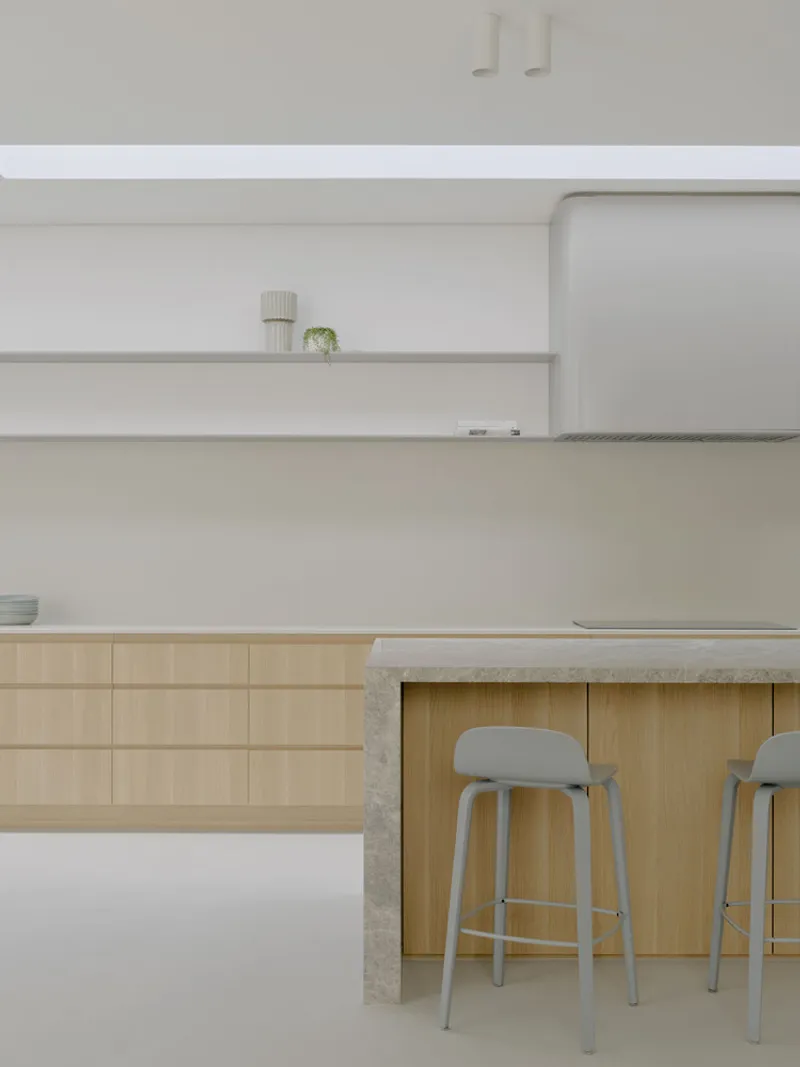
The kitchen concentrates the project's material ambitions into a compact zone. An island with a timber base and concrete countertop anchors the room, while pale timber cabinetry lines the wall behind. An angled skylight pours light directly onto the work surface, an orientation that eliminates the need for task lighting during daylight hours and turns meal preparation into a surprisingly pleasant act.
Floating white shelves above the counter keep storage visible and accessible, a practical move that also keeps the wall from feeling heavy. The terrazzo counter on the island introduces a subtle texture that plays against the smooth timber and the rough brick that appears elsewhere in the plan. Nothing here is accidental: the material shifts correspond to functional zones, guiding the eye and the hand without labels.
Detail and Materiality Up Close
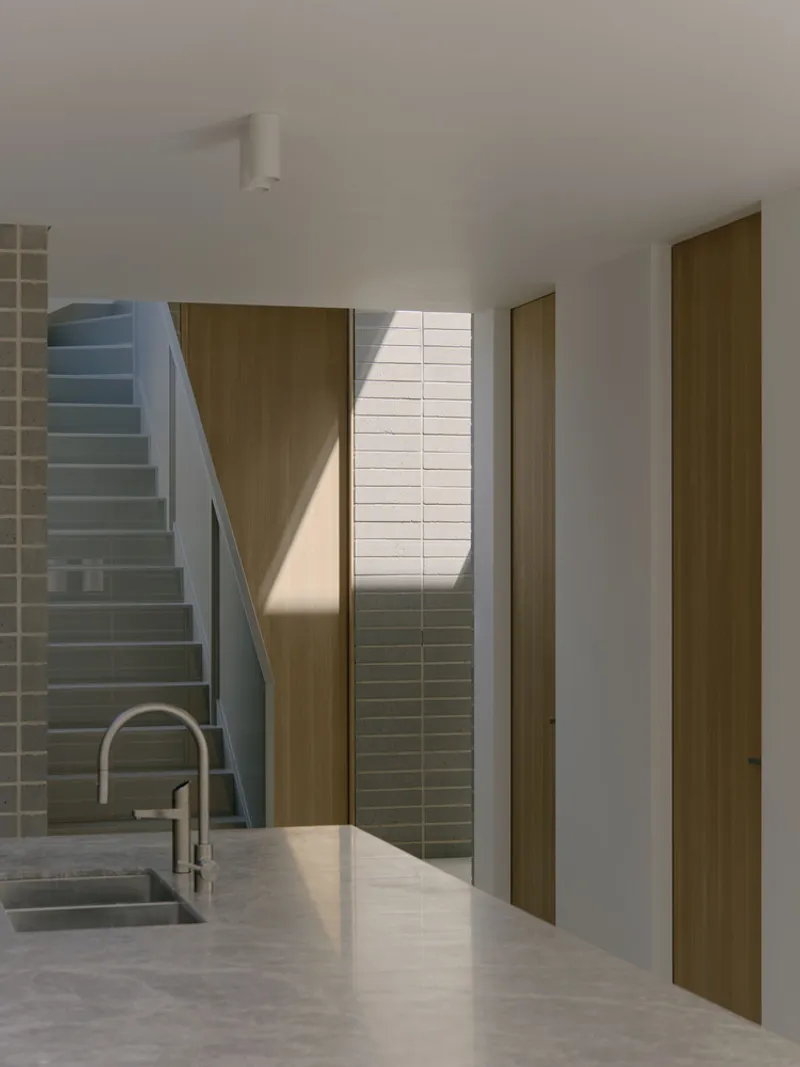

Zooming in reveals how carefully the junctions were resolved. A grey tiled wall meets a timber door edge in a clean line that lets afternoon light from the skylight above cast a sharp diagonal shadow across the surface. These are the details that separate a considered house from a competent one. The tile, supplied by Artedomus, has a matte finish that absorbs rather than bounces light, keeping the palette calm even where direct sun hits the wall.
Oversized doors and high ceilings amplify the effect, making rooms feel taller than their actual dimensions. Perforated metal banisters on the staircase allow courtyard views to filter through to upper-level circulation, sustaining the project's commitment to transparency at every turn. The overall impression is one of restraint: each material earns its place, and nothing is added for decoration alone.
Why This Project Matters
Bonded House demonstrates that brick, one of the oldest building materials in Melbourne's residential vocabulary, still has unexplored potential when paired with precise environmental thinking. The central light well, cross-ventilation strategy, double glazing, rainwater tanks, and solar panels are not bolted-on sustainability features; they are embedded in the architectural logic from the first sketch. That integration is what distinguishes passive design done well from passive design done for a rating certificate.
More broadly, the project offers a replicable model for family housing on tight urban lots. By collapsing the boundary between material, structure, and finish, C.Kairouz Architects reduced the number of systems competing for attention and produced a home that is legible, durable, and genuinely pleasant to move through. In a market saturated with white-box renovations and rendered facades, Bonded House argues quietly but persuasively for the expressive weight of a well-laid brick.
Bonded House by C.Kairouz Architects. Northcote, Melbourne, Australia. 252 m². Completed 2023. Photography by Tom Ross.
About the Studio
Share Your Own Work on uni.xyz
If projects like this are the kind of work you want to make, uni.xyz is a place to publish your own, find collaborators, and enter design competitions.


Popular Articles
Popular articles from the community


graciastudio Turns a Viewless Tijuana Lot Inward Around a Courtyard of Concrete, Timber and Trees
In Tijuana, Jorge Gracia's GA2 House stacks a timber-clad private floor over exposed concrete and replaces a missing view with a planted interior patio.

David Ortega Stacks a Two-Story Mexico City Penthouse Around a Steel Stair and a Pergola-Shaded Roof Terrace
In Colonia Roma, a 300 m² penthouse uses oak joinery, a planted steel stair and a slatted roof pergola to make a new-build apartment feel like a house.

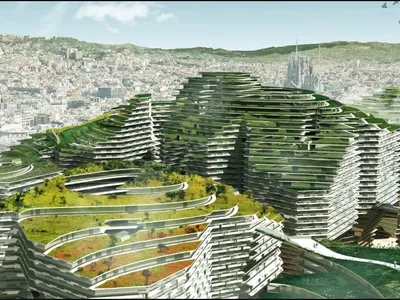
Manzana Morphosis: Stretching Barcelona's Grid into a Living Landscape for 2050
A radical reworking of the Eixample manzana turns density into a tool for generous public space, vertical ecology, and environmental performance.

Cube Design Draws an Ecological Corridor Between Two Shenzhen Hills with the Nankai Building
Beside Shenzhen's container docks, the Nankai Building pairs stacked balconies with a climbing green screen to connect two hillsides across its height.

Similar Reads
You might also enjoy these articles


Hodi-Mandai Geram
Project Function: Preservation and revitalization of the Intangible heritage and socio-spatial identity of the Hodi by Housing, Cultural Memory Center, Sacred Grove, landscape, local tourism economy


Olio Towers: A Mid-Rise for Performers That Fuses Housing, Rehearsal, and Stage
Located blocks from Houston's Theater District, this modular tower stacks living units around a central performance atrium.

Oasis: Modular Green Housing Carved into Dhaka's Urban Fabric
A shortlisted Plugin Housing entry reclaims unauthorized settlements in Dhaka with stepped concrete volumes, green roofs, and ventilation-driven design.

Black Hole: A Floating Megastructure for the Post-Physical Era
Emiliano Mazzarotto envisions a spherical, self-scaling arena where e-sports, digital hotels, and holographic stadiums replace traditional public space.

Explore Housing Competitions
Discover active competitions in this discipline

Challenge to reimagine the Iron Throne

Photograph architecture without architects

Illustrate the lost glory of Angkor Wat - Render Challenge

Design challenge to reuse E-waste
Comments (0)
Please login or sign up to add comments
No comments yet. Be the first to comment!