

Bookstore Architecture in Wetlands: Xixi Goldmye Bookstore by Atelier Wen'Arch
Xixi Goldmye Bookstore transforms a former office into immersive bookstore architecture in wetlands, blending timber structure with natural light.


Reimagining an Office into a Floating Cultural Landmark
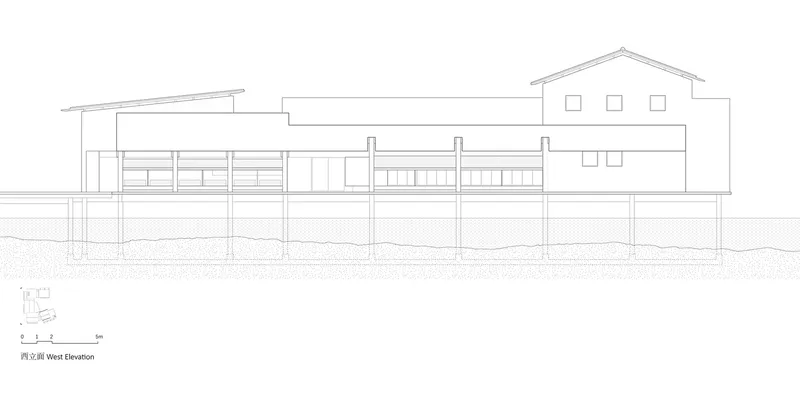
In the heart of Hangzhou’s Xixi Wetland, Atelier Wen'Arch transforms a 20-year-old office structure into a stunning example of bookstore architecture in wetlands. The Xixi Goldmye Bookstore is more than a retail space—it is a spatial re-composition, where literature, architecture, and nature converge. Elevated above the water and redesigned with lightness and openness, the project delicately inserts a cultural landmark into a living ecological system.
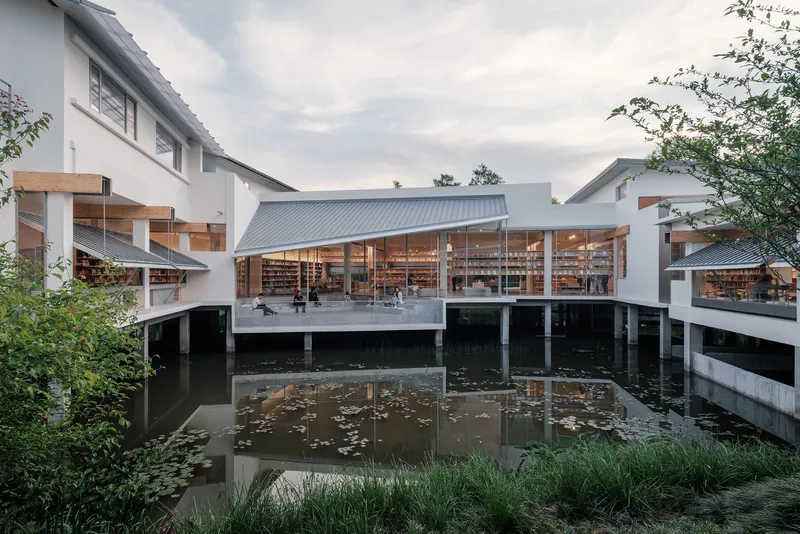

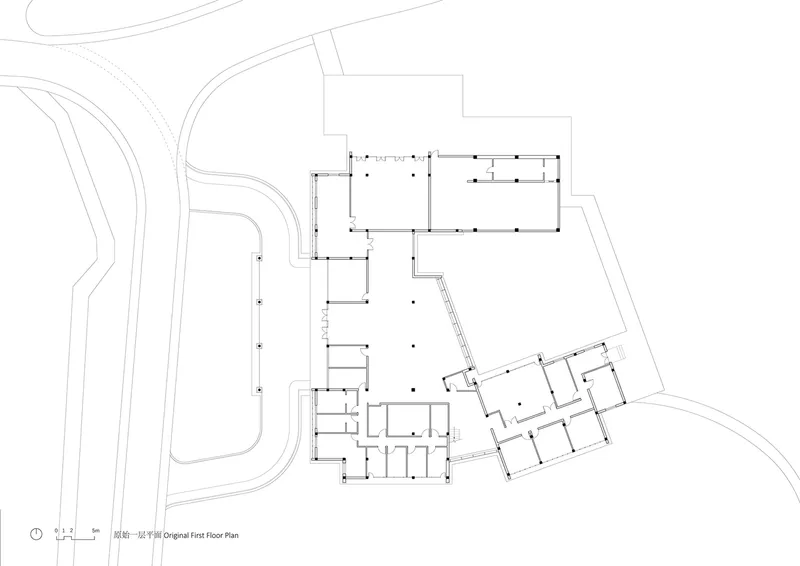
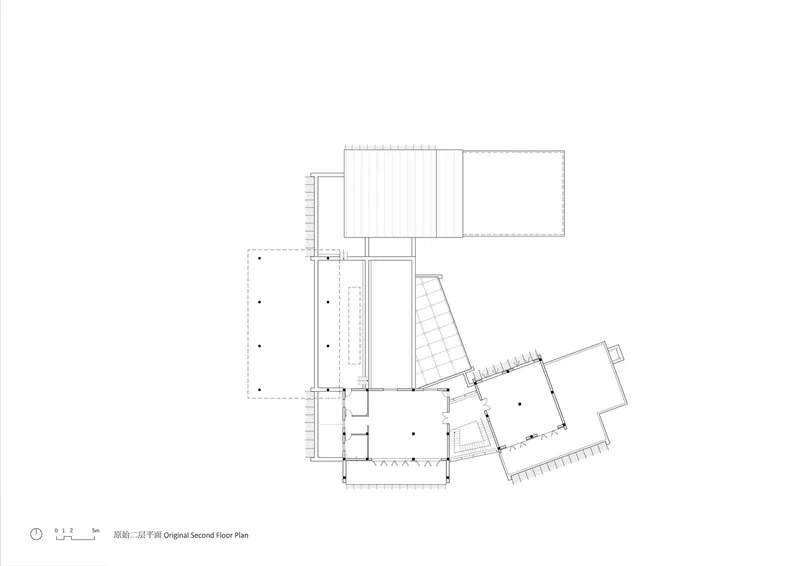
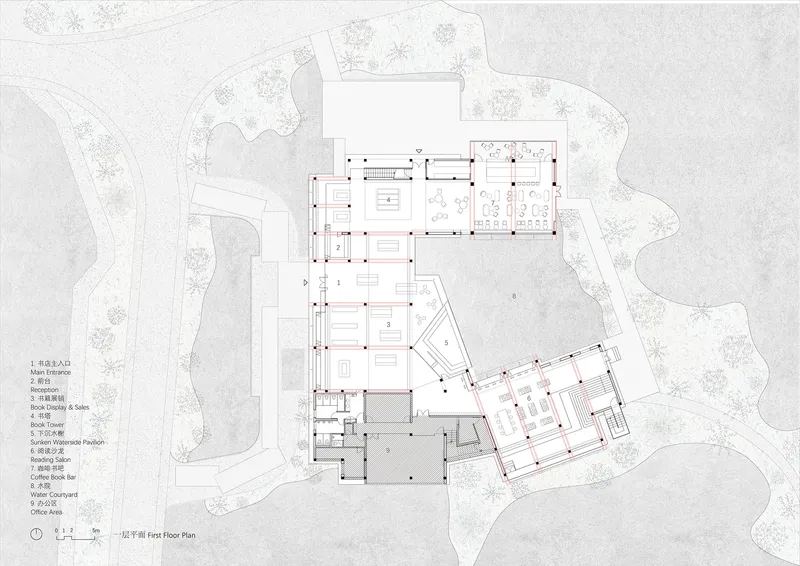
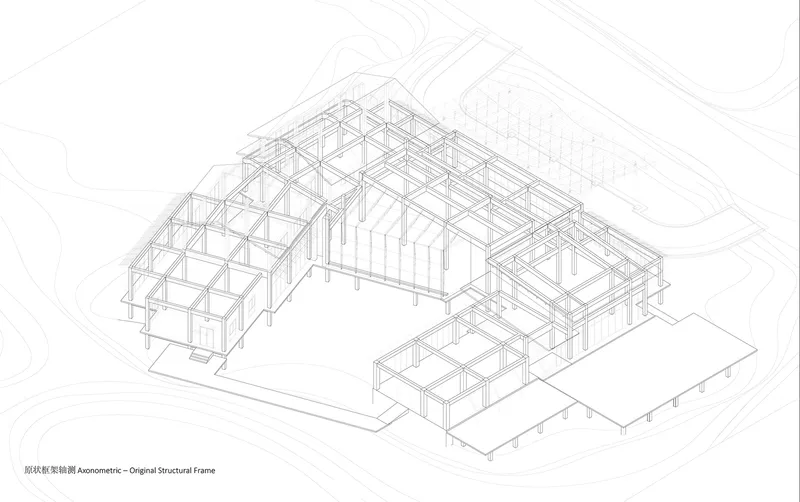
The original U-shaped building, with its rigid concrete framework and enclosed water courtyard, once lacked connection to its natural context. The architectural intervention strips away opacity and introduces layered spatial orders through a sensitive reinterpretation of structure and form. What emerges is a bookstore that feels as though it floats—both physically above the wetland and conceptually between tradition and innovation.

Introducing Structural Clarity to Organic Chaos
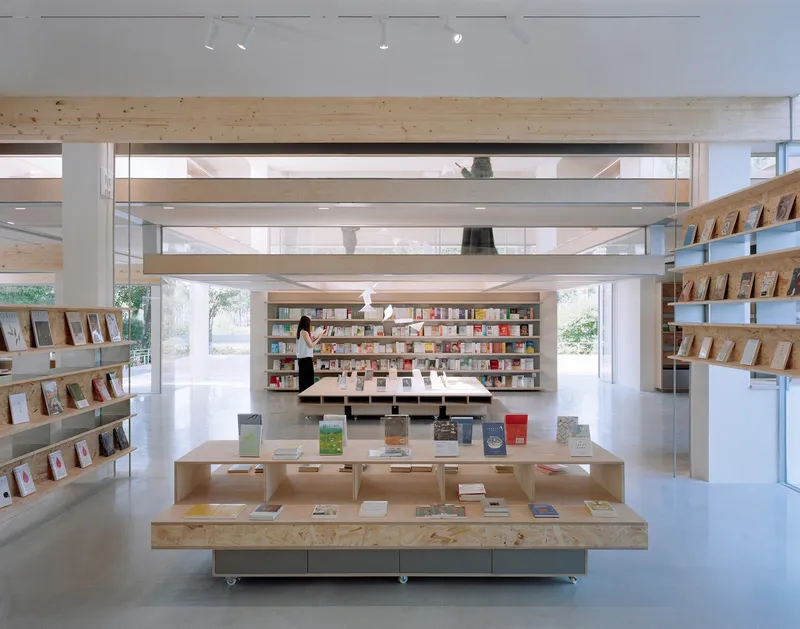
To counteract the disordered legacy of the building, the architects implemented new systems of order using timber and steel. The formerly chaotic spatial grid was reimagined as a forest of vertical concrete columns, now organized by a secondary timber beam structure. These double beams create a harmonious spatial rhythm, establishing a horizontal framework that connects the indoor reading experience to the surrounding wetland.
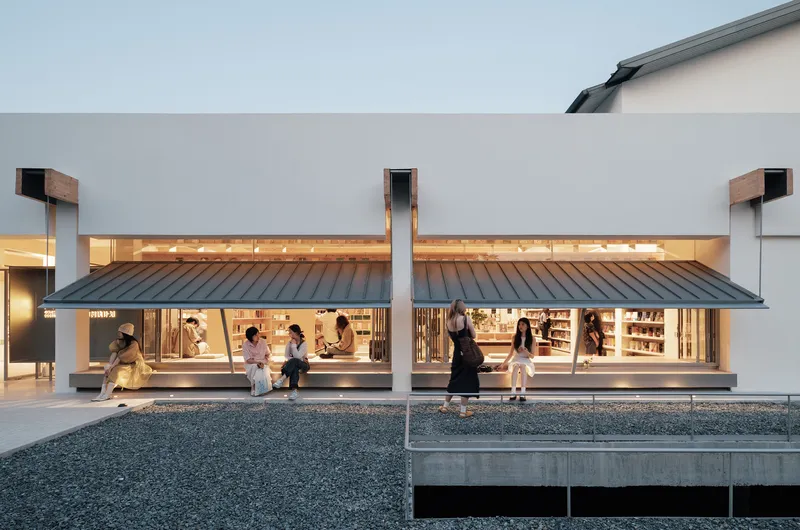

The ceiling integrates mechanical systems and lighting within the gaps between the beams, while visually maintaining clarity and calm. As a result, the architecture becomes both performative and poetic, articulating a newfound spatial balance between frame and void, light and shadow.
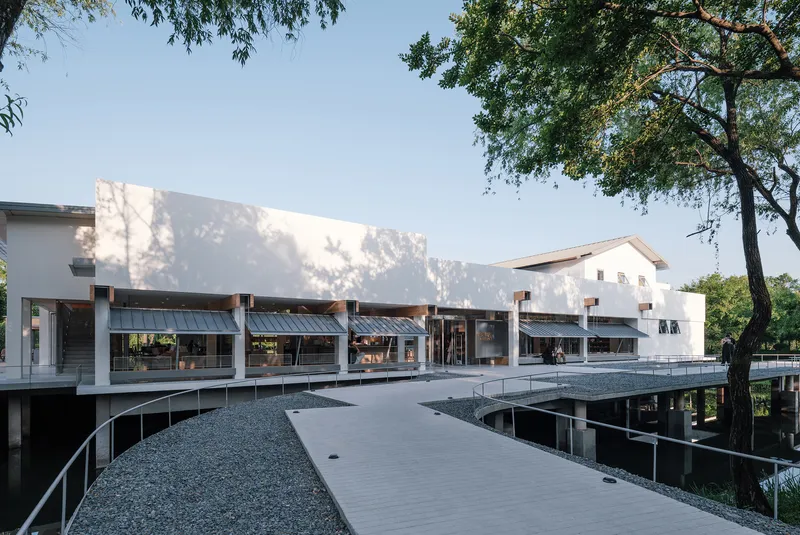
The Book Tower: A Vertical Theater of Reading
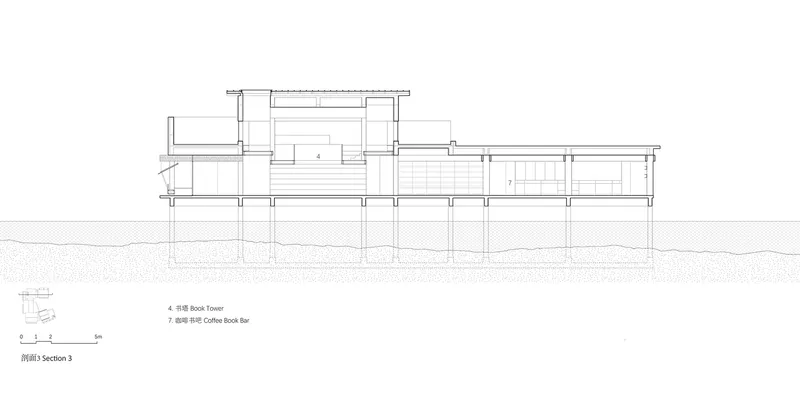
At the southwest corner, a tall volume is transformed into a “Book Tower”—a vertical punctuation in the otherwise horizontal landscape. Two nested rings of mezzanines form layered, amphitheater-like terraces. The spatial arrangement encourages readers to sit, ascend, or simply pause while engaging with books and framed views of the wetlands.
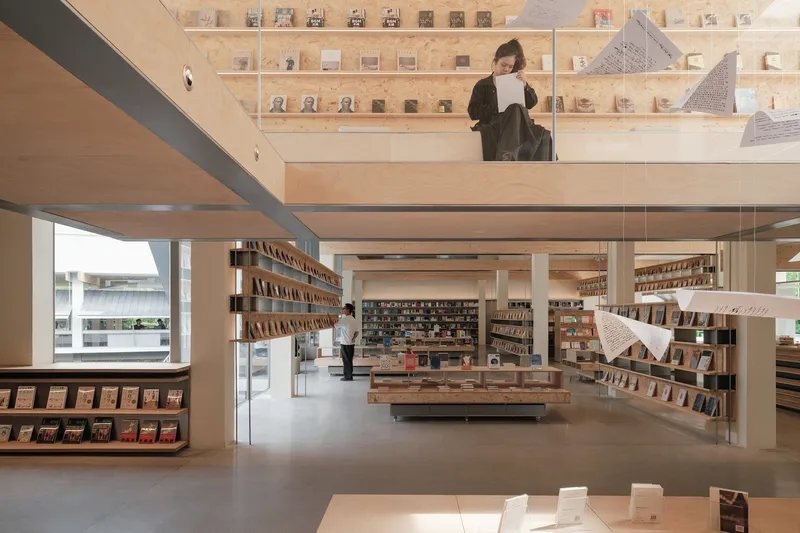
The steel mezzanine structure suspends a grid of I-beams, aligned flush with wooden floors to blend structural clarity with material warmth. Light filters down from a skylight, bouncing off horizontal surfaces and animating the space. Here, readers become performers and participants in a slow, architectural choreography that celebrates both solitude and spectacle.
The Waterside Pavilion: Blurring Architecture and Landscape
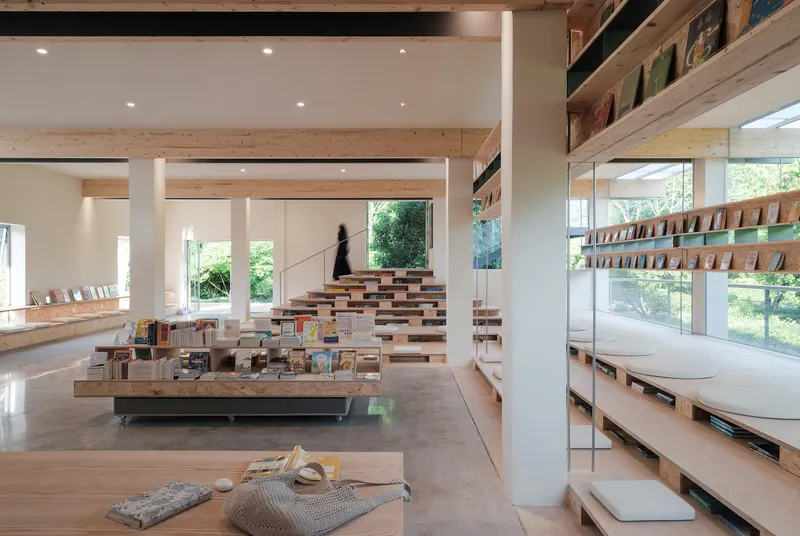
On the eastern edge of the U-shape, the bookstore dips downward to form a sunken waterside pavilion. This pavilion replaces a former glass volume with a diagonally pitched roof that draws attention to the water’s edge. The lowered floor slab creates an intimate amphitheater of terraced seating, allowing readers to gather around, gaze at the wetland, and participate in the subtle theatre of natural reflection.

The titanium-zinc roof and silver-painted ceiling amplify the atmospheric interplay between interior space and the water surface. Morning light dances on the pavilion canopy, pulling the texture of ripples into the bookstore’s interior—making nature not only visible but experiential.
Secondary Eaves and Book-Beams: Intermediary Interfaces
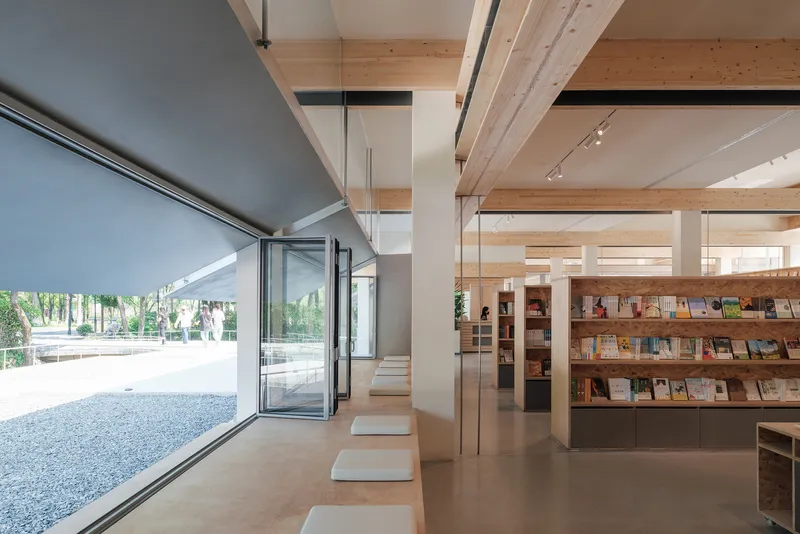
A poetic detail of the project is the reinterpretation of the Song dynasty “zhangri ta” sun-shading screen. Suspended secondary eaves are delicately cantilevered from the timber beams using tension rods, regulating light and scale while subtly blurring the boundary between inside and outside. These eaves also visually shield the building from urban intrusions, refocusing attention on the natural courtyard and reinforcing the building’s floating presence.


In a structural and symbolic gesture, bookshelves themselves become part of the architecture. The “book-beams”, suspended between columns, serve as both storage and structure. Composed of laminated wood, OSB panels, and stainless-steel plates, these 6-meter spans offer a layered, weightless field of books suspended in midair. As visitors browse, they glimpse the wetlands through the shelves—reading not only pages but also the passing reflections of birds, trees, and sky.


A Transparent Cultural Retreat in the Heart of Xixi
The Xixi Goldmye Bookstore stands as a powerful example of bookstore architecture in wetlands, bridging urban life and ecological sensitivity. By deconstructing and recomposing an aging office structure into a serene, flowing space for culture and community, Atelier Wen'Arch has crafted a model for how architecture can exist with nature, not against it.
This project is not simply about adaptive reuse or bookstore typology—it’s a meditation on spatial thresholds, material softness, and sensory immersion. It invites readers to not only lose themselves in books, but also in light, water, and the layered rhythm of timber and air. It is, ultimately, an architecture of reflection—intellectual, environmental, and architectural.

All Photographs are works of Hao Chen


Popular Articles
Popular articles from the community


Aquadapt: An Underwater Habitat That Rewrites Its Rooms by the Hour
Curved modules ring the seabed while one shell shifts from breakfast room to cinema, farm and football pitch as residents' needs change.


Cube Design Draws an Ecological Corridor Between Two Shenzhen Hills with the Nankai Building
Beside Shenzhen's container docks, the Nankai Building pairs stacked balconies with a climbing green screen to connect two hillsides across its height.

ETEH Reworks the Shared Spaces of São Domingos School in Brazil Around Timber, Color and Hanging Plants
At São Domingos School in Brazil, 436 m² of hall, refectory and library are recast with timber joinery, a yellow and blue code and trailing greenery.

David Ortega Stacks a Two-Story Mexico City Penthouse Around a Steel Stair and a Pergola-Shaded Roof Terrace
In Colonia Roma, a 300 m² penthouse uses oak joinery, a planted steel stair and a slatted roof pergola to make a new-build apartment feel like a house.

Similar Reads
You might also enjoy these articles
Cube Design Draws an Ecological Corridor Between Two Shenzhen Hills with the Nankai Building
Beside Shenzhen's container docks, the Nankai Building pairs stacked balconies with a climbing green screen to connect two hillsides across its height.

Praksis A and Studio Sted Bend a Red Timber Cabin Across the Granite of Norway's Southern Coast
On the southern Norwegian coast, a 105 m² cabin follows the rock on slender posts, pairing red cladding outside with pine, brick and plywood within.
David Ortega Stacks a Two-Story Mexico City Penthouse Around a Steel Stair and a Pergola-Shaded Roof Terrace
In Colonia Roma, a 300 m² penthouse uses oak joinery, a planted steel stair and a slatted roof pergola to make a new-build apartment feel like a house.

PARALELA and LB2 Thread a Public Walkway Through the Base of a Las Condes Residential Tower
In Las Condes, Santiago, the Hamlet Building gives its fenceless ground floor to a 70-metre wooded passage linking two streets and the metro.

Explore Architecture Competitions
Discover active competitions in this discipline

Challenge to reimagine the Iron Throne

Photograph architecture without architects

Illustrate the lost glory of Angkor Wat - Render Challenge

Design challenge to reuse E-waste
Comments (0)
Please login or sign up to add comments
No comments yet. Be the first to comment!