
Box Varies: A Modular Cemetery That Grows Life from Death in Shanghai
Stacking memory vertically with modular boxes that transform cremation ashes into living gardens across a reclaimed urban parking lot.


What happens when ashes become soil, and a parking lot becomes a cemetery that no one fears visiting? In one of the world's densest cities, Ranjuel Yron proposes a structure where the dead literally nourish the living: cremation ashes dissolve into nutrient-rich substrate, feeding memorial flora inside modular greenhouse units stacked vertically above Shanghai's streets. "Box Varies" is not a mausoleum in any conventional sense. It is a hybrid of cemetery, park, greenhouse, and smart parking infrastructure, compressed into a scalable grid of transformable boxes.
The project takes aim at a real and accelerating crisis: land scarcity in Shanghai has pushed cemeteries into underused, neglected pockets of the city, while traditional burial practices collide with environmental limits. China's memorial culture is already shifting from tombs toward tree burials and digital remembrance, and Yron's proposal rides that trajectory forward, imagining a staged evolution from pilot modular units in 2020 to a fully integrated urban cemetery by mid-century.
White Frames and Turquoise Glass: A Vertical Landscape of Memory


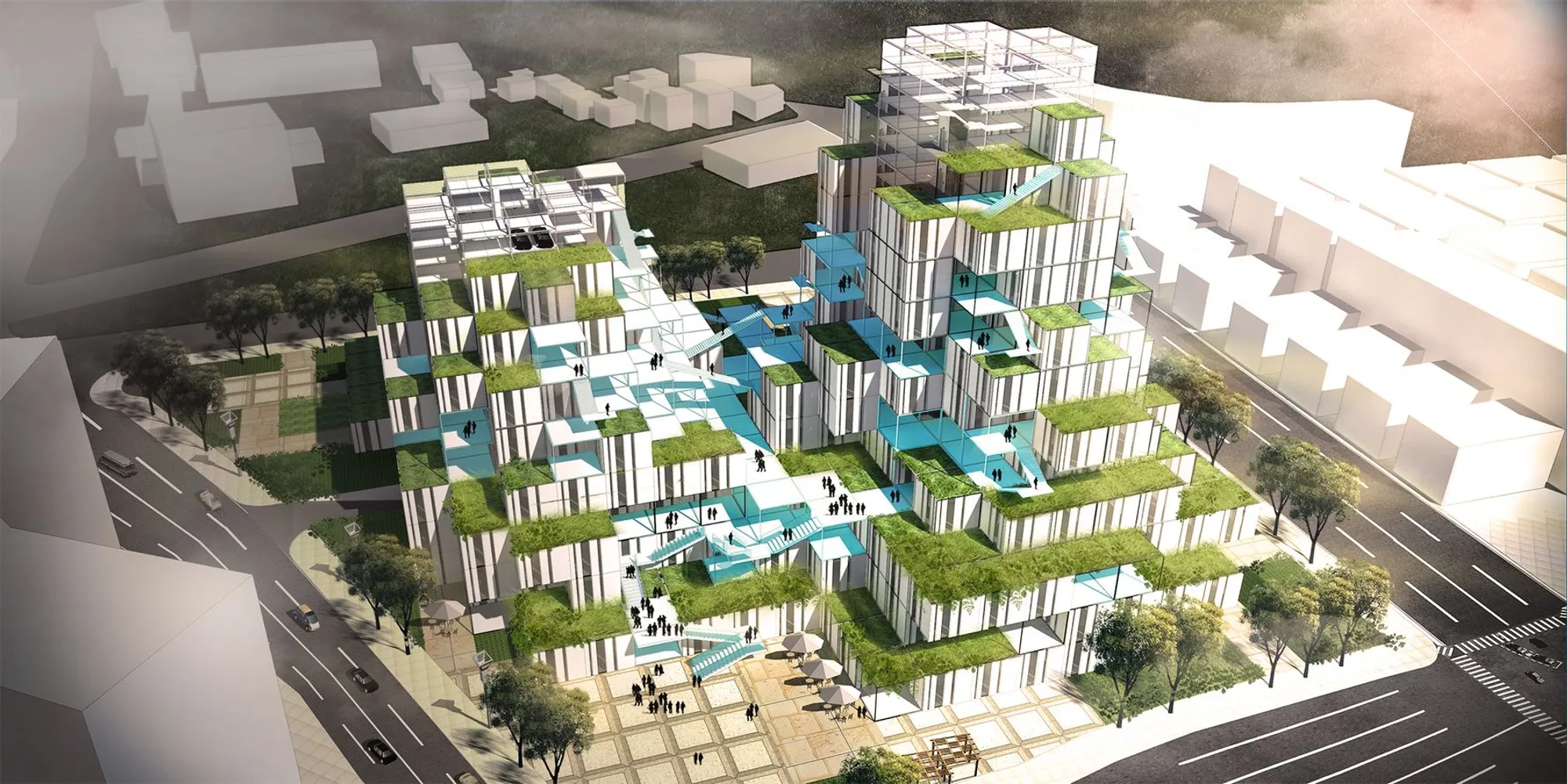
The sectional model reveals the project's essential architectural language: white rectilinear volumes framing discrete programmatic zones, threaded together by turquoise glass staircases and lifting platforms. Rooftop plantings cap each module, giving the structure a living crown that signals its function from the street. The exploded axonometric breaks the system apart to show how vertical circulation connects ashes storage at lower levels to leisure spaces, greenhouse planting zones, and meditation areas above. Each module is not a fixed room but a transformable unit that can be reconfigured for cultural rituals, plant growth stages, or public gathering.
The brilliance of the modular box as a unit lies in its philosophical ambiguity. It is simultaneously a container for death and a vessel for growth. As ashes dissolve and nourish vegetation within the germination spaces, the box itself undergoes a quiet transformation from memorial to garden. The scalability of the system means the structure can respond incrementally to shifting burial preferences and increasing public usage over decades, growing organically alongside the city it serves.
Bridges Between the Living and the Dead

The interior courtyard views show something unexpected for a cemetery: transparency, connection, and movement. Turquoise glass bridges and platforms intersect at multiple levels, linking white volumes across open voids. Visitors do not walk down silent corridors to face a wall of plaques. Instead, they navigate a three-dimensional landscape of interconnected spaces on folding stairs and lifting platforms, encountering meditation zones, VR death experience rooms, and solemn remembrance areas as part of a continuous spatial journey. The architecture deliberately blurs the line between sacred and public, making the act of visiting the dead inseparable from the act of engaging with the city.
Sectional Logic: Planting Zones, Public Programs, and Staged Growth

The axonometric diagrams map the layering strategy in detail. Planted spaces and public zones are interleaved vertically, with human figures providing scale and suggesting the casual, everyday nature of the interactions Yron envisions. A roof garden and germination space foster plant growth directly from nutrient-rich ashes, completing a natural life cycle within the building section itself. The proposal outlines a phased timeline: modular foundation and pilot units around 2020, increasing public usage and shifting burial preferences through 2025 to 2050, and ultimately a cemetery fully integrated into the rhythms of daily city life.
What the diagrams communicate most effectively is that this is not a single building but a system. The modular grid can extend, contract, or be replicated on other reclaimed sites across Shanghai. Strategic siting on what was previously just a parking lot transforms dead urban land into productive, meaningful space, a move that addresses both the memorial and the infrastructural needs of the city simultaneously.
Why This Project Matters
Most cemetery proposals treat efficiency and reverence as opposing forces. Box Varies refuses that compromise. By making the decomposition of ashes into the literal engine of a greenhouse ecosystem, Yron collapses the boundary between memorial and living infrastructure. The dead do not simply rest here; they participate in an ongoing biological process that produces gardens, clean air, and public space. It is a circular logic applied to the most linear of human experiences.
The project also raises a provocative question about what cities owe their dead in an age of extreme density. If land cannot be spared for sprawling cemeteries, then vertical, modular, and multiprogrammatic solutions are not just desirable but necessary. Yron's work suggests that this necessity, far from diminishing the dignity of memorial, can actually enrich it, turning places of remembrance into places of growth, encounter, and transformation.
View the Full Project
About the Designers
Designer: Ranjuel Yron
Enter a Design Competition on uni.xyz
uni.xyz runs architecture and design competitions year-round that reward proposals with spatial conviction and real site intelligence.
Project credits: Box Varies" by Ranjuel Yron.



Popular Articles
Popular articles from the community


The Ocean Hive: Sustainable Architecture for a Self-Sufficient Civilization at Sea
The Ocean Hive imagines sustainable architecture at sea, where modular habitats, algae, wave power and ocean waste sustain a growing colony.

The Earth Pod: 3D Printed Homes for Resilient Refugee Communities
The Earth Pod reimagines refugee housing through 3D printed homes made from clay, combining resilience, self-sufficiency, and rapid shelter.

AL-JANNAH: Sustainable Architecture and Permaculture for Afghan Widows
AL-JANNAH uses sustainable architecture and permaculture to create resilient oasis of housing, learning, work and renewal for Afghan widows.

Riyadh For All: Intergenerational Urban Design for Active Aging in Rabat
Riyadh For All reimagines urban design in Rabat with intergenerational co-living, adaptive courtyards, and Moroccan cultural exchange today.

Similar Reads
You might also enjoy these articles

Day and Night Park: A Time-Based Urban Newsstand in Beijing
A temporary urban newsstand in Beijing blending travel, light, and reading through poetic colors, compact form, and community-focused design.

Modernist Patio Renovation in El Masnou, Barcelona by Oliver Segura Arquitectura + Cebrià Arquitectura
Modernist patio renovation blending tradition and innovation with a movable pool, leveled floors, and Catalan materials in El Masnou.

Alto Residencial Coop: Cooperative Housing Development in Santiago de Compostela by Carbajo Barrios Arquitectos
A linear cooperative housing complex blending white volumes and perforated metal façades, enhancing community living, natural light, privacy, and urban integration.

Vil Genis School by BPA ARCHITECTURE – Massy, France
Vil Genis School in Massy, France, features sustainable design, south-facing classrooms, community integration, accessible spaces, and modern educational architecture.

Explore Vertical Cemetery Competitions
Discover active competitions in this discipline


Challenge to design locus for the upliftment of human rights


Design challenge to reuse E-waste
Comments (0)
Please login or sign up to add comments
No comments yet. Be the first to comment!