
Designing evolutionary workspaces
Breaking Down Work Of 2050


Storyline
The 21st century has seen the most rapid shifts in how we live - what we do, driven by technologies and will continue to steer at a similar pace. From a time when humans were doing most of the work by hand, innovation led to the formation of tools, making our work efficient. The same tools were used to build machines that made work even more effortless for us. Robots are now the next big thing happening where machines could do almost everything; even build themselves. Beyond this, a steady transition has been seen from manual to digital where how we work has changed with these shifts. The humankind’s push to develop more and more in this race to stay ahead, the ways we work has transformed tremendously as well.
A world more connected via digital merging with physical – is now the only norm that is constant.
The challenge particular to this generation will be to manage the transition. But individuals who need to retrain for new careers won’t be the young, but middle-aged professionals.
While machines evolve at a tremendous speed, it will be humans who will have to keep up by bringing more value to survive. With growing automation, this race to survival will get only tougher. Humans today have to work more hours with the changing trends of the world - this is a precursor yet significant indicator of this phenomenon today.
Eventually, this takes a toll on the human body to which makes things even worse.
Brief
As the future of work and the role of humans in it look very uncertain, a designer’s part becomes significant in finding new spaces that enable humans to work better.
‘Breaking Work’ is an annual challenge focussed on finding the finest workspace concepts of the future. The design theme for this year’s challenge was to find how technology and humans can work together in singularity in the times to come.
Design Questions:
In a future when most mundane works can be automated, how humans can view this as an opportunity to do more?
How can technology, instead of fighting against humans for livelihood, can be seen as an enabler to make better use of their times?
How will humans complement each other’s skill set in a time when collaboration is the only way to thrive?
How workspaces can be ready for faster company setups and even faster hiring of people?
In times when corporations want to make their employees work more, how can health and happiness follow in terms of design, with this growing component of work?
Design challenge:
The design challenge was to visualize work in 2050 and create a model workspace design that aimed at enabling working more predicting 2050.
The jury for the competition consisted of esteemed designers, professionals and academicians from around the world. The Lead Jurors for the competitions were as follows:
Zetao Chen, Co-Founder, Creative Director, FCHA, China
Raanan Stern, Founder, RUST architects, Israel
"Some of the Best of competition projects are:"
Winning Project: Synchronicity
By: Rogar Chanin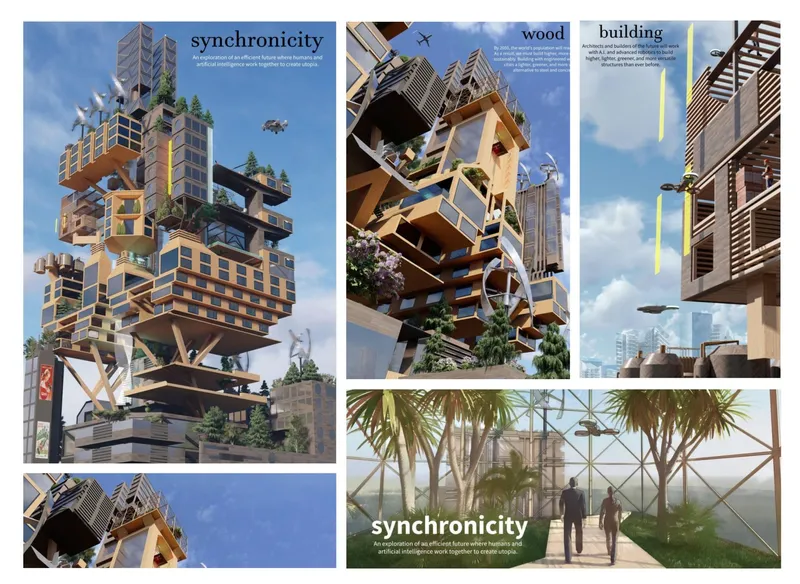
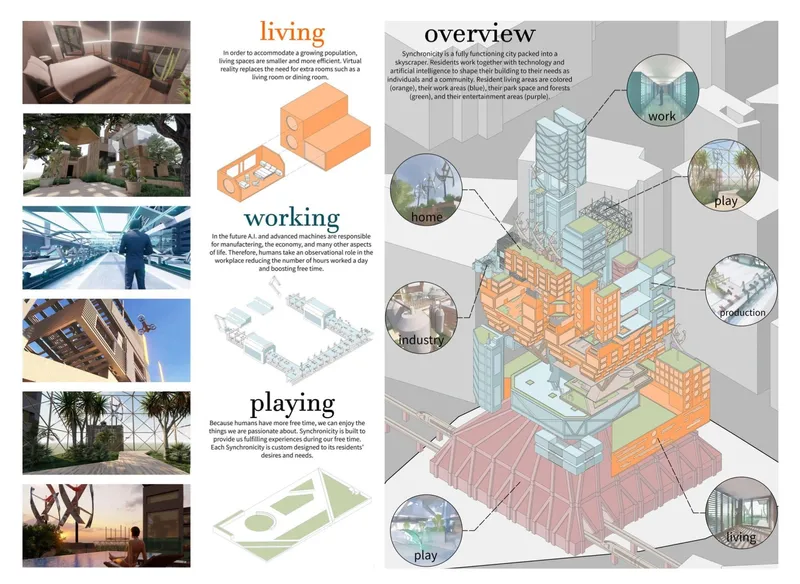
Description: An exploration of an efficient future where humans and artificial intelligence work together to create utopia. Synchronicity is an exploration of an efficient future where humans and artificial intelligence work together to create utopia. The resulting prototype design depicts what a building of the future may look like when humans and artificial intelligence work together to create a product that is sustainable, healthy, and adaptable.
-----------------
Runner - Up: Straggler
By:Sena Tokmak, Melisa Tunca & Büşra Bal
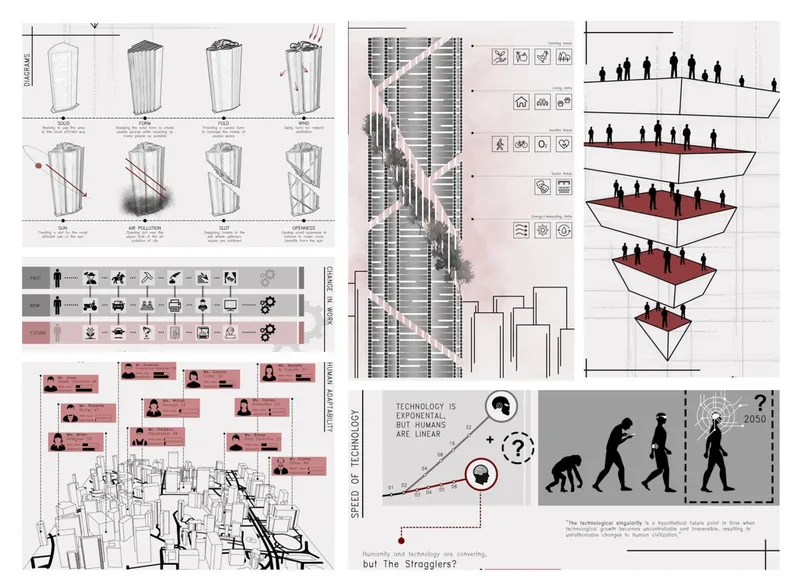
Description: In the future, there will be stragglers due to the rapid development of technology. The main idea of this project is to create a second chance for the society that the system is trying to remove. This design serves to stragglers to hold on to time by continuing to live their current consciousness. In the future, there will be stragglers due to the rapid development of technology. The main idea of this project is to create a second chance for the society that the system is trying to remove. This design serves to stragglers to hold on to time by continuing to live their current consciousness.
-------------------------
Organizer Choice : Dynacrowd Laboratories
By: Jordan Micham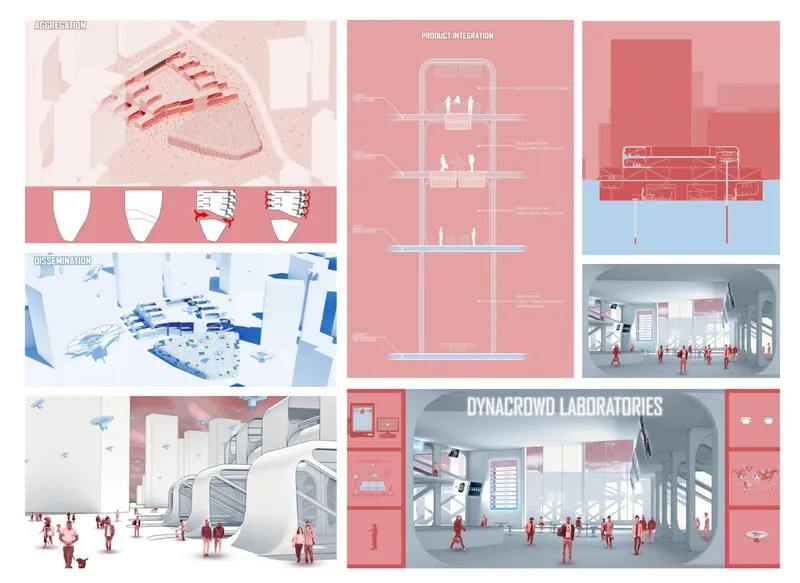
Description: This visualization for the integration of human interaction with artificial intelligence creates a blend between a traditional shopping center and manufacturing plant-- but with a twist. The facility implements a dynamic crowd-sourcing process in which humans test a variety of prototypes while AI uses their reactions to produce more attractive products. My concept is a facility in which products go through innovation, development, and manufacturing all in the same location. AI generates a product prototype where it is then placed into a showroom where it is interacted with by humans. AI then observes all the ways in which humans react to their products. This includes heart rate, ocular stimulation, engagement, mood, and vocal feedback.
-----------------
Discover the full results here: https://uni.xyz/competitions/breaking-work-singularity/entries
Discover the design brief here: https://uni.xyz/competitions/breaking-work-singularity/info/about
Follow us on social media: Facebook | Instagram | LinkedIn | Twitter | Youtube
Discover other design competitions to participate here: https://uni.xyz/competitions


Popular Articles
Popular articles from the community


Architekt Andreas Gruber Scatters 23 Dark Timber Chalets Across a South Tyrolean Forest Edge
In Molini di Tures, Amonti Chalets breaks a resort into a hamlet of gabled timber houses, with parking, storage and services pushed into the slope.

longwave studio Reorganizes a 112 m² Tainan Apartment Around the Daily Routines of a Family and Two Cats
In Tainan, Taiwan, birch plywood, rust-red furniture and a freestanding plaster wall link arrival, storage, work and family life in one apartment.

Cube Design Draws an Ecological Corridor Between Two Shenzhen Hills with the Nankai Building
Beside Shenzhen's container docks, the Nankai Building pairs stacked balconies with a climbing green screen to connect two hillsides across its height.

Jaramillo Van Sluys Arquitectura and Urbanismo Turn a Demolished Registry Lot in Quito into an Orchard Plaza
In Quito's Centro Histórico, a 2,800 m² plaza exposes the San Agustín convent wall and redraws its lost Augustinian orchard in volcanic stone.

Similar Reads
You might also enjoy these articles


Aquadapt: An Underwater Habitat That Rewrites Its Rooms by the Hour
Curved modules ring the seabed while one shell shifts from breakfast room to cinema, farm and football pitch as residents' needs change.

Play: Fragments of Their World: Remembered Architecture Rebuilt as a Modular Playground for Refugee Camps
Tom Gardner abstracts domes, arches and towers from the homelands of displaced families into a kit of child-scaled play parts for camp settlements.
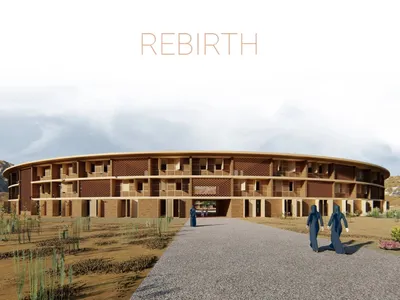
REBIRTH: A Circular Settlement Where Afghan Widows and Their Children Rebuild Life Together
A shortlisted Resile entry turns the circle into a protective ring of timber and brick, gathering homes, classrooms and gardens around a shared landscape.
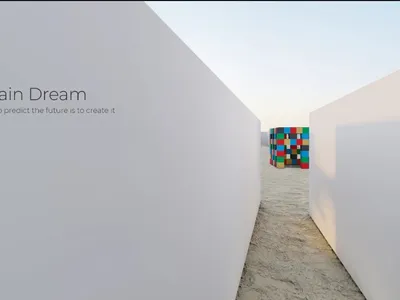
The Main Dream: A Recycled Plastic Kit That Lets Refugee Children Build Their Own Playground
Thirty-centimetre interlocking cubes that connect on three axes turn play into construction, letting children author the spaces they occupy.
Explore Futuristic Workspaces Competitions
Discover active competitions in this discipline

Challenge to imagine architecture inspired by fiction

Design challenge to equip cities with modern furniture

Challenge to reimagine the Iron Throne

Photograph architecture without architects
Comments (0)
Please login or sign up to add comments
No comments yet. Be the first to comment!