
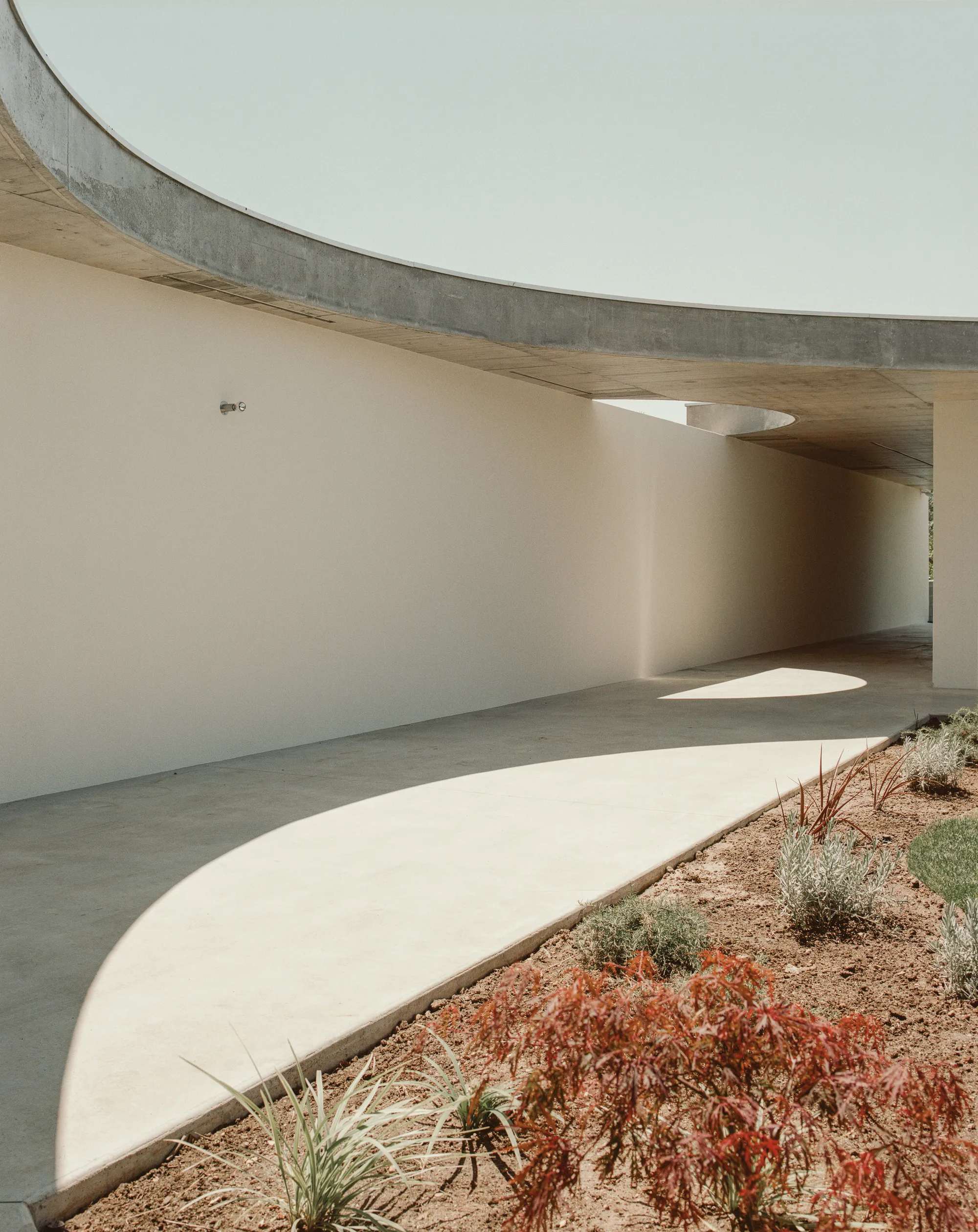
Bruno Dias Arquitectura Wraps a Portuguese Village Home Around an Oval Courtyard of Light
In the historic center of Ansião, a 765 square meter single-story house hides behind village walls to orbit a lush central patio.


The word âmago translates from Portuguese as marrow, core, focal point. It is an unusually literal name for a house that organizes every room, every sightline, and every breath of air around a single oval courtyard punched through its reinforced concrete roof. Designed by Bruno Dias Arquitectura and completed in 2022, Âmago House sits in the historic center of Ansião, a small town in the Leiria district of central Portugal. The site previously held two ruined dwellings of no particular architectural interest, and the replacement is anything but modest: 765 square meters of living space spread across a single floor, shielded from the street by walls and gates that let it pass as another quiet neighbor.
What makes the project genuinely interesting is not its size but its organizational conviction. The plan is orthogonal, almost mundane in its grid logic, yet the roof above it is sculptural and organic, with curving concrete slabs that carve circular openings for light and rain. The tension between those two geometries, the rational plan and the biomorphic ceiling, produces spaces that shift from corridor to cave to garden clearing in the span of a few steps. It is a house that reads one way from above and entirely another from within.
The Core: An Oval Garden as Organizing Principle
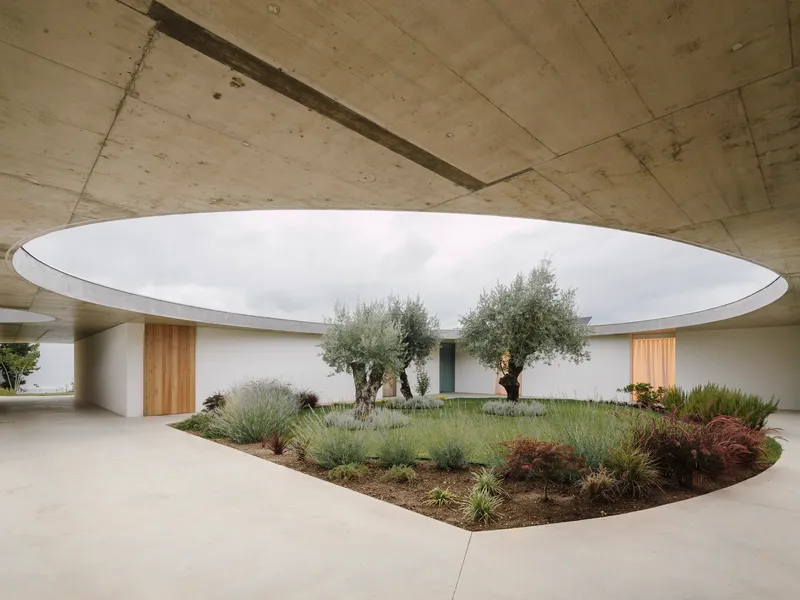


The central courtyard is the event from which everything else follows. An oval opening in the concrete roof admits daylight, rainwater, and sky into a planted garden of olive trees, ornamental grasses, and ground cover. This is not a decorative atrium tucked behind glass; it is an exterior room open to the weather, surrounded by the house's circulation and living spaces. Bedrooms, bathrooms, and social areas all orient toward it or derive their natural light from it.
The planting strategy reinforces the Mediterranean dryness of the site. Feathery grasses and mulched beds appear both inside the courtyard and in secondary patios attached to bedrooms and bathrooms, so the boundary between interior garden and exterior landscape blurs. Stone pavers zigzag through gravel, and every planted corner feels considered rather than merely filled.
Concrete as Canopy
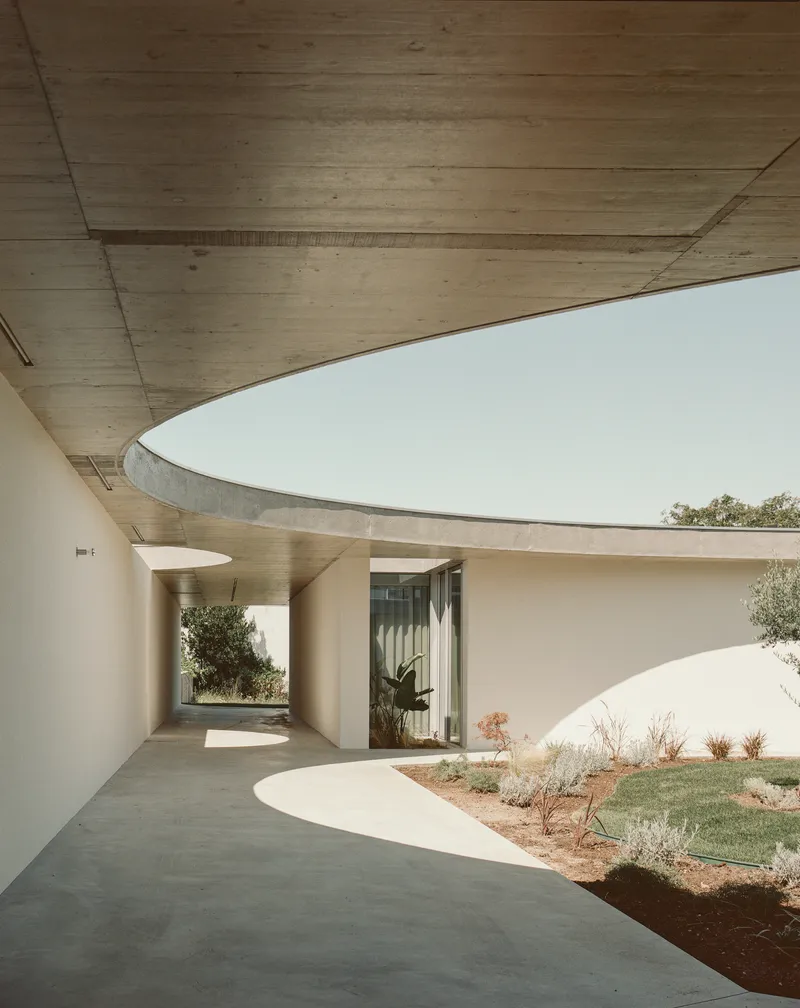
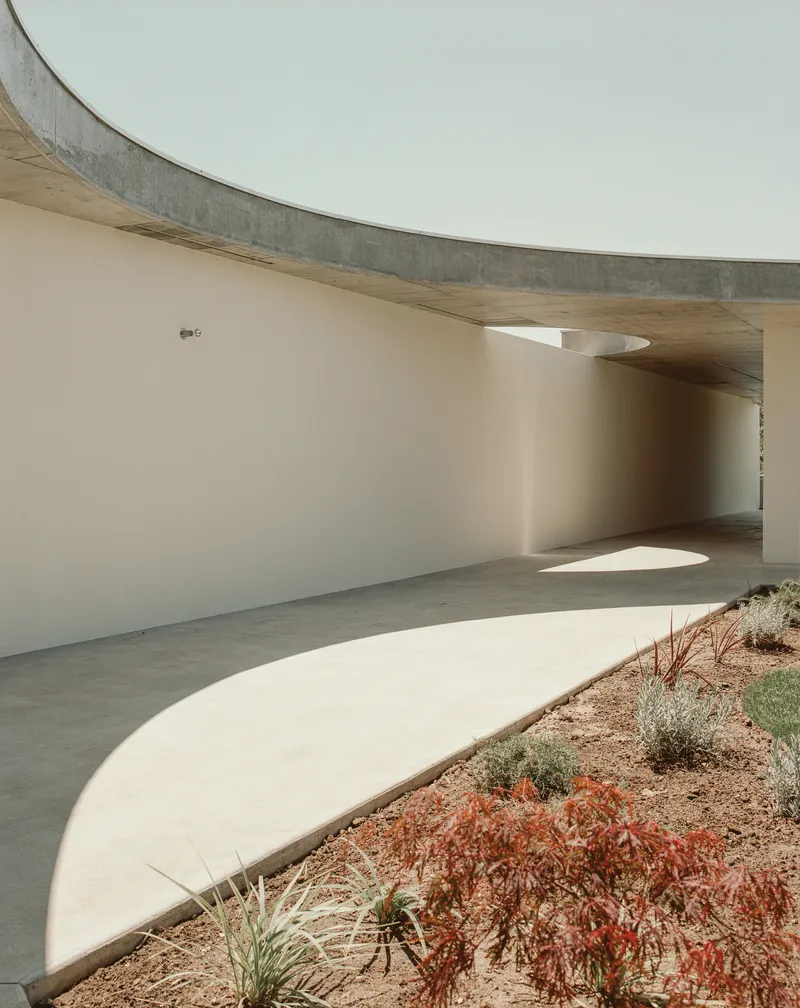
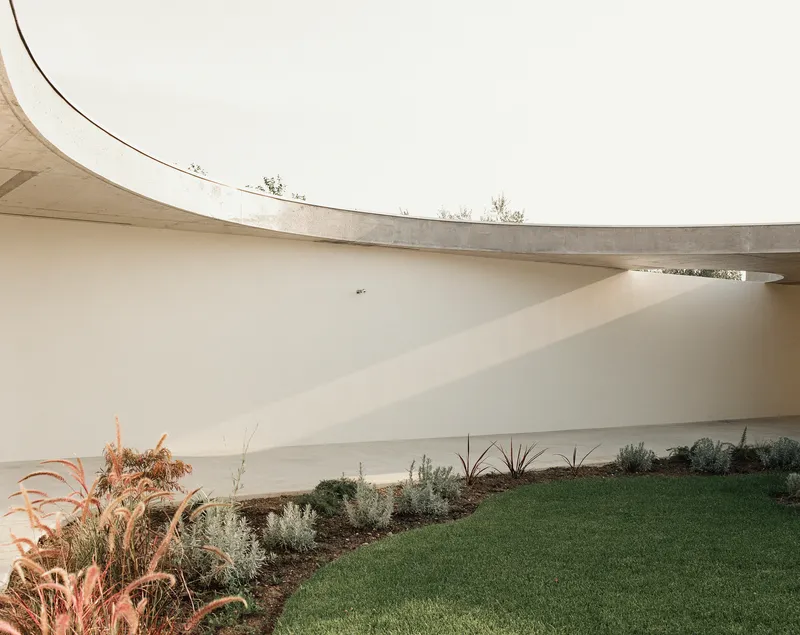
The board-formed concrete roof is the project's most assertive architectural gesture. It curves, thickens, and opens in ways that make it read less as a structural slab and more as a landscape element draped over the house. Walking beneath it feels like passing under a canopy of stone: the formwork texture is rough, the edges are rounded, and pools of light drop through circular apertures onto the floors and walls below.
Bruno Dias uses this heavy material to produce surprisingly delicate effects. Where the concrete meets white rendered walls, the shadow line is sharp and clean. Where it extends over planted beds and walkways, the overhang creates covered passages that are neither fully inside nor fully outside. The result is a series of threshold conditions that encourage slow movement through the house, a quality rare in single-story plans that can otherwise feel flat and undifferentiated.
Timber Warmth Against Raw Structure

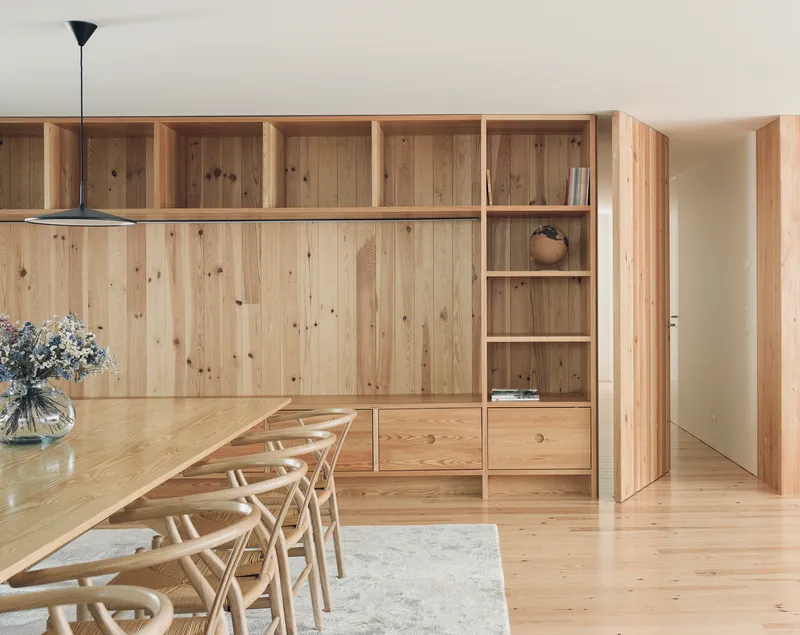
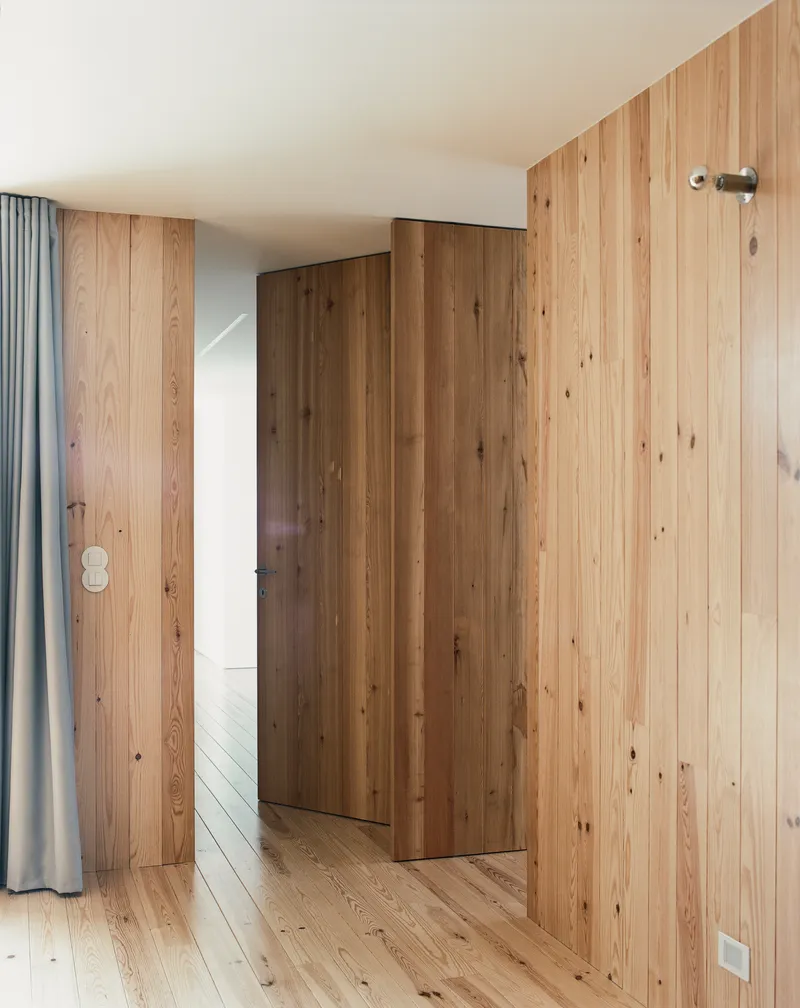
Inside, golden timber paneling does the heavy lifting of making the concrete and white plaster feel habitable. Vertical timber walls conceal doors to private quarters, sliding panels reveal or close off rooms, and custom carpentry by MCJADuarte integrates storage, display shelving, and spatial dividers into a single language of oak. The dining area, with its long table set against a timber storage wall, is a good example: the wood grain carries warmth across what would otherwise be a stark volume.
The material palette stays deliberately restrained. Pale oak floors by Paumarc run through most rooms, concrete reappears in bathroom flooring, and veined stone surfaces anchor wet areas. A grey fabric curtain beside a steel column in one hallway is about as decorative as things get. The discipline keeps attention on proportions and light rather than finish.
Living Between Inside and Out
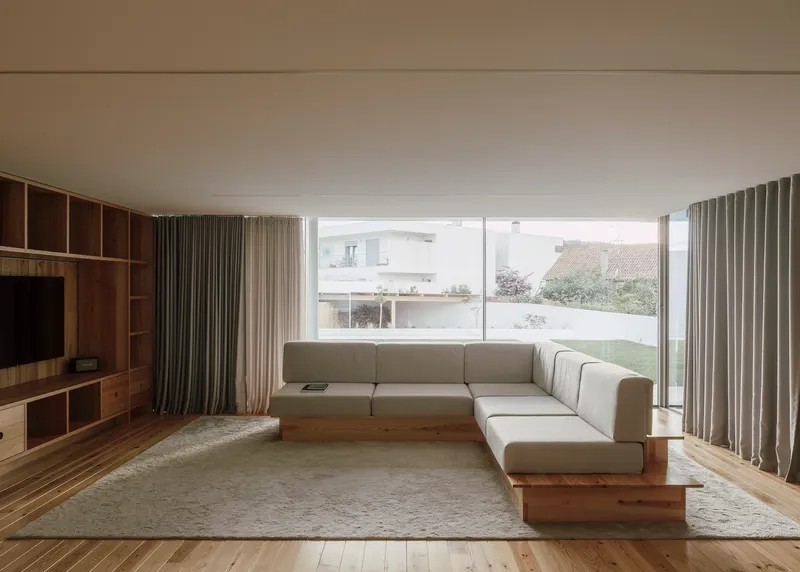


The social areas, living room, kitchen, and a barbecue zone, occupy the western portion of the plan, where they capture afternoon and early evening light through floor-to-ceiling glazing. The living room looks over a lawn toward the rooftops of neighboring houses, a framing device that quietly acknowledges the village context without mimicking it. A timber chair sits on a covered terrace beside a planted bed, and the curved concrete roof edge overhead provides shade without enclosure.
The bathroom with its dual stone trough basins, timber cabinetry, and glass-enclosed shower opening directly onto a private courtyard is perhaps the clearest demonstration of the house's ambition: to make every utilitarian room feel connected to the garden. Small patios serve bedrooms and bathrooms alike, providing natural ventilation and daylight in rooms that a conventional plan would have pushed to windowless interior zones.
Exterior: Pool, Carport, and the Village Edge

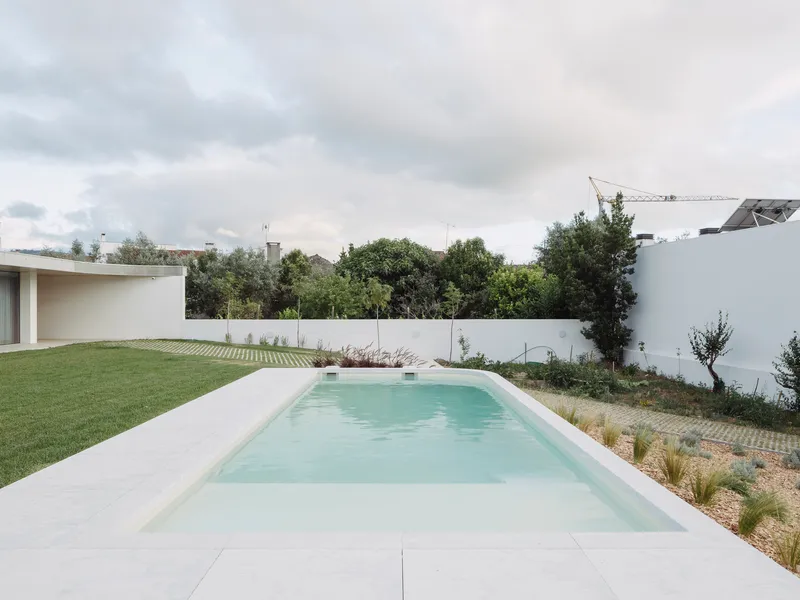

A rooftop lawn and pool terrace cap the western end, where a curved concrete volume wraps glass doors and the swimming pool stretches between white walls and planted beds. The pool itself is a simple rectangle, pale-bottomed, set into white paving and flanked by grass. It reads as an extension of the courtyard strategy: a controlled outdoor room walled off from the village.
At the eastern entry, a covered carport with timber posts, exposed beams, and a corrugated metal ceiling adds a more rustic note. Stacked firewood and sliding wood panel doors signal domesticity and daily use, and the facade detail nearby, vertical ribbed metal cladding meeting board-formed concrete with a bronze plaque at the joint, shows the care taken at every material transition. The street-facing elevation, by contrast, is intentionally reticent, a wall and gate that let the house disappear into the historic fabric of Ansião.
Corridors as Spatial Events


Single-story houses often suffer from hallway syndrome: long runs of white wall punctuated by doors. Âmago House treats its corridors as design opportunities. Recessed ceiling channels of light run along white-walled passages, creating a glowing datum line overhead. Timber sliding doors and oak flooring warm the transitions, and the occasional steel column or curtain adds punctuation without clutter.
Outside, concrete paving steps ascend through a mulched hillside planted with low shrubs and young trees, connecting the house to its sloped site. The landscaping by the entry is as carefully composed as any interior room, reinforcing the idea that the building's architecture does not stop at the threshold.
Plans and Drawings


The floor plan confirms the organizational logic visible in the photographs. Rooms arrange themselves around the oval courtyard in an orthogonal grid, with the garage and vehicle entry to the east and the garden and pool to the west. The axonometric drawing reveals how the roof plane, with its oval opening, operates as a unifying element that ties together rooms of varying size and function. Four bedrooms distribute across the western and eastern edges: two bedrooms and a suite face the western garden, while a third bedroom faces the central patio. The plan is generous but not sprawling, and the courtyard ensures that no room sits more than a few meters from open air.
Why This Project Matters
Âmago House is a persuasive argument that the courtyard house, one of architecture's oldest spatial types, still has room for invention. By introducing organic roof geometry over a rational plan, Bruno Dias creates a domestic landscape that constantly shifts between shelter and exposure, solid and void. The concrete canopy, the oval garden, and the carefully placed timber interiors all serve the same idea: that the center of a house should be open sky, not closed ceiling.
The project also demonstrates how a large contemporary house can sit within a historic village without either dominating it or resorting to pastiche. The street facade is quiet; the architectural ambition is entirely inward-facing. In a moment when residential architecture often seems to prioritize external spectacle, Âmago House insists that the most important view is the one from your own courtyard, looking up.
Âmago House by Bruno Dias Arquitectura, Ansião, Portugal. 765 m². Completed 2022. Photography by Hugo Santos Silva.
About the Studio
Share Your Own Work on uni.xyz
If projects like this are the kind of work you want to make, uni.xyz is a place to publish your own, find collaborators, and enter design competitions.




Popular Articles
Popular articles from the community


Riyadh For All: Intergenerational Urban Design for Active Aging in Rabat
Riyadh For All reimagines urban design in Rabat with intergenerational co-living, adaptive courtyards, and Moroccan cultural exchange today.

Hill & Cross Opera: Sculptural Opera House Architecture Shaped by Tallinn’s Landscape and Identity
Hill & Cross Opera reimagines opera house architecture in Tallinn through its sculptural hill, civic plaza, glass wave and a luminous cross.

The Earth Pod: 3D Printed Homes for Resilient Refugee Communities
The Earth Pod reimagines refugee housing through 3D printed homes made from clay, combining resilience, self-sufficiency, and rapid shelter.

AL-JANNAH: Sustainable Architecture and Permaculture for Afghan Widows
AL-JANNAH uses sustainable architecture and permaculture to create resilient oasis of housing, learning, work and renewal for Afghan widows.


Similar Reads
You might also enjoy these articles

Bao Huynh Watercolor Atelier: A Serene Art Retreat in Hội An
Bao Huynh Watercolor Atelier in Hội An blends multifunctional art spaces, sustainable design, local materials, and family-friendly living in a serene environment.

Atelier Macri Concept Store Interior Design by CASE-REAL
Atelier Macri store features a "ko" counter, walnut wood details, cork displays, blending retail, gallery, and seamless customer experiences.

Manuel Vargas Izquierdo Stadium and High-Performance Sports Center: Architectural Excellence in Jalpa de Méndez
The Manuel Vargas Izquierdo Stadium blends sustainable design, inclusive sports facilities, and cultural-inspired architecture, revitalizing Jalpa de Méndez’s public spaces.

KAKR Buluh Awar Hall: Revitalizing Community and Ecology Through Bamboo Architecture
Community built bamboo hall revitalizes Buluh Awar village, empowering youth, restoring ecology, celebrating vernacular craftsmanship through sustainable architecture and culture.



Comments (0)
Please login or sign up to add comments
No comments yet. Be the first to comment!