
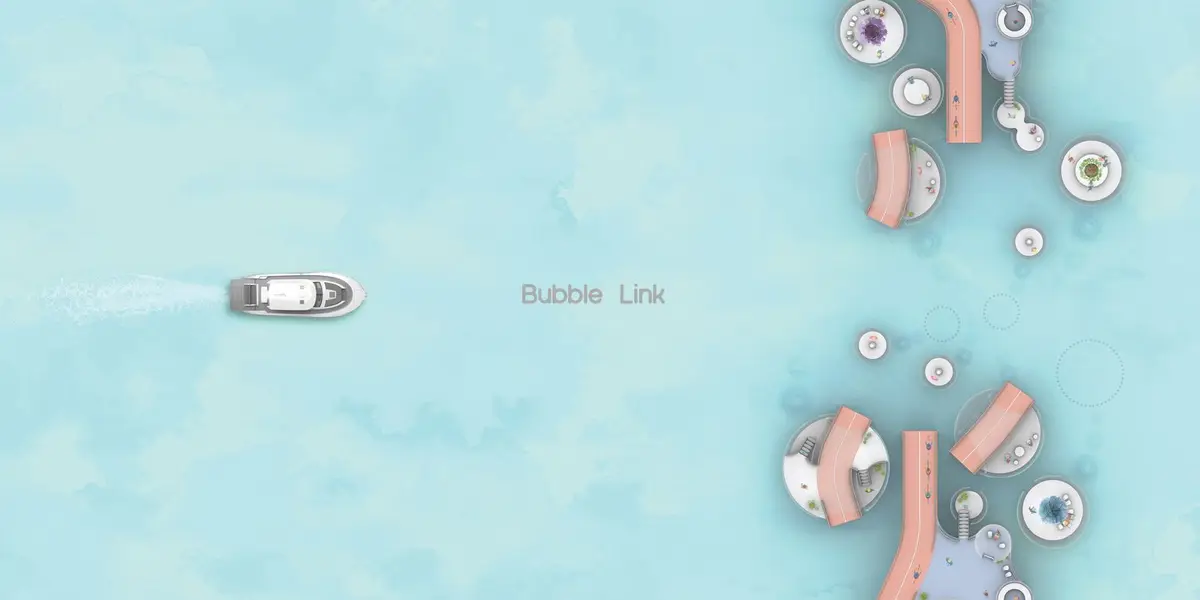
Bubble Link: Rethinking Copenhagen's Bridge as a Floating Public Living Room
A modular bridge of bubble-shaped pavilions replaces vertical opening mechanics with horizontal shifting to keep cyclists, pedestrians, and boats moving.


What if a bridge could grow? Not in some distant metaphorical sense, but literally: adding rooms, shifting modules, expanding its footprint as the city around it evolves. Bubble Link takes that premise seriously, proposing a pedestrian and cycling bridge in Copenhagen where bubble-shaped pavilions cluster along a central spine, each one a self-contained public room floating above the water. The structure refuses to behave like a mechanical object. It borrows instead from organic systems, forming, connecting, and adapting the way bubbles do.
Designed by Shiyu Hu and Taisuke Wakabayashi for the The City Link competition, Bubble Link is sited in Copenhagen, a city whose cycling culture and human-scaled urbanism make it an ideal testing ground for infrastructure that doubles as civic space. The project challenges three assumptions at once: that bridges need vertical opening mechanisms, that they should follow rectilinear geometry, and that they are ever truly finished.
A Spine of Bubbles Branching into the Harbor
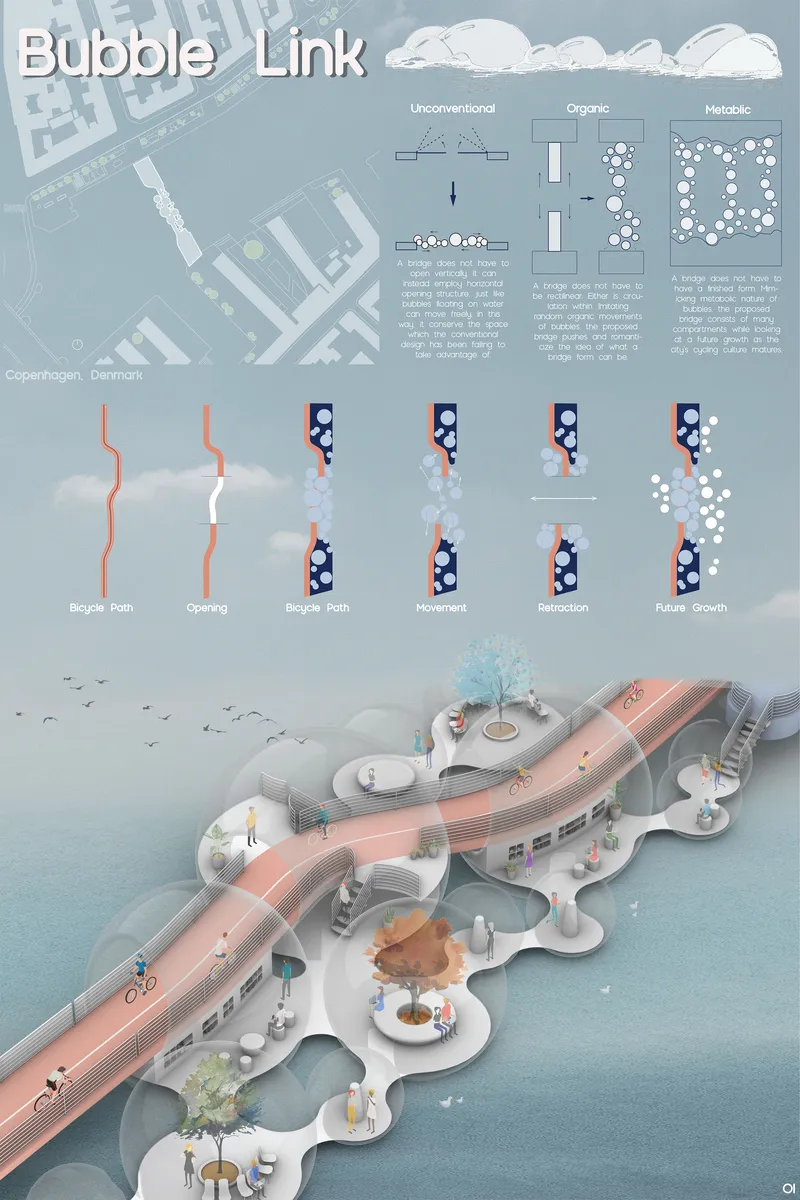
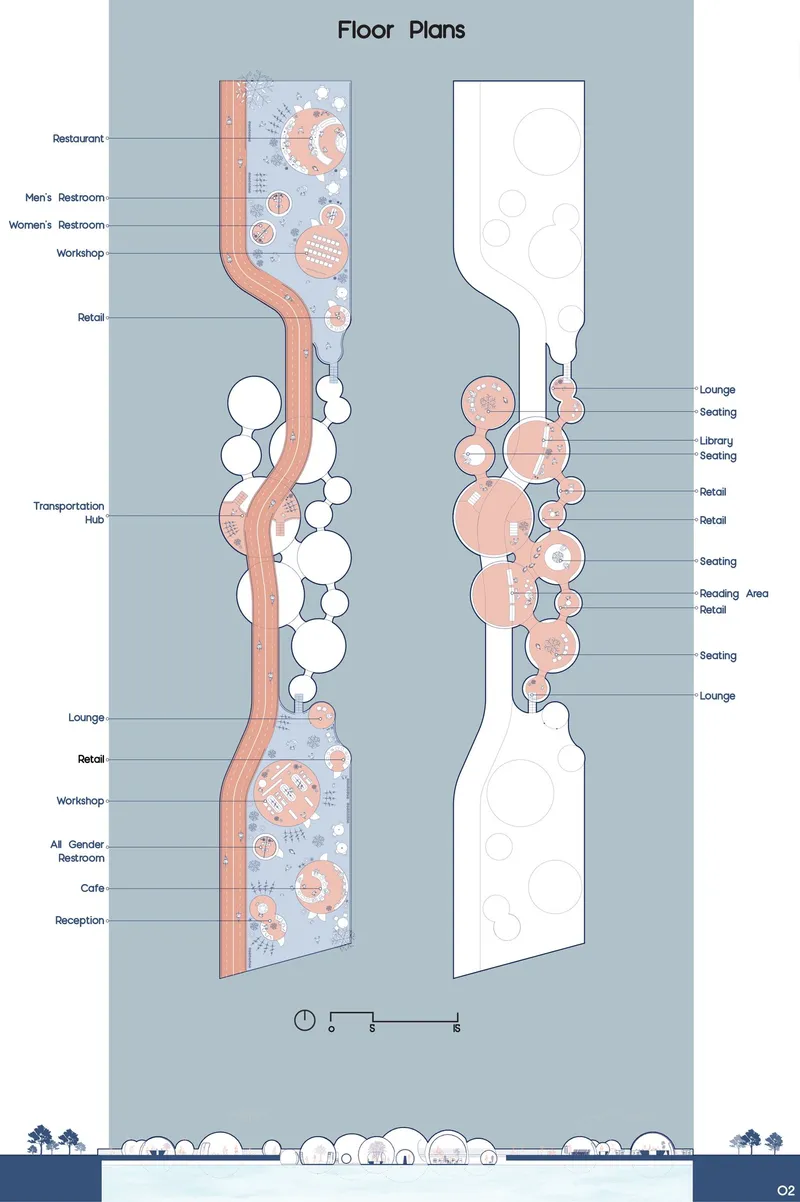
The axonometric view reveals the project's fundamental logic: a linear circulation spine from which bubble-shaped pavilions branch laterally into the surrounding water. Each bubble is a discrete volume, yet they are all linked to the central path, forming a continuous urban experience rather than an isolated crossing. The floor plan makes this legibility even sharper. Organic, circular program spaces are arrayed along the spine, their radii varying to accommodate different functions. There is no grid here, no modular repetition for its own sake. The geometry is closer to cellular biology than civil engineering.
What separates this from mere formal playfulness is the programmatic specificity. Each bubble houses a distinct public use: cafés, libraries, workshops, retail areas, rest zones, and lounges are distributed across the bridge so that the structure accumulates reasons for people to stay, not just pass through. The plan shows how the central bicycle route remains uninterrupted while pedestrians are drawn off-axis into these inhabitable pockets, a dual circulation strategy that lets speed and slowness coexist on the same structure.
Cycling Through Coral-Tinted Enclosures
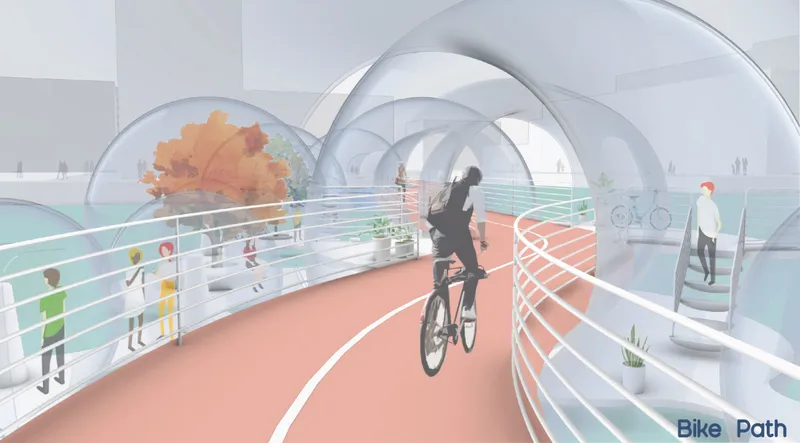
The interior perspective is where Bubble Link shifts from diagram to sensation. A coral-colored bike path threads through transparent arched enclosures, their surfaces catching mist and diffused light. Cyclists move through the space as if inside a series of connected greenhouses, sheltered but never sealed off from the water and sky. The color choice is deliberate and surprising: Copenhagen's muted palette of brick and slate gets a warm counterpoint that signals the bridge as something categorically different from its surroundings.
The arch profiles visible in this rendering reinforce the bubble metaphor structurally. Each enclosure reads as a swollen membrane, taut and translucent, rather than a rigid frame with cladding. For cyclists, the experience is a smooth, flowing trajectory. The path's continuity is never broken by doors, ramps, or level changes, reinforcing Copenhagen's commitment to cycling as a primary mode of transportation.
Stacked Worlds: Bikes Above, Gathering Below
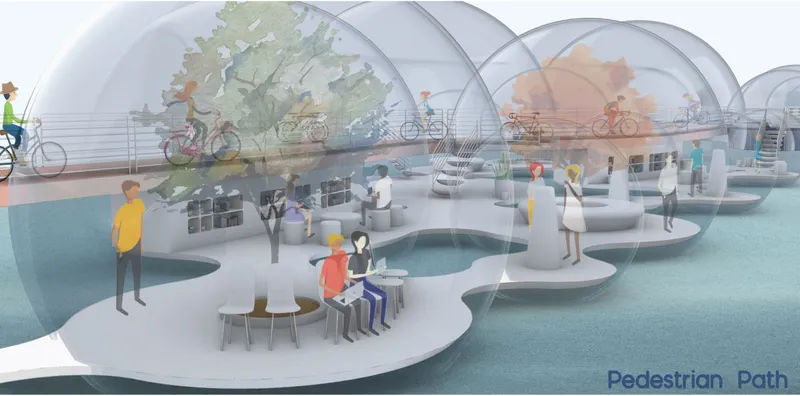
The cross-section peels the bridge open to show how two distinct worlds occupy the same bubble volume. On the upper level, cyclists pass through on the dedicated route. Below and alongside, pedestrians sit, read, or socialize in generous seating areas tucked within the curved enclosures. The section makes it clear that these are not token rest spots: they are fully realized interior spaces with enough depth and height to feel like rooms, not corridors.
This layering is key to Bubble Link's ambition. By stacking movement and occupation vertically, the designers avoid the common trap of infrastructure that privileges one mode at the expense of another. Cyclists get speed; pedestrians get atmosphere. Neither compromises the other, and both benefit from the proximity. You can sit in a lounge and watch bikes glide overhead, or pedal across the harbor while glimpsing people gathered in the bubble below.
Programmatic Diversity Along a Floating Framework
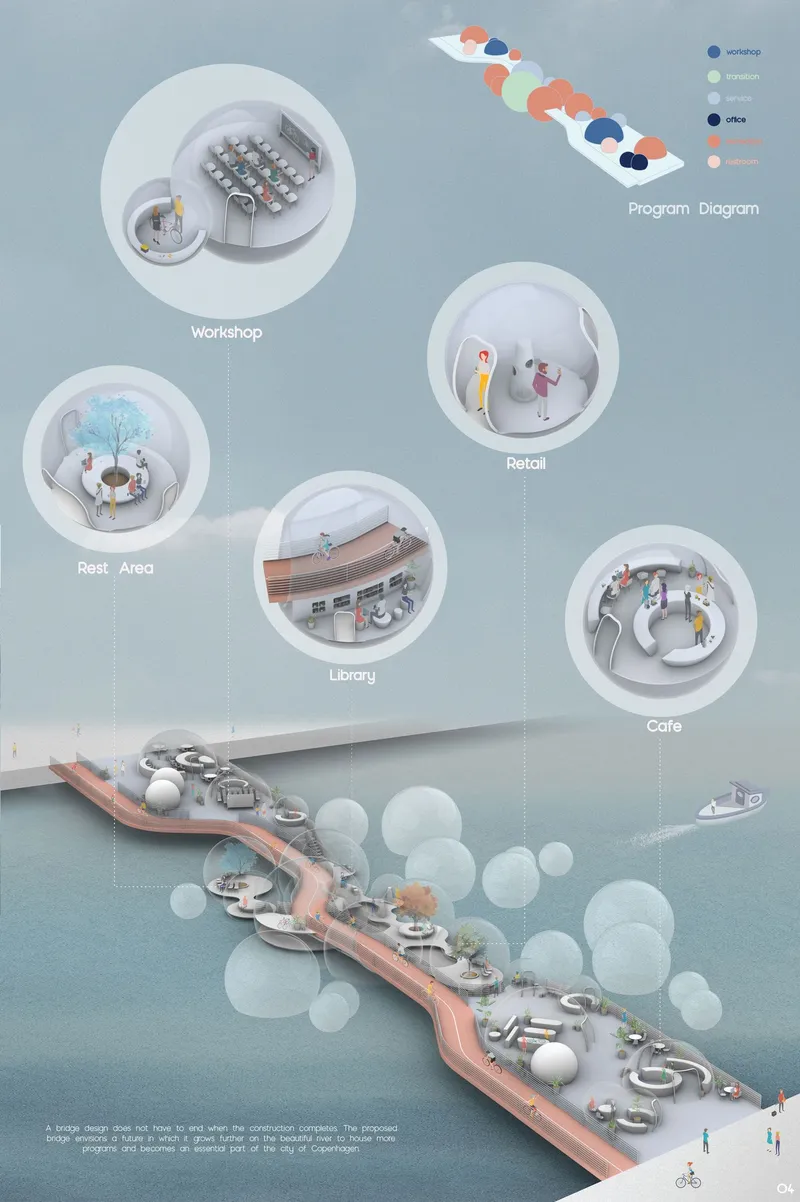
The program diagram lays out the full inventory of uses: workshop, retail, library, café, and more, each assigned to its own bubble module along the floating bridge structure. What matters here is not just the variety but the distribution. Functions are spaced so that repeated visits yield different encounters. A morning commute might pass the library bubble; an evening walk might end at the café. The bridge becomes woven into the rhythms of daily life rather than sitting apart from them.
The modular nature of these bubbles also points toward future growth. Because each pavilion is a self-contained unit connected to the spine, new bubbles could theoretically be added as the city's needs change. Bubble Link is designed without a final form. It is an expandable framework, and that open-endedness is perhaps its most provocative claim: that a bridge can be a living system, not a monument frozen at the moment of its completion.
Horizontal Opening: Letting Boats Pass Without Breaking the Experience
Most opening bridges solve the boat problem vertically: they lift, swing, or split upward, creating a spectacle but also a hard interruption. Bubble Link sidesteps this entirely with a horizontal opening strategy. When vessels approach, bubble modules shift laterally to create navigable passages through the structure. The bridge never disconnects from itself. Spatial continuity is maintained even during the opening sequence, which means pedestrians and cyclists experience a reconfiguration rather than a rupture.
It is a small move with large implications. By keeping the bridge plane intact, the designers preserve the sense that this is a continuous landscape, not a drawbridge waiting to snap shut. The visual effect of bubbles gliding apart to let a sailboat through is also, frankly, beautiful in its strangeness, a piece of infrastructure that performs like a living organism responding to its environment.
Why This Project Matters
Bubble Link matters because it refuses to treat infrastructure as neutral. Most bridge proposals optimize for one thing: getting people or vehicles from point A to point B with structural elegance. Hu and Wakabayashi ask what happens when you optimize for public life instead, when the bridge becomes a place people choose to inhabit rather than simply cross. The answer, in their telling, is a structure that houses libraries and workshops, shifts to accommodate marine traffic, and leaves room to grow with the city.
The project also offers a sharp conceptual reframe for Copenhagen specifically. A city that has already proven the viability of cycling as urban transport deserves infrastructure that celebrates the culture surrounding it, not just the mechanics. Bubble Link imagines cycling not as a commute to be endured but as a phenomenological experience to be enriched, threading riders through misty, translucent enclosures with views of the harbor and the hum of public life on every side. That ambition, to make the journey itself worth taking, is what elevates this from speculative exercise to genuine provocation.
View the Full Project
About the Designers
Designers: Shiyu Hu, Taisuke Wakabayashi
Enter a Design Competition on uni.xyz
uni.xyz runs architecture and design competitions year-round that reward proposals with spatial conviction and real site intelligence.
Project credits: Bubble Link by Shiyu Hu, Taisuke Wakabayashi The City Link (uni.xyz).


Popular Articles
Popular articles from the community


Aquadapt: An Underwater Habitat That Rewrites Its Rooms by the Hour
Curved modules ring the seabed while one shell shifts from breakfast room to cinema, farm and football pitch as residents' needs change.


graciastudio Turns a Viewless Tijuana Lot Inward Around a Courtyard of Concrete, Timber and Trees
In Tijuana, Jorge Gracia's GA2 House stacks a timber-clad private floor over exposed concrete and replaces a missing view with a planted interior patio.

Cube Design Draws an Ecological Corridor Between Two Shenzhen Hills with the Nankai Building
Beside Shenzhen's container docks, the Nankai Building pairs stacked balconies with a climbing green screen to connect two hillsides across its height.

The Amber Palace Opera: A Geological Fiction Surfaces on Tallinn's Baltic Waterfront
Pierre Brillard reimagines a Baltic legend as a public landscape, opera house, and waterfront promenade rooted in Tallinn's coastal identity.

Similar Reads
You might also enjoy these articles
Yenisei Monitoring Center: A Sun-and-Moon Sphere Anchors a Research Campus on Siberia's Great River
In Krasnoyarsk, shifting square blocks, a glazed central sphere and descending window rhythms turn river science into a public spectacle on the Yenisei.
Andretta Artist's Village: A Node-Based Masterplan That Lets the Hills Write the Plan
A cultural landscape strategy for Palampur's artist colony threads studios, residences and stages along a porous spine shaped by the Dhauladhar terrain.
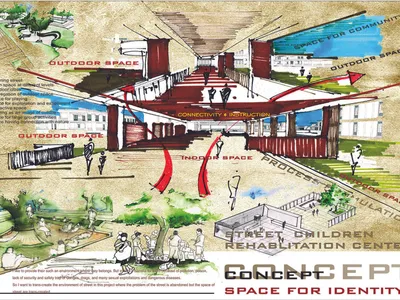
Street Children Rehabilitation Center: A Brick Campus That Eases Children From Street to Safety
A low-rise courtyard campus where learning streets, uthans and shaded verandahs stage a gradual passage from street into protective, family-scale life.
The NEON Culture: A Field of Pavilions Built for the 24-Hour City
Smaran Alva spreads galleries, stages, clubs and markets across a varied site, treating light, sound and ramped movement as the real building materials.

Explore Cycling Bridge Competitions
Discover active competitions in this discipline

Challenge to design locus for the upliftment of human rights

Design challenge to reuse E-waste
Comments (0)
Please login or sign up to add comments
No comments yet. Be the first to comment!