
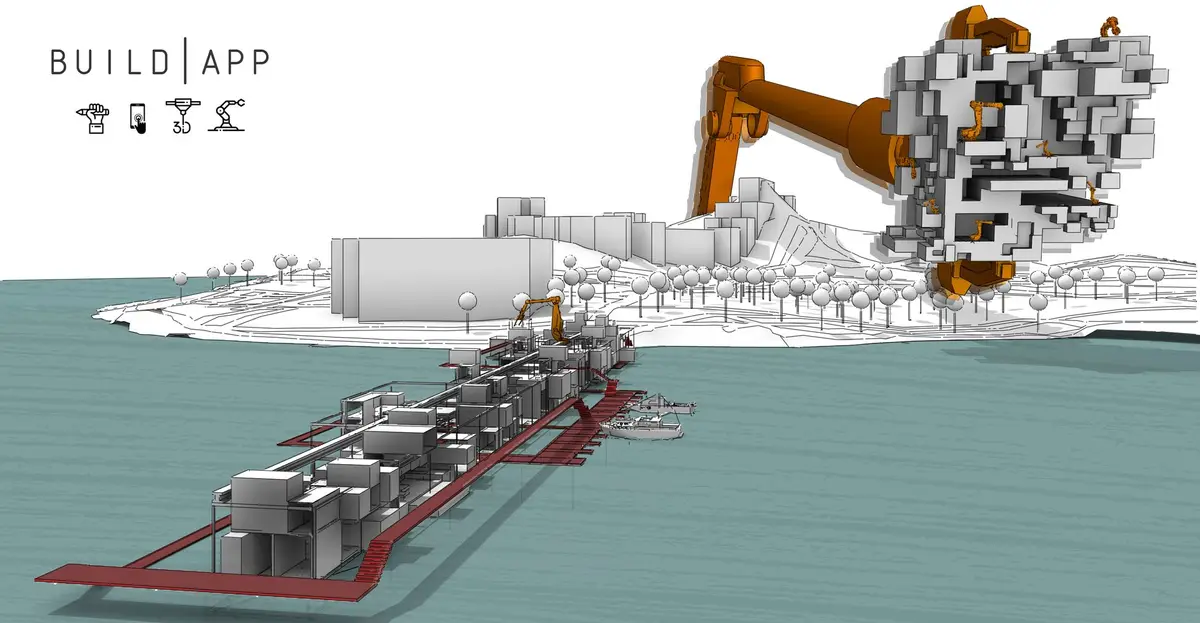
BUILD|APP: An Interactive Platform Where Robotic Arms Construct Architecture Over Water
A shortlisted Athenaeum entry imagines a waterfront application that lets users design, fabricate, and assemble modular spaces with robotic precision.


What if the act of designing a building and the act of constructing it collapsed into a single interactive experience? BUILD|APP proposes exactly that: a platform where users generate, modify, and convert architectural spaces through a digital interface, then watch robotic arms and 3D printing systems assemble those designs in real time on a floating waterfront infrastructure. The proposal treats architecture not as a finished product but as a continuous loop of creation, evaluation, and material reuse.
Designed by Atakan Gündüz and Selcan Şimşek, BUILD|APP was shortlisted in the Athenaeum competition. The project charts an evolution of space from 2020 to 2040, imagining how modular architectural volumes could be fabricated, transported, and assembled on a pier structure that extends over water. Its ambition sits at the intersection of education, sustainability, and robotic construction, asking users to participate directly in the design process rather than simply inhabit its results.
A Red Walkway Reaching Over the Waterline
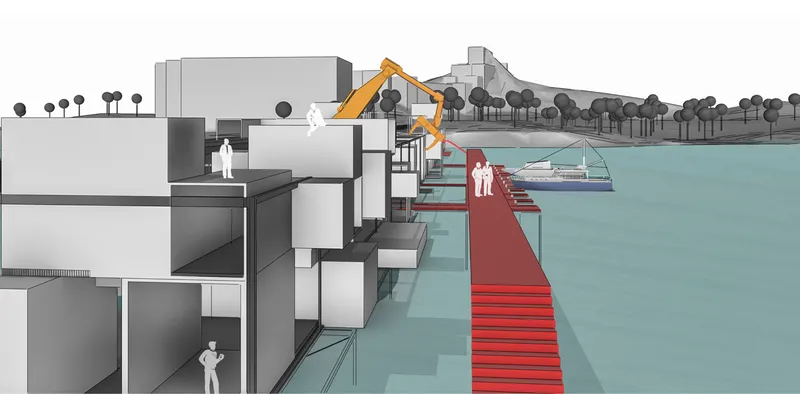
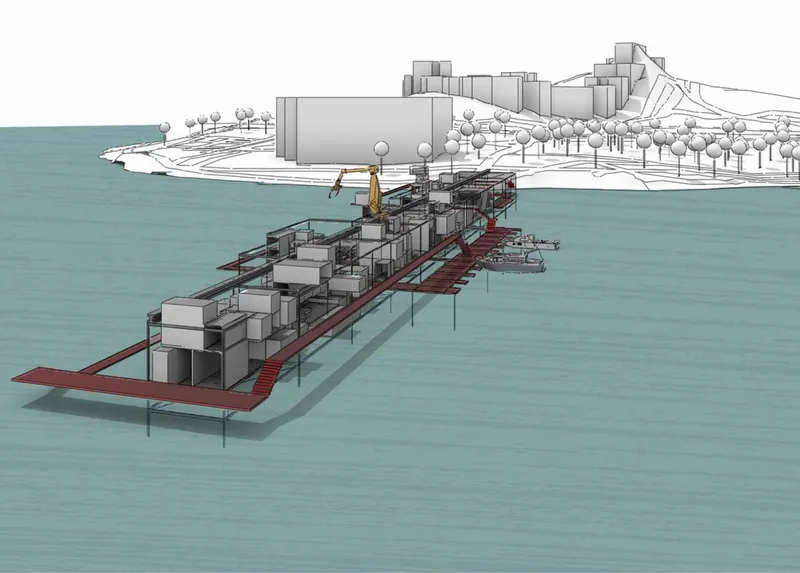
The project's sectional drawings establish a strong spatial relationship between terraced waterfront housing and a floating pier that pushes out over the water. A bold red walkway serves as the primary circulation spine, connecting land-based program to the aquatic construction zones. Cranes and modular volumes populate the pier, suggesting a site in perpetual assembly. The aerial perspective reveals the full extent of this infrastructure: a network of red paths, glazed enclosures, and open platforms hovering above the waterline, with the modular volumes arranged as an evolving constellation rather than a fixed plan.
Below the Surface: Submerged Structure and Glazed Pavilions
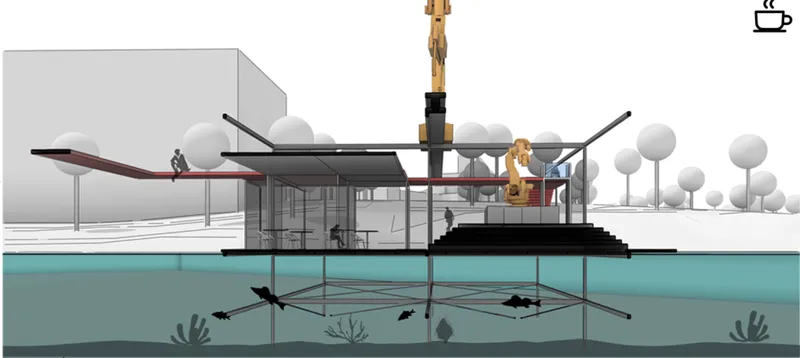
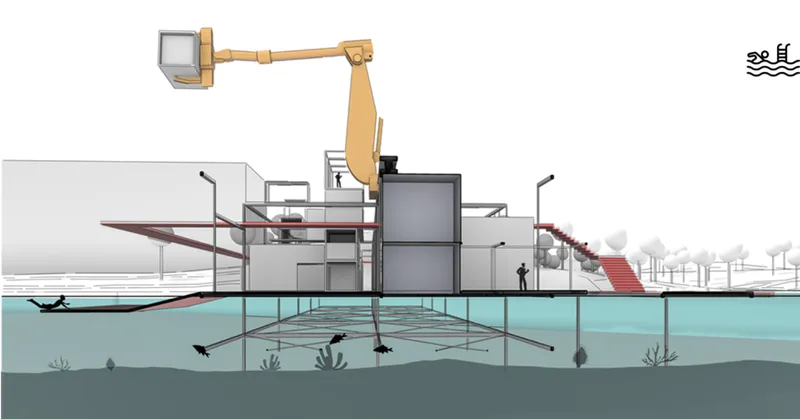
Some of the most compelling drawings in the set look beneath the waterline. A floating pavilion with glazed walls reveals aquatic life below, framing the underwater environment as part of the architectural experience rather than something hidden by the structure. The section cuts expose submerged structural supports and show how the red stairways descend toward the water's edge, pulling occupants into direct contact with the site's hydrology. A crane overhead reinforces the idea that construction is not a phase that precedes occupation; it is simultaneous with it.
Diagramming the Interface Between Land, Water, and Activity
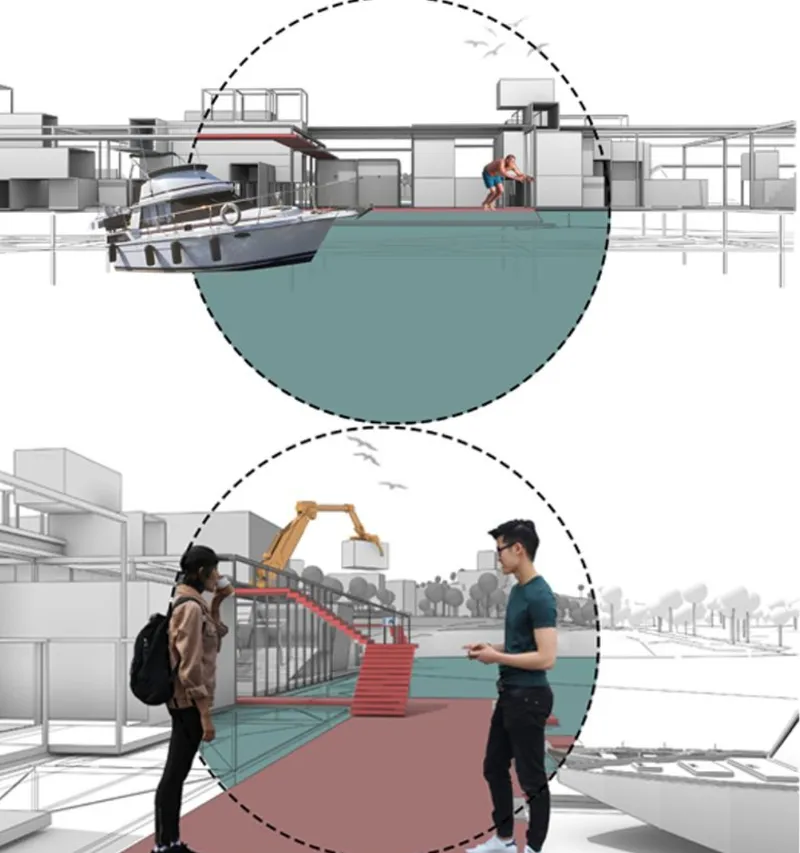
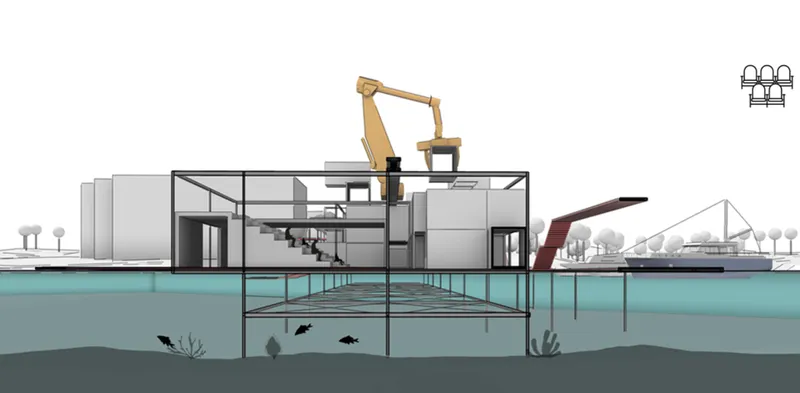
A program diagram maps the above and below waterline activities, illustrating boat docking zones, pedestrian interactions on the pier surface, and the structural logic of the floating platforms. This drawing does the critical work of showing how the digital application translates into spatial reality: different zones correspond to different actions within the BUILD|APP interface, from design generation to material recycling. The accompanying section of a floating platform with its glazed enclosure and crane confirms the structural ambition, with the submerged supports rendered as legible architectural elements rather than hidden engineering.
Robotic Arms and Cantilever Walkways: Interior Life Under Construction
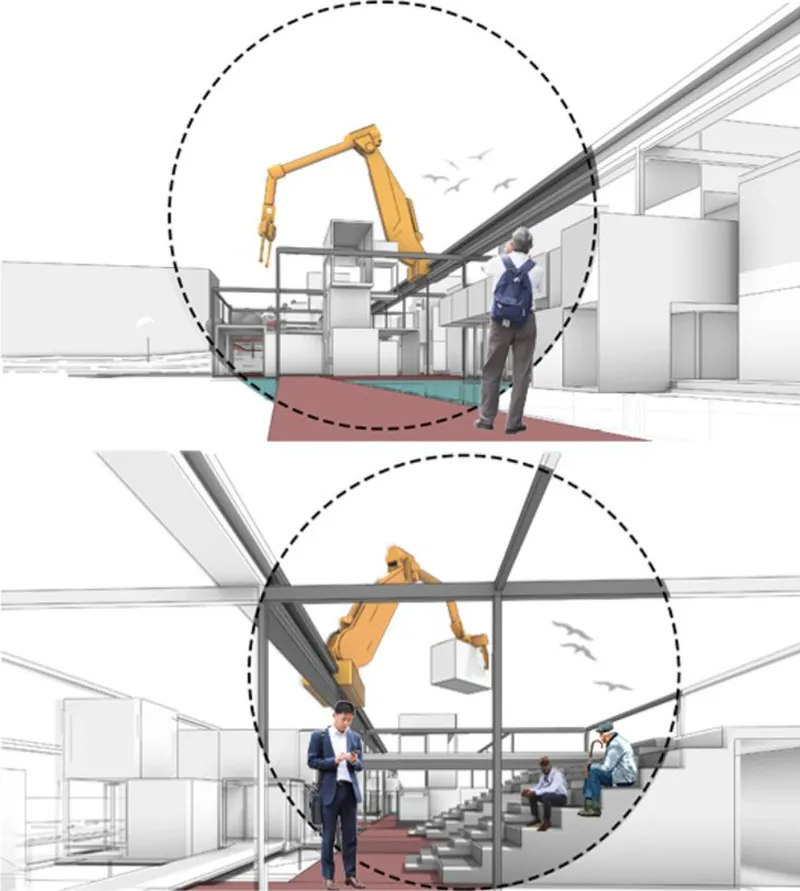
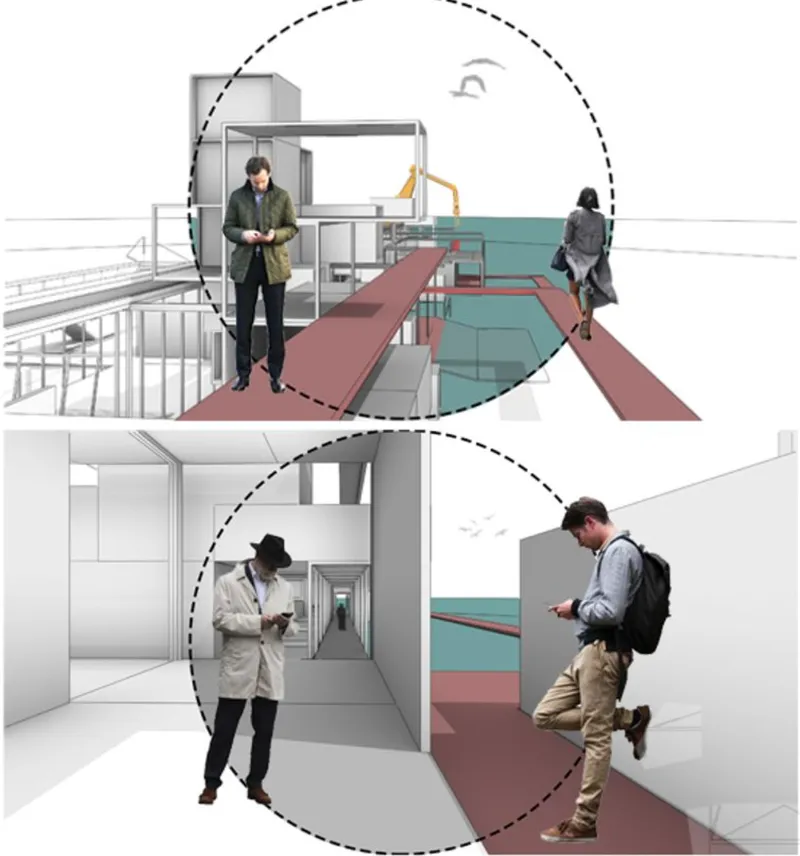
The interior perspectives bring the robotic construction narrative into sharp focus. Cantilever walkways extend through multilevel spaces where robotic arms are actively fabricating or positioning elements overhead, while occupants move through the same volumes. Transparent floor panels allow visual connections between levels, and the modular enclosures read as discrete volumes that could be reconfigured or replaced as the application's users propose new designs. The atmosphere is workshop as much as library, construction site as much as public space.
Accessibility and Coexistence with Machines
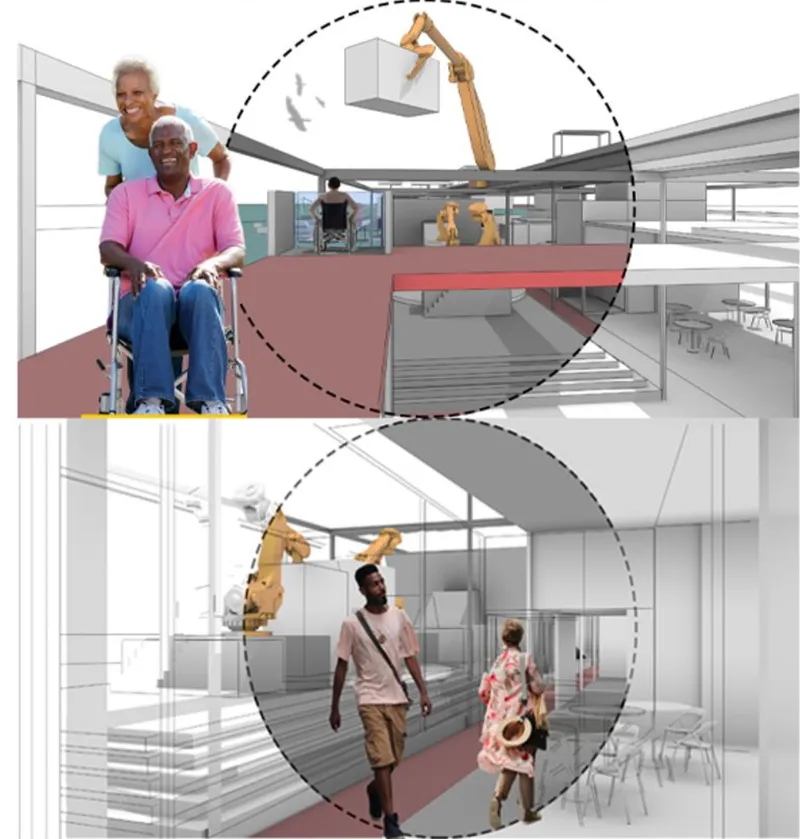
A final perspective rendering shows a suspended walkway with robotic arms operating overhead while a wheelchair user occupies the space below. It is a quiet but important image. The project does not relegate robotic construction to a back-of-house zone; it places human bodies, including those with mobility constraints, directly within the fabrication environment. The implication is that BUILD|APP's architecture is genuinely public, designed so that the act of making space is visible to, and shared by, everyone who enters it.
Why This Project Matters
BUILD|APP takes the increasingly familiar concepts of robotic fabrication and parametric design and asks a harder question: what happens when these tools become public infrastructure? By situating the entire cycle of design, fabrication, assembly, and material recycling on a single waterfront site, the project collapses the distance between architect and user, between construction and occupation. Its 2020 to 2040 timeline is not just speculative futurism; it is a framework for thinking about how buildings might evolve when their users have direct agency over their form.
The strength of the entry lies in its sectional ambition. The drawings that cut through the waterline, exposing submerged supports, aquatic life, and the structural logic of the floating platforms, do more than illustrate a concept. They argue for an architecture that is transparent about its own making. Gündüz and Şimşek have proposed a space where learning about architecture and building architecture are indistinguishable, and where the tools of construction are as visible and accessible as the spaces they produce.
View the Full Project
About the Designers
Designers: Atakan Gündüz, Selcan Şimşek
Enter a Design Competition on uni.xyz
uni.xyz runs architecture and design competitions year-round that reward proposals with spatial conviction and real site intelligence.
Project credits: BUILD|APP by Atakan Gündüz, Selcan Şimşek Athenaeum (uni.xyz).


Popular Articles
Popular articles from the community


ETEH Reworks the Shared Spaces of São Domingos School in Brazil Around Timber, Color and Hanging Plants
At São Domingos School in Brazil, 436 m² of hall, refectory and library are recast with timber joinery, a yellow and blue code and trailing greenery.

Cube Design Draws an Ecological Corridor Between Two Shenzhen Hills with the Nankai Building
Beside Shenzhen's container docks, the Nankai Building pairs stacked balconies with a climbing green screen to connect two hillsides across its height.


Aquadapt: An Underwater Habitat That Rewrites Its Rooms by the Hour
Curved modules ring the seabed while one shell shifts from breakfast room to cinema, farm and football pitch as residents' needs change.

David Ortega Stacks a Two-Story Mexico City Penthouse Around a Steel Stair and a Pergola-Shaded Roof Terrace
In Colonia Roma, a 300 m² penthouse uses oak joinery, a planted steel stair and a slatted roof pergola to make a new-build apartment feel like a house.

Similar Reads
You might also enjoy these articles

Vereda Arquitetos Renovates a 40-Square-Meter Apartment Inside Niemeyer's Copan Building
A compact unit in São Paulo's most iconic residential tower gets a material overhaul that pairs exposed concrete with bold blue Formica.

Shakur's House: Exposed Brick as an Interior Organiser in a 168 m² Mashhad Residence
Brick moves indoors in this Mashhad residence, where masonry walls, glass partitions and teal planes sequence a compact home without closing it off.

Day and Night Park: A Time-Based Urban Newsstand in Beijing
A temporary urban newsstand in Beijing blending travel, light, and reading through poetic colors, compact form, and community-focused design.

Modernist Patio Renovation in El Masnou, Barcelona by Oliver Segura Arquitectura + Cebrià Arquitectura
Modernist patio renovation blending tradition and innovation with a movable pool, leveled floors, and Catalan materials in El Masnou.


Comments (0)
Please login or sign up to add comments
No comments yet. Be the first to comment!