
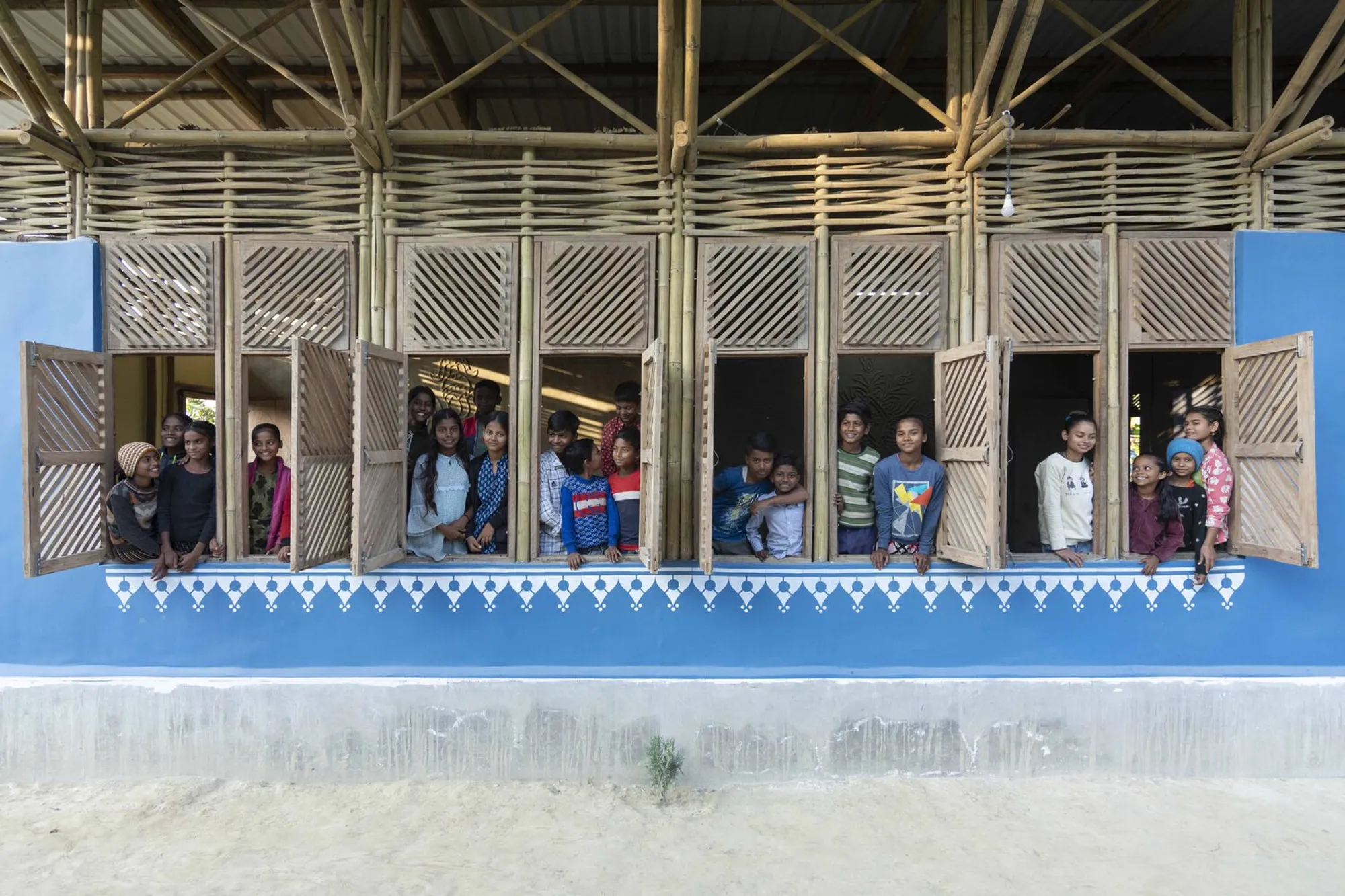
Arch Aid Builds a Bamboo and Earth School in Bihar Where Government Education Failed
In one of India's poorest villages, a participatory construction process and local materials create a 230-square-meter primary school that resists floods a


Bahuarwa is a village in Bihar, India's poorest state, where the government primary school has sat non-operational for years. Children from Scheduled Castes and Tribes, already among the country's most marginalized communities, have had little access to formal education. Into this gap stepped Arch Aid, a Swiss-based architectural NGO founded by Isha and Daniel Haselsberger, working alongside the local Bahuarwa Foundation to design and build a 230-square-meter school from bamboo, earth, and locally produced brick. Construction began in April 2022 and was completed in 2024.
What makes the project worth attention is not just its material palette, which is admirable, but the degree to which the design process itself functioned as a social instrument. The architects spent several weeks analyzing local building methods, resources, and crafts before drawing a single line. Nearly every person who worked on the construction came from Bahuarwa or surrounding villages. Parents of future students plastered walls and carved decorative reliefs. The building is lightweight enough to survive the region's earthquakes and elevated enough to withstand its floods. It requires no air conditioning and generates its own electricity. It is, in the most literal sense, architecture by and for the people who use it.
A Hybrid Structure Rooted in Place

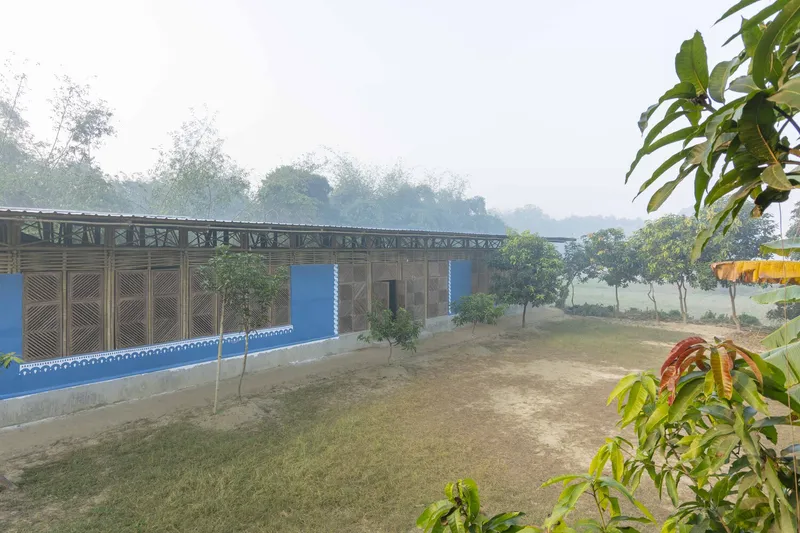

The school's structural logic is a deliberate hybrid: locally produced bricks form a high plinth that elevates the entire building above the flood line, while bamboo takes over for the walls, ceiling, and roof framework. A protruding metal roof, pitched and cantilevered generously, handles Bihar's monsoon rains. Between the ceiling and that metal skin sits a large air gap that acts as a thermal buffer, preventing the heat gain that would otherwise make a metal-roofed building in this climate uninhabitable.
The result reads as both familiar and inventive. Bamboo is abundant in the region and grows quickly, making it a regenerative choice, but its use here goes beyond affordability. The lightweight construction provides genuine earthquake resistance, a critical concern in northern Bihar's seismic zone. The architects combined vernacular knowledge with contemporary structural thinking, producing a building that local craftspeople could construct but that performs at a level the old government school never approached.
Walls That Breathe and Walls That Tell Stories
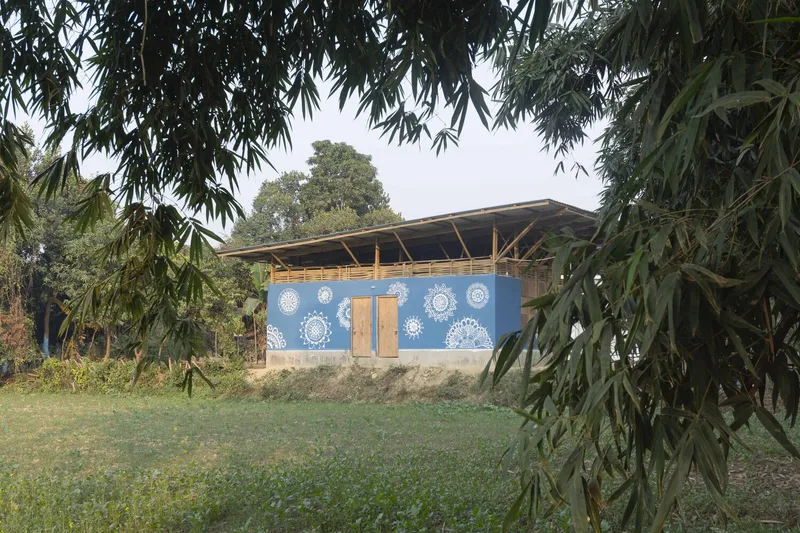
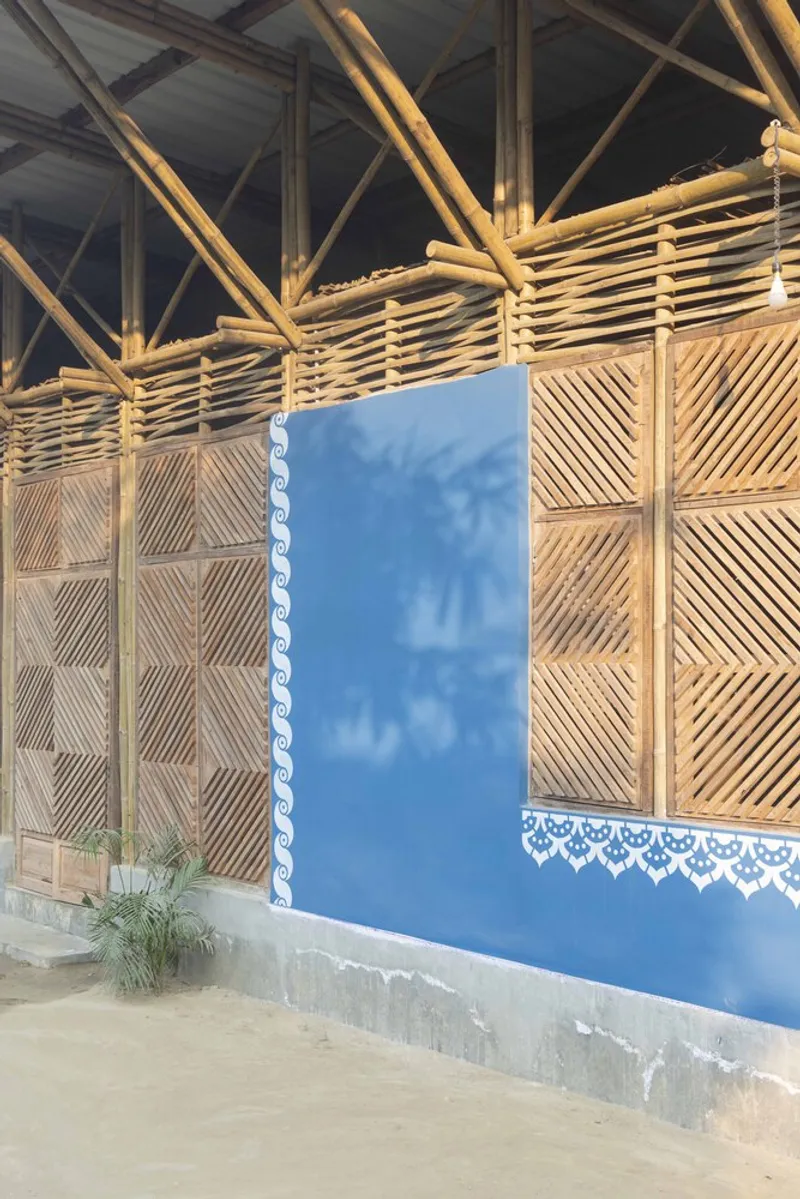
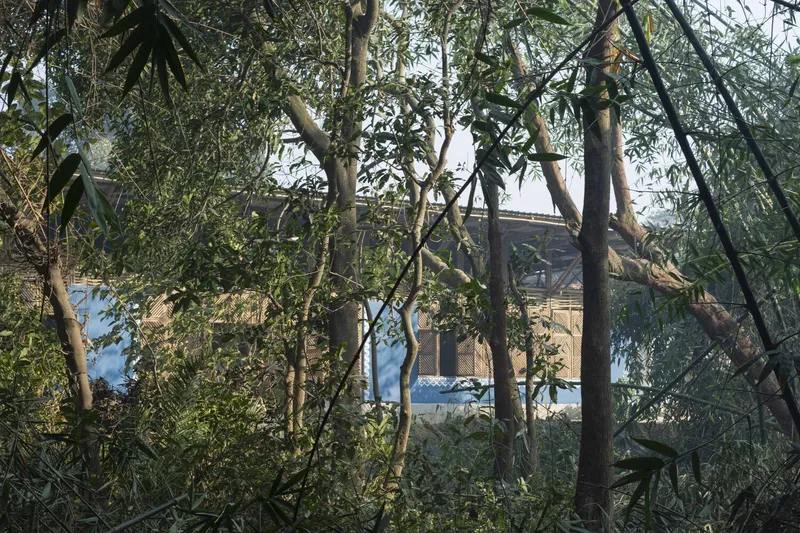
The facade is a layered composition. Woven bamboo panels alternate with sections of cement plaster painted a vivid blue, trimmed with white mandala patterns drawn by the children themselves. The combination feels deliberate: the bamboo reads as honest, textured, rooted in craft, while the painted plaster signals aspiration and modernity. The community wanted a building that looked contemporary, not provisional, and the architects respected that desire without compromising the environmental logic of the construction.
Interior walls use an earth-and-straw infill applied to the bamboo framework. These earthen surfaces provide thermal mass that keeps rooms cool during Bihar's scorching summers, eliminating any need for mechanical cooling. The contrast between the rough earthen interior and the crisp painted exterior is not accidental: it reflects a building that performs thermally from the inside while projecting civic pride on the outside.
Light, Shadow, and the Bamboo Interior
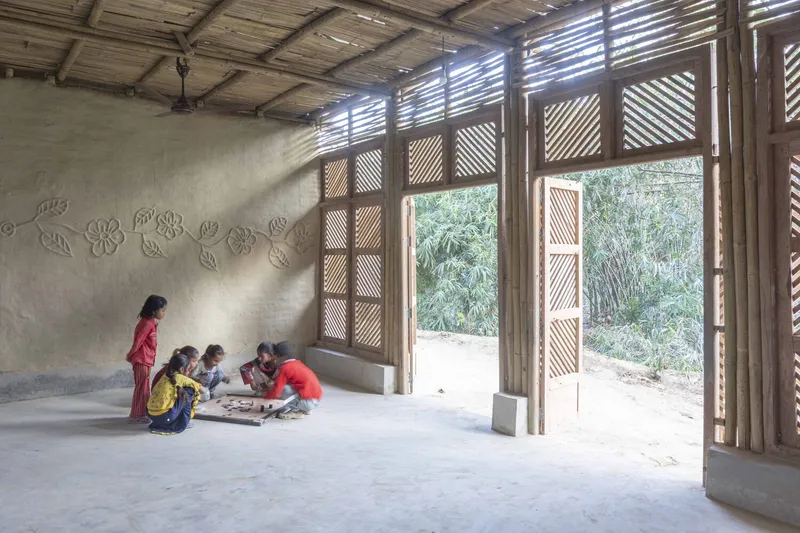
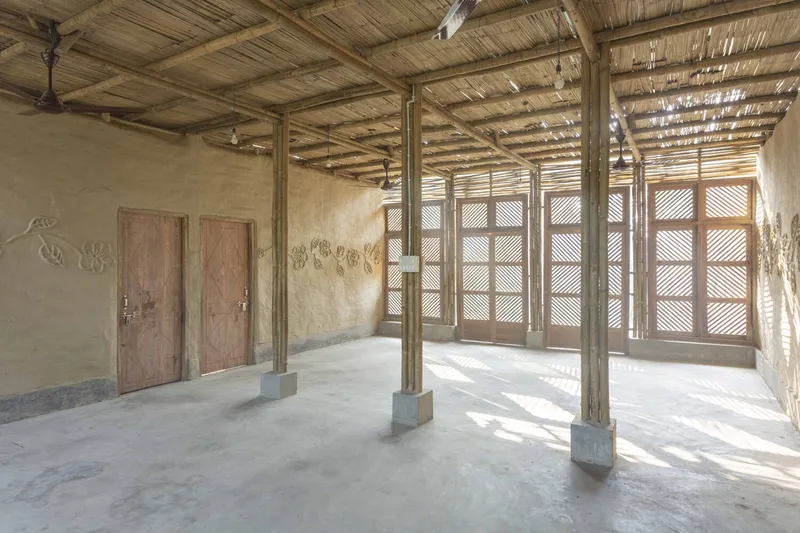

Inside, the bamboo ceiling and slatted wall panels cast constantly shifting patterns of light across the concrete floors. Diagonal lattice shutters filter afternoon sun into striped shadows that move across benches and walls throughout the day. The effect is not decorative for its own sake. It is a byproduct of the ventilation strategy: the lattice allows cross-breezes while controlling glare, and the bamboo ceiling remains open enough to let warm air rise toward the thermal buffer above.
The interiors feel spacious and airy despite the modest 230-square-meter footprint. Louvered timber shutters at the windows provide another layer of environmental control, and the concrete floor, resting on that elevated brick plinth, stays cool underfoot. For children who previously had no functioning school building at all, the quality of these spaces, the care taken with light and air, communicates something important: that their education matters enough to be housed well.
Construction as Community Act
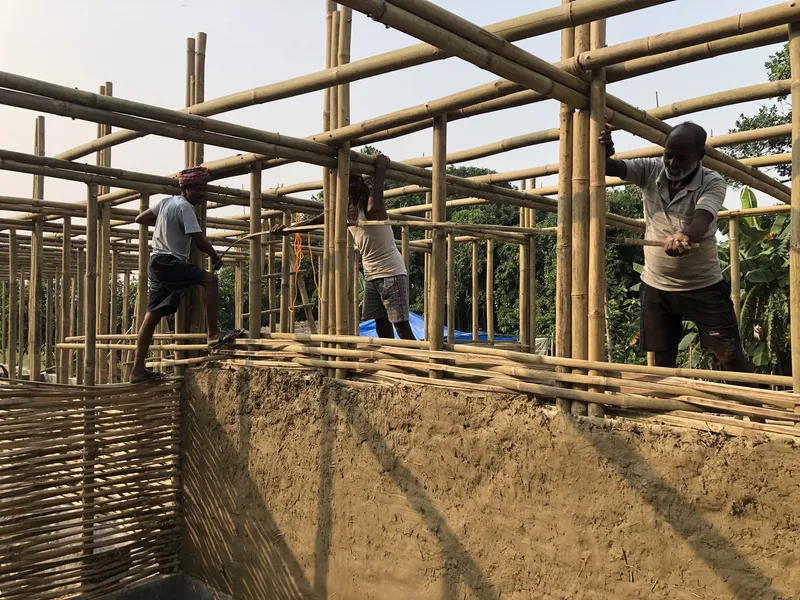
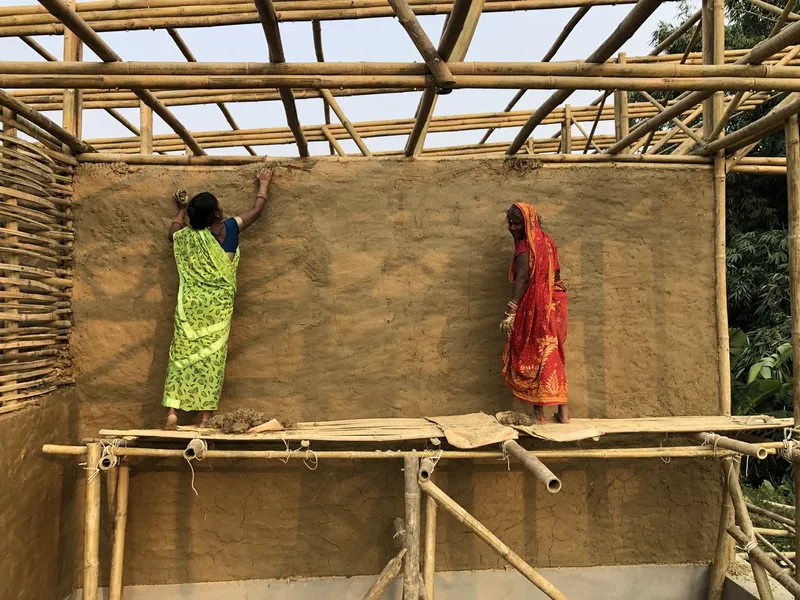
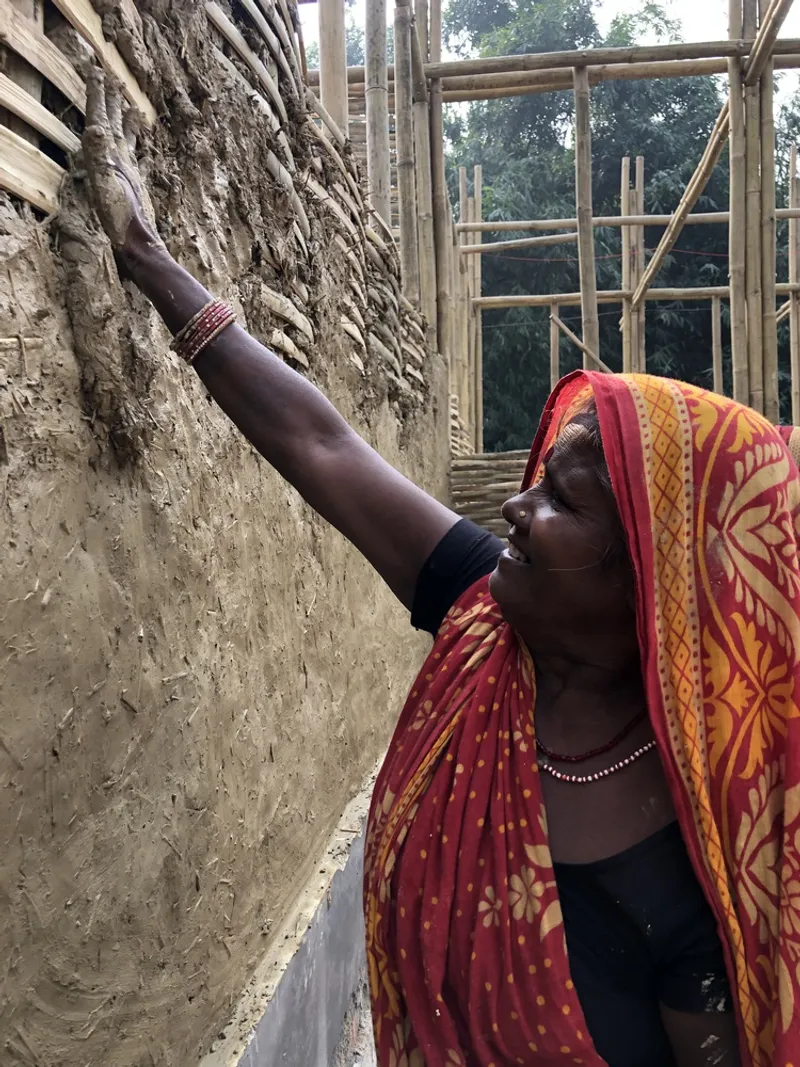
Only three bamboo experts came from outside the village. Everyone else, the brick layers, plasterers, carpenters, and laborers, was local. Women applied earth-and-straw mixtures to woven bamboo wall panels by hand. Workers plastered timber columns and shaped earthen walls under the bamboo roof framework. The participatory construction model was not a romantic afterthought but a deliberate strategy to reduce costs, build local capacity, and ensure the community felt ownership over the finished building.

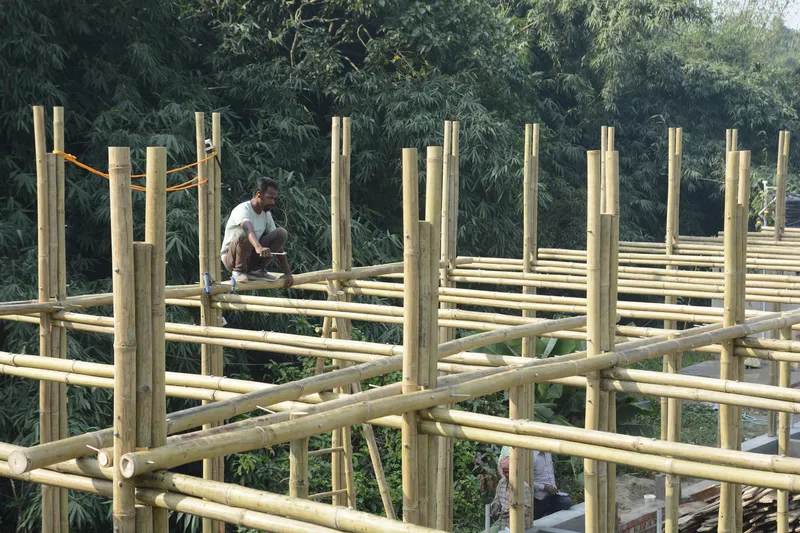
The weeks of pre-construction research, studying local crafts, material availability, and building traditions, paid off in practical terms. The construction team already understood the materials they were working with. What Arch Aid contributed was the structural engineering, the passive climate strategy, and the organizational framework that turned scattered vernacular knowledge into a coherent, high-performing building.
The Handmade Surface
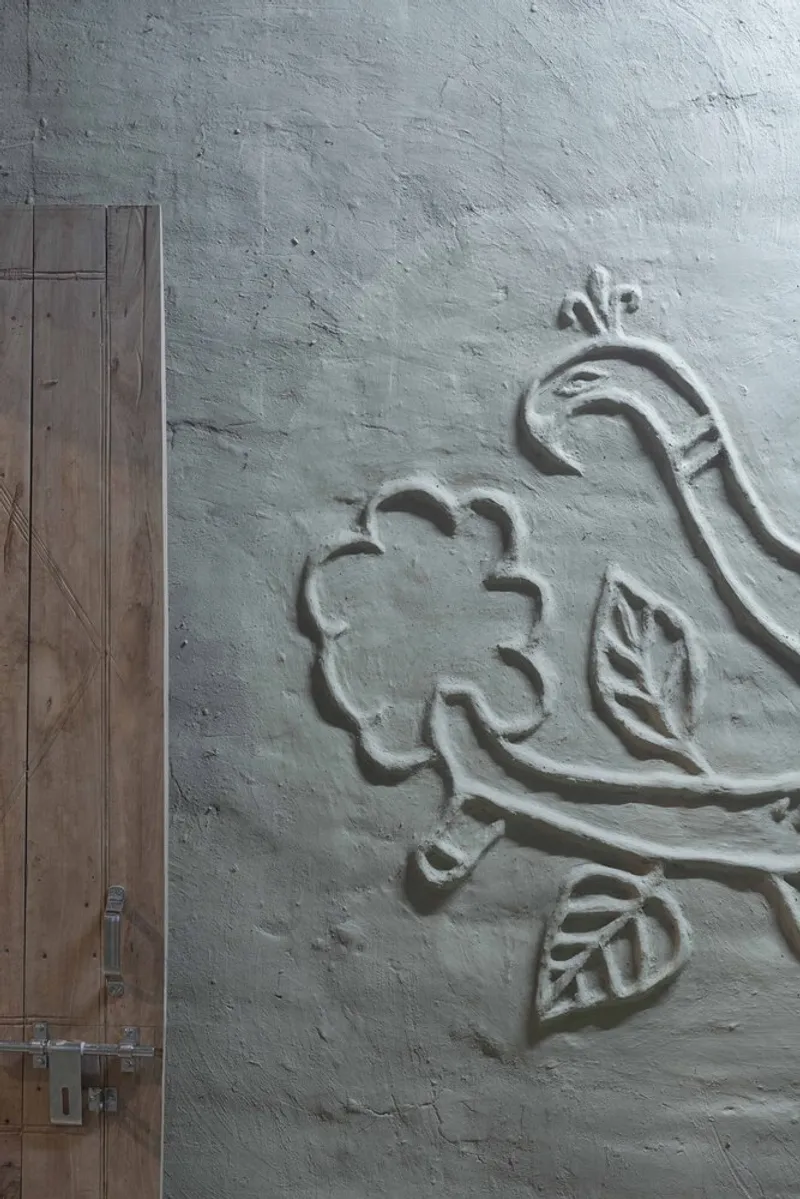


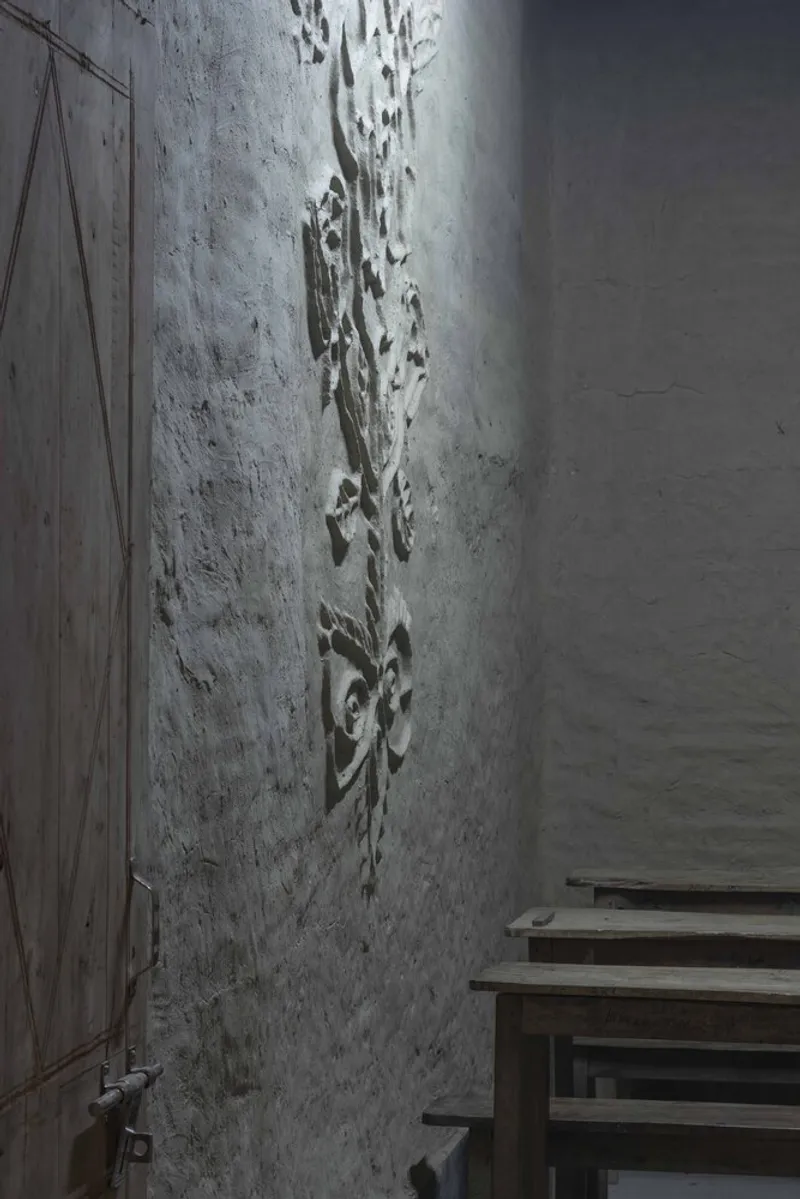
Some of the most compelling details in the school are its wall reliefs. Women from the village hand-carved floral motifs into wet plaster, producing raised patterns that catch light differently throughout the day. A lotus flower appears beside a timber door. Textured impressions mark the plaster surfaces near wooden benches. These are not applied ornaments; they are integral to the walls themselves, emerging from the same construction process that produced the building's structure.
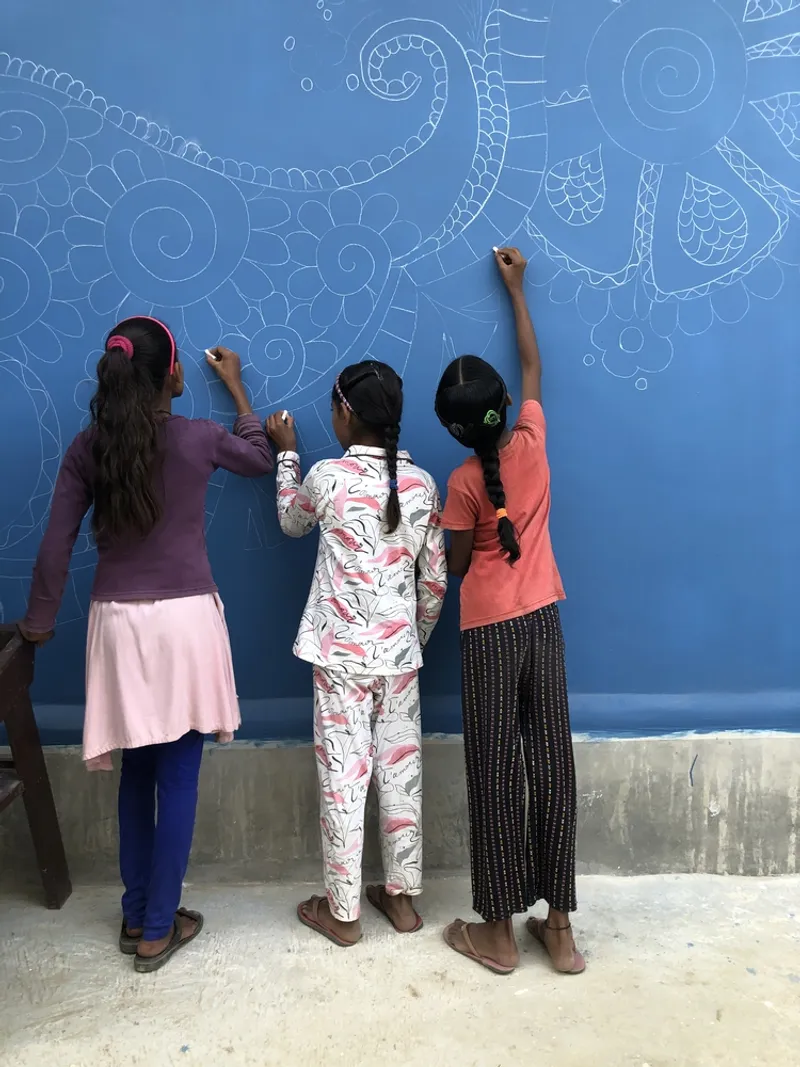

The children, too, left their mark. White line patterns and floral designs cover sections of the blue exterior walls, drawn by the students who would eventually occupy the classrooms. One child was photographed sketching intricate pattern details on an architectural elevation at a desk, a small but telling image of design education happening as a natural extension of the building process. The school's surfaces are a collective autobiography, recording the hands that made it.
Landscape and Setting
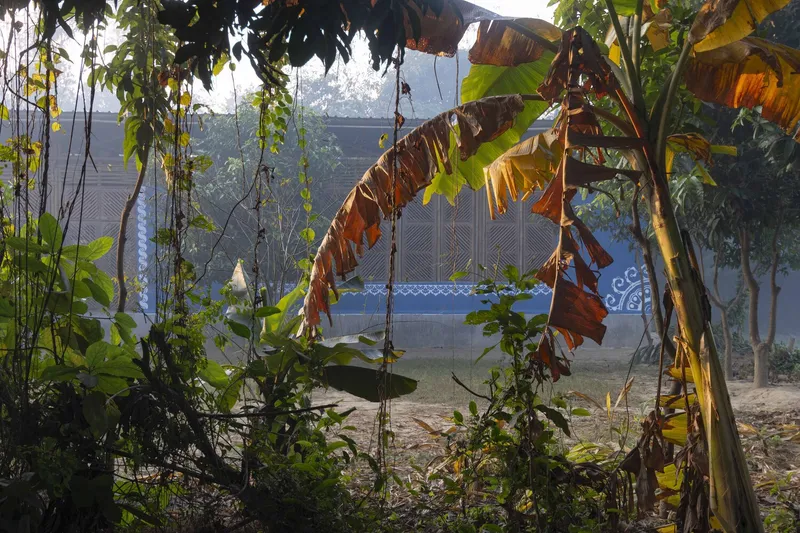
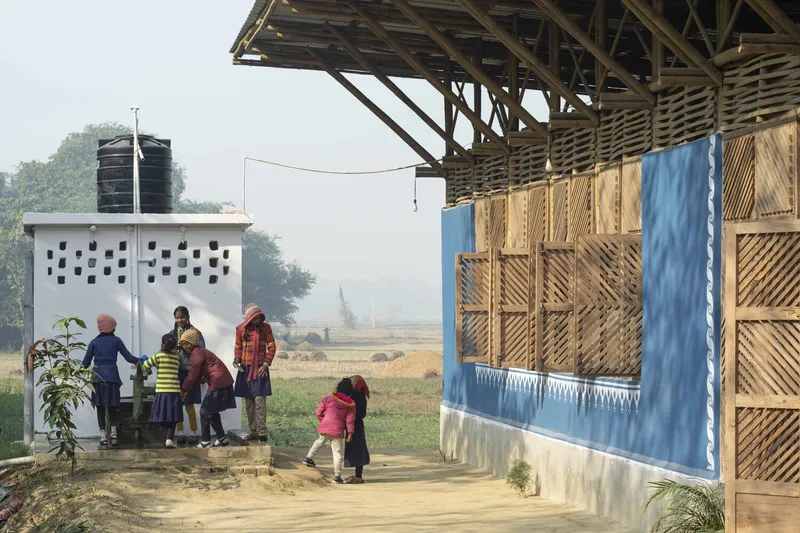

The school sits among banana trees and dense vegetation, its blue walls appearing through the green canopy like something between a civic building and a garden pavilion. The morning mist that regularly blankets the village softens the metal roof and bamboo panels into near-abstraction. A white latrine block stands nearby, its simple form a practical complement to the main structure. Children gather beneath the overhanging roof canopy, using the covered exterior as freely as the rooms inside.
Solar panels on the roof ensure the school has a reliable, independent power supply, critical in a region where the electrical grid is unreliable at best. The combination of energy independence, flood resistance, earthquake resilience, and passive cooling makes this one of the most context-responsive school buildings we have seen in rural South Asia.
Plans and Drawings
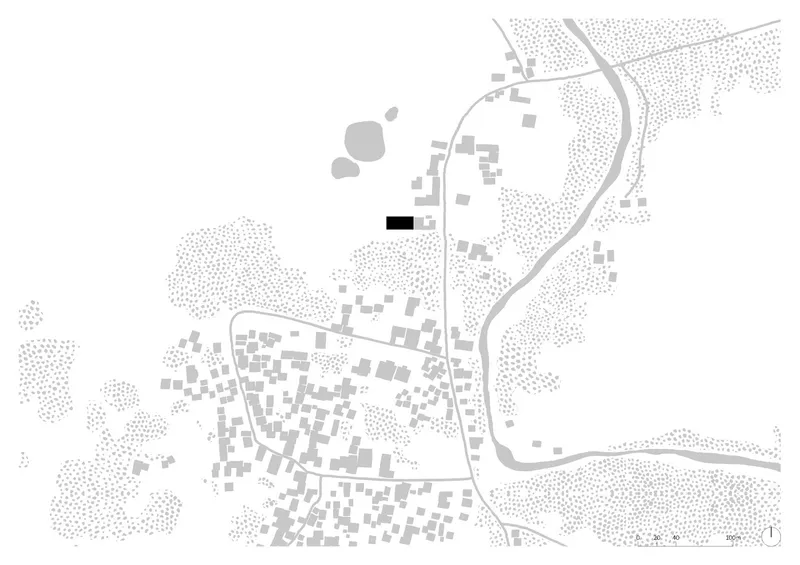


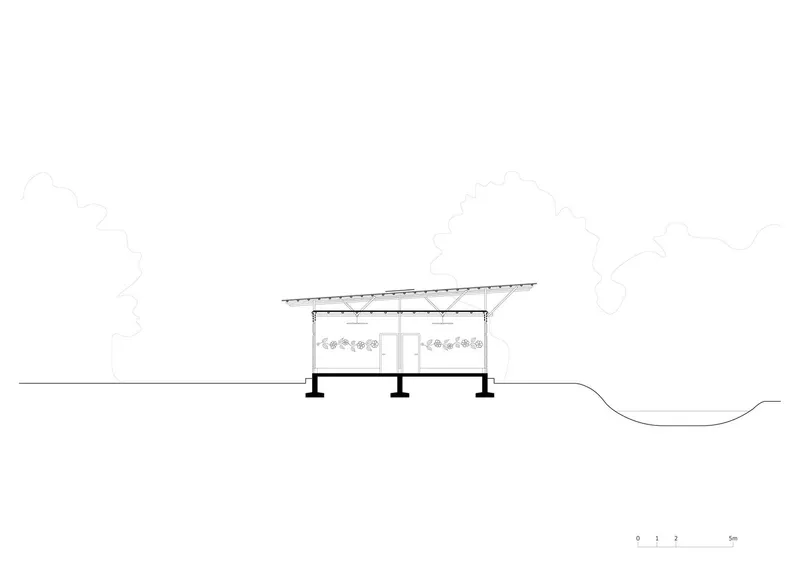
The site plan reveals the school's position within Bahuarwa's scattered village fabric, close to a winding river that explains the flood risk driving the elevated plinth design. Sections show the sloped roof structure clearly: columns rise from the brick base, supporting the bamboo framework and the air gap beneath the metal roof. Decorative murals and partition walls appear in the interior sections, confirming that the ornamental program was planned from the start, not improvised during construction.
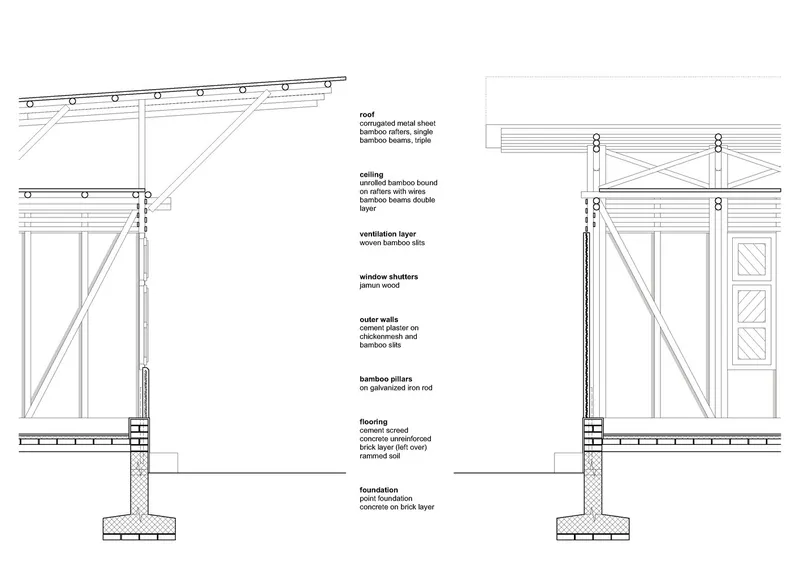
The construction detail drawings are particularly valuable, illustrating the bamboo wall assembly, roofing layers, and foundation system with material annotations. They document a building method that could, in principle, be replicated across Bihar and other flood-prone, seismically active regions of South Asia. A separate section drawing shows a small pavilion structure with angled roof and timber bracing, suggesting additional program elements on the site.
Why This Project Matters
There is no shortage of bamboo school projects in the world, and the genre risks becoming a cliché of well-intentioned development architecture. What separates Bahuarwa Primary School is the rigor of its environmental response and the authenticity of its community engagement. The building does not merely use local materials for aesthetic effect; it deploys them in a structural system calibrated to specific, measurable threats: floods, earthquakes, extreme heat, unreliable power. Every design decision traces back to a local condition, not a global sustainability narrative.
The participatory process matters as much as the finished structure. When parents build the school their children attend, when women carve reliefs into the walls they will walk past daily, the building becomes something more durable than bamboo and earth. It becomes a shared investment. Arch Aid has demonstrated that architectural quality and social empowerment are not competing goals but mutually reinforcing ones. In a state where government infrastructure has failed its most vulnerable citizens, this small school offers a credible alternative model.
Bahuarwa Primary School by Arch Aid in collaboration with the Bahuarwa Foundation, located in Bahuarwa, Bihar, India. 230 m². Completed 2024. Photography by Isha Haselsberger and Daniel Haselsberger.
About the Studio
Share Your Own Work on uni.xyz
If projects like this are the kind of work you want to make, uni.xyz is a place to publish your own, find collaborators, and enter design competitions.




Popular Articles
Popular articles from the community


Play: Fragments of Their World
Familiar architecture becomes modular playground design, creating safe spaces where displaced children can learn, connect, imagine and play.

The Ocean Hive: Sustainable Architecture for a Self-Sufficient Civilization at Sea
The Ocean Hive imagines sustainable architecture at sea, where modular habitats, algae, wave power and ocean waste sustain a growing colony.

Conexión: Biophilic Design Reimagines High-Rise Living in Hong Kong
Conexión reimagines high-rise living in Hong Kong through biophilic design, green facades, shared spaces, daylight, water and nature within.

Co-Life: Senior Housing Design That Reconnects Older Adults With the City
Co-Life reimagines senior housing design through healing gardens, shared streets, workshops, and a sustainable community across generations.


Similar Reads
You might also enjoy these articles


Hodi-Mandai Geram
Project Function: Preservation and revitalization of the Intangible heritage and socio-spatial identity of the Hodi by Housing, Cultural Memory Center, Sacred Grove, landscape, local tourism economy


Olio Towers: A Mid-Rise for Performers That Fuses Housing, Rehearsal, and Stage
Located blocks from Houston's Theater District, this modular tower stacks living units around a central performance atrium.

Oasis: Modular Green Housing Carved into Dhaka's Urban Fabric
A shortlisted Plugin Housing entry reclaims unauthorized settlements in Dhaka with stepped concrete volumes, green roofs, and ventilation-driven design.

Black Hole: A Floating Megastructure for the Post-Physical Era
Emiliano Mazzarotto envisions a spherical, self-scaling arena where e-sports, digital hotels, and holographic stadiums replace traditional public space.


Explore BMS College Of Architecture Competitions
Discover active competitions in this discipline



Challenge to reimagine the Iron Throne


Photograph architecture without architects


Illustrate the lost glory of Angkor Wat - Render Challenge


Design challenge to reuse E-waste
Comments (0)
Please login or sign up to add comments
No comments yet. Be the first to comment!