

Building Blocks of Education: A School Organized Around Exploring, Making and Presenting
Brendan Chong's shortlisted school breaks the single classroom into explore, construct and present zones connected by corridors used as learning space.


Most schools are still drawn around the act of teaching: a room, a board, a front and a back. Building Blocks of Education starts from the opposite premise. It asks what a school looks like when it is organized around the act of learning, and its answer is to dismantle the single classroom and redistribute it across a building where students move between modes of inquiry, making and communication rather than between numbered rooms.
Designed by Brendan Chong and shortlisted in the School Of Thought 2020 competition, the project argues that rigid, teacher-centric classrooms no longer match how contemporary students learn. Chong's response is a network of interconnected environments, each tuned to a different cognitive or social way of working, set within a site plan that treats forest, outdoor classrooms and open ground as part of the curriculum rather than leftover space.
Explore, Construct, Present: A Pedagogy Stacked Floor by Floor
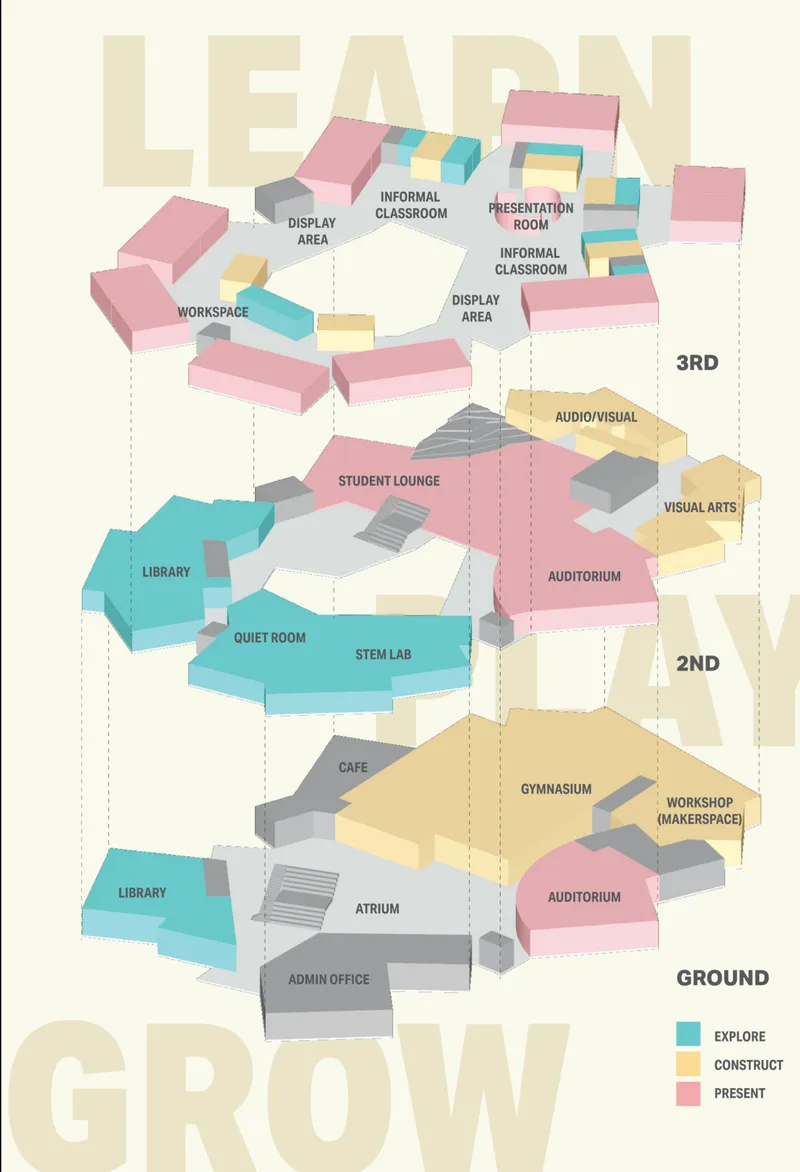
The exploded axonometric is the clearest statement of the project's logic. Each floor is color-coded by learning mode, so the building reads less as a stack of classrooms and more as a diagram of how a student's day might unfold. Explore gathers the library, STEM labs, quiet rooms, research nooks and outdoor learning areas, the places for independent discovery. Construct holds the workshops, visual arts studios and audio-visual rooms where ideas become objects. Present collects the auditorium, presentation rooms, student lounges and informal classrooms where work is shared.
What makes the tripartite system convincing is that it describes a cycle rather than a hierarchy. Inquiry feeds making, making feeds communication, and communication sends students back to inquiry. By giving each phase its own spatial identity, Chong turns an abstract pedagogical model into something a student can physically walk through, and the large shared volumes labeled in the drawing, the gymnasium, auditorium and lounge, anchor the stack as common ground for the whole school.
A Stepped Atrium, a Makerspace and Rooms for Being Alone
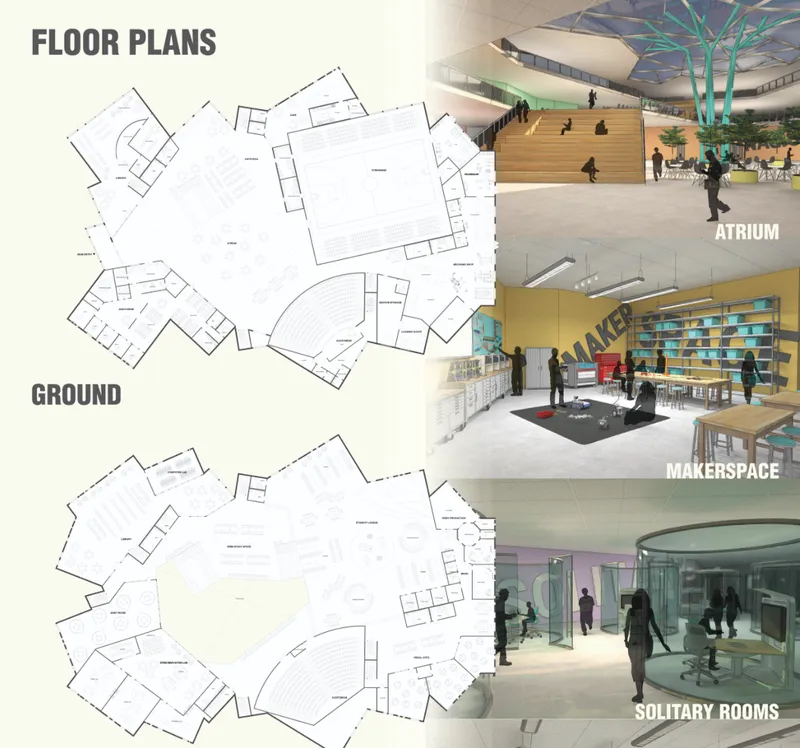
The ground and second floor plans translate the diagram into a range of room types sized for different groups and activities. The renderings alongside them make that range tangible: a stepped atrium that doubles as seating and stage, a makerspace lined with shelving for materials and work in progress, and glass-enclosed solitary rooms for focused, individual study. These are three very different answers to the question of where learning happens, and the project insists that a school needs all of them.
The circulation is where the scheme is most persuasive. Corridors are not treated as transitional zones but fitted with collaborative tables, display areas and presentation zones, so the hallway becomes an extension of the classroom. The glass solitary rooms reinforce this: privacy without disappearance, quiet work that stays visually connected to the activity around it. The result is a building where spontaneous exchange is designed in rather than left to chance.
Upper Classrooms and a Campus That Opens to the Landscape
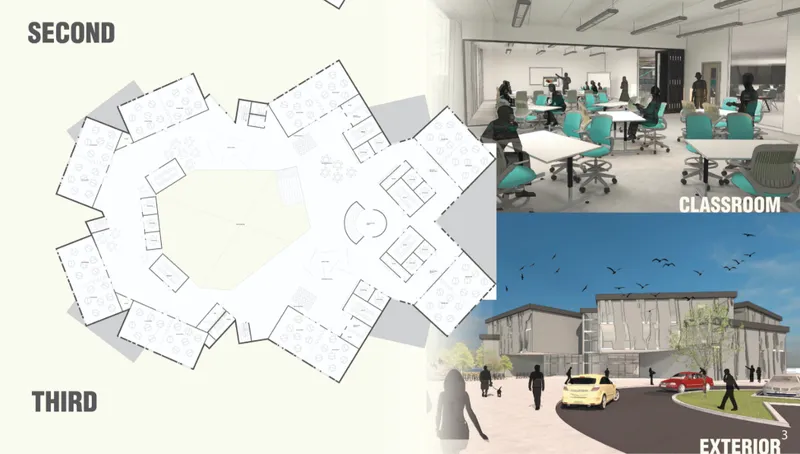
The second and third floor plans continue the spectrum of classroom types, and the rendering of a classroom furnished with teal chairs shows a room scaled for a group rather than a lecture. The furniture suggests a space that can be rearranged by teachers and students to suit the activity, which is the practical test of any claim to flexibility.
The exterior view places the building back on its site, and here the plan's broader strategy comes into focus. The footprint is organized around a central hub with programme distributed outward, and outdoor classrooms, forested zones and recreational areas are woven into that arrangement. This decentralized layout encourages movement and exploration, extending the explore, construct and present cycle beyond the building envelope and into the landscape.
Why This Project Matters
Flexible learning space is a phrase that has been used so often it risks meaning nothing. Building Blocks of Education gives it specific content. Instead of offering open plans and movable partitions as a generic fix, Chong ties every space to a defined learning mode and then makes those modes legible in plan, section and color. The flexibility here is not about a room that can be anything; it is about a school that offers many deliberately different rooms and lets students choose.
The project's most transferable idea is its treatment of the in-between. By turning corridors into working landscapes and the site into a sequence of outdoor classrooms, it recovers space that conventional schools waste and puts it to use for collaboration and display. For designers thinking about education beyond the closed classroom, this shortlisted entry offers a clear framework: organize by how people learn, and let the architecture carry that organization from the quietest study cell to the edge of the forest.
View the Full Project
About the Designers
Designer: Brendan Chong
Enter a Design Competition on uni.xyz
uni.xyz runs architecture and design competitions year-round that reward proposals with spatial conviction and real site intelligence.
Project credits: Building Blocks of Education by Brendan Chong School Of Thought 2020 (uni.xyz).


Popular Articles
Popular articles from the community


Faces of the Soviet Avant-Garde: Turning Moscow's Street Names into an Open-Air Museum
A network of sculptural installations across a Moscow residential district transforms forgotten architect names into spatial encounters with cultural memor

Singing Woman: An Opera House That Performs Before the Curtain Rises
Ovidiu Cristian Pavel's conceptual opera house translates Estonia's choral identity into a sculpted waterfront landmark facing the Baltic Sea.

Tsunami Convergenics: Turning Catastrophic Ocean Forces into Underwater Housing Infrastructure
A speculative underwater settlement off the coast of Onagawa, Japan, treats tsunamis and typhoons as energy sources rather than threats.

Manzana Morphosis: Stretching Barcelona's Grid into a Living Landscape for 2050
A radical reworking of the Eixample manzana turns density into a tool for generous public space, vertical ecology, and environmental performance.

Similar Reads
You might also enjoy these articles

Healing Façade: A Modular Chapel System That Restores Ethiopia's Sacred Forests
Winner of the Eco-Chapel competition, this circular timber façade collects water from air to rebuild soil and reforest degraded Ethiopian landscapes.
Kaffeebühnen: Where Coffee Shop Architecture Becomes a Civic Stage in Vienna
A linear sequence of timber boxes, transparent shells, and open yards turns the Viennese café tradition into a public performance space.
Eco Chapel: A Modular Forest Pavilion That Grows Like the Landscape It Protects
Hexagonal timber modules weave through existing trees, turning a chapel into a living system for prayer, education, and reforestation.


Urban Forest: A Vertical Ecosystem for 5,000 Workers in Singapore's Changi Business Park
Radially stacked pods and layered green decks turn a 7-acre plot into 47 acres of ecological workspace projected for 2040.

Comments (0)
Please login or sign up to add comments
No comments yet. Be the first to comment!