
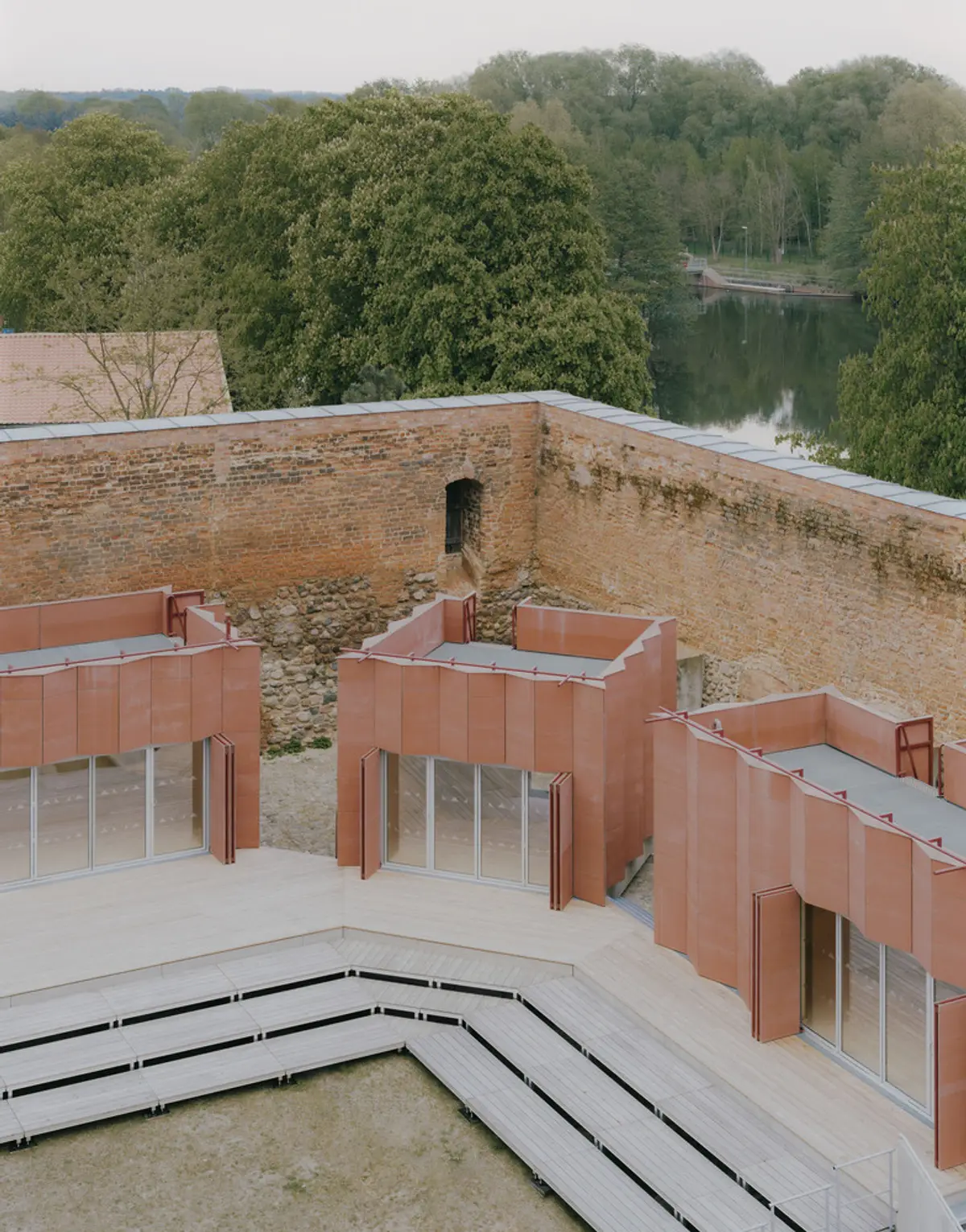
Atelier Fanelsa Nests Three Copper Pavilions Inside a Medieval Castle Courtyard in Beeskow
A trio of timber-framed volumes frames an outdoor stage within centuries-old fortress walls in eastern Germany's Brandenburg region.


Building inside a ruin is an act of negotiation. You are not starting from nothing; you are starting from everything, from layers of memory embedded in brick, stone, and the ground itself. At Beeskow Castle in Brandenburg, Atelier Fanelsa led by Niklas Fanelsa has inserted three copper-clad timber pavilions into a fortress courtyard that has witnessed centuries of construction, destruction, and renewal. The result, completed in 2024, is a 400-square-meter cultural venue called Burgbühne Beeskow that neither mimics the medieval masonry nor ignores it. Instead, it enters into a material conversation with it.
What makes the project worth studying is the precision of its restraint. The pavilions are designed to be neutral backdrops during performances and active architectural participants the rest of the year. They float on point foundations above the original paving, barely touching the archaeological layer below. Their faceted copper skins echo the warm reds and browns of the surrounding brickwork without resorting to literal mimicry. And through an ingenious system of folding shutters and sliding glass, the buildings can open entirely to the courtyard or seal shut for winter gallery use. It is a project that understands the difference between deference and timidity.
A Stage Set in Stone
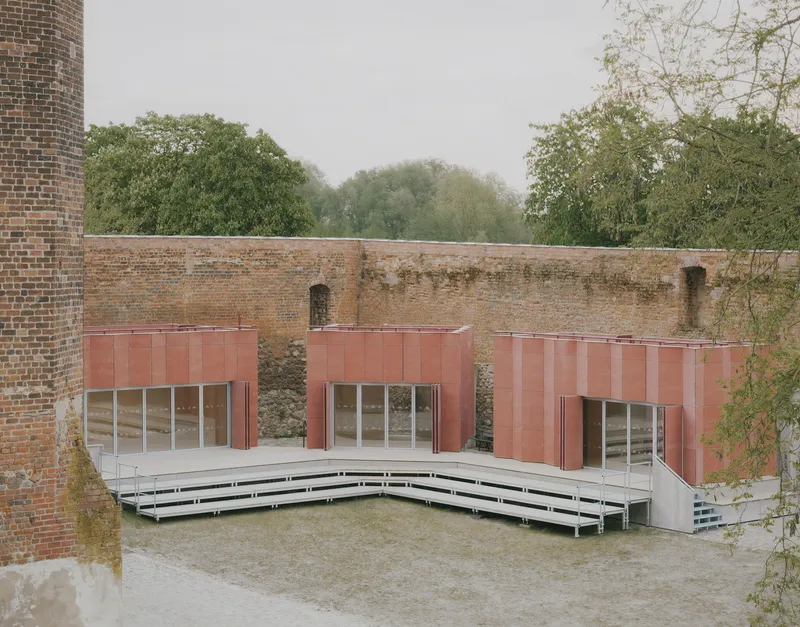
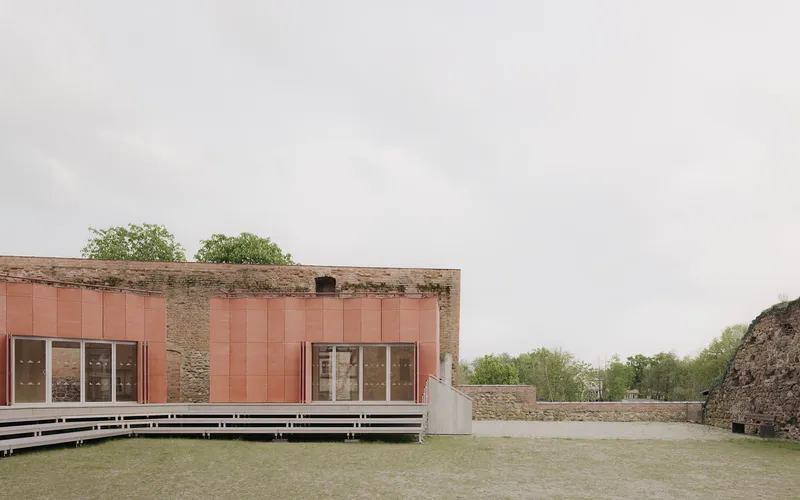
The three pavilions are arranged to frame a central outdoor stage, turning the castle courtyard into an amphitheatre with crumbling brick walls as its permanent scenography. Tiered timber seating rises along the courtyard edges, and the pavilions themselves serve as backstage, dressing rooms, and set extensions. Crucially, the roofs are accessible, giving performers a second level to work with. A musician can emerge from a doorway at ground level while an actor appears on the rooftop above, all framed by the castle's weathered ramparts.
This spatial arrangement transforms the architecture into theatrical infrastructure without flattening it into pure utility. When performances end and festival season closes, the same volumes host workshops, small exhibitions, and community gatherings. The castle, which once functioned as a knight's seat and later a bishop's residence, now serves as a regional cultural center for the rural community of Beeskow. The pavilions simply extend that mission with new spatial tools.
Copper Against Brick
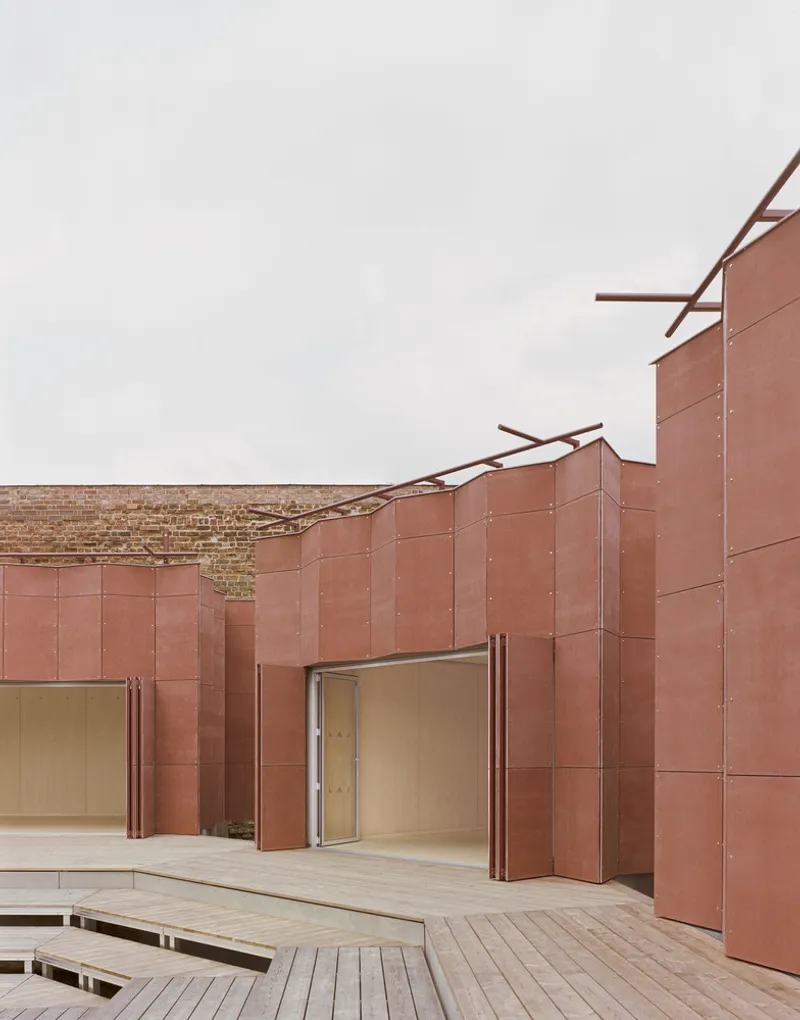
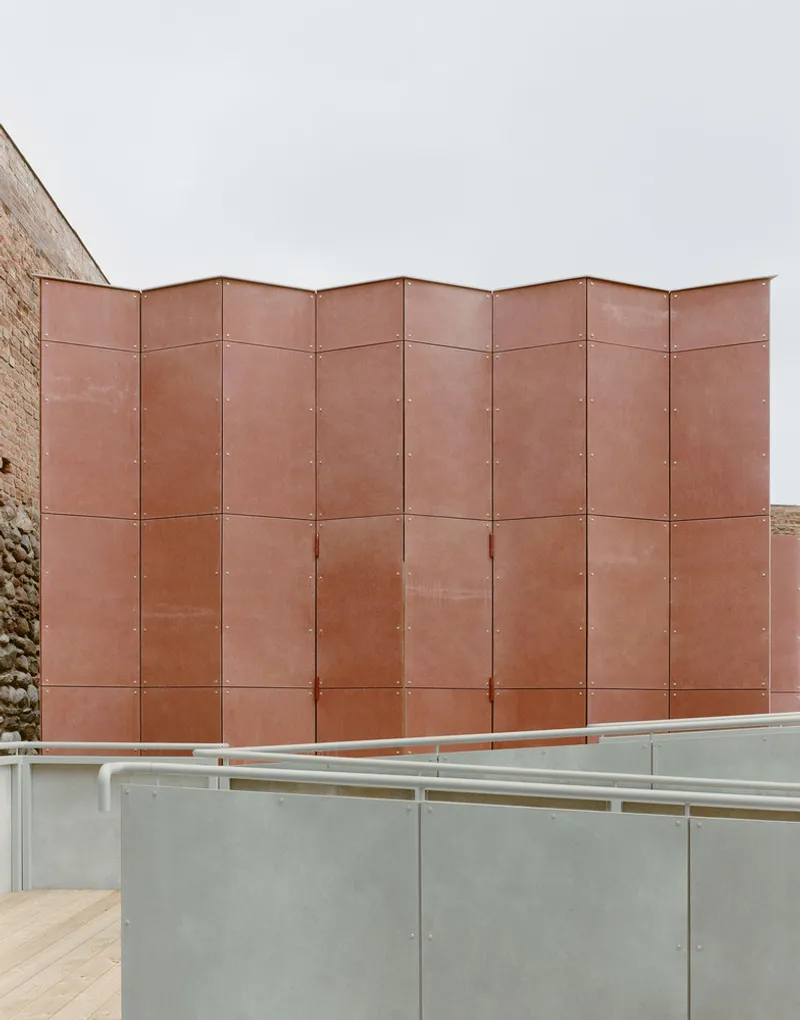
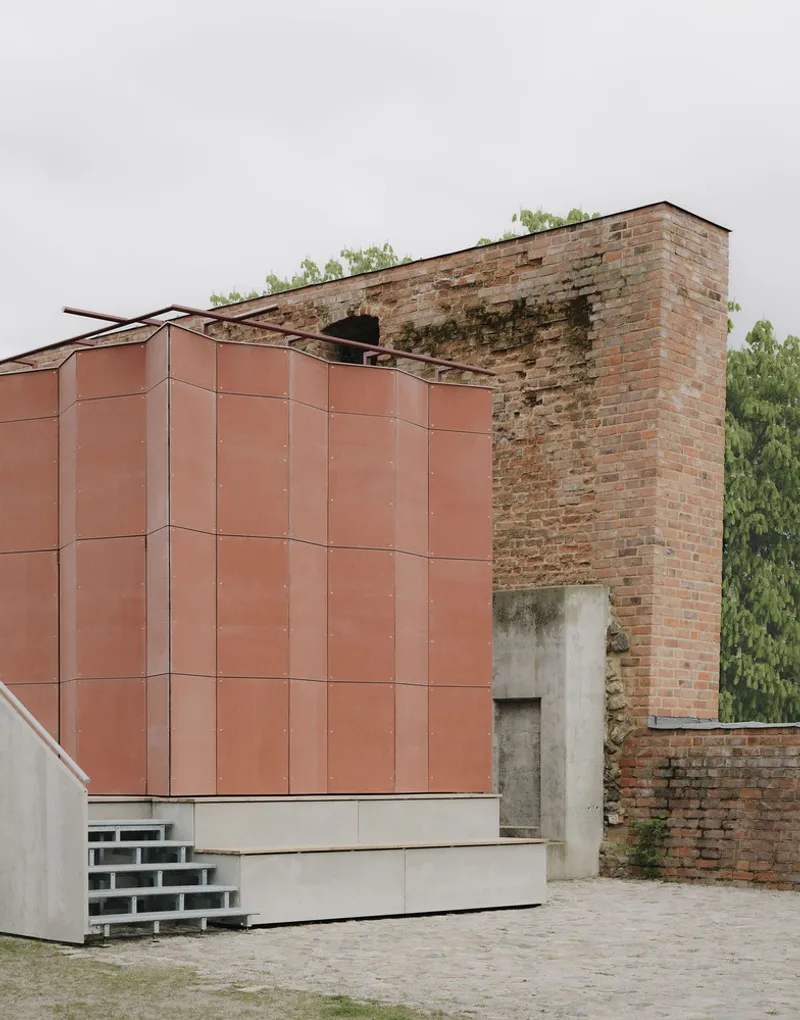
The most striking decision here is the cladding. The folded copper panels pick up on the tonal warmth of the surrounding red brick, but their faceted geometry and visible mechanical fasteners make no attempt to pass as historic fabric. The panels are angled and creased like origami, catching light differently across each face and producing a surface that shifts from matte shadow to warm glow depending on the hour and the weather. Over time, the copper will patinate toward greens and browns, drawing even closer to the palette of the ruin without ever matching it exactly.
Where the copper meets the deteriorated masonry, the junction is handled with deliberate honesty. There are no transition strips or decorative moldings smoothing the seam between old and new. The two materials simply abut, registering the gap in centuries between them. It is a detail that communicates the project's philosophical stance: the new structures acknowledge the castle's authority but do not subordinate themselves to it.
Opening and Closing
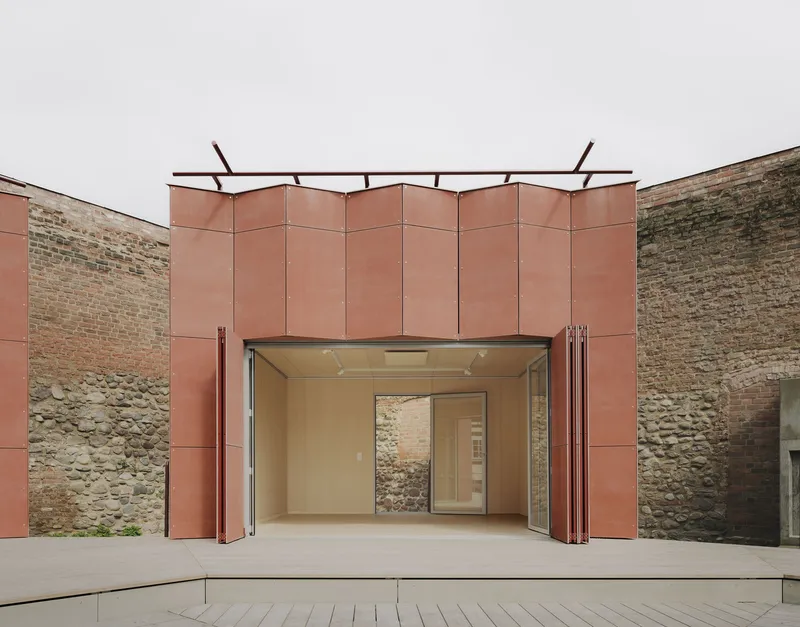
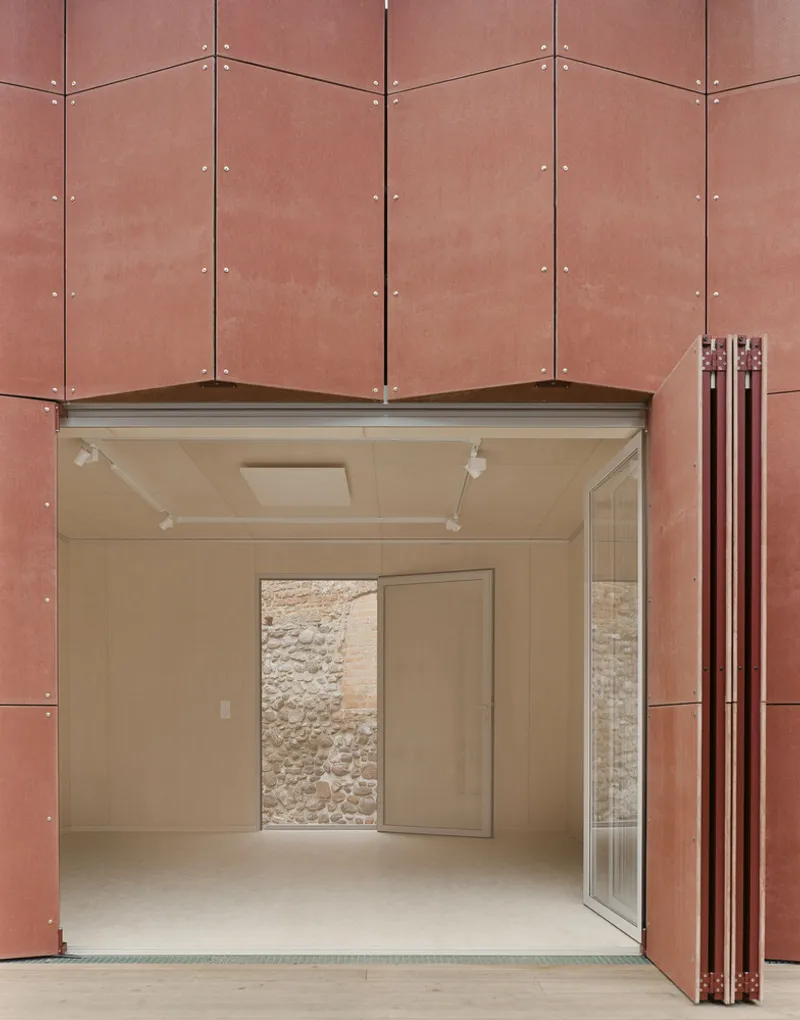
The courtyard-facing facades can transform completely. Large folding glass doors swing open beneath cantilevered copper canopies, dissolving the boundary between interior gallery space and the stone courtyard. When fully opened, the pavilions read less as buildings and more as covered extensions of the stage, their plywood-lined ceilings extending shelter without enclosure. When closed, the copper facades present a unified, almost sculptural front, and the interiors become insulated rooms warm enough for winter use.
This operable quality is central to the project's identity. A performance venue in a rural German town cannot afford to be seasonal. Wood-fiber insulation and the thermal mass of the timber frame allow the pavilions to function year-round, while the folding mechanisms give the castle staff the ability to reconfigure the courtyard in a matter of minutes. It is low-tech responsiveness: no motorized systems, just well-designed hardware and lightweight panels.
Light Touch on Historic Ground
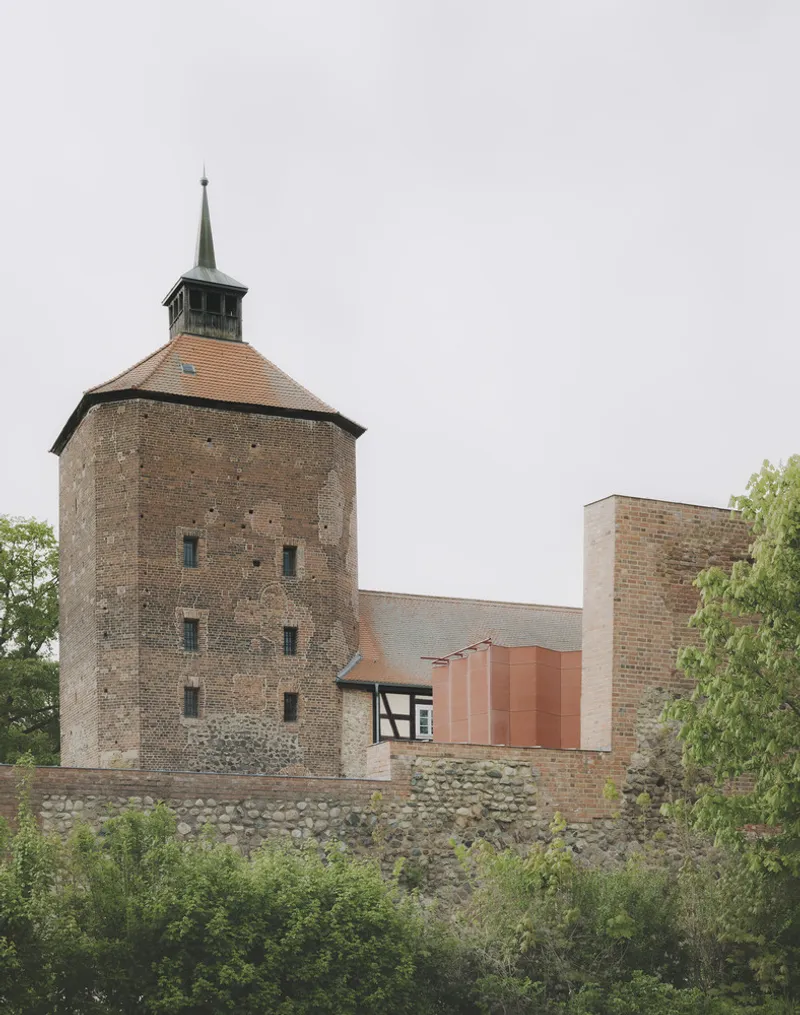
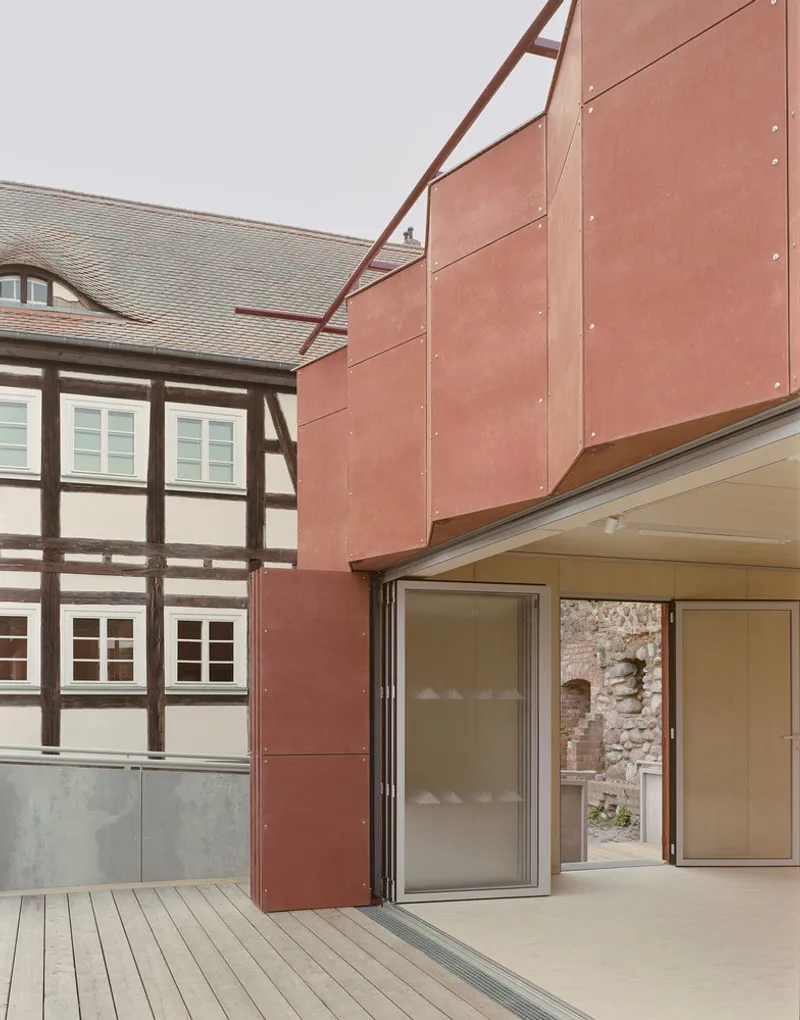
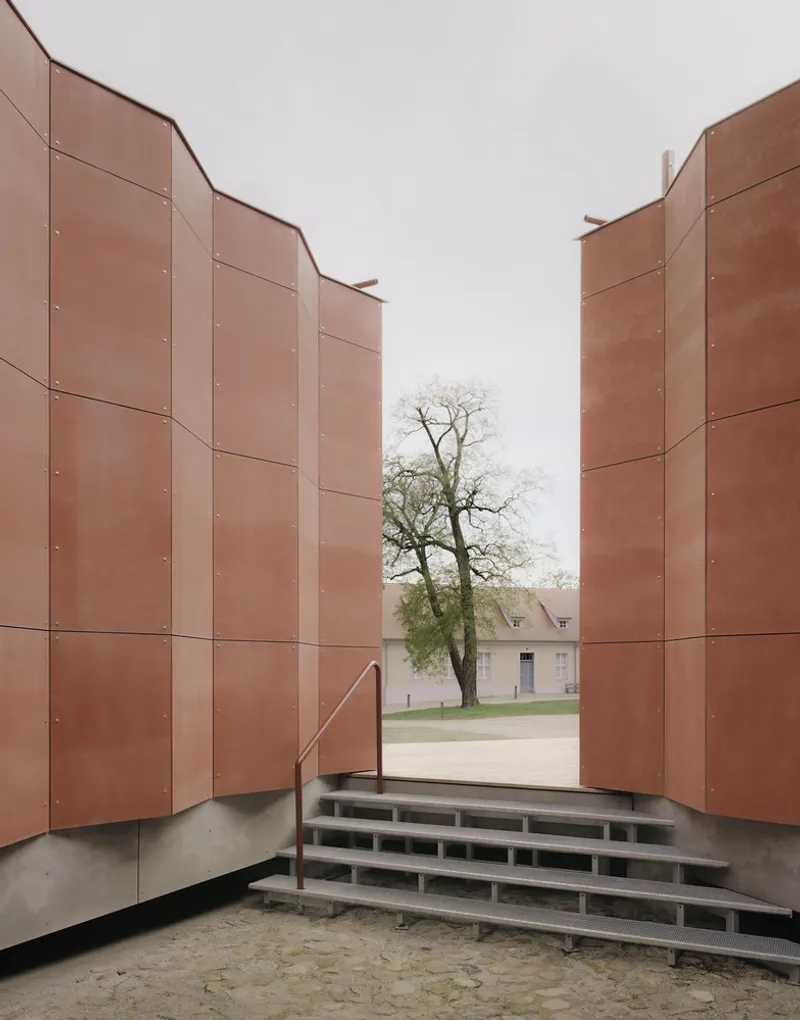
The pavilions sit on point foundations placed directly atop the historic paving, a strategy that minimizes excavation and concrete use while preserving the archaeological record below. The structures hover just above the ground plane, registering as insertions rather than implants. From certain angles, especially from the castle's cylindrical brick tower with its green copper spire, the new volumes read as crisp geometric objects floating within the irregular geometry of the medieval compound.
The narrow passages between pavilion walls create compressed sightlines that frame fragments of the surrounding landscape: a bare tree, a distant building, the castle's crumbling rampart. These interstitial views are not accidental. They reward movement through the courtyard with constantly shifting compositions of copper, brick, sky, and vegetation. The architecture creates a choreography of discovery that extends the performative logic of the stage into everyday circulation.
Timber Craft and Local Continuity
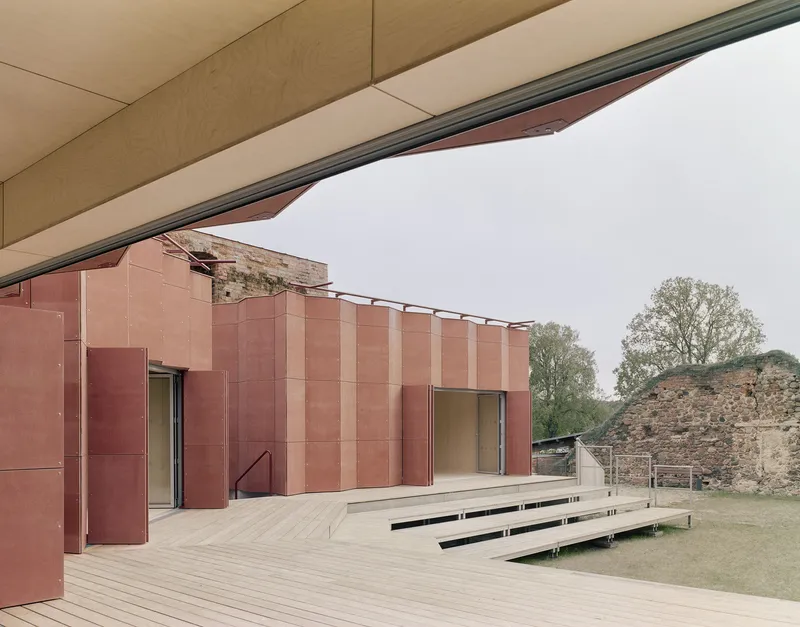
Most of the construction was carried out by a local carpentry firm now in its third generation of involvement with the castle. That detail matters. It means the hands that shaped these timber frames belong to a lineage of craft that has maintained the castle's fabric for decades. The interiors reflect that continuity: light-colored wood, linoleum flooring, and clean joints that speak to careful workmanship rather than expensive specification. Geo-based and bio-based materials were prioritized throughout, keeping the environmental footprint low and the supply chains short.
Viewed from beneath the cantilevered plywood ceilings, with the copper facade glowing beyond a timber deck, the pavilions feel simultaneously modest and refined. The material palette is small, the details are legible, and the construction logic is transparent. You can see how these buildings were put together, and that legibility is part of their honesty.
Plans and Drawings
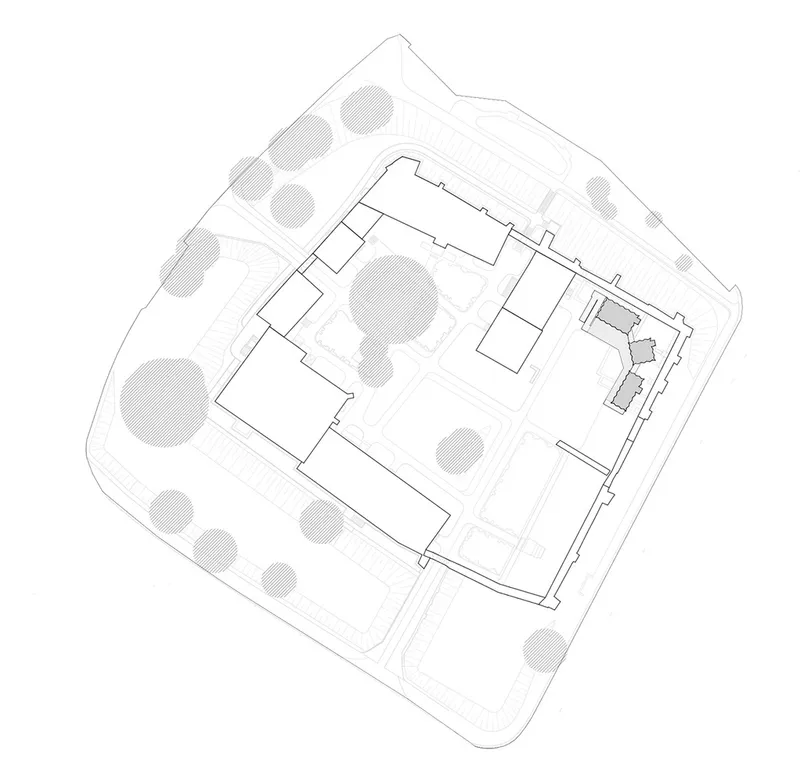
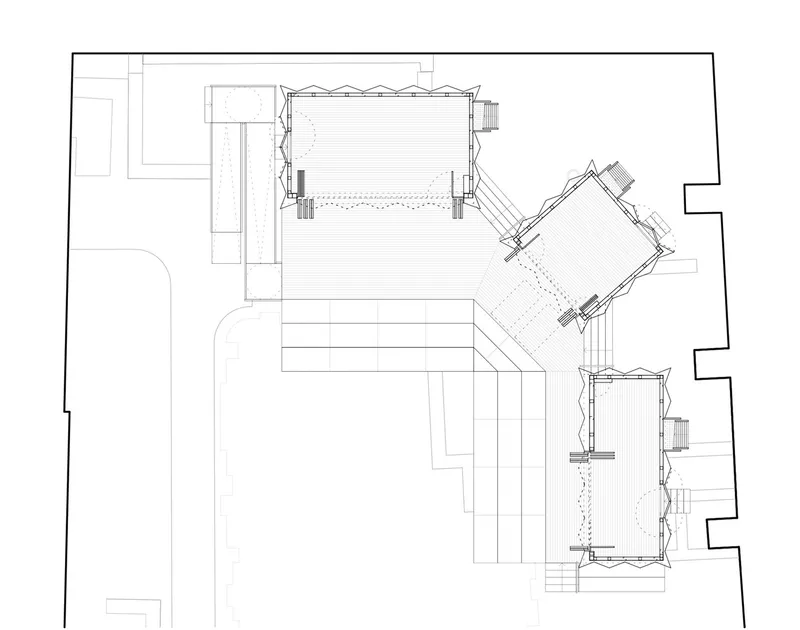
The site plan reveals how the three rectangular volumes are positioned within the rounded boundary of the castle walls, their orthogonal geometry playing against the irregular medieval enclosure. A diagonal linking corridor connects the pavilions, creating backstage circulation that keeps performer movement hidden from the audience. The floor plan shows the straightforward logic: three independent structures, each a single open room capable of subdivision, oriented to maximize their relationship with the central stage.
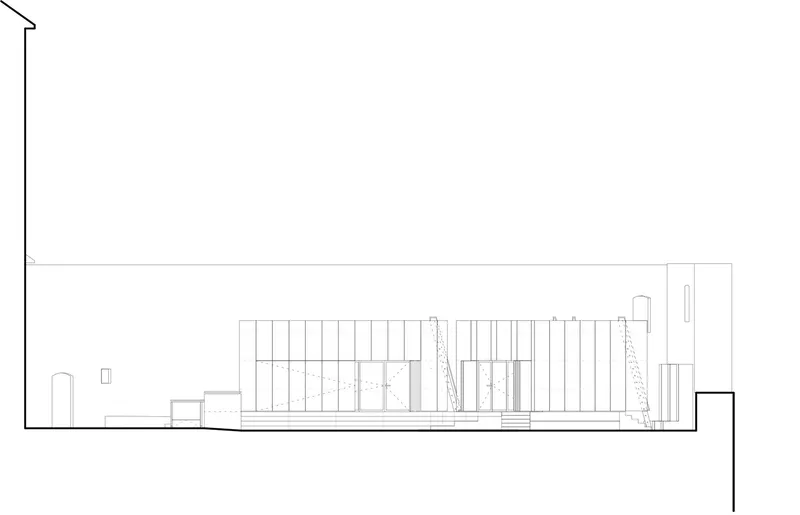
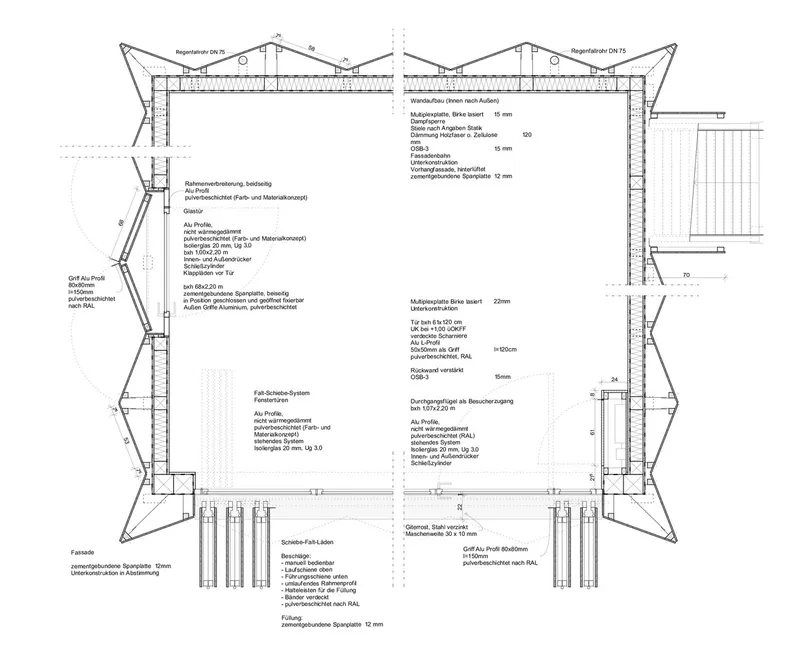
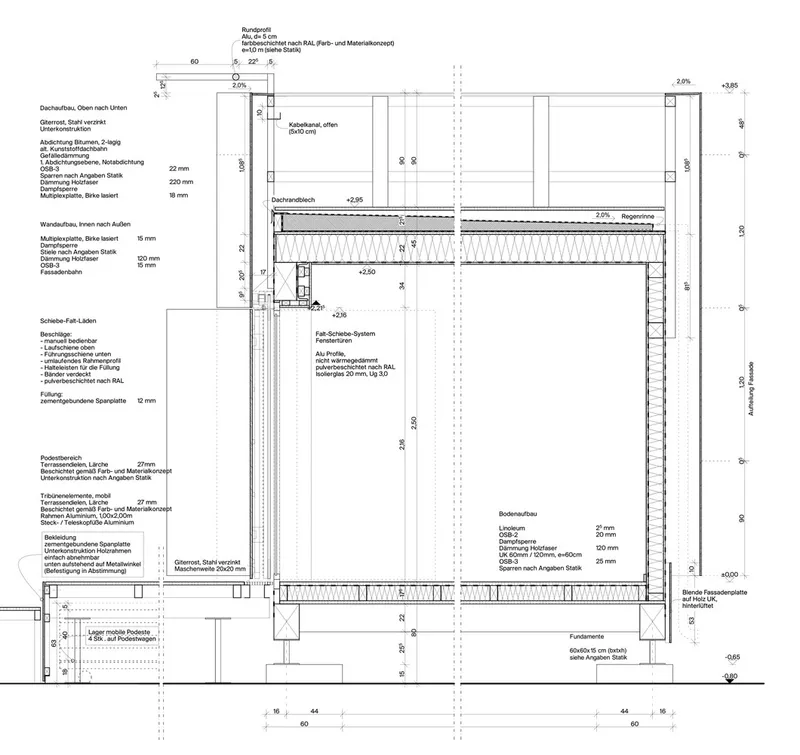
The section drawings are where the construction intelligence becomes fully legible. The angled facade structure and folding screen system are detailed with care, showing how the copper panels are mounted on a subframe that stands free of the primary timber structure. A layered wall assembly drawing with full dimensions reveals the wood-fiber insulation sandwiched between plywood and copper, achieving thermal performance without synthetic materials. Vertical slat screens provide additional modulation between interior and exterior, filtering light and views when full enclosure is not needed.
Why This Project Matters
Burgbühne Beeskow is a counter-argument to two common tendencies in heritage architecture: the glass-and-steel insertion that announces its modernity at maximum volume, and the faux-historic pastiche that pretends centuries never passed. Atelier Fanelsa has found a third path. The copper facades share the castle's warmth without copying its language. The timber frames use local craft traditions without performing nostalgia. And the point foundations demonstrate that you can build within a ruin without damaging it, an ethical position as much as a structural one.
The project also offers a lesson in rural cultural infrastructure. Small towns across Europe struggle to maintain public venues that justify year-round operation. By designing pavilions that can open into an outdoor stage in summer and close into insulated gallery rooms in winter, Fanelsa has given Beeskow a building that never goes dark. The architecture adapts to the community's rhythms rather than demanding the community adapt to it. That kind of programmatic generosity, achieved through simple mechanical means and honest materials, is worth far more than spectacle.
Burgbühne Beeskow by Atelier Fanelsa (Niklas Fanelsa, Anna Wulf, Felix Arlt). Beeskow, Brandenburg, Germany. 400 m². Completed 2024. Client: Landkreis Oder-Spree.
About the Studio
Share Your Own Work on uni.xyz
If projects like this are the kind of work you want to make, uni.xyz is a place to publish your own, find collaborators, and enter design competitions.


Popular Articles
Popular articles from the community


The Musturak Paradise: Senior Living Architecture for a Connected Future in Temara, Morocco
The Musturak Paradise reimagines senior living architecture in Temara via private homes, social spaces, culture, community, and shared care.

Co-Life: Senior Housing Design That Reconnects Older Adults With the City
Co-Life reimagines senior housing design through healing gardens, shared streets, workshops, and a sustainable community across generations.

Co-life: Sustainable Architecture for Age-Friendly Community Living
Co-life reimagines sustainable architecture for seniors through courtyards, rammed earth, shared gardens, and spaces designed for belonging.

Little Red Riding Hood: Architectural Design as a Journey Through Fear, Light, and Storytelling
Little Red Riding Hood reimagines the fairy tale through architectural design shaped by fear, light, scale, memory, uncertainty, and choice.

Similar Reads
You might also enjoy these articles


Hodi-Mandai Geram
Project Function: Preservation and revitalization of the Intangible heritage and socio-spatial identity of the Hodi by Housing, Cultural Memory Center, Sacred Grove, landscape, local tourism economy


Olio Towers: A Mid-Rise for Performers That Fuses Housing, Rehearsal, and Stage
Located blocks from Houston's Theater District, this modular tower stacks living units around a central performance atrium.

Oasis: Modular Green Housing Carved into Dhaka's Urban Fabric
A shortlisted Plugin Housing entry reclaims unauthorized settlements in Dhaka with stepped concrete volumes, green roofs, and ventilation-driven design.

Black Hole: A Floating Megastructure for the Post-Physical Era
Emiliano Mazzarotto envisions a spherical, self-scaling arena where e-sports, digital hotels, and holographic stadiums replace traditional public space.

Explore Architecture Competitions
Discover active competitions in this discipline

Challenge to reimagine the Iron Throne

Photograph architecture without architects

Illustrate the lost glory of Angkor Wat - Render Challenge

Design challenge to reuse E-waste
Comments (0)
Please login or sign up to add comments
No comments yet. Be the first to comment!