

Wardle Builds a Coastal Family Home from Hand-Torn Terracotta on Victoria's Cliff Edge
A cruciform beach house in Anglesea replaces a fire-damaged shack with baked earth, recycled timber, and passive solar strategy.


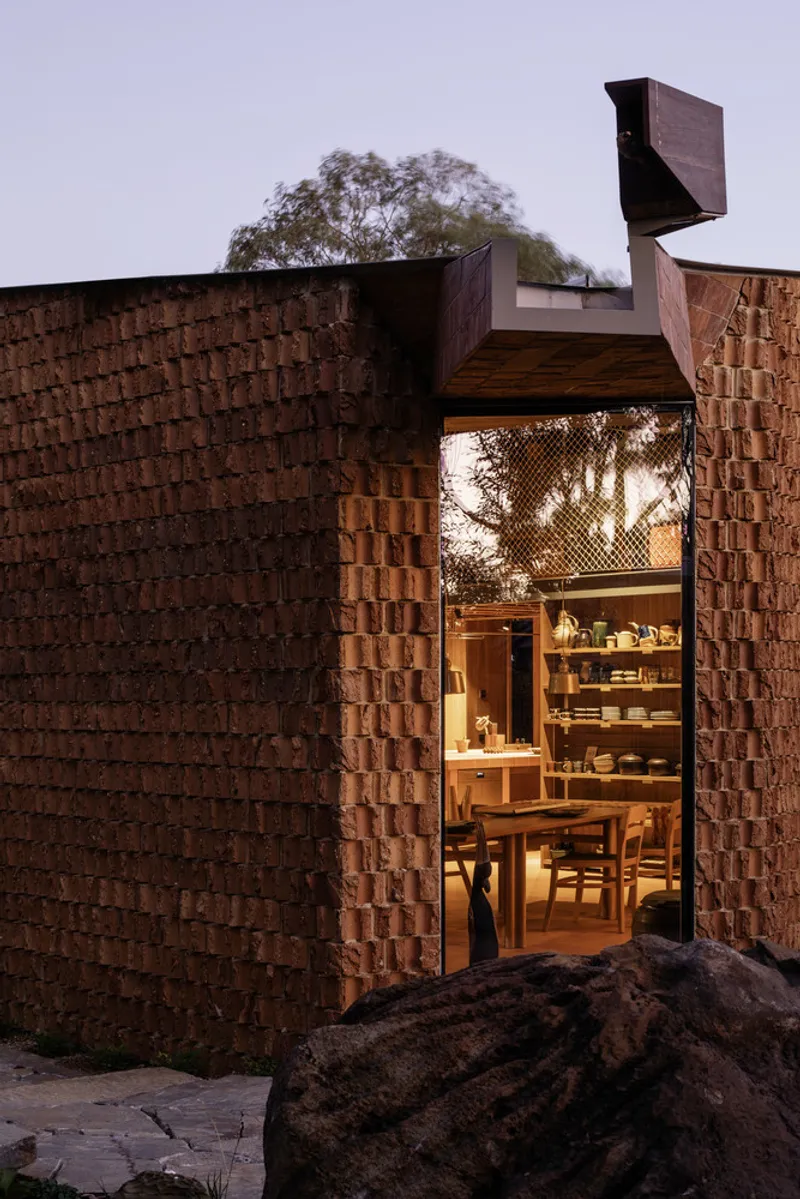
The question that launched this house was a simple one: is there a building material that is as natural and accessible as timber but lighter on the planet? Wardle's answer was baked earth. On a craggy cliff above the Southern Ocean in Anglesea, along Victoria's Great Ocean Road, the practice replaced a beach shack half-destroyed by the Ash Wednesday bushfires with a two-storey terracotta residence that treats material invention as a form of placemaking. Every brick was extruded by machine and torn by hand, yielding a facade whose rough texture and tonal range echo the scorched earth and coastal banksia of the site itself.
What makes the Burnt Earth Beach House genuinely interesting is the depth of its material experiment. Wardle worked with third-generation Victorian brickmakers Krause to develop a custom brick that reproduces the colour of nearby cliff faces. Terracotta tiles for the interior were sourced from Cotto Manetti in Chianti, shaped from Galestro clay and mechanically brushed after drying to feel handmade. A master craftsperson in Italy hand-coiled a custom terracotta bathtub, adding one layer per day. The result is a house where a single material family, baked earth, runs continuously from exterior wall to interior floor to bathtub, giving the building an almost geological coherence.
A Facade That Weathers Like the Cliff Below
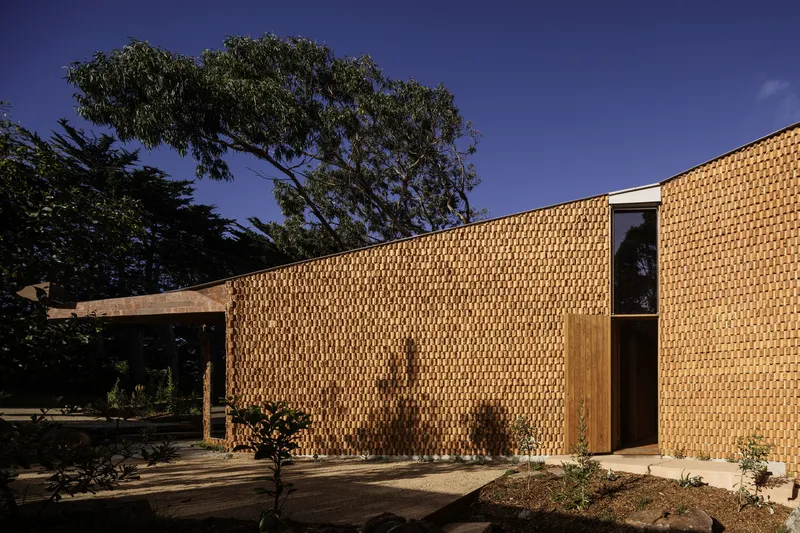
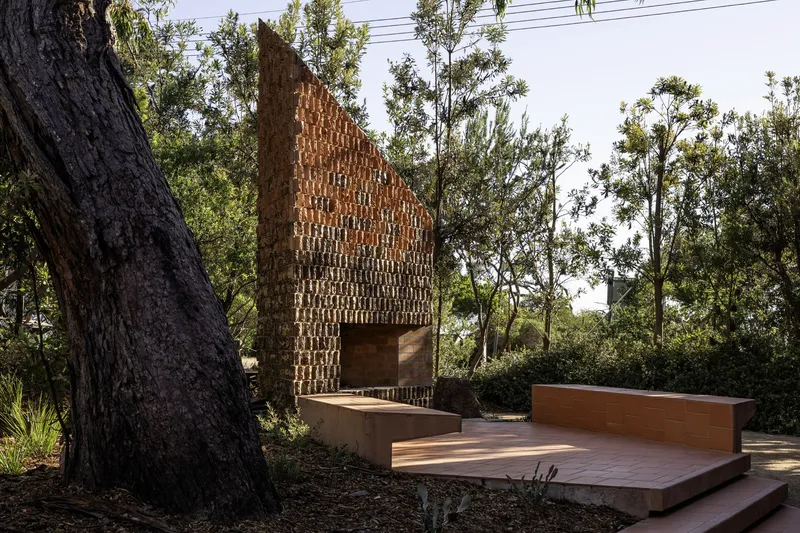
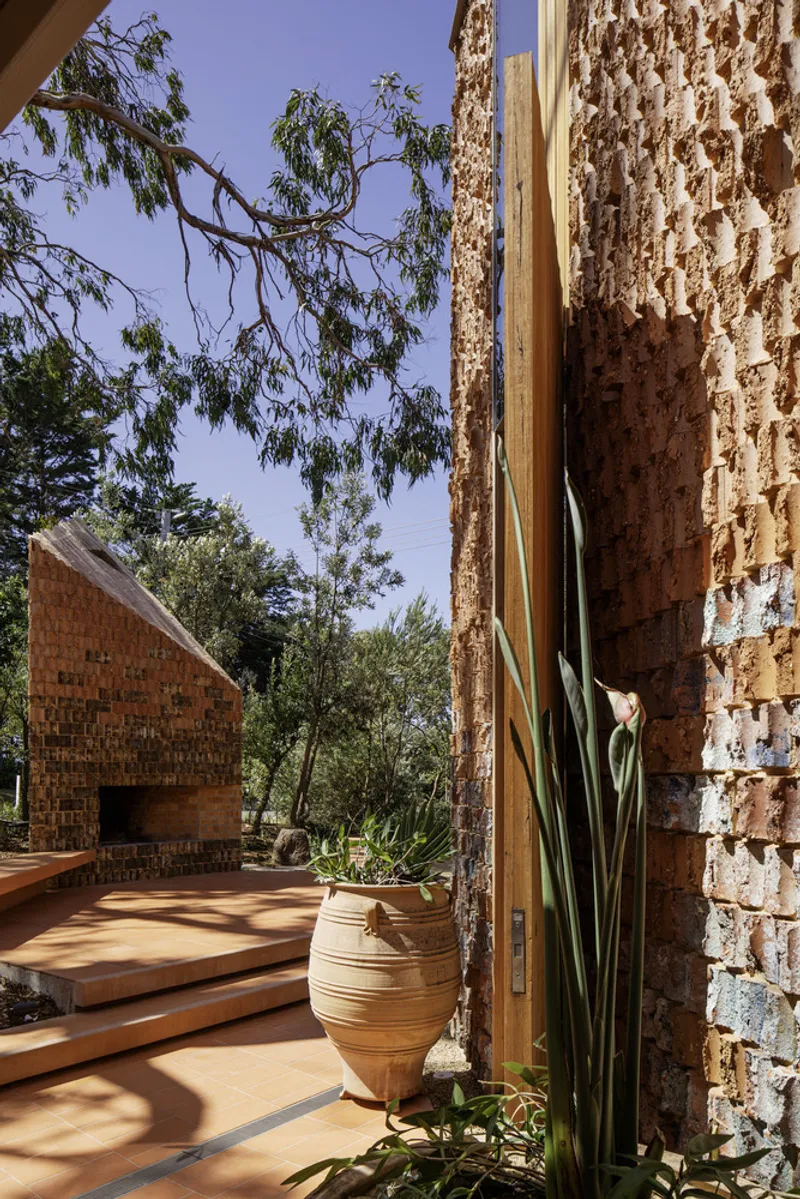
The exterior brickwork moves between profiled unglazed and glazed surfaces. Most bricks are single-fired to cut the carbon footprint of double-firing; select sections carry mottled green and brown glazes that recall the lichen and foliage of the coastal scrub. The basketweave patterning visible at the gable ends is not decorative whimsy but a strategy for modulating light and shadow across the wall plane, giving the facade a grain that shifts through the day. Tall, narrow openings punctuate the masonry, framing controlled glimpses rather than panoramic sheets of glass.
Wardle has long advocated for the "framed view," rejecting expansive glazing in favour of carefully composed sightlines. That conviction is structurally evident here: the building's mass reads as solid first, open second, which also makes practical sense in a BAL-29 high-risk fire zone. The house presents itself as something already of the ground, a volume of baked earth returned to the cliff edge from which its palette was drawn.
Courtyard and Cruciform: Organizing Light and Sociability
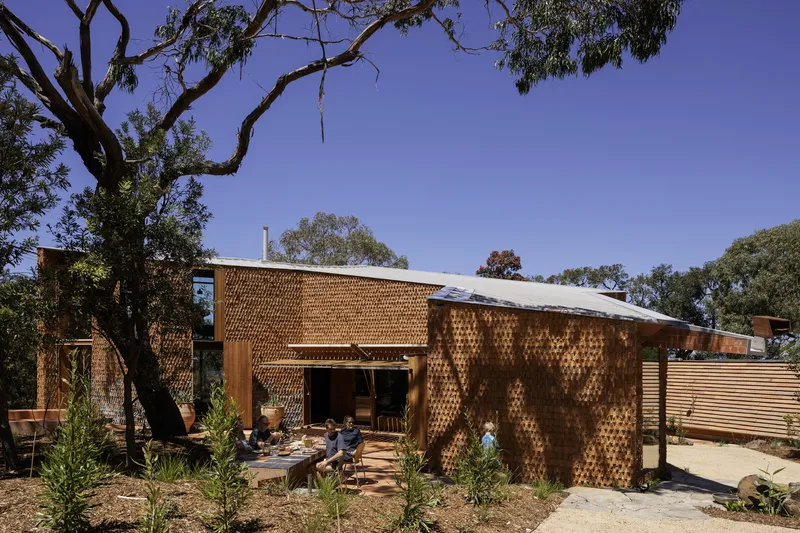
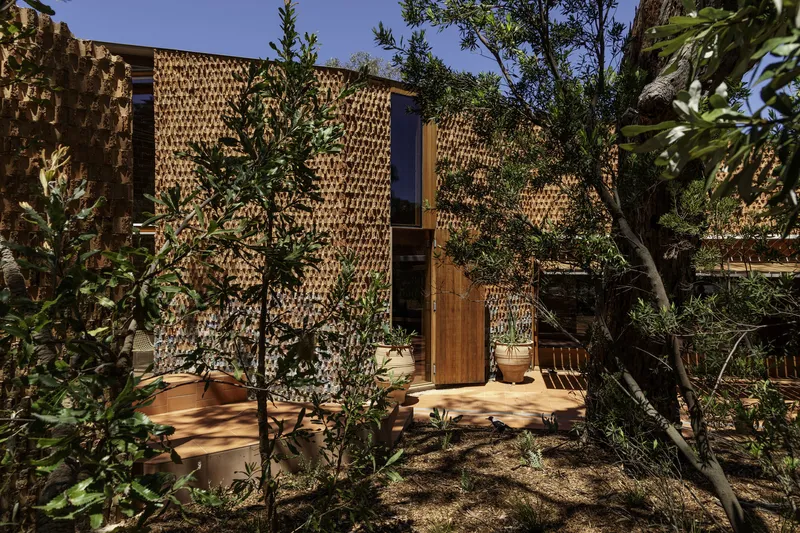
The plan is broadly cruciform, and that X-shape does two things well. It describes four view corridors that pull daylight deep into the centre of the house, and it pushes external terraces outward around a broad courtyard. The kitchen island sits at the crossing point, literally the social nucleus of a multi-generational family home. From there, living and dining areas extend toward the ocean while two bedrooms and utility spaces lock into the southern boundary.
The courtyard, visible through glazed openings and framed by planted saplings and existing eucalyptus, acts as a second room. At dusk, the illuminated interior glows through the narrow entrance gap between brick walls, compressing space before releasing it into the dining area. That threshold sequence, from courtyard to slot to lit interior, gives a sense of ceremony to what could otherwise be a casual beach house arrival.
Terracotta Inside and Out
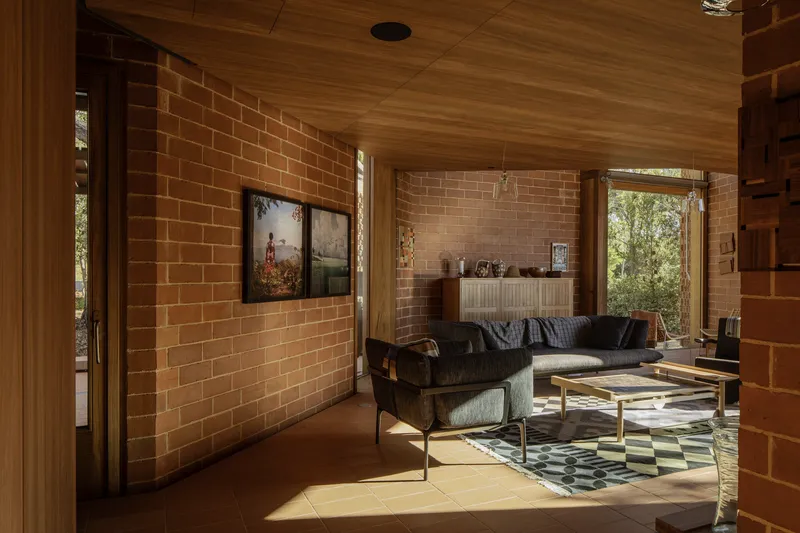
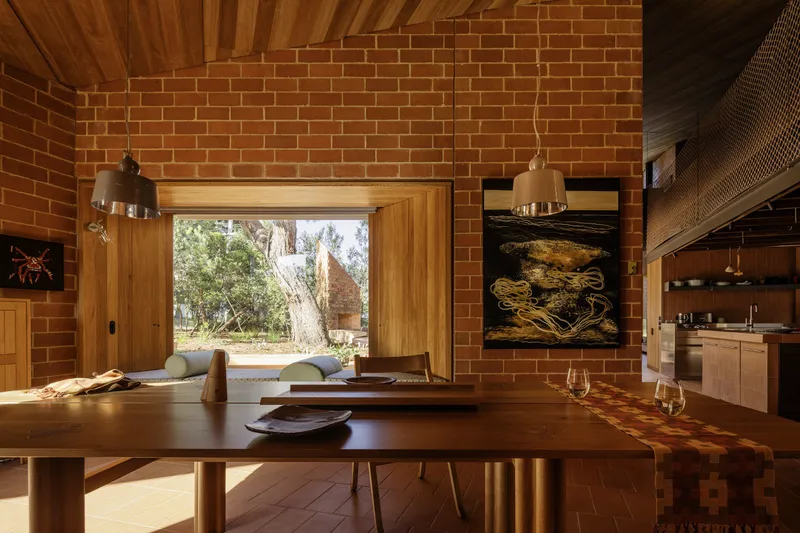
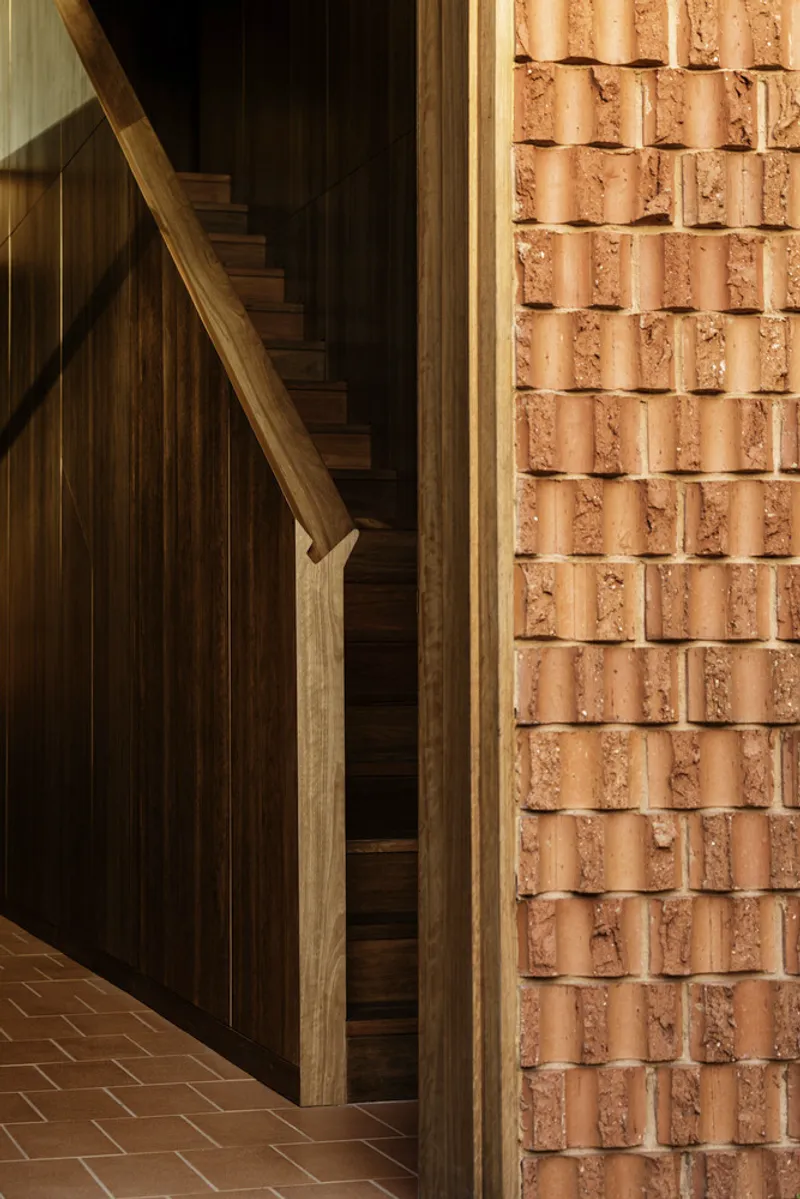
Inside, the terracotta theme intensifies rather than retreats. Walls, floors, and joinery elements are lined with Italian terracotta tiles from Cotto Manetti. The tiles' soft, mechanically brushed finish absorbs light rather than bouncing it, producing interiors that feel warm without needing warm-coloured lighting. Spotted gum timber, used as recycled floorboards, veneer joinery, solid window frames, and exposed structural beams, provides a tonal counterpoint: golden against the red-brown of the clay.
A single ceiling plane unifies the interior volumes, and afternoon sunlight enters through open doorways and high-level windows to rake across brick surfaces. The stair alongside a terracotta wall becomes a light well in its own right, catching filtered rays through a carefully placed opening. These are not accidental effects; the house was designed to chase sunlight, establishing different zones of sociability as the sun moves through the day.
The Kitchen as Crossing Point
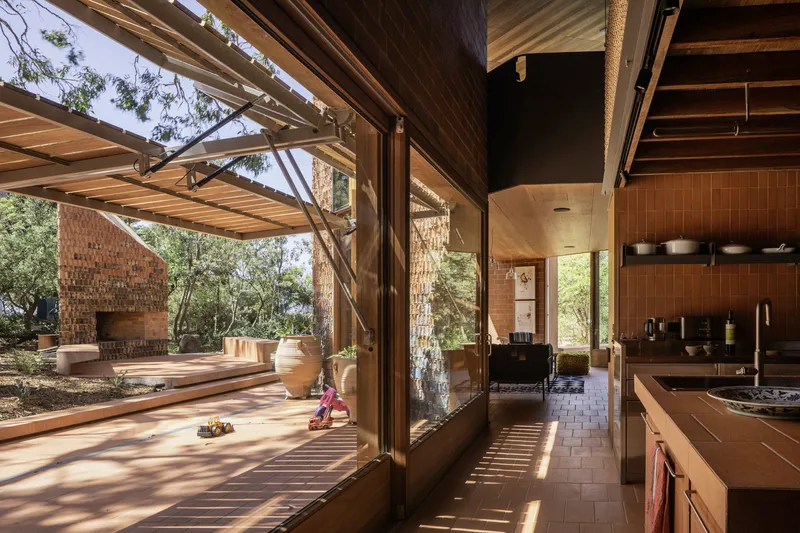
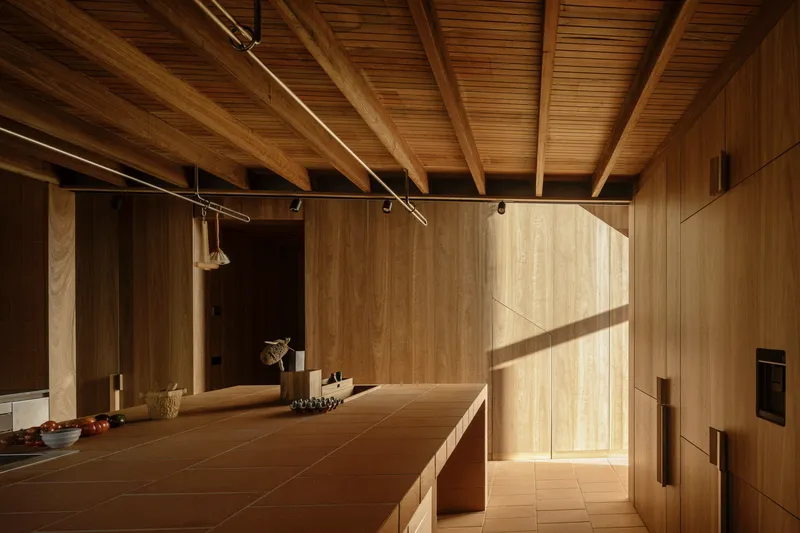
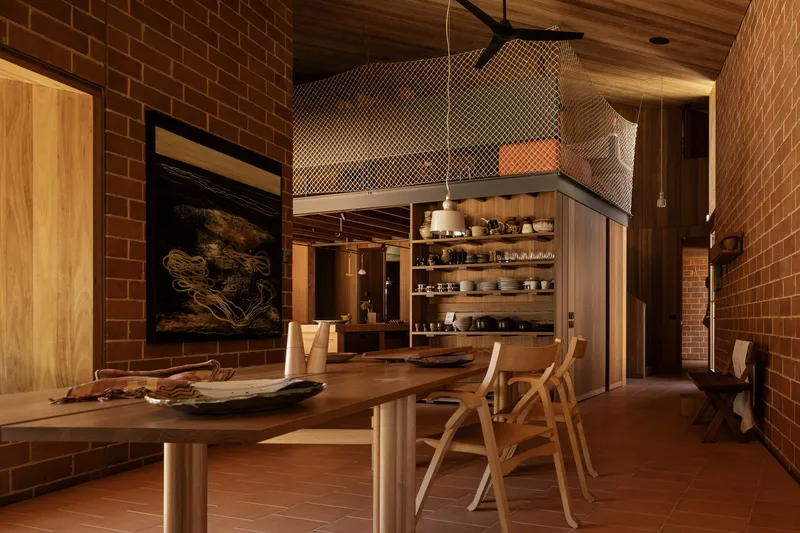
The kitchen occupies the exact centre of the cruciform plan and performs accordingly. Folding timber doors open directly to a covered outdoor deck and a brick fireplace, blurring the line between cooking indoors and eating outside. A stainless-steel bench handles meal preparation, while timber cabinetry and exposed beam ceilings keep the space materially consistent with the rest of the house. Above and adjacent, a mesh-wrapped volume containing the upstairs study hovers at the edge of the double-height space, adding visual depth without enclosing it.
This is the room where the cruciform logic pays off most directly. Standing at the island, you have sight lines in four directions: toward the ocean, the courtyard, the living room fire, and the terrace. It is a panopticon of hospitality, and the kind of spatial generosity that typically requires an open-plan barn, achieved here with a plan that also manages to feel intimate.
Hand-Knitted Netting and Craft Details
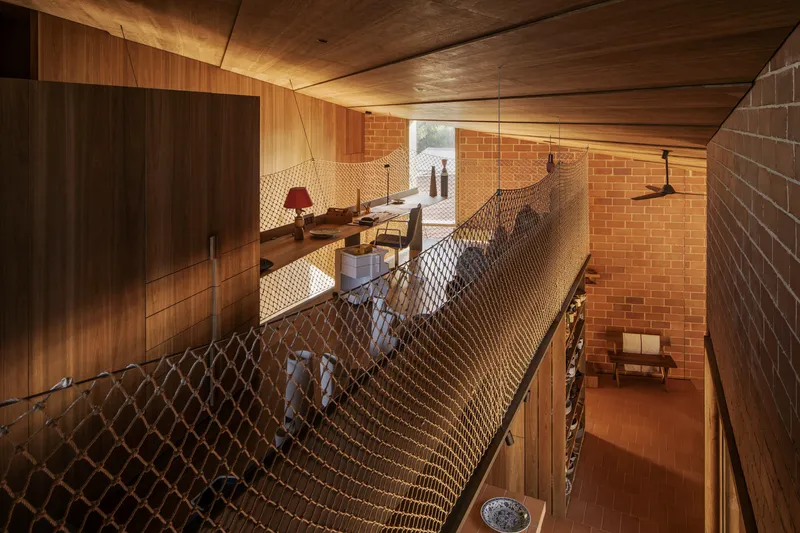
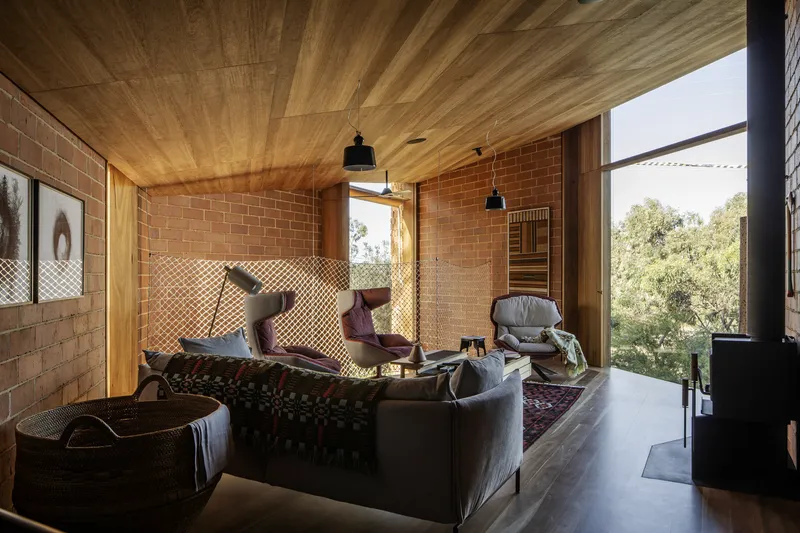
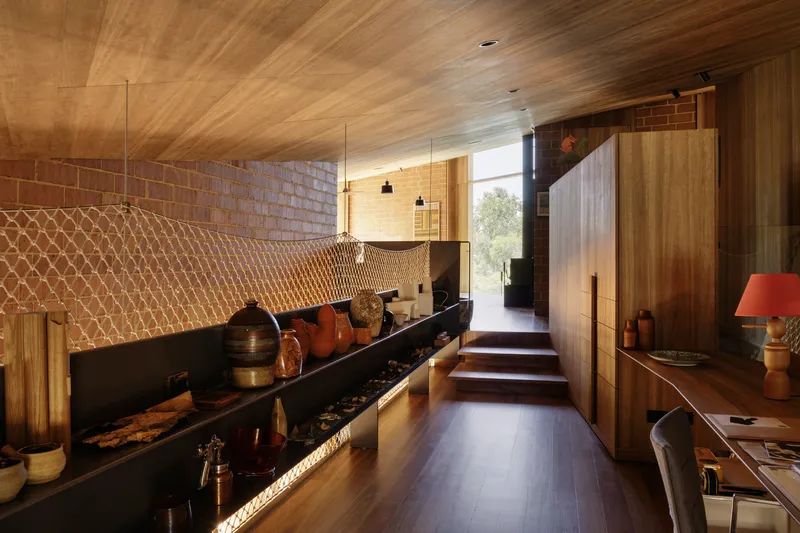
The most unexpected element is the rope mesh netting that wraps the upper-level study, hand-knitted in Vietnam and suspended between timber-clad walls and terracotta volumes across two storeys. It functions as balustrade, spatial divider, and tactile surprise all at once. The netting softens the transition between ground-floor communal life and the quieter upper bedrooms, filtering views without blocking them.
These moments of handcraft, the torn bricks, the brushed tiles, the coiled bathtub, the knotted net, accumulate into something larger than any single detail. They signal a design approach where time is embedded in material. Every surface records a hand or a process, giving the house an age before it has had time to age. In a fire-prone coastal setting where buildings are often treated as disposable, that investment in slow-made materials reads as an ethical stance.
Private Rooms and the Copper Bathtub
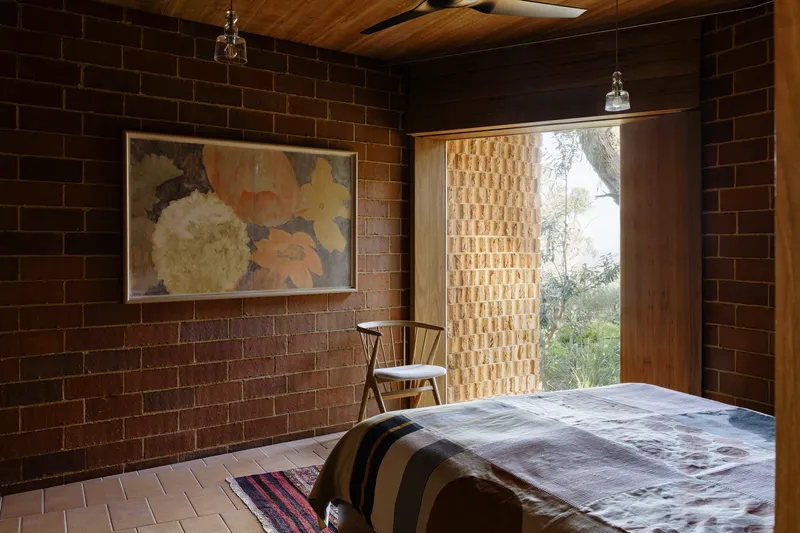
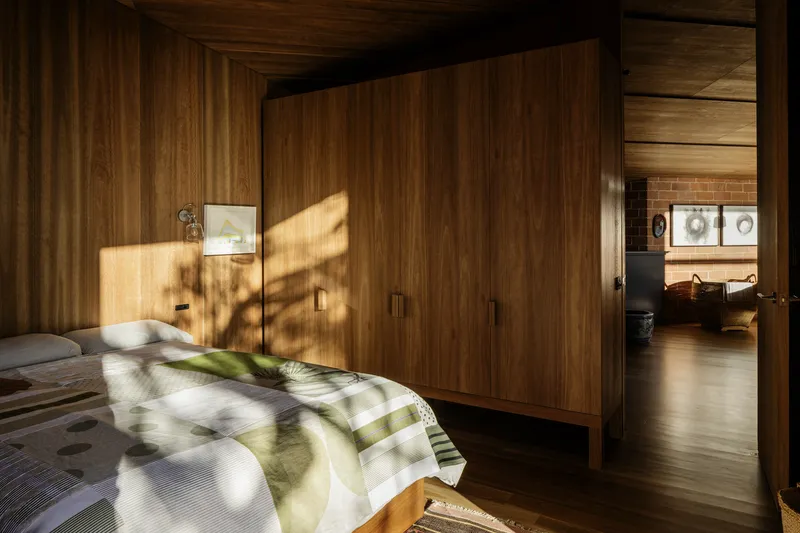
The bedrooms are quieter versions of the same material language. Timber panelling lines one bedroom; terracotta brick wraps another. Both use textured screen doors that open to the garden, maintaining the house's constant dialogue between interior and landscape. Morning light casts tree shadows across built-in wardrobes, reinforcing the sense that the bush is never far away.
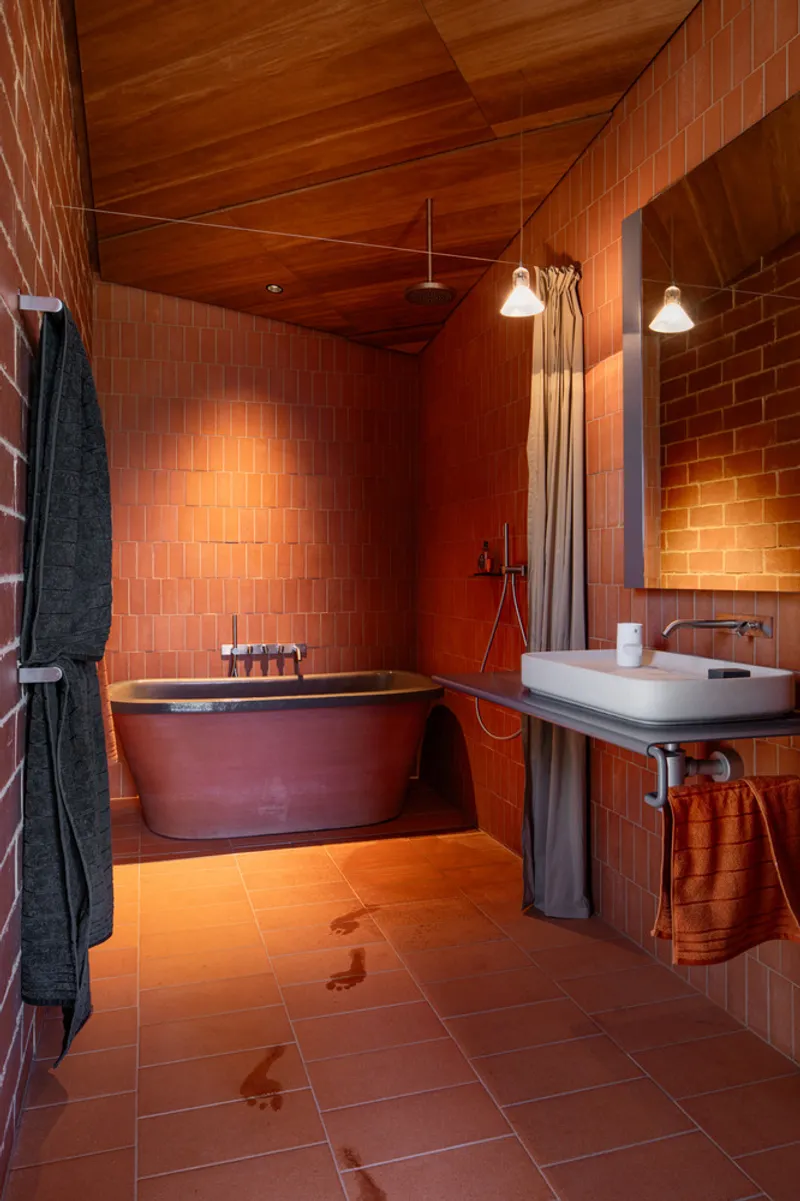
The bathroom deserves a paragraph of its own. Against terracotta brick walls and under a timber ceiling, a freestanding bathtub sits in what could be mistaken for a heritage cellar. That tub was hand-coiled by a Manetti master craftsperson using a gradual layering technique: one ring of clay per day, built up over weeks, then fired and glazed on the interior surface. It is, as far as building components go, closer to a ceramic sculpture than a fixture. Pendant lights and copper tones complete the scene, and the room feels less like a bathroom and more like a small chapel for bathing.
Passive Performance on a High-Risk Site
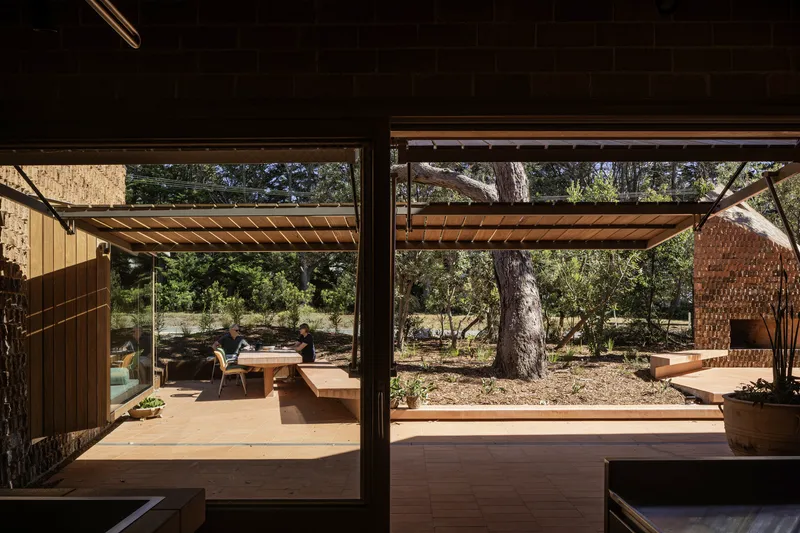
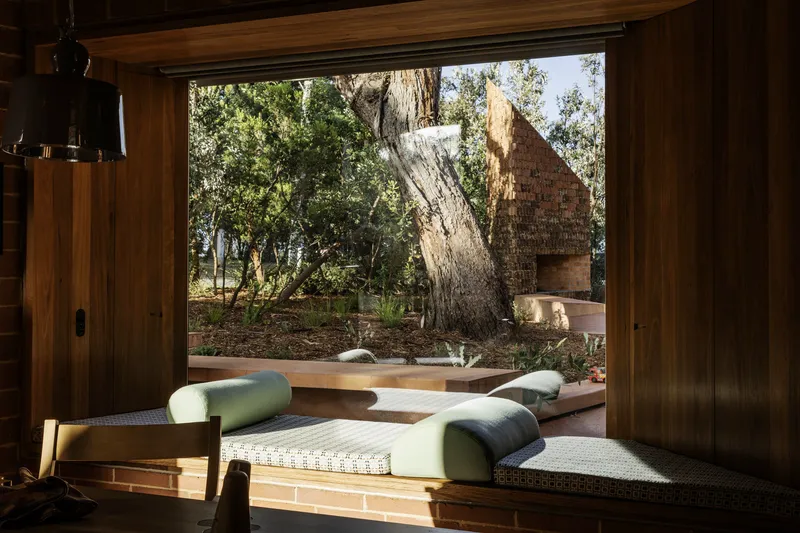
The house faces north with views to the Southern Ocean, a classic passive solar orientation for the southern hemisphere. A heavily insulated and sealed concrete slab mitigates terracotta's thermal conductivity, while operable blinds and shutters modify heat and light into the centre of the plan. Large shade awnings, operated with a two-stage tilt-up mechanism, control solar gain over the central living space. The building is 100% electric, running on a heat exchange water system, hydronic heating, and rooftop solar panels.
The site itself imposed constraints that shaped the design. It sits in a BAL-29 high-risk fire zone, on ground compromised by a 1920s landslip. Two-storey elements are positioned close to the cliff edge, mirroring the rugged topography rather than retreating from it. Covered terraces with timber slat roofs extend the living areas outward, but always with shading and ventilation control built in. The passive strategy is not an afterthought bolted onto an aesthetic concept; it is the concept, with terracotta serving simultaneously as expressive surface and thermal envelope.
Plans and Drawings
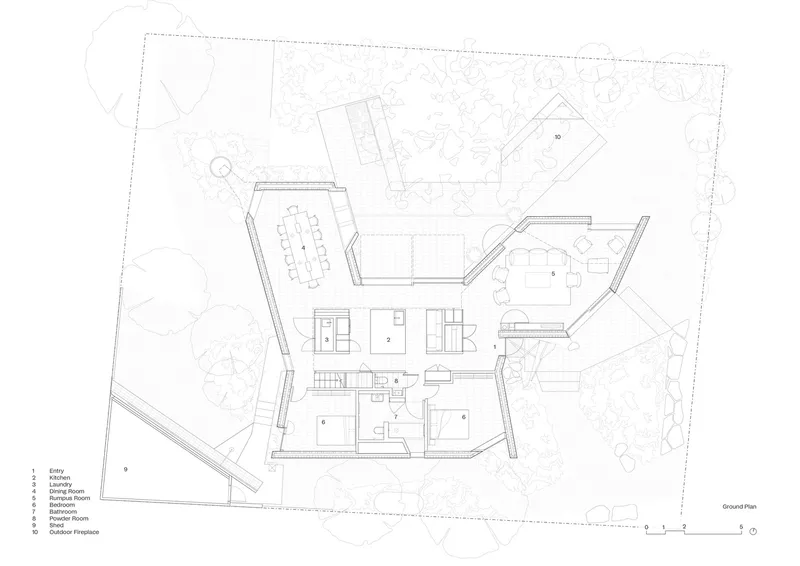
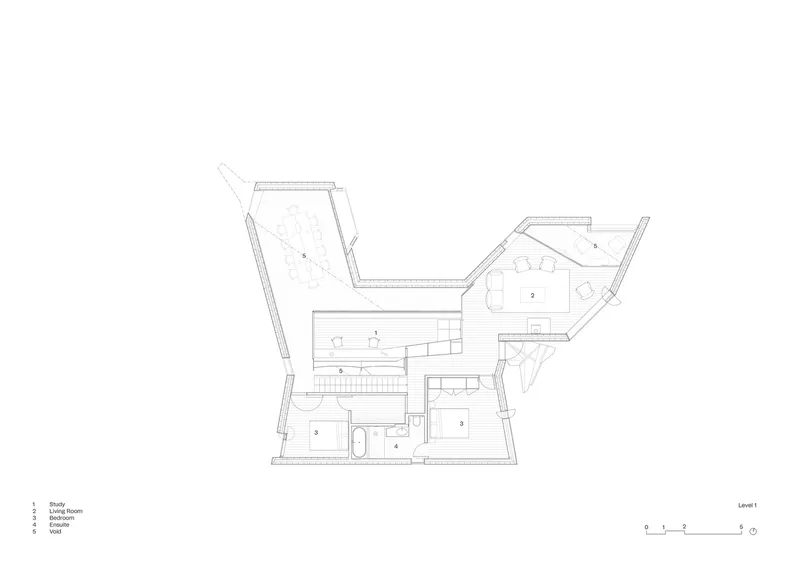
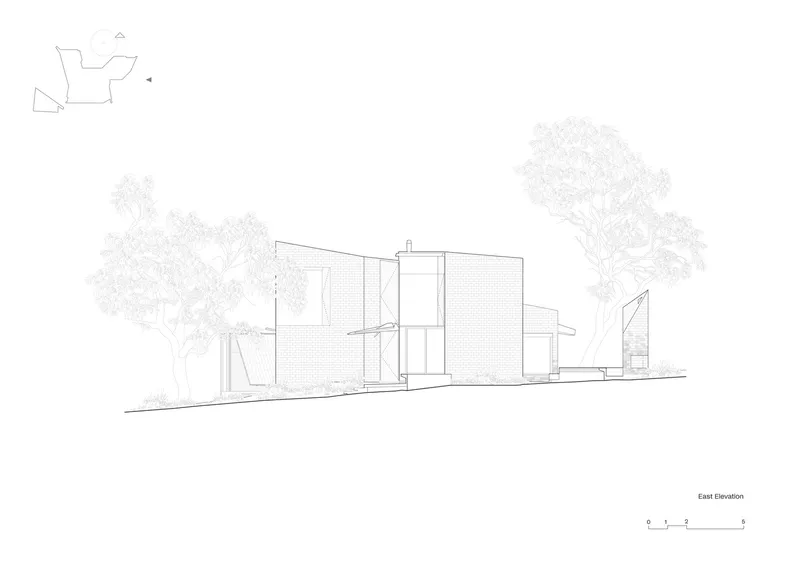
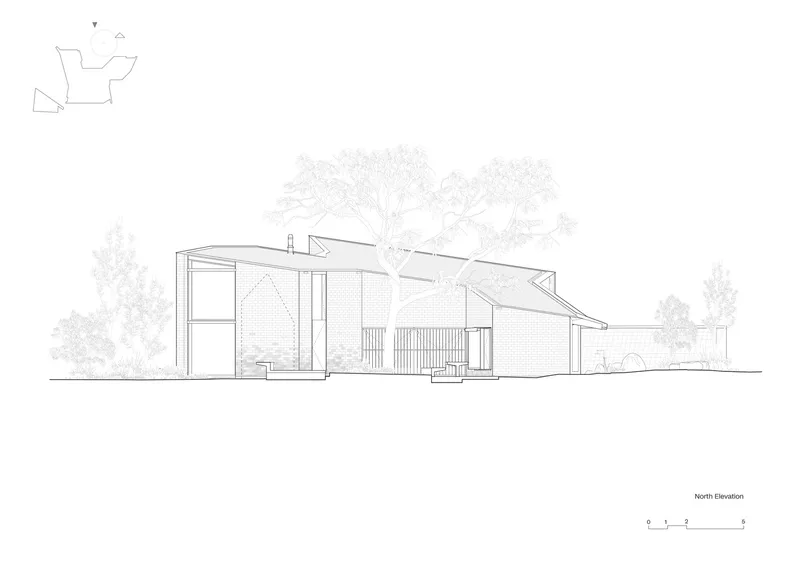
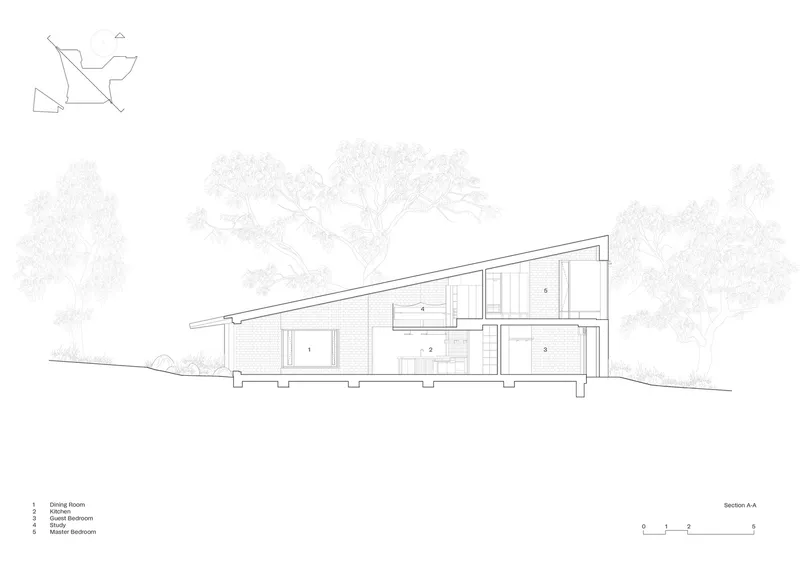
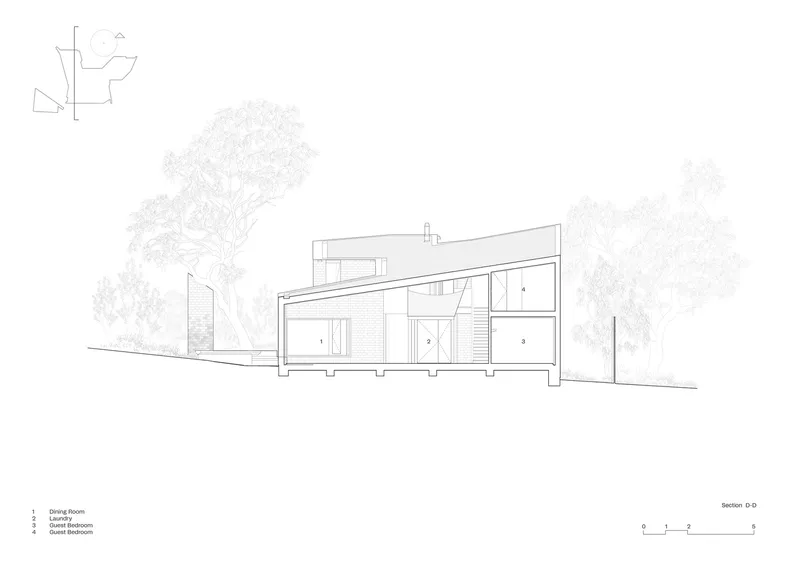
The ground floor plan reveals the cruciform logic clearly: four arms radiating from the kitchen island, with terraces filling the voids between them and a broad courtyard anchoring the composition. The upper level splits into a compact study projecting over the stair, a secondary living space, and two bedrooms. Sections show how the sloping and angled rooflines negotiate the cliff-edge topography, stepping down toward the ocean while maintaining a single ceiling plane that unifies the interior. The elevations confirm the dominance of brick, with glazed openings carved sparingly into substantial masonry walls.
Why This Project Matters
Burnt Earth Beach House matters because it treats material research as the primary architectural act. In a profession that often defaults to timber or steel and then applies a veneer of sustainability rhetoric, Wardle spent months with a local brickmaker developing a brick that belongs specifically to this cliff, this colour, this fire history. The collaboration extended across continents, from Krause in Victoria to Manetti in Chianti, linking regional craft traditions through a shared material: clay, shaped and fired. The house proves that baked earth can do everything timber does in a coastal Australian home, while introducing thermal mass, fire resistance, and a visual richness that wood alone cannot match.
More broadly, the project challenges the assumption that a beach house should be lightweight and transparent. Wardle's framed views, thick walls, and cruciform plan create a dwelling that feels sheltering rather than exposed, a quality that becomes increasingly relevant as climate pressures intensify along Australia's southern coast. It is a house built to outlast the next fire, the next storm, and the next generation, not through brute engineering but through careful alignment of material, orientation, and craft. That combination of pragmatism and poetry is rare, and it sets a benchmark for coastal residential architecture in Australia.
Burnt Earth Beach House by Wardle, Anglesea, Victoria, Australia. Approximately 200 square metres. Completed 2023. Photography by Trevor Mein.
About the Studio
Share Your Own Work on uni.xyz
If projects like this are the kind of work you want to make, uni.xyz is a place to publish your own, find collaborators, and enter design competitions.


Popular Articles
Popular articles from the community


Singing Woman: An Opera House That Performs Before the Curtain Rises
Ovidiu Cristian Pavel's conceptual opera house translates Estonia's choral identity into a sculpted waterfront landmark facing the Baltic Sea.

Aquadapt: An Underwater Habitat That Rewrites Its Rooms by the Hour
Curved modules ring the seabed while one shell shifts from breakfast room to cinema, farm and football pitch as residents' needs change.


graciastudio Turns a Viewless Tijuana Lot Inward Around a Courtyard of Concrete, Timber and Trees
In Tijuana, Jorge Gracia's GA2 House stacks a timber-clad private floor over exposed concrete and replaces a missing view with a planted interior patio.

Manzana Morphosis: Stretching Barcelona's Grid into a Living Landscape for 2050
A radical reworking of the Eixample manzana turns density into a tool for generous public space, vertical ecology, and environmental performance.

Similar Reads
You might also enjoy these articles


Hodi-Mandai Geram
Project Function: Preservation and revitalization of the Intangible heritage and socio-spatial identity of the Hodi by Housing, Cultural Memory Center, Sacred Grove, landscape, local tourism economy


Olio Towers: A Mid-Rise for Performers That Fuses Housing, Rehearsal, and Stage
Located blocks from Houston's Theater District, this modular tower stacks living units around a central performance atrium.

Oasis: Modular Green Housing Carved into Dhaka's Urban Fabric
A shortlisted Plugin Housing entry reclaims unauthorized settlements in Dhaka with stepped concrete volumes, green roofs, and ventilation-driven design.

Black Hole: A Floating Megastructure for the Post-Physical Era
Emiliano Mazzarotto envisions a spherical, self-scaling arena where e-sports, digital hotels, and holographic stadiums replace traditional public space.

Explore Architecture Competitions
Discover active competitions in this discipline

Challenge to reimagine the Iron Throne

Photograph architecture without architects

Illustrate the lost glory of Angkor Wat - Render Challenge

Design challenge to reuse E-waste
Comments (0)
Please login or sign up to add comments
No comments yet. Be the first to comment!