
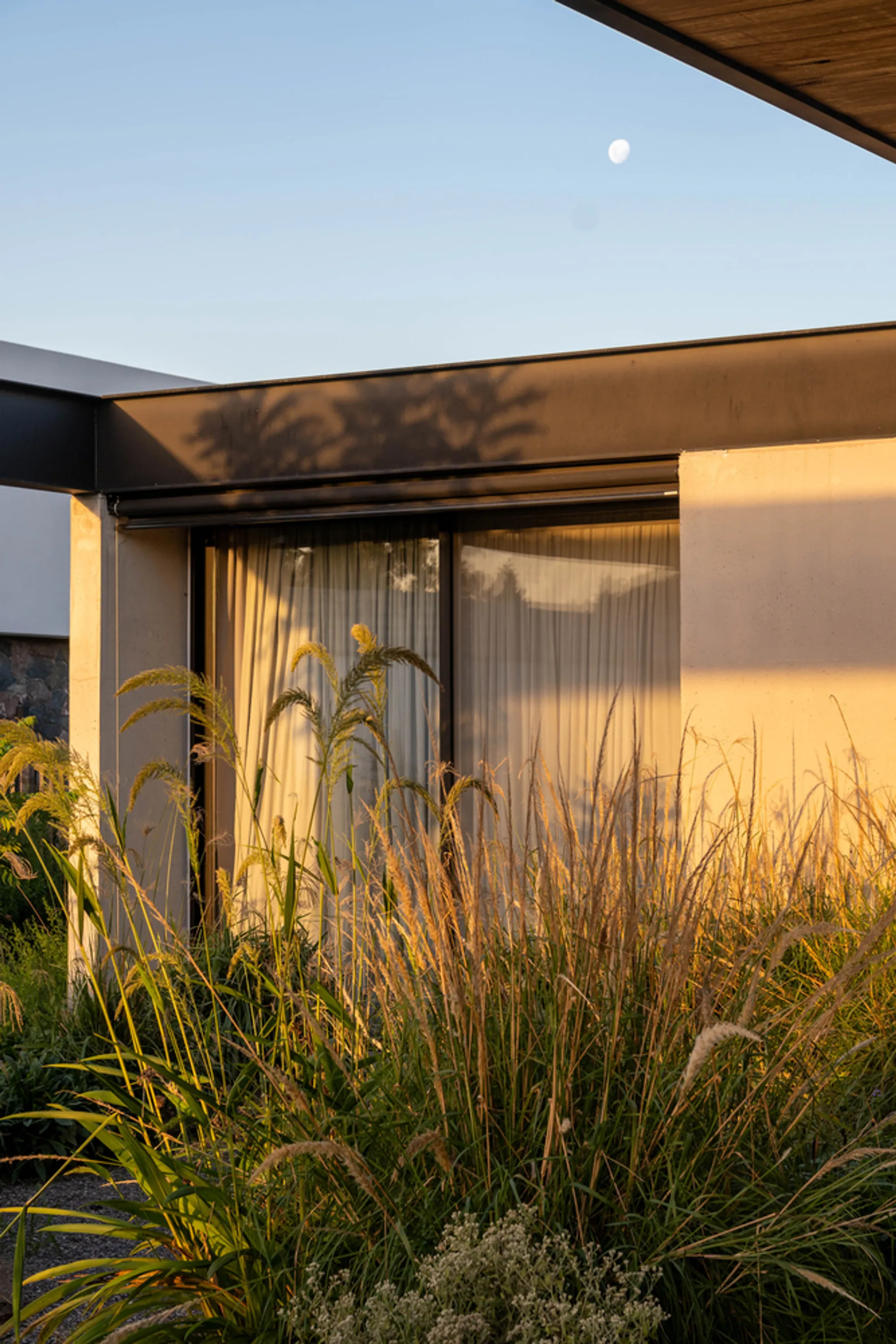
3164.estudio and SDF Arquitectos Split a Córdoba House Along a Central Axis That Opens to the Sky
Two volumes, one social and one private, frame courtyards of native grasses and a reflecting pool in a flat residential neighborhood.


A house that turns its back to the street and opens wide to the sky is not a new idea, but the Cañuelas House in Córdoba, Argentina, executes it with a precision that makes the trope feel purposeful again. Designed collaboratively by 3164.estudio and SDF Arquitectos, the 2023 residence splits its program into two concrete volumes linked by a central circulation spine. That spine is not merely a corridor. It is the organizing logic for everything: vehicle access, pedestrian entry, courtyard views, and the visual release at the rear into a pool deck and open grass.
What actually makes the project worth studying is its material discipline. Exposed concrete, irregular porphyry stone, timber soffits, and black steel framing recur throughout, but their placement shifts room by room. The barbecue gallery flips the palette, putting timber overhead and stone underfoot, while the bedrooms maintain the rawness of board-formed concrete. Nothing is ornamental. The landscape, planted entirely with native Córdoba species that bloom in different seasons, does the decorative work the architecture deliberately refuses to do.
Introverted Facades, Generous Interiors
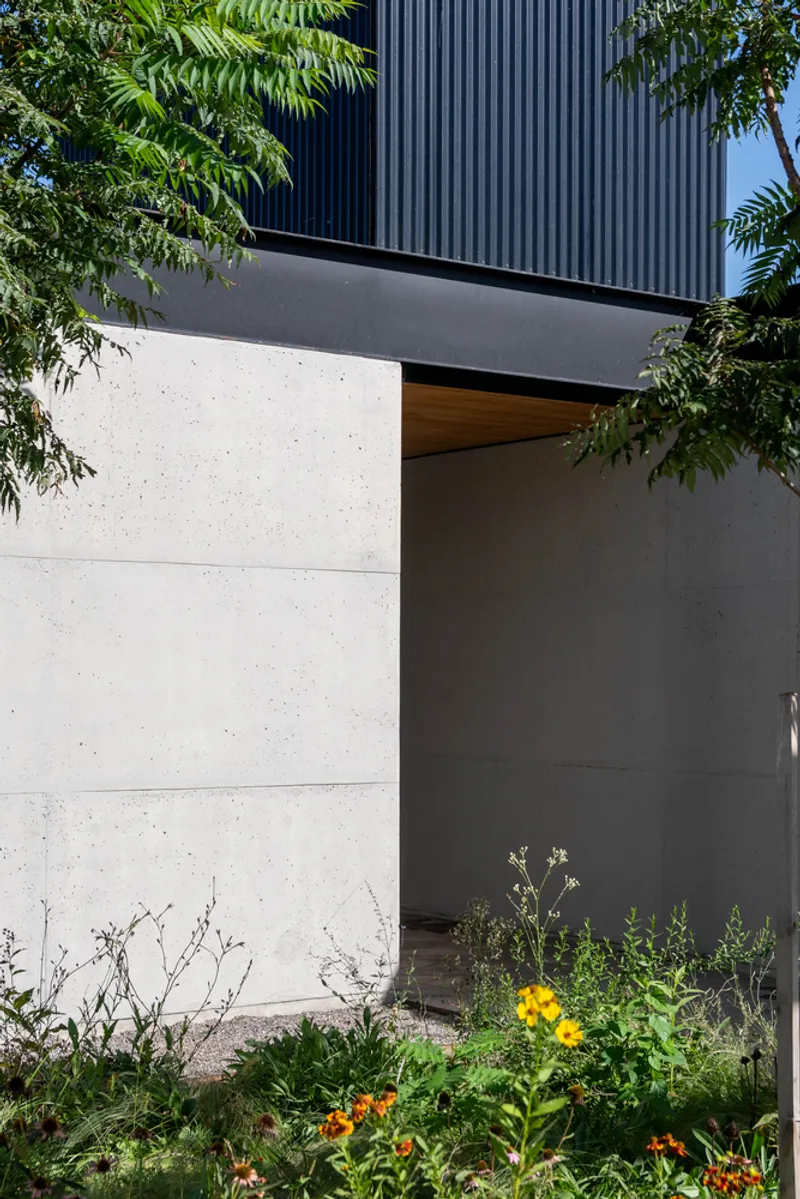
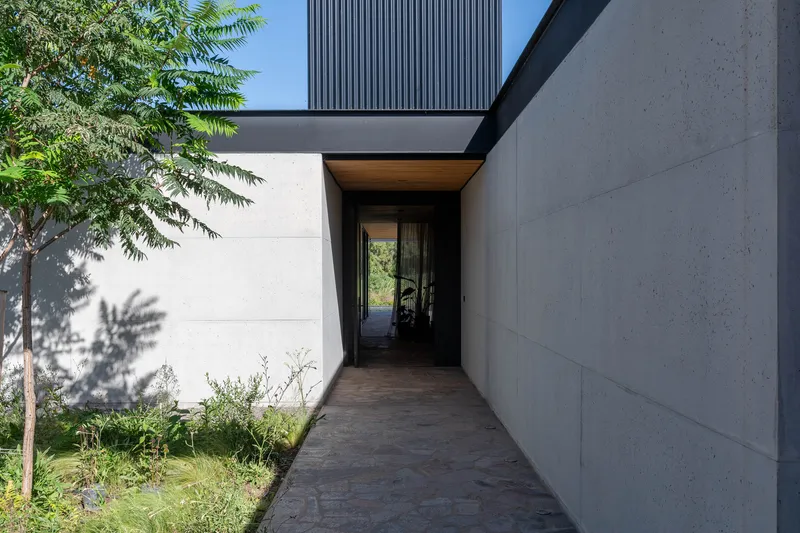
From the street, the Cañuelas House presents a nearly blank face. A corrugated upper volume sits above a concrete niche that reads as the entrance, flanked by flowering beds rather than conventional landscaping. The message is deliberate: look elsewhere. The concrete entry passage, with its timber-lined soffit and a single tree casting shadows against the wall, functions as a decompression chamber between public and domestic life.
The white rendered walls and dark fascia at the perimeter reinforce that introversion. Planted grasses soften the boundary without compromising it. The architects clearly understood that in a flat, purely residential neighborhood, privacy is not a luxury but a structural requirement of daily comfort.
The Central Axis as Spatial Engine
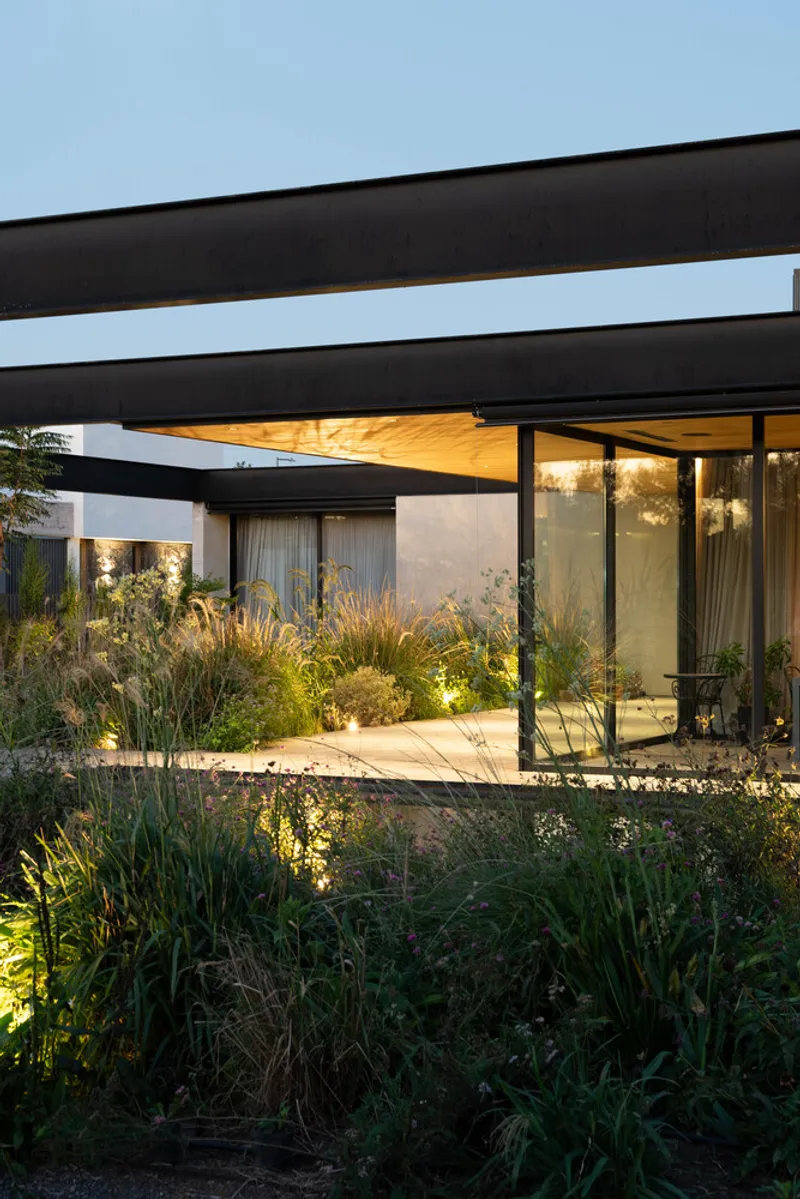
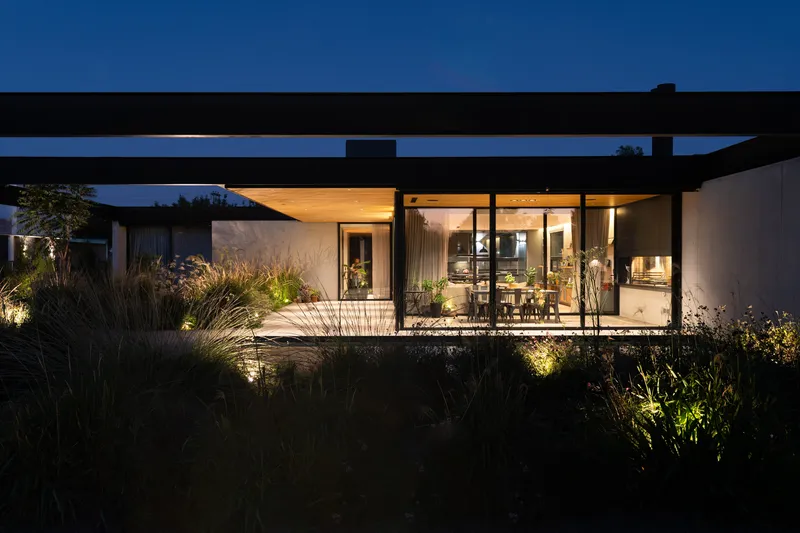
The axis that connects the two volumes is the real protagonist of the house. Beginning at the street with access for cars and pedestrians, it moves through a series of pauses: moments where the walls pull apart to reveal a courtyard, a reflecting pool, or a planted bed. These breaks are not accidental. They stagger the experience of entering the house so that by the time you reach the rear patio, the transition from city to domestic landscape feels complete.
At twilight, the steel beam pergola over the courtyard catches uplighting from the planted beds below, turning the structural frame into a kind of lantern. The glazed living spaces visible through this frame become a stage set, their warmth amplified against the cooling sky. It is a house that performs best at dusk, which is no accident in a climate where outdoor life tends to happen in the evening hours.
Social Volume: Kitchen, Grill, and the Blurred Edge
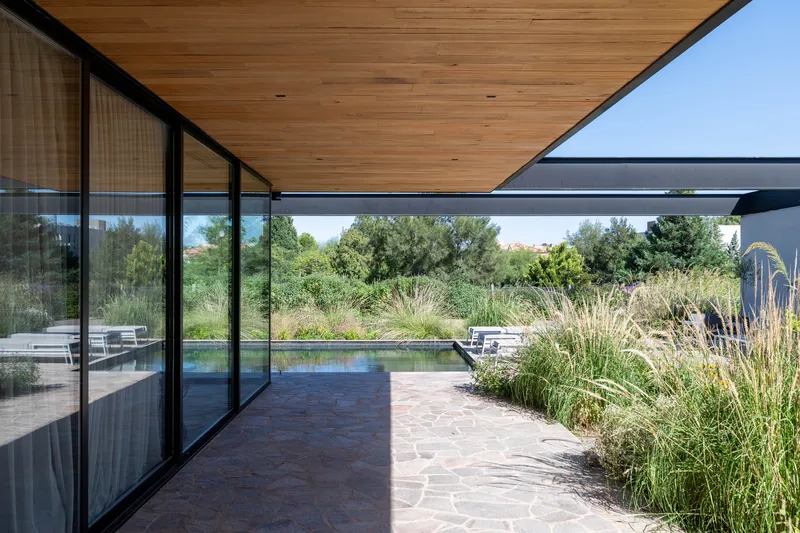
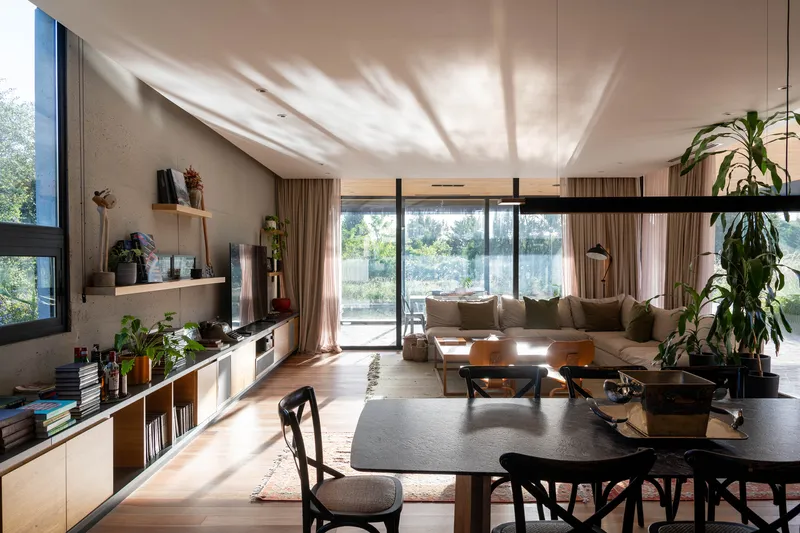
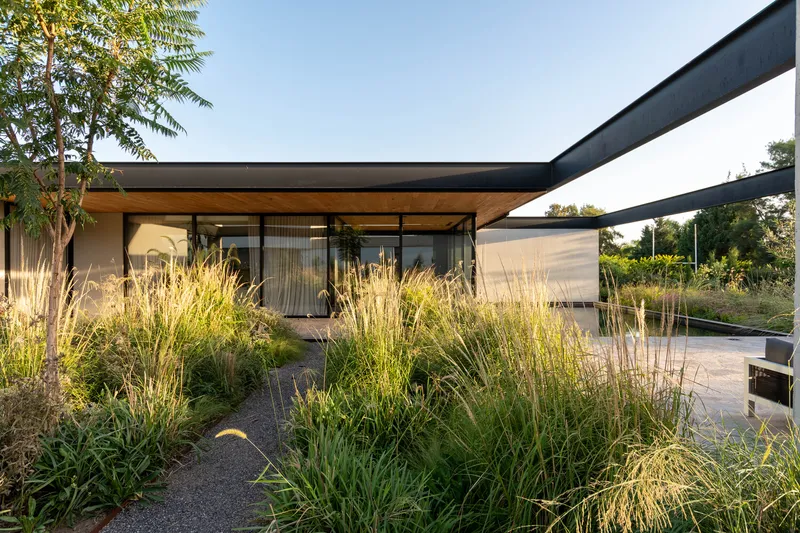
The social wing holds the kitchen, dining room, living room, and a grill area that can swing between indoor and outdoor use depending on the season. The covered terrace, with its timber ceiling and full-height glazing, is the hinge. It faces the pool and the open grass beyond, collapsing the distinction between a formal living room and a garden pavilion. The timber soffit overhead drops the scale to something intimate even though the view is expansive.
Inside, the open-plan living and dining space plays with dappled light filtering from above through planted zones and clerestory openings. Timber shelving and houseplants inject warmth into what could otherwise be a stark concrete interior. The material restraint keeps the eye moving toward the landscape rather than settling on any single interior surface.
Concrete, Porphyry, and the Reversed Palette
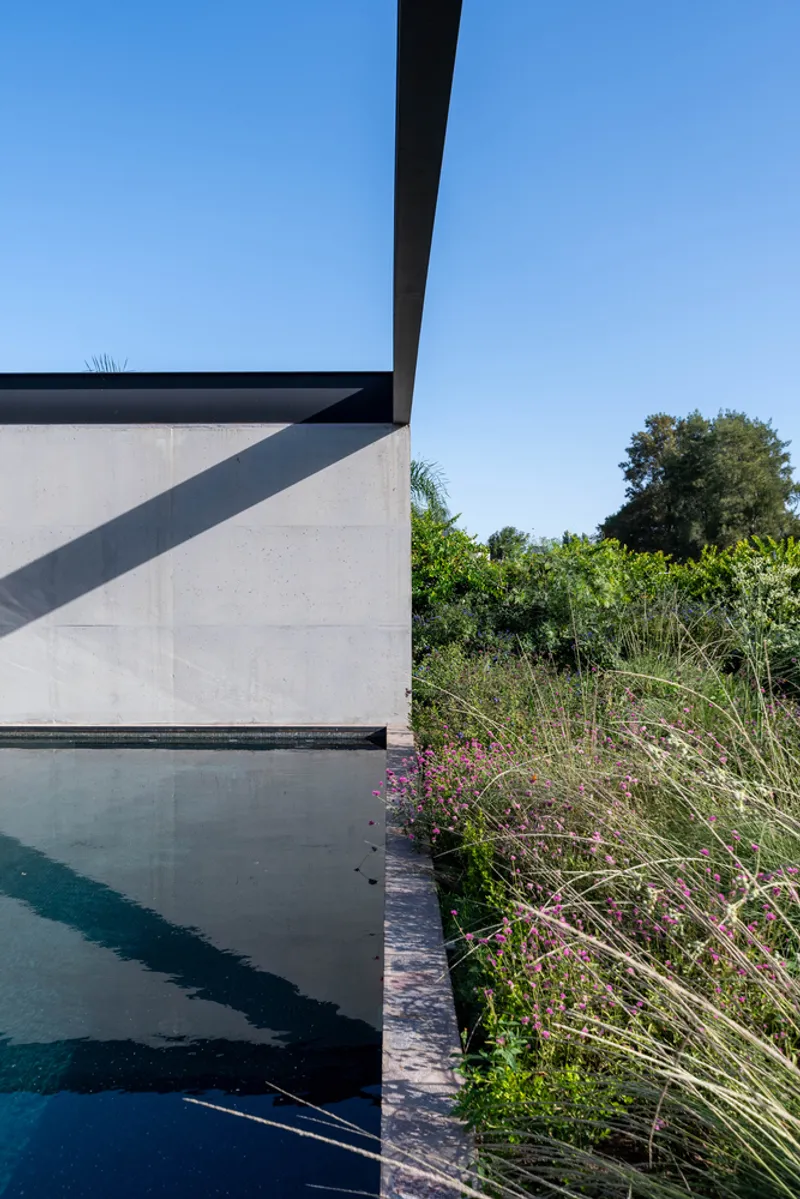
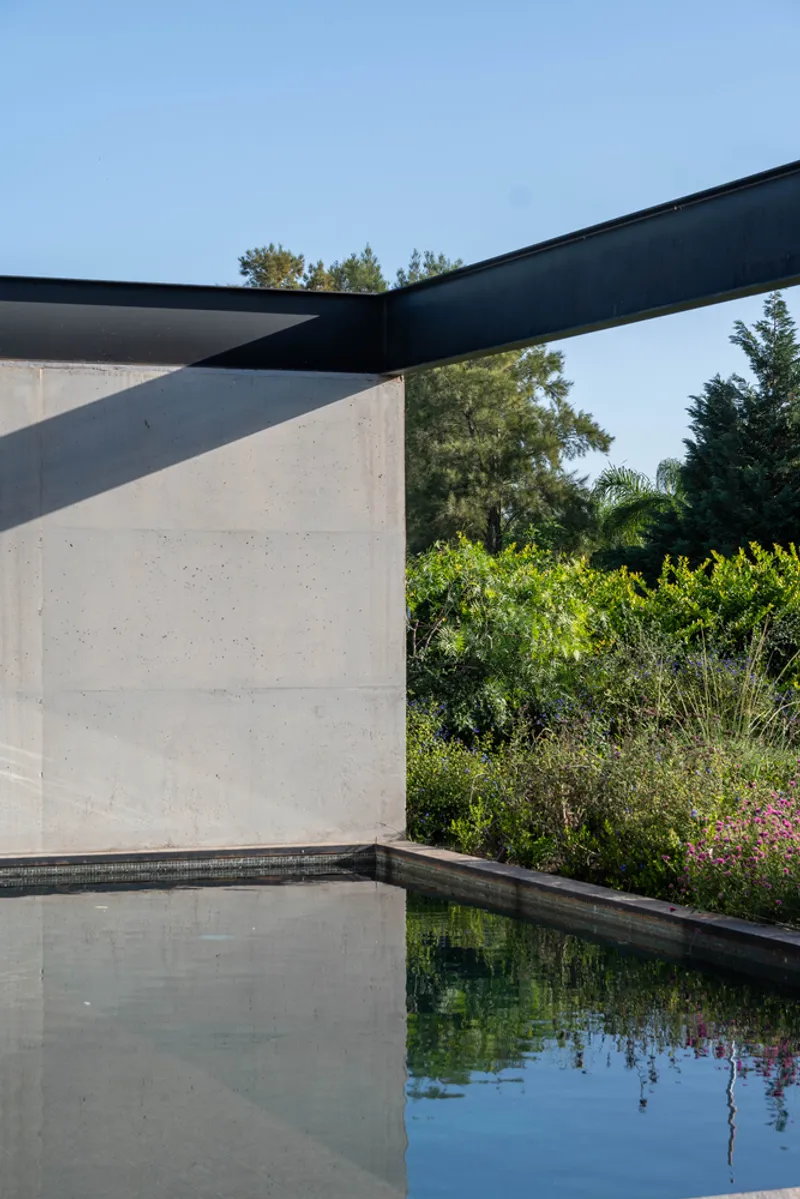
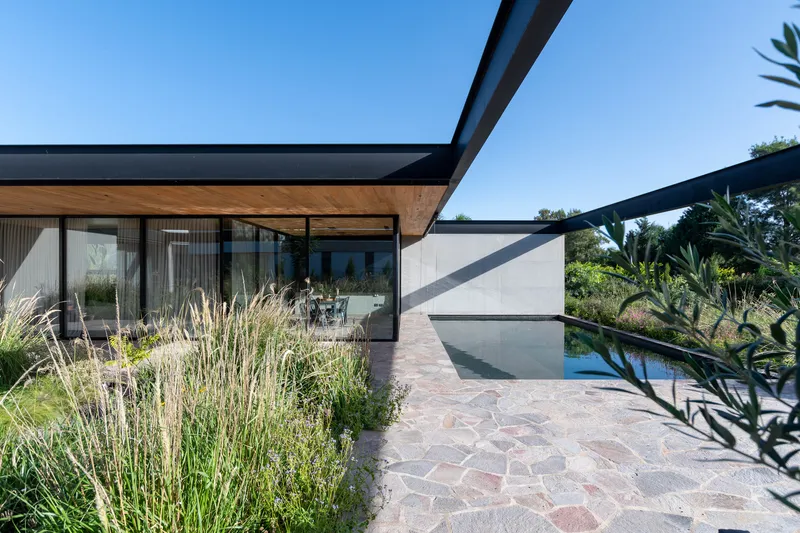
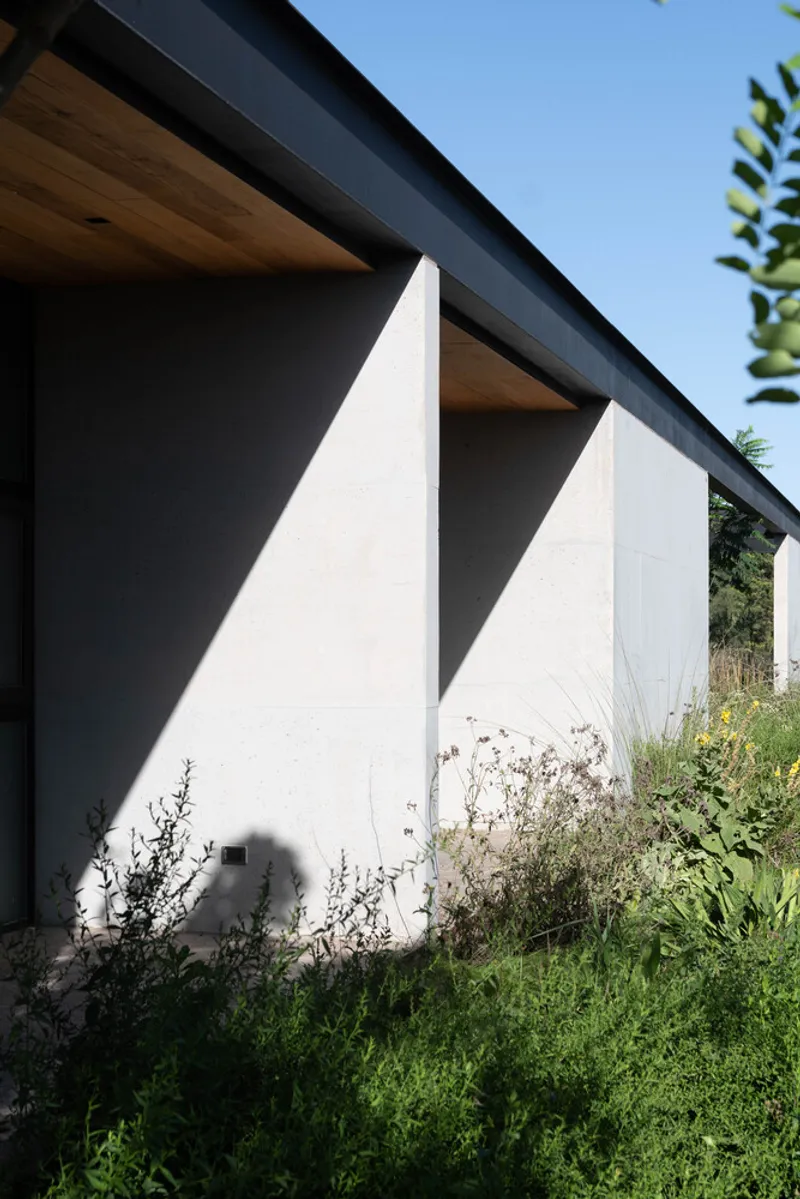
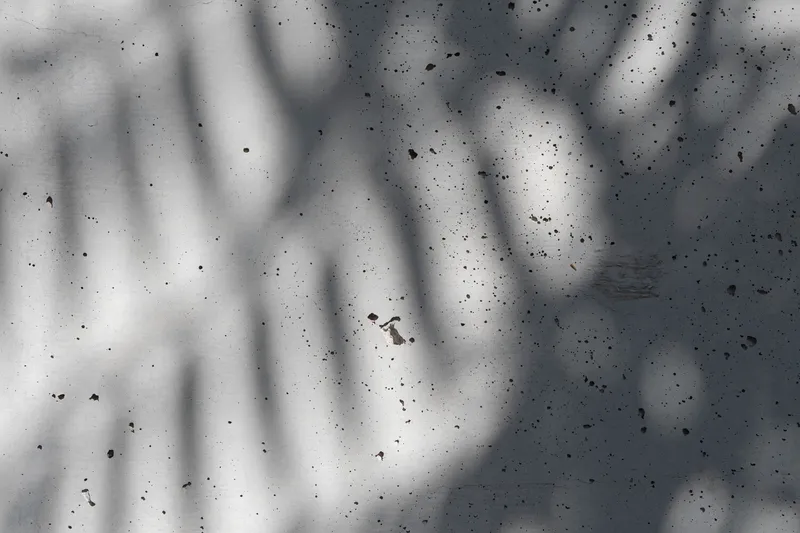
The material strategy deserves attention because it is both consistent and deliberately subversive. Exposed concrete dominates the walls, inside and out. Irregular porphyry stone covers the exterior terraces and paths, grounding the house in the region's geology. But in the lateral gallery and barbecue zone, the architects reverse the logic: timber moves to the ceiling, porphyry stays on the floor, and the concrete recedes. The result is a shift in atmospheric temperature that signals a change of use without a single partition wall.
The reflecting pool alongside the concrete perimeter wall is a sharp detail. Cantilevered black steel beams project over the water, their weight visually counterbalanced by wildflowers at the edge. The corner where concrete wall meets steel beam above the water is resolved with an almost sculptural clarity, a moment the architects clearly cared about getting right.
Native Landscape as Year-Round Material
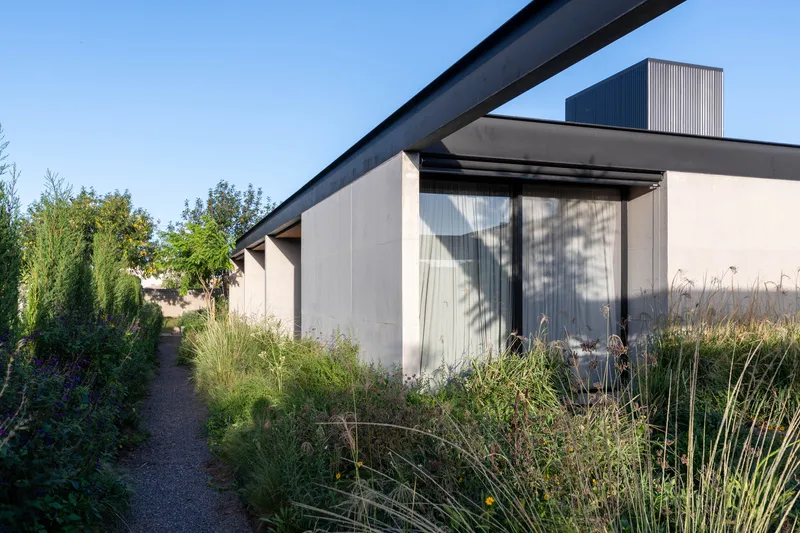
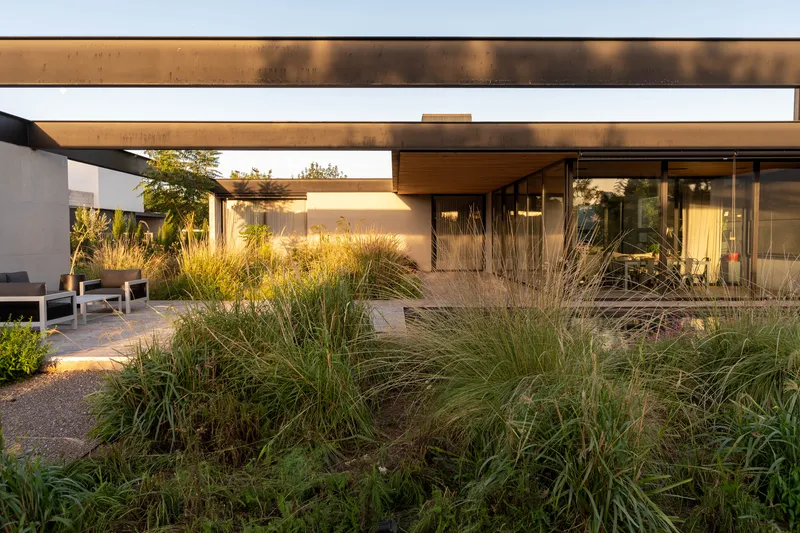
The landscape architect (or the architects themselves, as the credits suggest) selected native Córdoba province species that bloom at different points throughout the year. Tall grasses, wildflowers, and low plantings line the garden paths, fill the courtyard beds, and frame every window. At dusk, uplighting beneath the timber soffits turns the planted beds into glowing borders that define the house's edges more effectively than any wall.
The aerial shot of a figure walking across a white concrete surface, their shadow stretching diagonally, reveals the scale of the outdoor ground plane. The house gives as much square footage to landscape as it does to enclosed rooms. That ratio is the real argument of the project: in a flat neighborhood with generous lot sizes, the ground itself is the primary living space.
Plans and Drawings
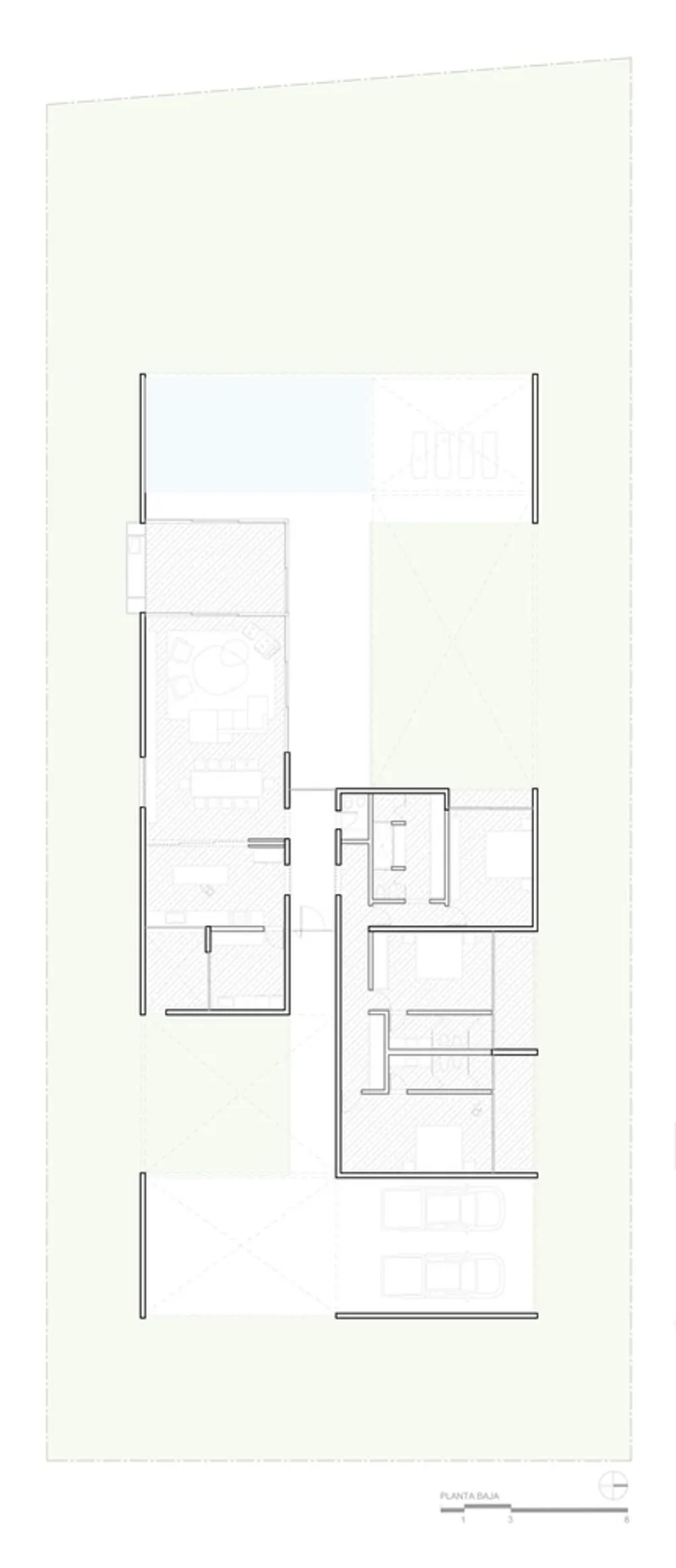
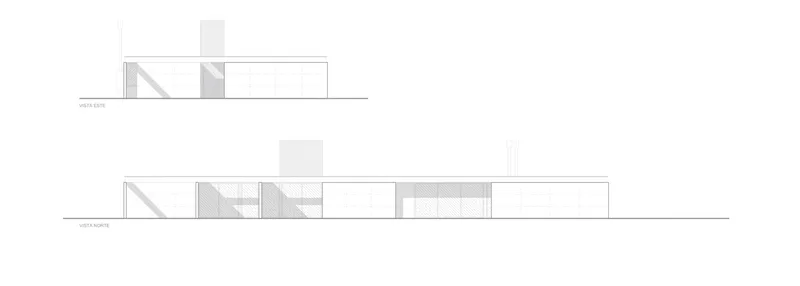
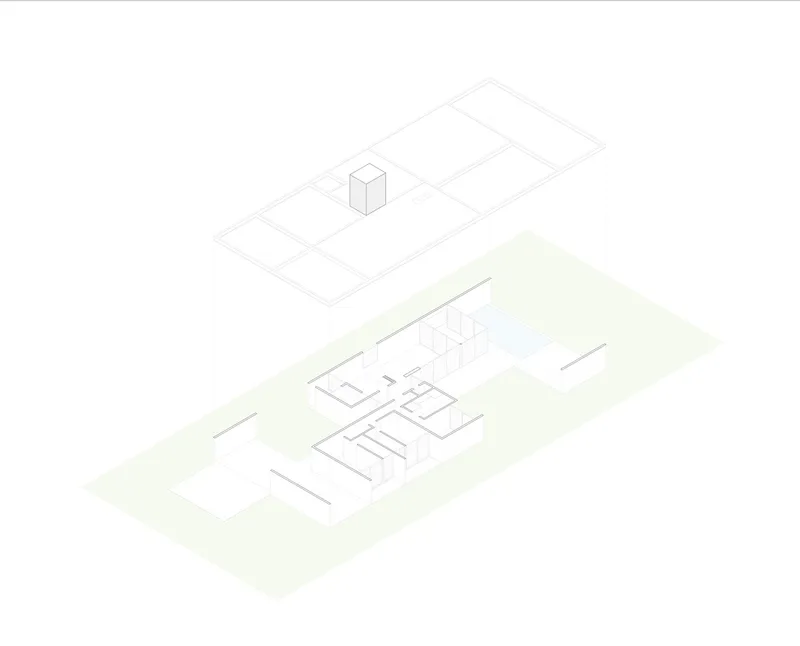
The floor plan confirms what the photographs suggest: two elongated volumes sit side by side, offset enough to generate courtyards between them. The pool occupies a central position, acting as both a visual anchor and a climatic buffer between the social and private wings. Rooms are arranged with an irregularity that avoids the monotony of a strict grid, allowing each bedroom and living space to claim its own relationship to a courtyard or garden.
The elevation drawings reveal the diagonal bracing of the steel frame, exposed on the exterior as an honest expression of the structure. A chimney stack punctuates the roofline, the only vertical element to break the otherwise insistent horizontality. The axonometric makes the courtyard organization legible in a single glance: the roof plane floats above the plan like a tray, and the open-air rooms between the volumes become as legible as the enclosed ones.
Why This Project Matters
The Cañuelas House does not reinvent the courtyard house or discover something new about concrete and steel. What it does is execute a familiar typology with a level of care that makes every decision feel considered. The axis is not just a hallway; it is a sequence of spatial compressions and releases. The material palette is not just raw; it shifts its logic room by room to signal changes in atmosphere. The landscape is not just decoration; it is the fourth wall of every interior.
For architects working in flat, low-density residential contexts, the project offers a useful lesson: the ground plane matters more than the section. When you cannot rely on topography or urban density to generate spatial drama, you have to build it laterally, through walls, courtyards, water, and planting. 3164.estudio and SDF Arquitectos understood that, and they built a house that proves it.
Cañuelas House by 3164.estudio and SDF Arquitectos, Córdoba, Argentina, 2023. Photography by Juan Cruz Paredes.
About the Studio
Share Your Own Work on uni.xyz
If projects like this are the kind of work you want to make, uni.xyz is a place to publish your own, find collaborators, and enter design competitions.




Popular Articles
Popular articles from the community


Play: Fragments of Their World
Familiar architecture becomes modular playground design, creating safe spaces where displaced children can learn, connect, imagine and play.

Lunar Spiral: Space Architecture Shaped by the Mathematics of the Universe
Lunar Spiral reimagines space architecture through Fibonacci geometry, lunar regolith, levitating habitats, and self-sustaining Moon living.

Hill & Cross Opera: Sculptural Opera House Architecture Shaped by Tallinn’s Landscape and Identity
Hill & Cross Opera reimagines opera house architecture in Tallinn through its sculptural hill, civic plaza, glass wave and a luminous cross.

The Earth Pod: 3D Printed Homes for Resilient Refugee Communities
The Earth Pod reimagines refugee housing through 3D printed homes made from clay, combining resilience, self-sufficiency, and rapid shelter.


Similar Reads
You might also enjoy these articles


Hodi-Mandai Geram
Project Function: Preservation and revitalization of the Intangible heritage and socio-spatial identity of the Hodi by Housing, Cultural Memory Center, Sacred Grove, landscape, local tourism economy


Olio Towers: A Mid-Rise for Performers That Fuses Housing, Rehearsal, and Stage
Located blocks from Houston's Theater District, this modular tower stacks living units around a central performance atrium.

Oasis: Modular Green Housing Carved into Dhaka's Urban Fabric
A shortlisted Plugin Housing entry reclaims unauthorized settlements in Dhaka with stepped concrete volumes, green roofs, and ventilation-driven design.

Black Hole: A Floating Megastructure for the Post-Physical Era
Emiliano Mazzarotto envisions a spherical, self-scaling arena where e-sports, digital hotels, and holographic stadiums replace traditional public space.


Explore Architecture Competitions
Discover active competitions in this discipline



Challenge to reimagine the Iron Throne


Photograph architecture without architects


Illustrate the lost glory of Angkor Wat - Render Challenge


Design challenge to reuse E-waste
Comments (0)
Please login or sign up to add comments
No comments yet. Be the first to comment!