
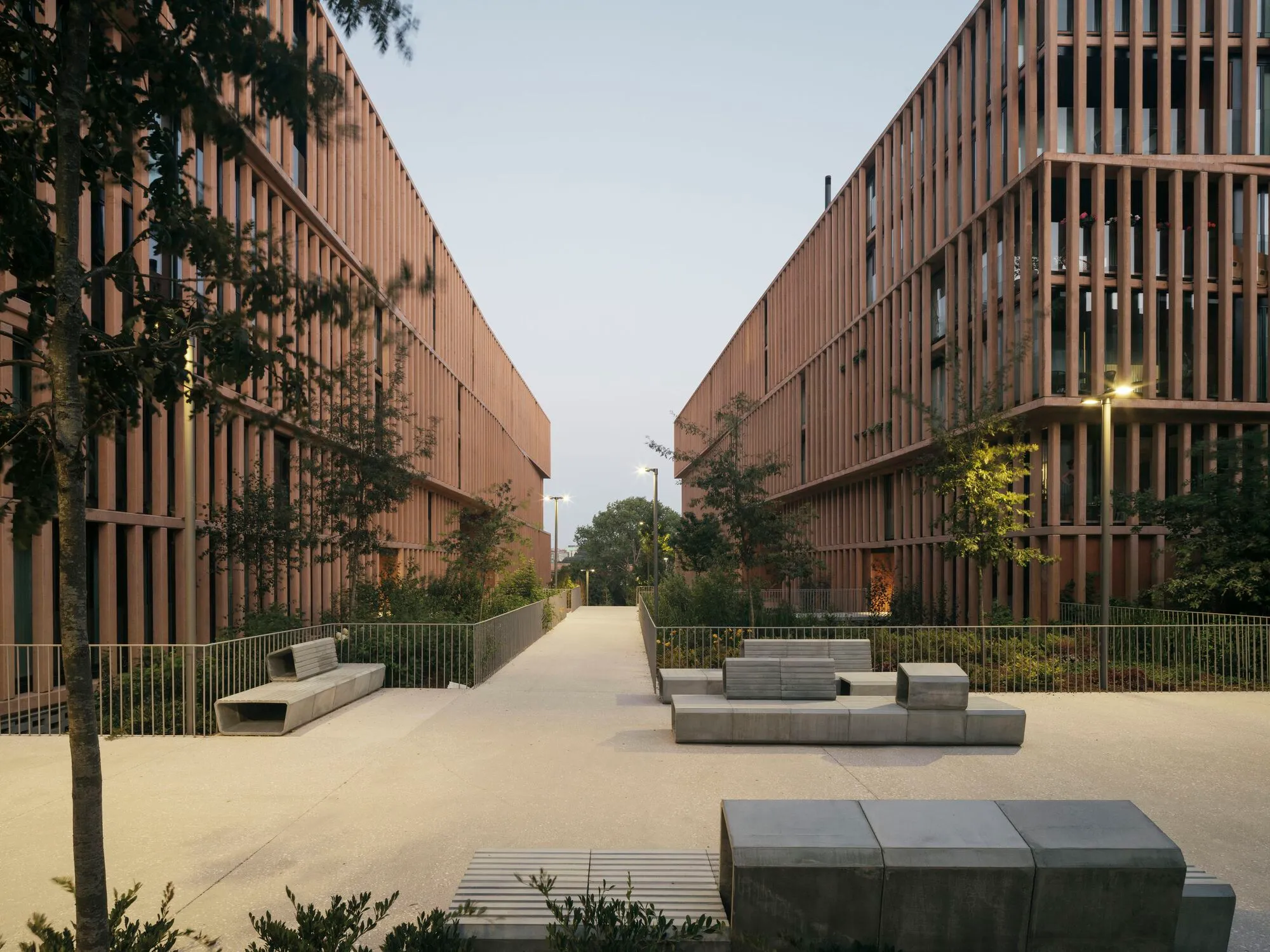
Carbajo Barrios Arquitectos Wraps 125 Apartments in a Ferruginous Lattice on a Former Railway Site
Three stepped residential bars recall the industrial past of Santiago de Compostela's Cornes Station while anchoring a new green corridor.


For seventy years, the Cornes Railway Station linked Santiago de Compostela to the coast. The first rail line in Galicia ran from here to Carril beginning in 1873, carrying passengers until 1943 and freight for decades after that. The station's demolition left behind a slab of post-industrial land on the southwest edge of the city's expansion, a place with a strong identity but no clear future. Carbajo Barrios Arquitectos took on the task of converting that identity into a residential neighborhood: 28,500 square meters organized as three long bars, six stories each, housing 125 apartments across 22 distinct typologies.
What makes this project worth studying is not the unit count but the way the architects manage scale. Buildings between 60 and 100 meters long could easily read as institutional slabs. Instead, the floors shift laterally over one another, breaking the prismatic envelope into a series of staggered volumes. A precast concrete brise-soleil, tinted to a rust color that nods to the site's railway past, wraps the entire perimeter, filtering views between facing blocks and softening sunlight. The result is a complex that feels closer to a terraced hillside than a housing estate.
The Ferruginous Skin
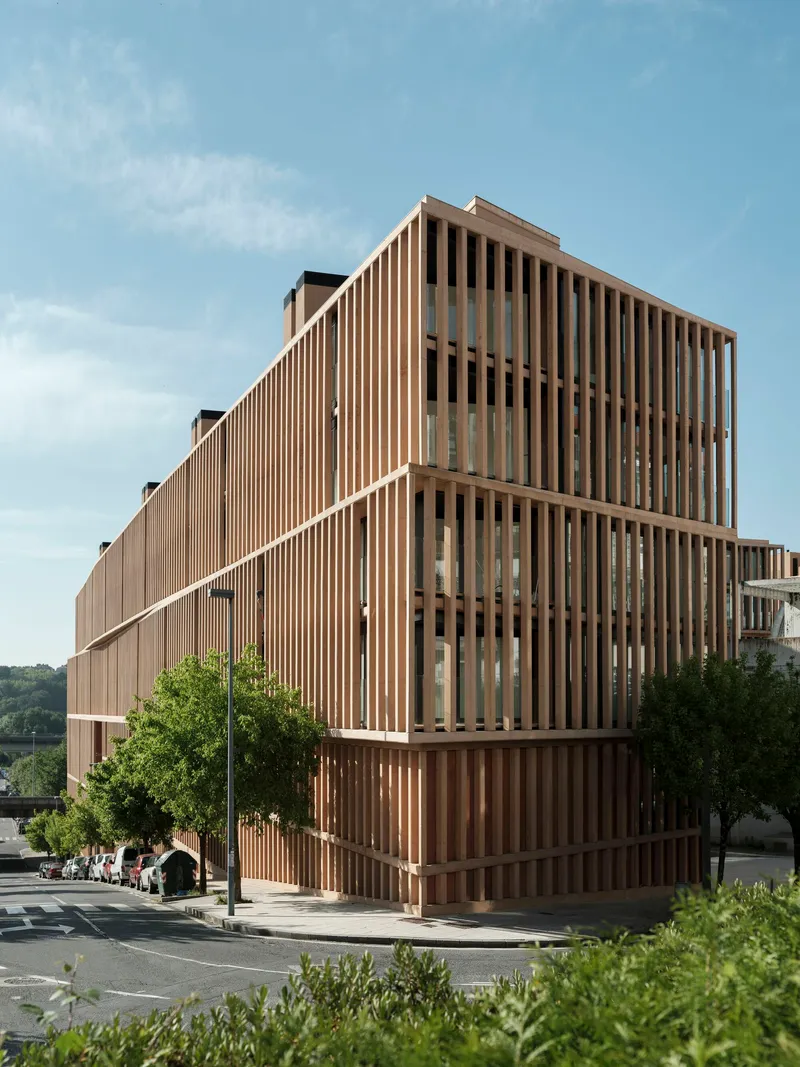
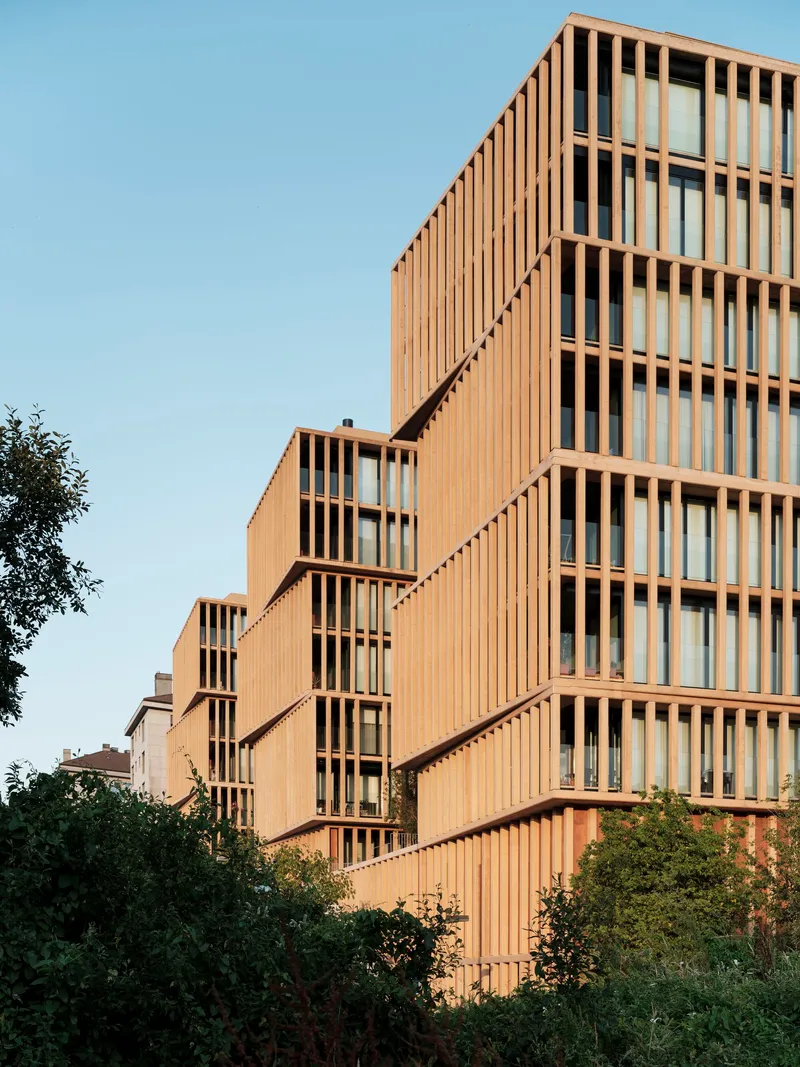
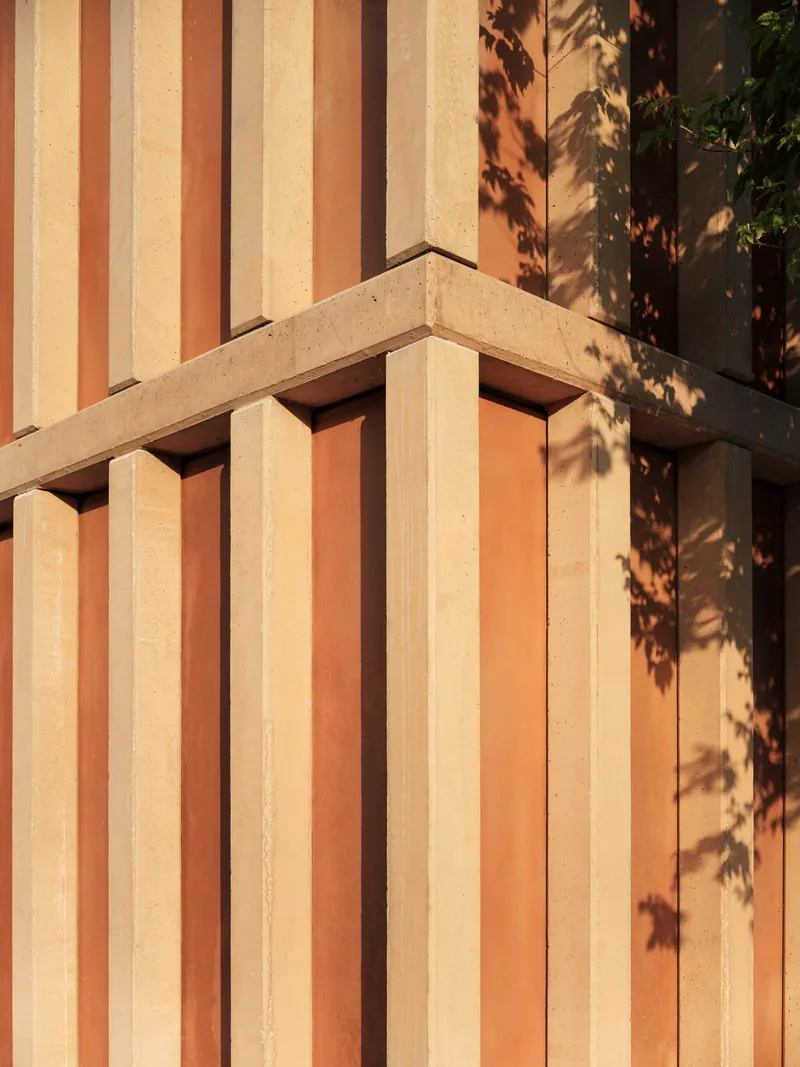
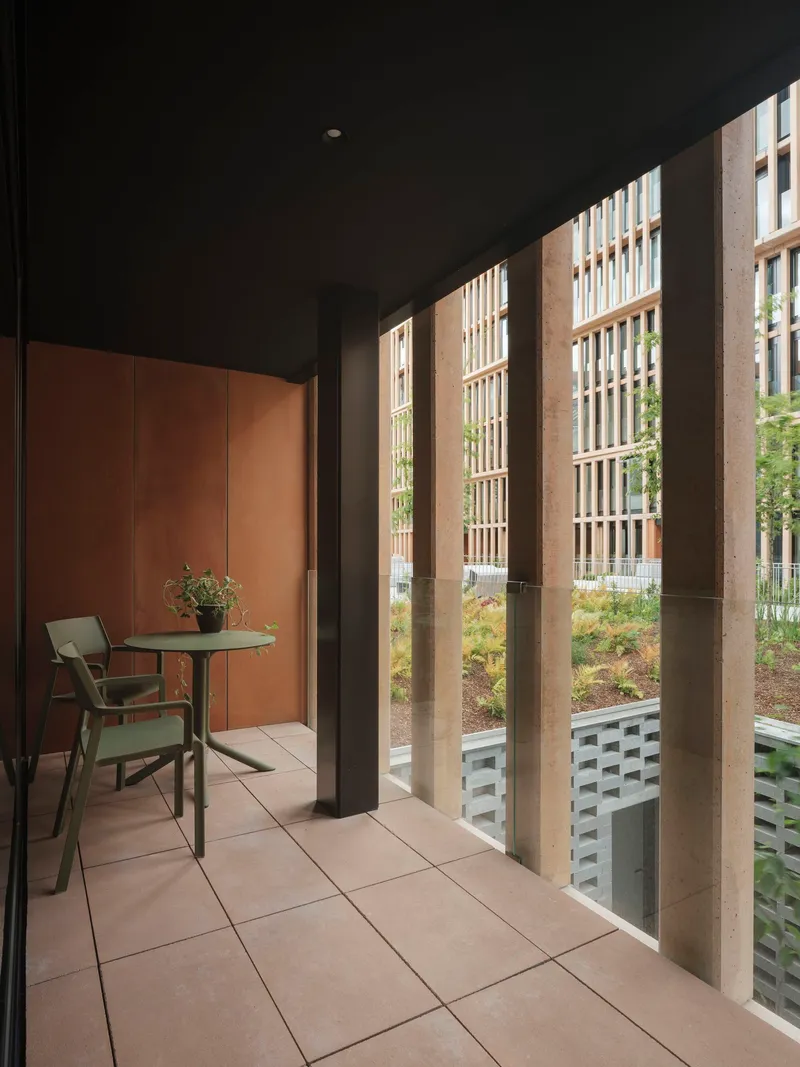
The dominant material is a precast concrete lattice assembled from 20x20-centimeter elements spaced 80 centimeters apart. Tinted with iron oxide to achieve a ferruginous tone, the screen reads as timber from a distance but reveals its mineral weight up close. The color is deliberate: it recalls the corroded steel and industrial patina of the former rail yard, giving the complex an immediate material connection to its site history.
Structurally, each building spans a 12-meter bay depth with cantilevered overhangs running around the entire perimeter. Floors are unified in pairs of two slabs, and the lateral shifts between these paired levels create the stepping effect visible in the facade. The lattice wraps continuously over these offsets, lending visual coherence to what is actually a fairly dynamic section. Behind it, a fully glazed enclosure maximizes natural light while Bandalux vertical blinds provide a second layer of solar control.
Courtyard Ground: Landscape as Infrastructure
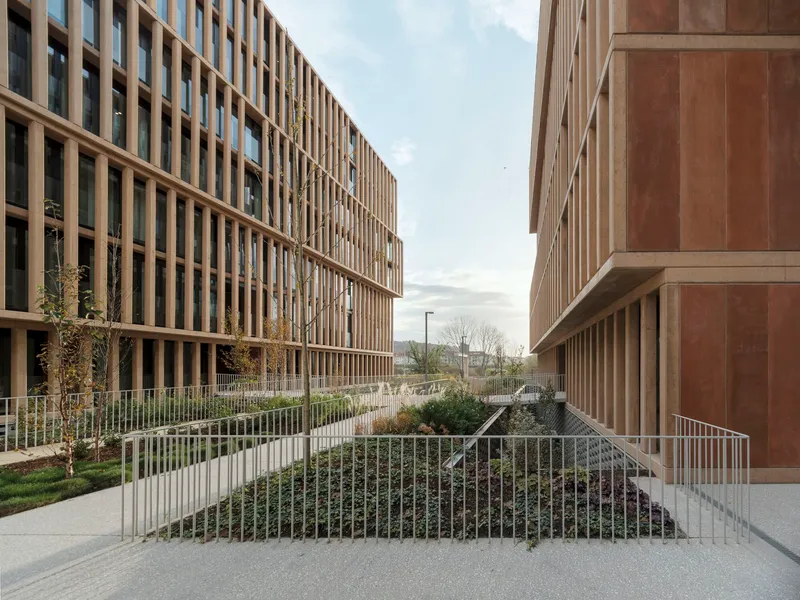
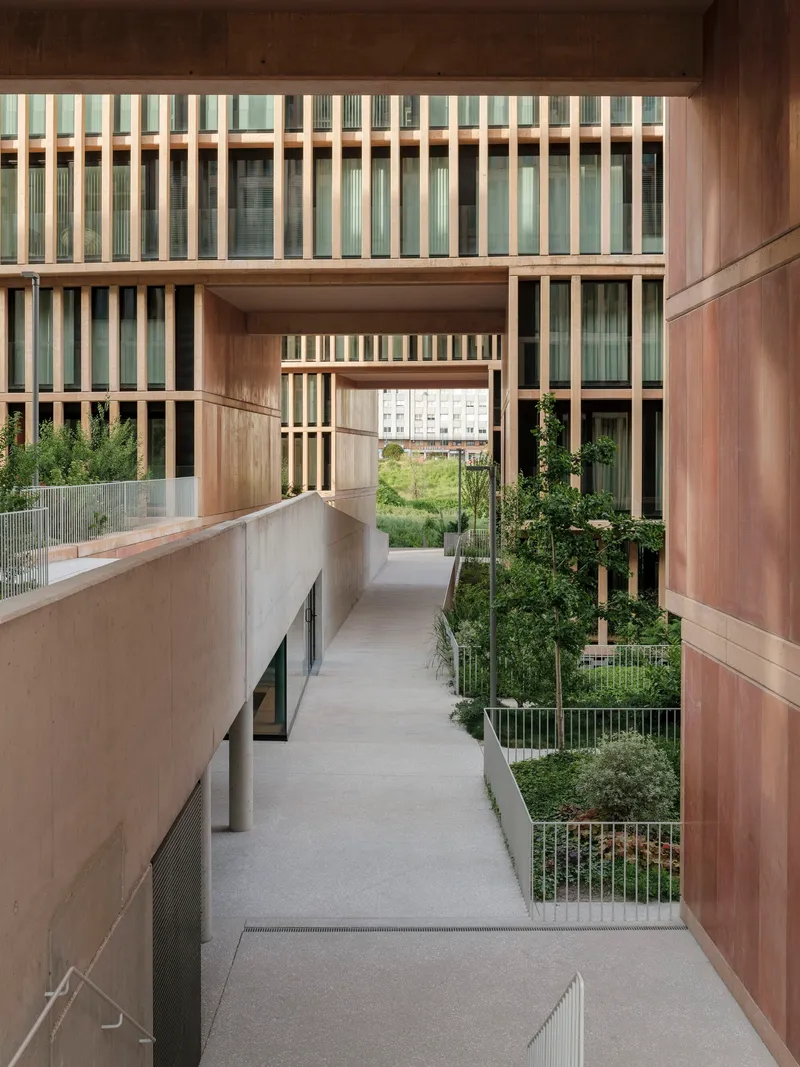
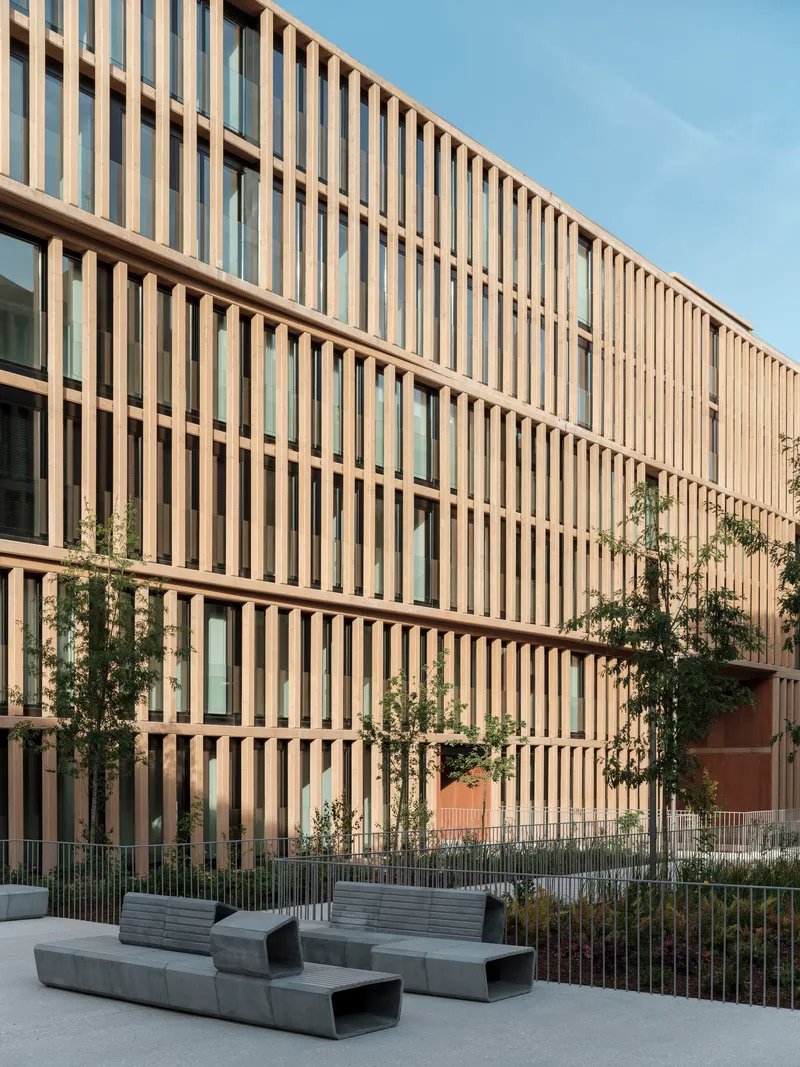
Between the three bars, the ground plane operates as a green corridor platform. The site slopes, so the ground floor fragments into two levels, an opportunity the architects exploit to introduce large vegetation down through voids that also bring daylight and ventilation to the underground garages and storage rooms below. Transversal pedestrian passages cut through the buildings at grade, releasing cross views and decompressing the space between blocks.
Longitudinal paths connect the courtyards visually and ecologically with the surrounding parks of Santiago's expansion. The planting strategy is generous: hydrangeas, grasses, and young trees soften the concrete benches and metal railings that define the outdoor rooms. This is not decorative landscaping but a connective tissue that ties the project into the city's larger green network.
Passages and Thresholds
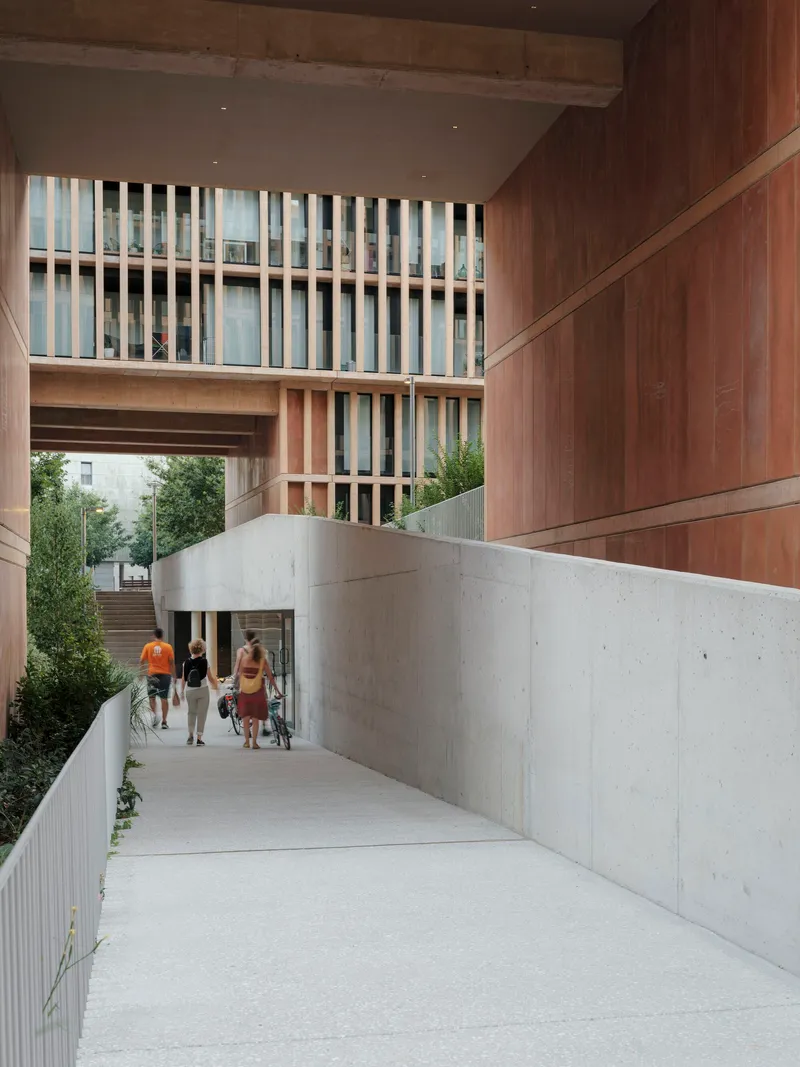
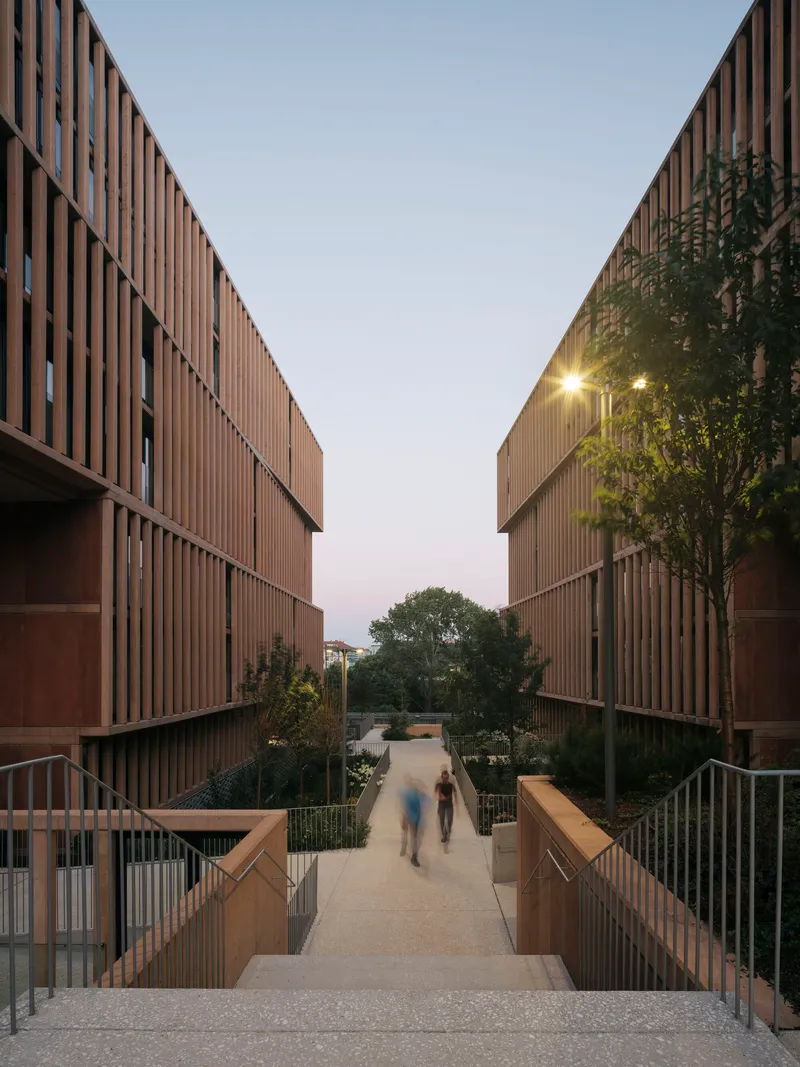
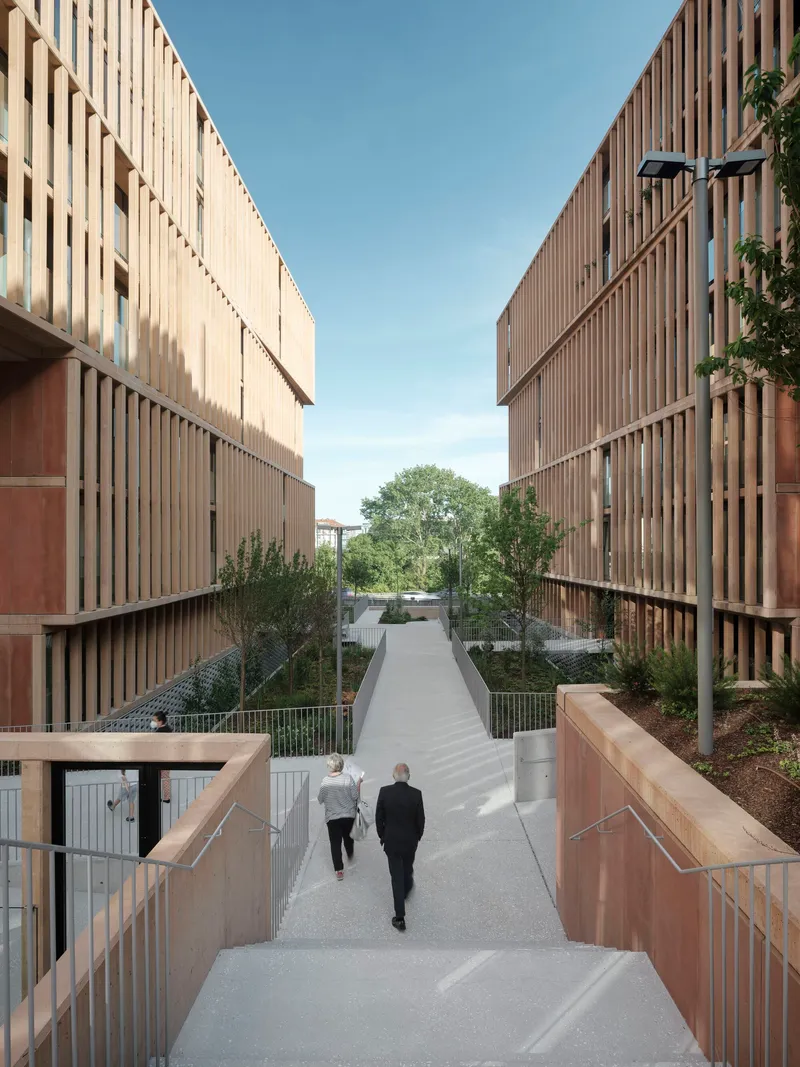
The transitions between public, communal, and private space are handled with care. Sloped concrete passages with timber-clad soffits guide pedestrians beneath the buildings, framing views of the courtyards ahead. Elevated walkways and bridges connect the blocks at upper levels, creating a network of circulation that keeps the ground plane permeable. At dusk, these passages take on a cinematic quality, the lattice screen filtering ambient light into stripes across the walkways.
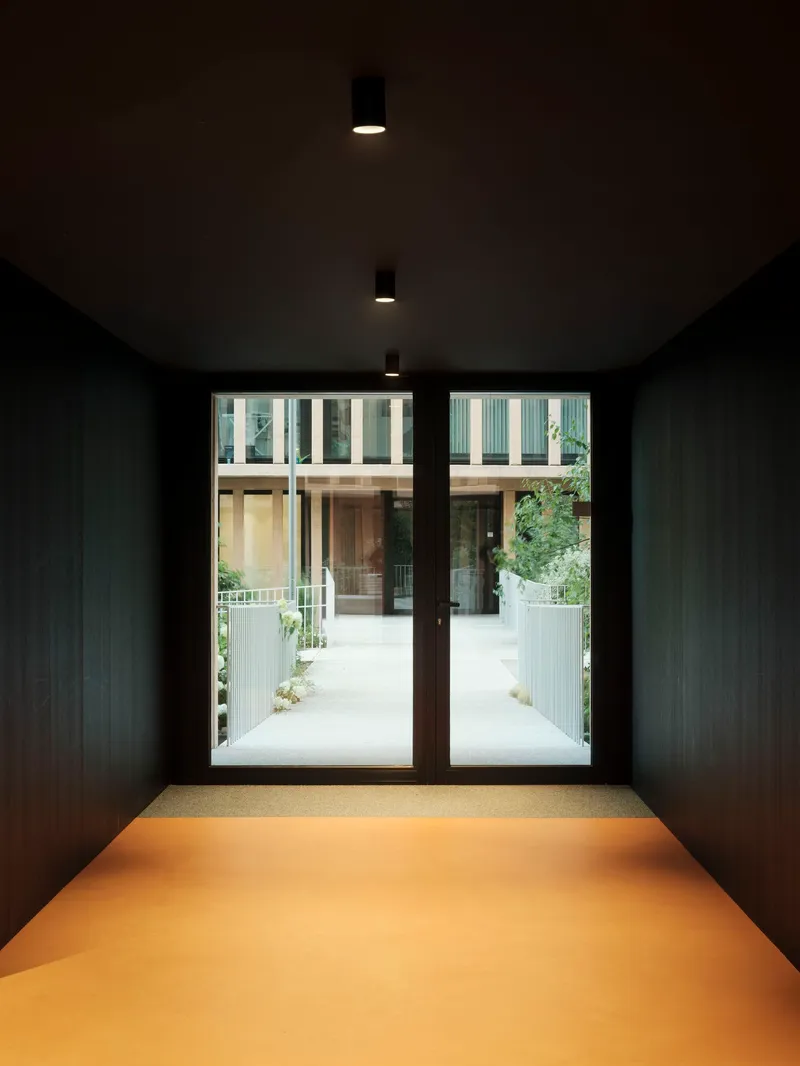
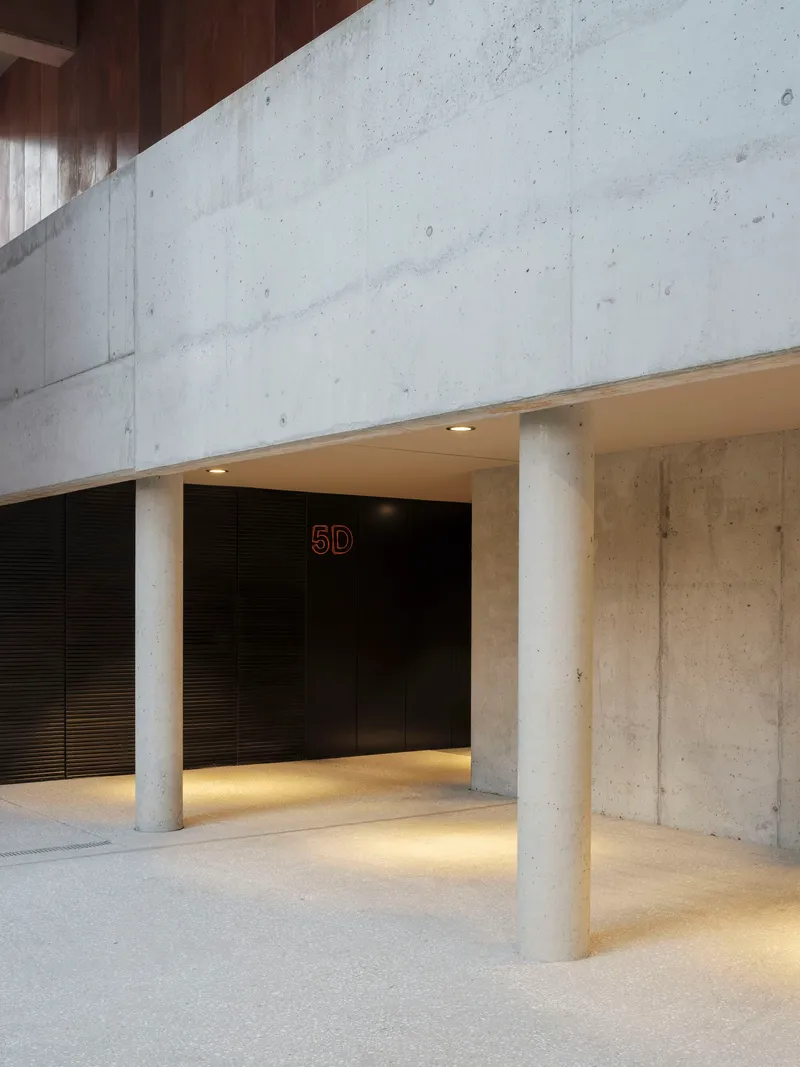
The entry sequence is similarly calibrated. Dark vestibules with resin floors and glass doors open onto sunlit courtyards, a compression-release rhythm that gives residents a clear psychological arrival. Concrete lobbies with cylindrical columns and strip lighting maintain a restrained material palette that carries from exterior to interior without interruption.
Common Spaces and the Perimeter Corridor
Three covered community spaces, a children's playroom, a gym, and a dining room, supplement the residential program. Community bicycle parking acknowledges Santiago's compact urban fabric and the site's proximity to transit infrastructure. These are not afterthought amenities but programmatic anchors that give the complex a collective identity beyond the individual unit.
Every apartment includes a perimeter corridor used as exterior living space, an open-air room screened by the brise-soleil lattice. This move doubles the usable threshold between inside and out, giving even modestly sized units a sense of spatial generosity. The lattice provides privacy from neighboring blocks while maintaining views toward the parks and the city skyline.
Inside the Units
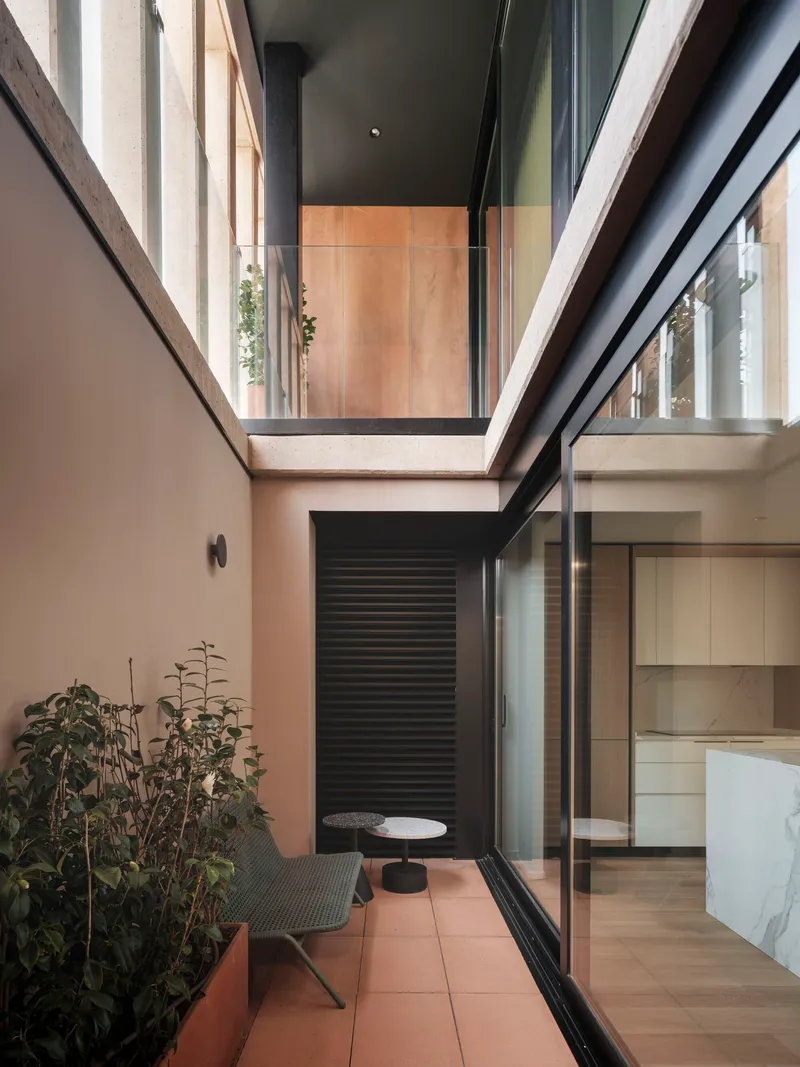
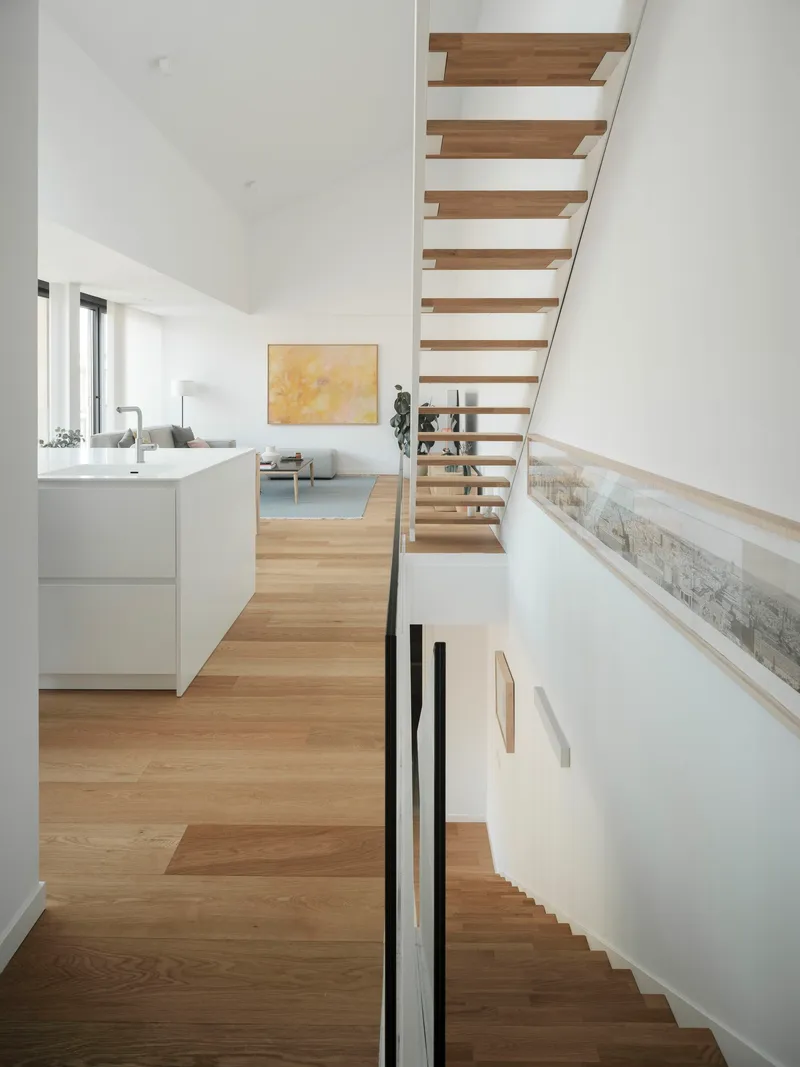
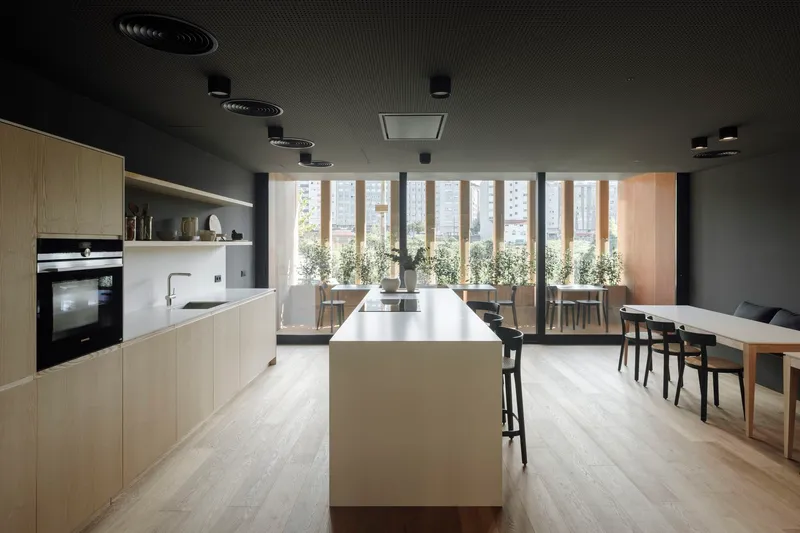
Twenty-two typologies, both single-floor and duplex, occupy the 125 units. Interiors follow a restrained palette of light oak flooring, white walls, and floor-to-ceiling glazing that floods rooms with light filtered through the exterior lattice. Duplex units feature open-tread timber staircases that maintain visual continuity between levels. Kitchens open directly onto terraces through sliding glass doors, collapsing the boundary between cooking and outdoor dining.
The rooftop penthouses are the most generous: private terraces with views over the surrounding residential fabric and, in clear weather, the towers of the old city. A centralized aerothermal heating and hot water system serves all units, a pragmatic sustainability move that avoids the visual clutter of individual mechanical equipment on facades or rooftops.
Rooftop and Upper Levels
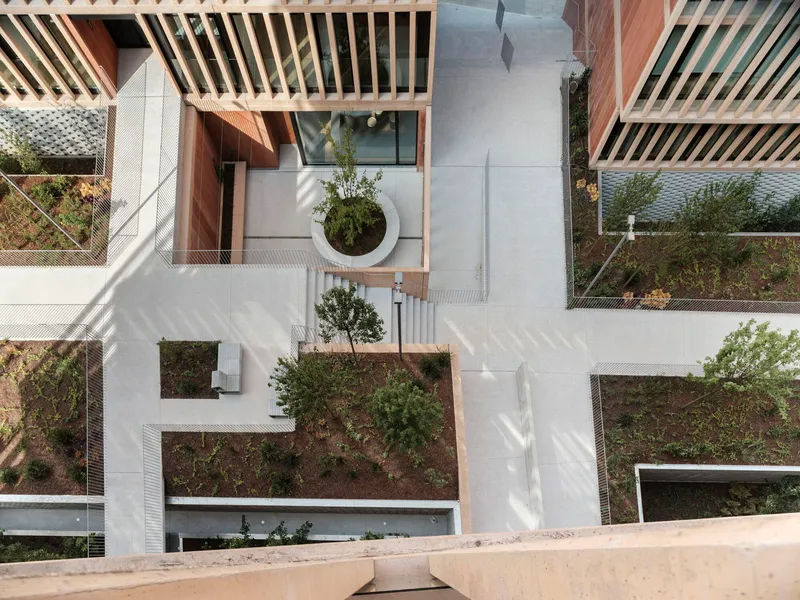
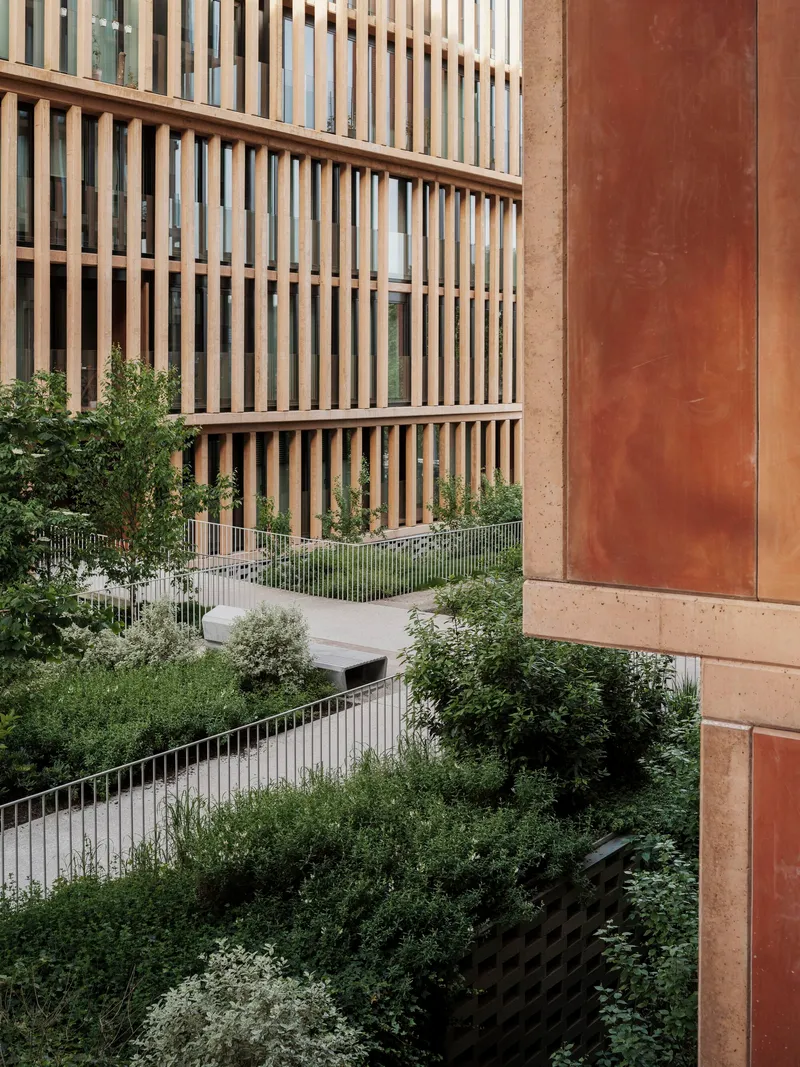
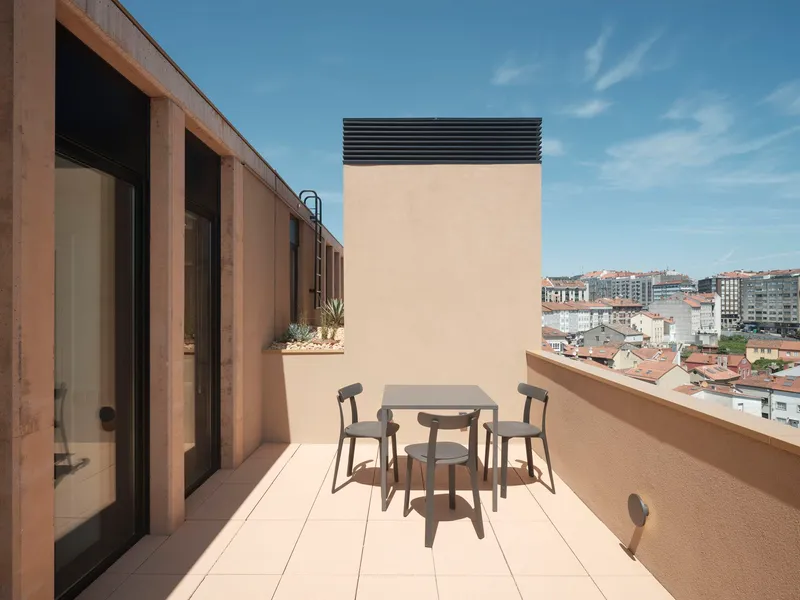
At the upper levels, the stepping of volumes creates terraced conditions with planted balconies and circular planters. Weathered steel panels appear alongside the timber-toned concrete lattice, adding another layer of material texture that reinforces the industrial memory of the site. The rooftop gardens are not merely ornamental; they contribute to stormwater management and thermal insulation, though the architects wisely let them function first as livable outdoor rooms.
Urban Scale and Context
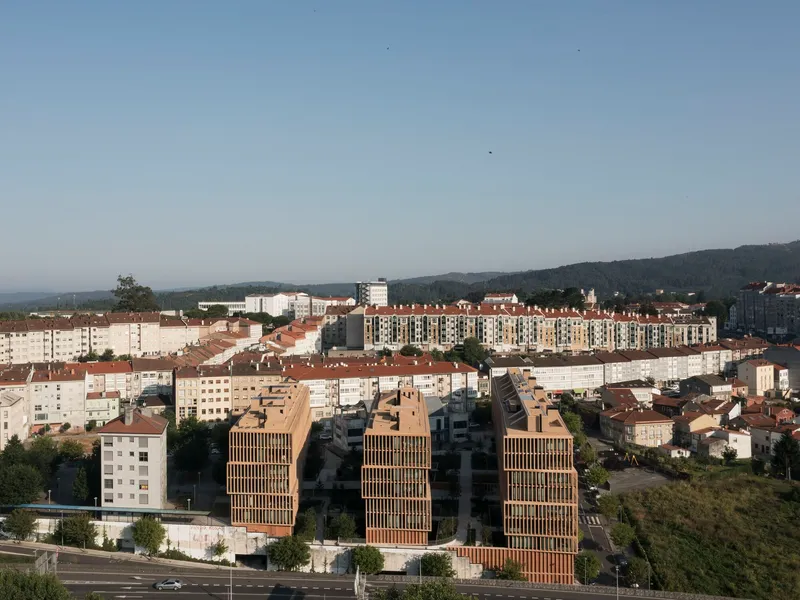
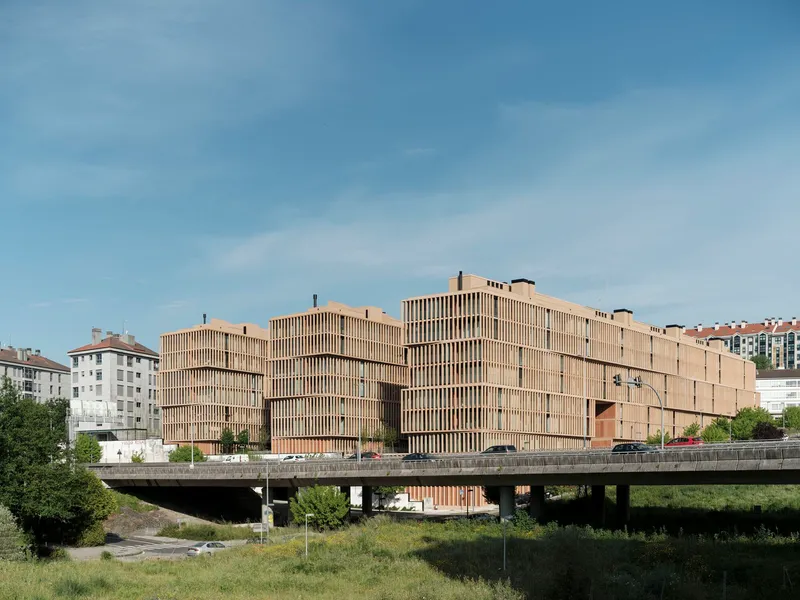
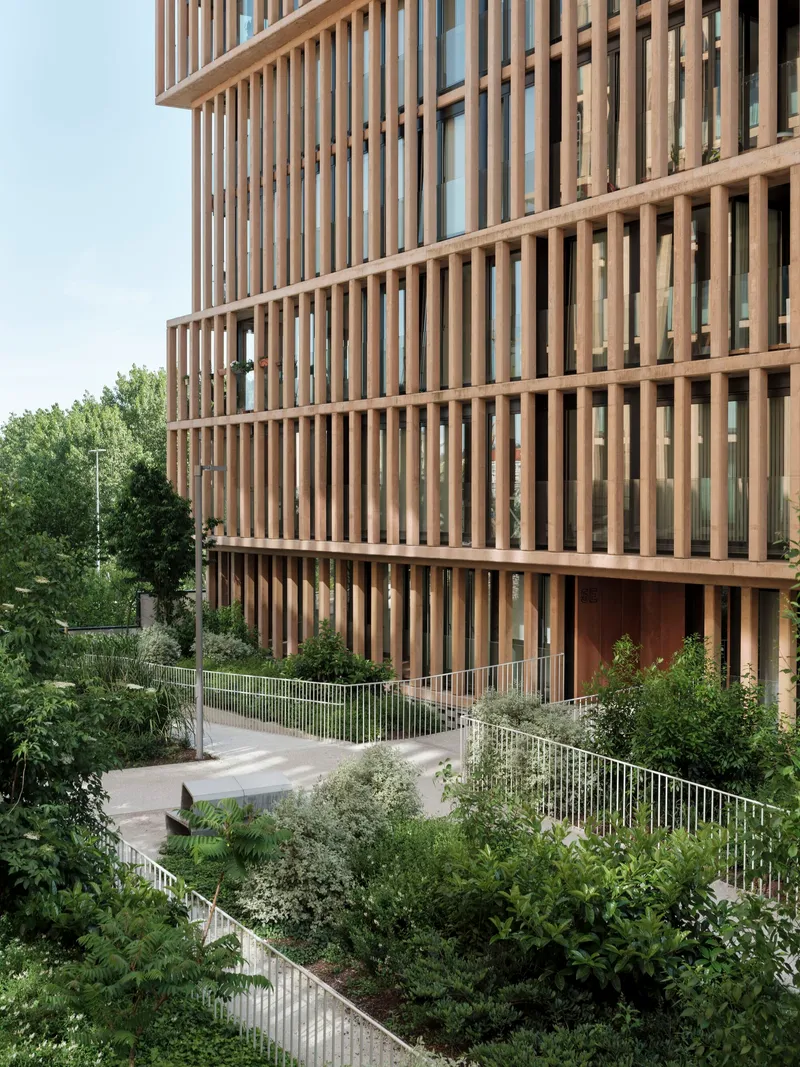
Seen from across the city at dusk, the three rust-toned bars register as a coherent ensemble against the white stucco of Santiago's typical apartment buildings. The ferruginous color acts as a beacon on the southwest edge of the city's expansion, marking the former industrial precinct with a warmth that reads simultaneously as contemporary and historical. Part of the original station has been rehabilitated as the Casa das Asociacións, so the project exists in dialogue with a surviving fragment of its own origin story.
The urban plan allocated three linear blocks with two private open spaces designated for public use, a framework that Carbajo Barrios Arquitectos respected while introducing enough volumetric movement to prevent the composition from reading as a monotonous repetition. The angled footprints respond to the sloped terrain, creating varied spatial conditions at ground level that would be impossible with a rigid orthogonal layout.
Plans and Drawings
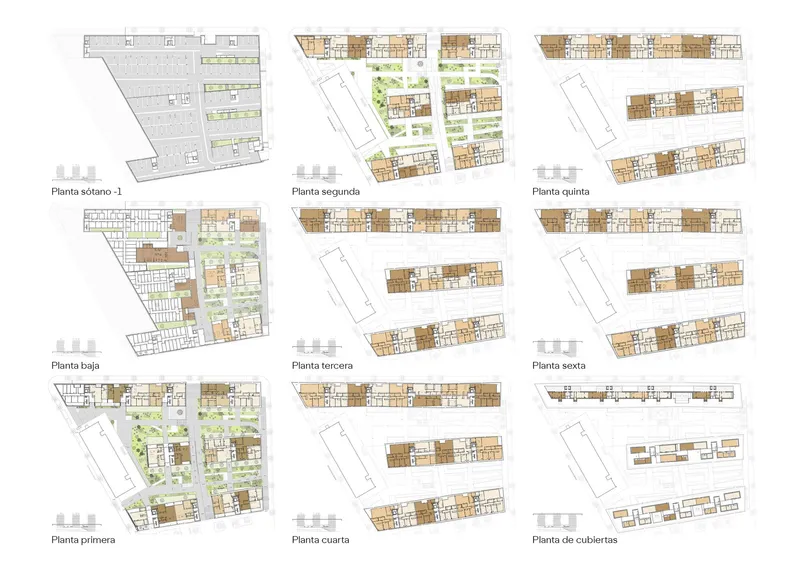
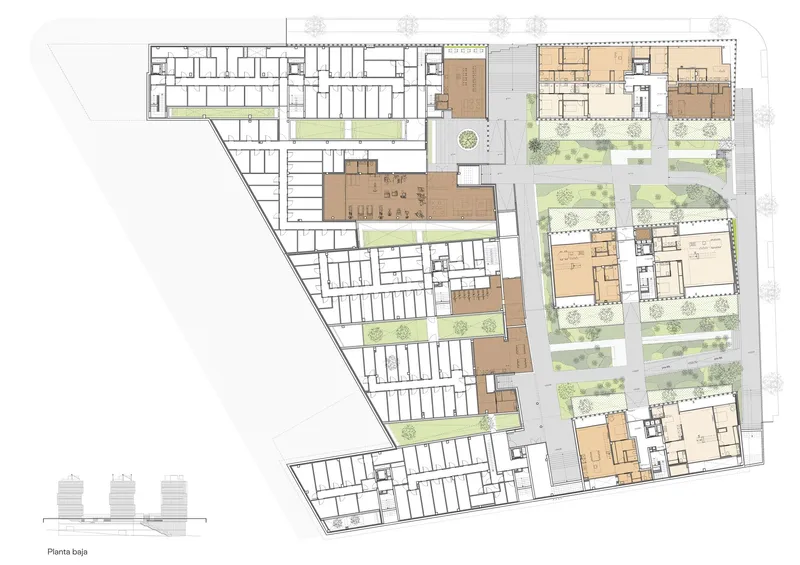
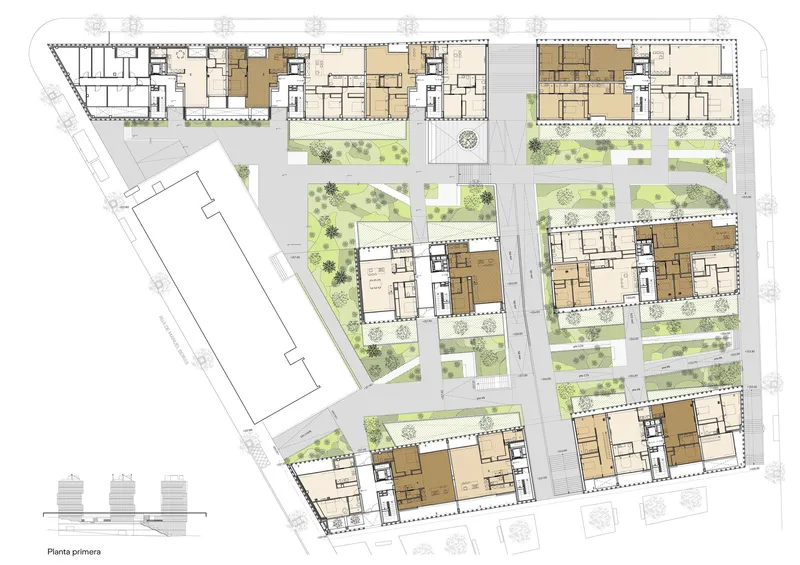
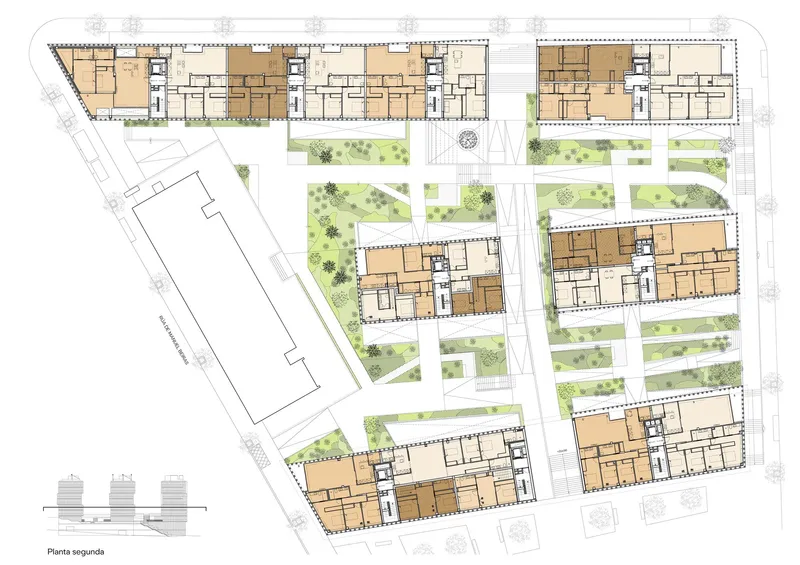
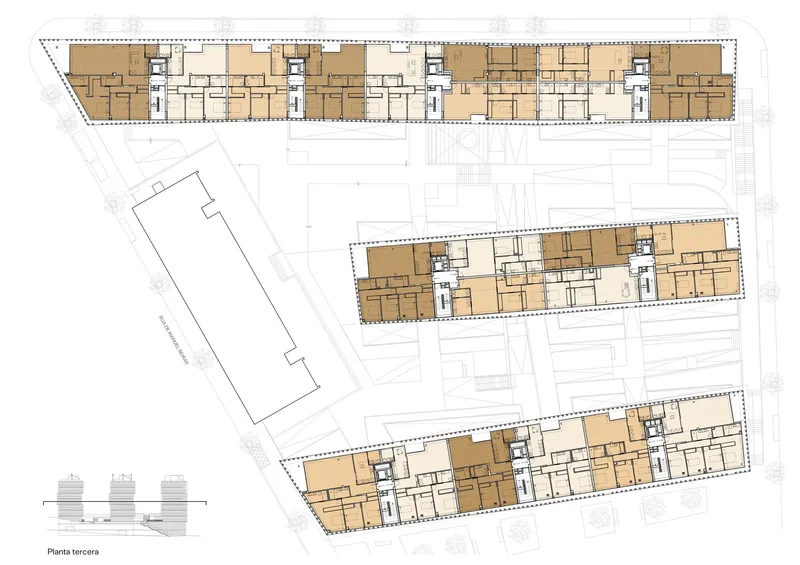
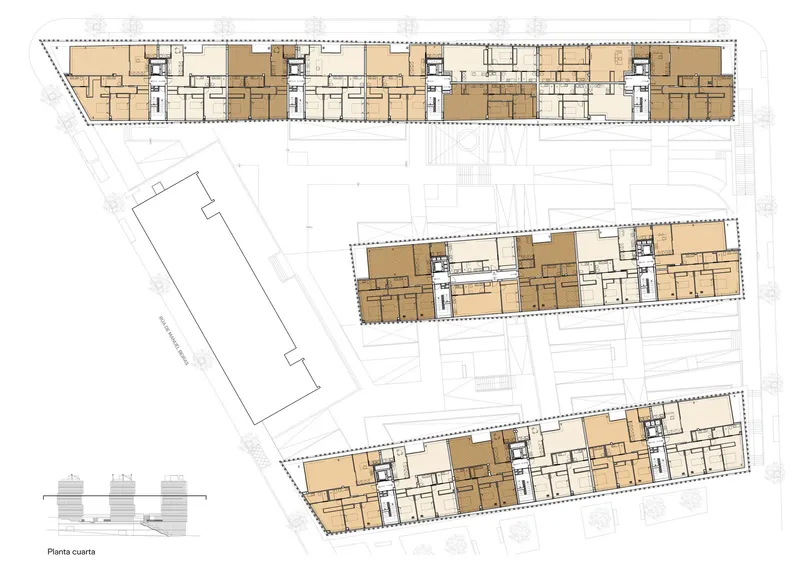
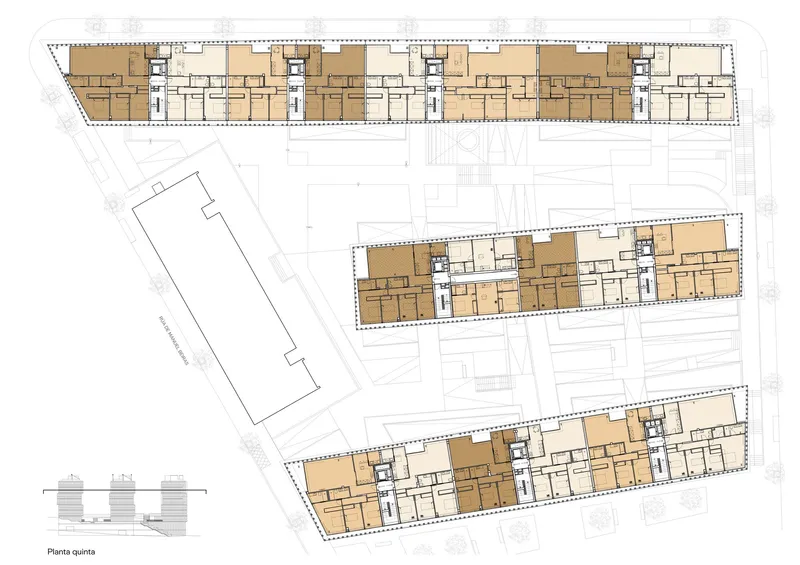
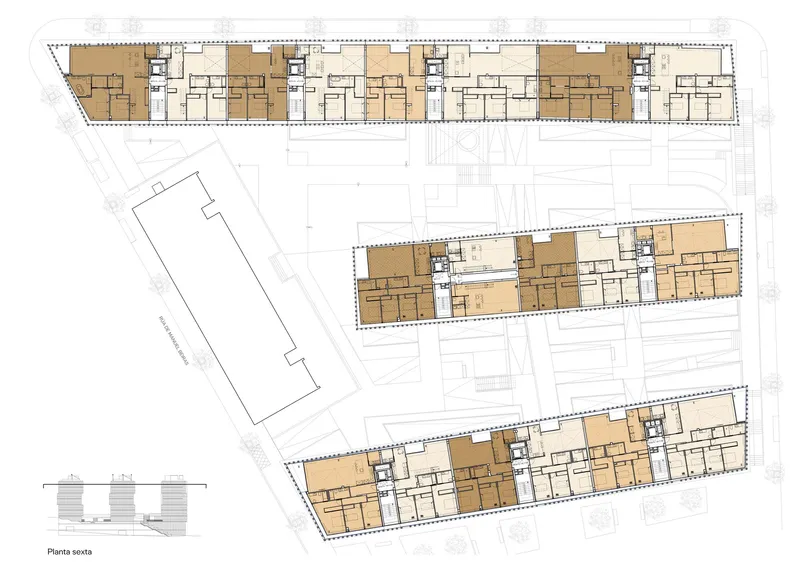
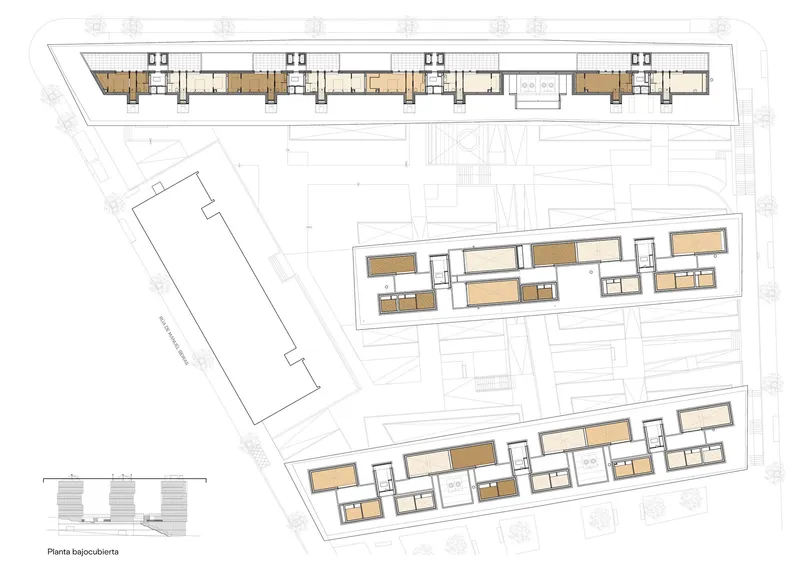
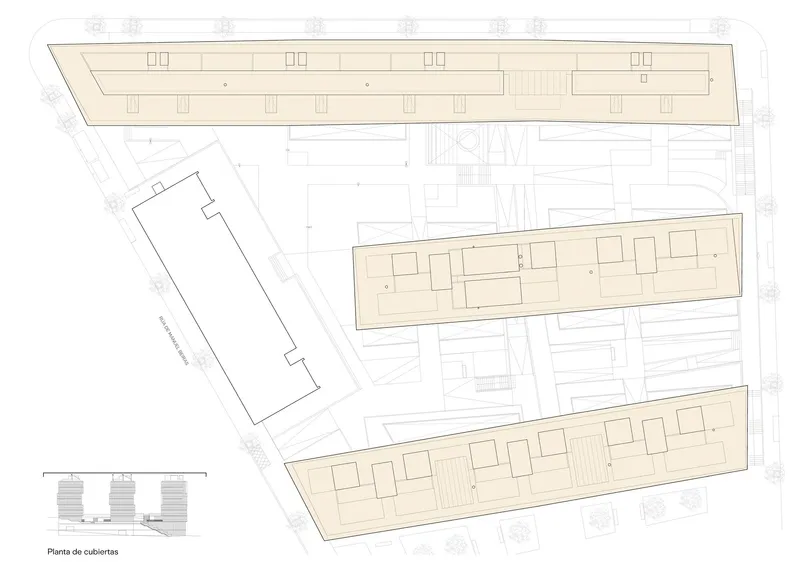
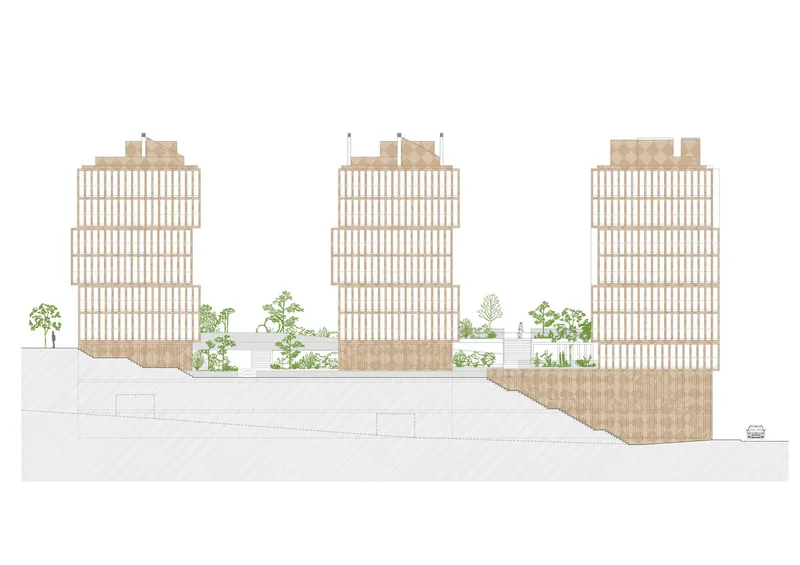
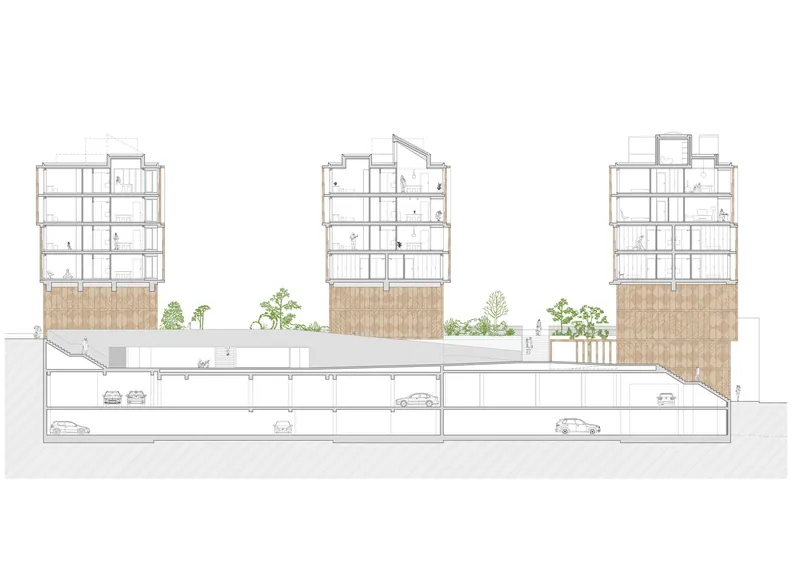
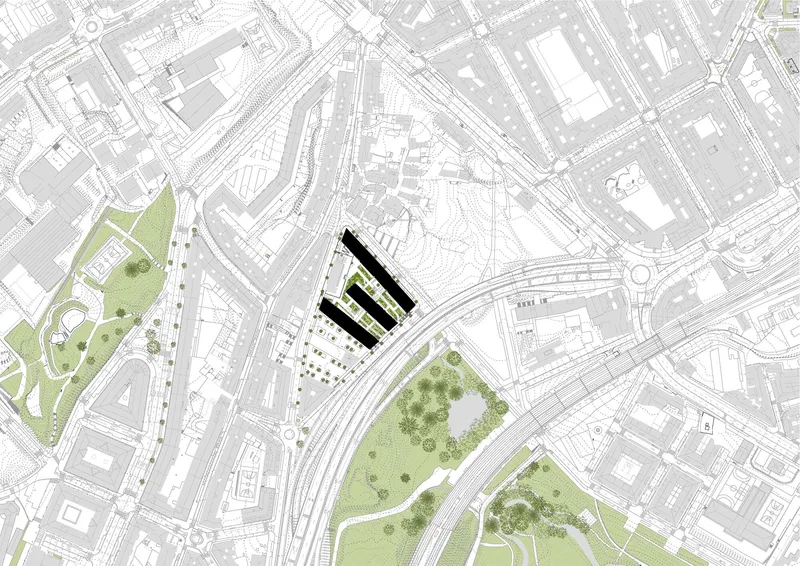
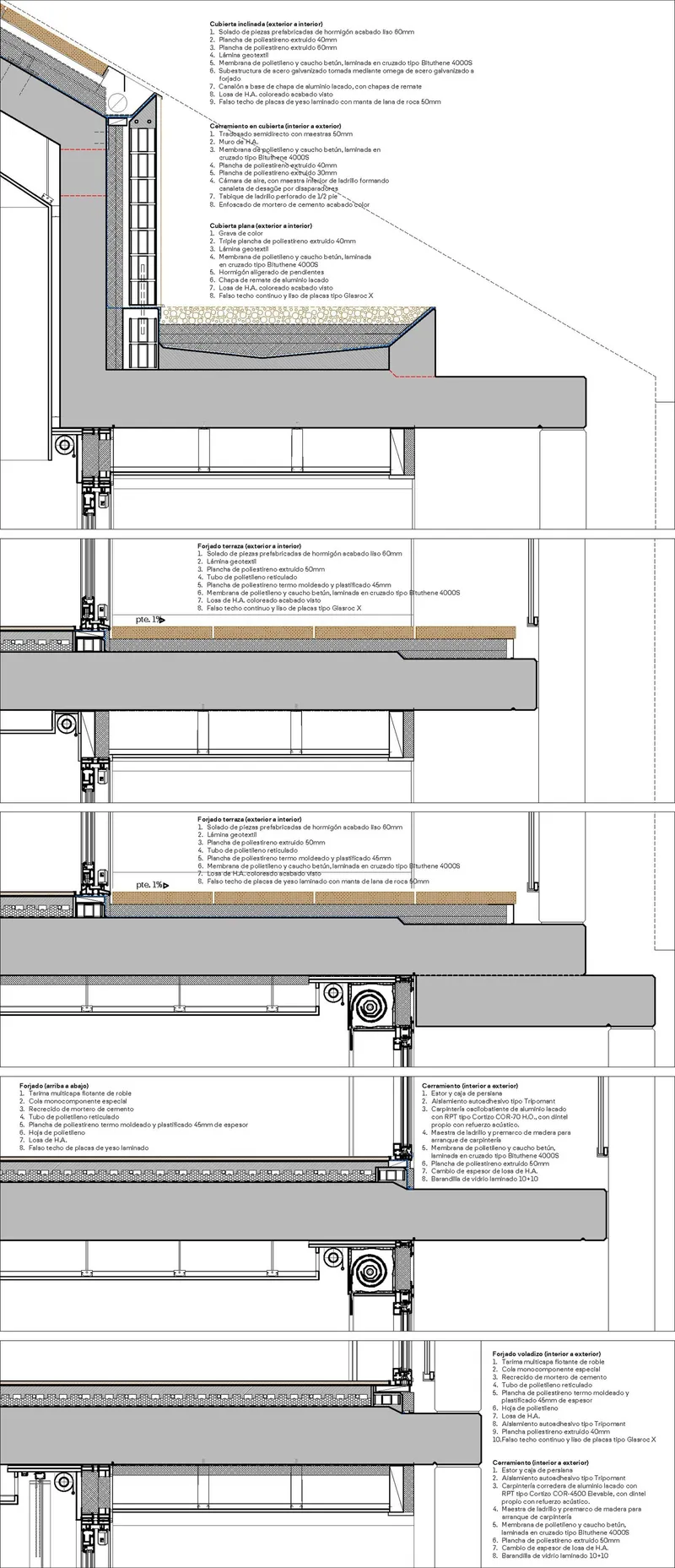
The plan drawings reveal the logic behind the volumetric shifts: floor plates stagger laterally at each paired level, creating the alternating cantilevers visible from outside. The section through all three buildings shows the shared underground parking garage, the voids that bring light and vegetation to subterranean levels, and the stepped roofscape. The site plan clarifies the relationship between the angled residential bars, surrounding green spaces, and transit infrastructure. A construction detail of the window sill and floor slab junction demonstrates the precision required to maintain a continuous lattice over a shifting structural grid.
Why This Project Matters
Medium-density housing on post-industrial land is a common brief across European cities, and most of the time it produces competent but forgettable results. What Carbajo Barrios Arquitectos achieved in Santiago de Compostela is a project that takes its site history seriously without becoming nostalgic, uses material color and texture as genuine urban signifiers rather than styling, and delivers 22 apartment typologies within a coherent volumetric language. The ferruginous lattice does real work: it controls solar gain, manages privacy, references the railway past, and unifies three buildings into a single readable composition.
The project also demonstrates that density and livability are not opposed. Every unit gets a perimeter corridor, the ground plane remains permeable to pedestrians, and the landscape strategy extends the city's green infrastructure into the heart of the complex. In a discipline that often treats housing as a problem of efficiency, Conjunto Cornes is a reminder that generosity, both spatial and conceptual, is what turns a residential complex into a neighborhood.
Conjunto Cornes Espacio Residencial by Carbajo Barrios Arquitectos. Santiago de Compostela, Spain. 28,500 m². Completed 2022. Photography by Luis Díaz Díaz.
About the Studio
Share Your Own Work on uni.xyz
If projects like this are the kind of work you want to make, uni.xyz is a place to publish your own, find collaborators, and enter design competitions.




Popular Articles
Popular articles from the community


Co-Life: Senior Housing Design That Reconnects Older Adults With the City
Co-Life reimagines senior housing design through healing gardens, shared streets, workshops, and a sustainable community across generations.

Co-life: Sustainable Architecture for Age-Friendly Community Living
Co-life reimagines sustainable architecture for seniors through courtyards, rammed earth, shared gardens, and spaces designed for belonging.

Riyadh For All: Intergenerational Urban Design for Active Aging in Rabat
Riyadh For All reimagines urban design in Rabat with intergenerational co-living, adaptive courtyards, and Moroccan cultural exchange today.

Play: Fragments of Their World
Familiar architecture becomes modular playground design, creating safe spaces where displaced children can learn, connect, imagine and play.


Similar Reads
You might also enjoy these articles

Bao Huynh Watercolor Atelier: A Serene Art Retreat in Hội An
Bao Huynh Watercolor Atelier in Hội An blends multifunctional art spaces, sustainable design, local materials, and family-friendly living in a serene environment.

Atelier Macri Concept Store Interior Design by CASE-REAL
Atelier Macri store features a "ko" counter, walnut wood details, cork displays, blending retail, gallery, and seamless customer experiences.

Manuel Vargas Izquierdo Stadium and High-Performance Sports Center: Architectural Excellence in Jalpa de Méndez
The Manuel Vargas Izquierdo Stadium blends sustainable design, inclusive sports facilities, and cultural-inspired architecture, revitalizing Jalpa de Méndez’s public spaces.

KAKR Buluh Awar Hall: Revitalizing Community and Ecology Through Bamboo Architecture
Community built bamboo hall revitalizes Buluh Awar village, empowering youth, restoring ecology, celebrating vernacular craftsmanship through sustainable architecture and culture.


Explore Residential Complex Competitions
Discover active competitions in this discipline



Challenge to reimagine the Iron Throne


Photograph architecture without architects


Illustrate the lost glory of Angkor Wat - Render Challenge


Design challenge to reuse E-waste
Comments (0)
Please login or sign up to add comments
No comments yet. Be the first to comment!