
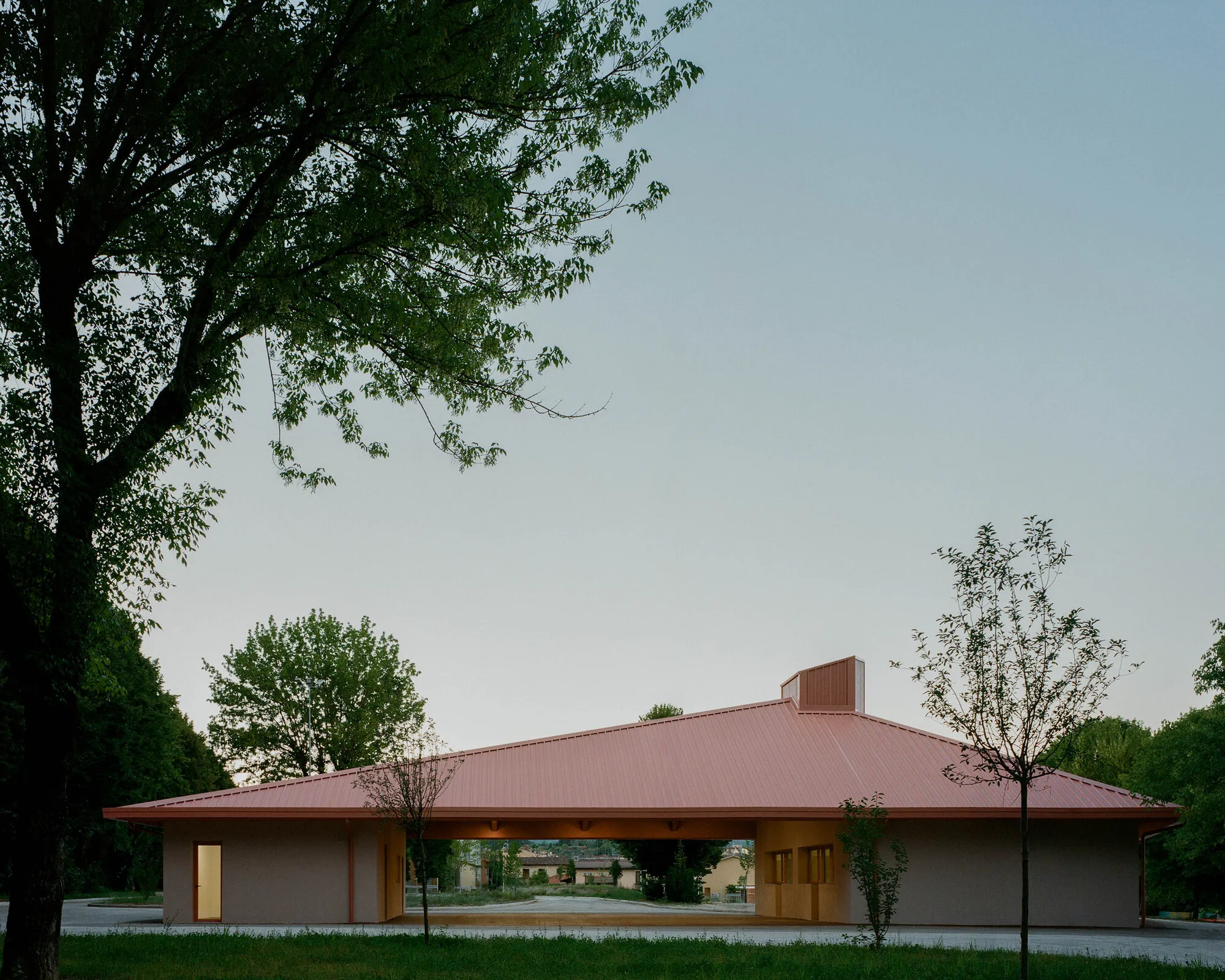
Caret Studio Gives a Tuscan Town Its Living Room Back with a Pink Glulam Pavilion
A rose-terracotta roof in Borgo San Lorenzo turns a historic fairground into a year-round civic stage for the Mugello region.


Every Italian town has a piazza, but not every town has a fairground that has hosted agricultural festivals since the early 1900s. Borgo San Lorenzo, tucked into the Mugello valley north of Florence, has the Foro Boario: a site that for over a century served as the town's communal anchor for livestock fairs, concerts, and local festivals. When PNRR recovery funds made a full urban regeneration possible, Caret Studio was tasked not just with redesigning a building but with restoring a civic identity. The result is a 400-square-meter pavilion beneath a conspicuous rose-terracotta roof, set within a 20,000-square-meter park that reconnects the town to the river.
What makes the project genuinely interesting is not the roof's color, though that helps. It is the decision to treat the roof itself as the architecture's primary civic gesture, elevating a protective canopy into an identifying landmark that speaks the same dialect as the town's vernacular traditions. The building underneath is almost secondary: two compact service volumes flanking a vast open-air hall. The roof does the talking, the gathering, and the sheltering. It is a deliberate rejection of modernist formal neutrality in favor of something the population can claim as its own.
A Roof That Functions as a Civic Symbol
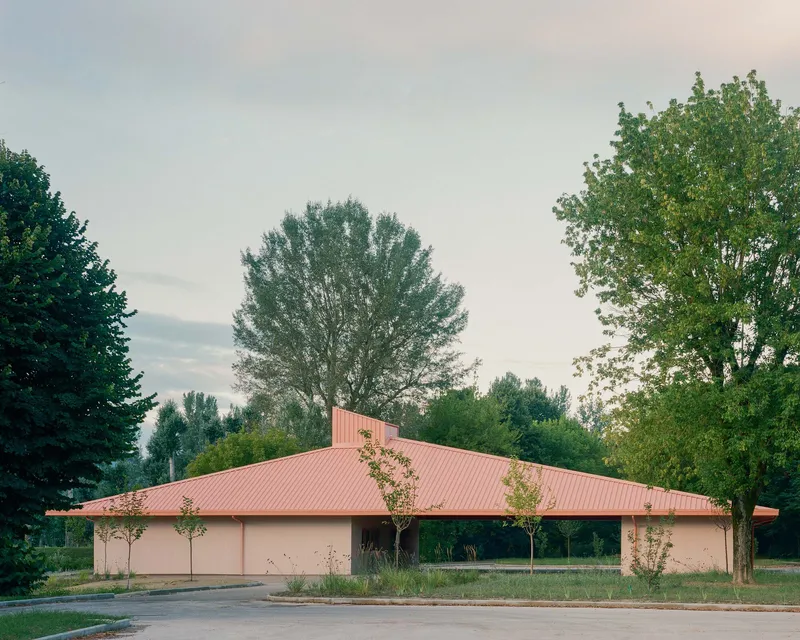
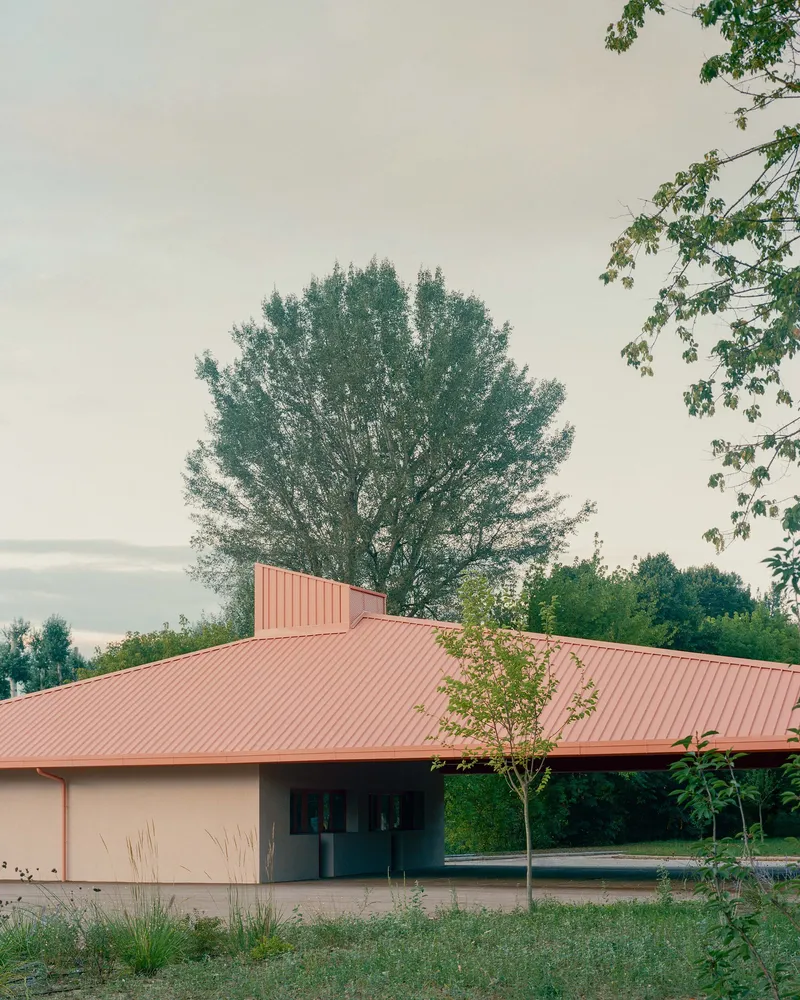
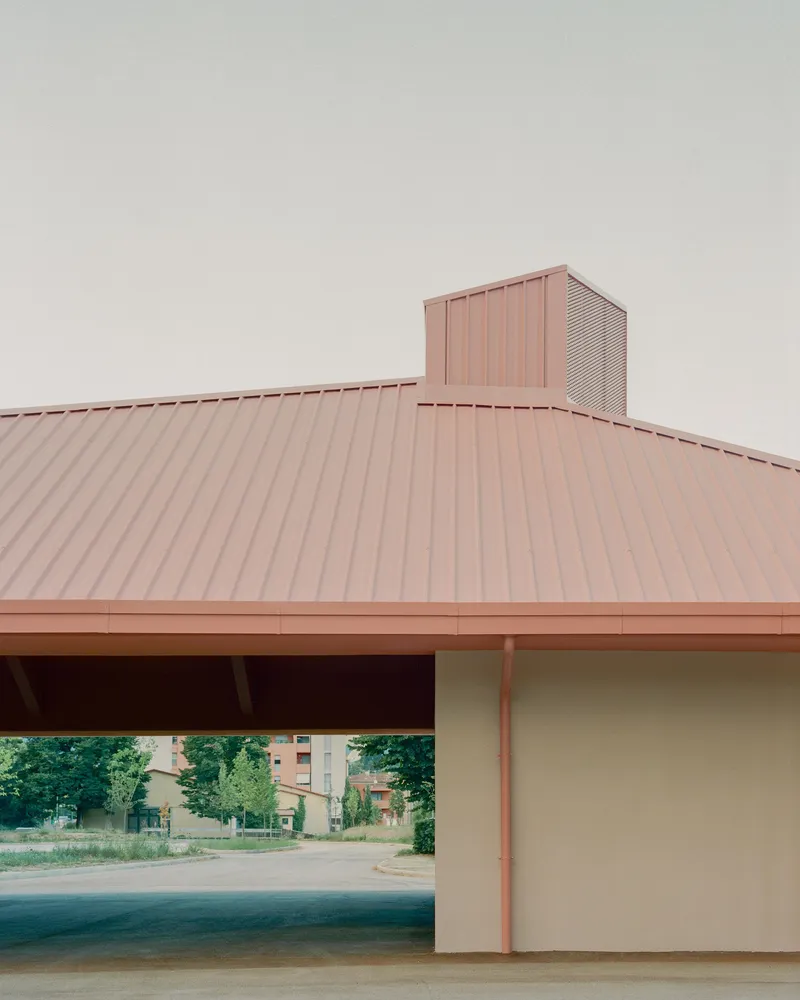
The standing seam metal roof, finished in a warm rose-terracotta tone, dominates every approach. Its broad hipped profile sits low against the tree line, reading less as a building and more as a territorial marker. Caret Studio designed it this way on purpose: the roof is the element that dialogues with the town, not the walls or the program behind them. From the adjacent basketball court or the pedestrian paths, it is the color and silhouette that register first.
Perforated metal ventilation boxes punctuate the roofline, adding an industrial texture that keeps the palette honest. The pink is assertive without being theatrical; it recalls the terracotta tones of Tuscan soil and brickwork while remaining clearly contemporary. Against overcast skies or evening light, the roof shifts temperature, sometimes earthy, sometimes closer to salmon. It is a color that earns its place by connecting to the landscape rather than competing with it.
Timber Structure as Spatial Language
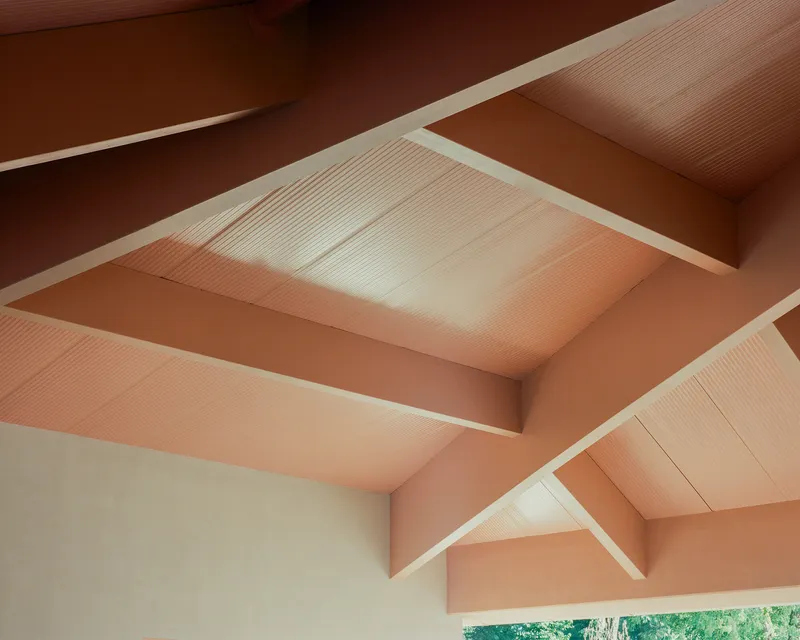
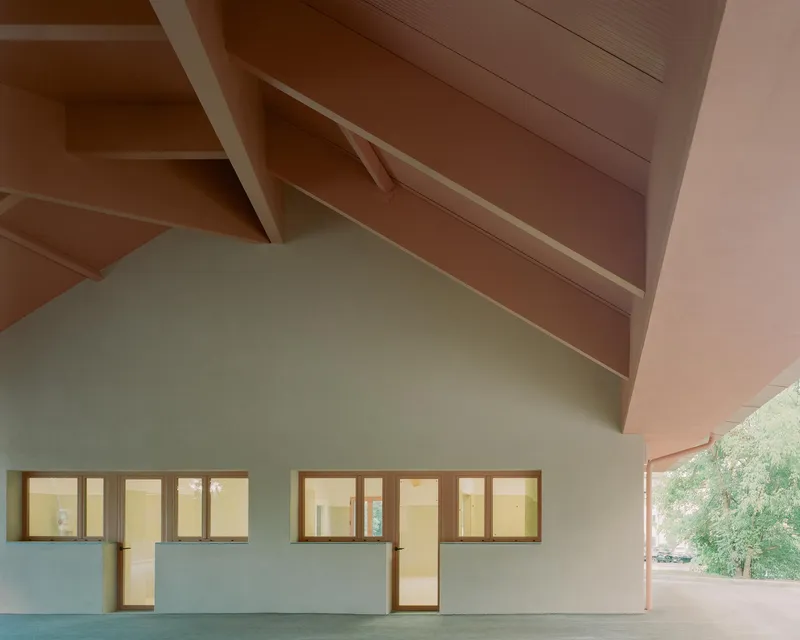
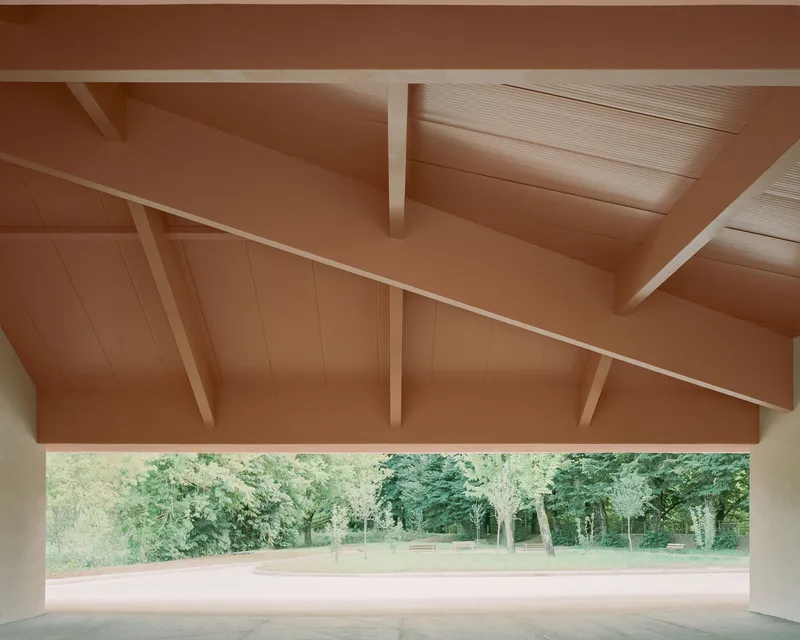
Underneath the metal cladding, the load-bearing structure is entirely glulam timber, and Caret Studio lets it perform. Intersecting gabled ceilings create a vaulted geometry that lifts the interior atmosphere well beyond what a 400-square-meter pavilion normally delivers. The beams are left exposed, their warm blonde tones amplified by the corrugated metal panels above. Clerestory windows between the roof planes introduce diffused light that washes along the timber, turning the ceiling into the most compelling surface in the building.
The covered porch condition is where this structure really pays off. Open on multiple sides, the loggia frames views of the surrounding park while the timber beams overhead provide a domestic scale. It is the kind of space that invites people to linger without any programmatic instruction: a dance floor, a dining hall, a gathering spot, depending on the season and the occasion. The 220-square-meter dance floor at the center makes this flexibility explicit.
Two Volumes and an Open-Air Hall
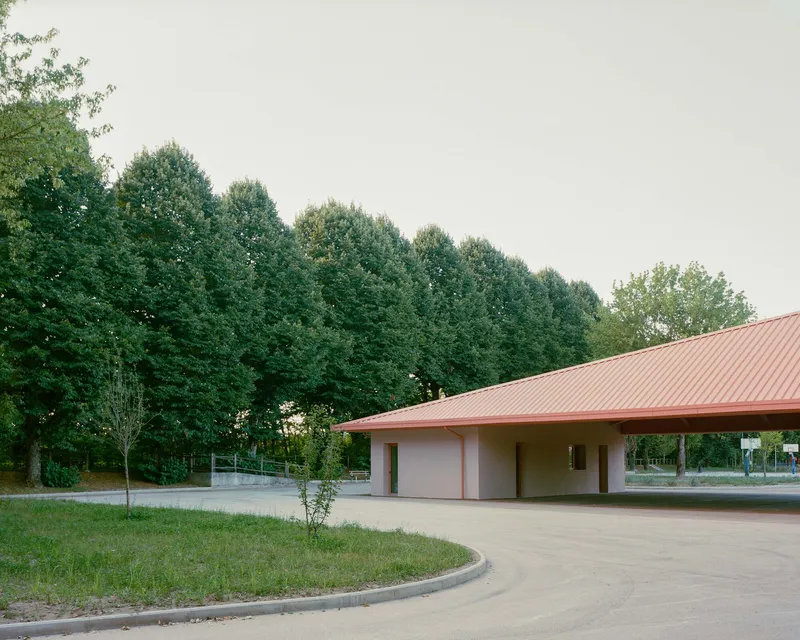
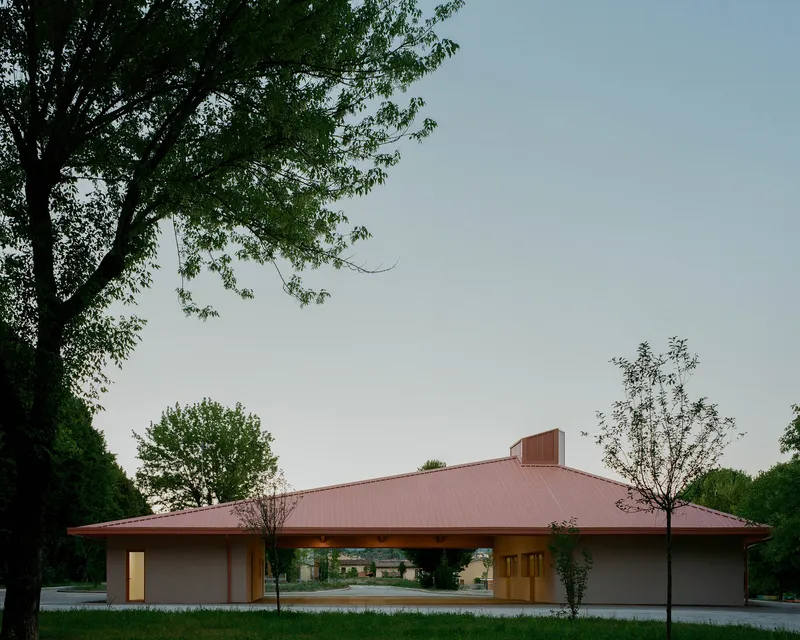
The pavilion's plan is structured as a bridge: two enclosed service volumes sit at either end, with the open civic hall stretching between them beneath the continuous roof. One volume houses community-use kitchens, the other a bar managed by local associations alongside public restrooms. The split is functional but also strategic. By placing services at the periphery, Caret Studio ensures the center remains permeable, a covered outdoor room that people pass through rather than enter.
This permeability is key to the building's role in the larger park. Pedestrian and cycle paths flow through and around the pavilion, linking the town to the north and the river to the south. The architecture does not block movement; it channels it. At dusk, when the recessed openings beneath the overhanging roof edge glow, the pavilion reads as an inhabited threshold rather than a destination. You move through it on your way somewhere else, and that transit is the civic act the building is designed to produce.
Landscape as Infrastructure
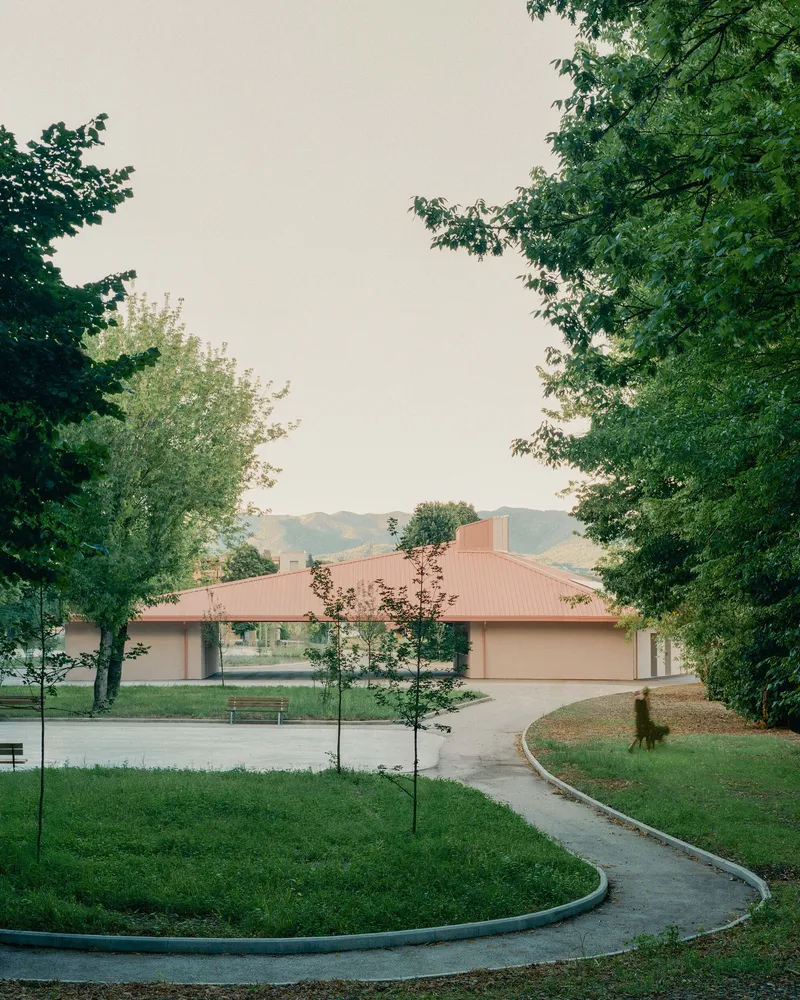
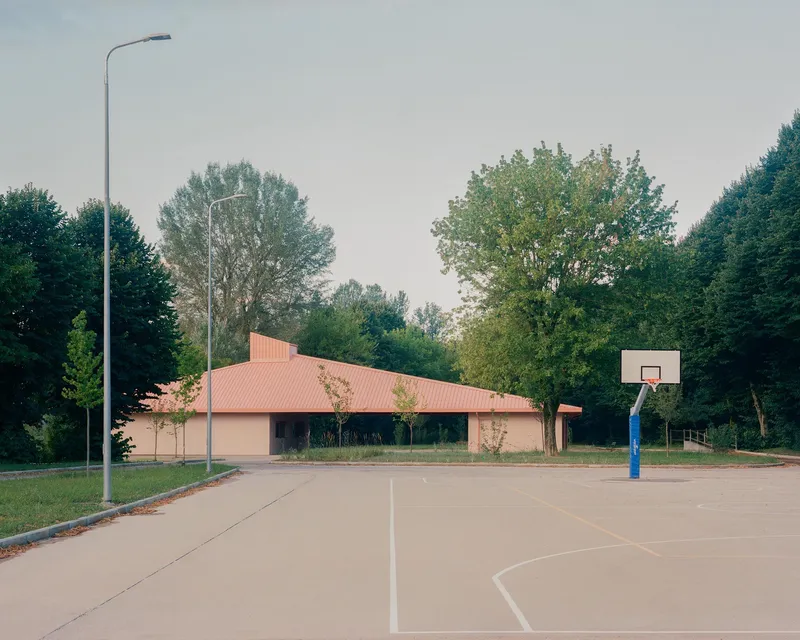
The 20,000-square-meter park is not a decorative setting for the pavilion; it is half the project. Caret Studio relocated Via Caduti di Montelungo to the lowest of three existing terraces, pushing vehicular traffic away from the river and maximizing the sensory distance between the park and the road. Noise mitigation here is accomplished through topography and planting rather than walls. Forty-two new trees, combined with existing mature poplars and deciduous specimens, form a layered buffer.
Curved concrete pathways and planted beds guide movement from the town center toward the pavilion and onward to the river. An 80-space parking lot absorbs cars at the edge without intruding on the pedestrian experience. The landscape design originated from a participatory process that began in 2021 with Agenzia Lama, meaning the path alignments and planting choices reflect actual use patterns rather than speculative diagrams. That consultative groundwork shows in the result: the park feels inevitable rather than imposed.
Evening Presence
The building shifts character significantly after dark. Timber-framed openings beneath the metal cladding emit a warm amber light that pools beneath the overhang, turning the perimeter into a lantern condition. The pink roof disappears into the night sky, and the pavilion becomes all about what happens at ground level: lit porticos, populated thresholds, the hum of a bar or a festival kitchen. Lorenzo Zandri's photographs capture this duality well, showing a structure that is simultaneously monumental in daylight and intimate at dusk.
Plans and Drawings
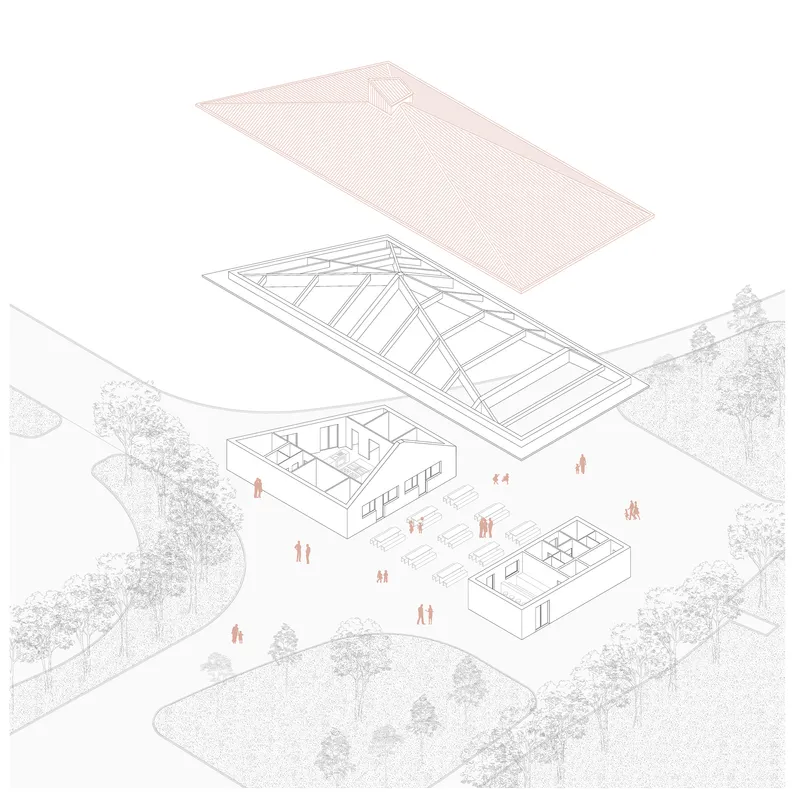
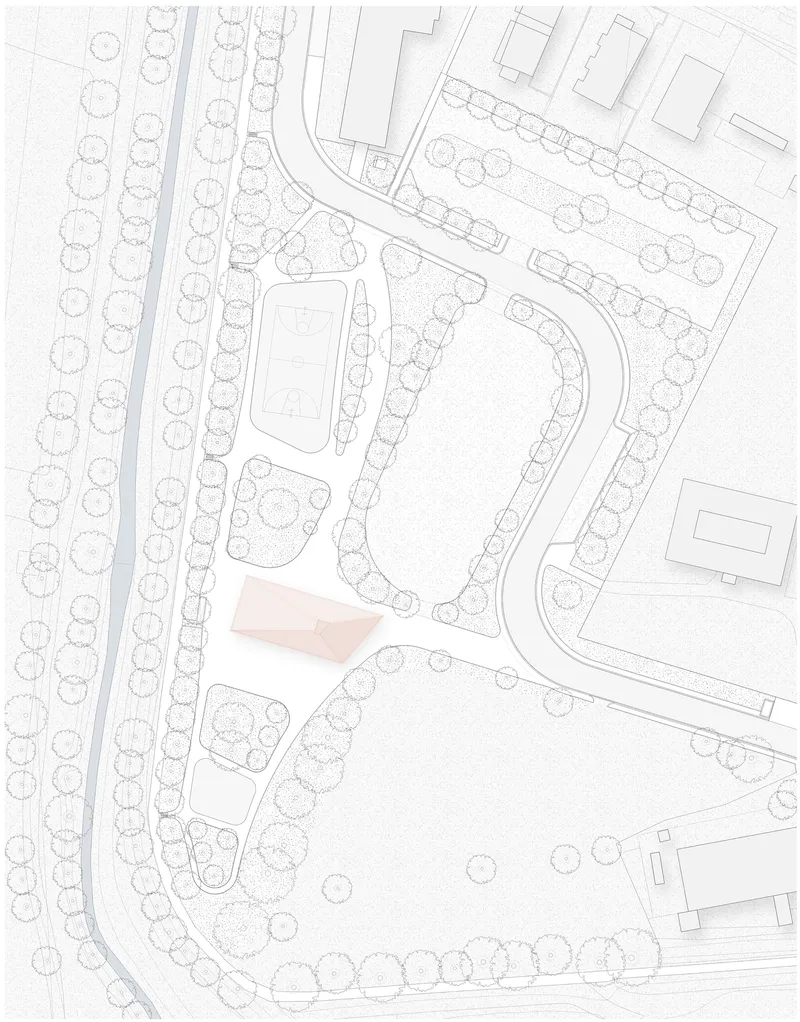
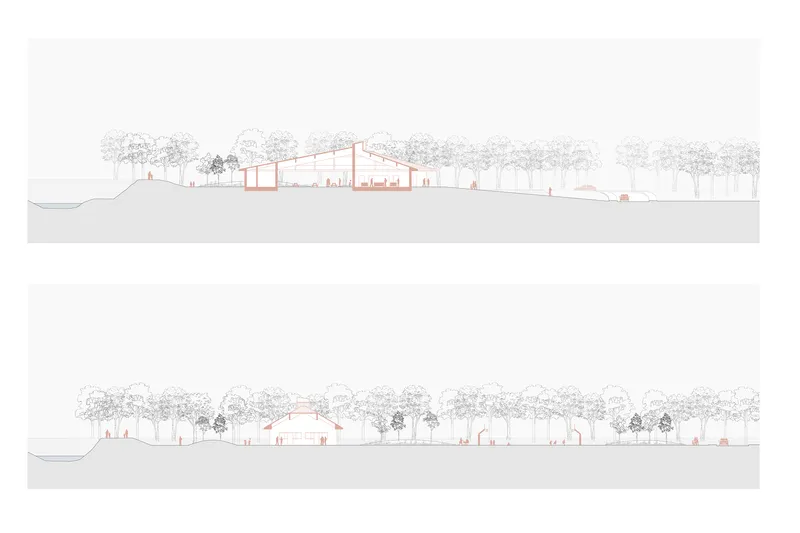
The axonometric drawing reveals what photographs cannot: the relationship between the timber framing, the roof envelope, and the two enclosed volumes. The structure reads as a kit of parts, with the glulam frame establishing a regular rhythm that the service boxes simply slot into. The site plan confirms the ambition of the landscape strategy, showing curving paths radiating outward from the pavilion through dense tree planting toward the river and surrounding streets. Elevation drawings place the building in profile against its context, demonstrating how the arched roof volumes sit low among the tree rows on the sloping terrain, never competing with the canopy line.
Why This Project Matters
The Foro Boario project matters because it takes the simplest possible architectural proposition, a roof, and turns it into a genuine instrument of civic recovery. In a moment when public architecture often defaults to either spectacular form-making or anonymous functionality, Caret Studio chose a third path: a recognizable, rooted gesture that people in Borgo San Lorenzo can identify with because it was designed in conversation with them. The participatory process, the vernacular color, the open plan that defers to community use rather than prescribing it: these are not radical ideas, but they are executed here with uncommon discipline.
The project also demonstrates that PNRR regeneration funds, when directed at the right scale, can produce architecture that functions as both infrastructure and identity. A 400-square-meter pavilion should not be able to anchor a 20,000-square-meter park, but by concentrating its architectural energy on the roof and distributing its program to the landscape, Caret Studio makes it work. The pink roof is not a gimmick. It is a claim: this place belongs to this town, and the town knows it.
Under The Pink Roof, Foro Boario, by Caret Studio. Located in Borgo San Lorenzo, Italy. Park area: 20,000 m²; pavilion area: 400 m². Completed in 2025. Photography by Lorenzo Zandri.
About the Studio
Share Your Own Work on uni.xyz
If projects like this are the kind of work you want to make, uni.xyz is a place to publish your own, find collaborators, and enter design competitions.



Popular Articles
Popular articles from the community


Lunar Spiral: Space Architecture Shaped by the Mathematics of the Universe
Lunar Spiral reimagines space architecture through Fibonacci geometry, lunar regolith, levitating habitats, and self-sustaining Moon living.

Co-life: Sustainable Architecture for Age-Friendly Community Living
Co-life reimagines sustainable architecture for seniors through courtyards, rammed earth, shared gardens, and spaces designed for belonging.

Conexión: Biophilic Design Reimagines High-Rise Living in Hong Kong
Conexión reimagines high-rise living in Hong Kong through biophilic design, green facades, shared spaces, daylight, water and nature within.

Hill & Cross Opera: Sculptural Opera House Architecture Shaped by Tallinn’s Landscape and Identity
Hill & Cross Opera reimagines opera house architecture in Tallinn through its sculptural hill, civic plaza, glass wave and a luminous cross.

Similar Reads
You might also enjoy these articles

Bao Huynh Watercolor Atelier: A Serene Art Retreat in Hội An
Bao Huynh Watercolor Atelier in Hội An blends multifunctional art spaces, sustainable design, local materials, and family-friendly living in a serene environment.

Atelier Macri Concept Store Interior Design by CASE-REAL
Atelier Macri store features a "ko" counter, walnut wood details, cork displays, blending retail, gallery, and seamless customer experiences.

Manuel Vargas Izquierdo Stadium and High-Performance Sports Center: Architectural Excellence in Jalpa de Méndez
The Manuel Vargas Izquierdo Stadium blends sustainable design, inclusive sports facilities, and cultural-inspired architecture, revitalizing Jalpa de Méndez’s public spaces.

KAKR Buluh Awar Hall: Revitalizing Community and Ecology Through Bamboo Architecture
Community built bamboo hall revitalizes Buluh Awar village, empowering youth, restoring ecology, celebrating vernacular craftsmanship through sustainable architecture and culture.

Explore Rooftop Competitions
Discover active competitions in this discipline


Challenge to design a portable theatre

Challenge to design a portable music platform

Challenge to design an open learning module for the elderly
Comments (0)
Please login or sign up to add comments
No comments yet. Be the first to comment!