
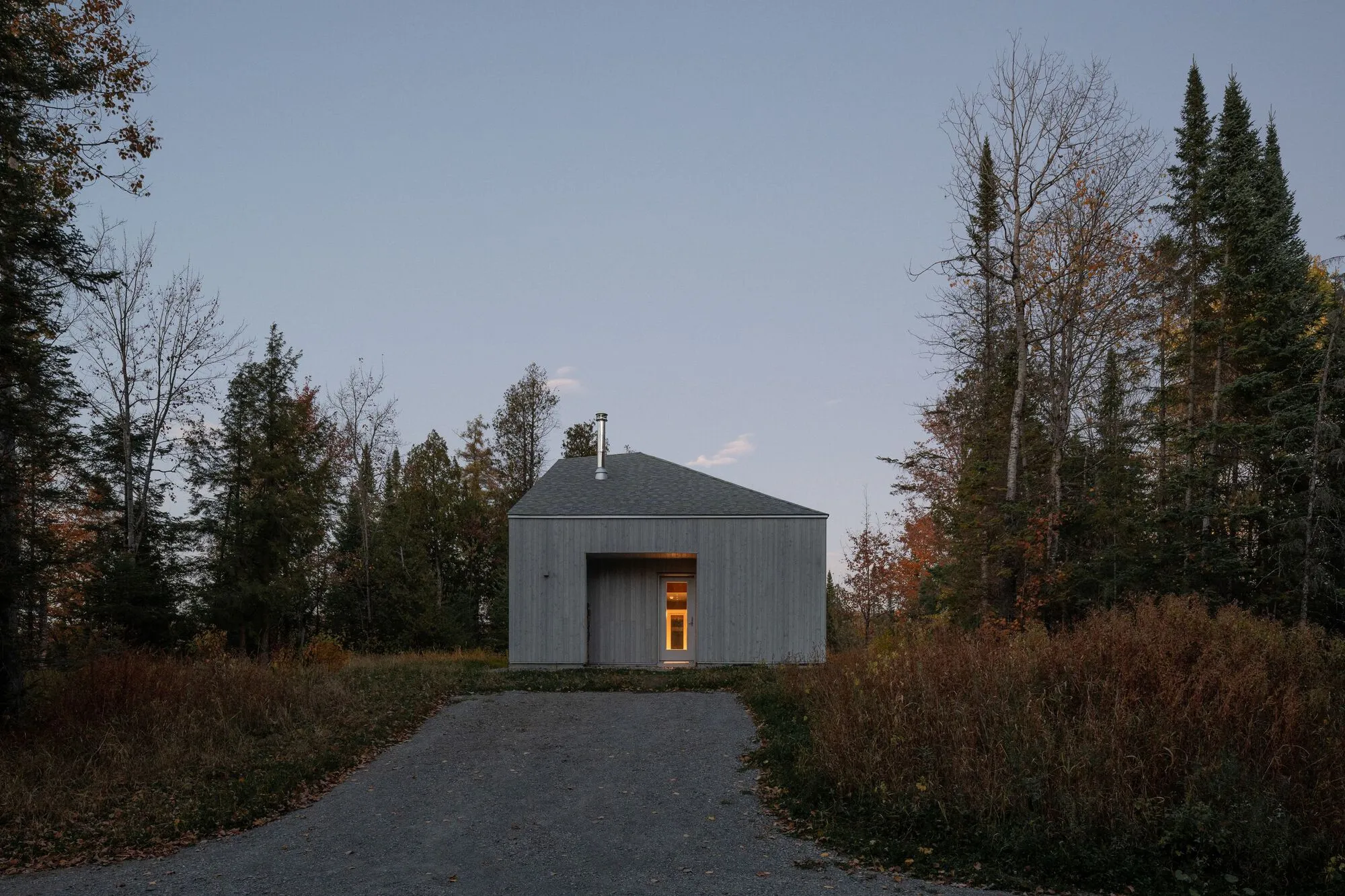
CARTA. Architecte + Designer Tuck a Pine-Lined Retreat into a Quebec Forest Plateau
In Argenteuil's deep woods, a corrugated metal cabin plays dark volumes against knotty pine warmth to redefine the Canadian chalet.


The Canadian chalet has a long and well-worn identity: log walls, pitched roofs, a fireplace, and a general disposition toward coziness. It is a typology so deeply ingrained that most architects either replicate it wholesale or reject it in favor of something flat-roofed and antagonistic. CARTA. Architecte + Designer chose a third path with the Scotch Chalet. Perched on a plateau in the forests of Argenteuil Regional County Municipality, the project keeps the gable, keeps the wood stove, keeps the pitched ceiling, but rewrites the material and spatial logic from the inside out.
What makes the project genuinely interesting is the tension between its two material registers. Outside, the building wears corrugated metal cladding and vertical timber siding that let it read as a quiet, almost utilitarian form among the birches and maples. Inside, every surface is knotty pine: ceilings, walls, alcoves, built-in shelving. The contrast is not accidental. The exterior is guarded and muted; the interior is warm, grain-heavy, and unapologetically tactile. The building saves its personality for the people who enter it.
A Clearing, a Cabin, a Canopy
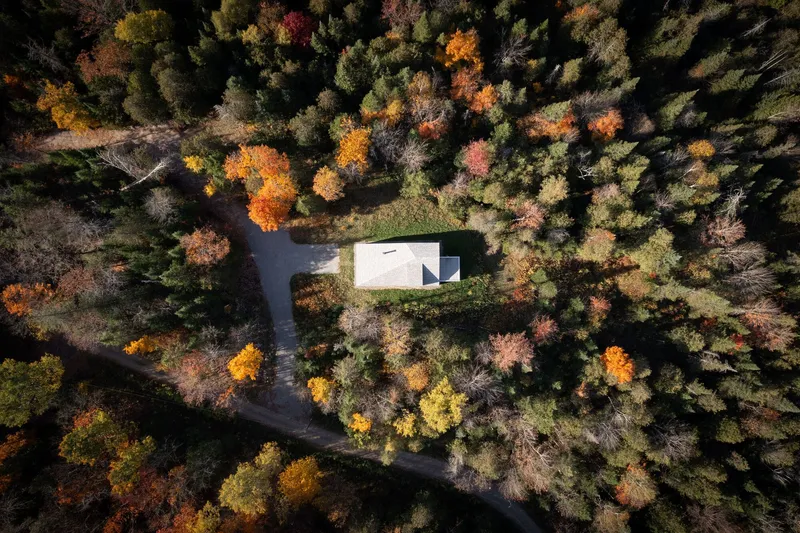
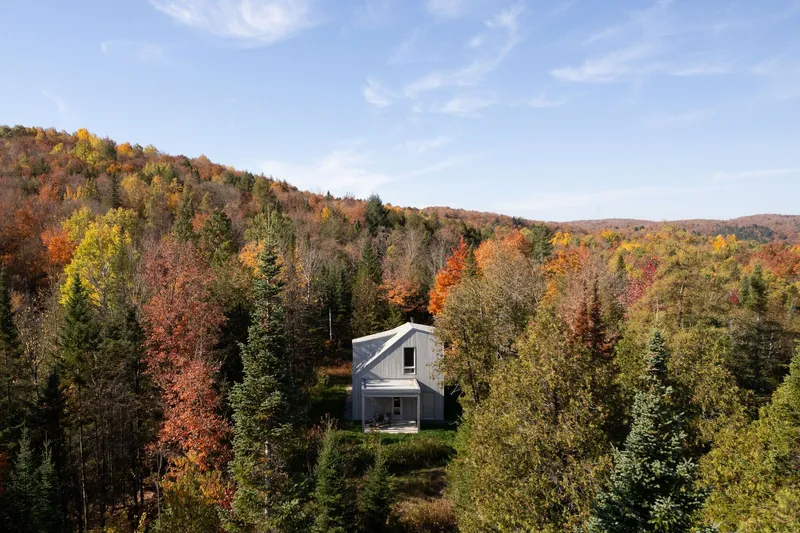
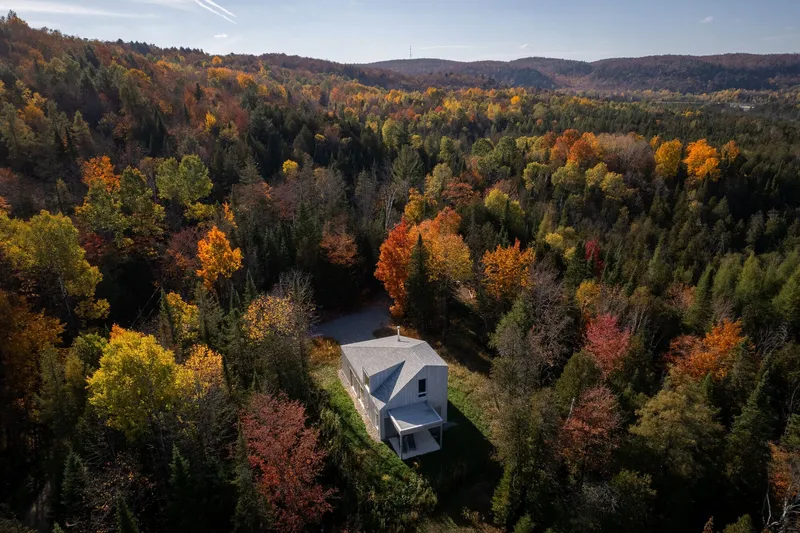
From above, the Scotch Chalet reads as a single white gabled form dropped into a clearing among dense deciduous and coniferous trees. The aerial views reveal how deliberately the building is sited: it occupies just enough of the plateau to claim a footprint without competing with the surrounding canopy. The autumn foliage, caught at peak color in Raphael Thibodeau's photographs, makes the metal roof almost disappear against the sky while the forest becomes the dominant presence.
The drone perspective also exposes a subtle cantilever on the upper volume, where the building pushes past its ground floor footprint toward the trees. It is a small move, but it introduces a sense of suspension that a strictly symmetrical gable would lack. The cabin doesn't just sit on the land; it leans into its surroundings.
Corrugated Metal and Vertical Timber
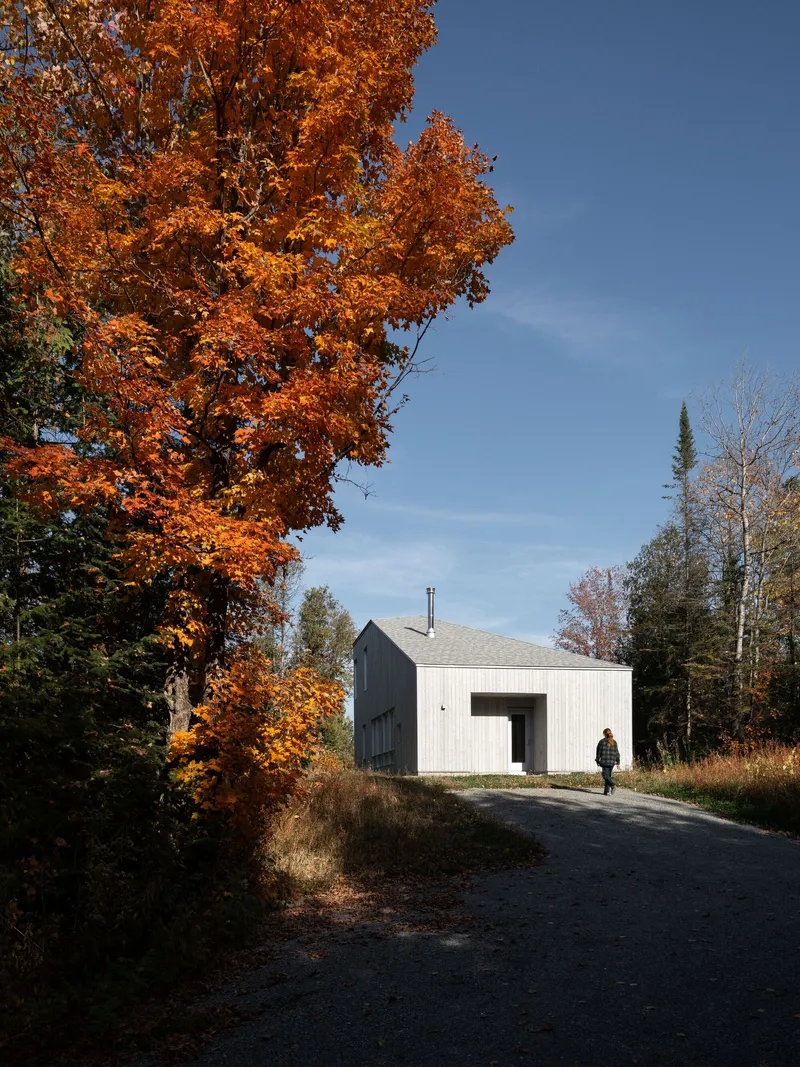
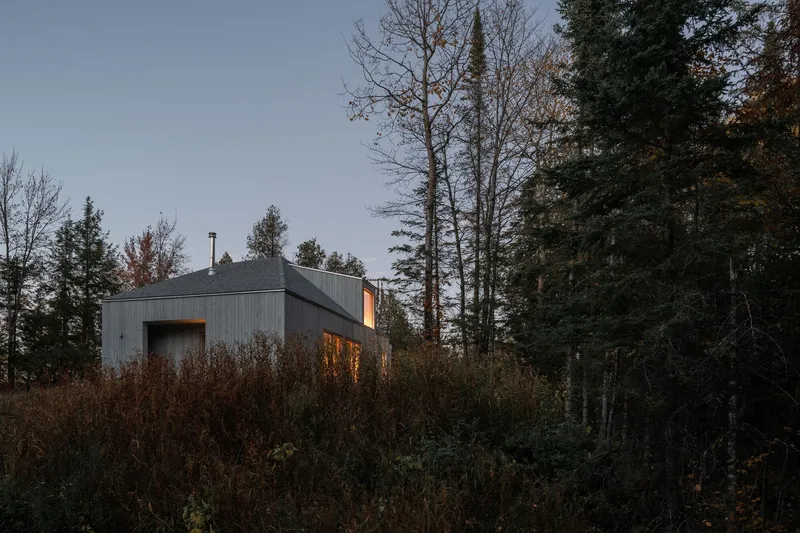
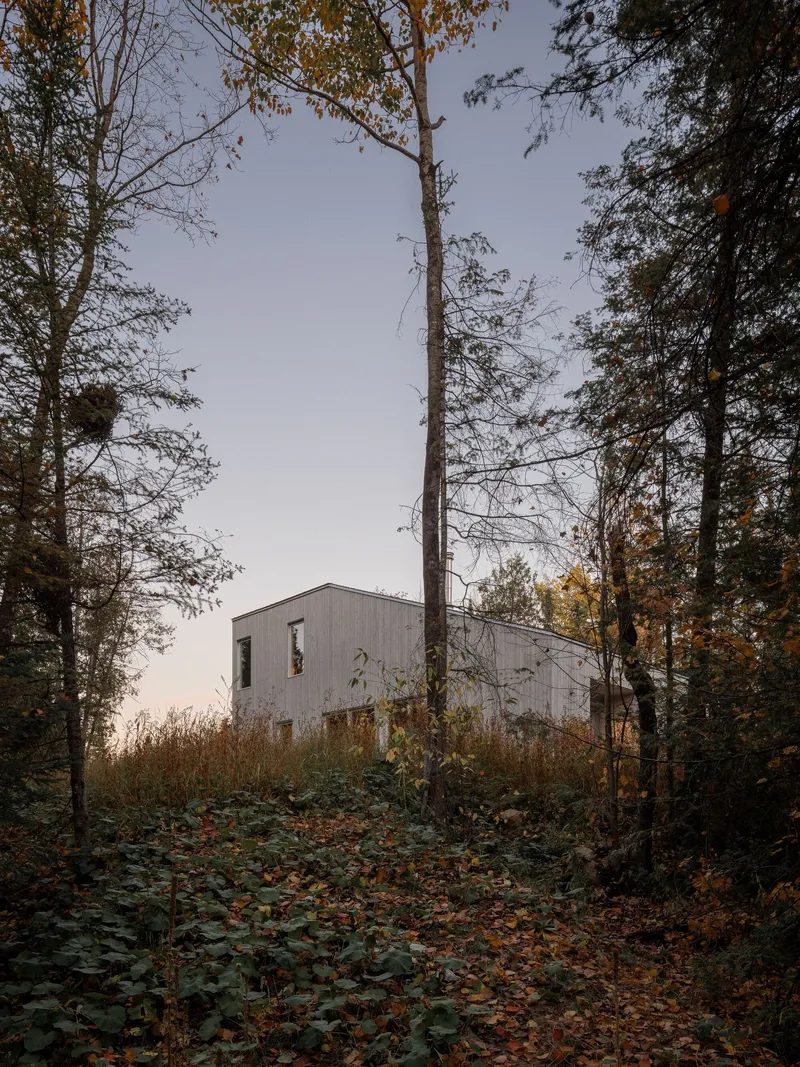
The exterior material strategy is deliberately restrained. White and grey corrugated metal wraps major surfaces, while vertical timber cladding appears on secondary volumes and the recessed entry. The result is a building that shifts appearance with the light: at midday it looks crisp and almost industrial; at dusk it softens into the forest edge, the timber darkening and the metal catching the last warm glow. The recessed entry on the gravel path side is a simple gesture that carves out a threshold without fuss.
One of the quieter successes here is the absence of decoration. No trim profiles, no shutters, no ornamental gable details. CARTA. Architecte lets the corrugation pattern itself serve as the texture, and the vertical timber boards handle the grain. It is a chalet that trusts its proportions.
Dusk Reveals the Section
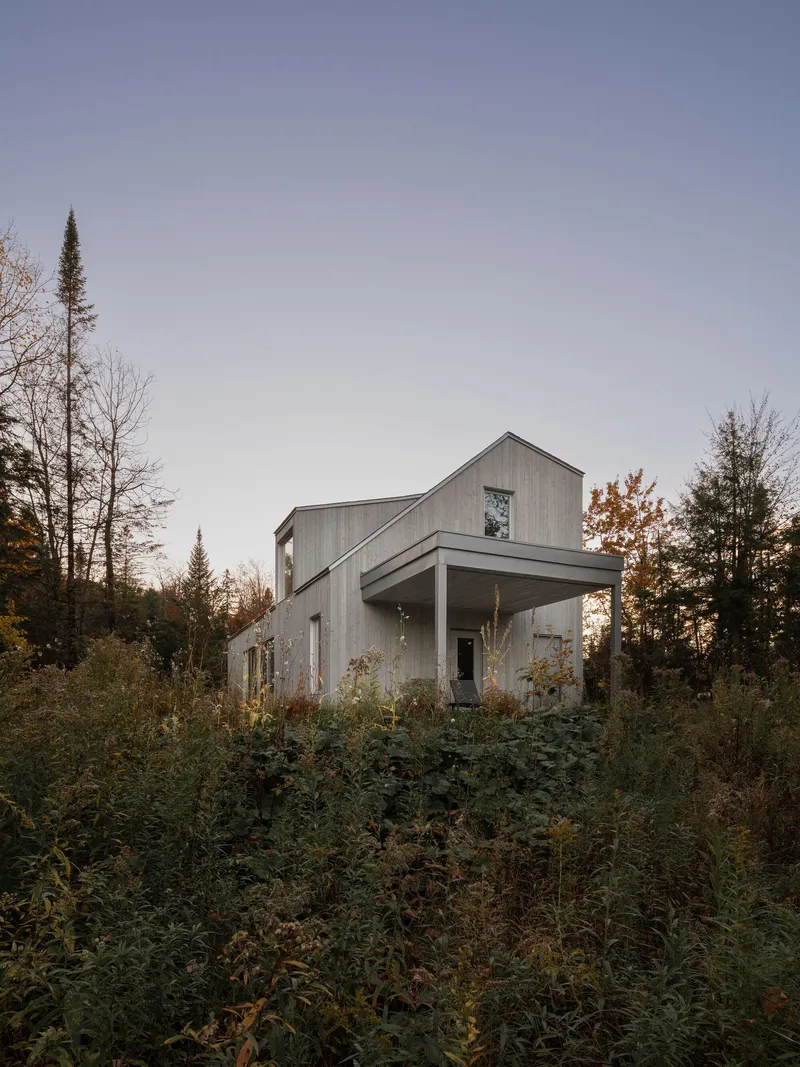
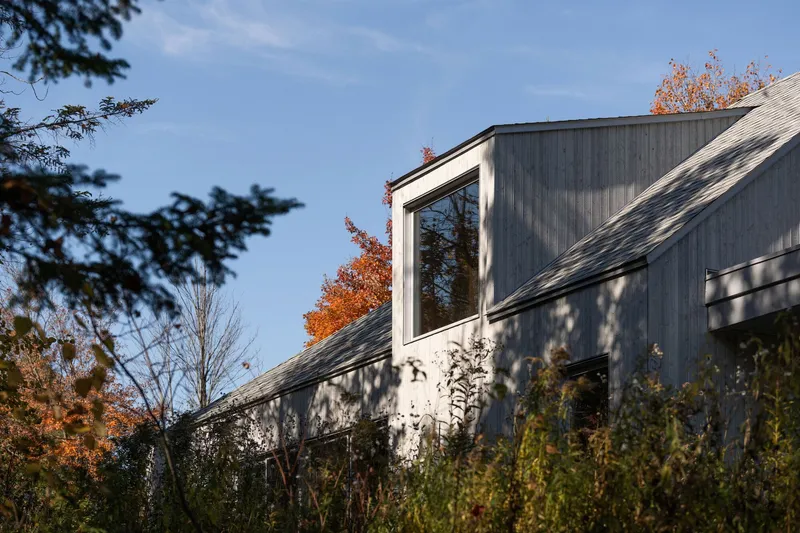
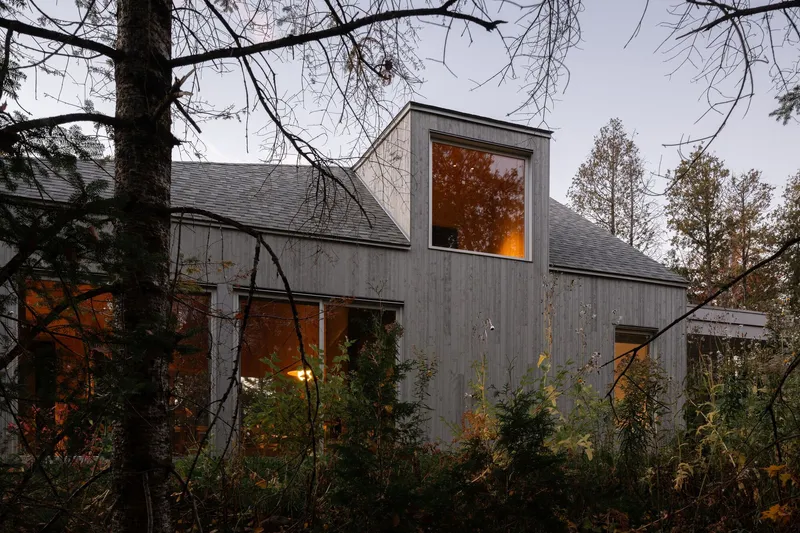
The twilight photographs are the most revealing. When the interior lights turn on, the building's section becomes legible through its glazing: the projecting upper volume glowing above a recessed ground floor, the tall windows cutting vertical slots through the cladding, the clerestory at the ridge admitting light deep into the roof peak. The composition of solid and void, opaque cladding and punched openings, reads most clearly when backlit.
The timber-clad volumes at dusk take on an almost lantern quality. Through the bare winter trees, the cabin becomes a series of warm rectangles floating in a dark lattice of branches. It is a fundamentally romantic image, and the architects have clearly designed for it, placing windows where they will read most strongly from the approach paths.
Knotty Pine and Cathedral Ceilings
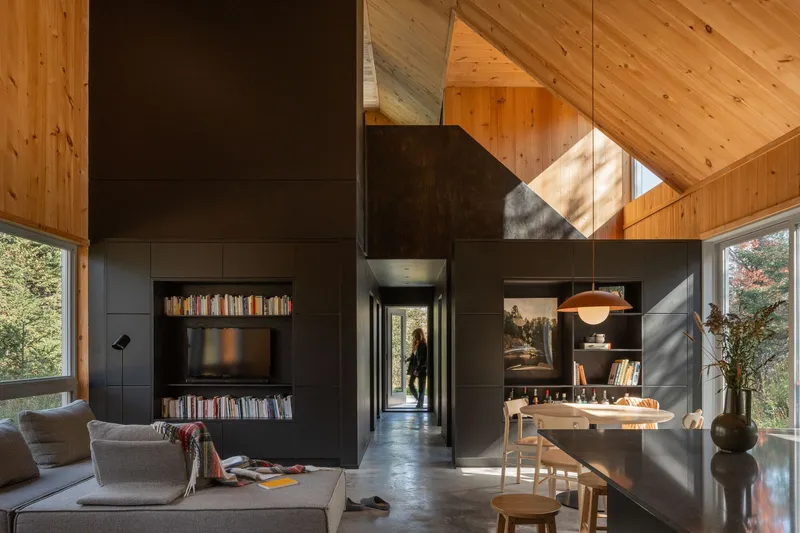
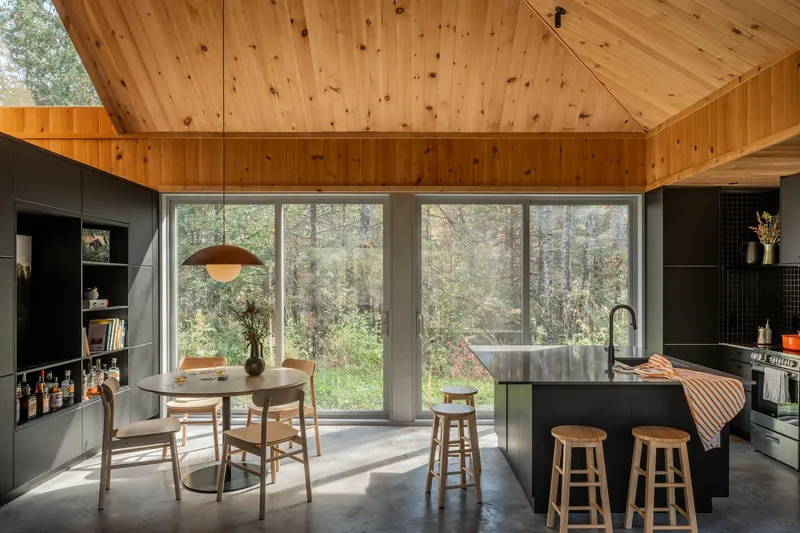
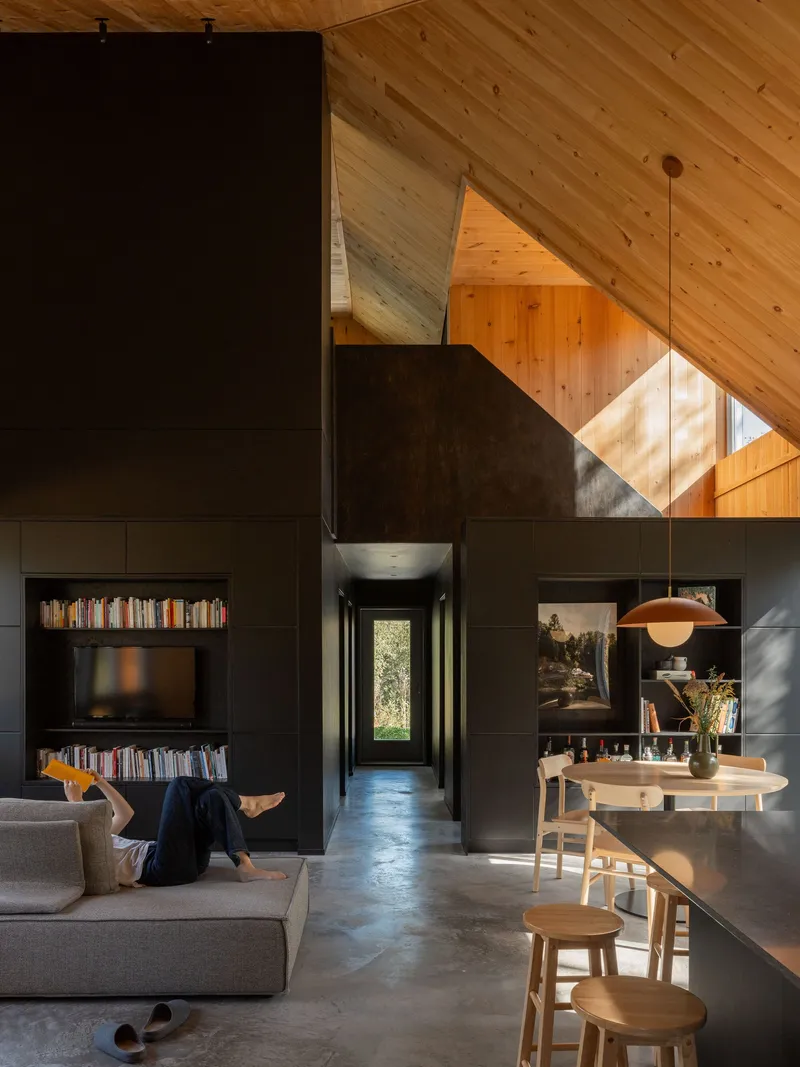
Step inside and the material palette flips entirely. Knotty pine planks line the cathedral ceiling, the walls, and much of the built-in furniture. The knots are not hidden or filled; they are the ornament. Under the sloped ceiling, the living space opens to full-height glazing overlooking the forest, while a blackened steel fireplace wall anchors one end of the room. That dark volume, housing storage and the flue, acts as a counterweight to all the blonde wood, preventing the interior from tipping into saccharine warmth.
The open kitchen and dining area sit beneath the same pine ceiling, with a skylight positioned directly above the dining table. Diagonal afternoon sunlight slices through this opening, painting a bright wedge across the black storage wall. It is a cinematic moment, and one suspects the architects spent considerable time calibrating that skylight's position relative to the sun's autumn angle.
Nooks, Alcoves, and the Art of Framing
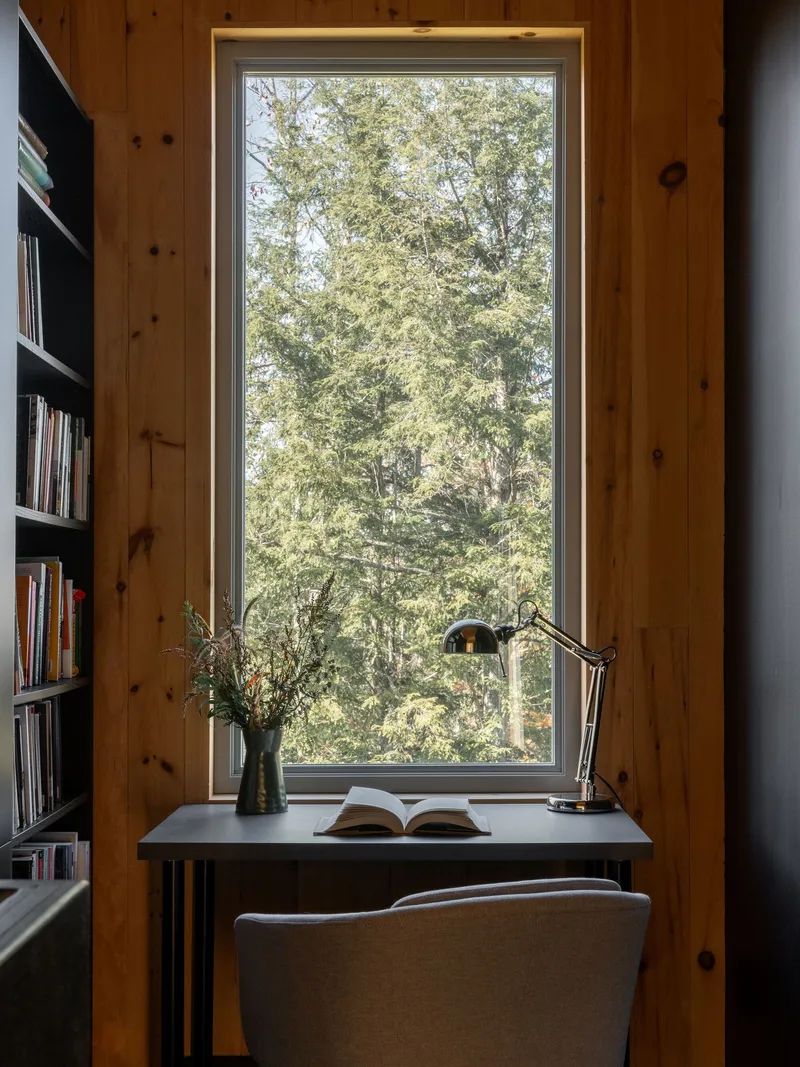
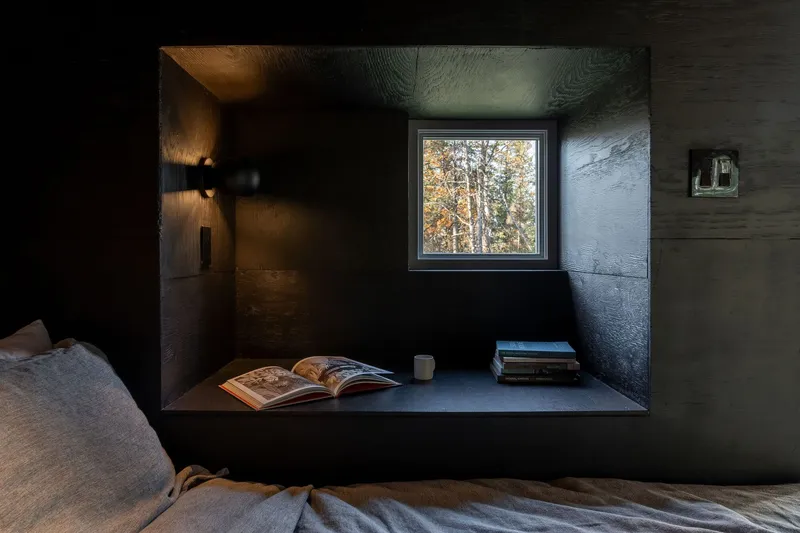
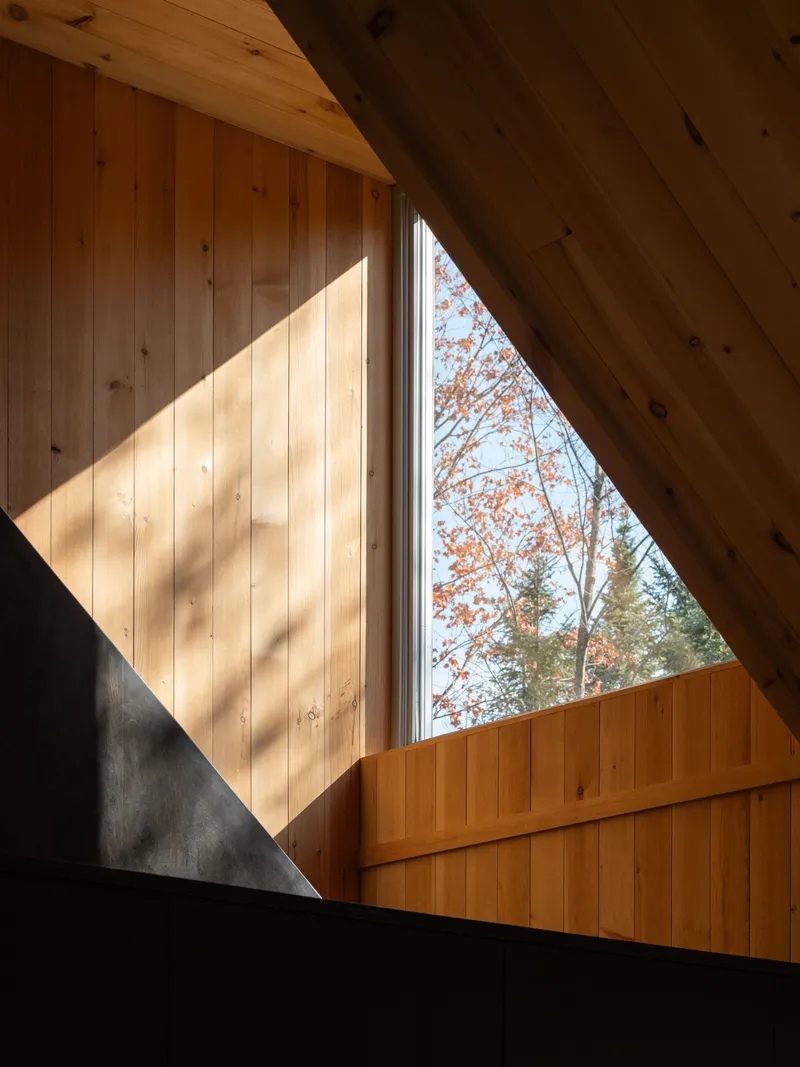
The Scotch Chalet is not a single open loft. It is a sequence of carefully scaled spaces: a reading nook framed by knotty pine with a tall window aimed at the deciduous canopy; a built-in shelf recessed into blackened plywood with a square window punched through to the trees; a triangular window cut through timber panels that casts a sharp diagonal shadow across the wall. Each of these moments does more than provide a view. They compress the space, slow you down, and make the act of looking outward feel deliberate rather than passive.
The variety of window shapes is worth noting. Rather than standardizing to one opening type, the architects use tall verticals, small squares, triangular cuts, and full-height glass walls depending on what each space needs. The reading nook gets a vertical slot because you are seated and looking up into the canopy. The bedroom alcove gets a small square because the view is intimate, not panoramic. The logic is spatial, not stylistic.
Sleeping and Bathing Under the Roof
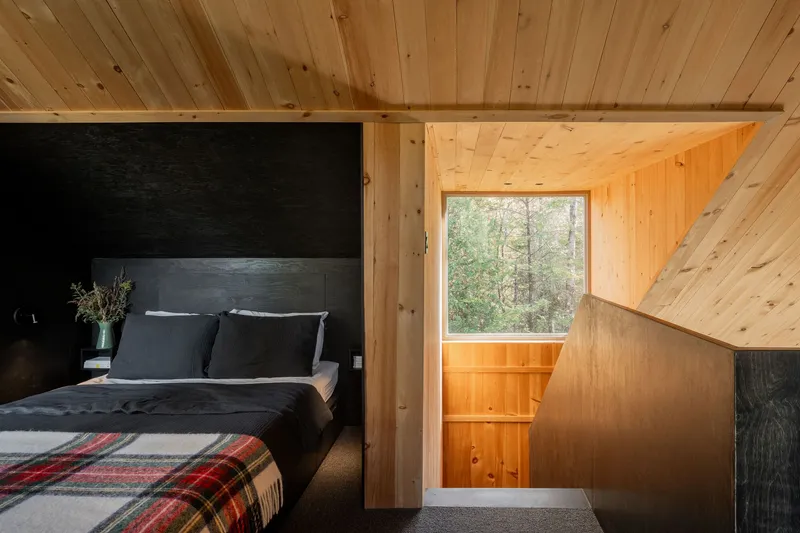
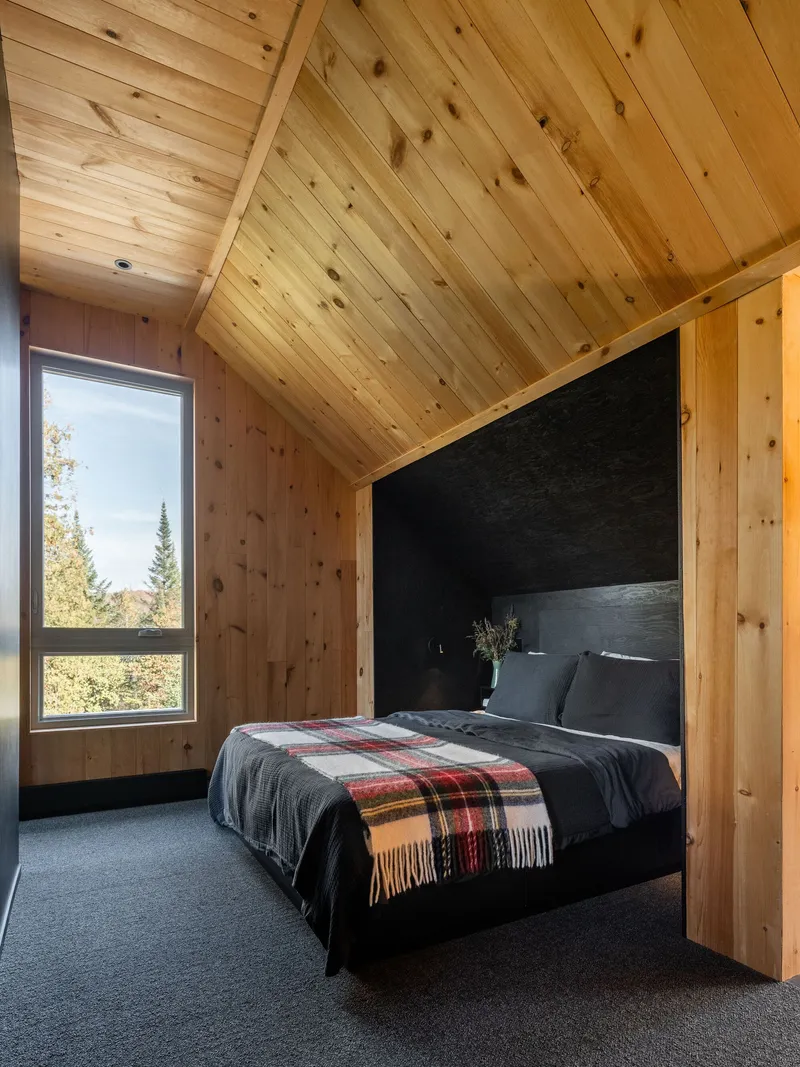
The upper level tucks sleeping and bathing spaces under the pitched roof. A sleeping loft features a black accent wall and an angled timber ceiling that opens to a window seat, while the main bedroom offers a vaulted pine ceiling with a corner window framing evergreen forest. The sloped geometry of the roof becomes an asset here rather than a constraint, creating pockets of compression at the eaves and height at the ridge that give each room a distinct character.
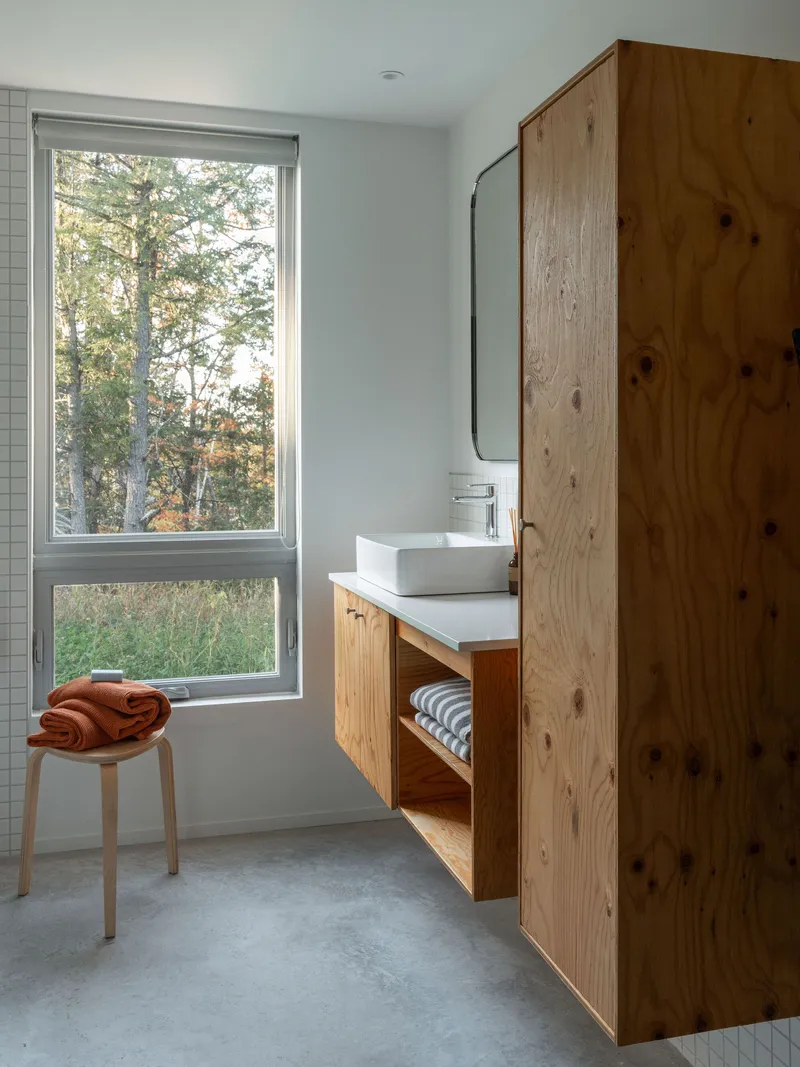
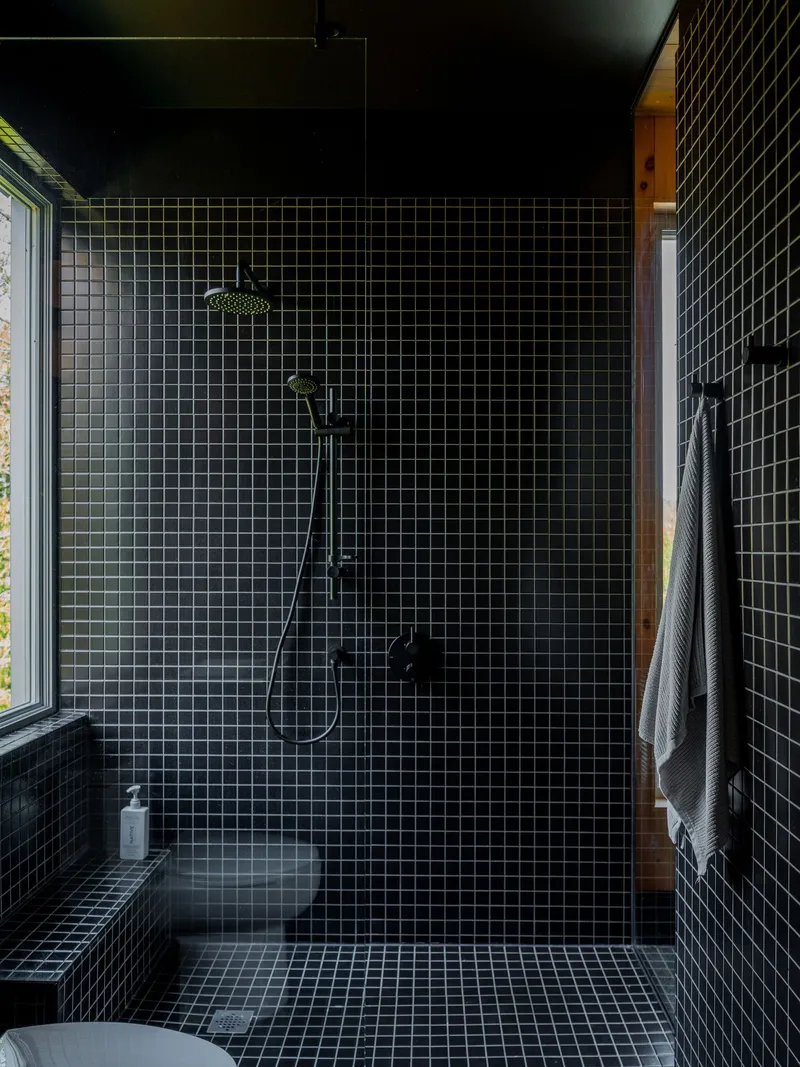
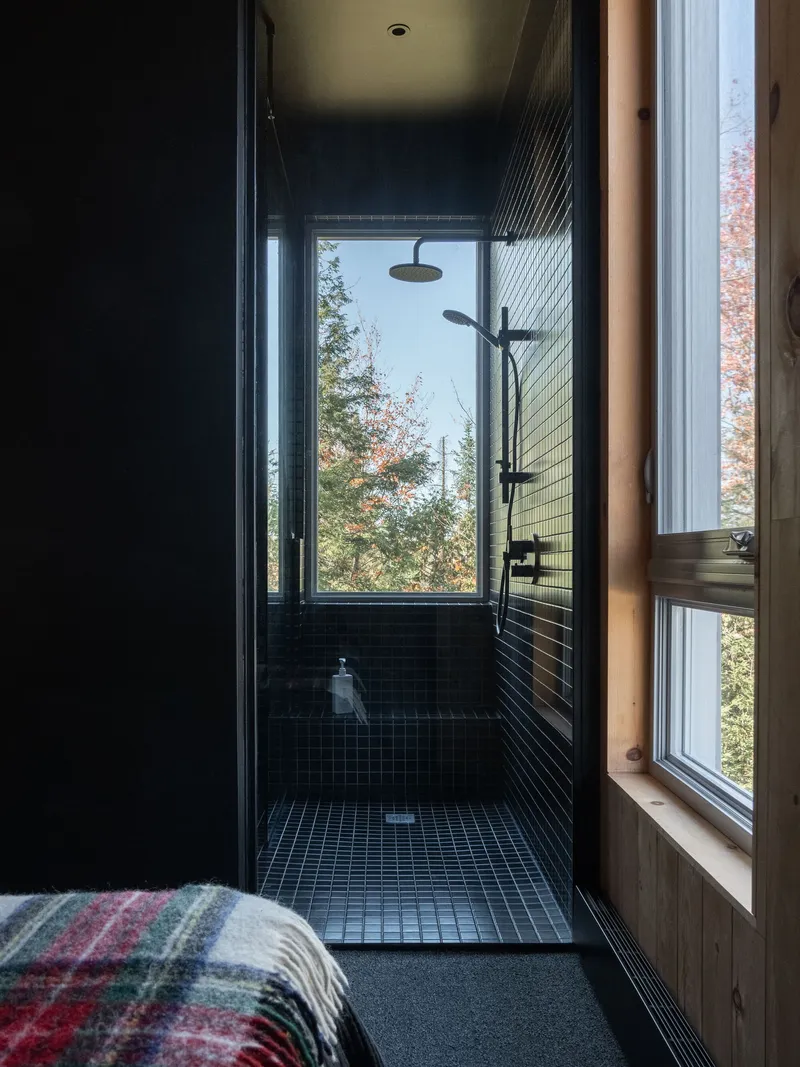
The bathroom pairs knotty timber with small-format black mosaic tile in the shower enclosure. A narrow vertical window in the shower frames autumn foliage, turning a utilitarian room into something more considered. The material shift from pine to black tile is abrupt and effective: it signals a change in function without needing a door to announce it.
Fire and Light
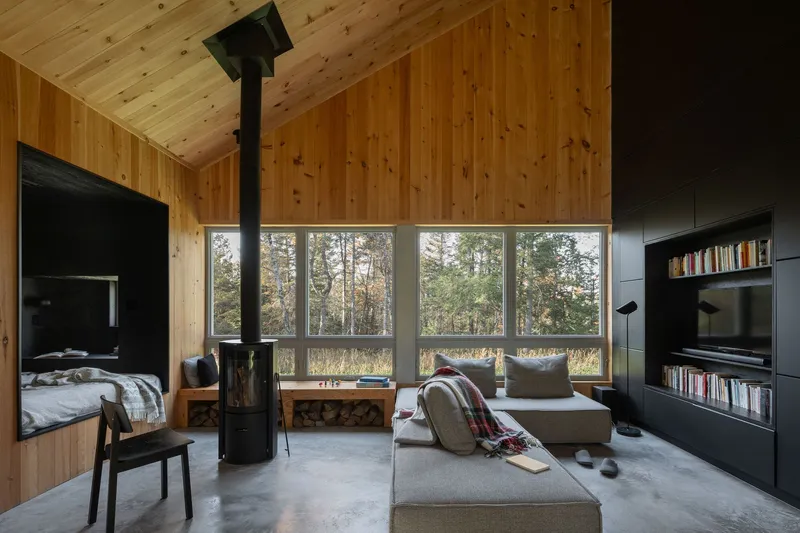
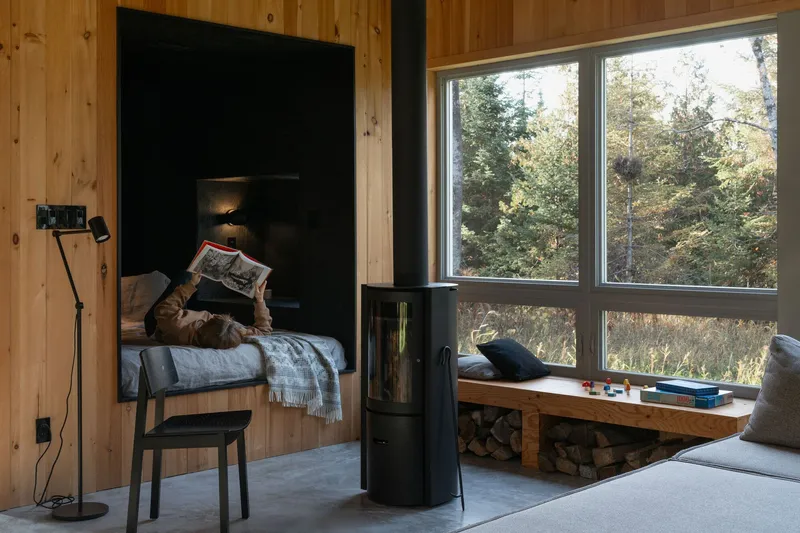
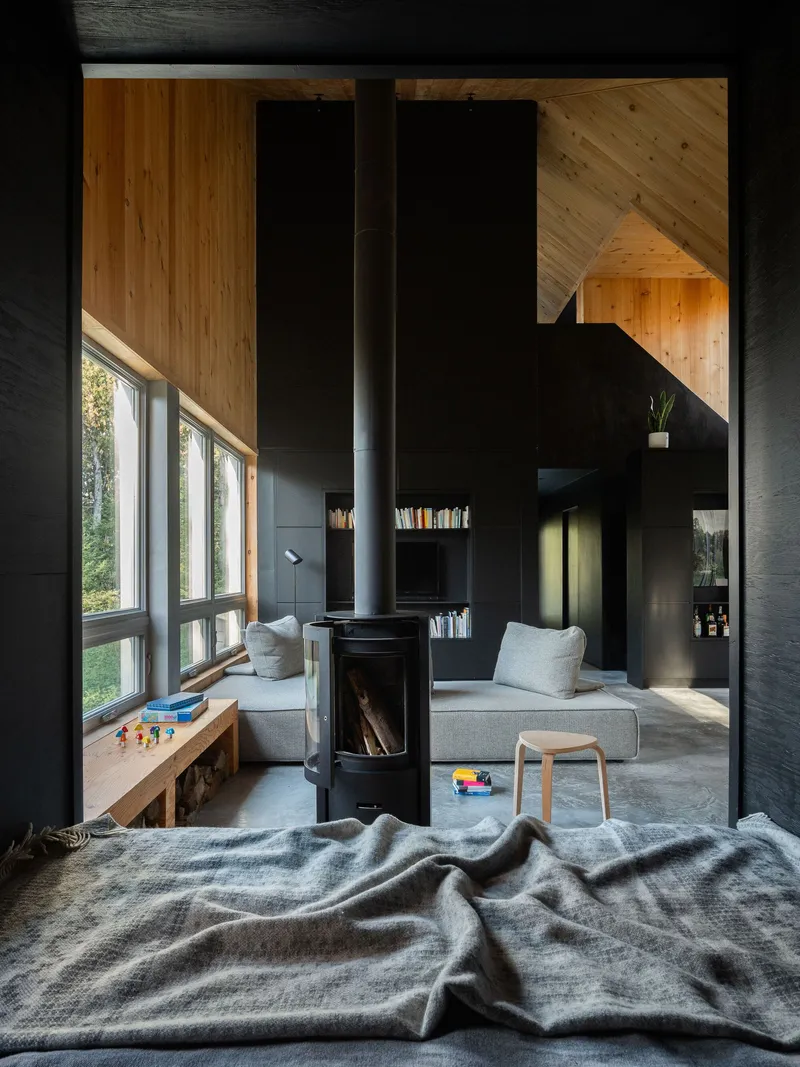
Two wood stoves appear in the project, and both are positioned with precision. In the main living area, a freestanding unit sits against horizontal windows that frame the meadow and tree line. In the reading nook, another stove anchors a smaller space surrounded by large windows overlooking the forested slope. Fire, in both cases, is not just heating. It is a spatial anchor, a reason to sit and stay.
The view from the bedroom through a doorway into the living space, past the wood stove and toward the window seat alcove, captures the project's best quality: a depth of field that unfolds through layers of framed space. You are always looking through something to get to something else. The building never shows you everything at once.
Plans and Drawings
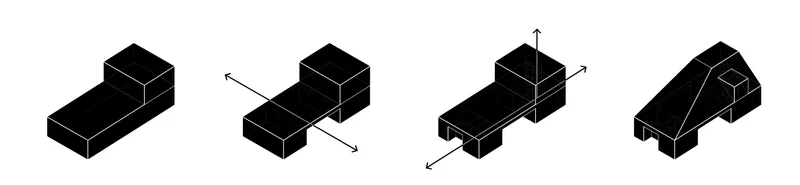
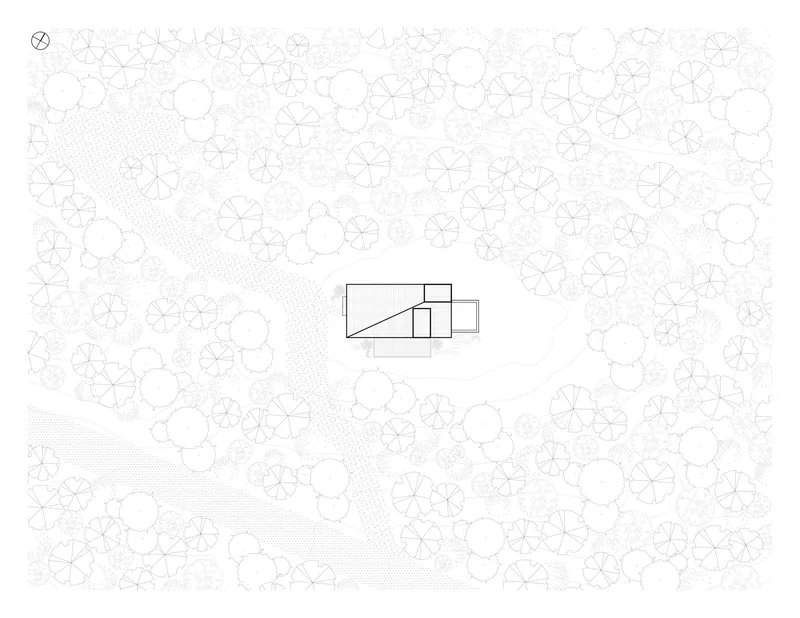
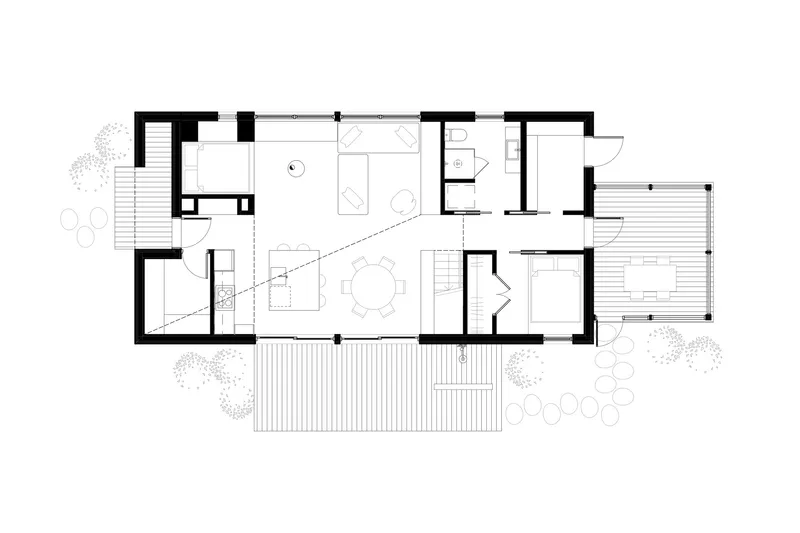
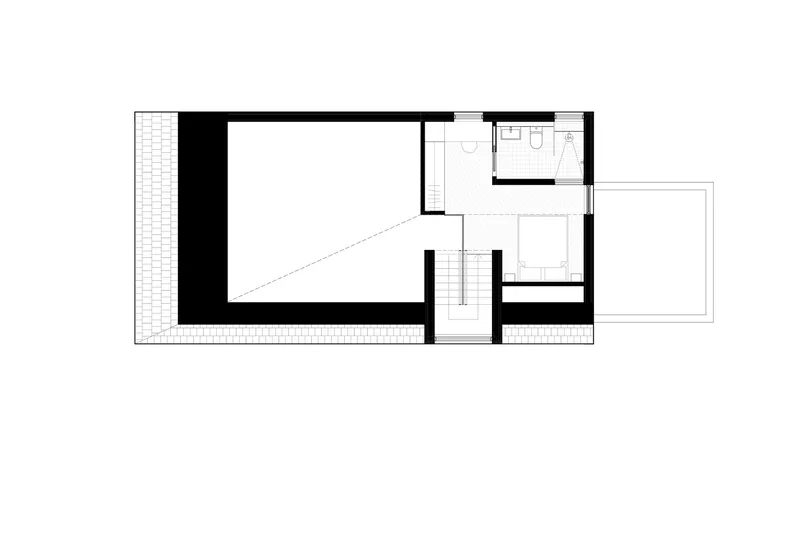
The axonometric diagram reveals the compositional logic most clearly: four interlocking rectangular volumes are assembled in stages, each rotated or offset to create the overhangs, recesses, and height variations visible in the photographs. The site plan confirms the building's relationship to its clearing, centered among stylized tree canopy circles that suggest the forest was a co-author of the plan. The ground floor plan shows the open living and dining areas flowing to exterior decks on multiple sides, while the upper level organizes a large open space and bathroom around a central stairwell.
What the drawings make explicit is that the apparent simplicity of the gabled form is the result of a carefully orchestrated aggregation. The building is not one volume; it is four, and the joints between them produce the cantilevers, clerestories, and alcoves that define the experience. The diagram is worth studying for anyone designing in a forest context where a single monolithic form risks either dominating or disappearing.
Why This Project Matters
The Scotch Chalet matters because it demonstrates that the Canadian forest cabin does not need to be either a nostalgic replica or a modernist provocation. CARTA. Architecte + Designer have found a register that is contemporary without being cold, referential without being derivative. The corrugated metal is honest. The knotty pine is honest. The wood stoves are honest. But the spatial intelligence, the layering of views, the calibration of window types to specific moments of use, is anything but simple.
In a market flooded with minimalist black cabins and Instagram-ready A-frames, this project stands apart by investing its energy in the interior experience rather than the exterior image. The outside is quiet on purpose. The inside is where the architecture happens: in the diagonal light across a pine ceiling, in the square window behind a bookshelf, in the layered view from bed to stove to meadow. That prioritization of lived experience over photogenic form is, frankly, the more difficult design problem, and the one more worth solving.
Scotch Chalet by CARTA. Architecte + Designer. Located in Argenteuil Regional County Municipality, Canada. Completed in 2025. Photography by Raphael Thibodeau.
About the Studio
Share Your Own Work on uni.xyz
If projects like this are the kind of work you want to make, uni.xyz is a place to publish your own, find collaborators, and enter design competitions.



Popular Articles
Popular articles from the community


Co-Life: Senior Housing Design That Reconnects Older Adults With the City
Co-Life reimagines senior housing design through healing gardens, shared streets, workshops, and a sustainable community across generations.

Play: Fragments of Their World
Familiar architecture becomes modular playground design, creating safe spaces where displaced children can learn, connect, imagine and play.

The Musturak Paradise: Senior Living Architecture for a Connected Future in Temara, Morocco
The Musturak Paradise reimagines senior living architecture in Temara via private homes, social spaces, culture, community, and shared care.

The Earth Pod: 3D Printed Homes for Resilient Refugee Communities
The Earth Pod reimagines refugee housing through 3D printed homes made from clay, combining resilience, self-sufficiency, and rapid shelter.

Similar Reads
You might also enjoy these articles

Bao Huynh Watercolor Atelier: A Serene Art Retreat in Hội An
Bao Huynh Watercolor Atelier in Hội An blends multifunctional art spaces, sustainable design, local materials, and family-friendly living in a serene environment.

Atelier Macri Concept Store Interior Design by CASE-REAL
Atelier Macri store features a "ko" counter, walnut wood details, cork displays, blending retail, gallery, and seamless customer experiences.

Manuel Vargas Izquierdo Stadium and High-Performance Sports Center: Architectural Excellence in Jalpa de Méndez
The Manuel Vargas Izquierdo Stadium blends sustainable design, inclusive sports facilities, and cultural-inspired architecture, revitalizing Jalpa de Méndez’s public spaces.

KAKR Buluh Awar Hall: Revitalizing Community and Ecology Through Bamboo Architecture
Community built bamboo hall revitalizes Buluh Awar village, empowering youth, restoring ecology, celebrating vernacular craftsmanship through sustainable architecture and culture.



Comments (0)
Please login or sign up to add comments
No comments yet. Be the first to comment!