
mf+arquitectos Wraps a Brazilian Weekend Retreat in Bamboo, Timber, and Perforated Screens
Casa Laranjeiras unfolds as a series of tropical pavilions nestled into a misty hillside in southeastern Brazil.


There is a specific genre of Brazilian weekend house that tends to collapse the boundary between architecture and landscape so thoroughly that the building feels grown rather than built. Casa Laranjeiras, designed by mf+arquitectos, belongs to that lineage but pushes it further. The house is not one volume but a constellation of low pavilions linked by covered walkways, courtyards, and filtered thresholds. Every transition from inside to outside is mediated by a screen, a slatted wall, or a canopy of timber that makes the shift feel gradual rather than abrupt.
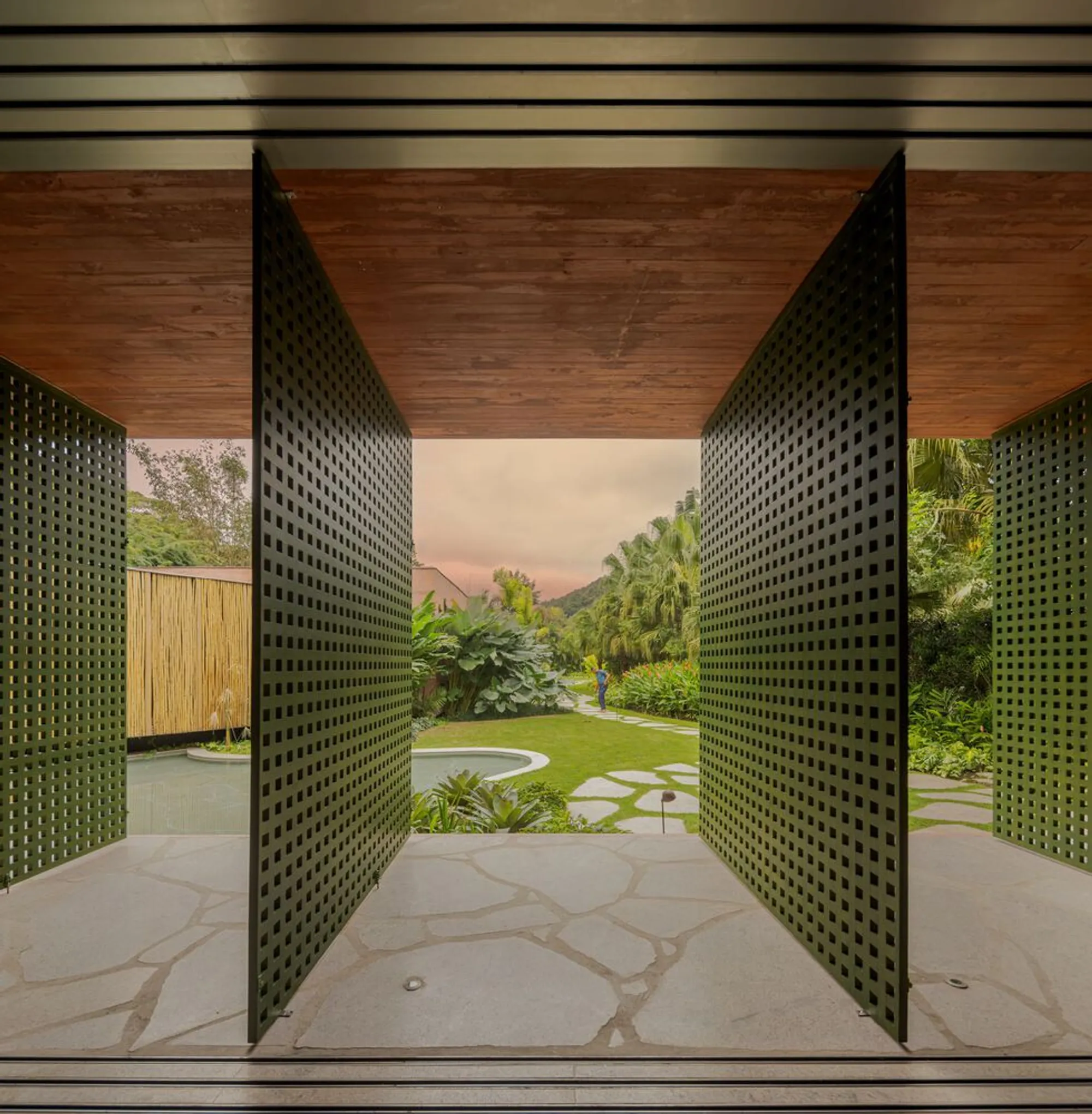
What makes this project genuinely interesting is the hierarchy of enclosure. The architects deploy at least four different screen typologies: perforated green metal panels, vertical bamboo slat walls, perforated brick screens, and pivoting timber doors. Each one calibrates privacy, ventilation, and light in a slightly different way. The result is a house where no two rooms have the same quality of filtered daylight, and where the occupant's relationship to the surrounding tropical garden is always being renegotiated.
A Pavilion Strategy
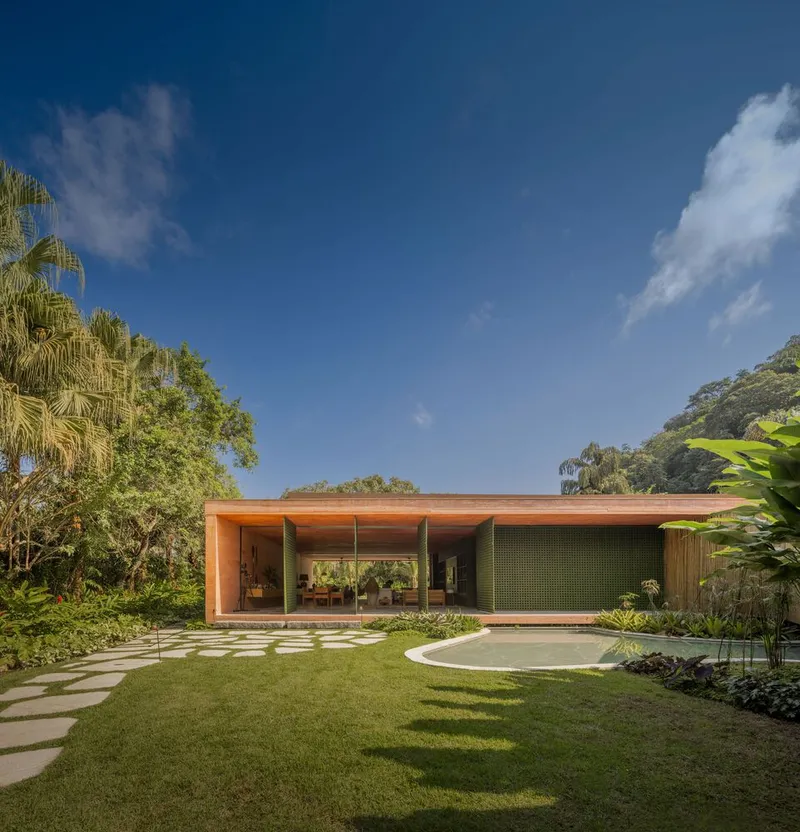

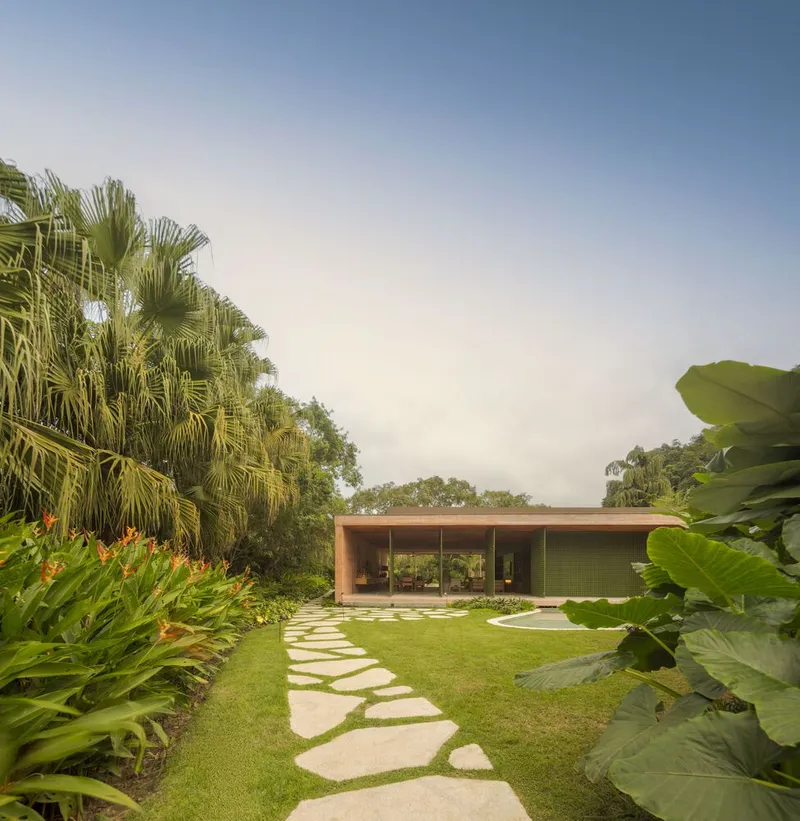
The house reads as a collection of single-story timber pavilions arranged across the site. Deep overhangs extend the roof planes well beyond the enclosure line, creating covered thresholds that are neither interior nor exterior. Curved paver paths and stepping stones stitch the pavilions to a lawn that itself merges with the planted hillside beyond. The architecture stays deliberately low, horizontal, and recessive.
Flat roofs clad in terracotta or timber keep the profile quiet against the forested mountains visible in the distance. There is no dominant volume, no singular gesture. Instead, the strategy distributes program across the landscape so that moving through the house also means moving through the garden. It is an approach that privileges sequence over spectacle.
Screens as Architecture
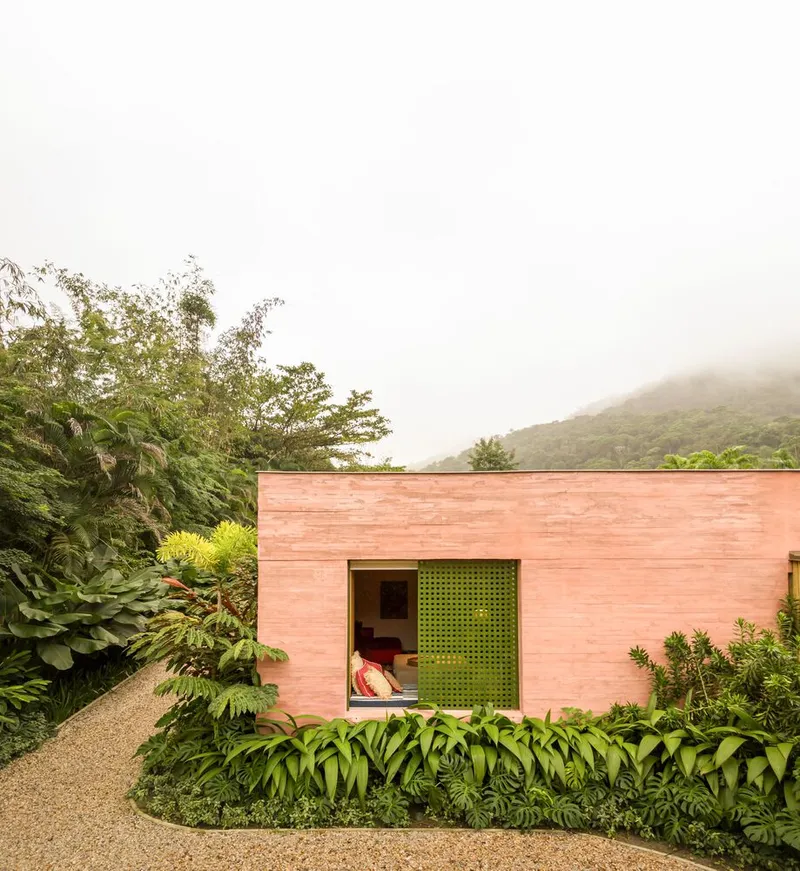
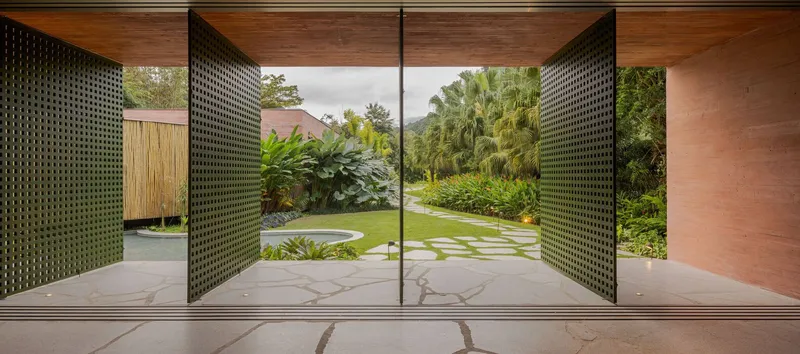
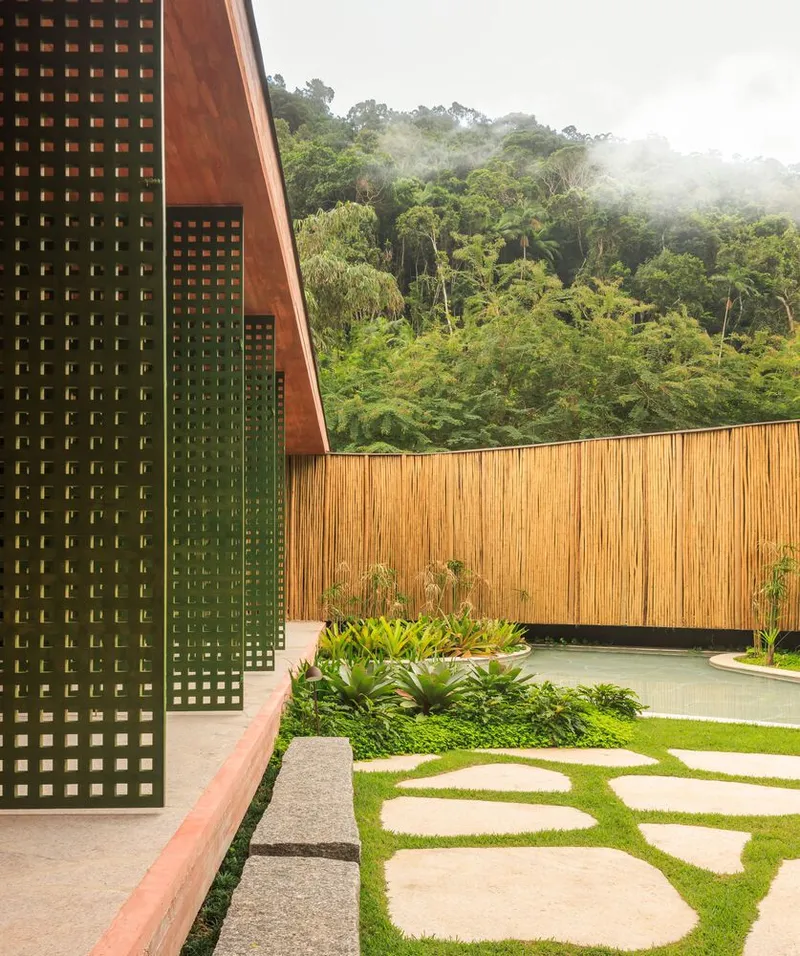
The perforated green metal screens are the most visually distinctive element. Mounted as large pivoting doors, they transform entire wall planes into operable filters. When closed, they reduce the garden to a dappled pattern of light and shadow. When open, they frame precise views of the stepping stone paths and distant mountains. The pivot mechanism means these are not just decorative; they are genuinely functional, allowing occupants to reconfigure spatial relationships throughout the day.
A second screen system, built from perforated brick, appears at the pool terrace and entry thresholds. Its texture is rougher and more grounded, and it reads as part of the landscape infrastructure rather than as furniture. The layering of these two systems, one metal and one masonry, gives the house a tonal range that a single material could not achieve.
Bamboo Corridors and Thresholds
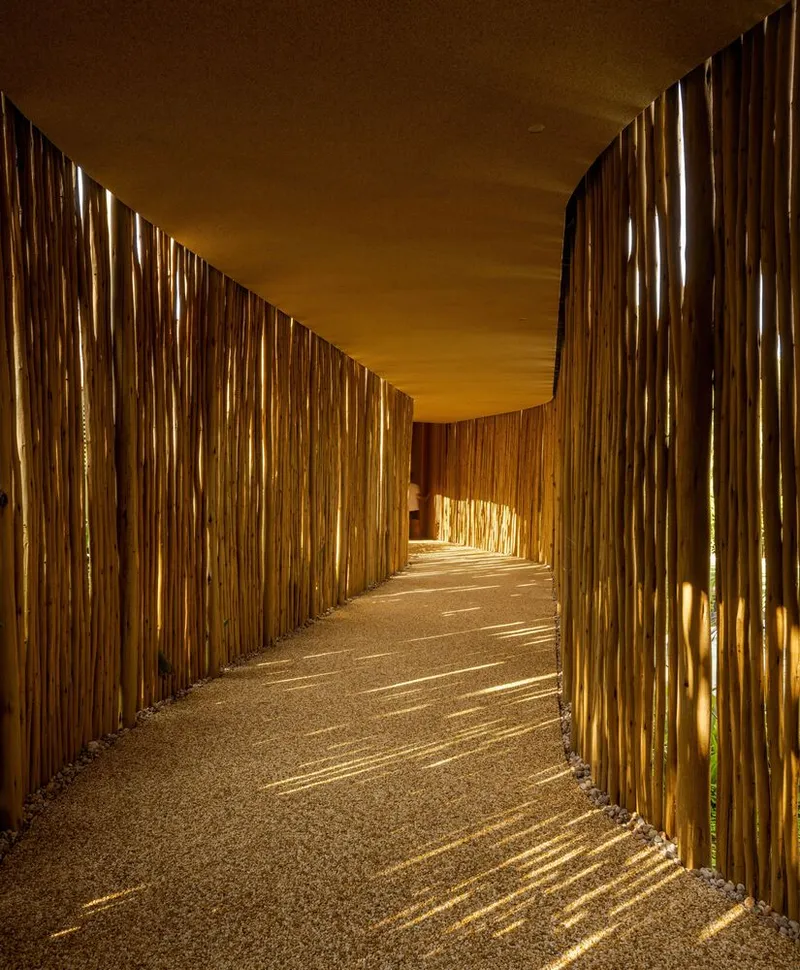
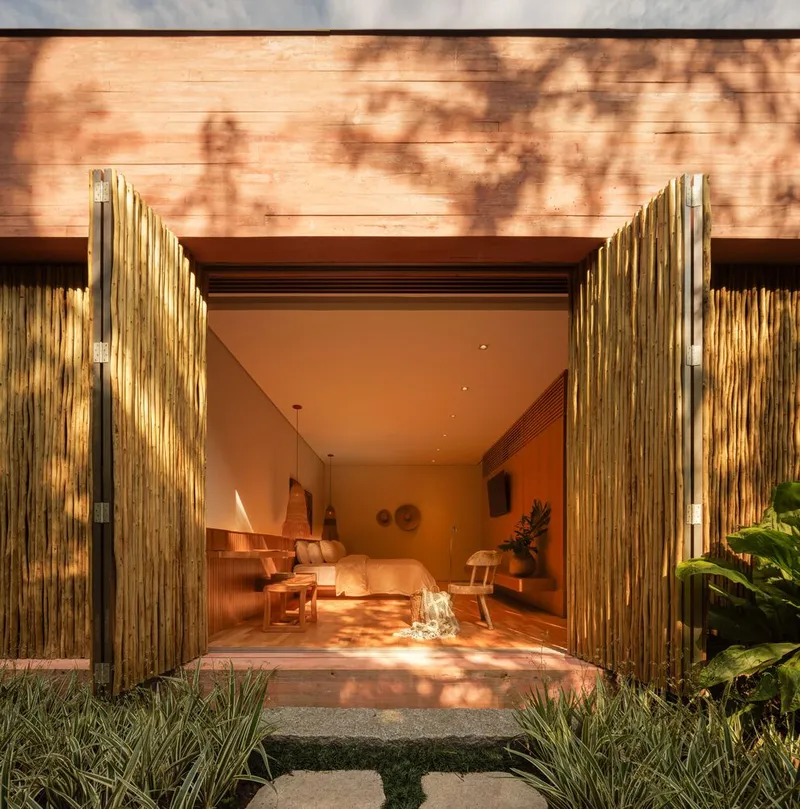
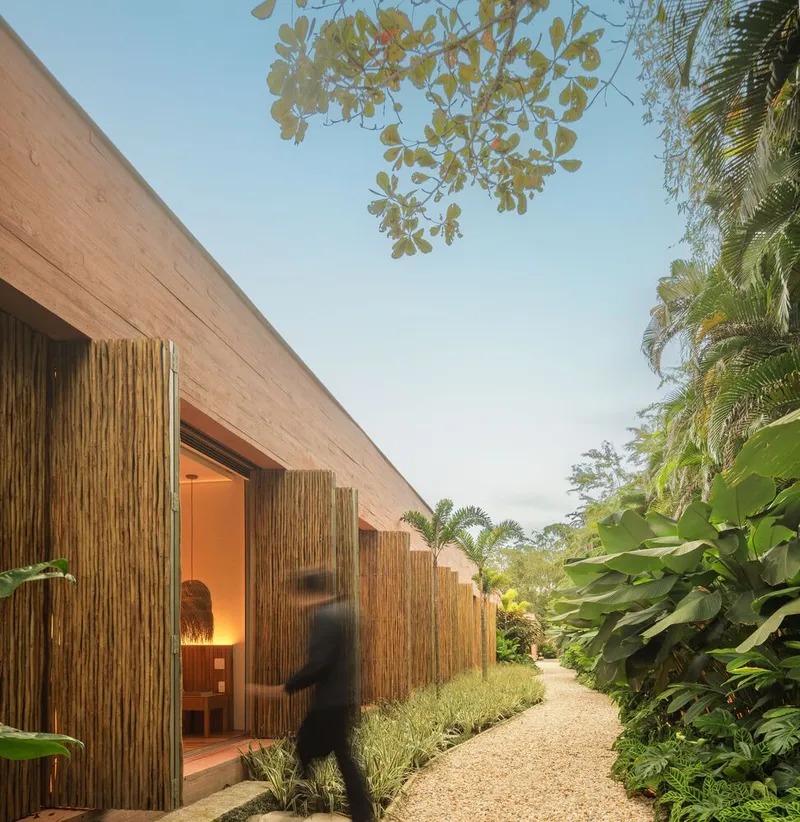
Vertical bamboo slats line the corridors and entry passages, creating a warm, rhythmic enclosure that filters sunlight into stripes across the stone floors. The curved corridor is a standout moment: the slats follow the radius of the curve, and at golden hour, the resulting light pattern is almost cinematic. It is a simple move, but executed with enough precision to elevate the experience of walking from one room to the next.
At night the bamboo facades glow from within, as seen in the illuminated doorway along the gravel path. The material becomes translucent rather than opaque, and the house shifts from being a series of garden rooms to a collection of lanterns set into the vegetation. This duality, solid by day and luminous by night, is one of the project's quieter achievements.
Living Under Timber Ceilings
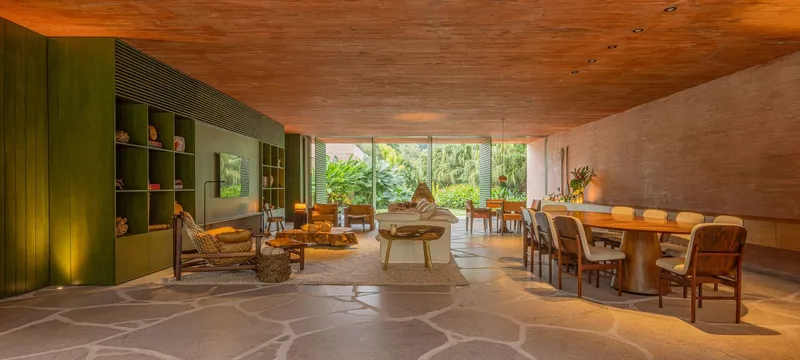
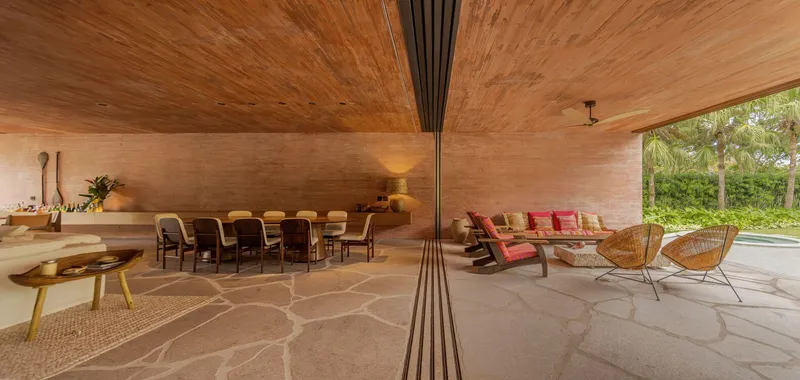
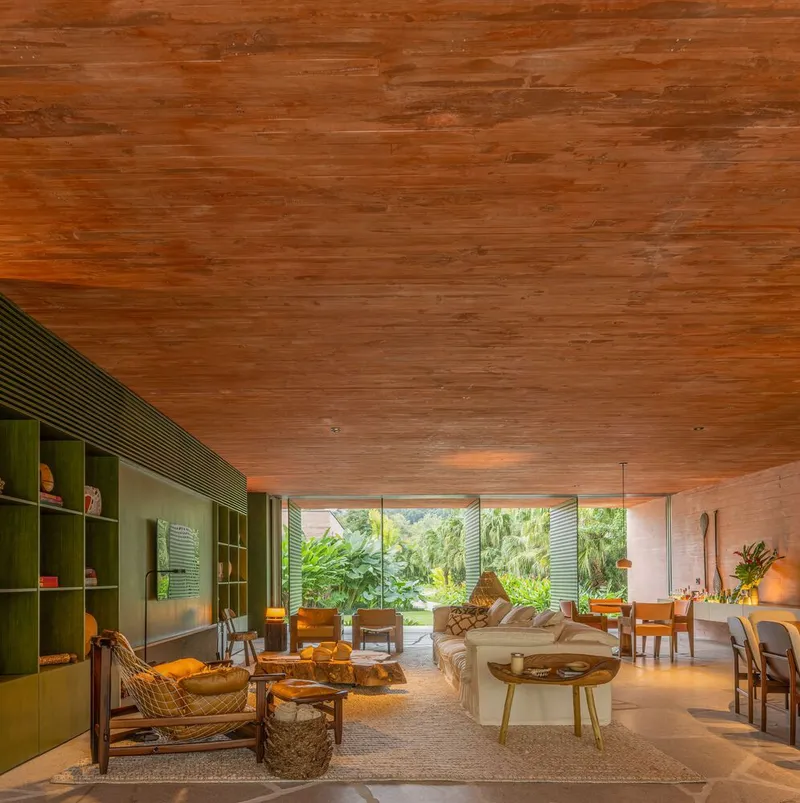
The interiors are dominated by timber plank ceilings that run the full length of each pavilion. In the main living and dining area, the ceiling lifts into a shallow vault supported by a central metal column, introducing a subtle sense of compression and release. Glass walls on at least two sides dissolve the room's edges into the garden. The palette is deliberately restrained: timber, stone, metal. Nothing competes with the landscape visible through the screens.
Flagstone floors anchor the living spaces to the ground. The material continues from the interior out onto the covered terraces and pathways, reinforcing the sense that the house is a single continuous surface rather than a series of enclosed boxes. The furniture is sparse enough that the architecture remains legible as the primary experience.
Bedrooms That Open Completely
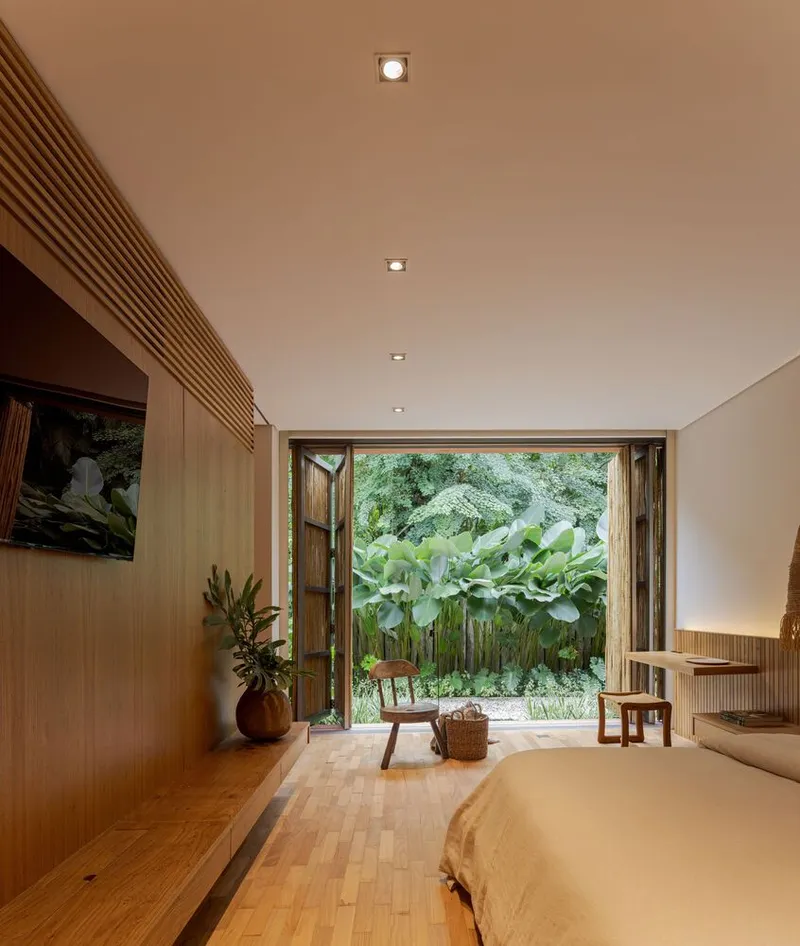
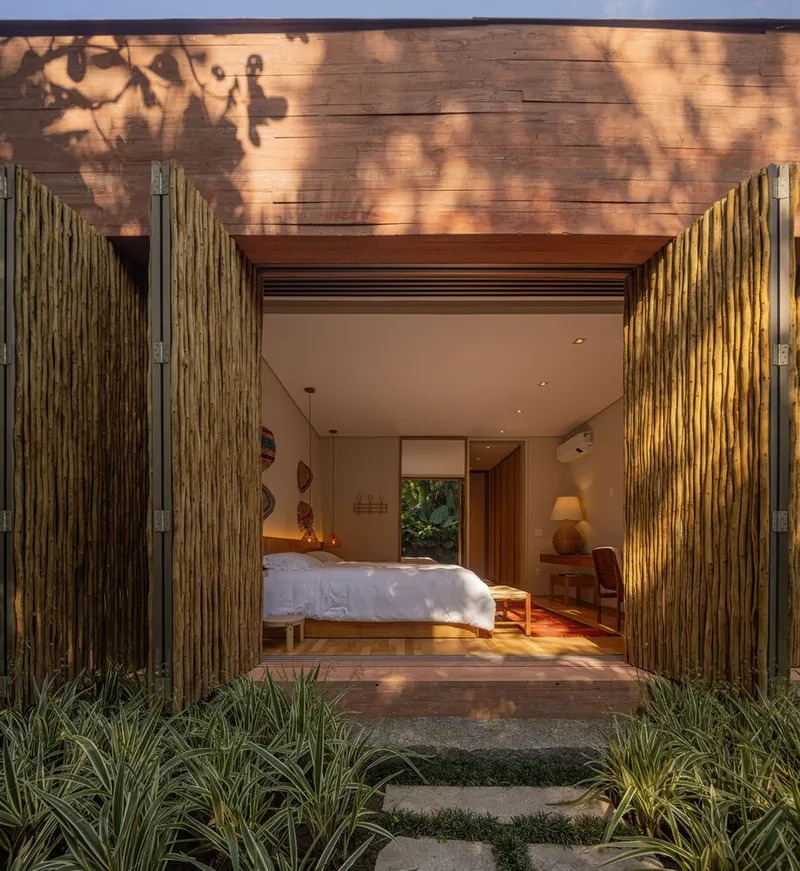
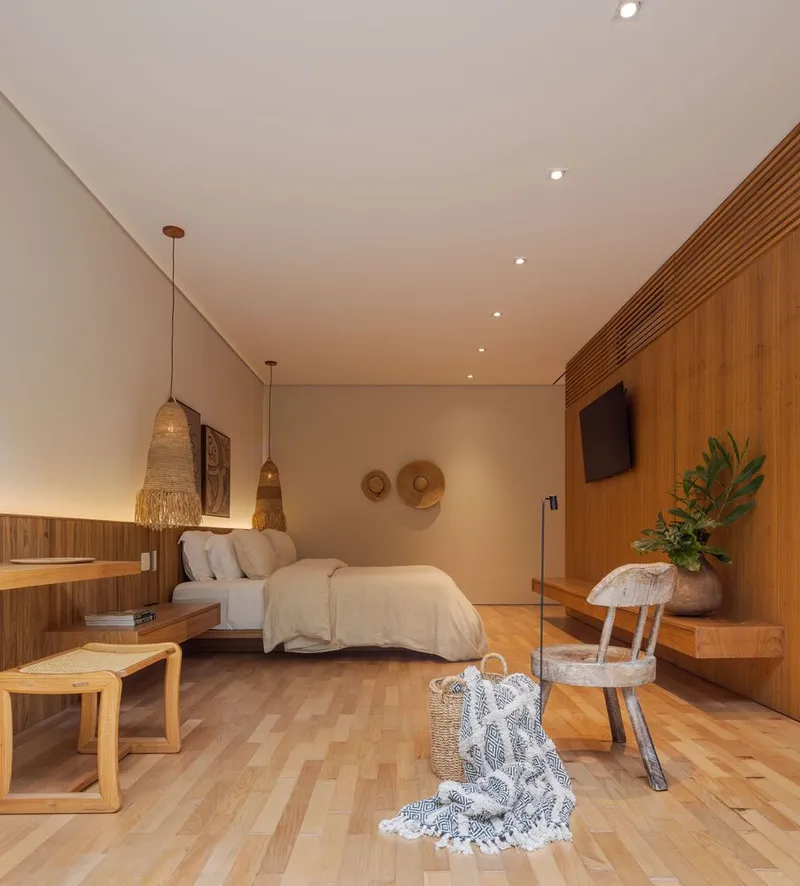
The bedrooms take the open-air ethos to its logical conclusion. Folding timber doors swing wide to expose entire wall planes to the garden, so that sleeping effectively happens outdoors beneath a roof. Banana trees and palms press close to the openings. In one bedroom, vertical bamboo doors pivot to reveal a courtyard planted with ground cover and bisected by a stone path. The boundary between corridor and bedroom becomes ambiguous.
Interior finishes are warmer here: parquet wood flooring, timber wall panels, woven pendant lights. These rooms are calibrated for intimacy rather than openness, yet they never feel enclosed. The architects clearly understand that in a tropical climate, the ability to open a bedroom wall completely is not a luxury but a necessity.
Water, Landscape, and the Curved Pool
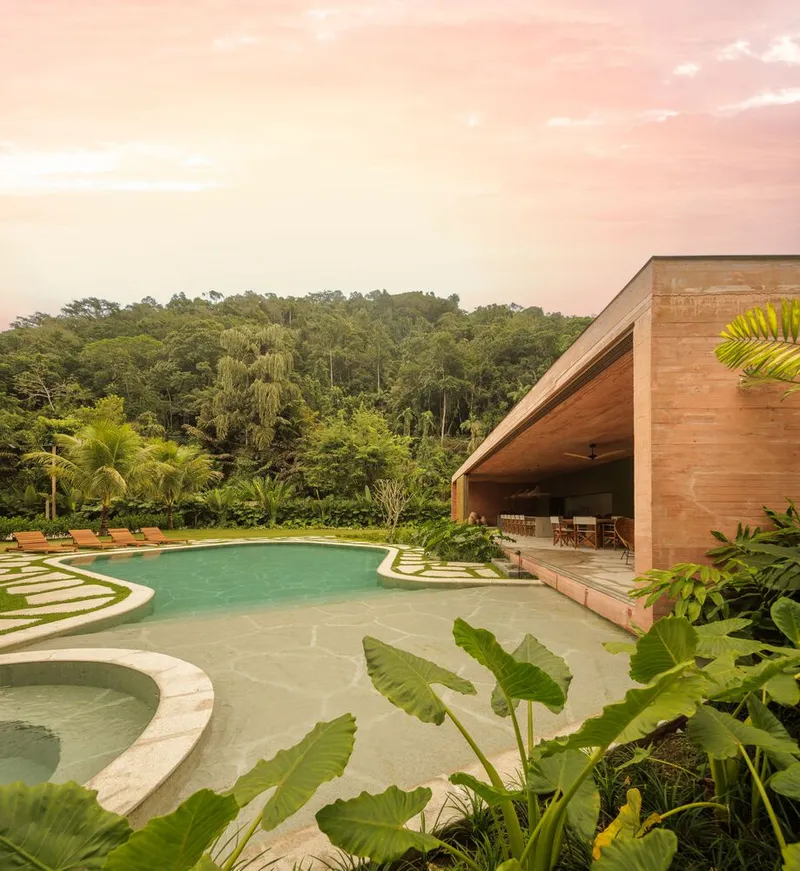
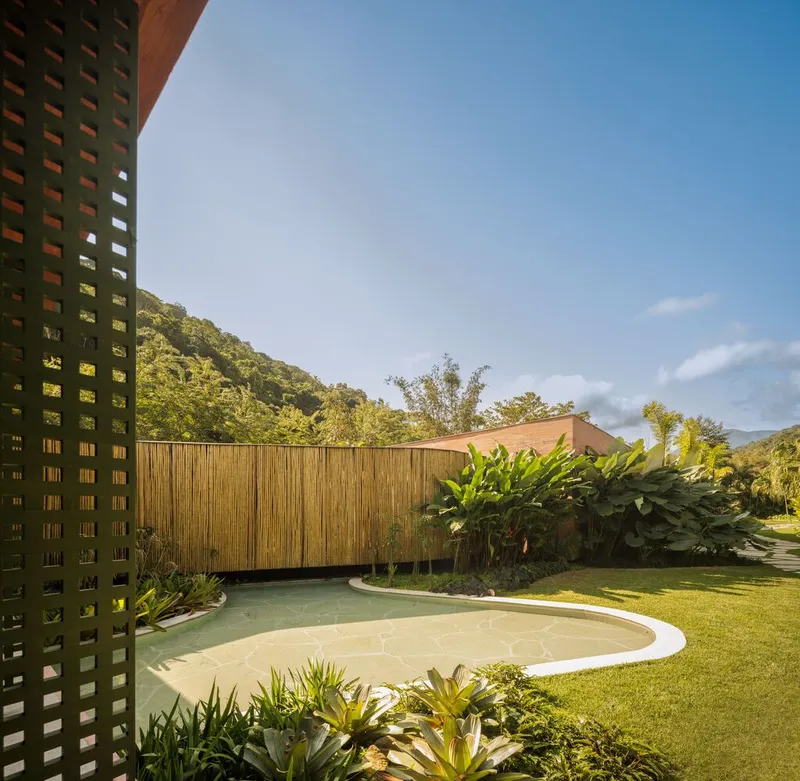
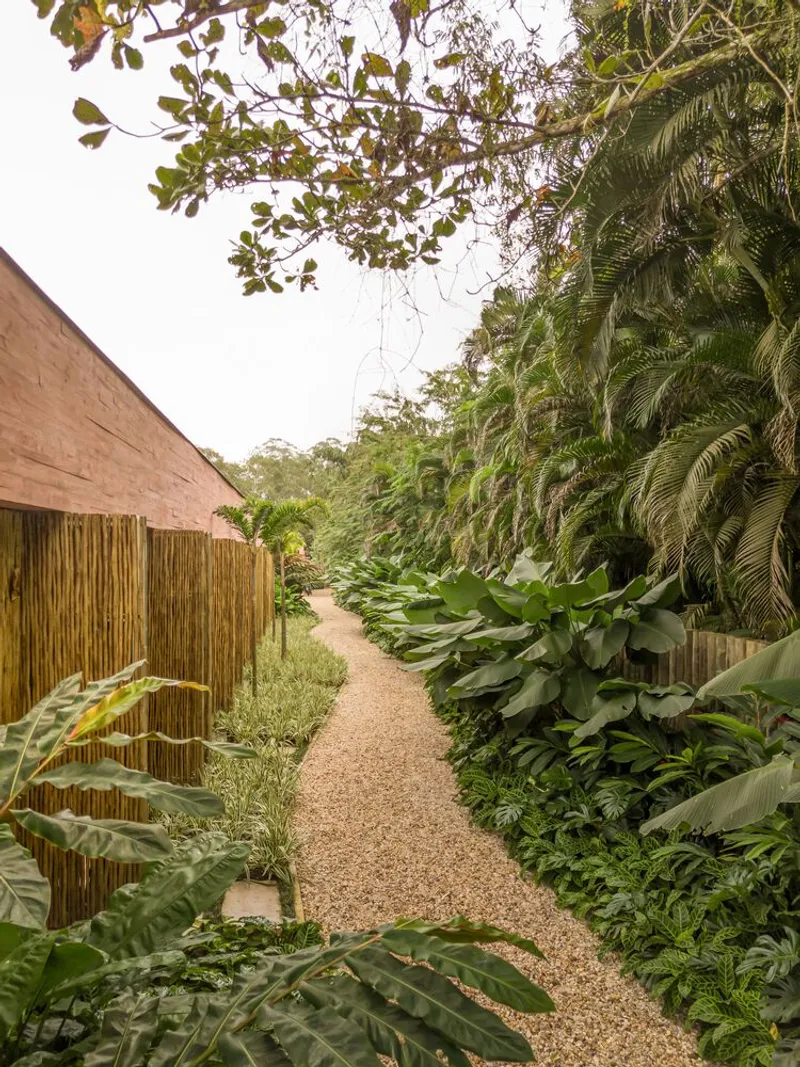
The swimming pool curves through the site like a river section, with an integrated circular wading pool that reads as a separate element at first glance but is connected by a shallow edge. The pool terrace is the one moment where the architecture becomes explicitly social: a covered timber pavilion faces the water, and the perforated brick screen wall provides a backdrop that echoes the hillside vegetation above.
The landscape design is dense and layered. Gravel pathways lined with bamboo fencing thread between the pavilions, and tropical plantings fill every gap between built elements. The planting is not decorative; it is infrastructural. It provides shade, privacy, fragrance, and habitat, and it turns what could have been a compound of isolated buildings into a single, continuous garden punctuated by shelter.
Inhabiting the In-Between
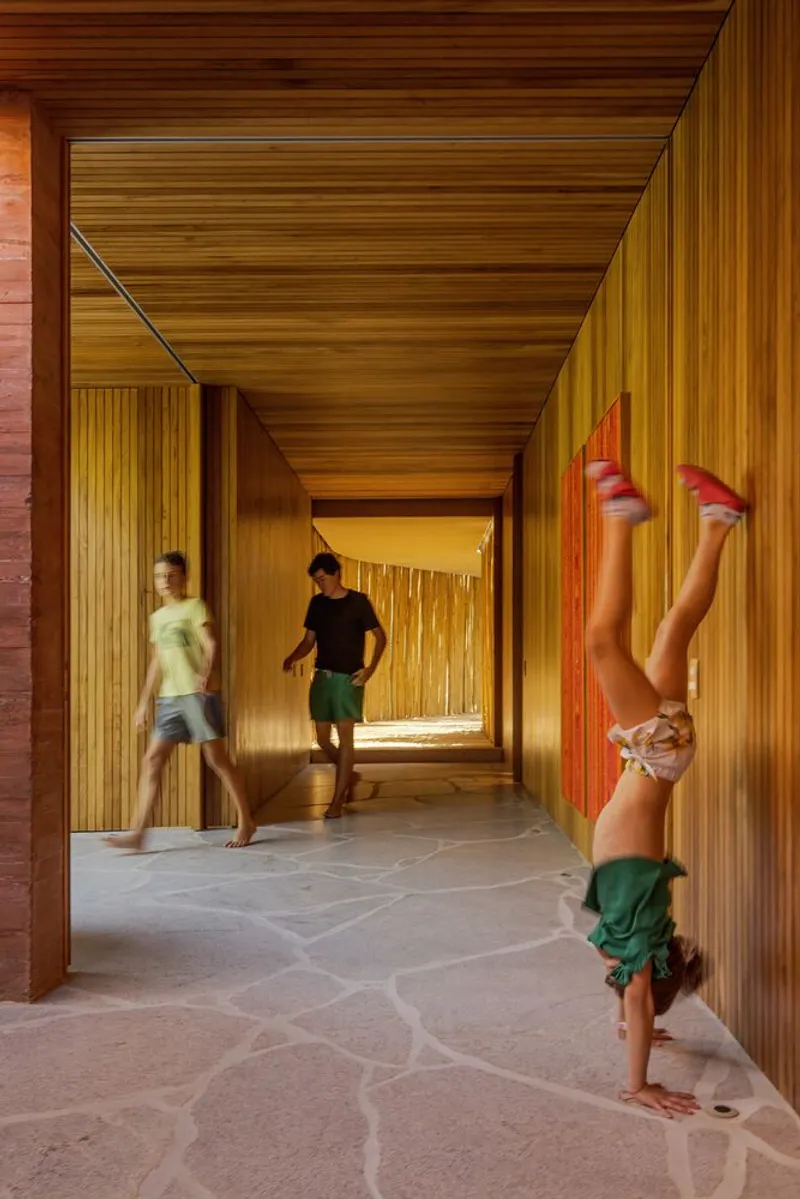

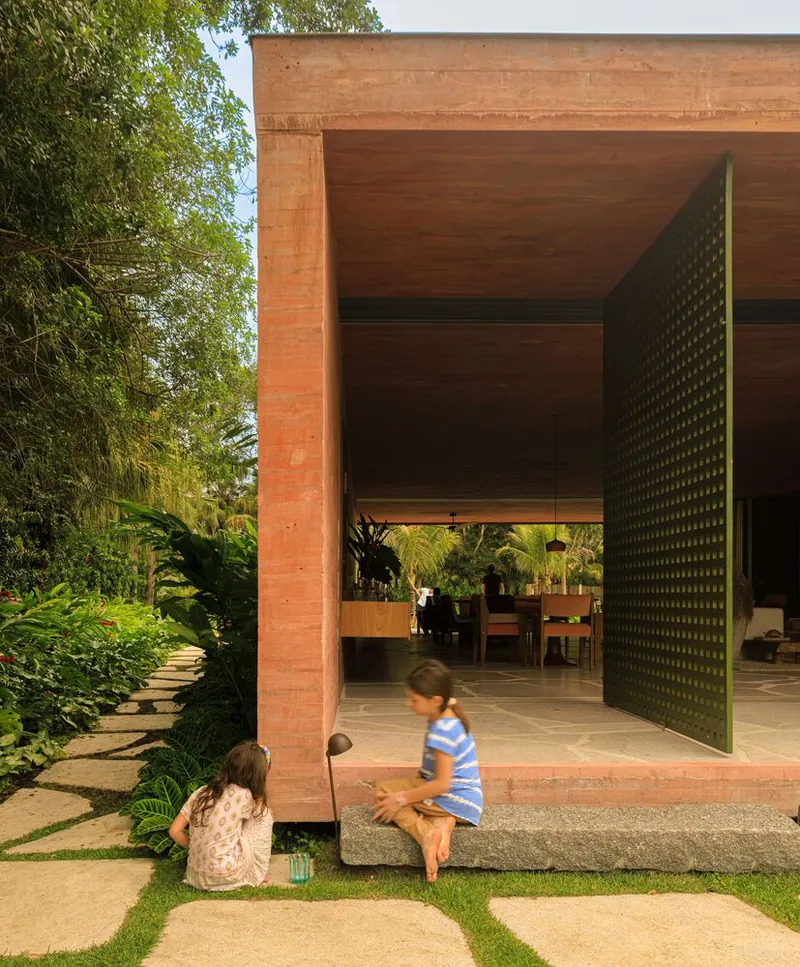
Some of the best moments in the house are the spaces that resist easy categorization. A covered walkway with a slatted timber ceiling and a planted bed running its full length is technically circulation, but its generosity makes it habitable. Children walk, play, and do handstands in a timber-lined corridor that is simultaneously a passage and a room. A covered terrace with a perforated brick screen door becomes a threshold for play.
These transitional zones represent a significant portion of the house's total area, and the architects have invested as much care in their detailing as in the primary rooms. The lesson is familiar but worth repeating: in tropical climates, the quality of the in-between spaces often matters more than the quality of the rooms themselves.
Why This Project Matters
Casa Laranjeiras succeeds because it treats every boundary as an opportunity for nuance rather than a binary decision. The house does not simply open to the garden; it opens through bamboo, through perforated metal, through pivoting brick, through folding timber. Each filter calibrates the relationship between interior and exterior differently, and the cumulative effect is a domestic environment that feels alive to the time of day, the quality of light, and the movement of air.
In a broader context, the project demonstrates that the Brazilian pavilion house is far from exhausted as a typological experiment. By distributing program across the site, investing in the quality of corridors and thresholds, and deploying multiple screen systems with real discipline, mf+arquitectos have produced a weekend retreat that feels both rooted in its tropical setting and formally precise. It is proof that restraint and generosity are not opposites but collaborators.
Casa Laranjeiras by mf+arquitectos, Brazil.
About the Studio
Share Your Own Work on uni.xyz
If projects like this are the kind of work you want to make, uni.xyz is a place to publish your own, find collaborators, and enter design competitions.




Popular Articles
Popular articles from the community


Conexión: Biophilic Design Reimagines High-Rise Living in Hong Kong
Conexión reimagines high-rise living in Hong Kong through biophilic design, green facades, shared spaces, daylight, water and nature within.

Co-Life: Senior Housing Design That Reconnects Older Adults With the City
Co-Life reimagines senior housing design through healing gardens, shared streets, workshops, and a sustainable community across generations.

AL-JANNAH: Sustainable Architecture and Permaculture for Afghan Widows
AL-JANNAH uses sustainable architecture and permaculture to create resilient oasis of housing, learning, work and renewal for Afghan widows.

Co-life: Sustainable Architecture for Age-Friendly Community Living
Co-life reimagines sustainable architecture for seniors through courtyards, rammed earth, shared gardens, and spaces designed for belonging.


Similar Reads
You might also enjoy these articles


Hodi-Mandai Geram
Project Function: Preservation and revitalization of the Intangible heritage and socio-spatial identity of the Hodi by Housing, Cultural Memory Center, Sacred Grove, landscape, local tourism economy


Olio Towers: A Mid-Rise for Performers That Fuses Housing, Rehearsal, and Stage
Located blocks from Houston's Theater District, this modular tower stacks living units around a central performance atrium.

Oasis: Modular Green Housing Carved into Dhaka's Urban Fabric
A shortlisted Plugin Housing entry reclaims unauthorized settlements in Dhaka with stepped concrete volumes, green roofs, and ventilation-driven design.

Black Hole: A Floating Megastructure for the Post-Physical Era
Emiliano Mazzarotto envisions a spherical, self-scaling arena where e-sports, digital hotels, and holographic stadiums replace traditional public space.


Explore Architecture Competitions
Discover active competitions in this discipline



Challenge to reimagine the Iron Throne


Photograph architecture without architects


Illustrate the lost glory of Angkor Wat - Render Challenge


Design challenge to reuse E-waste
Comments (0)
Please login or sign up to add comments
No comments yet. Be the first to comment!