

SOLAR Restores a Rare 19th-Century Madrid Moderno House with Two Contrasting Facades
Castelar House pairs handcrafted Neo-Mudejar restoration at the front with recycled aluminum at the rear in one of Madrid's last garden-city homes.


Of the ninety-six houses built in Madrid's Colonia Madrid Moderno at the close of the 19th century, barely fourteen survive. The rest fell to decades of real estate pressure that has reshaped the Las Ventas neighborhood since the 1970s. Castelar House is one of those survivors, and architectural studio SOLAR, led by Pablo Canga and Ana Herreros, has turned its restoration into something more than preservation: an argument that old buildings carry thermodynamic and informational capital worth reinvesting, not discarding.
What makes the project genuinely interesting is SOLAR's refusal to treat heritage as a single register. The front facade was rebuilt by hand using classical restoration procedures: templates drawn up, woodwork shaped manually, traditional crafts harnessed at a deliberately slow pace. The rear facade is its temporal opposite, clad in a perforated recycled aluminum skin cut by numerical control. The two faces of the house represent two different moments in time, and the tension between them gives Castelar House a conceptual clarity that most restoration projects never achieve. The COAM 2024 Emerging Award, granted by the Official College of Architects of Madrid, confirmed that the profession noticed.
The Courtyard as Organizing Principle
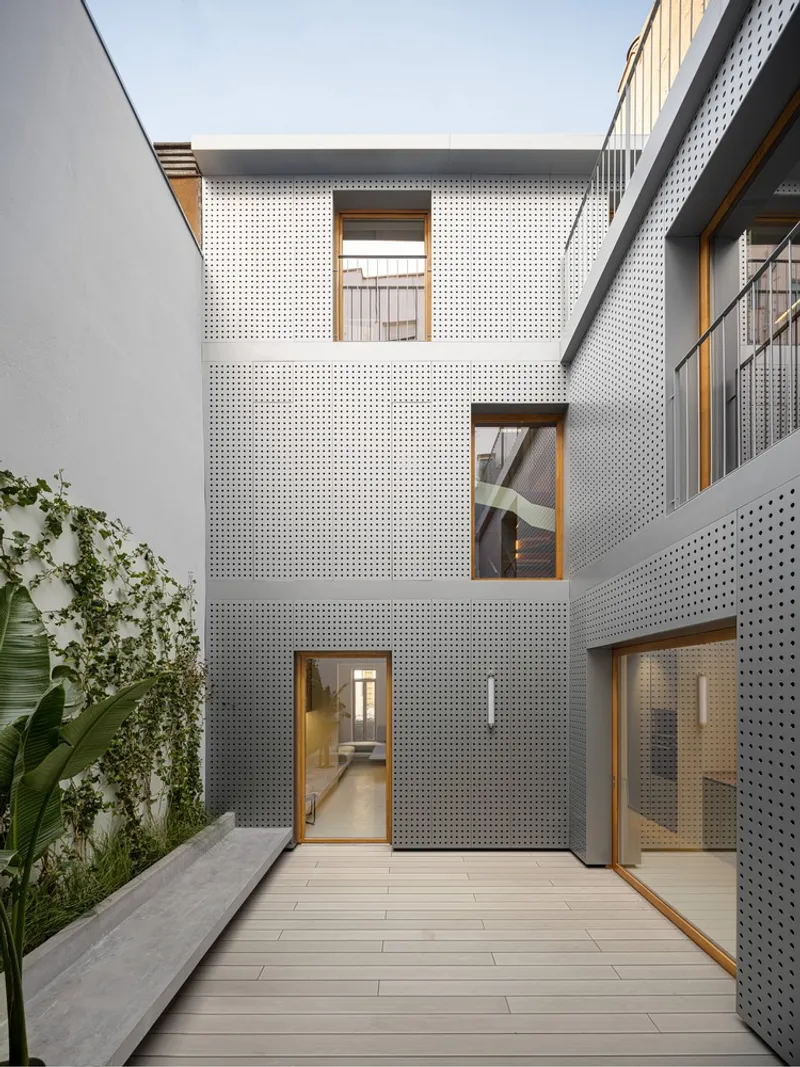
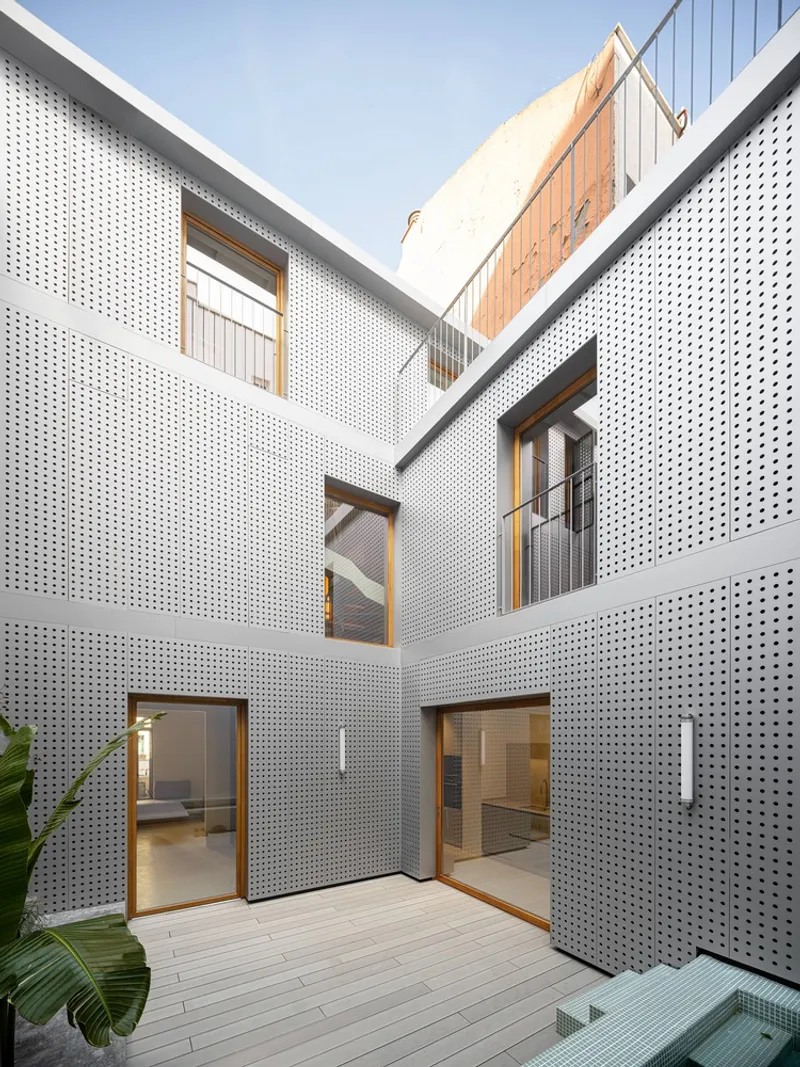
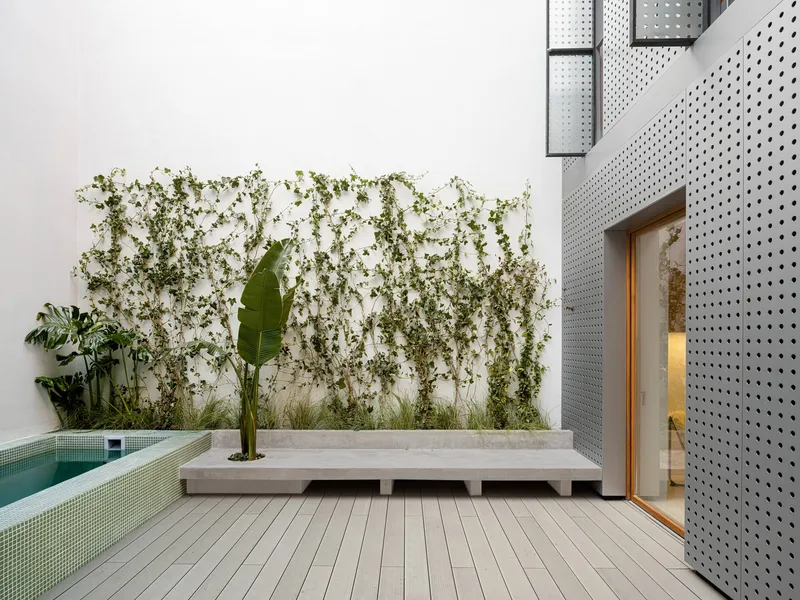
The original 1890 layout arranged the house in an L-shape around a central courtyard, a configuration rooted in the hygienist garden-city ideals that drove the Madrid Moderno development. Over the decades, additions had crowded the plot and choked off that core spatial logic. SOLAR's strategy was essentially subtractive: strategic demolitions cleared away the accretions and recovered the courtyard as the house's organizing heart.
Today the courtyard is a compact outdoor room defined by timber decking, a concrete planter bench, and climbing vines that will, over time, soften the perforated metal walls. It distributes light and air to the rooms arranged around it, and because the house's program radiates outward from this void, every interior space maintains a visual and atmospheric connection to the open sky. The courtyard is not decorative. It is the engine of the house's environmental and spatial performance.
A Perforated Aluminum Skin
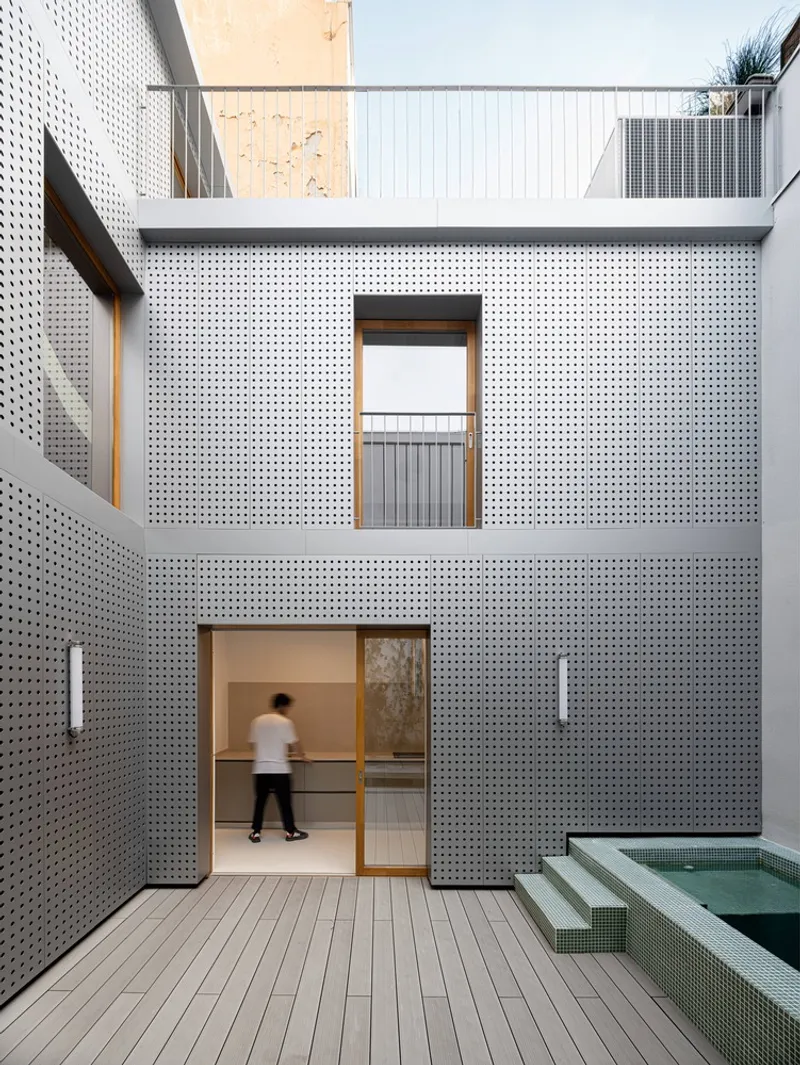
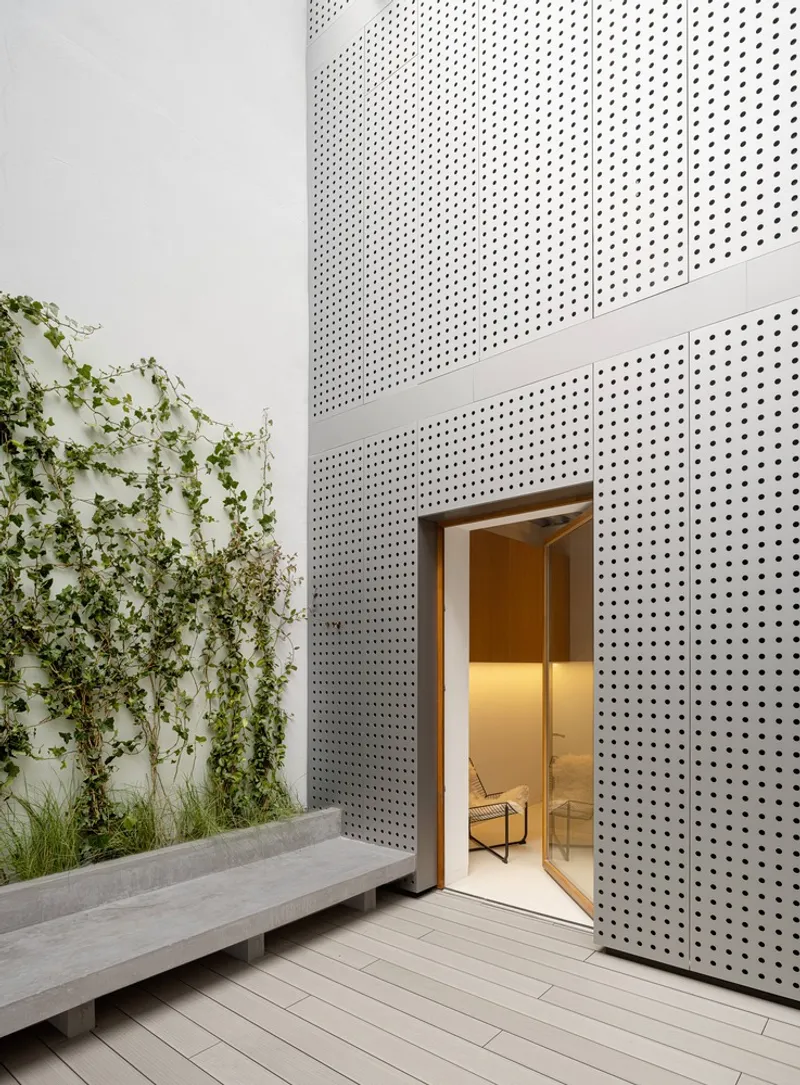
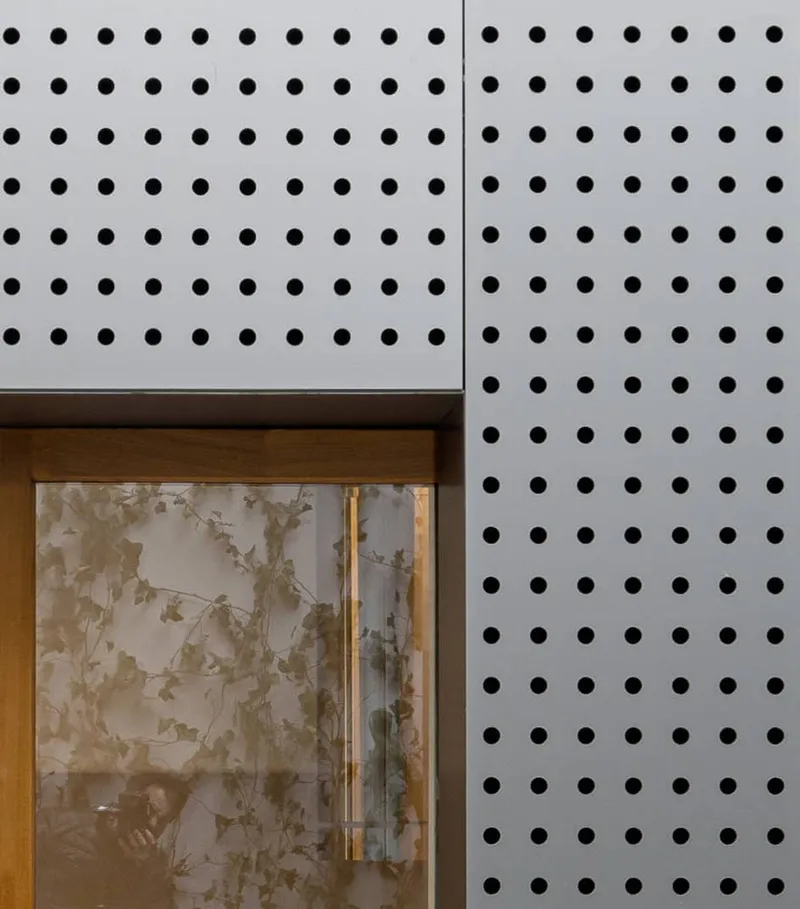
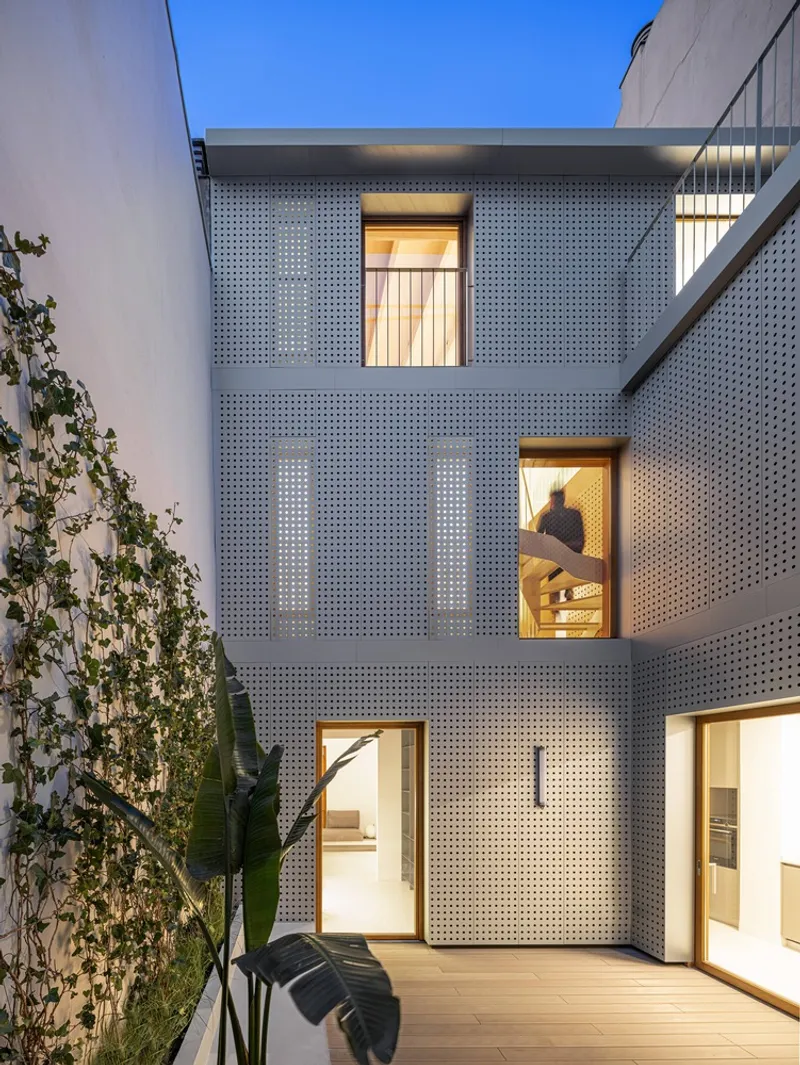
The rear and courtyard facades are wrapped in a lightweight skin of recycled aluminum, perforated in patterns that modulate light, views, and ventilation. The material reads as industrial but behaves as craft: each panel was cut by numerical control to precise specifications, and the perforations create a shifting moiré effect as you move through the courtyard. At dusk, interior light turns the panels into a lantern screen.
Choosing recycled aluminum was not a token sustainability gesture. The material is light enough that it did not impose heavy structural loads on the rebuilt frame, it weathers without maintenance, and it can be dismantled and reused when its service life ends. Against the handcrafted Neo-Mudejar brickwork of the front, the aluminum panels make SOLAR's temporal argument legible at the scale of a single detail: what restoration looked like in 1890, and what it can look like now.
Thresholds and Filtered Light
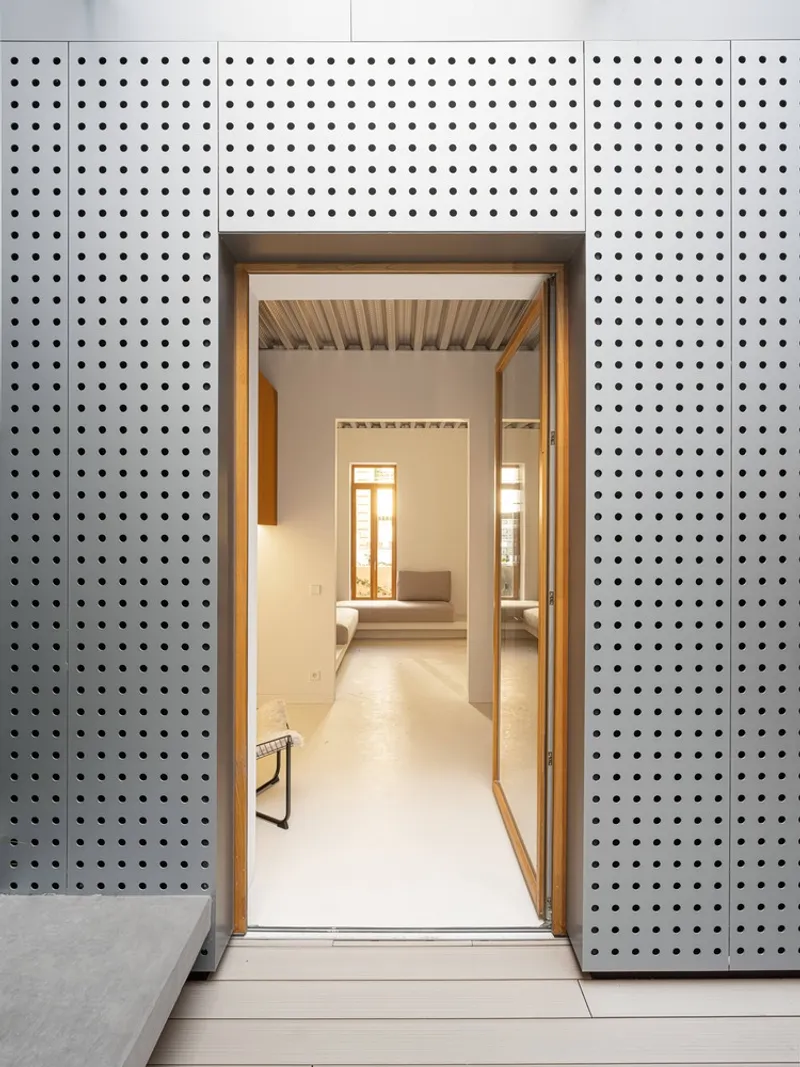
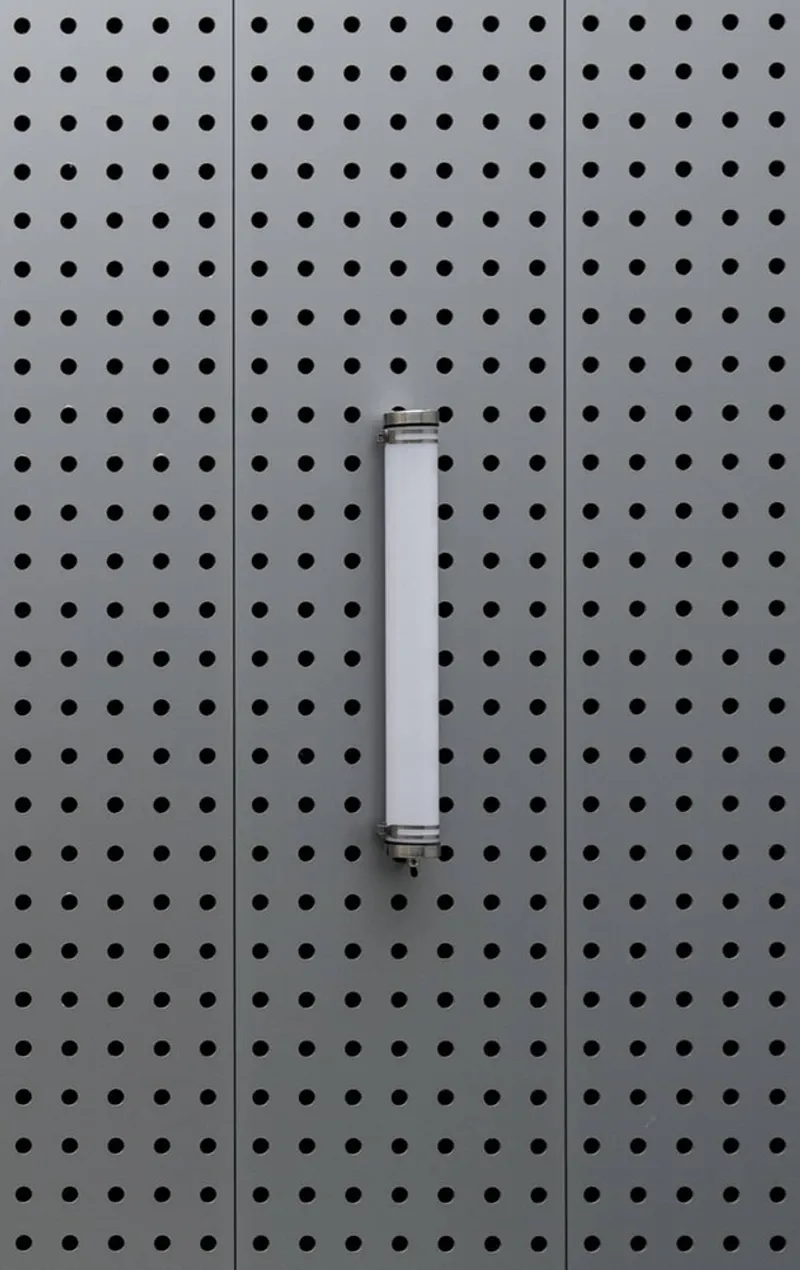
The meeting point between the aluminum skin and the timber-framed openings is where the project's detailing is most deliberate. Doorways punch through the perforated wall to reveal interior corridors with slatted timber ceilings, creating a series of thresholds that compress and release space as you pass through them. A single tubular light fixture mounted on a grey metal panel shows how carefully SOLAR considered even the smallest junctions.
Light is never uncontrolled here. The perforations grade it, the timber frames warm it, and the planted beds along the courtyard walls will eventually filter it through leaves. The architects understood that in a Mediterranean climate, an excess of light can be as much a problem as a deficit, and they calibrated the facade to sit at the right point on that spectrum.
The Stairwell as Light Well
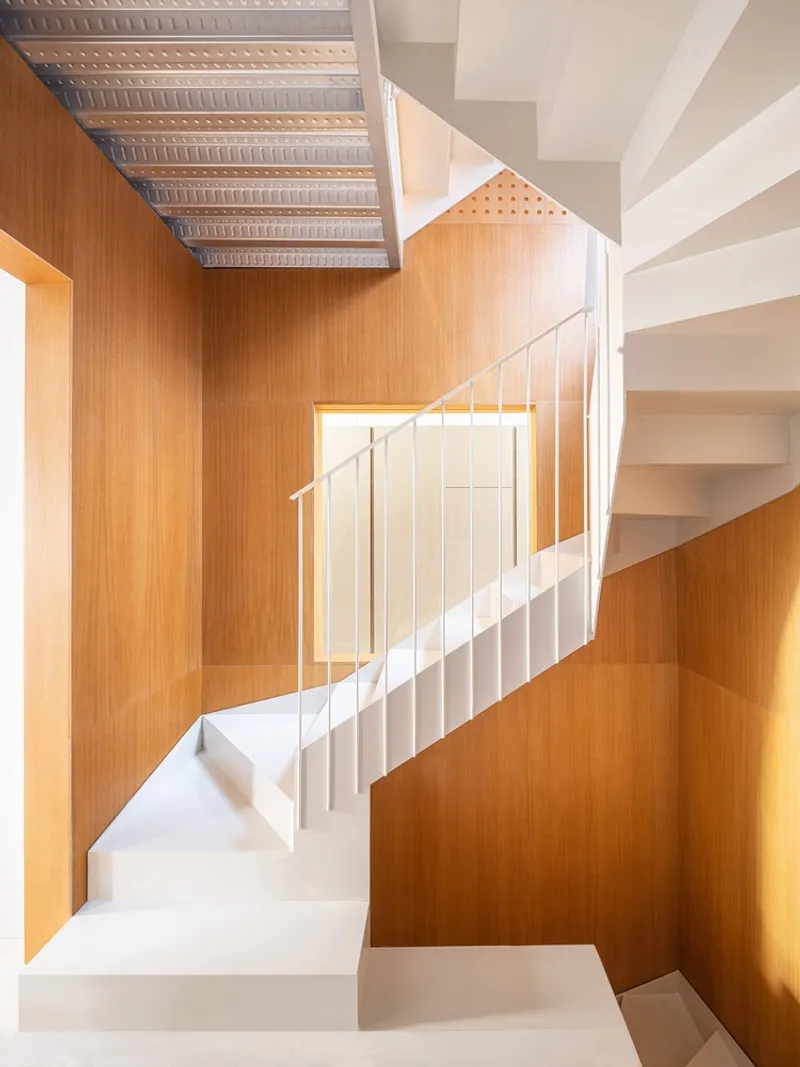
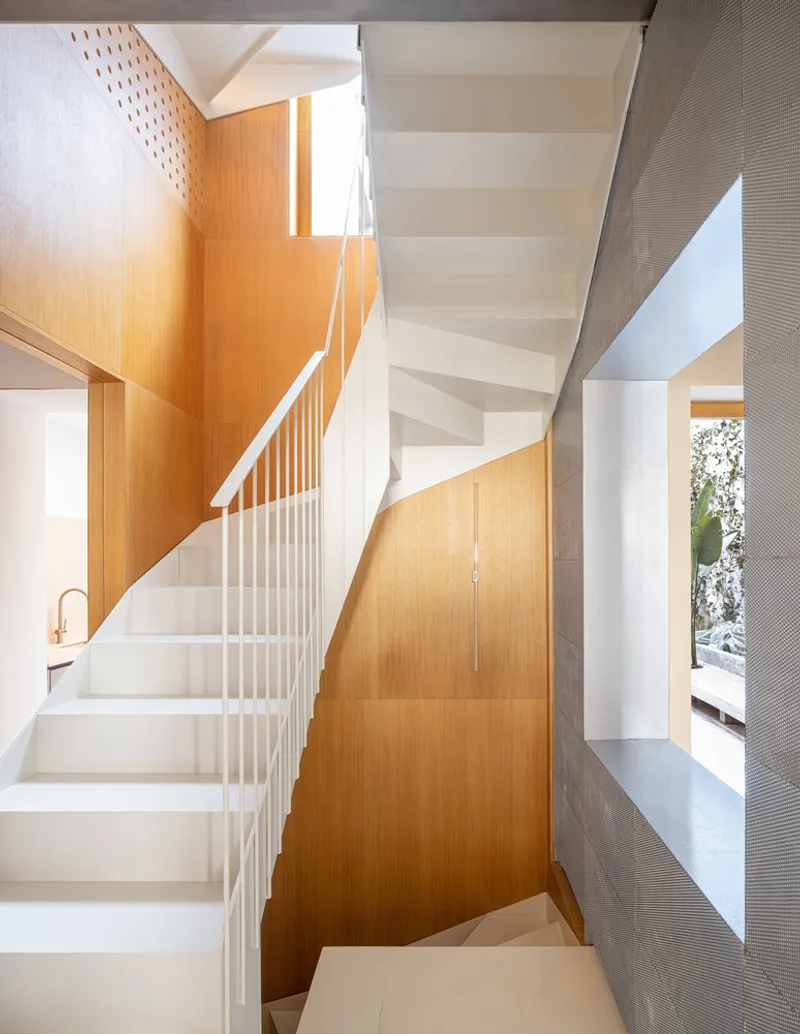
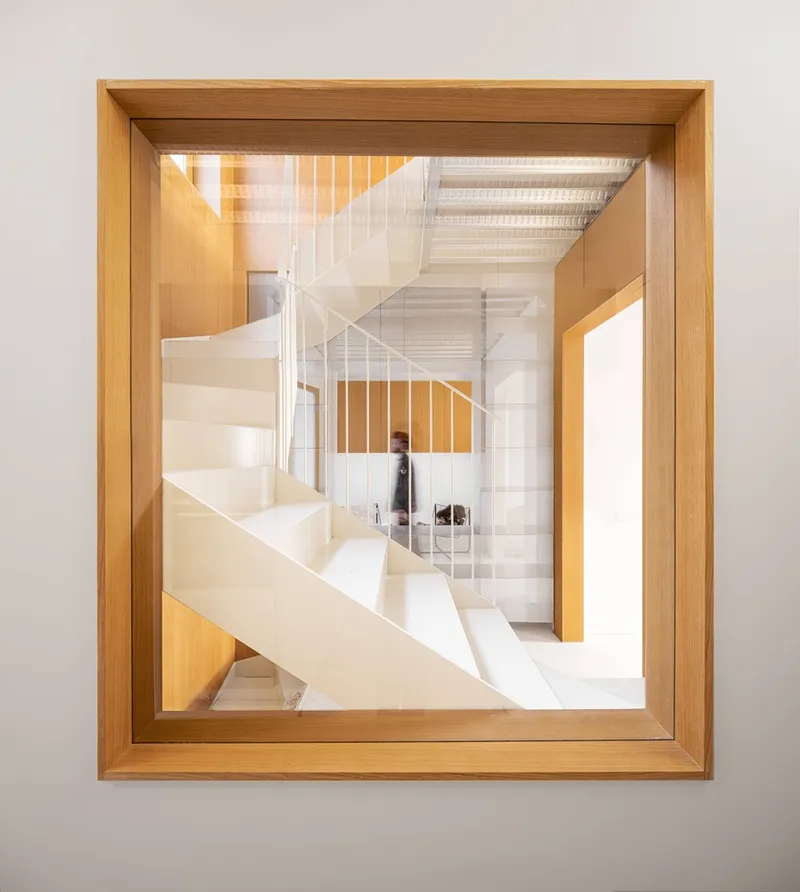
The central staircase is the vertical counterpart to the courtyard's horizontal void. Rising through a shaft lined in warm oak paneling, it acts as a sculptural light well that pulls daylight down through the house's three levels. White steel railings and perforated metal ceiling panels keep the shaft feeling open, while the timber lining gives it acoustic warmth. A figure caught mid-ascent in a timber-framed square opening reveals the scale: this is a generous domestic stair, not a corridor.
The stairwell also plays a bioclimatic role. Because it connects to the courtyard and to large openings on the rear facade, it facilitates cross-ventilation through the stack effect: warm air rises and exits at the top, drawing cooler air in from below. SOLAR treated the stair not as circulation infrastructure but as a piece of environmental equipment that happens to look good.
Interior Connectivity and Crossed Views
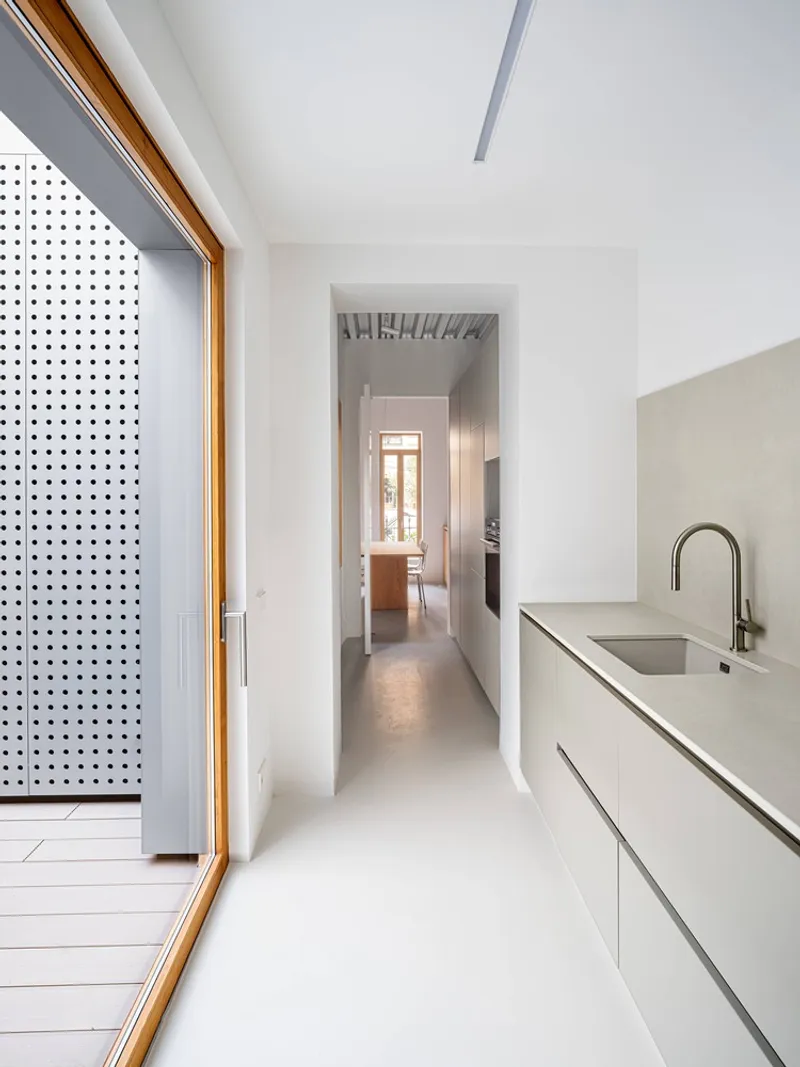
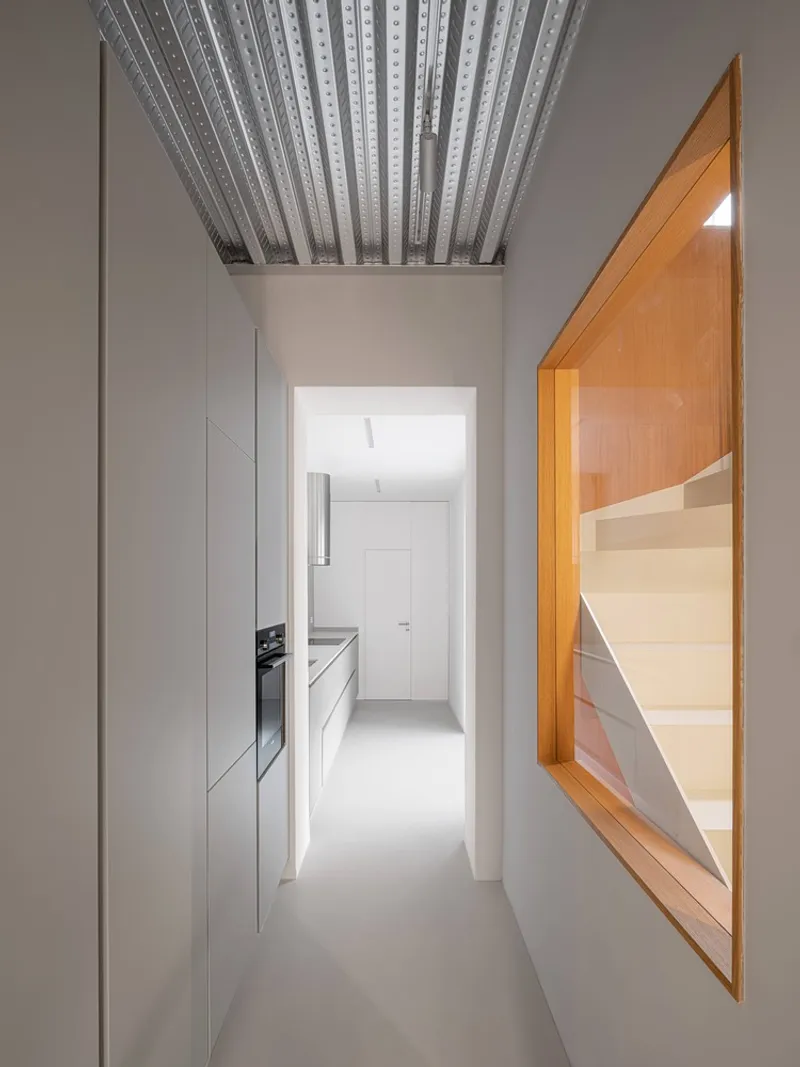
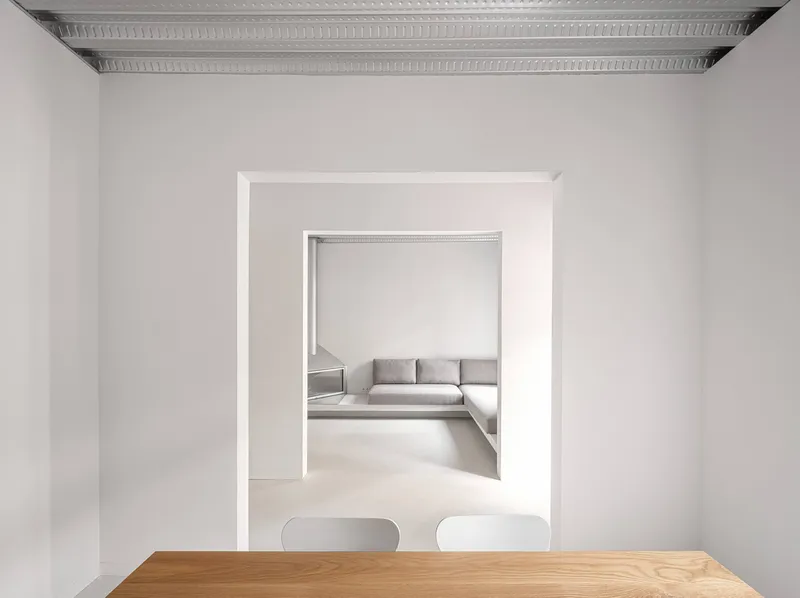
The interior plan is a concatenation of regular rooms connected by large voids to the stairwell, generating crossed views that shift as you move between levels. A white kitchen corridor slides open to a deck; a hallway frames a view through aligned doorways to a grey sectional sofa under perforated metal ceilings. Nothing is sealed off. Every room participates in a visual sequence that extends from facade to courtyard and back.
This spatial fluidity is not accidental. It recovers the original 1890 plan logic, in which rooms were connected en filade rather than isolated by corridors. SOLAR updated the device with contemporary openings scaled for modern living, but the underlying idea is pure 19th century: a house should feel larger than its footprint, and the way to achieve that is to let the eye travel.
Material Juxtapositions Inside
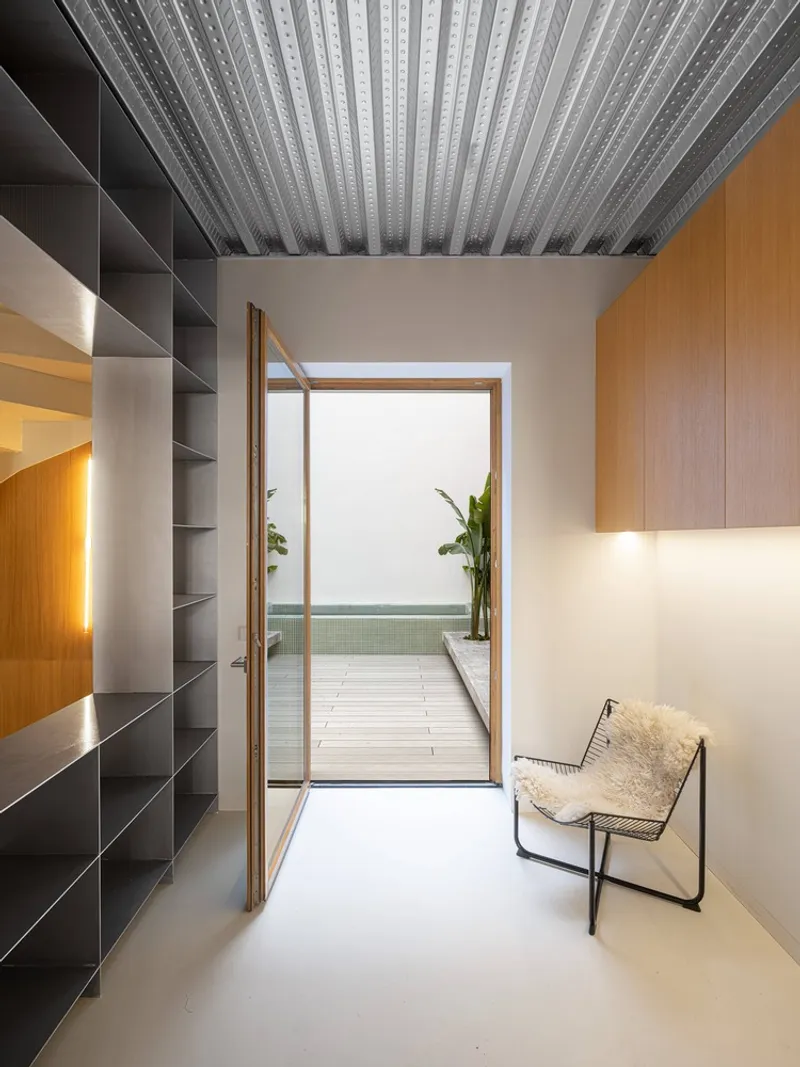
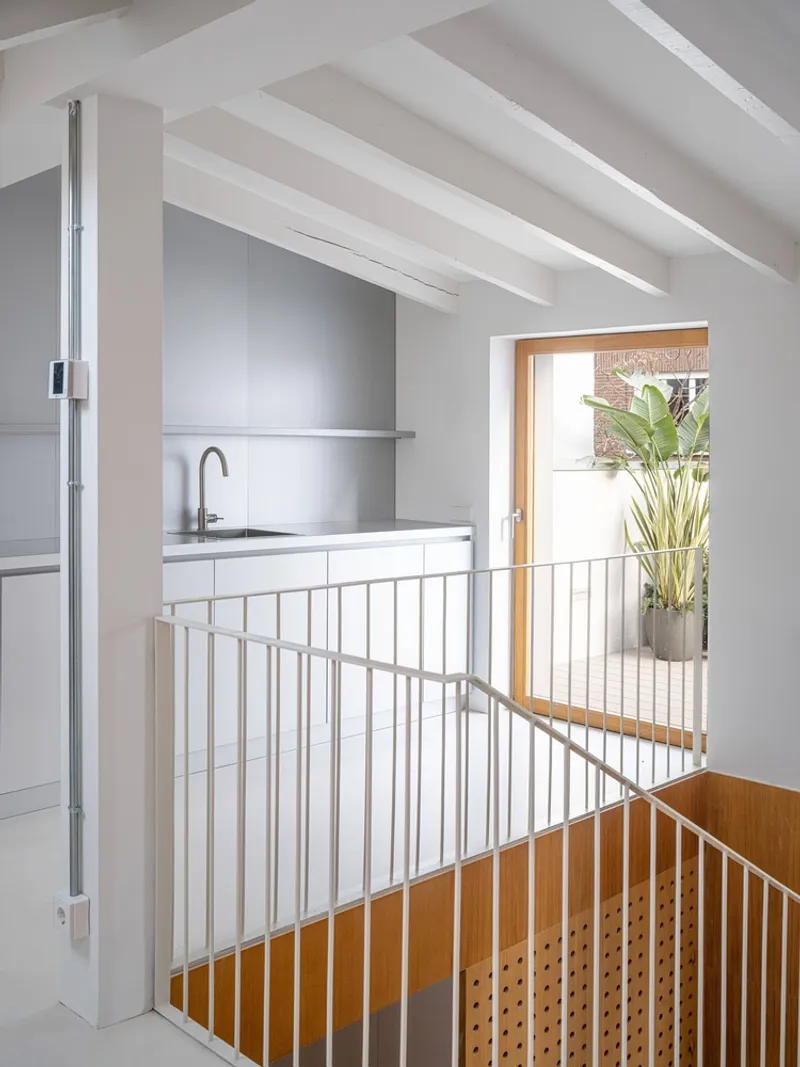
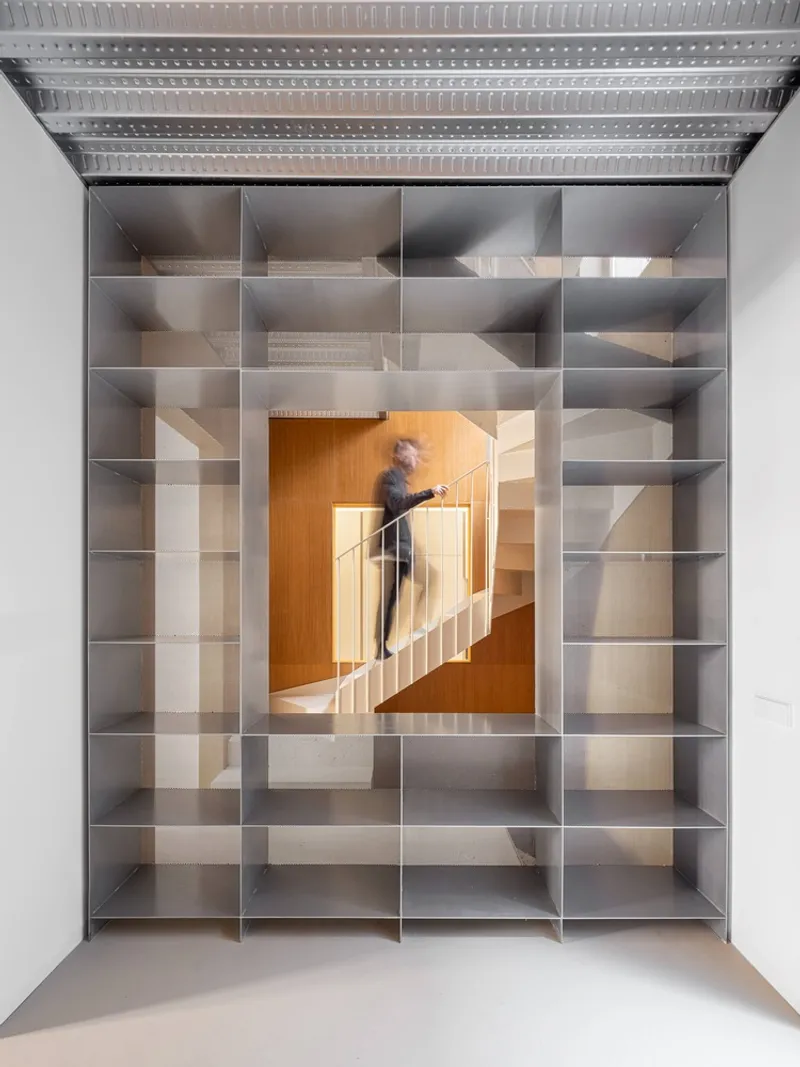
Inside, the material palette oscillates between the raw and the refined. Corrugated metal ceilings meet built-in shelving in a hallway that opens onto an exterior terrace. An upper-level kitchenette sits behind a white metal railing overlooking the stairwell's timber balustrade. A steel shelving grid with a central opening frames a view of a person ascending the oak-lined stair. The materials are few, but their juxtapositions are specific and considered.
The overall effect is a house that reads as both warm and precise. Oak, white-painted steel, corrugated metal, and perforated aluminum form a tight vocabulary, and each material does double duty: structural and atmospheric, functional and expressive. There are no decorative finishes applied for effect. Everything you see is either holding something up, letting light through, or storing something.
Plans and Drawings
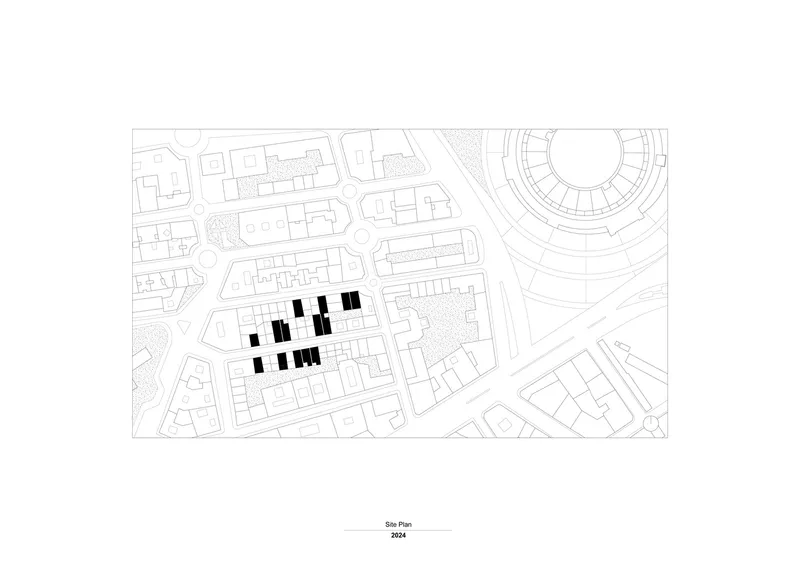
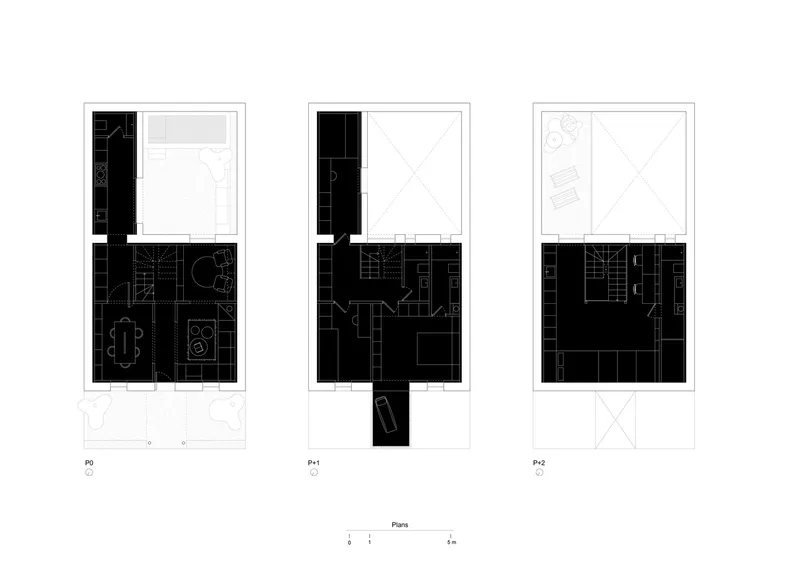
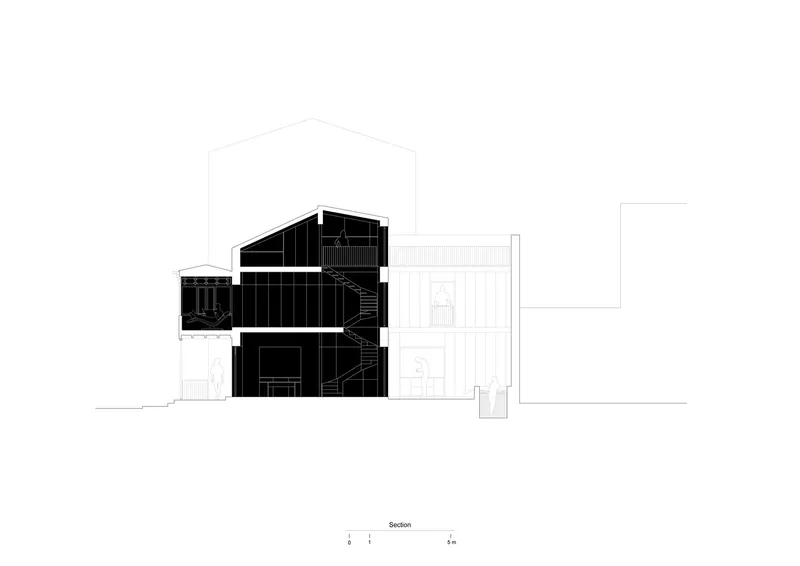

The site plan reveals the house's position within a curved urban block, one of the last original footprints in a fabric that has been almost entirely redeveloped. The three-level floor plans confirm the L-shaped courtyard arrangement and show how the stairwell sits at the joint of the L, commanding views into every wing. A section through the gabled three-story dwelling exposes the relationship between the stair shaft, the courtyard, and the exterior stairs that serve the rear.
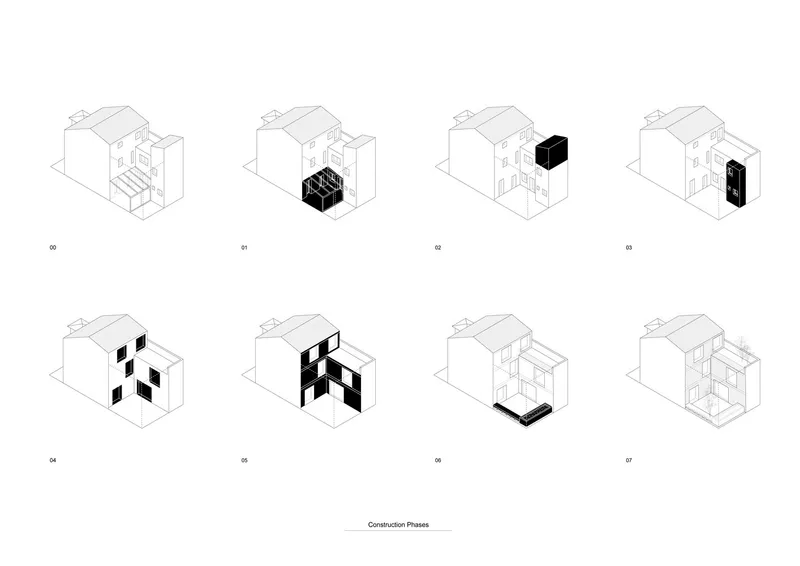
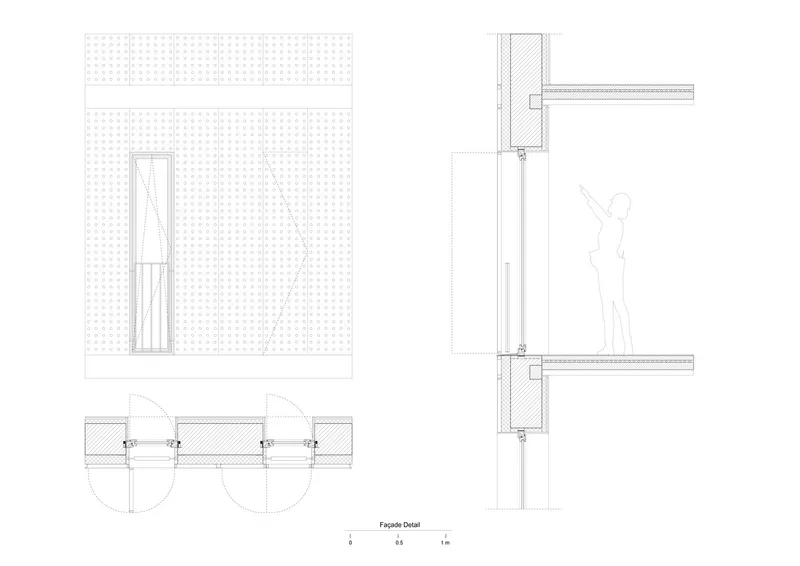
The analytical diagrams are where SOLAR's research shows most clearly. A grid study illustrates how dwelling units in the original Madrid Moderno colony varied their infill configurations within a standardized plot framework. An axonometric sequence breaks the construction into eight phases, revealing the logic behind the restoration's selective demolitions and reconstructions. The facade detail drawings show the perforated aluminum assembly and its relationship to horizontal slabs, with a human figure for scale. These are not decorative appendices. They are the intellectual backbone of the project.
Why This Project Matters
Castelar House matters because it reframes heritage restoration as a design problem rather than a compliance exercise. SOLAR did not simply stabilize a listed facade and fill in behind it with generic developer interiors. They treated the entire building as a system: thermal, spatial, material, and historical. The result is a house that consumes over 70% less energy than before, reads as unmistakably contemporary from the courtyard, and still holds its place in a 19th-century colony of garden-city houses. That is a harder trick than it sounds.
More broadly, the project is a reminder that the most sustainable building is often the one that already exists. In a city where only fourteen of ninety-six original houses remain, every restoration is a political act as much as an architectural one. SOLAR's decision to design two contrasting facades, one painstakingly handcrafted and one digitally fabricated from recycled material, makes the temporal argument visible and legible. It says: this building has a past and a future, and we are not embarrassed by either.
Castelar House by architectural studio SOLAR. Madrid, Spain. Completed 2024. Photography by Adrià Goula.
About the Studio
Share Your Own Work on uni.xyz
If projects like this are the kind of work you want to make, uni.xyz is a place to publish your own, find collaborators, and enter design competitions.


Popular Articles
Popular articles from the community


Cloaked Colonization: A Mobile Underwater Habitat That Moves Like a Fish
Micah Abaya's shortlisted EHC Pacific entry reimagines ocean settlement as a dispersed network of self-sustaining architectural organisms.

Opera on the Sea: Driftwood Logic Shapes a Timber Opera House on Estonia's Coast
Trevor Orgill's opera house translates the entangled drift of floating timber into a civic building where wood, water, and music converge.
Opera by the Sea Estonia: Three Shells Dissolving Architecture into Tallinn's Coastline
A winning opera house proposal replaces monumental form with interconnected shells that blur the boundary between building, park and Baltic Sea.

The Amber Palace Opera: A Geological Fiction Surfaces on Tallinn's Baltic Waterfront
Pierre Brillard reimagines a Baltic legend as a public landscape, opera house, and waterfront promenade rooted in Tallinn's coastal identity.

Similar Reads
You might also enjoy these articles


Hodi-Mandai Geram
Project Function: Preservation and revitalization of the Intangible heritage and socio-spatial identity of the Hodi by Housing, Cultural Memory Center, Sacred Grove, landscape, local tourism economy


Olio Towers: A Mid-Rise for Performers That Fuses Housing, Rehearsal, and Stage
Located blocks from Houston's Theater District, this modular tower stacks living units around a central performance atrium.

Oasis: Modular Green Housing Carved into Dhaka's Urban Fabric
A shortlisted Plugin Housing entry reclaims unauthorized settlements in Dhaka with stepped concrete volumes, green roofs, and ventilation-driven design.

Black Hole: A Floating Megastructure for the Post-Physical Era
Emiliano Mazzarotto envisions a spherical, self-scaling arena where e-sports, digital hotels, and holographic stadiums replace traditional public space.

Explore Conservation Architecture Competitions
Discover active competitions in this discipline

Challenge to reimagine the Iron Throne

Photograph architecture without architects

Illustrate the lost glory of Angkor Wat - Render Challenge

Design challenge to reuse E-waste
Comments (0)
Please login or sign up to add comments
No comments yet. Be the first to comment!