![[tp3] architekten Weave 21st-Century Concrete into a 14th-Century Austrian Castle Ruin](https://img.uni.xyz/eyJidWNrZXQiOiJ1bmktYmxvZyIsImtleSI6IjQzLzJhYWU0OWQzLTFkZDMtNGViYi1iNTdlLWRkOTIwMzhiMmQwNy91bmllZGl0b3JpYWwyMDI2LTAxLTMxVDE2LTE1LTA3LTA0MjI4OS5wbmciLCJlZGl0cyI6eyJyZXNpemUiOnsid2lkdGgiOjY0fSwianBlZyI6eyJxdWFsaXR5IjoxMH0sIndlYnAiOnsicXVhbGl0eSI6MTB9LCJmbGF0dGVuIjpmYWxzZSwibm9ybWFsaXNlIjpmYWxzZX19)
![[tp3] architekten Weave 21st-Century Concrete into a 14th-Century Austrian Castle Ruin](https://img.uni.xyz/eyJidWNrZXQiOiJ1bmktYmxvZyIsImtleSI6IjQzLzJhYWU0OWQzLTFkZDMtNGViYi1iNTdlLWRkOTIwMzhiMmQwNy91bmllZGl0b3JpYWwyMDI2LTAxLTMxVDE2LTE1LTA3LTA0MjI4OS5wbmciLCJlZGl0cyI6eyJyZXNpemUiOnsid2lkdGgiOjEyMDAsImZpdCI6Imluc2lkZSJ9LCJqcGVnIjp7InF1YWxpdHkiOjcyfSwid2VicCI6eyJxdWFsaXR5Ijo3Mn0sImZsYXR0ZW4iOmZhbHNlLCJub3JtYWxpc2UiOmZhbHNlfX0=)
[tp3] architekten Weave 21st-Century Concrete into a 14th-Century Austrian Castle Ruin
A two-decade conservation effort turns a crumbling medieval fortress in Reichenau an der Rax into a living cultural venue.


A castle built before 1397 sits above the town of Reichenau an der Rax in Lower Austria. For centuries it weathered wars, fires, and the slow erosion of relevance that kills most medieval structures. By 1932 the Starhemberg family had formally abandoned it to decay. Roofs collapsed, frost split the masonry, and wind scoured the exposed walls until, at the turn of the millennium, the ruin was a single harsh winter away from becoming rubble. In 2004, Graz-based [tp3] architekten received the commission to stop that clock, launching a phased conservation and revitalization effort that would stretch nearly twenty years and culminate in 2023 across 2,500 square meters of stabilized, accessible, and culturally active space.
What makes the project worth studying is the refusal to choose between preservation orthodoxy and contemporary spectacle. The architects treated the ruin not as a frozen artifact but as a structure that has been continuously modified for 700 years and simply needed its next chapter written in an honest material language. New concrete, timber, and steel elements are legible as interventions of the present. Some are intentionally reversible. None cut into old masonry. The result is a building that holds its scars in full view while functioning as a theater venue, a tourist destination, and a public gathering space. It is neither museum nor stage set but something rarer: a ruin that is still becoming.
A Fortress in Its Landscape
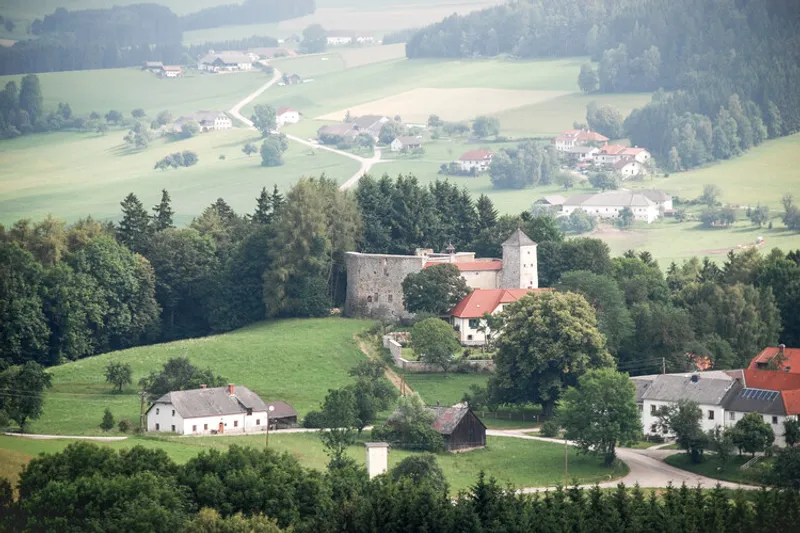

From a distance, Castle Reichenau still reads the way a hilltop fortress should: dominant, compact, and visually anchored to the ridgeline above the valley hamlet. The drone views reveal red tile roofs, stone curtain walls, and rolling green meadows that place the complex firmly in the Alpine foothills. The relationship between settlement and stronghold is remarkably intact. The castle does not hover above the town in romantic isolation; it is connected to it by roads, sightlines, and the cultural program that now draws visitors uphill.
That legibility at the landscape scale matters because it sets the stakes for every detail decision closer in. Any intervention visible from the valley floor had to respect the silhouette that seven centuries of construction and erosion had produced. [tp3] architekten achieved this by keeping new volumes low and tucking the most visibly modern materials, fair-faced concrete and glazing, behind the surviving masonry envelope.
Reading the Ruin
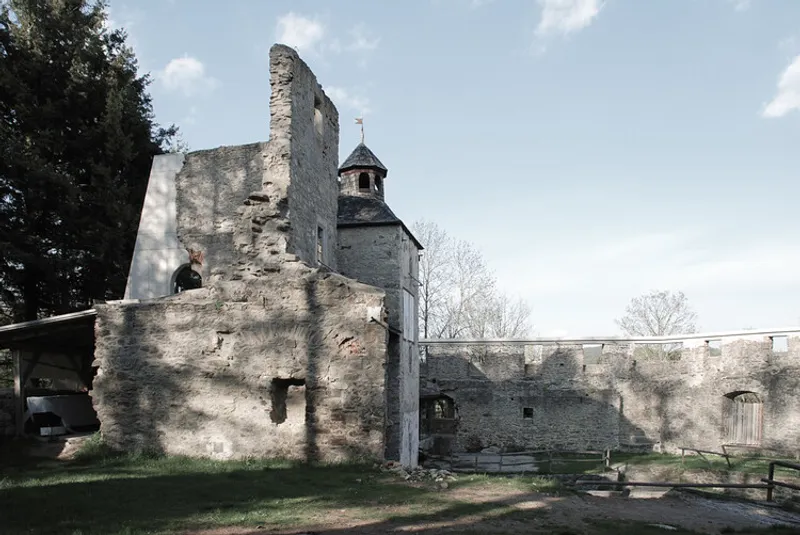
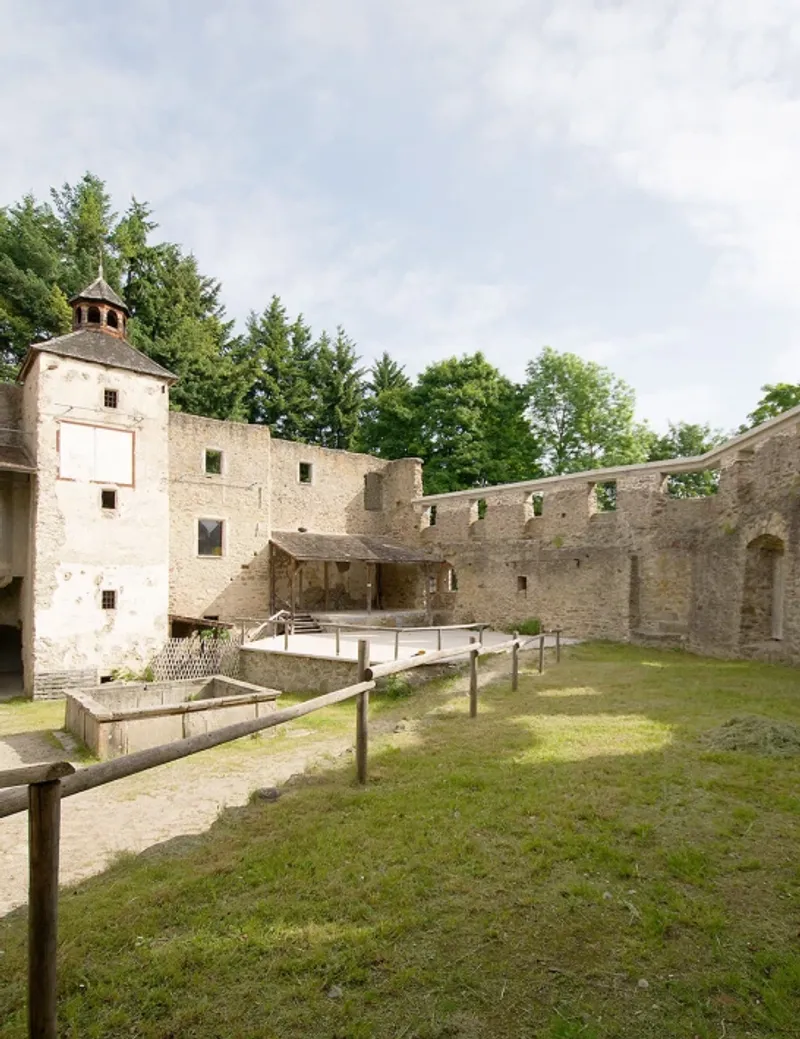
At ground level the castle's age announces itself bluntly. Arched openings frame sky where glazing once sat. A bell tower rises behind fortified walls that are cracked and re-pointed in layers that chart different centuries of repair. The grassy inner courtyard, ringed by battlements and a timber shelter, reads as both picturesque and precarious. There is no effort to hide the damage. The ruin is presented as evidence, not scenery.
The architects' conservation philosophy hinged on a simple rule: stabilize without cutting. No new channels were chased into old stone. Where walls needed to be rebuilt, the closure techniques followed precedents from internationally recognized restorations of freestanding masonry, including methods comparable to those used at the Colosseum in Rome. Sandblasting cleaned surfaces without removing the patina that gives the stone its biographical texture.
Concrete as Counterpoint

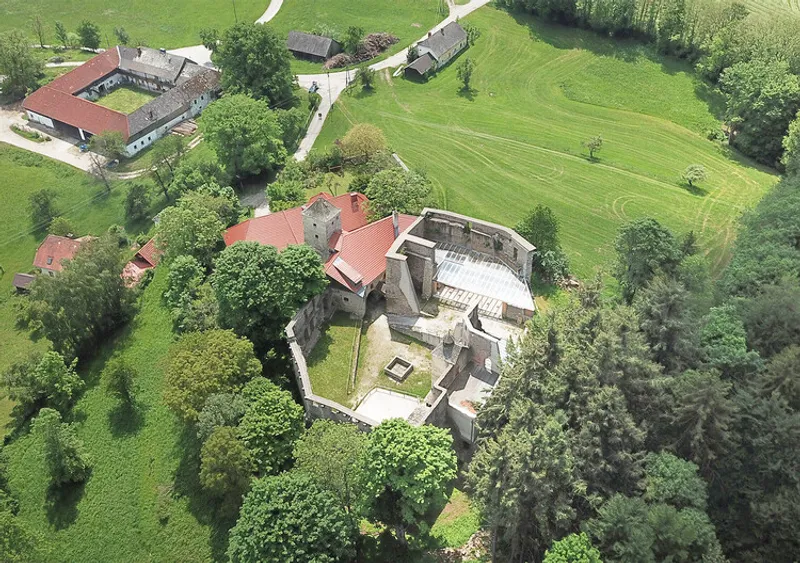
The single most assertive move is the board-formed concrete insertion visible along the southeast wing. Rising behind crumbling rubble stone, the concrete reads as a geological deposit of a different era: smooth where the masonry is rough, precise where the wall fragments are ragged. Moss and ivy creep across the boundary, softening a joint that the architects deliberately left hard. The message is unambiguous. This is not stone pretending to be old. It is concrete declaring itself new.
Structurally, a continuous concrete ring wraps the outer walls of the southeast wing, performing two roles at once. It locks the historic masonry in place against further collapse, and it provides the bearing surface for a temporary stage roof that can be installed for theater and cultural events. That dual function is efficient design in the most literal sense: one element, two problems solved, zero cuts into medieval fabric.
Interior Layers
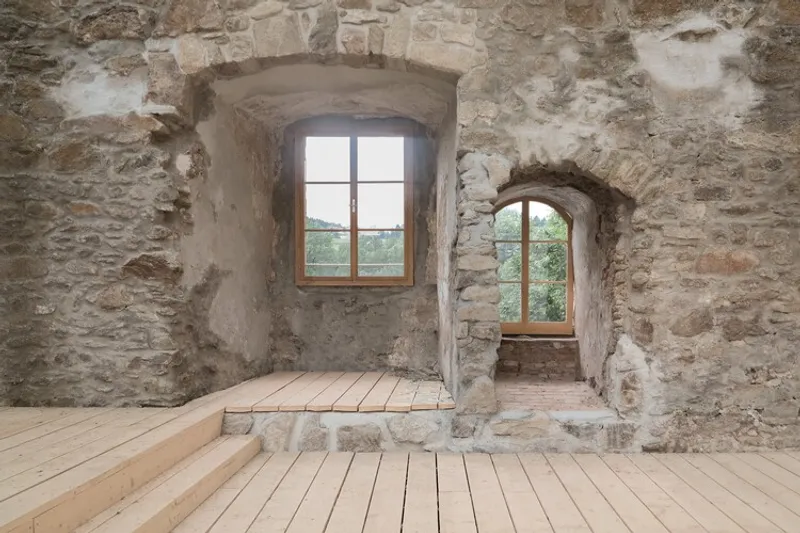
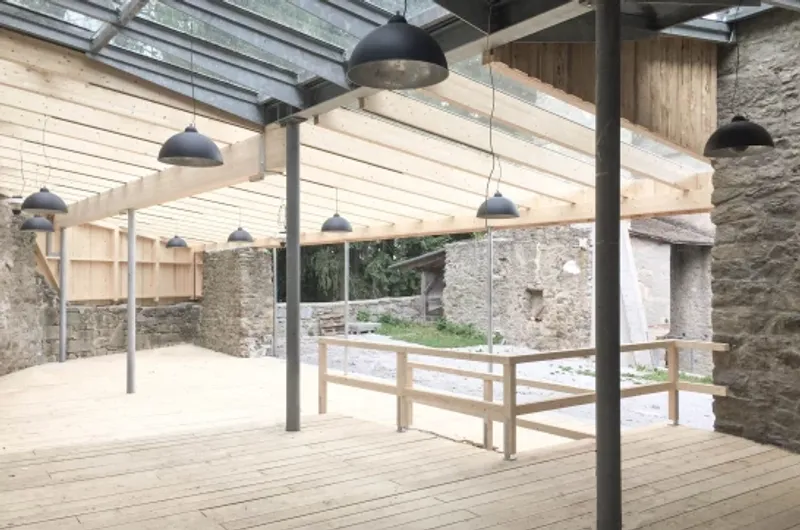
Inside, the strategy shifts from stabilization to activation. Rough stone walls frame arched window openings that now sit above new timber flooring, a clean datum that makes the unevenness of the original construction legible by contrast. Elsewhere, steel columns and timber ceiling beams support a glazed skylight that opens a formerly roofless volume to controlled daylight. The materiality is warm but restrained: timber and steel do the structural work, glass admits light, and the stone walls provide the atmosphere.
Accessibility upgrades, including modern barrier-free toilet facilities, were threaded into these interiors without competing for attention. The goal throughout was to make the castle usable for theater performances, cultural events, and tourism while keeping the architectural register quiet enough to let the medieval fabric dominate. It is a balance that most adaptive reuse projects talk about and few actually achieve.
The Model as Document
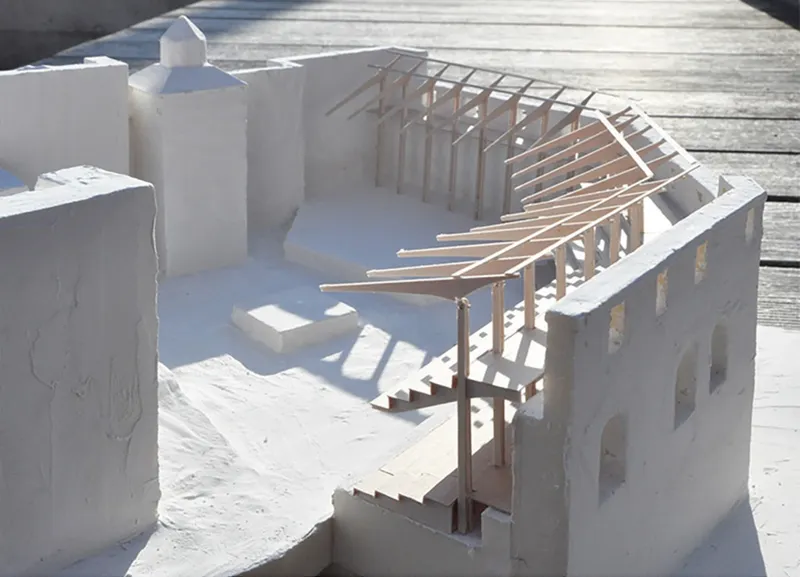
A physical model of the complex reveals the structural logic with a clarity that photographs cannot. Exposed timber roof framing rises above white masonry walls, showing how the new roofs sit within the existing envelope rather than capping it. The model also makes legible the phased nature of the work: different interventions at different scales, accumulated over nearly two decades. It is a useful reminder that this is not a single gesture but a slow, deliberate accumulation of small, correct decisions.
Why This Project Matters
Castle Ruin Reichenau rejects the two most common traps in heritage architecture. It does not reconstruct a fantasized past, and it does not treat the ruin as an inert backdrop for a flashy contemporary insertion. Instead, [tp3] architekten positioned their work as the latest in a continuous sequence of modifications stretching back to the early 1300s. The project's honesty about time, about damage, about the difference between old and new, gives it a moral seriousness that transcends its modest scale.
There is also a practical lesson here about pace. The twenty-year timeline was not a bug; it was the method. Phased intervention allowed each step to be assessed before the next was taken, and it allowed the budget and the cultural program to evolve together. In an era that rewards fast, photogenic gestures, Reichenau is proof that the most durable architectural work is often the slowest.
Castle Ruin Reichenau by [tp3] architekten. Reichenau an der Rax, Austria. 2,500 m². Completed 2023. Photography by Nikolaus Schullerer-Seimayr.
About the Studio
Share Your Own Work on uni.xyz
If projects like this are the kind of work you want to make, uni.xyz is a place to publish your own, find collaborators, and enter design competitions.


Popular Articles
Popular articles from the community


The Amber Palace Opera: A Geological Fiction Surfaces on Tallinn's Baltic Waterfront
Pierre Brillard reimagines a Baltic legend as a public landscape, opera house, and waterfront promenade rooted in Tallinn's coastal identity.
Temporary Home for Dogs: A Reversed Zoo Rethinks Animal Shelter Architecture
In Bucharest, a sinuous corridor and freed landscape flip the logic of containment, designing a shelter that works to make itself unnecessary.

Faces of the Soviet Avant-Garde: Turning Moscow's Street Names into an Open-Air Museum
A network of sculptural installations across a Moscow residential district transforms forgotten architect names into spatial encounters with cultural memor

Extended Shell: Retrofitting Kolkata's Balconies as Living Urban Thresholds
A modular retrofit system recovers the social and environmental intelligence of Kolkata's historic verandas for contemporary Park Street residents.

Similar Reads
You might also enjoy these articles


Hodi-Mandai Geram
Project Function: Preservation and revitalization of the Intangible heritage and socio-spatial identity of the Hodi by Housing, Cultural Memory Center, Sacred Grove, landscape, local tourism economy


Olio Towers: A Mid-Rise for Performers That Fuses Housing, Rehearsal, and Stage
Located blocks from Houston's Theater District, this modular tower stacks living units around a central performance atrium.

Oasis: Modular Green Housing Carved into Dhaka's Urban Fabric
A shortlisted Plugin Housing entry reclaims unauthorized settlements in Dhaka with stepped concrete volumes, green roofs, and ventilation-driven design.

Black Hole: A Floating Megastructure for the Post-Physical Era
Emiliano Mazzarotto envisions a spherical, self-scaling arena where e-sports, digital hotels, and holographic stadiums replace traditional public space.

Explore Ruins Competitions
Discover active competitions in this discipline

Challenge to reimagine the Iron Throne

Photograph architecture without architects

Illustrate the lost glory of Angkor Wat - Render Challenge

Bring back Drive In's
Comments (0)
Please login or sign up to add comments
No comments yet. Be the first to comment!