
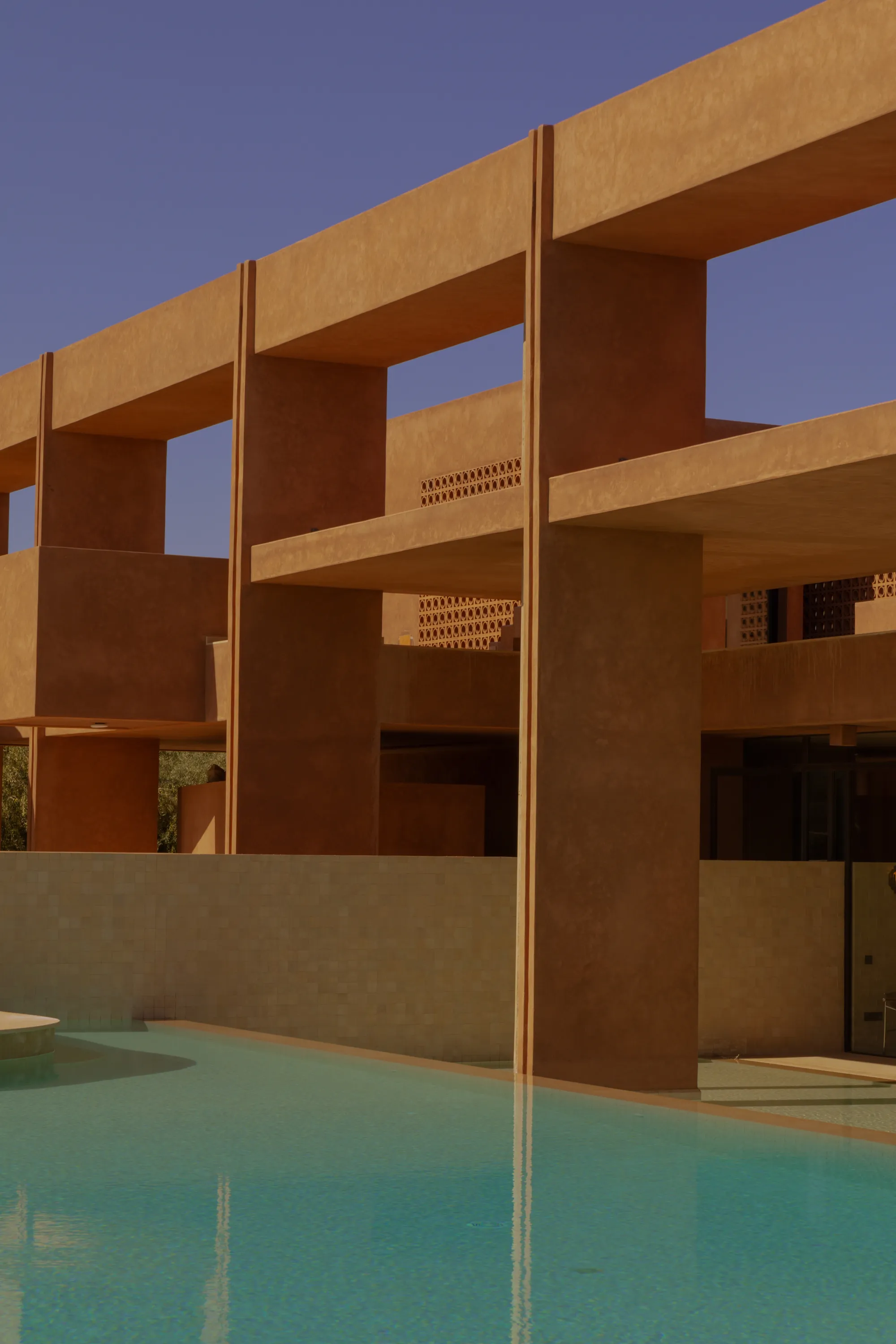
CD Architectes Builds a Terracotta Hospitality Villa at the Foot of Morocco's Atlas Mountains
Villa Elfida organizes two volumes around a 30-by-30-meter module, connecting them with a slender bridge over courtyards and pools.


Villa Elfida is a hospitality project that treats the building itself as landscape. Designed by CD Architectes and completed in 2025 at the foot of the Atlas Mountains, the 1,330 square meter compound layers cylindrical towers, cantilevered slabs, and breeze block screens into a composition that reads less like a hotel and more like a small fortified garden settlement. Two articulated volumes, linked by a slender bridge, organize the plan around a repeating 30 by 30 meter square module. The result is a promenade that refuses to distinguish between indoors and out.
What makes this project worth studying is its discipline. The palette is almost monochromatic: terracotta-toned stucco, rammed earth surfaces, and bronze-colored metal, all held in check by a rigorous modular geometry. The villa never resorts to decorative excess, yet it is deeply atmospheric. Light, shadow, and planted courtyards do the heavy lifting. The project also carries a poignant backstory: lead architect Gwenaël Clément passed away at the project's start, and the finished building stands as a testament to a vision carried through by the studio.
Earthen Volumes Against the Atlas
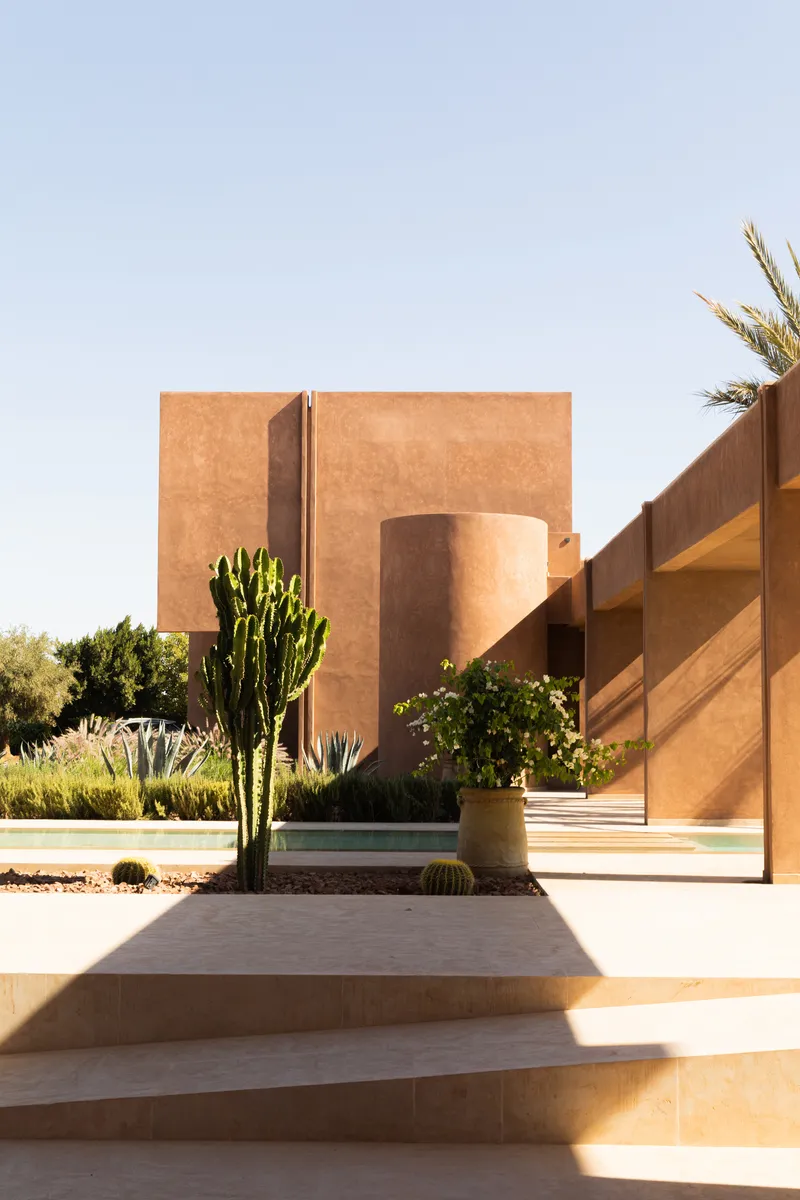
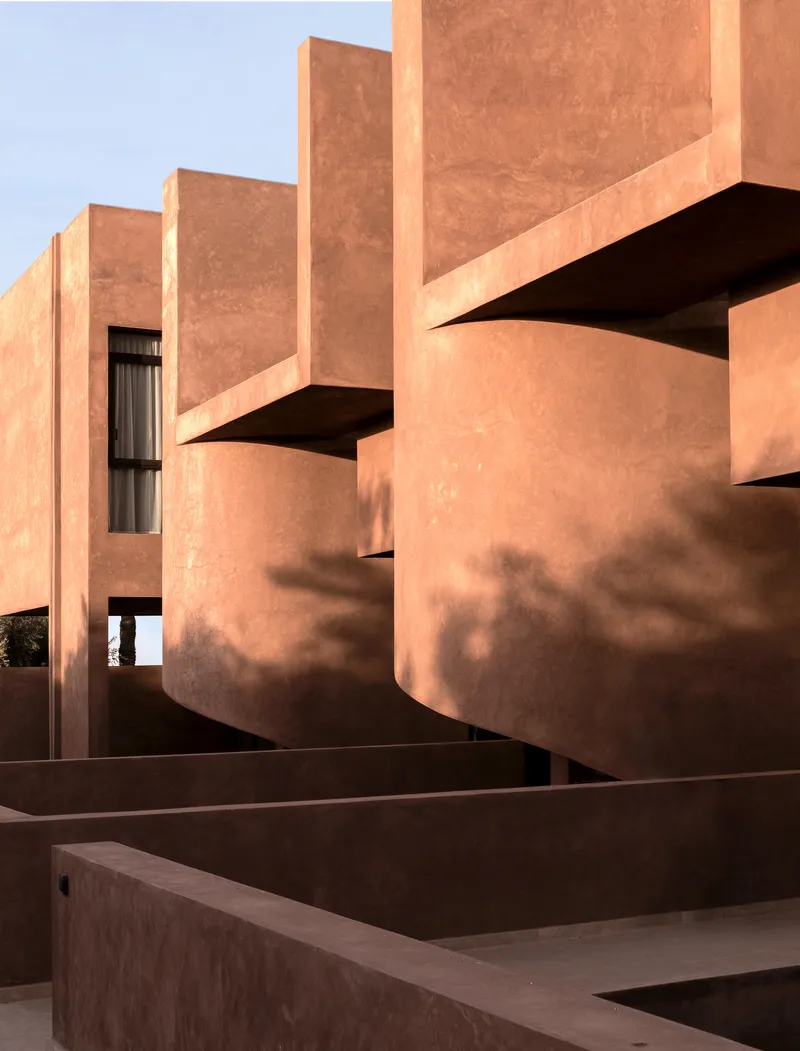
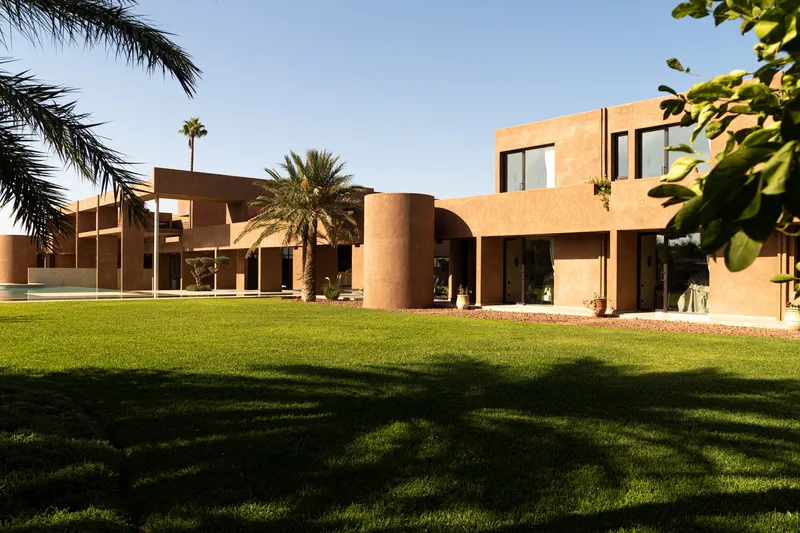
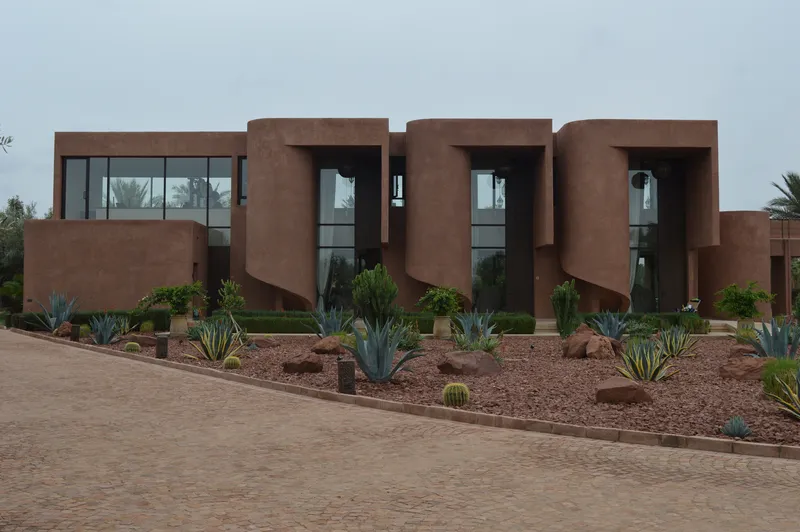
From the surrounding landscape, Villa Elfida rises as a cluster of stepped rammed earth volumes that could almost be geological formations. The warm, reddish tones of the facades blend with the arid terrain, and the massing avoids any single dominant form. Instead, cylinders, cubes, and cantilevered horizontal planes stack and slide against one another, creating a silhouette that changes with every angle of approach.
The decision to work with rammed earth and earth-toned stucco is not merely aesthetic. These surfaces absorb heat slowly during the day and release it at night, a passive climate strategy well suited to the Moroccan foothills. The lack of applied color forces attention onto geometry and shadow, and the buildings age gracefully as wind and sun weather the walls.
A Facade Built from Screens and Recesses
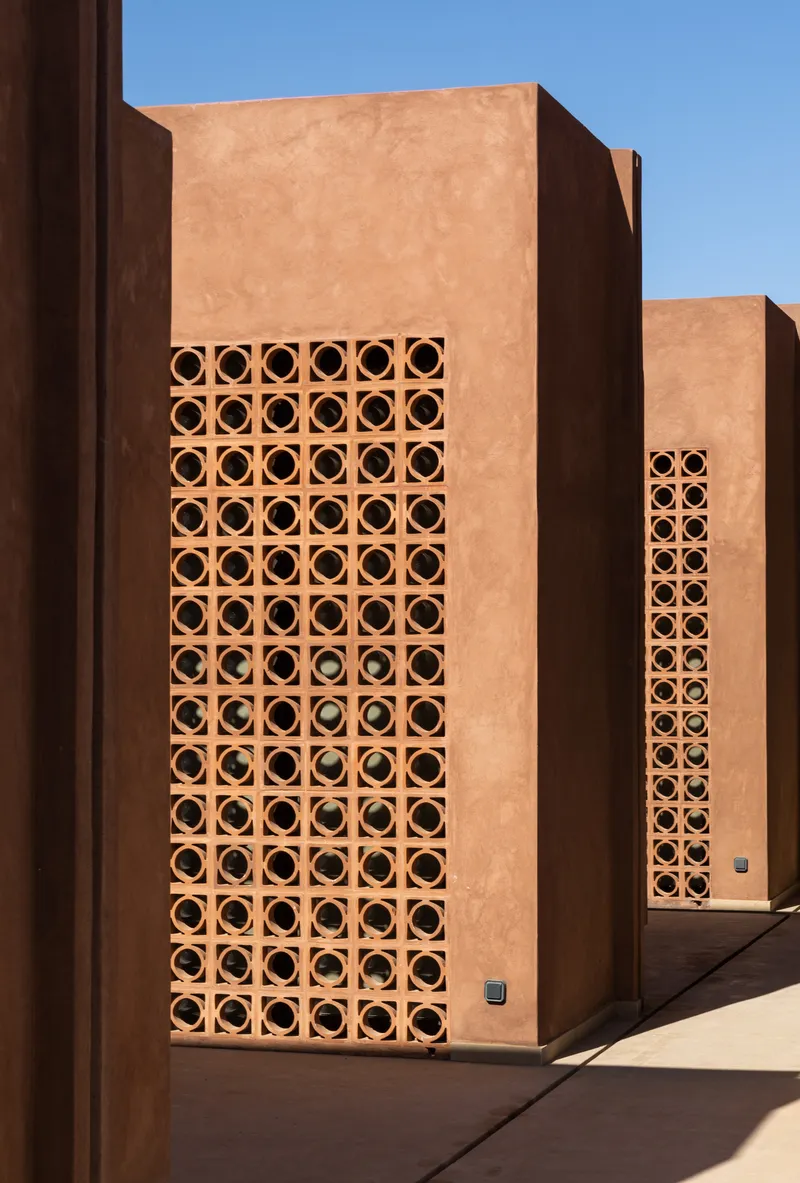


The facades are not flat surfaces but inhabited thresholds. Deep recesses, perforated breeze block panels, and slender columns punctuate the terracotta walls, creating a layered depth that controls light and ventilation without mechanical systems. The breeze blocks, cast in terracotta-colored concrete, appear as large-scale ornamental screens that filter direct sunlight while permitting airflow through interior rooms and corridors.
The lobed facade modules visible from the street introduce a repeating rhythm that structures the building's public face. Each module frames a glazed opening at its center, flanked by xeriscape planting at ground level. It is a straightforward idea, repeated with enough variation to keep it interesting across the full length of the compound.
Courtyards and the Interior Promenade

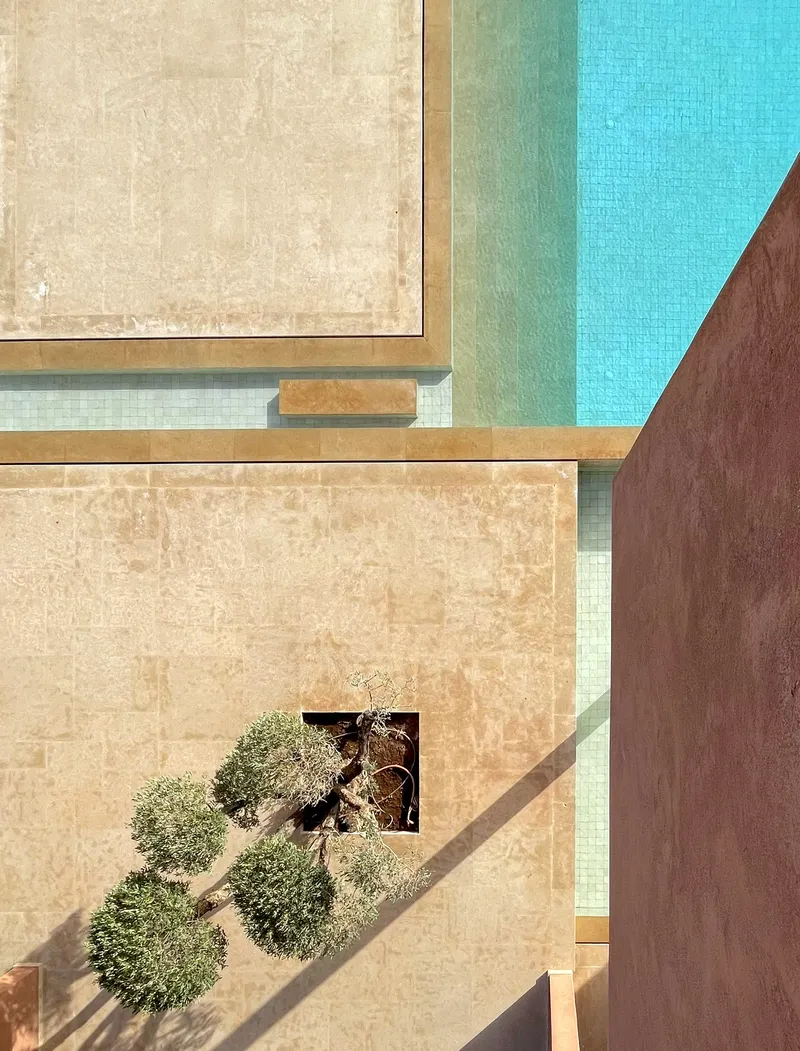
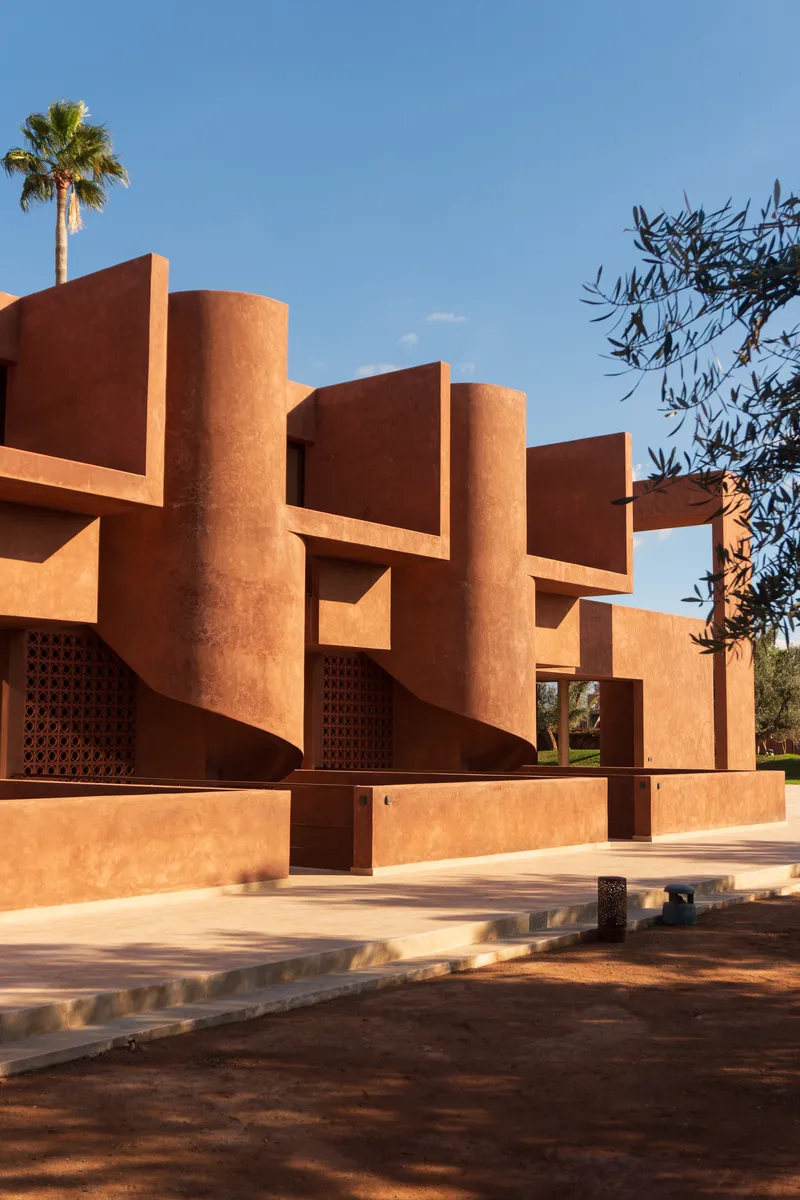
The plan pivots on courtyards. Stone-paved patios with olive trees, agaves, and aloes punctuate the linear circulation spine, turning every transition from one wing to the next into a moment of open sky and dappled shade. The 30 by 30 meter module creates a predictable cadence: enclosed room, courtyard, enclosed room. Yet the courtyards themselves vary. Some are intimate stone gardens with three potted olives; others expand into full-scale loggias with views toward the pool.
This is a building that wants you to walk slowly. The slender bridge connecting the two main volumes becomes the hinge of the whole composition, framing long views across planted beds and toward the mountains beyond. It is an old idea, the architectural promenade, executed here with genuine conviction.
Water as Architecture
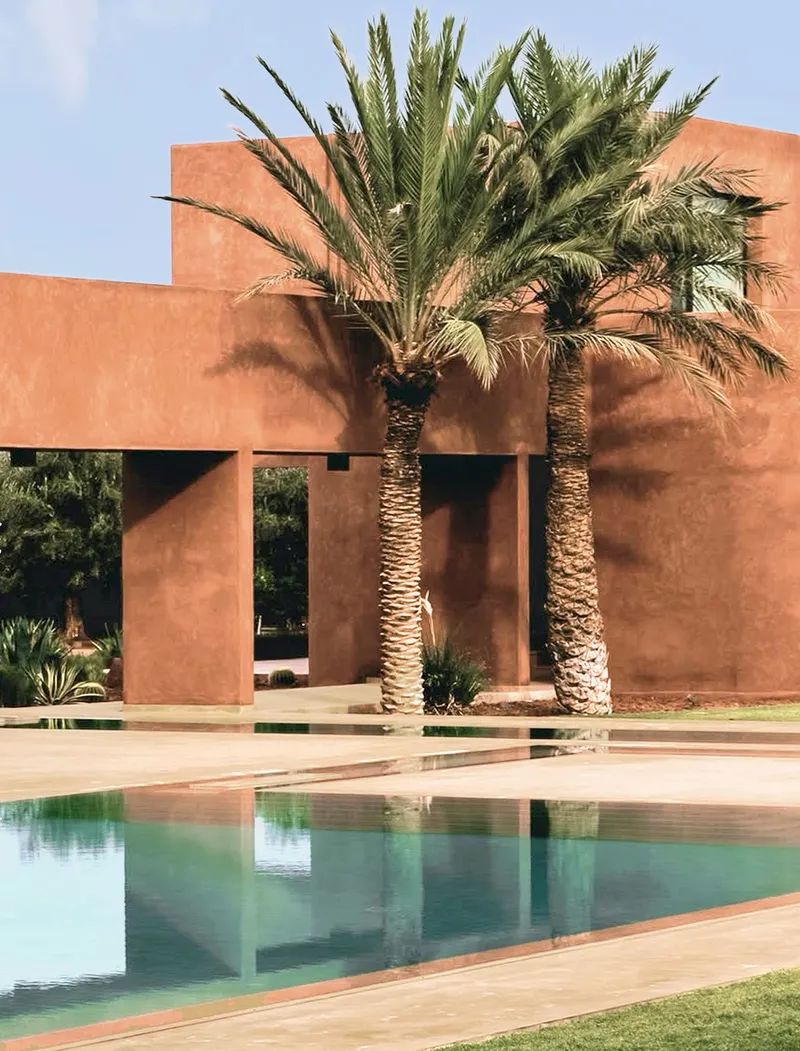

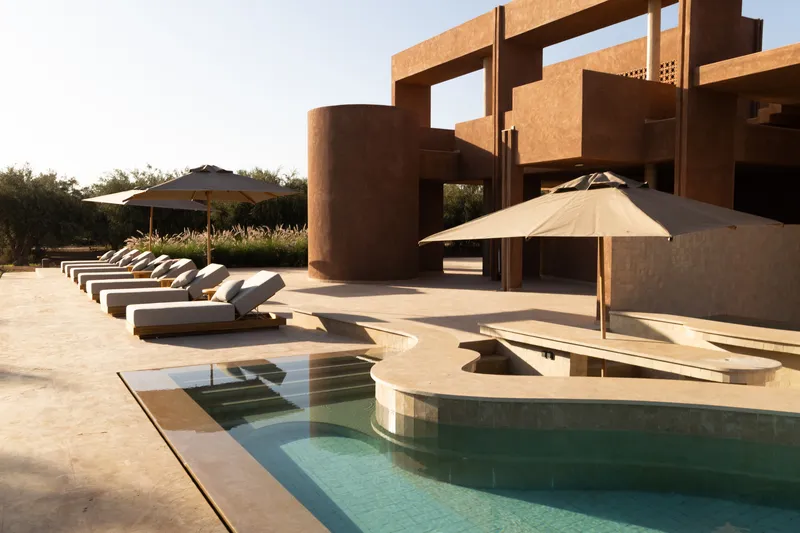
The swimming pool is not a standalone amenity but an integral part of the building's spatial logic. Positioned beneath a multi-story colonnade, the turquoise water acts as a horizontal mirror that doubles the height of the terracotta facades and reflects the palm canopy overhead. The pool edge curves at one end, pulling away from the strict orthogonal grid to introduce a moment of softness.
From the timber deck, with its rows of white loungers, the pool reads as a kind of interior room without a ceiling. The colonnades on either side define its edges as firmly as any wall, and the reflections on the water's surface animate the otherwise static facades with constant, gentle movement.
Dusk on the Terrace


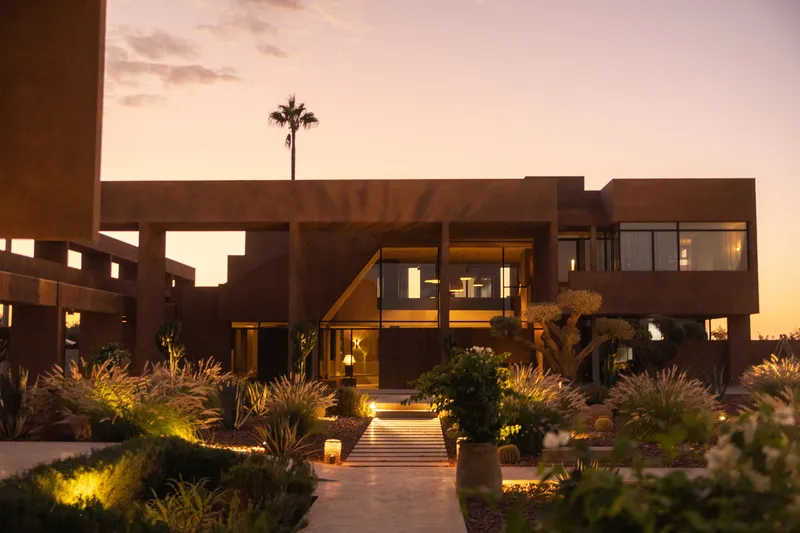
Villa Elfida transforms at twilight. The upper-level colonnade terrace, which during the day provides shaded views over the olive grove and pool, becomes a stage for warm artificial light that washes up through the colonnades and outlines the perforated screens. The terraced pathway, lined with planted beds and stone steps, draws a gentle processional line from the garden to the illuminated multi-level residence.
The architects clearly designed for this hour. The deep recesses that cast hard shadows at noon become soft, glowing apertures at dusk. It is a building that rewards lingering, which is, after all, the point of hospitality architecture.
Interiors: Restraint and Craft
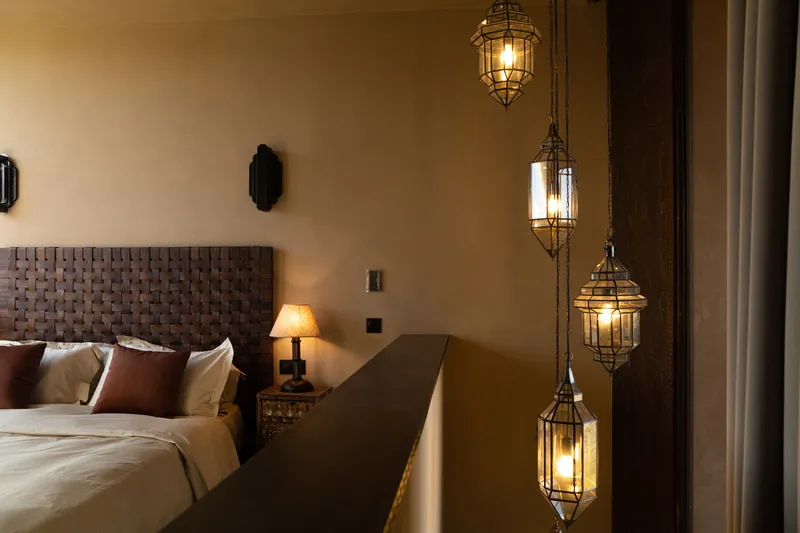
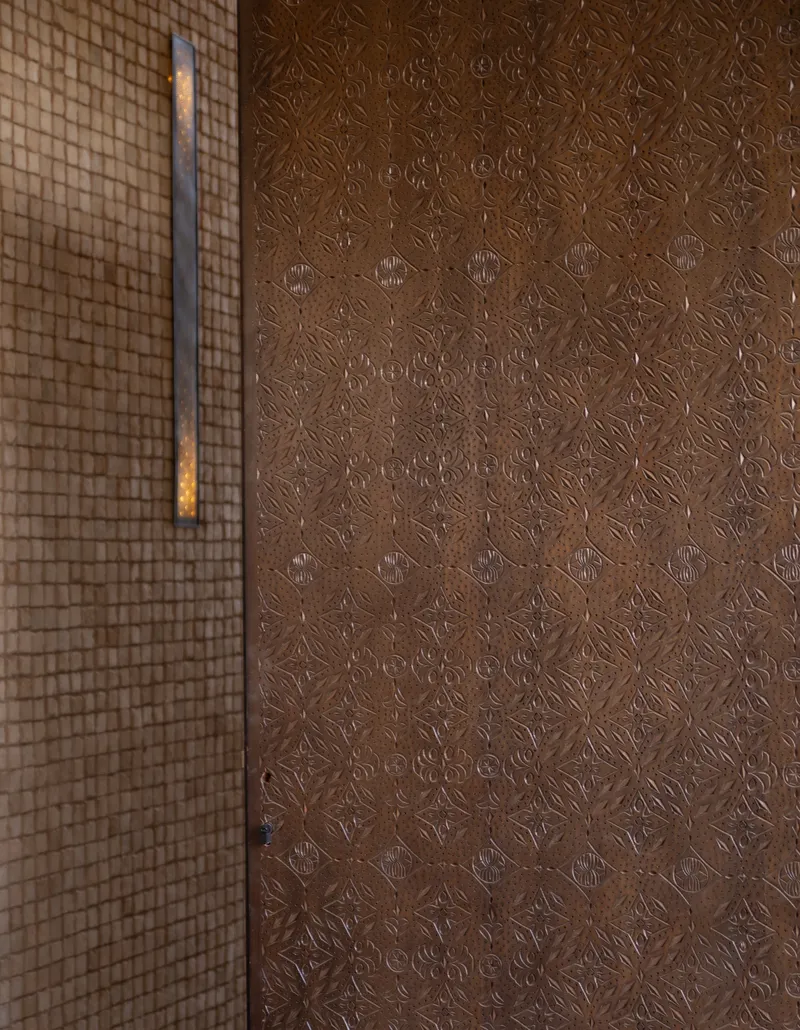
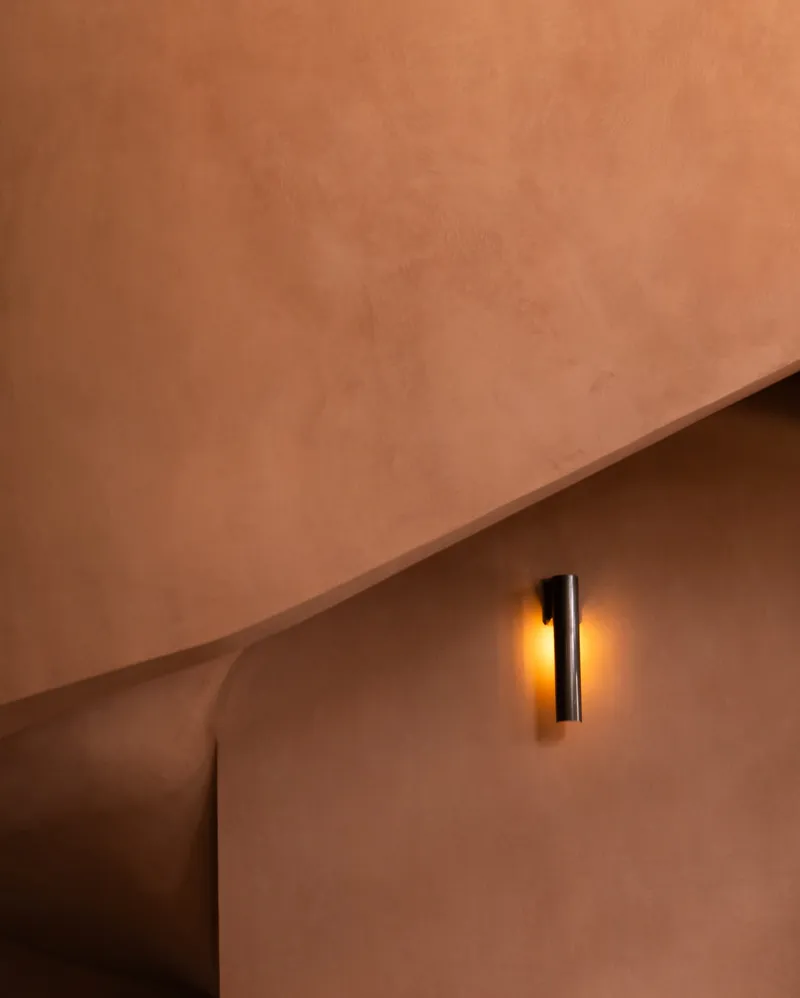
Inside, the villa maintains its discipline. Bedrooms feature woven leather headboards and clusters of suspended lanterns that cast warm, even light against smooth plaster walls. Embossed metal door panels with geometric patterns and gridded screen walls introduce layers of craft without veering into kitsch. Cylindrical wall sconces throw golden arcs onto curved plaster surfaces, emphasizing the building's sculptural DNA even in its most private rooms.
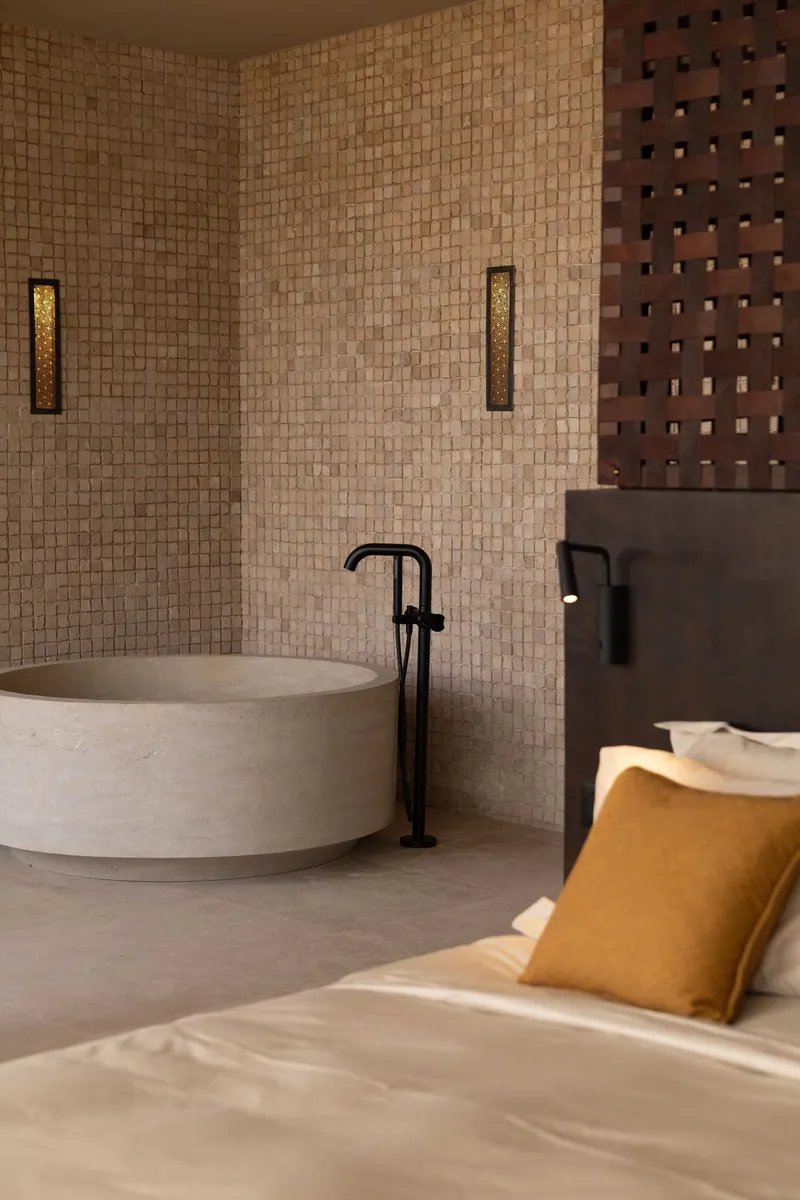

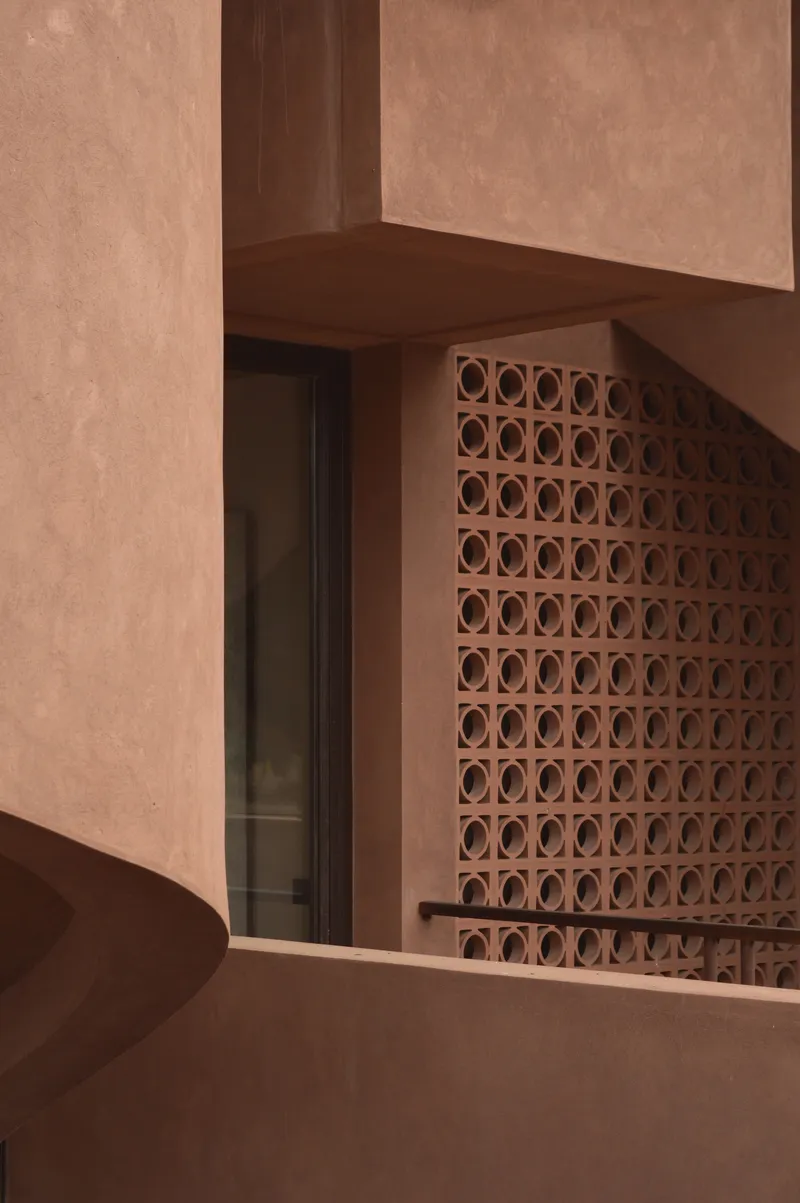
The bathrooms are particularly restrained. A circular stone bathtub sits against a small-tile mosaic wall, its freestanding black tap the only sharp vertical in the composition. Workspaces pair timber furniture with brass desk lamps and perforated metal wall sconces. The terracotta breeze blocks reappear indoors beside dark timber doorways, tying the exterior and interior material palettes together with a single, consistent element.
Stacking and Framing
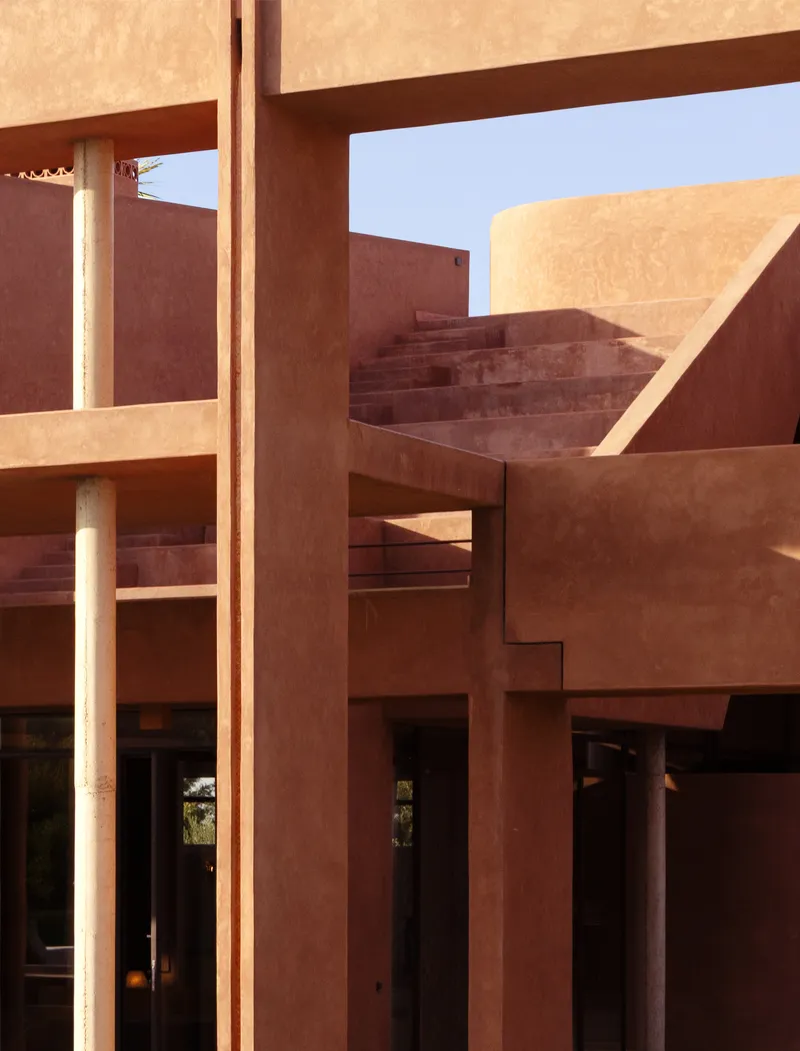


The section is where the project reveals its ambition. Layered terracotta stairs and beam structures frame openings that stack vertically, creating sight lines from upper terraces down through planted courtyards to the pool level. Stacked terraces with horizontal ribbon windows reflect palms and ornamental grasses, while curved stucco volumes with floor-to-ceiling glazing overlook planted gardens below. Each floor peels back to let light into the floor beneath it, a strategy that keeps the deep plan from ever feeling dark.
The curved volume visible in the courtyard elevation is a standout move. Where the rest of the building works in straight lines and right angles, this single cylindrical form anchors a corner and draws the eye, a deliberate accent in a composition that otherwise prizes regularity.
Plans and Drawings

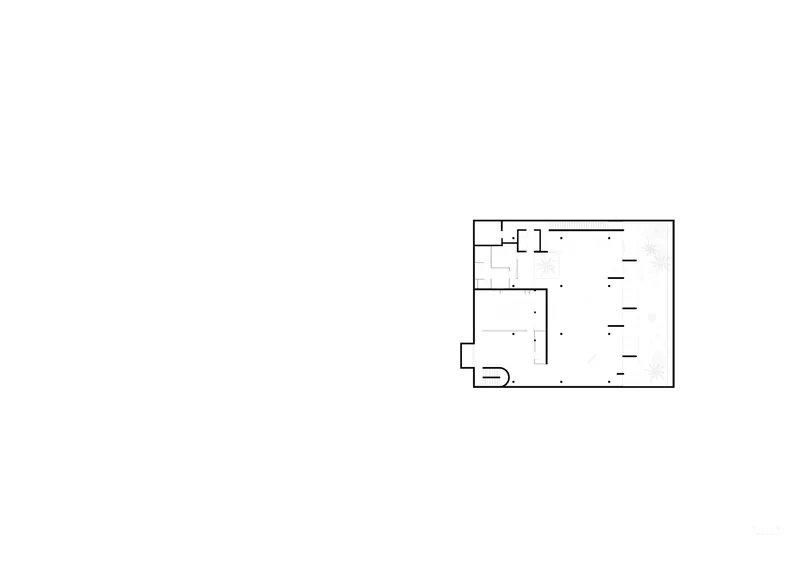
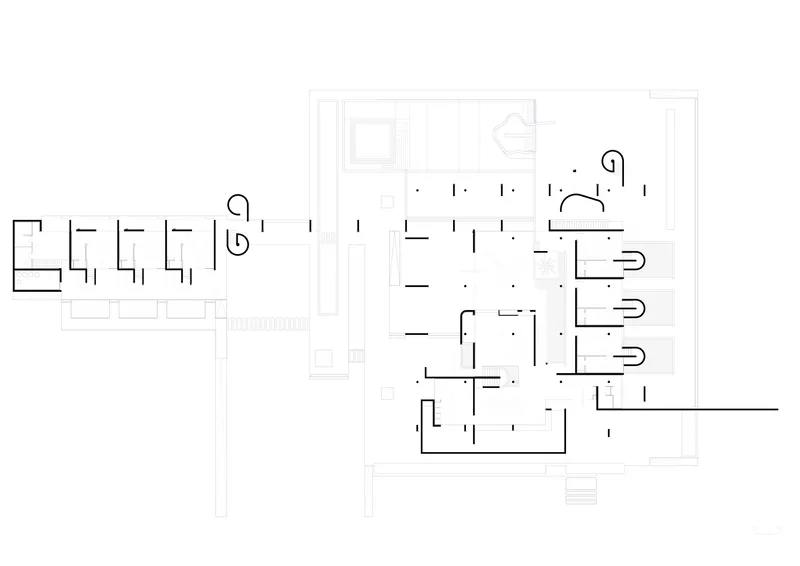
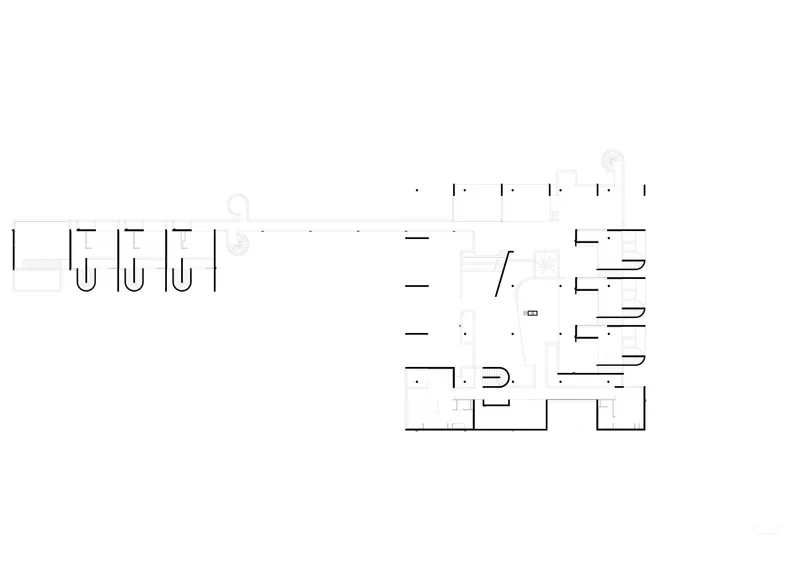
The axonometric drawing reveals the full logic: two multi-level volumes linked by a circulation spine, with courtyards carved out at regular intervals. The floor plans show how the 30 by 30 meter module governs room layout, with repeating guest units organized around a central open space in one wing and clustered room groupings in the other. The linear circulation corridor visible on the lower-level plan is the project's organizational backbone, connecting every room to the courtyards and pool without requiring a single corridor that is purely functional.
What the drawings make explicit is the degree of repetition at work. The module is strict, but variations in ceiling height, screen type, and courtyard planting keep the experience from feeling serial. It is modular architecture deployed in service of atmosphere rather than efficiency alone.
Why This Project Matters
Villa Elfida matters because it demonstrates that a monochromatic, modular building can be deeply atmospheric without relying on spectacle. In a hospitality market saturated with statement architecture and imported aesthetics, CD Architectes has produced a project that belongs to its site. The rammed earth facades, the xeriscape planting, the passive ventilation through breeze block screens: these are not gestures toward sustainability but the fundamental logic of the building.
The project also carries a weight beyond its architecture. Conceived under Gwenaël Clément, who did not live to see it completed, Villa Elfida is evidence of a studio's ability to honor and realize a founding vision. The clarity of the concept, the consistency of the material palette, and the precision of the modular plan all suggest a design that was fully formed before construction began. That the building reads as whole, rather than patched together, is its quiet triumph.
Villa Elfida, designed by CD Architectes (lead architect Gwenaël Clément, in memoriam). Located in Morocco at the foot of the Atlas Mountains. 1,330 m². Completed 2025.
About the Studio
Share Your Own Work on uni.xyz
If projects like this are the kind of work you want to make, uni.xyz is a place to publish your own, find collaborators, and enter design competitions.


Popular Articles
Popular articles from the community


The Musturak Paradise: Senior Living Architecture for a Connected Future in Temara, Morocco
The Musturak Paradise reimagines senior living architecture in Temara via private homes, social spaces, culture, community, and shared care.

Hill & Cross Opera: Sculptural Opera House Architecture Shaped by Tallinn’s Landscape and Identity
Hill & Cross Opera reimagines opera house architecture in Tallinn through its sculptural hill, civic plaza, glass wave and a luminous cross.

Co-Life: Senior Housing Design That Reconnects Older Adults With the City
Co-Life reimagines senior housing design through healing gardens, shared streets, workshops, and a sustainable community across generations.
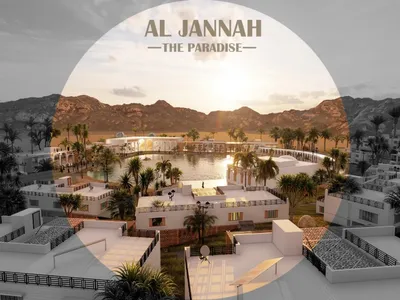
AL-JANNAH: Sustainable Architecture and Permaculture for Afghan Widows
AL-JANNAH uses sustainable architecture and permaculture to create resilient oasis of housing, learning, work and renewal for Afghan widows.


Similar Reads
You might also enjoy these articles

Bao Huynh Watercolor Atelier: A Serene Art Retreat in Hội An
Bao Huynh Watercolor Atelier in Hội An blends multifunctional art spaces, sustainable design, local materials, and family-friendly living in a serene environment.

Atelier Macri Concept Store Interior Design by CASE-REAL
Atelier Macri store features a "ko" counter, walnut wood details, cork displays, blending retail, gallery, and seamless customer experiences.

Manuel Vargas Izquierdo Stadium and High-Performance Sports Center: Architectural Excellence in Jalpa de Méndez
The Manuel Vargas Izquierdo Stadium blends sustainable design, inclusive sports facilities, and cultural-inspired architecture, revitalizing Jalpa de Méndez’s public spaces.

KAKR Buluh Awar Hall: Revitalizing Community and Ecology Through Bamboo Architecture
Community built bamboo hall revitalizes Buluh Awar village, empowering youth, restoring ecology, celebrating vernacular craftsmanship through sustainable architecture and culture.


Comments (0)
Please login or sign up to add comments
No comments yet. Be the first to comment!