

USER and NAUxLab Clad a Fire-Scarred Korean Hillside in 800 Square Meters of Charred Wood
Tan Mok Won in Ulsan, South Korea, transforms a 2013 wildfire site into a mixed-use space where architecture defers to surviving trees.


In 2013, a fire tore through a hillside in Ulsan, South Korea, leaving behind scorched earth and ten charred but living trees. The site's owner marked each survivor with a red ribbon, a quiet act of defiance against erasure. A decade later, architects Jongbang Park of USER and Suk Lee of NAUxLab have turned that gesture into a full building: Tan Mok Won, a mixed-use space wrapped in over 800 square meters of charred wood cladding, reportedly the first structure of its kind at that scale in Korea.
What makes Tan Mok Won genuinely compelling is its refusal to treat architecture as the protagonist. The building bows to its landscape at every turn: its footprint follows the existing contour lines, its courtyard frames three of the surviving trees, and its east facade is a mirror that reflects forest canopy back at visitors. The charred timber is not a trendy finish but a direct citation of the site's trauma, recast as a protective skin. The result is a place where the memory of destruction becomes the primary material of design.
Charred Timber as Testimony


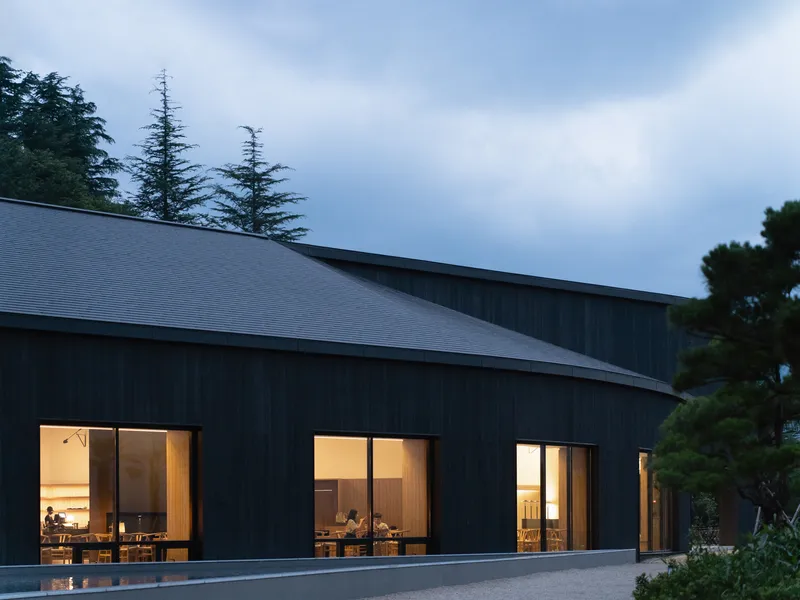
The yakisugi cladding here reads differently than it does on a Scandinavian cabin or a Brooklyn townhouse renovation. On this hillside, charred wood is not an imported aesthetic; it is a literal echo of the event that reshaped the site. The blackened surfaces wrap the building's gable form and extend onto the western outdoor terrace, creating a continuous material language that refuses to let visitors forget the fire. At dusk, warm light spills through the glazed openings, and the dark timber becomes a frame rather than a barrier, drawing attention to the life happening inside.
Scale matters here. Applying charred wood across 800-plus square meters is a logistical commitment that goes well beyond a mood board. The texture is tactile and fragrant, and it weathers in real time, meaning the facade will continue to evolve alongside the trees it commemorates. That kind of temporal honesty is rare in commercial mixed-use projects.
A Roof That Refuses to Sit Still

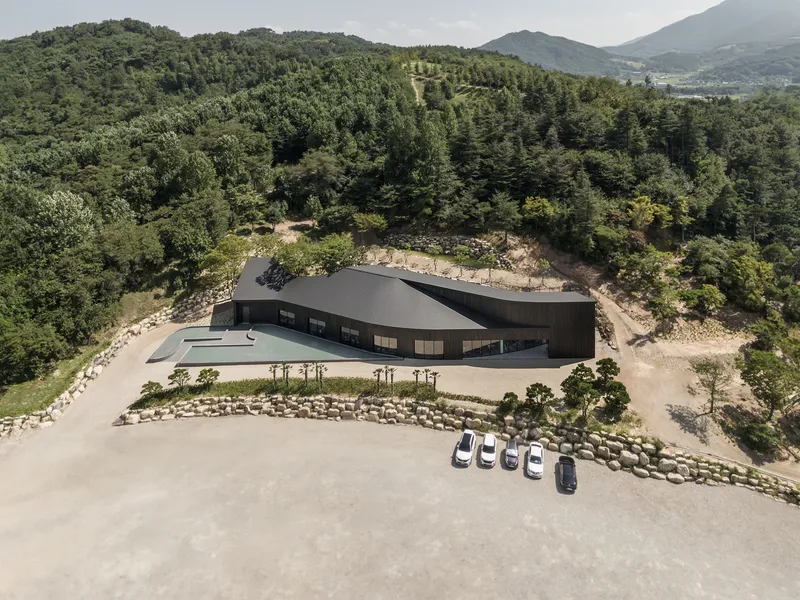
Tan Mok Won's roof looks like a barn gable from a distance, but closer inspection reveals something more restless. The ridge line does not run along the center of the plan. Instead, it connects two vertices diagonally, producing a doubly curved surface that shifts in profile as you walk around the building. From one angle it appears to peel upward; from another it hunches low against the hillside. The effect is sculptural without being theatrical, giving the silhouette a sense of geological movement that suits its mountain context.
The structural ambition becomes legible from the aerial view, where the roof's asymmetry and the way the building nestles into its clearing are both apparent. It is not a form imposed on a site but one negotiated with it, and the curved geometry does double duty by creating varied ceiling heights inside that keep the interior from feeling like a single monotonous volume.
Trees as Clients
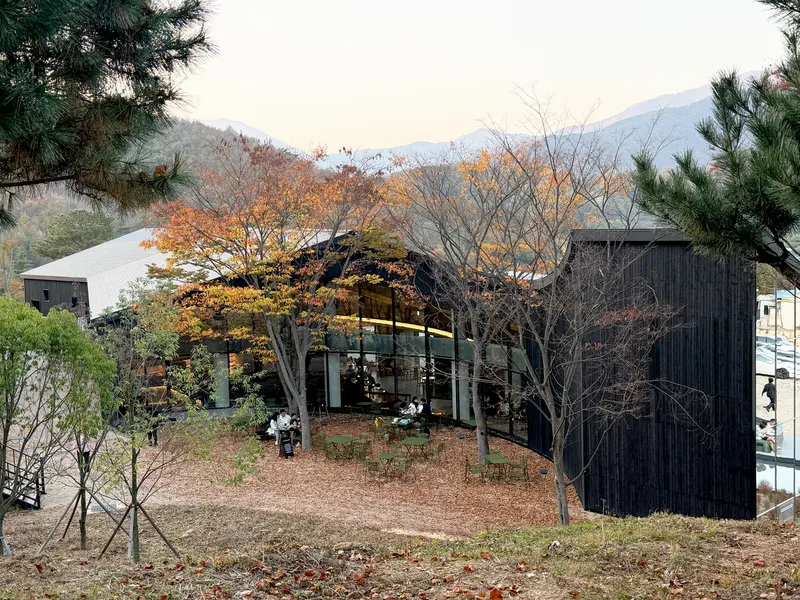
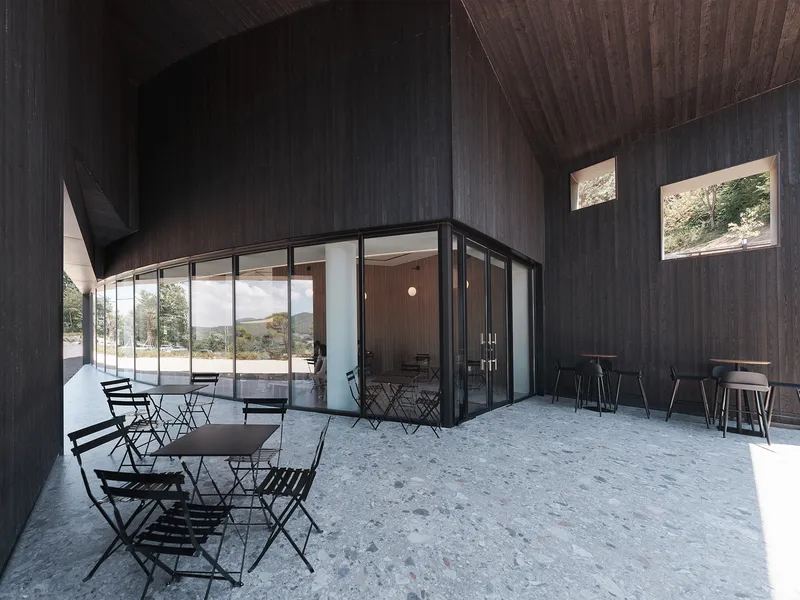
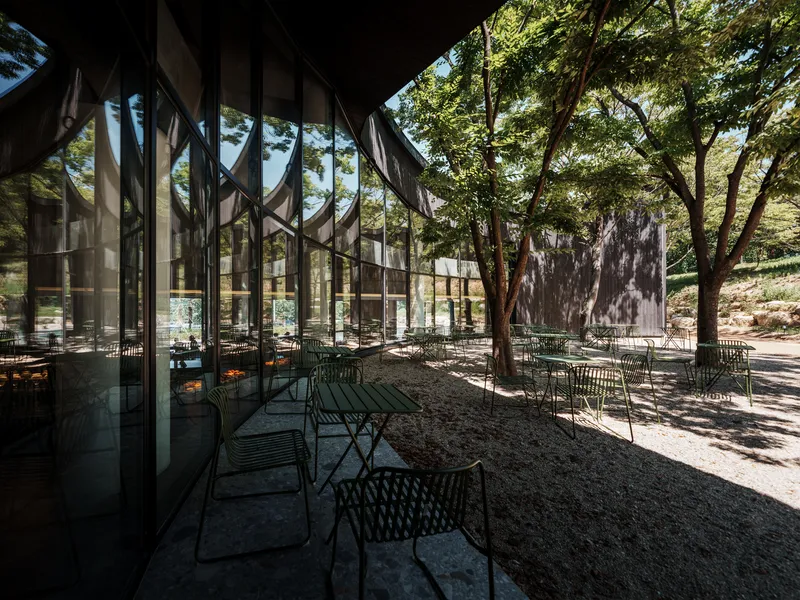
Three of the ten surviving trees now stand inside a southeastern courtyard, framed by charred timber walls and folding glass doors. The building literally wraps around them, treating the trees not as ornamental additions but as programmatic anchors. Visitors seated in the courtyard are surrounded by autumn foliage and blackened wood, a juxtaposition that collapses the distance between regrowth and ruin. It is a spatial argument that nature's timeline matters more than construction schedules.
The covered terrace on the western end extends this logic further. Diagonal timber branching columns support the roof while dappled shade filters through the remaining canopy above. The effect is closer to sitting beneath a grove than under a building, which is exactly the point: the architecture wants to disappear into its setting.
Controlling the Approach

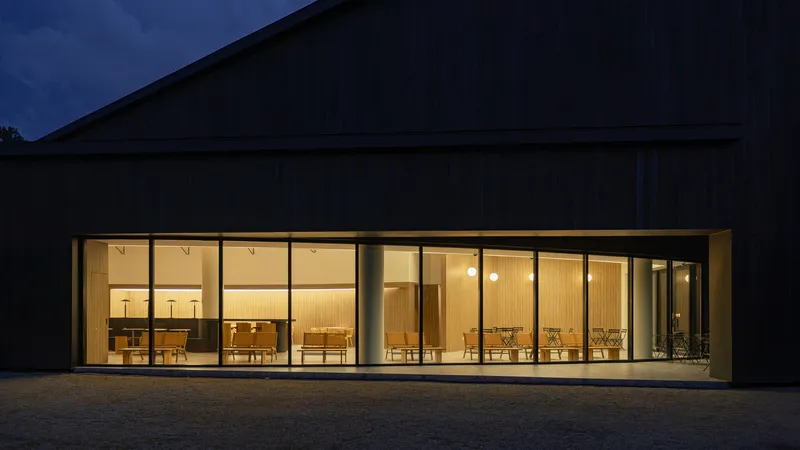
Arrival at Tan Mok Won is not incidental. A water feature placed in front of the building forces visitors to slow down, breaking the momentum of the car-to-door routine that most commercial buildings encourage. Terraced courtyard pools catch the last light at sunset, turning the threshold into a moment of pause rather than a passage to be crossed quickly. This is choreography, not decoration, and it reframes the entire visit as a deliberate act of attention.
The winding path and changing elevations mean that the building reveals itself in fragments: a slice of charred facade, then the curved roofline against the sky, then a glimpse of the mirror facade reflecting pines. By the time you step inside, the architecture has already taught you how to look at it.
Inside the Bakery and Dining Spaces


The interior program includes a bakery and dining areas that occupy a generous open plan beneath the curved roof structure. Exposed timber ceilings, board-formed concrete, and concrete columns create an honest material palette that avoids the slick minimalism typical of Korean commercial interiors. Tiered timber seating in the cafe space catches bands of sunlight, while the dining hall runs long under clerestory lighting that washes the curved wall with an even glow.
What keeps these spaces from feeling austere is the constant presence of landscape. Full-height curtain walls on multiple sides pull the forest into every sightline, so diners are never more than a glance away from the trees that justified the entire project. The seasonal shifts, from autumn gold to winter bark, become the primary interior decoration.
Craft in the Details

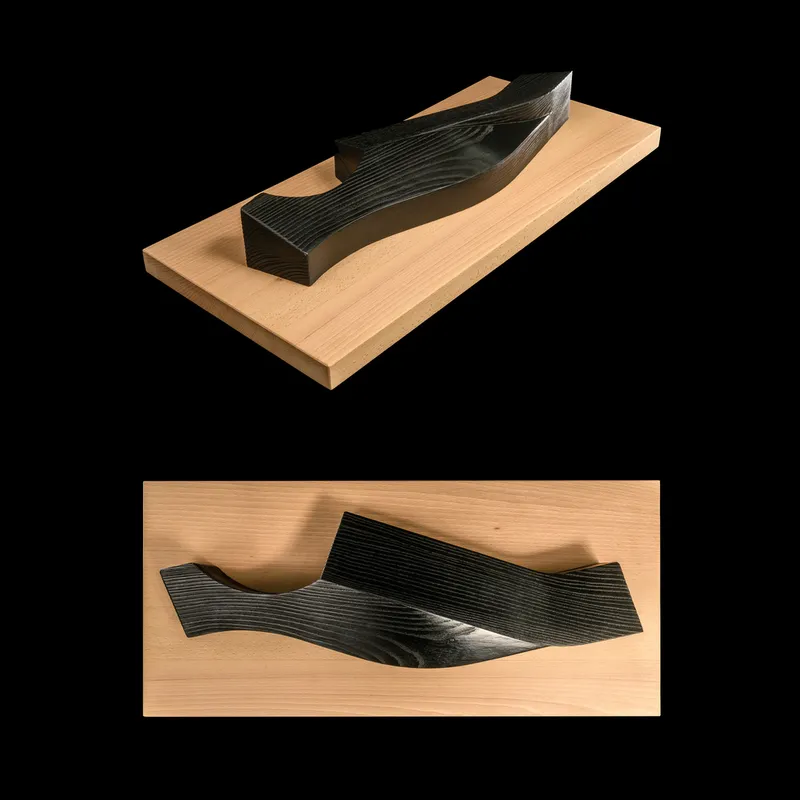
A detail shot of a white column meeting the curved plaster soffit reveals the care taken at junctions between materials. Board-formed concrete ceilings carry the imprint of their formwork, and integrated lighting fixtures are recessed so cleanly that they read as incisions rather than additions. The physical model, with its laminated curved form displayed against a black background, confirms that the roof geometry was worked out with sculptural precision before it was ever built. These are not afterthoughts; they are the evidence of a design process that took craft seriously from concept through construction.
Plans and Drawings
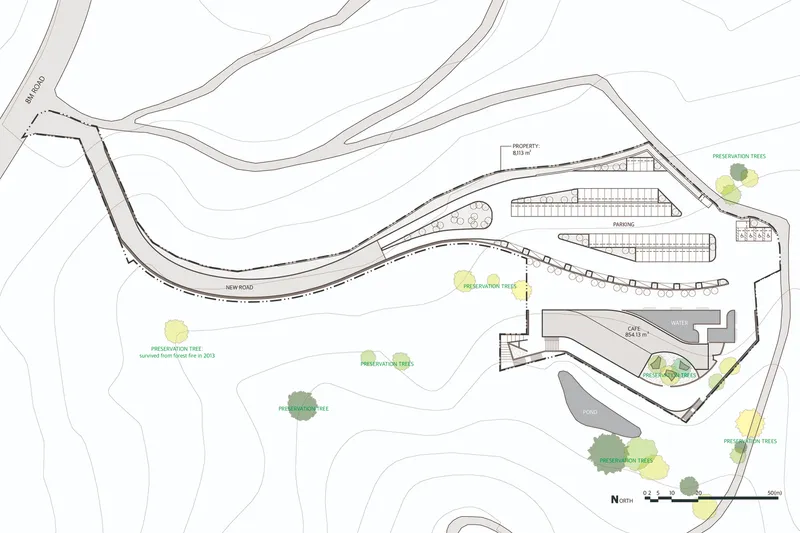
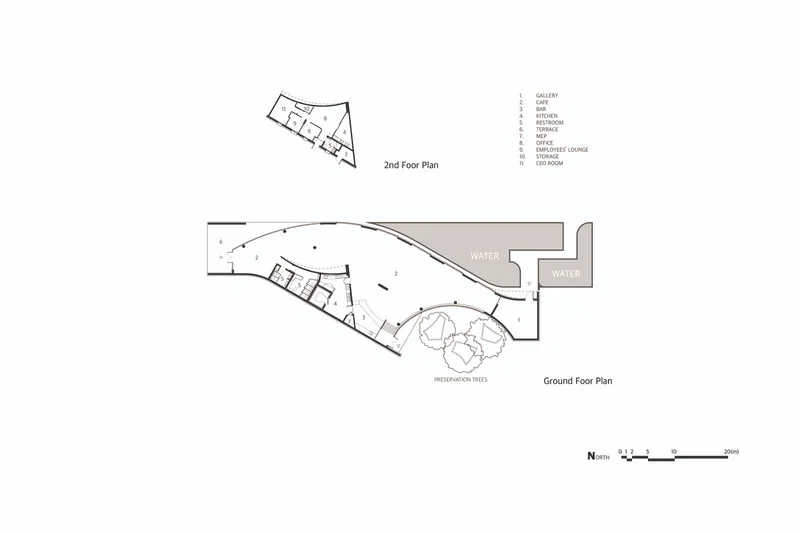
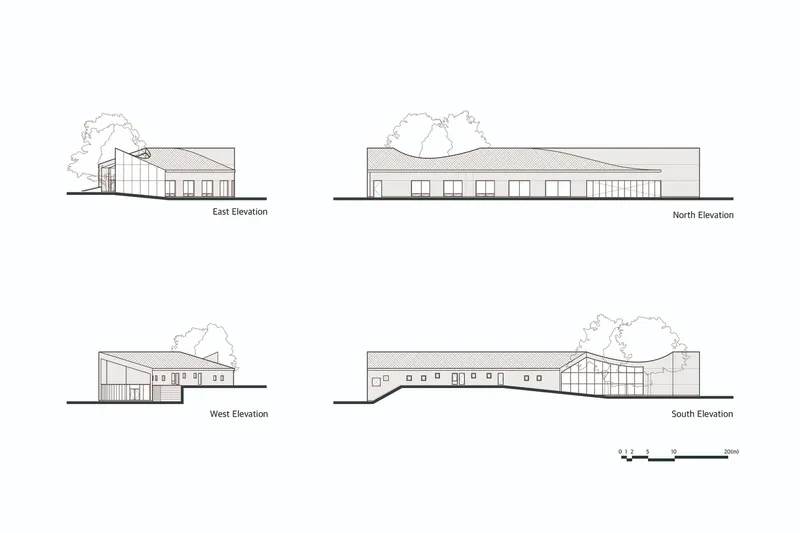
The site plan makes the contour-following strategy explicit: the building's footprint and access roads curve with the terrain rather than grading it flat, preserving existing trees along the perimeter. Ground and second-level plans reveal the angled wings that create the southeastern courtyard, with preservation trees marked clearly as fixed points around which the architecture was organized. The four-cardinal-direction elevations confirm how low the building sits against its hillside, the curved roof barely rising above the existing tree canopy.
Reading these drawings together, you see a project that was shaped as much by what it could not move as by what it chose to build. The trees, the slope, the memory of the fire: all of these were non-negotiable constraints that the architects converted into the building's strongest assets.
Why This Project Matters
Tan Mok Won is a corrective to the idea that memorial architecture requires monumental gestures. There is no plaza, no sculpture, no engraved timeline. The memorial is the material itself: charred wood on a site that burned, wrapped around trees that refused to die. That directness gives the project an emotional clarity that more symbolic approaches often struggle to achieve. It also demonstrates that a bakery and dining space can carry serious architectural intent without sacrificing warmth or accessibility.
For architects working on scarred or contested sites, USER and NAUxLab offer a useful model: listen to the land's history, let the survivors set the plan, and choose materials that tell the truth rather than covering it up. In an industry that frequently treats context as a box to be checked in a design statement, Tan Mok Won treats it as the entire project.
Tan Mok Won Mixed Use Space by USER and NAUxLab (Lead Architects: Jongbang Park and Suk Lee). Ulsan, South Korea. 848 square meters.
About the Studio
Share Your Own Work on uni.xyz
If projects like this are the kind of work you want to make, uni.xyz is a place to publish your own, find collaborators, and enter design competitions.


Popular Articles
Popular articles from the community


Aquadapt: An Underwater Habitat That Rewrites Its Rooms by the Hour
Curved modules ring the seabed while one shell shifts from breakfast room to cinema, farm and football pitch as residents' needs change.


FCC Arquitectura Expands a Portuguese Granite House with a Board-Marked Concrete Wing
In Portugal, JV House pairs a cleaned-up whitewashed and granite dwelling with a timber-shuttered concrete extension, courtyards and a garden pool.

The Amber Palace Opera: A Geological Fiction Surfaces on Tallinn's Baltic Waterfront
Pierre Brillard reimagines a Baltic legend as a public landscape, opera house, and waterfront promenade rooted in Tallinn's coastal identity.

Singing Woman: An Opera House That Performs Before the Curtain Rises
Ovidiu Cristian Pavel's conceptual opera house translates Estonia's choral identity into a sculpted waterfront landmark facing the Baltic Sea.

Similar Reads
You might also enjoy these articles

Cube Design Draws an Ecological Corridor Between Two Shenzhen Hills with the Nankai Building
Beside Shenzhen's container docks, the Nankai Building pairs stacked balconies with a climbing green screen to connect two hillsides across its height.

Praksis A and Studio Sted Bend a Red Timber Cabin Across the Granite of Norway's Southern Coast
On the southern Norwegian coast, a 105 m² cabin follows the rock on slender posts, pairing red cladding outside with pine, brick and plywood within.

David Ortega Stacks a Two-Story Mexico City Penthouse Around a Steel Stair and a Pergola-Shaded Roof Terrace
In Colonia Roma, a 300 m² penthouse uses oak joinery, a planted steel stair and a slatted roof pergola to make a new-build apartment feel like a house.

PARALELA and LB2 Thread a Public Walkway Through the Base of a Las Condes Residential Tower
In Las Condes, Santiago, the Hamlet Building gives its fenceless ground floor to a 70-metre wooded passage linking two streets and the metro.

Explore Charred Timber Competitions
Discover active competitions in this discipline

Challenge to reimagine the Iron Throne

Photograph architecture without architects

Illustrate the lost glory of Angkor Wat - Render Challenge

Design challenge to reuse E-waste
Comments (0)
Please login or sign up to add comments
No comments yet. Be the first to comment!