
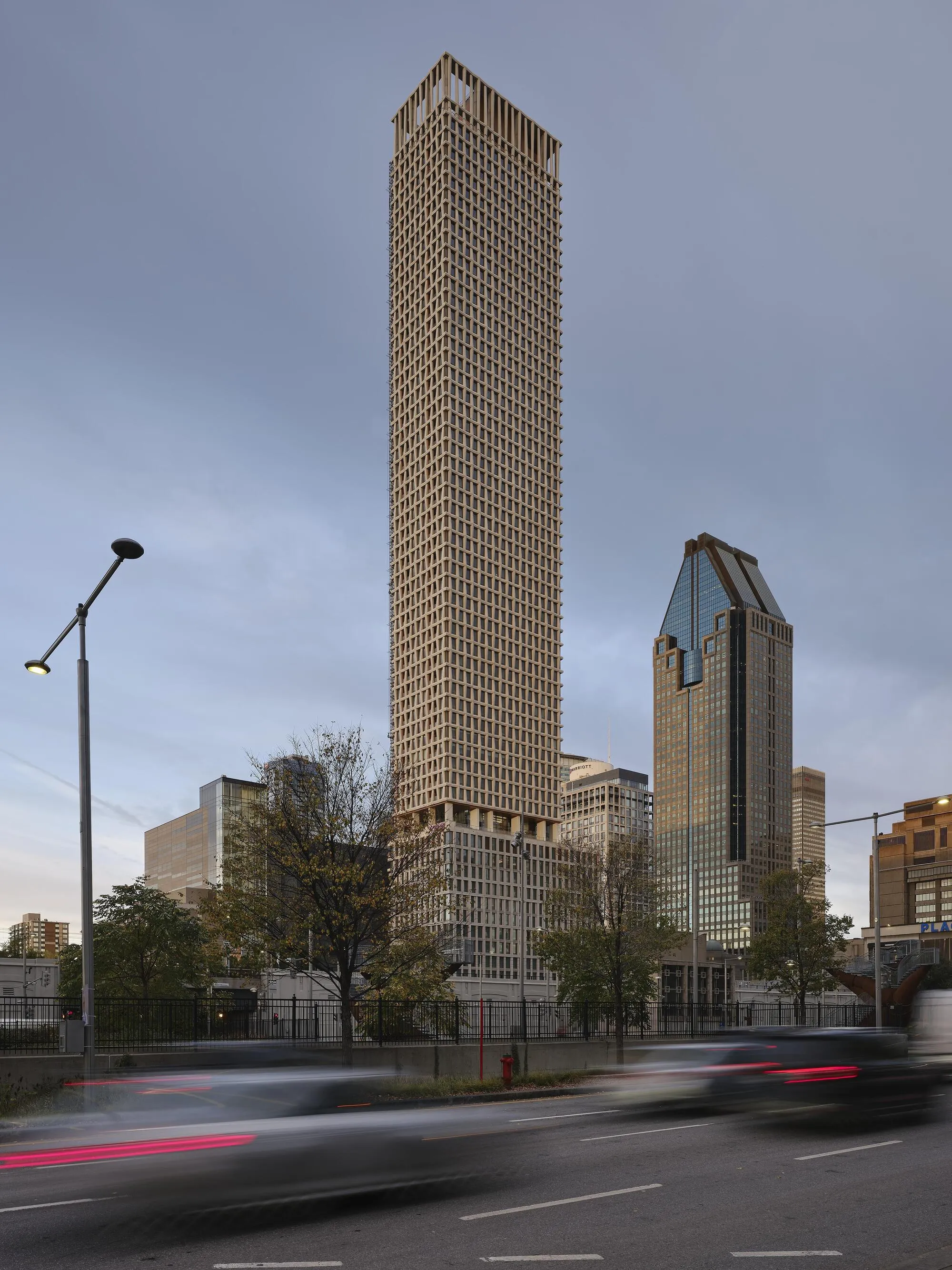
Chevalier Morales Wraps a Montreal Tower in a Zigzag Precast Concrete Veil
900 Saint-Jacques brings a textured, contextually grounded high-rise to the evolving Quartier des Gares district in Montreal.


Montreal's Quartier des Gares is a district caught between eras: rail corridors, stone churches, low-rise commercial blocks, and the pressure of rapid residential densification. Into this charged setting, Chevalier Morales Architectes, working alongside Brian Elsden Burrows and Le Groupe Architex Interior, have planted a slender residential tower that does something increasingly rare in the genre. It takes its cladding seriously. Not as ornament, not as brand identity, but as a structural and atmospheric strategy that ties the building to its city.
900 Saint-Jacques is a mixed-use high-rise whose most compelling move is its precast concrete facade: a zigzag lattice of angled mullions that gives the tower a shifting, almost woven appearance depending on the light and your angle of approach. The result is a building that reads as heavy and mineral from a distance, consistent with the masonry and concrete character of the surrounding blocks, yet reveals fine-grained depth up close. It is a tower that earns its height by investing in its skin.
A Diagonal Grid That Works at Every Scale
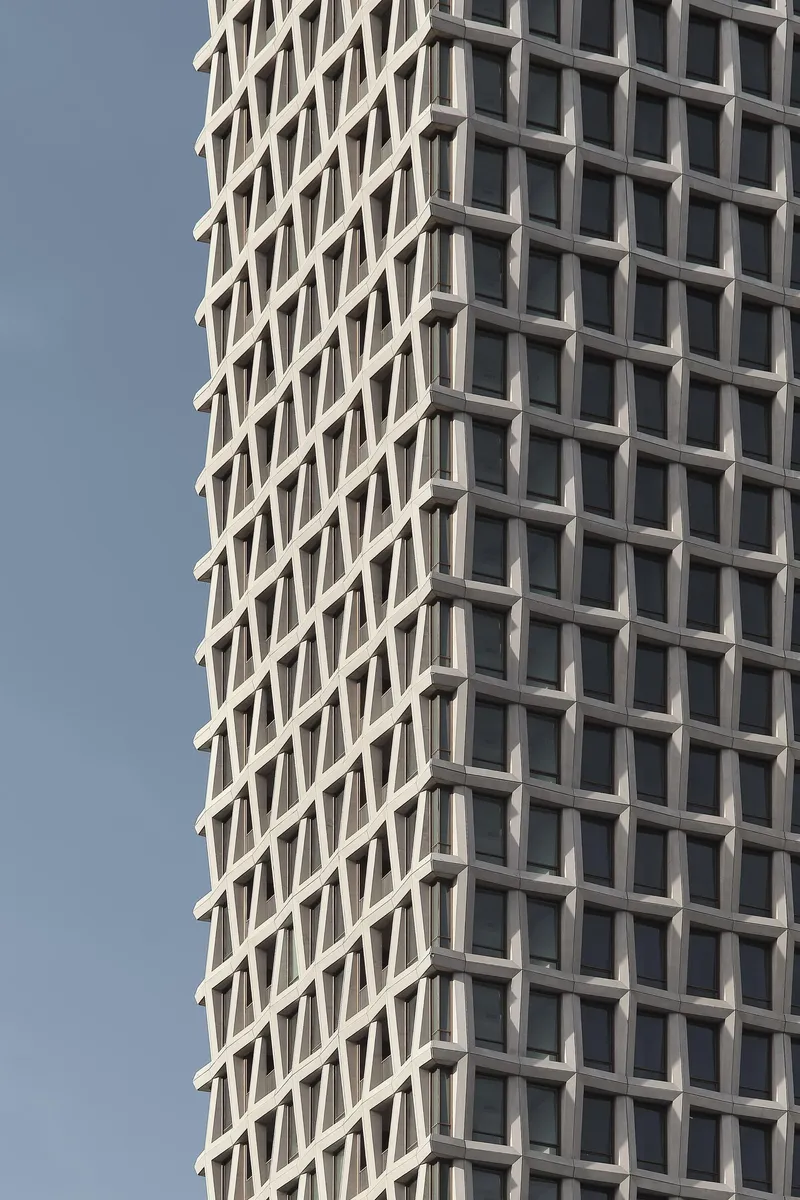


The defining detail of 900 Saint-Jacques is its facade pattern: precast concrete panels set at diagonal angles that create a zigzag rhythm across the full height of the tower. Seen from the street, the effect is somewhere between a woven textile and a folded screen. The angled mullions catch light unevenly, producing a sense of depth and shadow that flat curtain walls simply cannot achieve.
What keeps this from being a superficial gesture is the consistency of the logic. The diagonal grid is not applied selectively or interrupted by branding panels. It wraps the tower continuously, which means the building reads as a single coherent volume rather than a collage of marketing moments. Looked at from directly below, the concrete fins taper toward the sky with an almost geological quality, as though the tower were carved rather than assembled.
Urban Posture: Slender, Grounded, and Neighborly


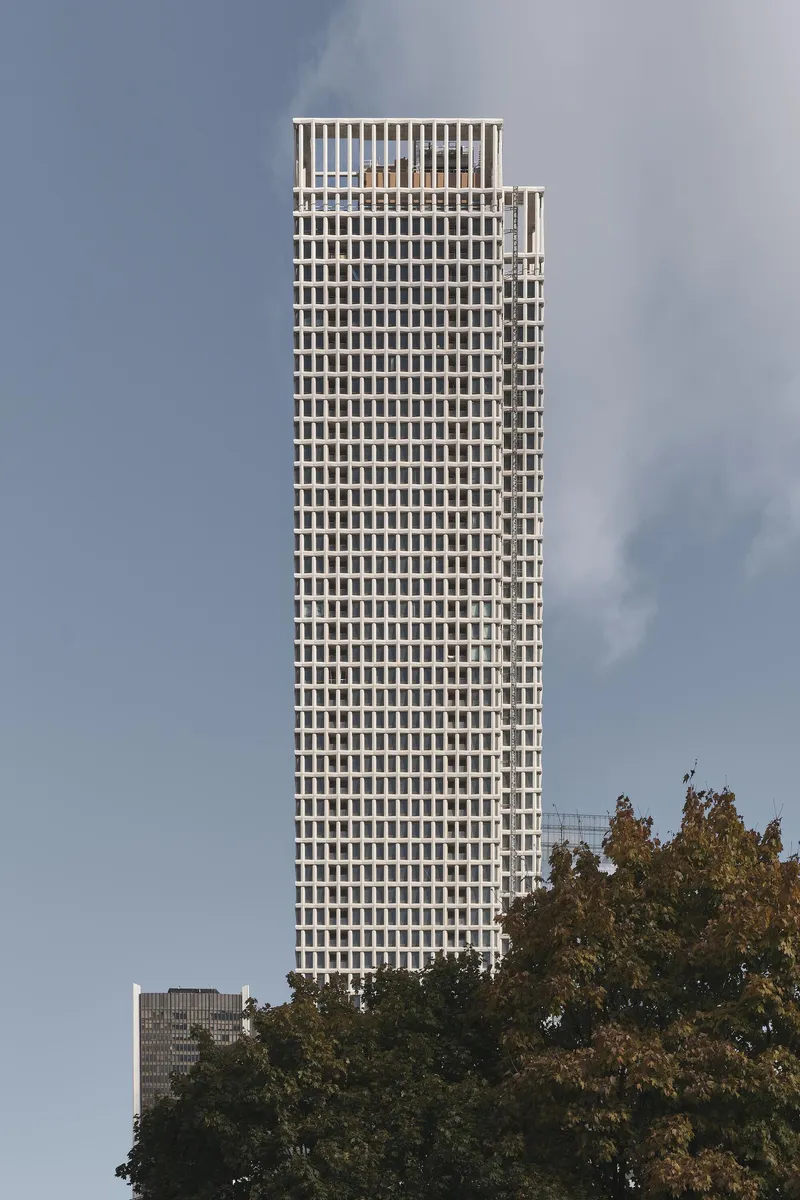
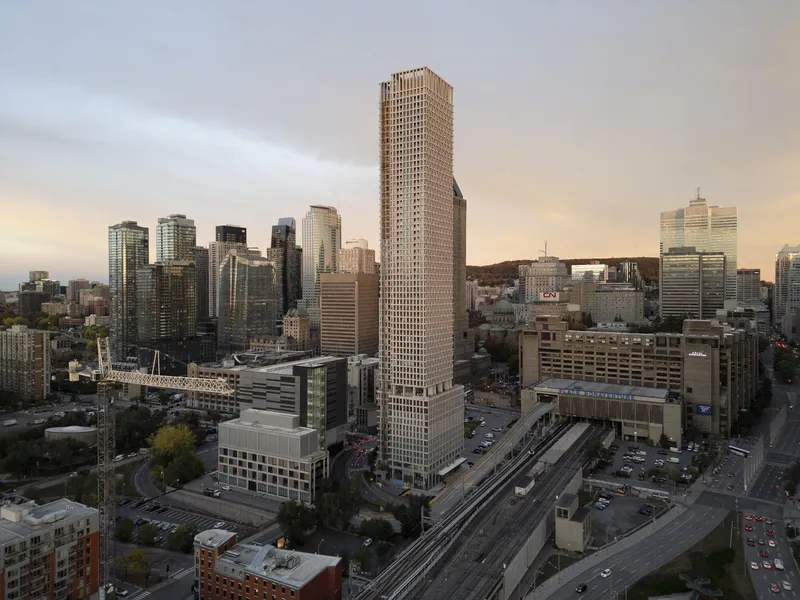
A tower's relationship to its context is defined less by height than by proportion and base condition. 900 Saint-Jacques is notably slender, which reduces its visual mass and allows it to coexist with the stone church visible from street level without overwhelming the block. The proportional restraint is deliberate: this is a tower that rises confidently but does not swagger.
Equally important is the way the building meets the ground. The podium volume, visible through autumn foliage, steps back to create a more human-scaled street edge. From different vantage points, the tower appears to grow out of the low-rise concrete fabric of the adjacent block rather than landing on it from above. The arched facade of a neighboring building, the transit guideway visible through window frames, the mature trees along the boulevard: these are not obstacles the design ignores, they are the conditions it responds to.
The Offset: Upper and Lower Volumes in Dialogue


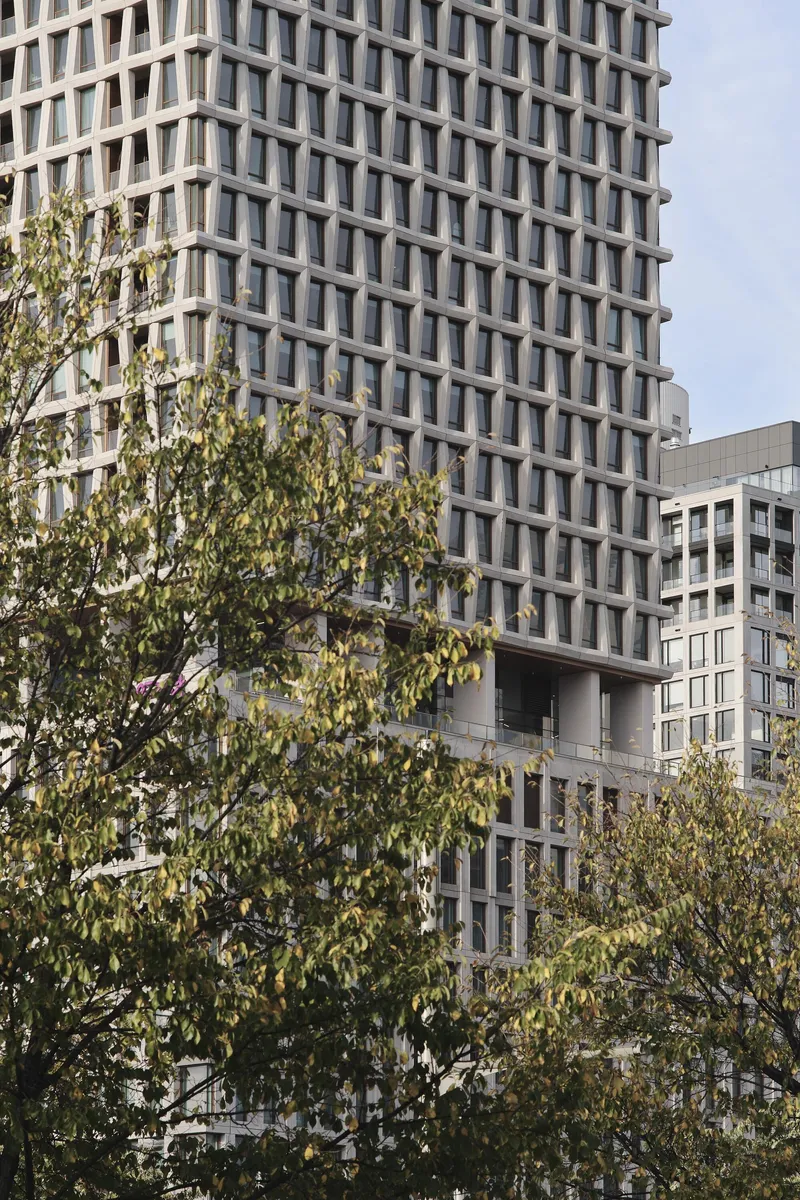
One of the tower's subtler compositional moves is the offset between its upper and lower volumes. Rather than rising as a single extrusion, the building shifts at a defined break point, creating a shadow line and a visual articulation that divides the mass without fragmenting it. The mid-section view makes this legible: the precast grid continues across both volumes, but the slight displacement gives the elevation a sense of weight distribution, as though the building is settling into its site.
The podium terraces, partially screened by street trees, offer an outdoor threshold between the tower and the sidewalk. The landscape is not purely decorative. It acts as a mediating layer, softening the transition from the mineral tower above to the life of the boulevard below.
Amenity Spaces That Honor the Material Palette

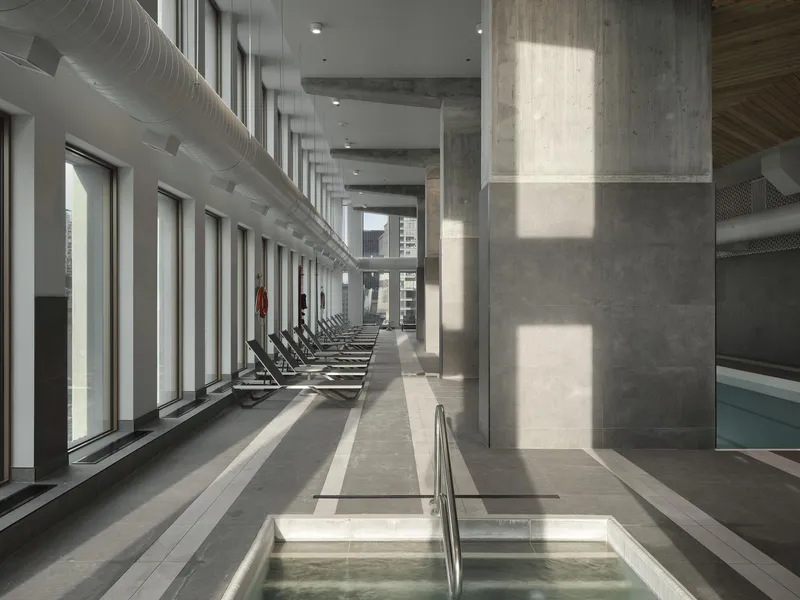

Interior amenity spaces in residential towers are often the first place material discipline falls apart: suddenly the concrete gives way to lobby wallpaper and generic lounge furniture. At 900 Saint-Jacques, the pool area and lobby hold the line. The double-height pool volume is framed by concrete columns and floor-to-ceiling glazing, with a wood ceiling that adds warmth without betraying the palette. Light pours in through tall perimeter windows, casting rectangular shadows across the pool deck that reinforce the geometric rigor of the facade outside.
The lobby seating nook follows the same logic: concrete walls, generous glazing, and a view into a courtyard framed by brick buildings. These are not luxury amenities designed to distract from the architecture. They are rooms that participate in the same spatial and material language as the tower itself.
Layered Views Through the Concrete Frame

One image captures the tower's relationship to its infrastructure context with particular clarity: a view through window openings reveals layered concrete facades and the elevated transit guideway beyond, all seen in shadow. The window frame becomes a cinematic device, compressing the city into a sequence of planes. This is a building that does not pretend the rail corridor doesn't exist. It incorporates it into the lived experience of looking out.
From the aerial view at dusk, the tower's slenderness becomes most legible. It rises above the urban fabric as a singular vertical element, its grid facade catching the last light while the city below settles into blue shadow. The proportions are disciplined: this is a high-rise that knows exactly how much real estate it wants to occupy in the skyline.
Plans and Drawings
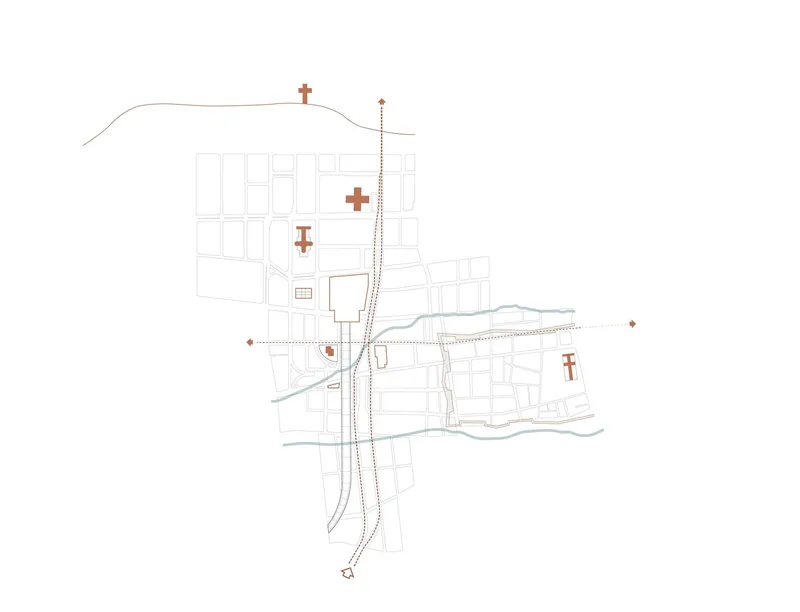


The site plan reveals the tower's position within the Quartier des Gares grid, showing how pathways and adjacent building footprints define its immediate territory. The physical models are instructive in a different way. The structural frame model exposes the precast concrete logic at its most elemental: open window apertures punched through a rhythmic grid of angled members. The massing model, meanwhile, makes the podium setback and overall proportional strategy legible at a glance. Together, these drawings and models confirm that the zigzag facade is not a decorative afterthought but an integral part of the structural and spatial concept.
Why This Project Matters
High-rise residential design in North American cities has largely settled into two modes: glass curtain walls for premium branding, or cheap cladding systems that degrade within a decade. 900 Saint-Jacques proposes a third path. By investing in precast concrete with genuine geometric ambition, Chevalier Morales have produced a tower that will age well, read coherently at multiple scales, and engage with the masonry and concrete character of its Montreal neighborhood without pastiche.
The project also demonstrates that contextual sensitivity is not the enemy of height. You can build a skyscraper that acknowledges a stone church, a rail corridor, and a low-rise streetwall without shrinking into false modesty. The trick is proportion, material commitment, and a willingness to let the facade do real architectural work. 900 Saint-Jacques gets all three right.
900 Saint-Jacques, Montreal, Canada. Architects: Chevalier Morales Architectes, Brian Elsden Burrows (Architect), Le Groupe Architex Interior (Interior). Category: Mixed Use, Residential, Skyscrapers. Photographer: Maxime Brouillet.
About the Studio
Share Your Own Work on uni.xyz
If projects like this are the kind of work you want to make, uni.xyz is a place to publish your own, find collaborators, and enter design competitions.




Popular Articles
Popular articles from the community


Co-Life: Senior Housing Design That Reconnects Older Adults With the City
Co-Life reimagines senior housing design through healing gardens, shared streets, workshops, and a sustainable community across generations.

Hill & Cross Opera: Sculptural Opera House Architecture Shaped by Tallinn’s Landscape and Identity
Hill & Cross Opera reimagines opera house architecture in Tallinn through its sculptural hill, civic plaza, glass wave and a luminous cross.

The Earth Pod: 3D Printed Homes for Resilient Refugee Communities
The Earth Pod reimagines refugee housing through 3D printed homes made from clay, combining resilience, self-sufficiency, and rapid shelter.

Co-life: Sustainable Architecture for Age-Friendly Community Living
Co-life reimagines sustainable architecture for seniors through courtyards, rammed earth, shared gardens, and spaces designed for belonging.
Similar Reads
You might also enjoy these articles

Bao Huynh Watercolor Atelier: A Serene Art Retreat in Hội An
Bao Huynh Watercolor Atelier in Hội An blends multifunctional art spaces, sustainable design, local materials, and family-friendly living in a serene environment.

Atelier Macri Concept Store Interior Design by CASE-REAL
Atelier Macri store features a "ko" counter, walnut wood details, cork displays, blending retail, gallery, and seamless customer experiences.

Manuel Vargas Izquierdo Stadium and High-Performance Sports Center: Architectural Excellence in Jalpa de Méndez
The Manuel Vargas Izquierdo Stadium blends sustainable design, inclusive sports facilities, and cultural-inspired architecture, revitalizing Jalpa de Méndez’s public spaces.

KAKR Buluh Awar Hall: Revitalizing Community and Ecology Through Bamboo Architecture
Community built bamboo hall revitalizes Buluh Awar village, empowering youth, restoring ecology, celebrating vernacular craftsmanship through sustainable architecture and culture.


Explore Architecture Competitions
Discover active competitions in this discipline



Challenge to reimagine the Iron Throne


Photograph architecture without architects


Illustrate the lost glory of Angkor Wat - Render Challenge


Design challenge to reuse E-waste
Comments (0)
Please login or sign up to add comments
No comments yet. Be the first to comment!