
Christian Tonko Designs a 20 Square Meter Alpine Cabin That Can Vanish Without a Trace
A shipping container-scaled weekend retreat in Carinthia, Austria, sits lightly on screw foundations and leaves no permanent mark on the land.


There is a particular kind of architectural ambition that has nothing to do with size. The MM01 Cabin by Christian Tonko is 20 square meters of interior space, enough for a bedroom, a living and work zone, a kitchen, and a bathroom, all arranged with a precision that makes the footprint feel generous rather than constrained. Sited in a sloping meadow at the edge of a forest in Carinthia, Austria, the cabin is a weekend base for two people whose primary relationship is with the landscape outside, not the walls around them.
What makes the project genuinely interesting is its commitment to reversibility. The name "MM01" references Malcolm McLean, the American trucking entrepreneur who invented the intermodal shipping container. Tonko borrows the container's structural steel profiles and modular dimensions, not as an aesthetic gesture, but as a logistical framework: the entire cabin can travel on a standard truck, sits on screw foundations that leave no permanent trace, and can be removed so that the site returns to its original state. It is architecture that refuses to claim the ground beneath it.
Sited at the Forest Edge
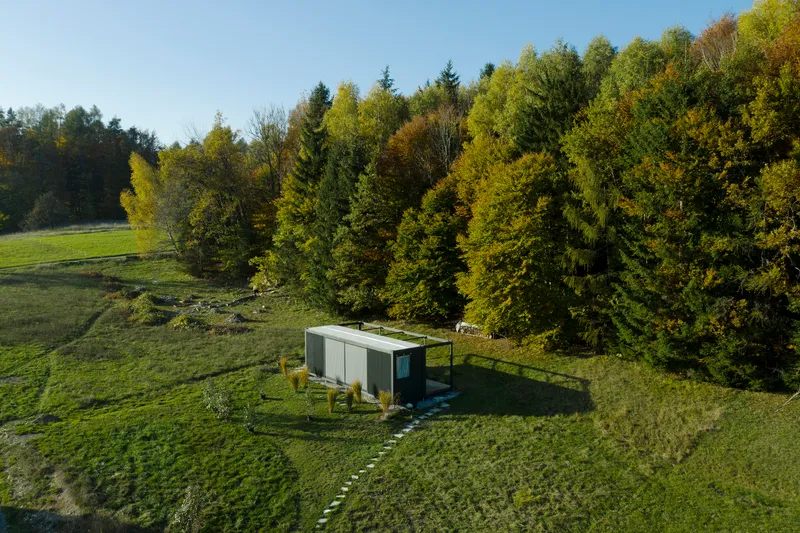
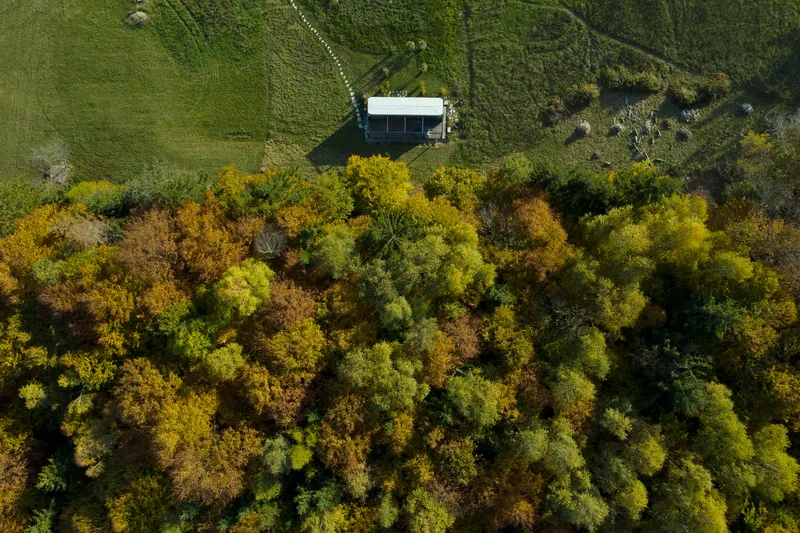
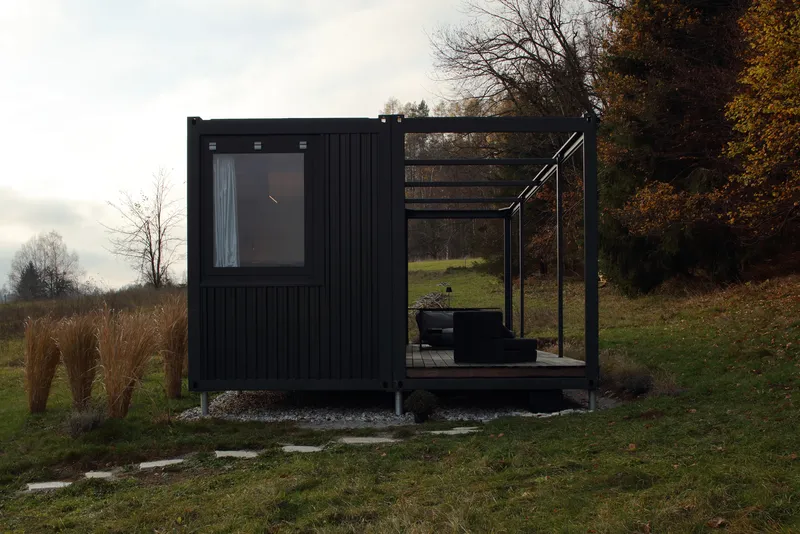
Aerial views reveal the cabin's careful positioning: a compact rectangular volume tucked against the treeline of a dense alpine forest, with open meadow falling away to the south. The terrace module, equal in area to the enclosed space, faces north toward the trees. This is a deliberate climatic strategy. The forest canopy provides shade on hot summer days and functions as a kind of natural air conditioning, with prevailing breezes channeled through the dwelling when the glass doors slide open.
The dark corrugated metal cladding, visible from a distance as a crisp dark bar against the green, avoids any pretense of camouflage. The cabin is clearly an object placed in the landscape, not an extension of it. That honesty is refreshing in a context where rural architecture often overcompensates with timber and pitched roofs.
A Closed Box and an Open Frame
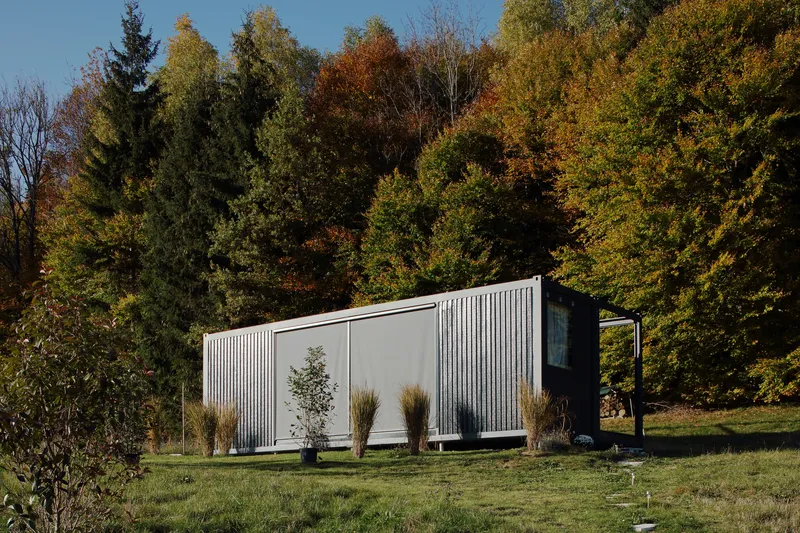
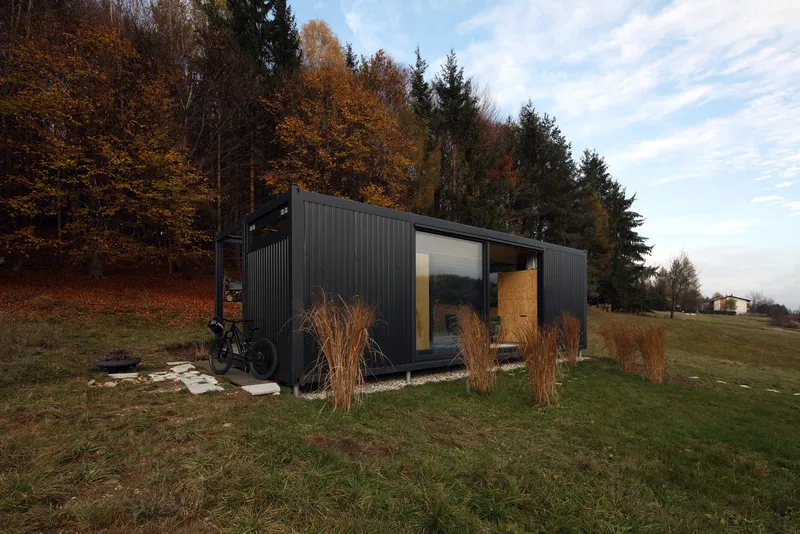
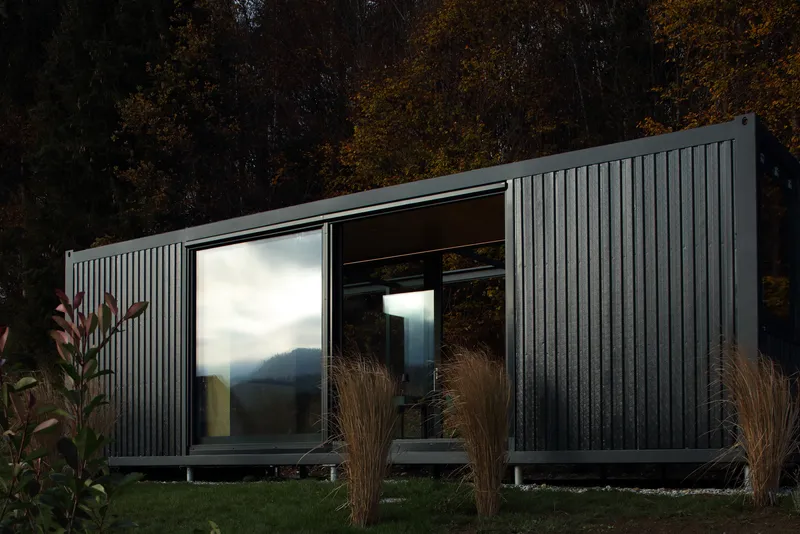
The cabin reads as two distinct architectural gestures. From the north and sides, it presents corrugated metal walls with minimal openings: a corner window here, a timber door there. The material is utilitarian, borrowing from agricultural and industrial building traditions that are native to rural Austria. Sliding panels allow the facade to change character, closing down to a near-hermetic box when the occupants are away.
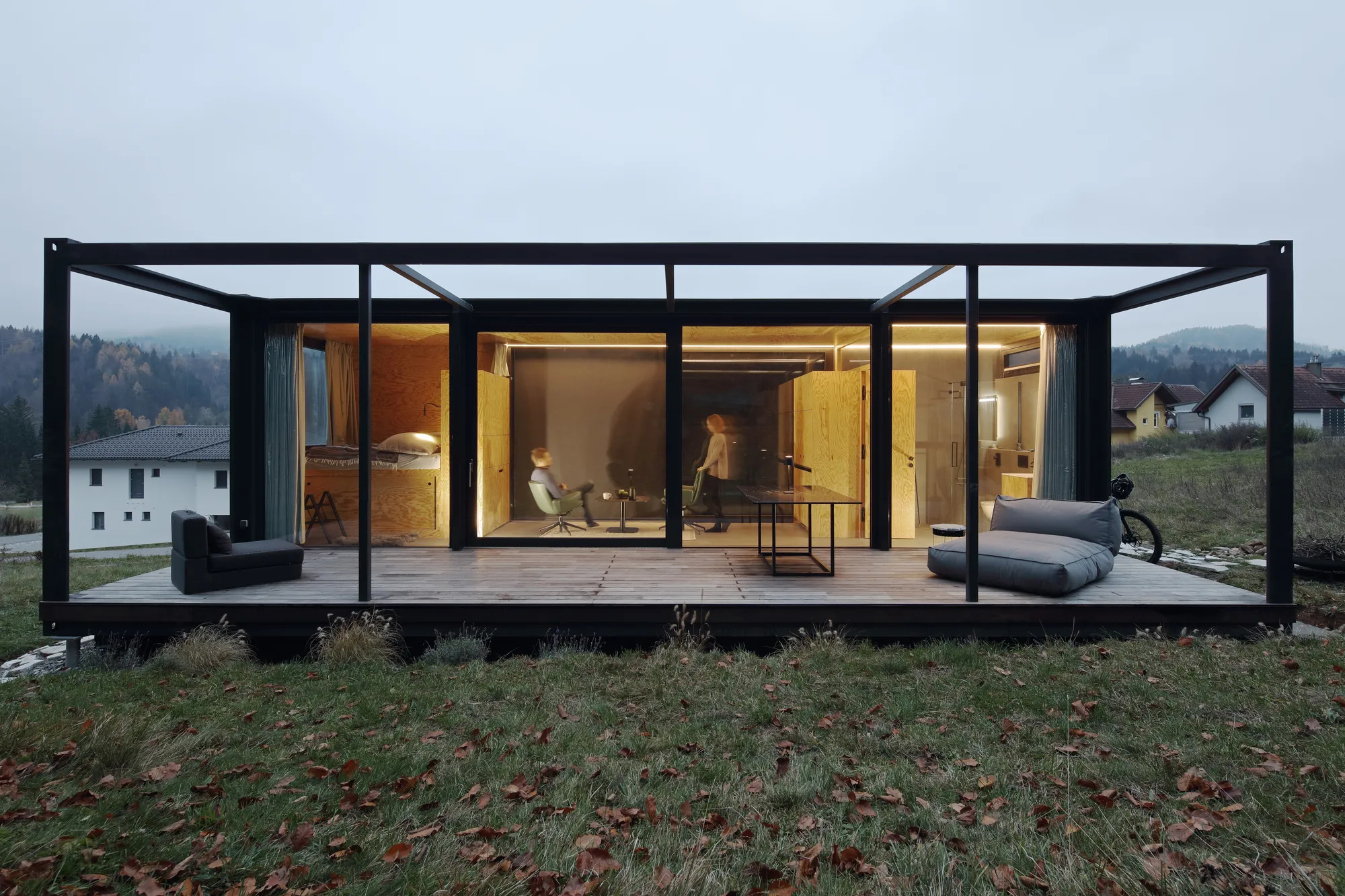
From the south, the entire posture shifts. Floor-to-ceiling glazing dissolves the boundary between interior and terrace, turning the cabin into a pavilion. The black steel frame that structures the terrace pergola extends the architectural language outward without enclosing it, creating a threshold zone that belongs to neither inside nor outside.
Living in the Open
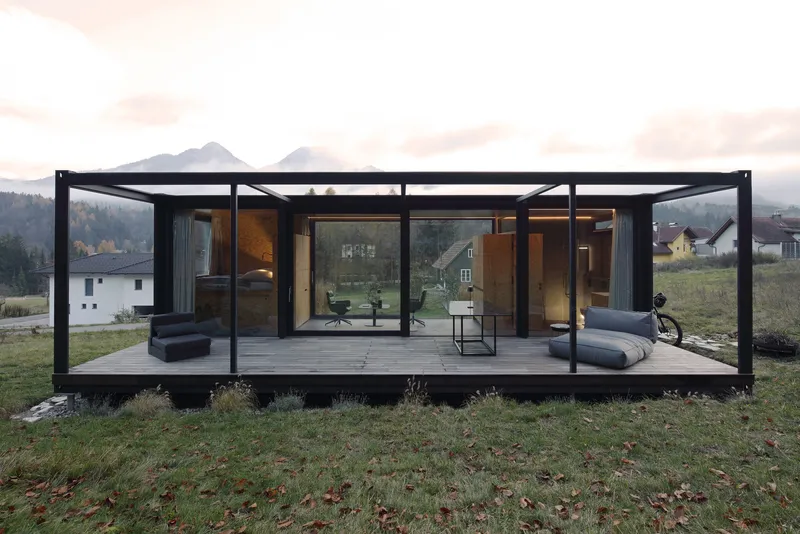
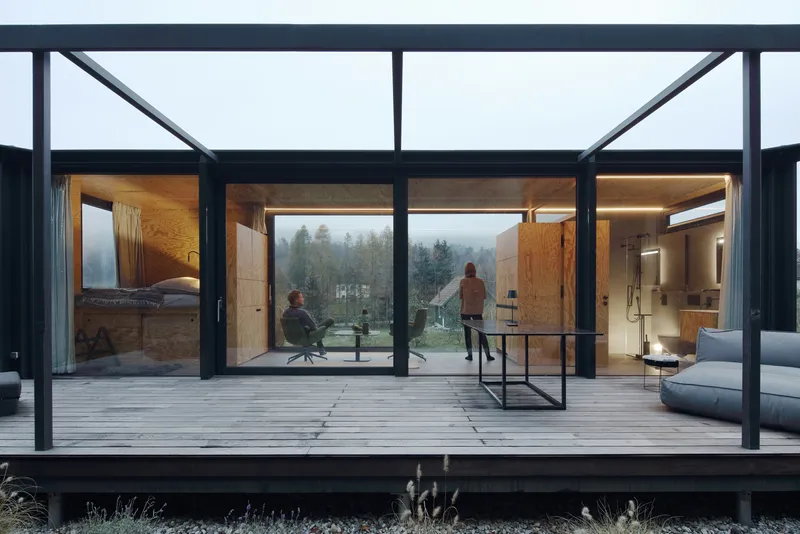
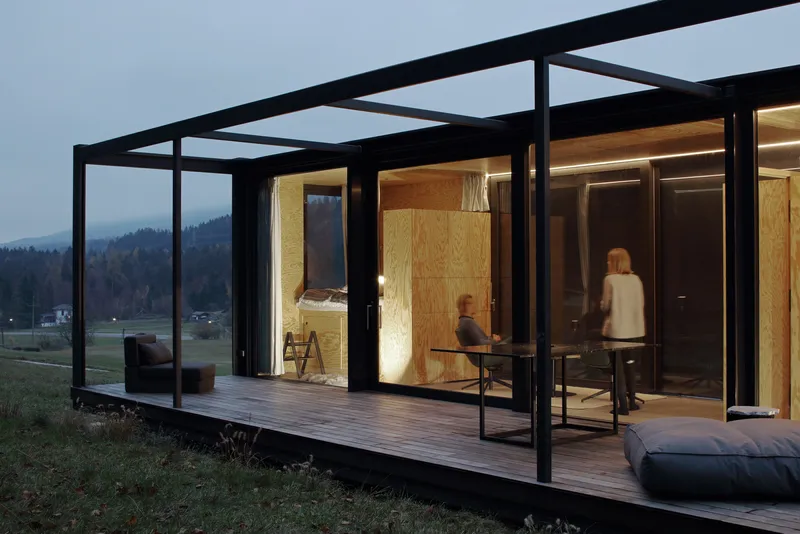
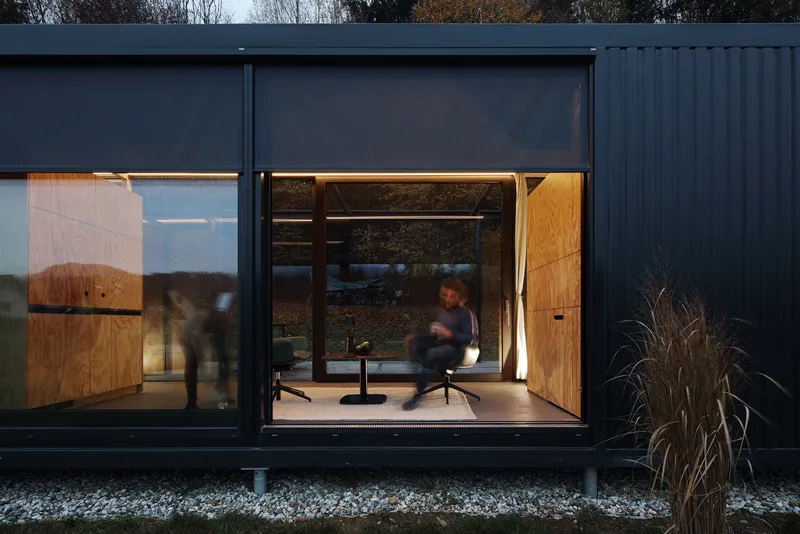
At dusk, the cabin becomes a lantern. The plywood-lined interior glows through the glass walls, and the steel pergola frames the terrace like a stage set for the valley beyond. These images capture the project's central spatial proposition: a life oriented outward. The terrace is not an accessory to the cabin; it is half the architecture. Two occupants on the deck in misty weather, with plywood-clad rooms visible behind them, tell you everything about the hierarchy. The outdoors comes first.
Tonko has managed to make 20 square meters feel expansive by refusing to treat the enclosure as the whole project. The terrace module doubles the usable area, and the full-height glazing means the interior borrows the landscape constantly. You are never more than a step from outside.
Compact Interior, No Compromises
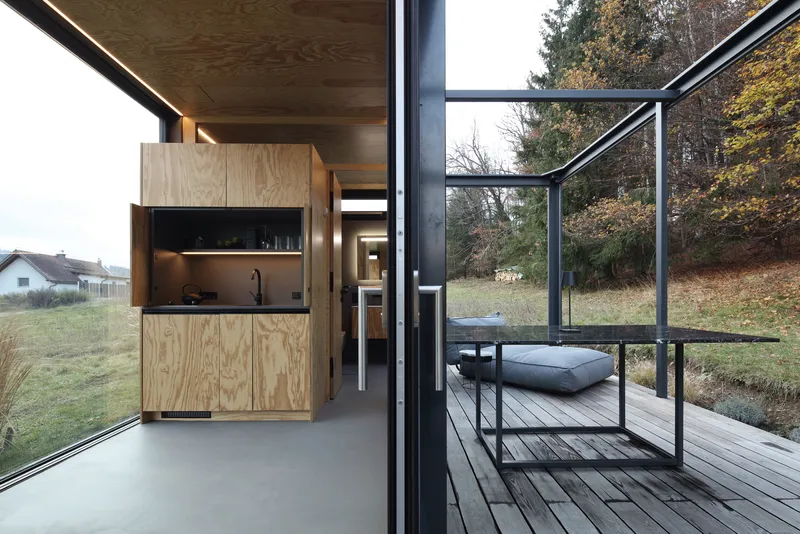
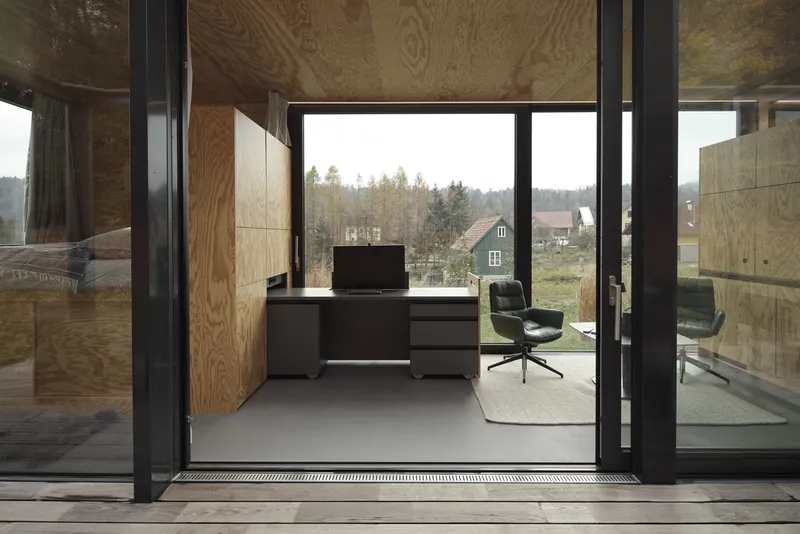
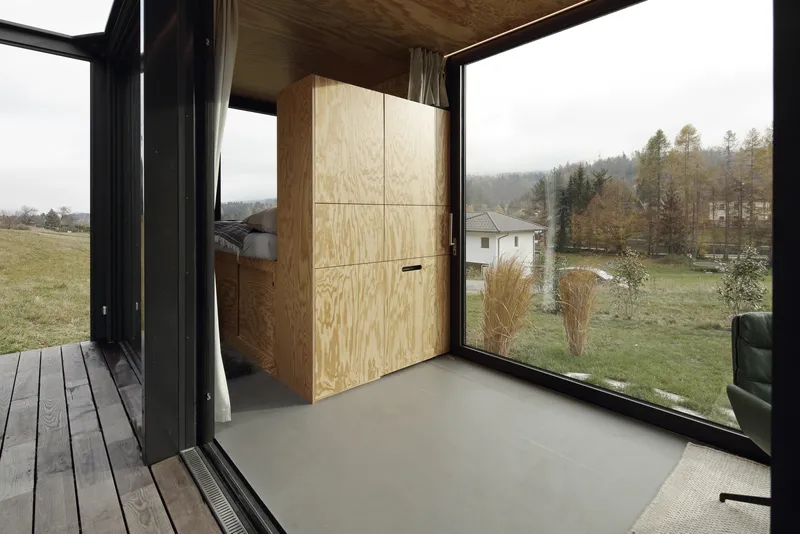
The interior is divided into four equally sized zones: bedroom, living and workspace, kitchen, and bathroom. Storage units do double duty as room dividers, eliminating the need for conventional partition walls and keeping sight lines open through the length of the cabin. A desk on wheels slides out from beneath the bed unit, a fold-away screen transforms it into a functional office, and the kitchenette closes up entirely when not in use. Everything has a stowed state and a deployed state.
Plywood lines the walls and ceiling, giving the interior a warm, uniform texture that contrasts sharply with the dark metal exterior. Linear strip lighting at the ceiling junctions and along cabinetry edges creates a soft, even illumination that avoids the harshness of overhead fixtures. The material palette is deliberately limited: plywood, glass, steel. Nothing competes for attention.
Thresholds and Transparency
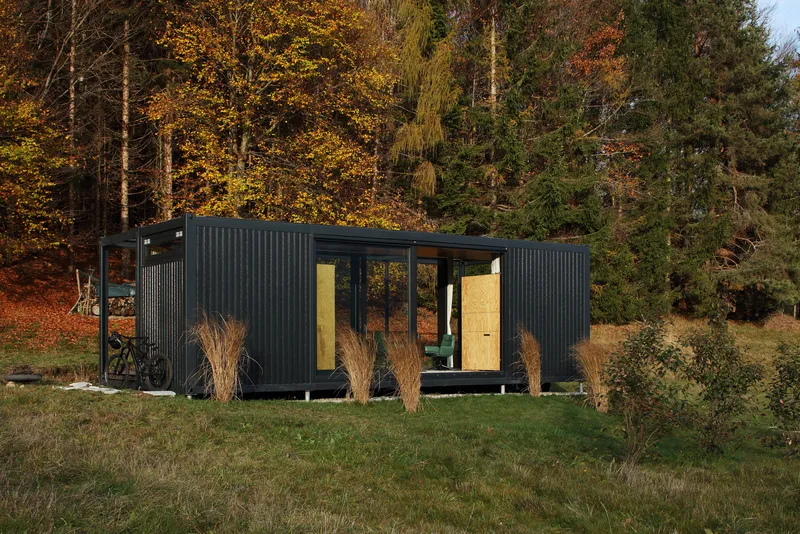
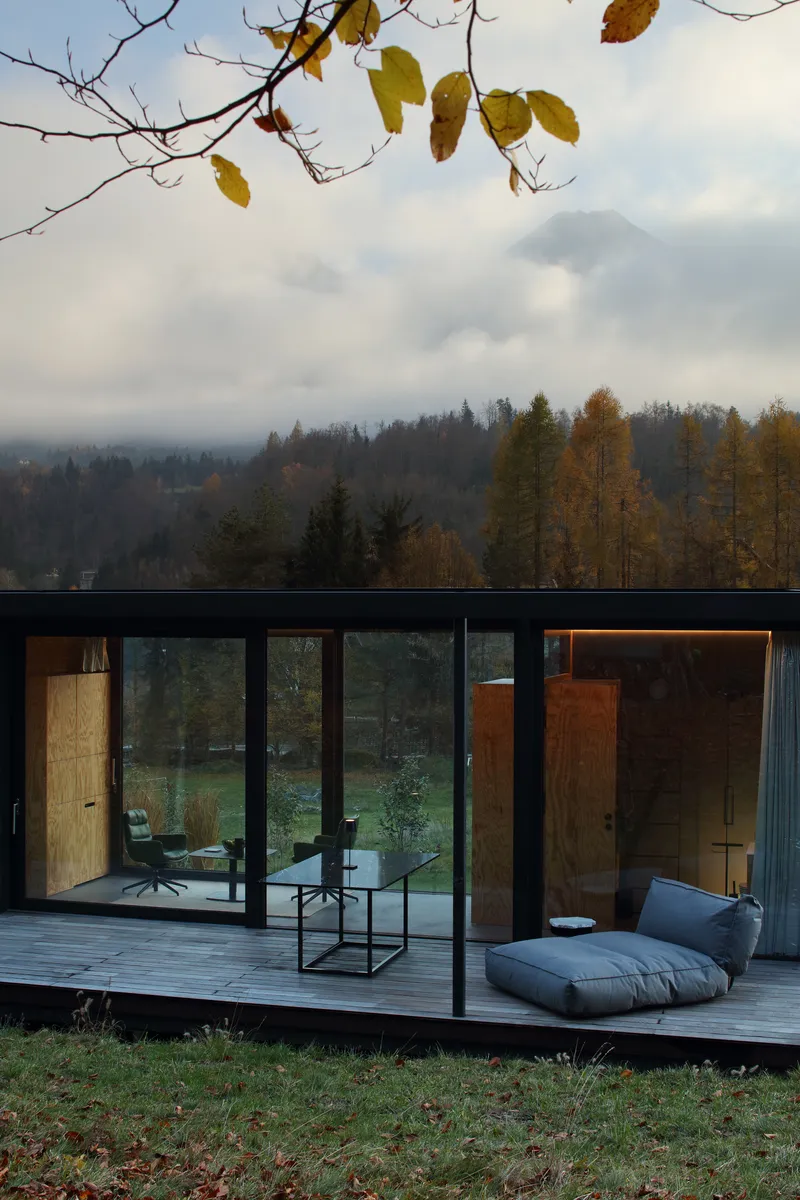
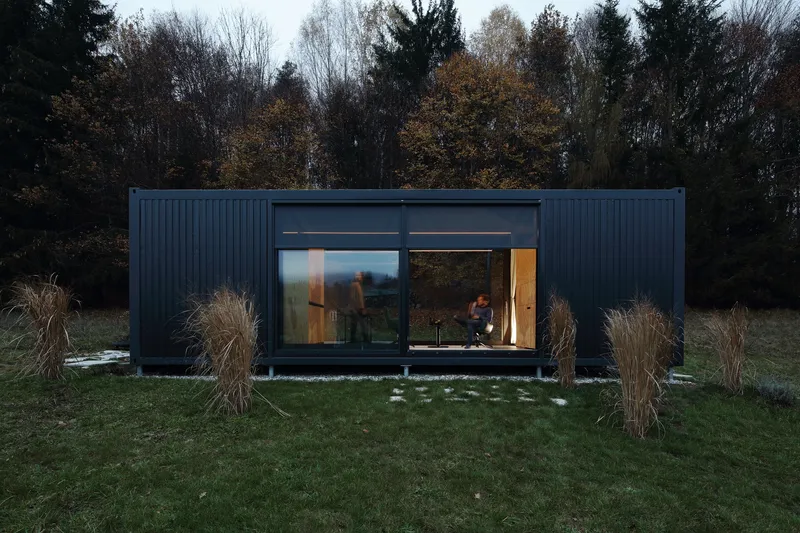
The entry sequence deserves attention. Yellow plywood doors swing open between ornamental grasses to reveal the interior, while on the glazed side, timber-framed doors open directly onto the wooden deck with autumn leaves drifting overhead. These thresholds are designed to be wide open or fully sealed. There is no half measure, no vestibule, no hallway. You step from meadow into room.
From the front elevation at dusk, the full-height glazing turns the cabin into a sectional drawing of itself. You can read every piece of furniture, every surface, every human movement. Privacy comes from curtains and from the cabin's remote siting rather than from opaque walls. It is a transparency born of trust in the landscape.
Details That Serve the Whole
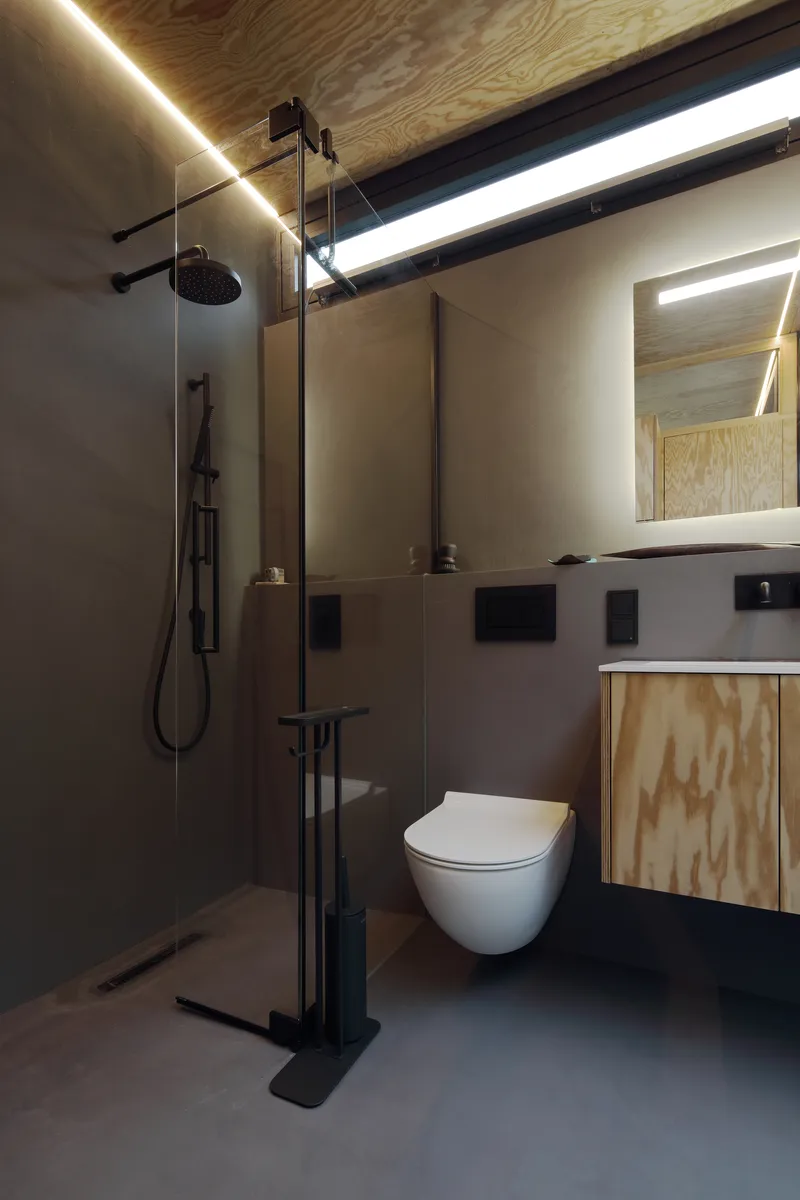
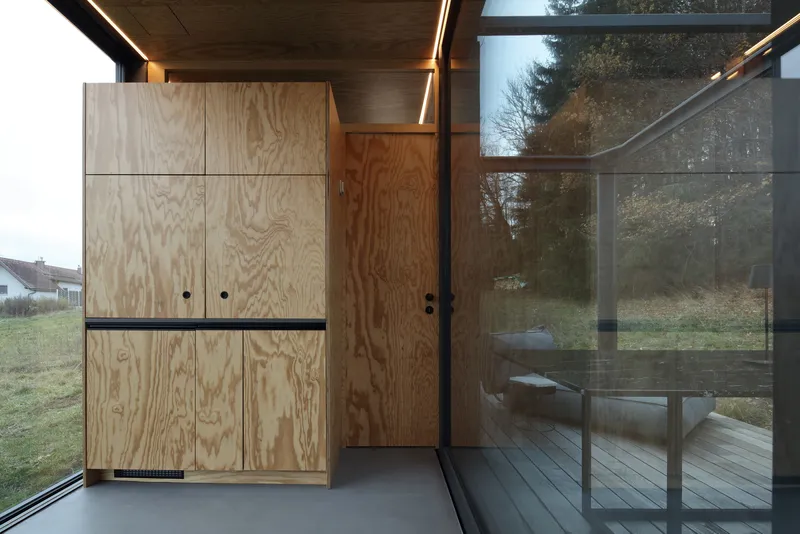
The bathroom, compact as it is, contains a wall-mounted toilet, plywood cabinetry, and linear ceiling lighting. It is fully equipped, as is the kitchen, which includes a dishwasher and a washing machine. These are not camping amenities. Tonko has packed domestic completeness into a volume that could easily have been reduced to a glamping shell. The insistence on genuine livability, on a dishwasher in 20 square meters, is a statement about what minimal architecture owes its occupants.
Glass sliding doors, plywood storage walls, and recessed lighting details repeat across the interior with a consistency that gives the tiny space a coherent architectural identity. There is no moment where the design gives up and defaults to an off-the-shelf solution. Every joint is considered.
Plans and Drawings
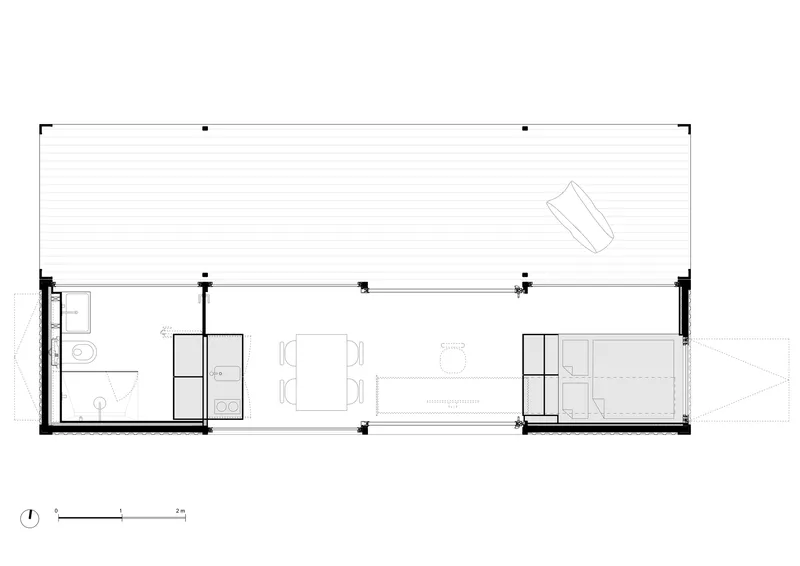
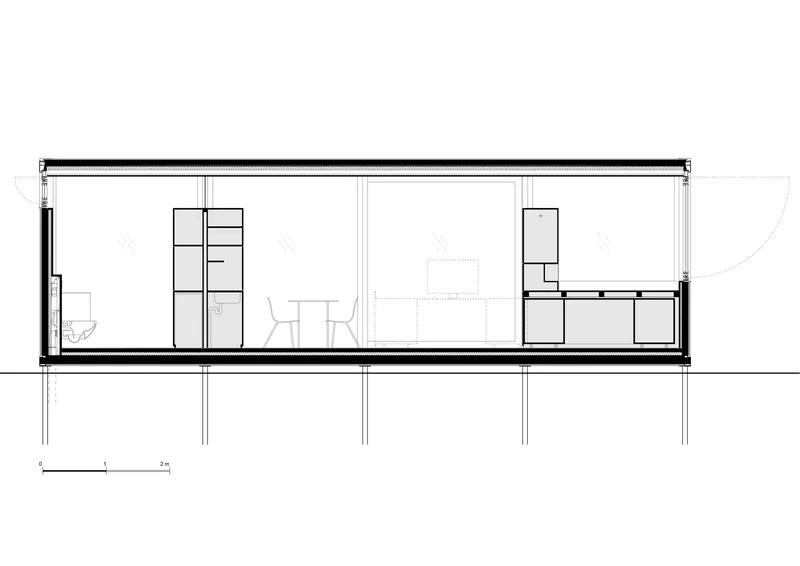
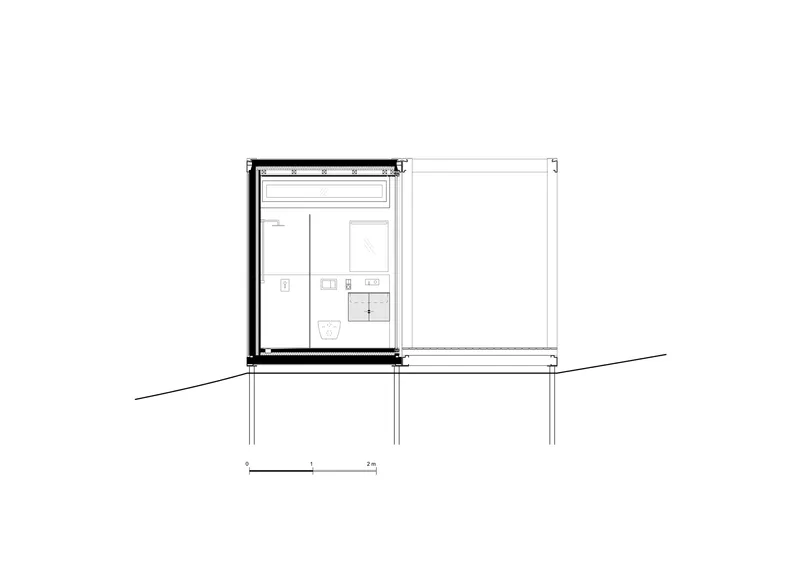
The floor plan confirms the strict four-part division: service cores at each end with a central living space between them. The section drawings reveal how the cabin sits on pilotis above the sloping ground, with built-in storage units flanking the living area and a clerestory zone that lifts the ceiling plane above the service volumes. The deck projects outward over the slope, cantilevering into the valley air. These drawings make legible what the photographs suggest: that the cabin's compactness is not a limitation but a discipline, every millimeter assigned a role.
Why This Project Matters
The MM01 Cabin matters because it takes the logic of prefabrication and modular transport seriously enough to let it shape every design decision, from the screw foundations that make the building removable, to the container-scaled steel frames that keep it road-legal, to the compact plan that refuses to sacrifice domestic completeness. It is not a tiny house in the Instagram sense, decorated and precious. It is an architectural proposition about how lightly a building can touch the earth while still functioning as a real home.
In an era when rural land is increasingly contested, when building permits carry environmental obligations, and when the permanence of architecture is no longer automatically virtuous, Tonko offers a credible alternative. A building that can arrive on a truck, operate autonomously, and disappear when its time is up is not a novelty. It is a model worth studying. The Eastern Alps will outlast the cabin, and that, precisely, is the point.
MM01 Cabin by Christian Tonko, Carinthia, Austria. 20 square meters. Completed in 2022. Photography by Christian Brandstätter.
About the Studio
Share Your Own Work on uni.xyz
If projects like this are the kind of work you want to make, uni.xyz is a place to publish your own, find collaborators, and enter design competitions.



Popular Articles
Popular articles from the community


Lunar Spiral: Space Architecture Shaped by the Mathematics of the Universe
Lunar Spiral reimagines space architecture through Fibonacci geometry, lunar regolith, levitating habitats, and self-sustaining Moon living.

Riyadh For All: Intergenerational Urban Design for Active Aging in Rabat
Riyadh For All reimagines urban design in Rabat with intergenerational co-living, adaptive courtyards, and Moroccan cultural exchange today.

Play: Fragments of Their World
Familiar architecture becomes modular playground design, creating safe spaces where displaced children can learn, connect, imagine and play.

The Earth Pod: 3D Printed Homes for Resilient Refugee Communities
The Earth Pod reimagines refugee housing through 3D printed homes made from clay, combining resilience, self-sufficiency, and rapid shelter.


Similar Reads
You might also enjoy these articles

Bao Huynh Watercolor Atelier: A Serene Art Retreat in Hội An
Bao Huynh Watercolor Atelier in Hội An blends multifunctional art spaces, sustainable design, local materials, and family-friendly living in a serene environment.

Atelier Macri Concept Store Interior Design by CASE-REAL
Atelier Macri store features a "ko" counter, walnut wood details, cork displays, blending retail, gallery, and seamless customer experiences.

Manuel Vargas Izquierdo Stadium and High-Performance Sports Center: Architectural Excellence in Jalpa de Méndez
The Manuel Vargas Izquierdo Stadium blends sustainable design, inclusive sports facilities, and cultural-inspired architecture, revitalizing Jalpa de Méndez’s public spaces.

KAKR Buluh Awar Hall: Revitalizing Community and Ecology Through Bamboo Architecture
Community built bamboo hall revitalizes Buluh Awar village, empowering youth, restoring ecology, celebrating vernacular craftsmanship through sustainable architecture and culture.
Explore Residential Building Competitions
Discover active competitions in this discipline


Challenge to design a portable theatre


Challenge to design a portable music platform


Challenge to design an open learning module for the elderly


Challenge to design mud housing for contemporary communities
Comments (0)
Please login or sign up to add comments
No comments yet. Be the first to comment!