

Christos Pavlou Architecture Builds Inward on a Barren Cypriot Plain with Three Courtyards
A 288-square-meter house near Nicosia turns its back on an inhospitable landscape and cultivates its own world within white walls.


When a site offers nothing, the most honest architectural response is to make something. On the outskirts of the village of Deftera, a few kilometers from Nicosia, there are no particular views, no established neighborhoods, and scarcely any greenery beyond reeds lining a dry ditch. The arid, flat terrain reads as a blank page. Christos Pavlou Architecture took that blankness seriously and designed a house that generates its own landscape, folding three distinct courtyards into a 288-square-meter volume that owes a clear debt to the inward-looking typology of the traditional Cypriot rural house.
What makes this project worth studying is not the courtyard idea itself, which is ancient and well-documented, but the specificity with which each of the three courtyards operates. They are not repetitions of a single gesture. Each one has a different shape, a different size, and a different atmospheric assignment: one separates and visually reunites the kitchen and living room across a double-height void, another extends the living room outward, and the third gives the kitchen its own planted territory. The courtyards are tools, not ornaments, and they do real work in a climate where the relationship between shade, breeze, and exposure to western sun is not a theoretical concern but a daily one.
Defensive Facades, Generous Interiors


From the street, the house presents a largely closed face. Cantilevered white volumes hover above recessed entries, and vertical timber cladding provides the only textural relief against broad planes of white render. There is nothing inviting about these elevations, and that is precisely the point. The surrounding landscape is inhospitable, and a busy main road generates noise that the western perforated wall is specifically designed to attenuate. The street facade says: this house is elsewhere, inside.
The contrast between exterior restraint and interior generosity is one of the oldest moves in Mediterranean residential architecture, and Pavlou handles it with confidence rather than drama. Punched windows are scattered across the upper volume almost casually, giving bedrooms controlled views of distant mountains without surrendering privacy.
The Courtyard as Architectural Engine

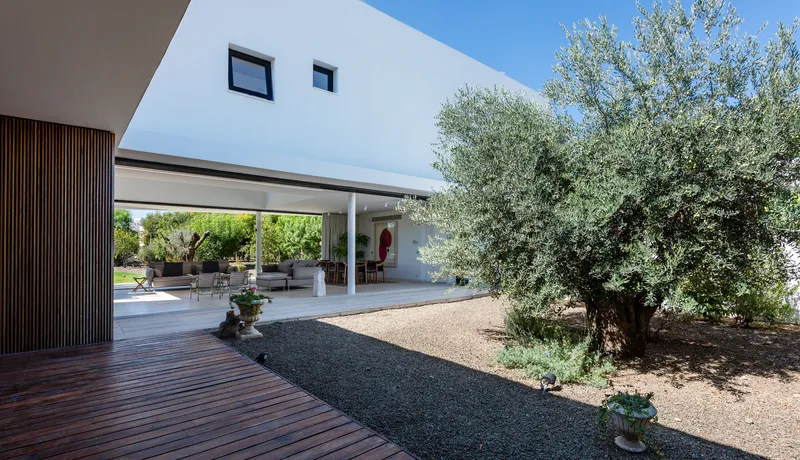

The three courtyards are arranged side by side between the two main volumes of the house, establishing a rhythm of solid, void, solid that runs through the plan like a spine. Gravel, timber decking, and mature olive trees fill these interstitial spaces, turning what could be leftover gaps into the most charged rooms in the house. One gravel courtyard sits beneath the cantilevered upper floor, creating deep shade and framing a single olive tree as the focal point. Another, open to the sky, is bounded by white plaster walls and a steel staircase, with a fig tree canopy providing dappled light.
The dialectical relationship Pavlou describes between indoor and outdoor space is legible in every section cut: the courtyards are not appended to the building but threaded through it. They influence the internal environment thermally and visually, pulling daylight into the center of the plan and channeling air movement through sliding glass walls.
Living on the Ground Floor
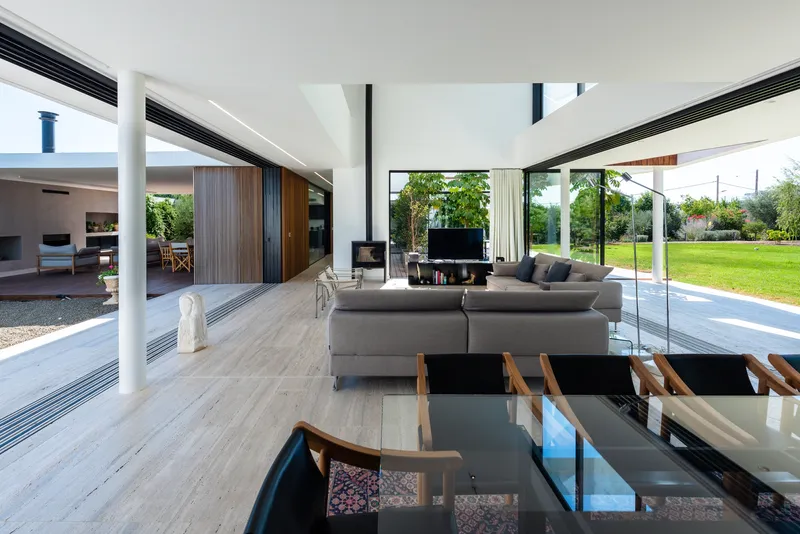
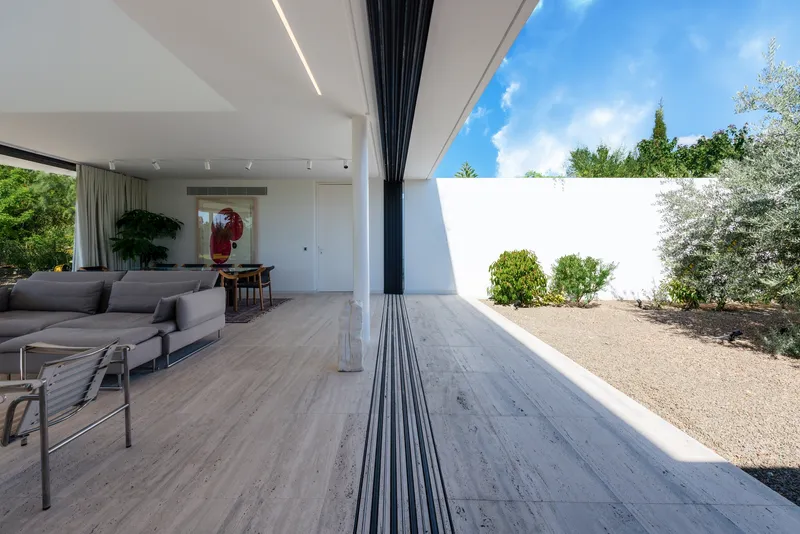

The ground floor is where the house does its most interesting spatial work. Living areas are arranged in a linear sequence parallel to the green courtyards, and floor-to-ceiling sliding aluminum glazing systems allow entire walls to retract. When the glass is open, the living room simply becomes the courtyard and vice versa. Slender steel circular columns carry the reversed concrete beam structure above, keeping the ground plane as free and permeable as possible.
A freestanding wood-burning stove anchors the living room without closing it off, and the steel-framed glazing reads as furniture rather than barrier. The double-height courtyard that separates the kitchen from the living room is the key spatial event: you can see from one zone to the other through a planted gap that brings sky, trees, and changing light into the core of the house.
Kitchen and Dining as Courtyard Extensions


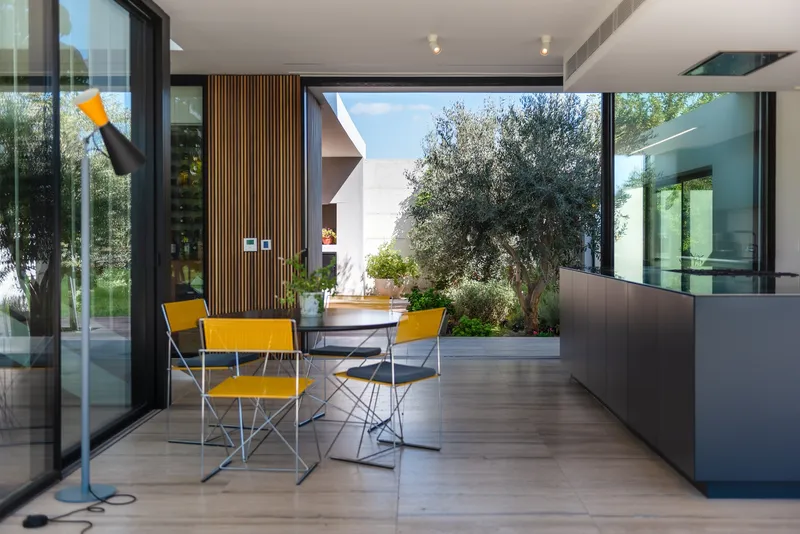
The open-plan kitchen, with its dark cabinetry and island bench, is oriented entirely toward the courtyard. Full-height glazing wraps two sides, and the line between countertop and landscape is deliberately thin. Yellow folding chairs add a punch of color that reads as playful against the otherwise restrained palette of white, timber, and dark stone. The dining area occupies the threshold between inside and out, framed on one side by vertical timber slats and on the other by an olive tree in a gravel bed.
Each courtyard functions as an exclusive extension of the room it serves. The kitchen gets its own planted territory; the living room gets another. The result is that two rooms on the same floor, separated by only a few meters, feel like they belong to different microclimates.
Upper Level: Screens, Shade, and Long Balconies
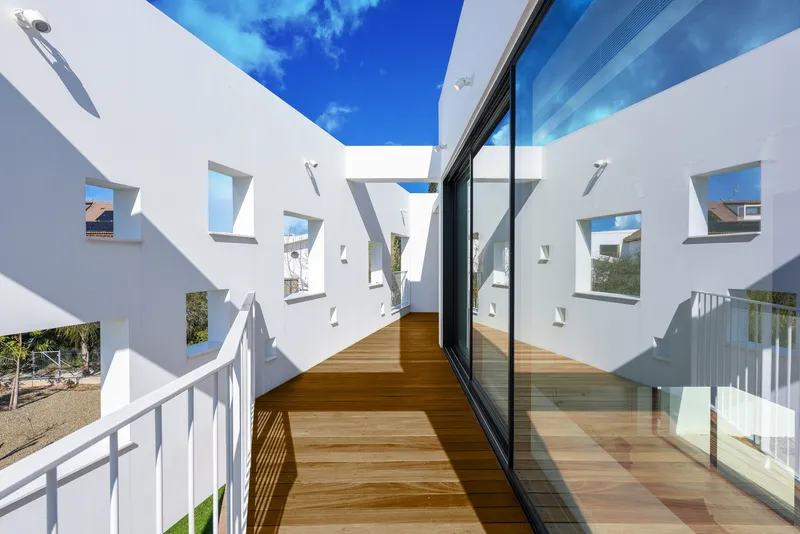
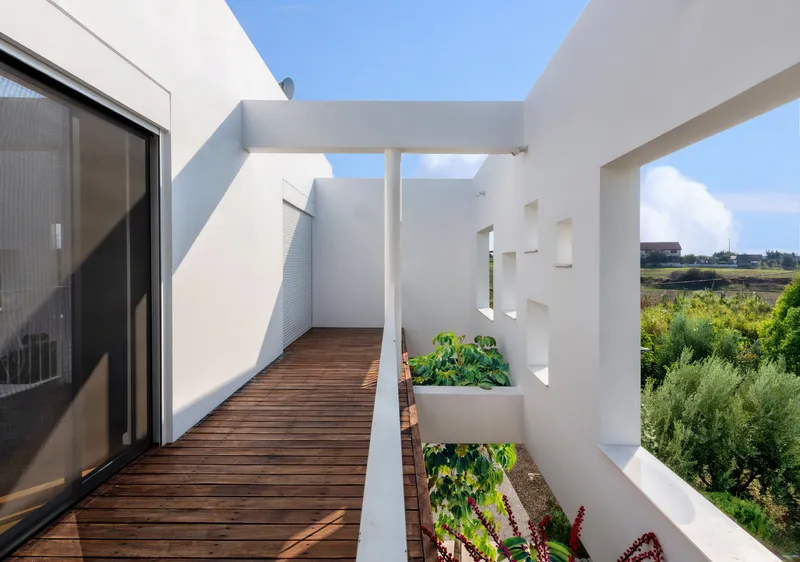

Upstairs, three bedrooms line the western edge, opening onto continuous long balconies that are protected by perforated white screen walls. These screens do double duty: they block the harsh afternoon sun and shield the rooms from road noise, while casting geometric shadow patterns across the timber decking that shift throughout the day. The balconies function as outdoor corridors, linking the private rooms in a linear sequence and giving each bedroom a sense of openness despite the defensive posture of the facade below.
A rooftop terrace with planted beds extends the habitable area further upward, and the white perforated walls continue here, maintaining the privacy screen while allowing ventilation. The combination of planted timber decks and punched screens gives the upper level a monastic quality, a place of retreat within a house already conceived as a retreat from its surroundings.
Timber Decks and Planted Thresholds


Timber decking runs throughout the courtyards and terraces, serving as the connective tissue between volumes. It wraps from interior floors through sliding glass thresholds and out into planted beds, reinforcing the idea that inside and outside share a single ground plane. A rectangular skylight opening above one of the decks frames a clean rectangle of blue sky, turning the act of looking up into a composed view.
Covered outdoor terraces with leather seating and a fireplace wall extend the living spaces into evening hours, when the Cypriot heat relents and the courtyards become the primary living rooms. These are not decorative additions; they are the programmatic center of the house.
Dusk and the Double-Height Void
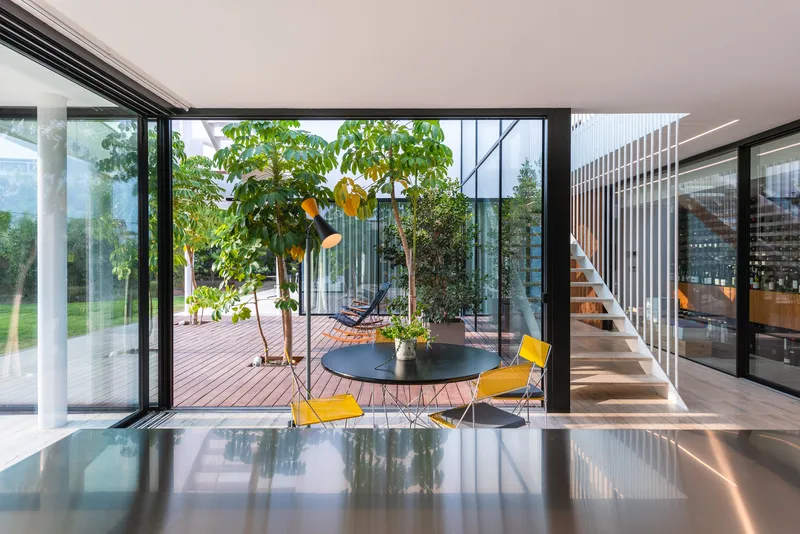


At dusk, the house reveals its full spatial ambition. The double-height living space, glazed on two sides and open to the courtyard, glows from within, and the potted trees on the timber deck become silhouettes against the fading sky. The section through this void is the project's best drawing: two stories of inhabited space flanking a planted well that is neither fully inside nor fully outside.
There is a person reclining on the timber deck beside a potted umbrella plant in one overhead view, and the scale is instructive. The courtyards are not grand gestures. They are room-sized, scaled to the body, and designed for the kind of solitary contemplation that a house on a desolate plain either provides or fails to provide entirely.
Plans and Drawings


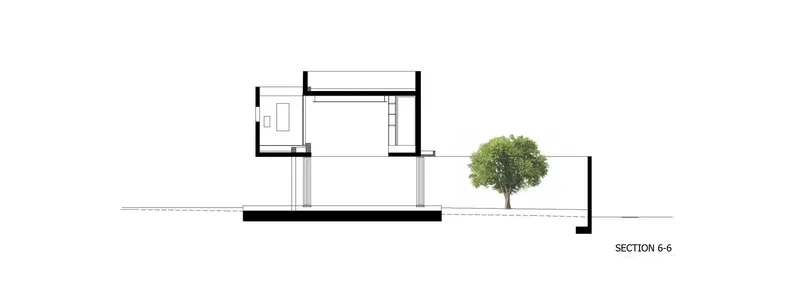

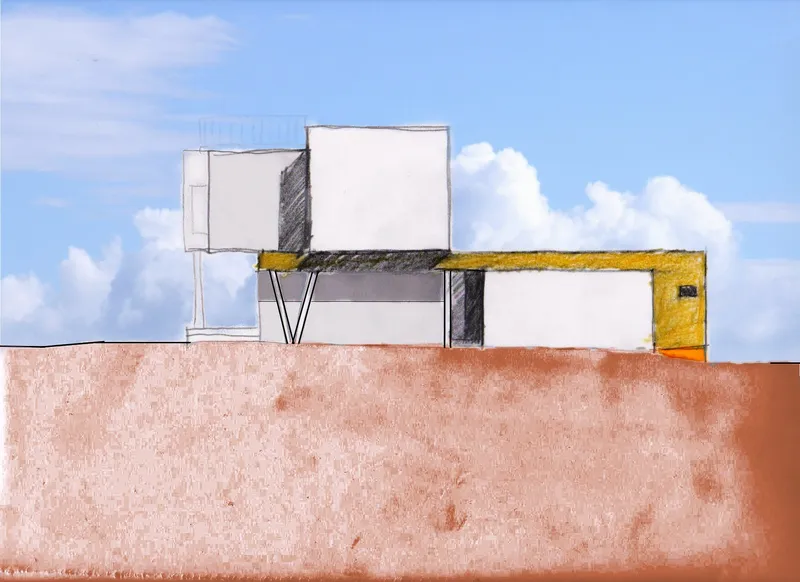
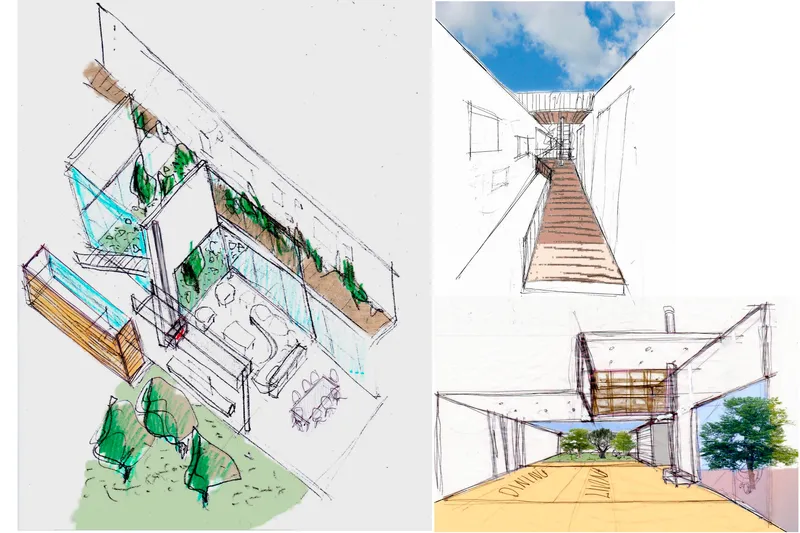
The site plan makes the strategy legible at a glance: a rectangular volume perforated by three voids, with circular tree symbols indicating the planted courtyards that break the mass into inhabitable fragments. The ground floor plan shows green landscaped areas threaded through the interior, while the second floor plan reveals the elongated bedroom wing and its continuous western balcony. Section drawings confirm the double-height courtyard well at the heart of the house, with trees planted at grade rising through the void. The elevation drawing shows the cantilevered upper volume hovering over a terracotta-colored earth berm, and the axonometric sketches make the terraced courtyard logic especially clear.
The reversed concrete beam structure, visible in the sections, allows slim steel columns to carry the upper floor with minimal visual obstruction on the ground level. This structural decision is not merely aesthetic; it enables the full-height glazing to operate without the visual weight of deep beams, keeping the threshold between room and courtyard as thin as possible.
Why This Project Matters
The courtyard house is among the most revisited typologies in architecture, and most contemporary versions treat the courtyard as a single spatial event: one void, one tree, one moment of sky. What Pavlou does differently is multiply the courtyard and differentiate it. Three courtyards, each with a distinct role, each attached to a specific room, each with its own atmosphere. The result is a house that feels larger and more varied than 288 square meters has any right to feel, and one that makes the case for the courtyard not as a passive amenity but as an active tool of spatial organization.
The project also demonstrates that when a site gives you nothing, you are free to invent everything. The absence of views, neighbors, and existing landscape becomes a license to construct an entire microclimate from scratch. In a warming Mediterranean climate where outdoor space is increasingly essential to daily life, this house shows how the oldest residential idea on the island, the inward-looking compound with planted courts, remains the most pragmatic one.
House With Courtyards by Christos Pavlou Architecture, Nicosia, Cyprus. 288 m², completed 2020. Photography by Unseen Views.
About the Studio
Share Your Own Work on uni.xyz
If projects like this are the kind of work you want to make, uni.xyz is a place to publish your own, find collaborators, and enter design competitions.


Popular Articles
Popular articles from the community

Tsunami Convergenics: Turning Catastrophic Ocean Forces into Underwater Housing Infrastructure
A speculative underwater settlement off the coast of Onagawa, Japan, treats tsunamis and typhoons as energy sources rather than threats.

The Amber Palace Opera: A Geological Fiction Surfaces on Tallinn's Baltic Waterfront
Pierre Brillard reimagines a Baltic legend as a public landscape, opera house, and waterfront promenade rooted in Tallinn's coastal identity.
Opera by the Sea Estonia: Three Shells Dissolving Architecture into Tallinn's Coastline
A winning opera house proposal replaces monumental form with interconnected shells that blur the boundary between building, park and Baltic Sea.

Singing Woman: An Opera House That Performs Before the Curtain Rises
Ovidiu Cristian Pavel's conceptual opera house translates Estonia's choral identity into a sculpted waterfront landmark facing the Baltic Sea.

Similar Reads
You might also enjoy these articles

Pixel Gardens: One Repeated Module Stacked Into a Terraced Social Housing Tower for Famagusta
Salem Bader's shortlisted housing tower builds a vertical neighbourhood from one repeated module, offsetting units to carve terraces, light and air.

Bao Huynh Watercolor Atelier: A Serene Art Retreat in Hội An
Bao Huynh Watercolor Atelier in Hội An blends multifunctional art spaces, sustainable design, local materials, and family-friendly living in a serene environment.

Atelier Macri Concept Store Interior Design by CASE-REAL
Atelier Macri store features a "ko" counter, walnut wood details, cork displays, blending retail, gallery, and seamless customer experiences.

Manuel Vargas Izquierdo Stadium and High-Performance Sports Center: Architectural Excellence in Jalpa de Méndez
The Manuel Vargas Izquierdo Stadium blends sustainable design, inclusive sports facilities, and cultural-inspired architecture, revitalizing Jalpa de Méndez’s public spaces.


Comments (0)
Please login or sign up to add comments
No comments yet. Be the first to comment!