

City Umbrella: Turning Dead Infrastructure into Bioclimatic Public Space
Modular canopy installations reclaim neglected urban pockets beneath flyovers and along boundary walls, offering shade, comfort, and social life.


Every city has them: the residual strips beneath flyovers, the barren stretches along compound walls, the leftover corners that collect litter and suspicion in equal measure. City Umbrella refuses to accept these zones as inevitable casualties of infrastructure. Instead, it treats them as precisely the sites where lightweight, colorful canopy modules can seed new forms of public life, transforming thermal discomfort and social exclusion into shade, seating, and encounter.
Designed by Vedalaxmi and published on uni.xyz, City Umbrella is an urban furniture proposal that operates at the intersection of architecture and bioclimatic design. The project targets the dead spaces generated by infrastructural development, zones that unintentionally invite crime or exclusion, and proposes modular umbrella-like installations that alter microclimate conditions while activating streetscapes at a human scale.
Canopies Along the Block Wall: Shade as Spatial Invitation
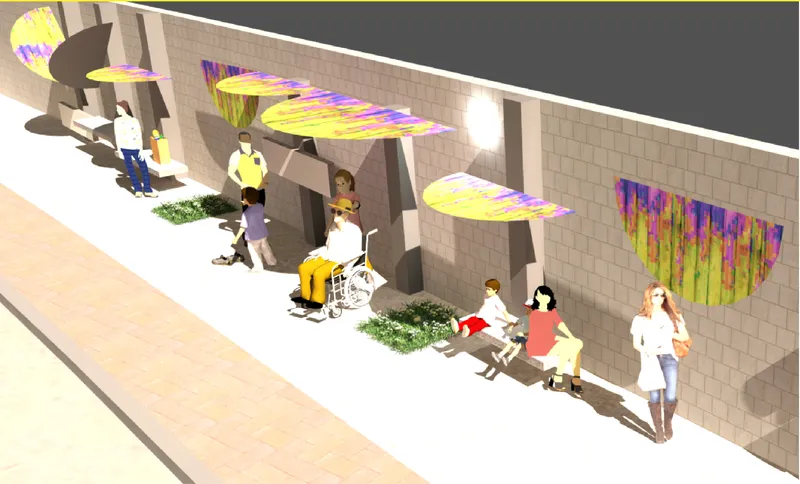
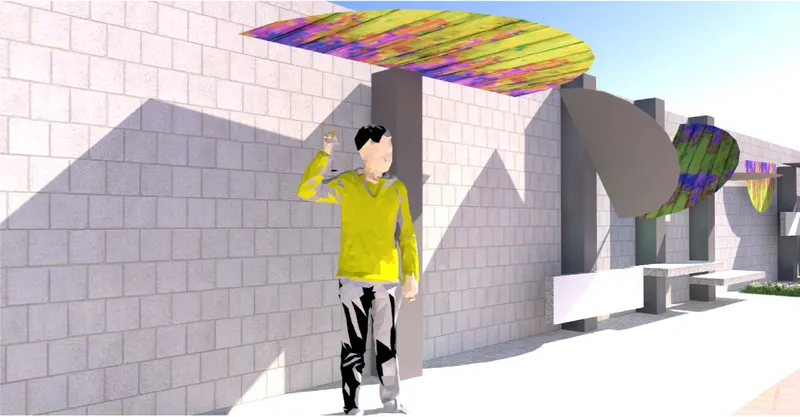
The streetscape renderings reveal the core proposition: a series of colored canopy elements mounted along a block wall, each sheltering a seating alcove below. Pedestrians move through these shaded intervals as if passing through a series of outdoor rooms. The canopies are not decorative afterthoughts; deployed in series, they function as bioclimatic enhancers that reduce heat buildup, improve airflow, and alter the thermal comfort profile of what would otherwise be a sun-blasted boundary wall.
What makes the gesture effective is its repetition. A single canopy is a bench with a hat. A sequence of them rewrites the character of an entire block, turning a passive wall into an active edge that draws people in. The color variation across the canopy modules serves a dual purpose: it creates visual rhythm along the streetfront and establishes identifiable landmarks within what could be an otherwise monotonous urban fabric.
Street Elevation: Modular Logic, City-Wide Scalability
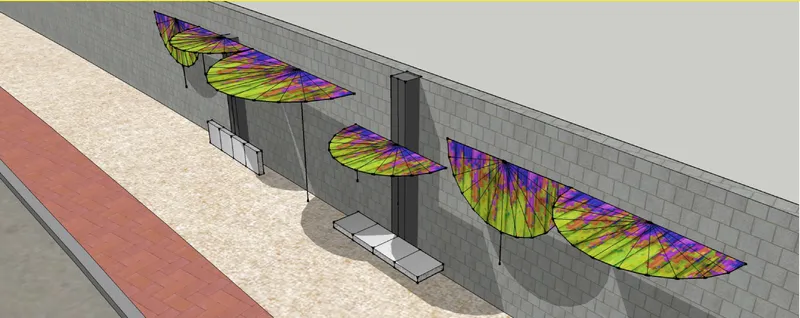

The street elevation rendering lays bare the modular logic of the system. Alternating colored canopy elements sit above benches at regular intervals, demonstrating how the lightweight, cost-effective framework could be replicated across an entire city without requiring bespoke engineering for each site. The structural clarity here matters: concrete beams overhead and pink-curbed ground zones at an intersection suggest that the intervention is designed to coexist with existing infrastructure rather than replace it.
Unlike conventional bus stops or benches, which tend to address a single user type, the adaptable modules respond to varying needs, including individuals with limited mobility. The seating is integrated rather than bolted on, and the canopy height provides shelter without creating the claustrophobic enclosure that discourages use. It is urban furniture that anticipates diversity rather than averaging it out.
Signals and Sidewalks: Designing for the Pedestrian First
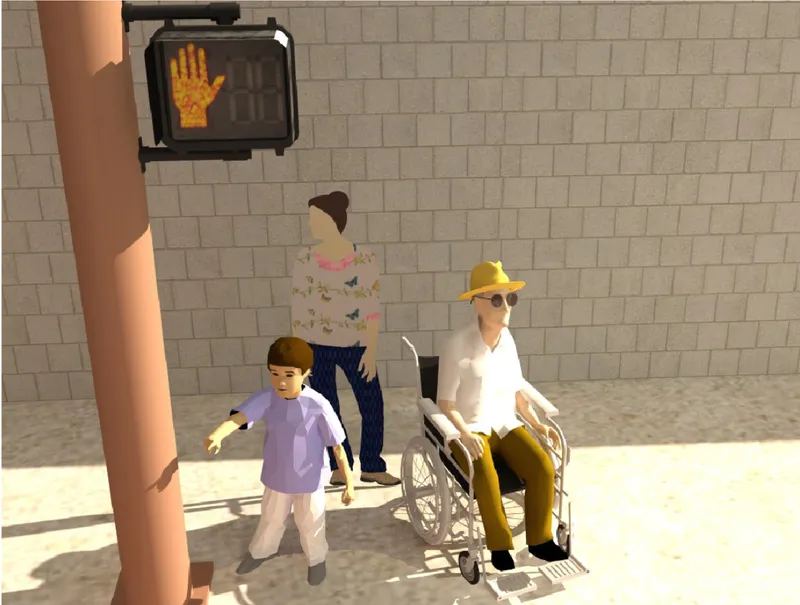
A seemingly incidental rendering of a pedestrian crossing signal captures the project's ideological center: people over vehicles. The orange hand icon, the figures on the sidewalk, the ordinary daylight of a city street. City Umbrella positions itself within this pedestrian reality, not in the aerial perspective of a masterplan but at eye level, where heat, glare, and the absence of a place to sit are felt most acutely. The proposal's strength lies in its insistence that comfort and inclusivity are not luxury additions to a city but baseline requirements.
After Dark: The Street Wall as Illuminated Social Stage
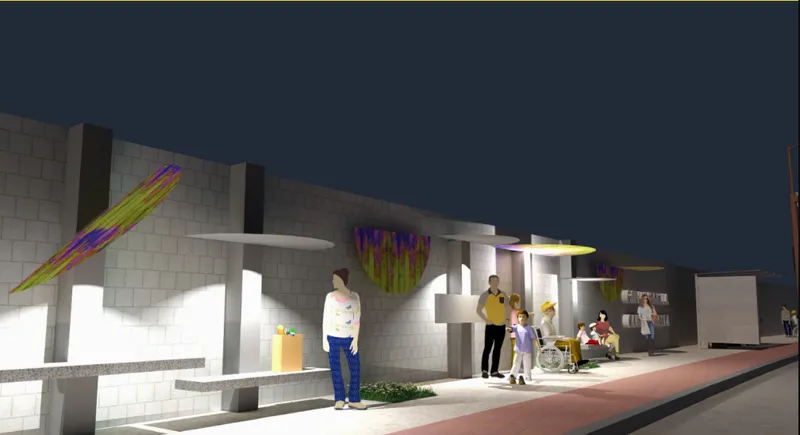
The night rendering shifts the narrative entirely. The colored canopies, now illuminated, transform the block wall into a glowing social stage where figures gather under warm light. Spaces that might otherwise feel unsafe after dark are activated by visibility, color, and the simple presence of other people. The lighting strategy converts an aesthetic decision into a safety mechanism: a well-lit, populated edge discourages the very crime and exclusion that neglected urban zones tend to attract.
The contrast between the daytime and nighttime views underscores the project's temporal adaptability. By day, the canopies manage solar heat gain and provide shade. By night, they become beacons that extend the usable hours of public space. The same structure serves two distinct bioclimatic and social functions without any mechanical transformation.
Why This Project Matters
City Umbrella is a reminder that the most impactful urban interventions are often the smallest. The project does not propose a new masterplan or a landmark building; it proposes a repeatable, economically viable module that can be inserted into the neglected seams of any dense cityscape. Its value lies in the accumulation of many small corrections: a degree of shade here, a bench there, a lit canopy after dark. These add up to a fundamentally different experience of walking through a city.
Vedalaxmi's work demonstrates a mature understanding of how architecture operates beyond buildings. The project interweaves bioclimatic performance, accessibility, and visual identity into a single lightweight system, proving that human-centric urban design does not require massive budgets or monumental gestures. It requires attention to the spaces everyone walks past and the willingness to claim them for public life.
View the Full Project
About the Designers
Designer: Vedalaxmi
Enter a Design Competition on uni.xyz
uni.xyz runs architecture and design competitions year-round that reward proposals with spatial conviction and real site intelligence.
Project credits: City Umbrella by Vedalaxmi.



Popular Articles
Popular articles from the community


Hill & Cross Opera: Sculptural Opera House Architecture Shaped by Tallinn’s Landscape and Identity
Hill & Cross Opera reimagines opera house architecture in Tallinn through its sculptural hill, civic plaza, glass wave and a luminous cross.

Co-Life: Senior Housing Design That Reconnects Older Adults With the City
Co-Life reimagines senior housing design through healing gardens, shared streets, workshops, and a sustainable community across generations.

Riyadh For All: Intergenerational Urban Design for Active Aging in Rabat
Riyadh For All reimagines urban design in Rabat with intergenerational co-living, adaptive courtyards, and Moroccan cultural exchange today.

Conexión: Biophilic Design Reimagines High-Rise Living in Hong Kong
Conexión reimagines high-rise living in Hong Kong through biophilic design, green facades, shared spaces, daylight, water and nature within.


Similar Reads
You might also enjoy these articles

Lunar Spiral: Space Architecture Shaped by the Mathematics of the Universe
Lunar Spiral reimagines space architecture through Fibonacci geometry, lunar regolith, levitating habitats, and self-sustaining Moon living.
The Main Dream: Modular Architecture for Play, Learning, and Community
A modular playground turns recycled plastic into adaptable spaces where refugee children can play, build, learn, and reconnect.

Play: Fragments of Their World
Familiar architecture becomes modular playground design, creating safe spaces where displaced children can learn, connect, imagine and play.

Wadi Rum Observatory: Desert Architecture Designed for the Night Sky
Wadi Rum Observatory turns desert architecture into a quiet instrument for astronomy, hiding research spaces under Jordan's starlit terrain.


Comments (0)
Please login or sign up to add comments
No comments yet. Be the first to comment!