

Studioninedots Flips a Warehouse on Its Side to House Amsterdam's Tolhuiskanaal Waterfront
A Magnelis steel building in Buiksloterham channels the neighborhood's industrial past into a mixed-use landmark on the canal.


Amsterdam's Buiksloterham district spent decades as a derelict stretch of industrial harbor, home to Nedcoat coating works and Air Products gas facilities. That era is over. The former brownfield north of the IJ is now the proving ground for a new generation of urban housing, and Studioninedots's C14 building, completed in 2024 on the Tolhuiskanaal, is perhaps the most architecturally assertive piece of that transformation. Part of a larger Cityplot framework that will deliver 550 homes and 4,000 square meters of workspace across a 100 by 100 meter plot, C14 does something deceptively simple: it takes the saw-tooth roof profile of a typical Dutch warehouse, rotates the logic 90 degrees, and lets the resulting angular silhouette do most of the heavy lifting.
What makes C14 genuinely interesting is how many problems that one formal move solves. The jagged cross-section is not decoration. It orients every balcony toward the south and the water, shelters outdoor space from wind and rain, controls solar gain on the facade, and gives each unit a different relationship to daylight. A single geometric idea delivers climate performance, variety in housing types, and a strong silhouette on the canal. The building proves that in post-industrial Amsterdam, industrial memory is not just a narrative device; it can be a structural strategy.
A Warehouse Turned Sideways
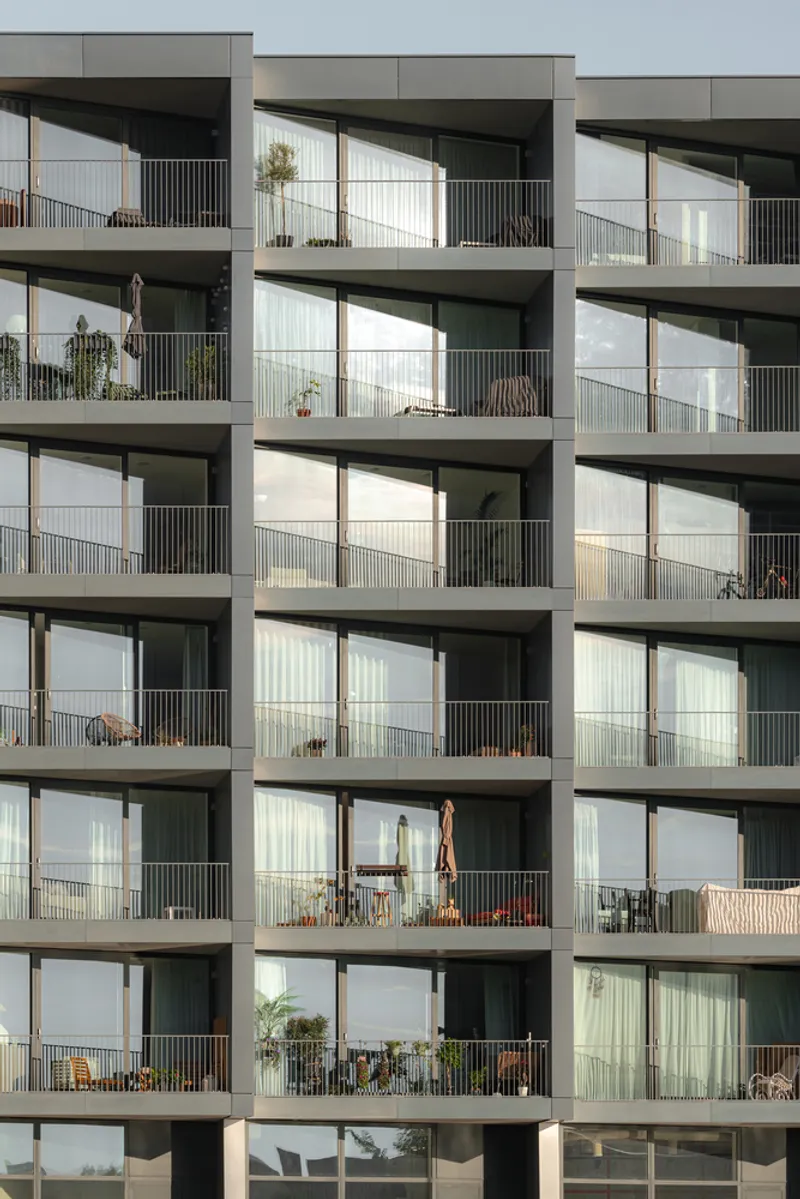
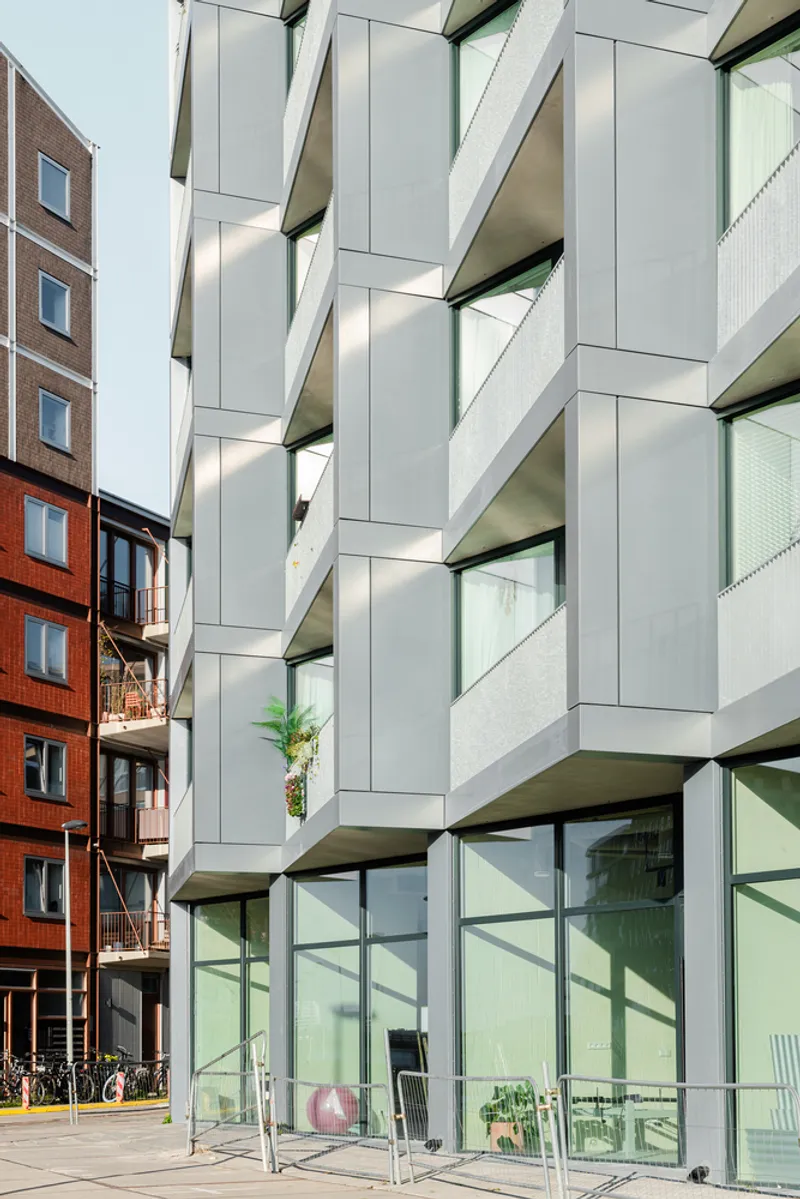
The tilted warehouse concept is immediately legible from the canal. Where a traditional shed roof rises and falls in a regular sawtooth, C14 translates that rhythm into a stepped section that staggers balconies at varying depths. Seen from the waterfront, the building reads as a single angular volume rather than a stack of identical floors. That angularity is not cosmetic: the south-facing slopes maximize winter daylight penetration into living spaces, while the steeper north-facing planes shade interiors in summer and reduce cooling loads.
The housing program is equally varied. Ground-floor units along the street have generous glass fronts that pull domestic life close to the sidewalk. Upper floors widen as the section steps outward, culminating in a broad top-floor apartment tucked into the building's pointed tip. It is a quiet rejection of the extruded slab, offering the kind of typological range that keeps a neighborhood from feeling like a monoculture.
Magnelis Steel and Industrial Memory
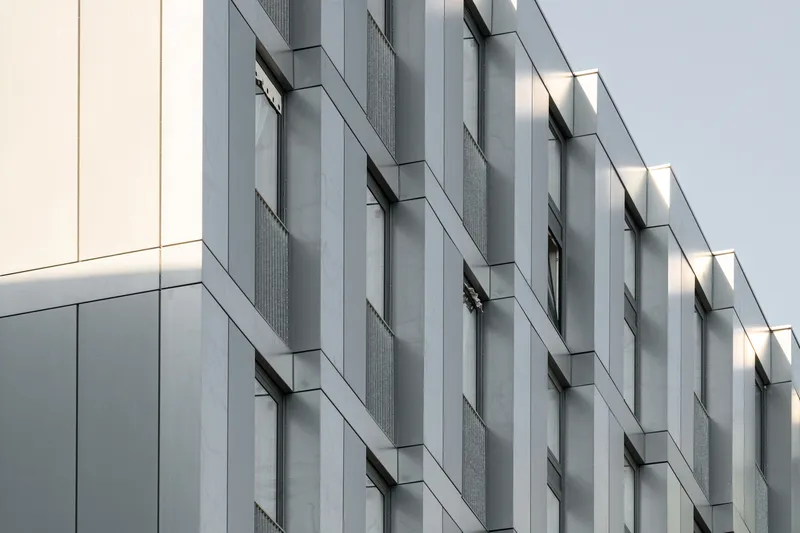
The facade material is Magnelis steel, a zinc-aluminum-magnesium alloy that is galvanized in a molten weld pool rather than applied as a coating. It is exceptionally durable, fully recyclable, and carries a matte grey tone that shifts between warm and cool depending on the light. Studioninedots chose it explicitly for its reference to Buiksloterham's industrial lineage: this is a neighborhood that once lived by metal fabrication, and the building wears that history on its skin without resorting to pastiche.
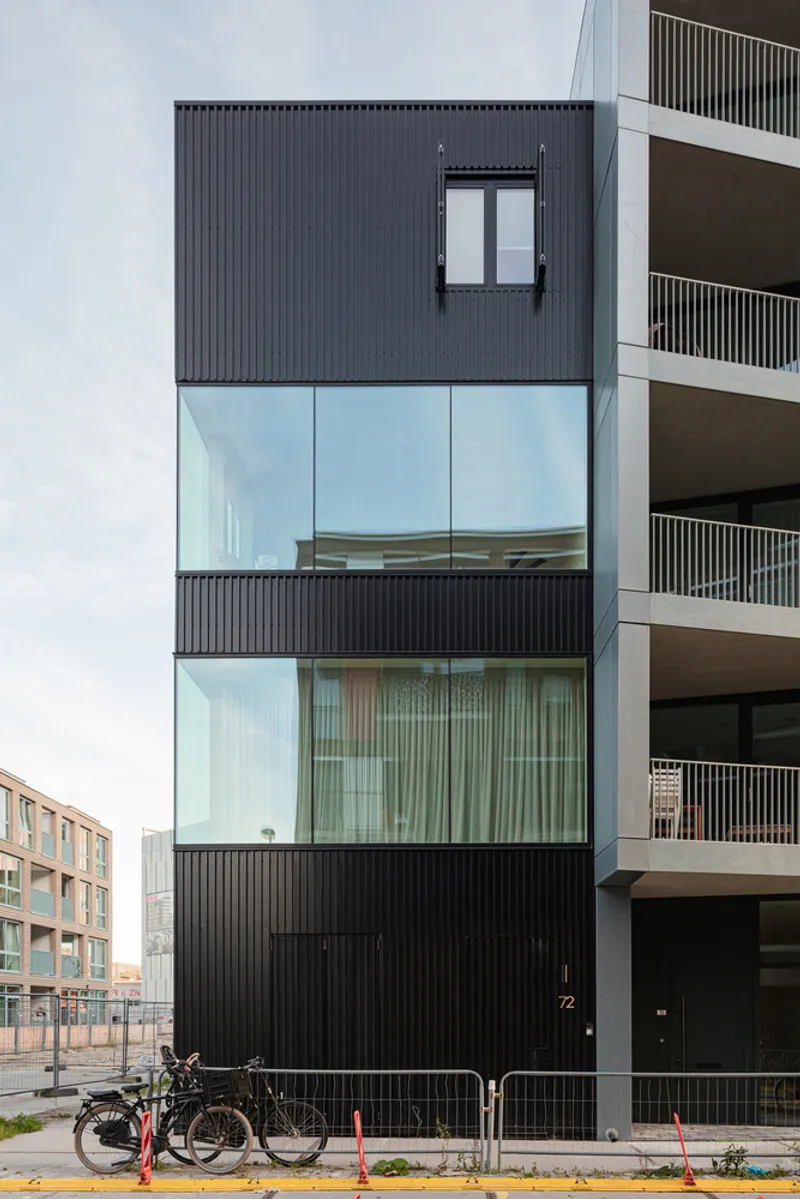
The staggered panel layout reinforces the saw-tooth geometry. Recessed vertical windows are cut into the cladding at irregular intervals, breaking what could be a relentless metallic surface into a textured, almost woven composition. Neighboring structures, like the black corrugated C19 building visible nearby, play supporting roles. Studioninedots conceived C14 as an abstract backdrop against which smaller, more expressive buildings could assert their own character, a generous piece of urbanism that prioritizes the ensemble over the individual object.
Balconies as Climate Devices
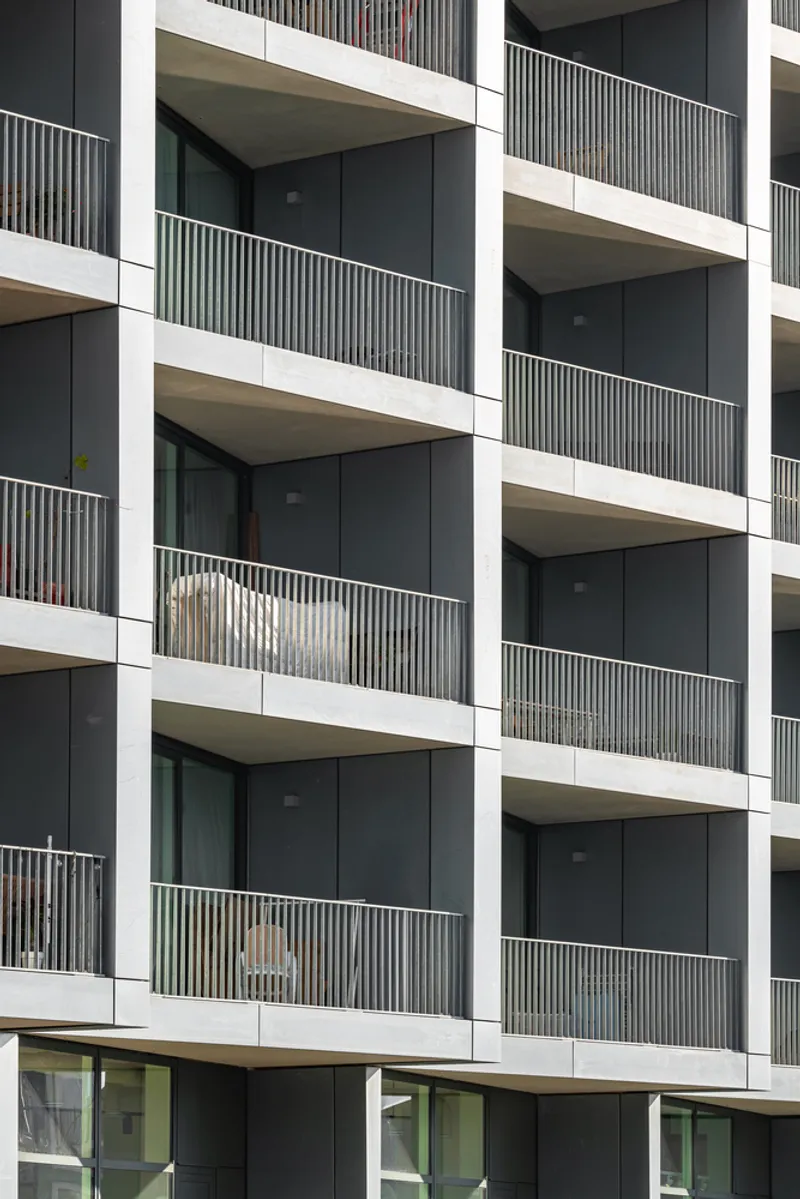
The jagged balcony sequence is the building's signature move, and it works harder than it looks. Each concrete slab oversails the one below at a slightly different angle, creating a cascade of sheltered outdoor spaces facing the water and the sun. The geometry means that upper balconies shade lower ones during peak summer hours, while low-angle winter light reaches deep into the apartments. Vertical timber slat screens add a layer of privacy and wind protection without blocking views, and they warm the palette of the courtyard side considerably.
All outdoor space is concentrated on the south and waterfront faces. The north facade, by contrast, is tighter and more opaque, a deliberate asymmetry that turns the building into a kind of environmental filter. Residents get sun, water views, and protection from the prevailing wind in a single architectural gesture, no mechanical louvers or operable screens required.
The Timber Pavilion and Its Quiet Infrastructure

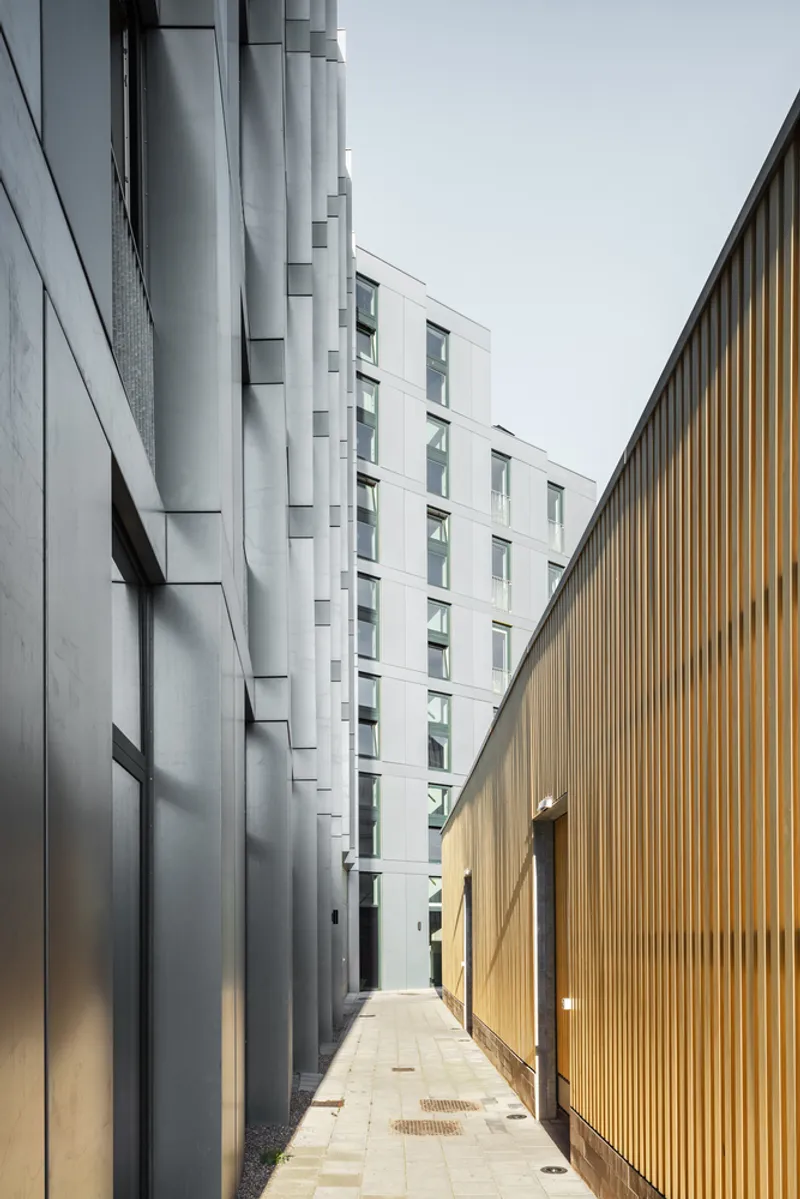
One of C14's smartest decisions happens at ground level, where bicycle parking has been relocated from the main building into a separate timber pavilion in the courtyard. The move frees up interior square meters for creative workspaces and residences, but the pavilion itself is more than a shed. Its exposed timber ceiling beams and metal bracing give it a workmanlike clarity, and the slatted facade transforms it into a glowing lantern after dark, a warm counterpoint to the cool steel of the main volume.
The pavilion also houses a rainwater retention system. Water collected on the roof is stored and redistributed to residents, a closed-loop strategy that fits neatly into Buiksloterham's broader sustainability ambitions. The narrow passageway between the pavilion's timber slats and C14's metal skin creates a compressed, almost intimate threshold between the public street and the semi-private courtyard, a piece of spatial choreography that feels effortless but is carefully calibrated.
Waterfront Urbanism After Dark
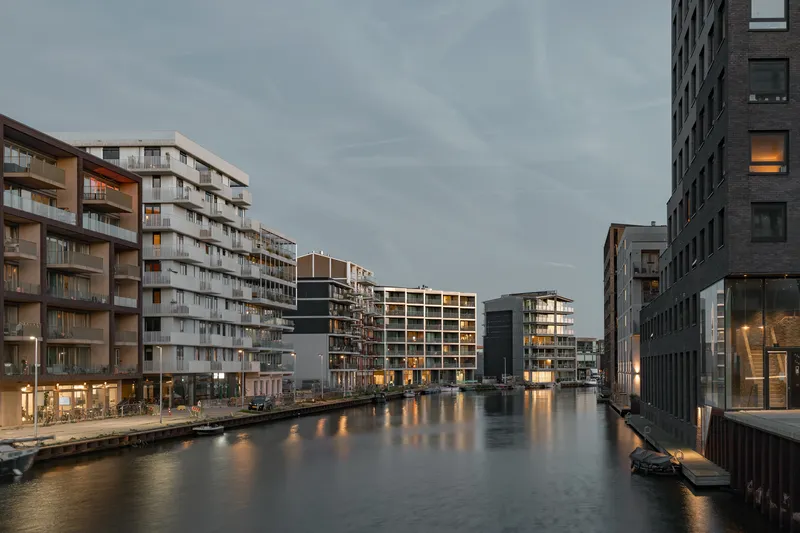
The dusk view from across the Tolhuiskanaal is where C14's urban argument lands most clearly. The building sits among its neighbors as a composed, slightly aloof presence, its lit interiors reflected in the canal water alongside smaller, darker volumes. The Cityplot concept demands that each building hold its own identity while contributing to a legible collective, and C14 fulfills that contract. Its angular profile anchors the waterfront without dominating it.
At street level, the mix of creative businesses on the waterfront side and glass-fronted residences on the road side ensures that the building engages both edges of the plot. There is no dead face, no service elevation hidden from view. For a district that is still actively under construction, this kind of 360-degree activation matters enormously. Empty plots forgive blank walls; finished neighborhoods do not.
Plans and Drawings
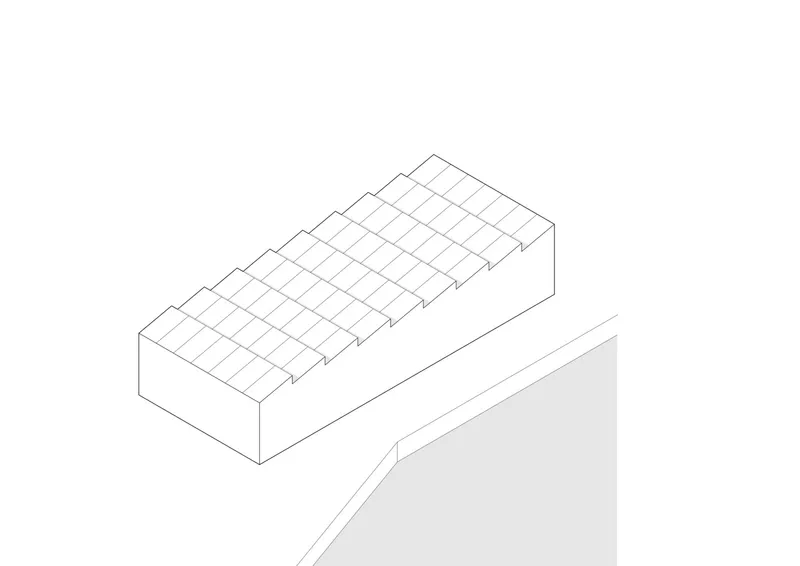
The axonometric drawing reveals the underlying logic with economy. The saw-tooth roof profile reads as a continuous zigzag in section, and the curved wall element at the base suggests how the courtyard pavilion wraps into the composition. What the drawing makes clear is that the building's formal complexity comes from a single repeated operation: a sloped plane, mirrored and stacked. There is no arbitrary geometry here. The angularity is systematic, and that discipline is what keeps the facade from tipping into expressionism.
Why This Project Matters
C14 demonstrates that referencing industrial heritage does not require brick arches or crane motifs. A material choice, a structural section, and a clear idea about how a warehouse roof works are enough to carry the narrative. Studioninedots has produced a building that earns its industrial references through performance rather than symbolism: the Magnelis steel is genuinely recyclable, the angular form genuinely manages solar exposure, and the separated timber pavilion genuinely improves the ground-floor program. Every gesture does at least two things.
For Buiksloterham and for Amsterdam's broader experiment in post-industrial urbanism, C14 sets a useful benchmark. It shows that density, sustainability, and architectural identity are not competing priorities but aspects of the same design problem. As the surrounding plots fill in and the Cityplot framework matures, this building will likely prove its value not as a standalone icon but as a reliable neighbor: visually strong, environmentally responsible, and spatially generous where it counts.
Cityplot Buiksloterham C14 Building by Studioninedots, Amsterdam, the Netherlands. Completed 2024. Photography by Sebastian van Damme.
About the Studio
Share Your Own Work on uni.xyz
If projects like this are the kind of work you want to make, uni.xyz is a place to publish your own, find collaborators, and enter design competitions.


Popular Articles
Popular articles from the community


Manzana Morphosis: Stretching Barcelona's Grid into a Living Landscape for 2050
A radical reworking of the Eixample manzana turns density into a tool for generous public space, vertical ecology, and environmental performance.

Opera on the Sea: Driftwood Logic Shapes a Timber Opera House on Estonia's Coast
Trevor Orgill's opera house translates the entangled drift of floating timber into a civic building where wood, water, and music converge.
Tsunami Convergenics: Turning Catastrophic Ocean Forces into Underwater Housing Infrastructure
A speculative underwater settlement off the coast of Onagawa, Japan, treats tsunamis and typhoons as energy sources rather than threats.
Extended Shell: Retrofitting Kolkata's Balconies as Living Urban Thresholds
A modular retrofit system recovers the social and environmental intelligence of Kolkata's historic verandas for contemporary Park Street residents.

Similar Reads
You might also enjoy these articles


Hodi-Mandai Geram
Project Function: Preservation and revitalization of the Intangible heritage and socio-spatial identity of the Hodi by Housing, Cultural Memory Center, Sacred Grove, landscape, local tourism economy


Olio Towers: A Mid-Rise for Performers That Fuses Housing, Rehearsal, and Stage
Located blocks from Houston's Theater District, this modular tower stacks living units around a central performance atrium.

Oasis: Modular Green Housing Carved into Dhaka's Urban Fabric
A shortlisted Plugin Housing entry reclaims unauthorized settlements in Dhaka with stepped concrete volumes, green roofs, and ventilation-driven design.

Black Hole: A Floating Megastructure for the Post-Physical Era
Emiliano Mazzarotto envisions a spherical, self-scaling arena where e-sports, digital hotels, and holographic stadiums replace traditional public space.

Explore Amsterdam Competitions
Discover active competitions in this discipline

Challenge to reimagine the Iron Throne

Photograph architecture without architects

Illustrate the lost glory of Angkor Wat - Render Challenge

Design challenge to reuse E-waste
Comments (0)
Please login or sign up to add comments
No comments yet. Be the first to comment!