
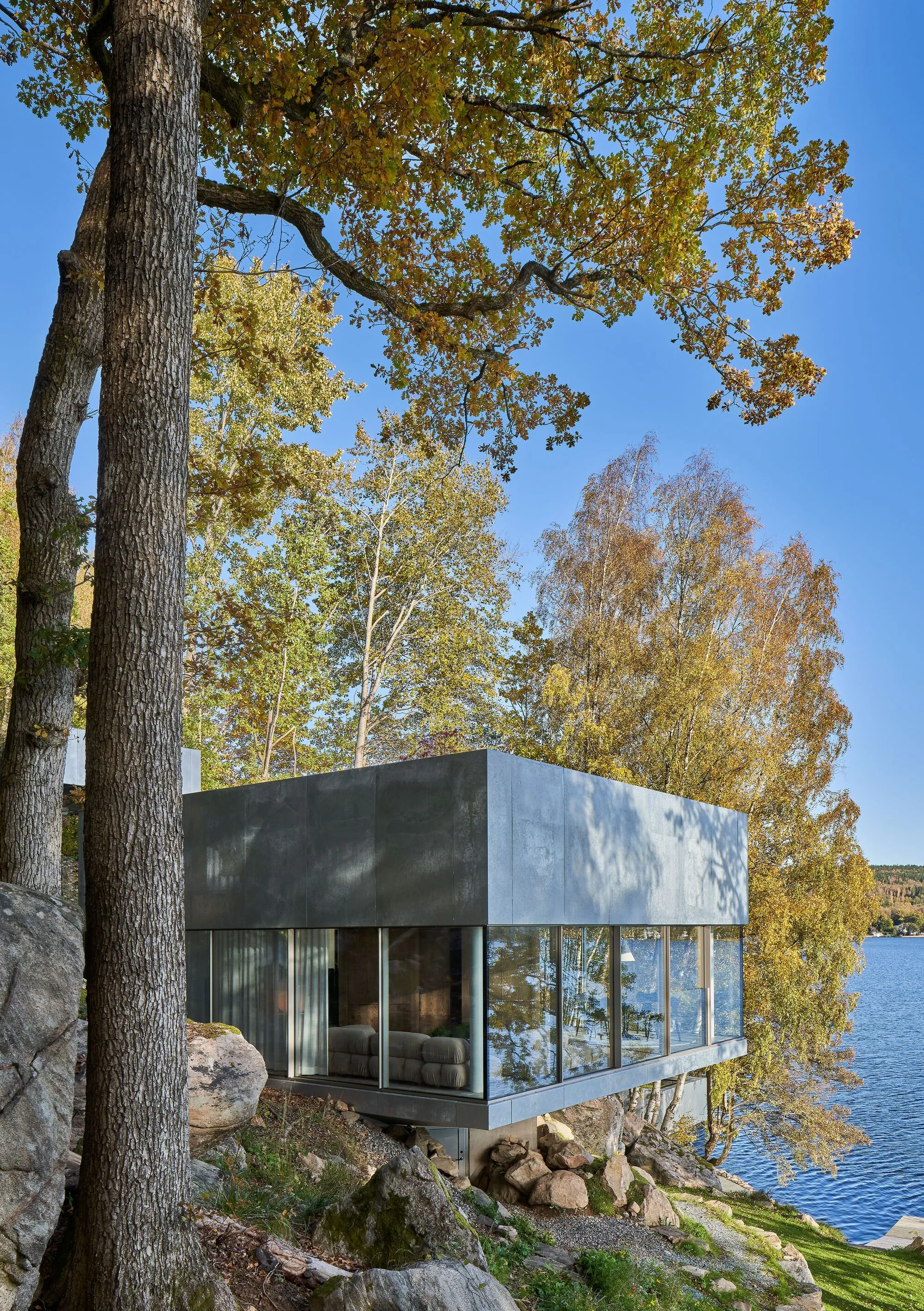
Claesson Koivisto Rune Floats Crystal Pavilions Above a Swedish Lakeside Rock Shelf
A 65-square-metre getaway near Borås lands four zinc-and-glass volumes on a steep, boulder-strewn slope at the edge of a forest lake.


Somewhere outside Borås, down a one-lane country road cut into a forested hillside, a rocky slope tumbles toward the shore of a Swedish lake. The site is steep, strewn with moss-covered boulders and flanked by birch and pine. It is the kind of place that resists building. Claesson Koivisto Rune, led by Mårten Claesson, treated that resistance as a design brief: rather than flatten the terrain, they placed four small cubic structures across it like rock crystals that have surfaced from the ground, barely touching the earth beneath them.
What makes the Borås Getaway House genuinely interesting is the compression. At 65 square metres, the main house is roughly the footprint of a generous studio apartment, yet it reads as four distinct rooms organized around a rotated inner core. The annex, sauna, and carport are separate buildings, each parallel to one another but turned 45 degrees to the lake. That rotation is not decorative: it widens the cone of water views from every glazed face while reducing glare from reflected sunlight. The result is a weekend retreat that feels expansive without consuming the landscape it occupies.
Touching Ground Lightly
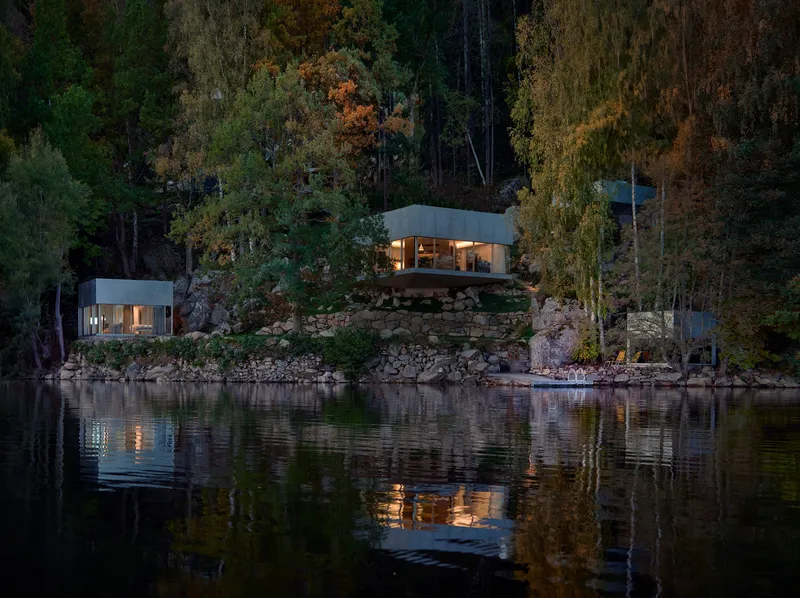
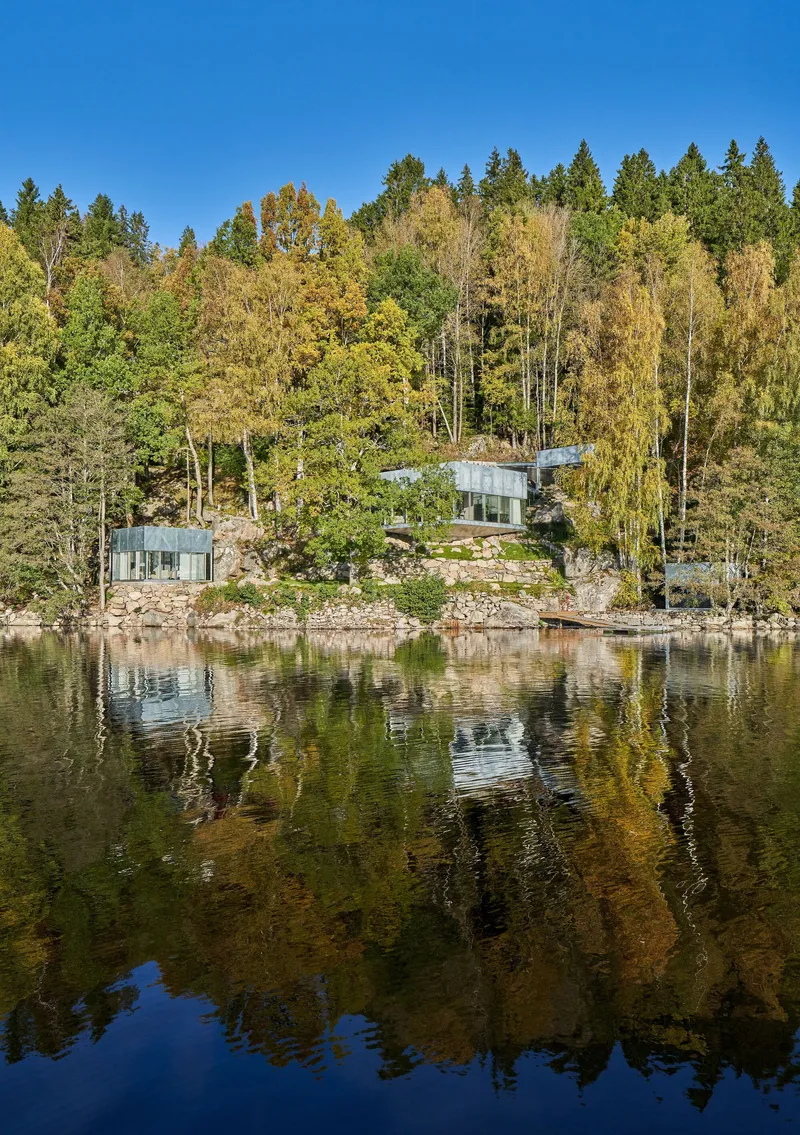
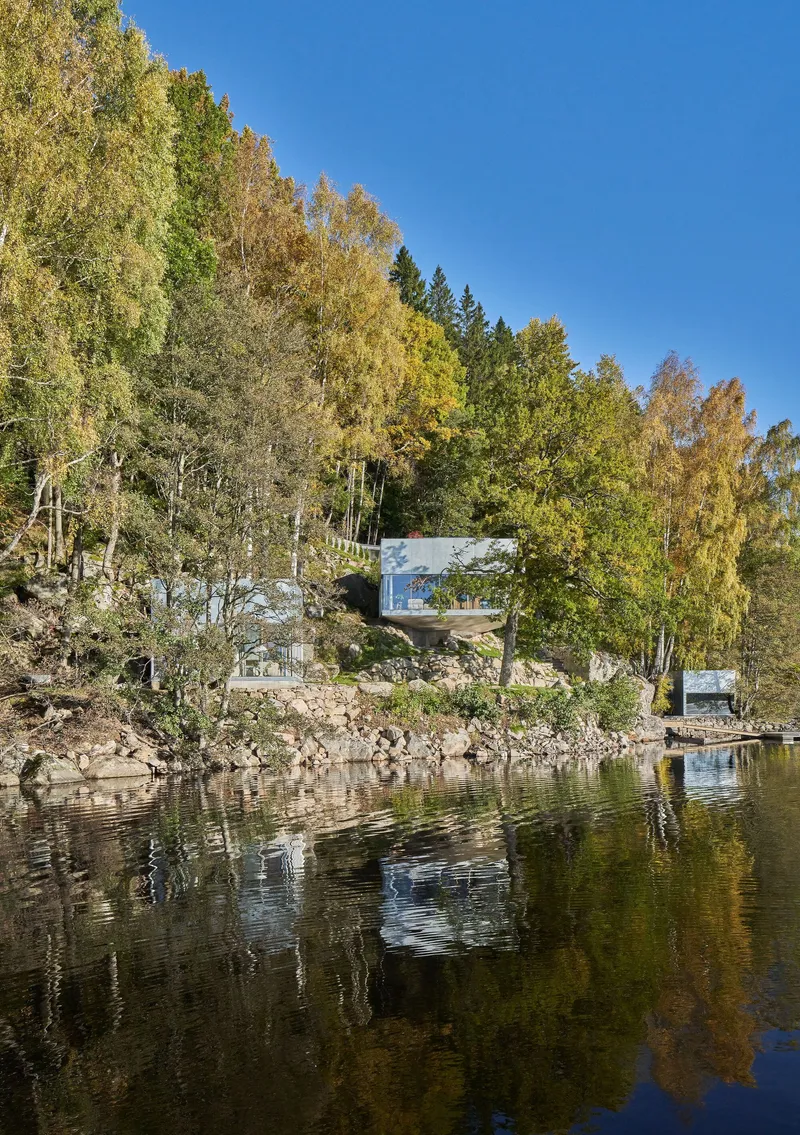
Seen from the water at dusk, the three lakeside volumes glow against the dark hillside like lanterns set into a geological display case. The buildings do not sit on the slope so much as hover above it, each cantilevered from a central structural core that descends into the rock below. Claesson Koivisto Rune describe the concept as a mushroom stalk: the inner cube carries the load while the surrounding glass envelope projects outward, freeing the perimeter from columns and giving the occupant unobstructed sightlines in every direction.
The small footprint strategy is ecological and aesthetic at once. Boulders, root systems, and drainage patterns remain largely intact. The buildings look as though they could be lifted away, leaving only a few concrete scars. For a lakeside getaway, that impermanence feels appropriate.
Zinc, Glass, and the Promise of Zero Maintenance
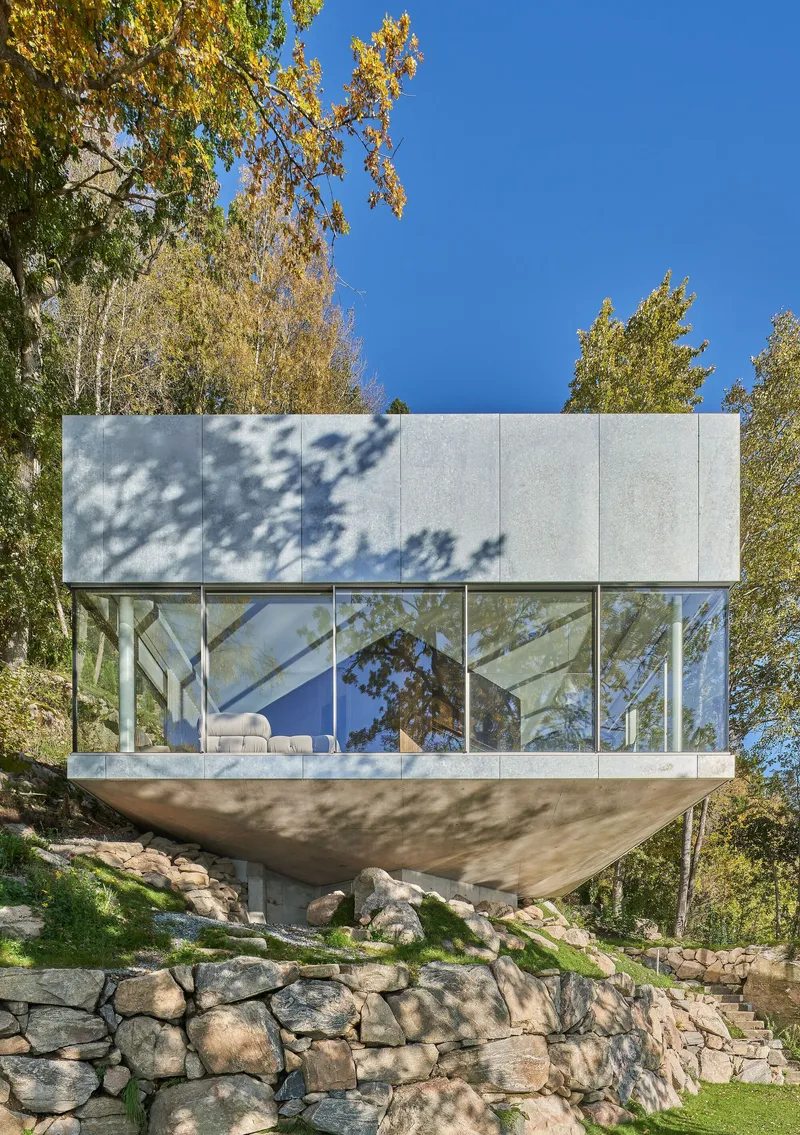
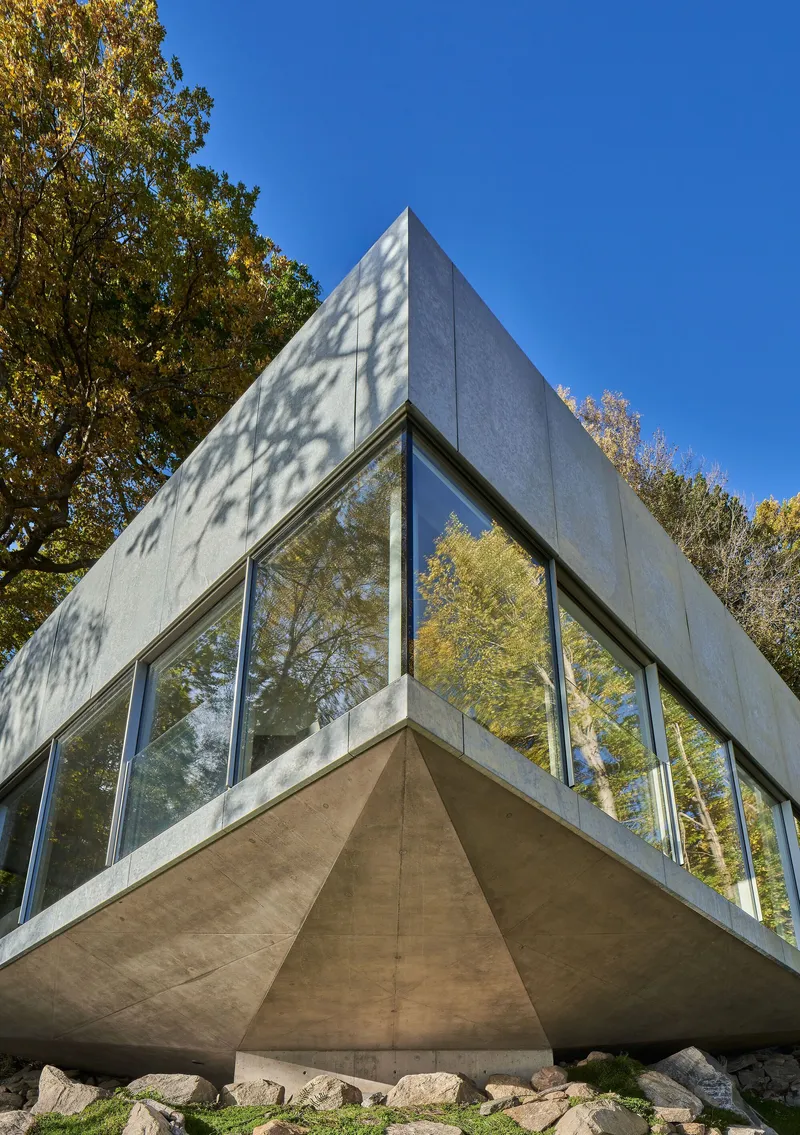
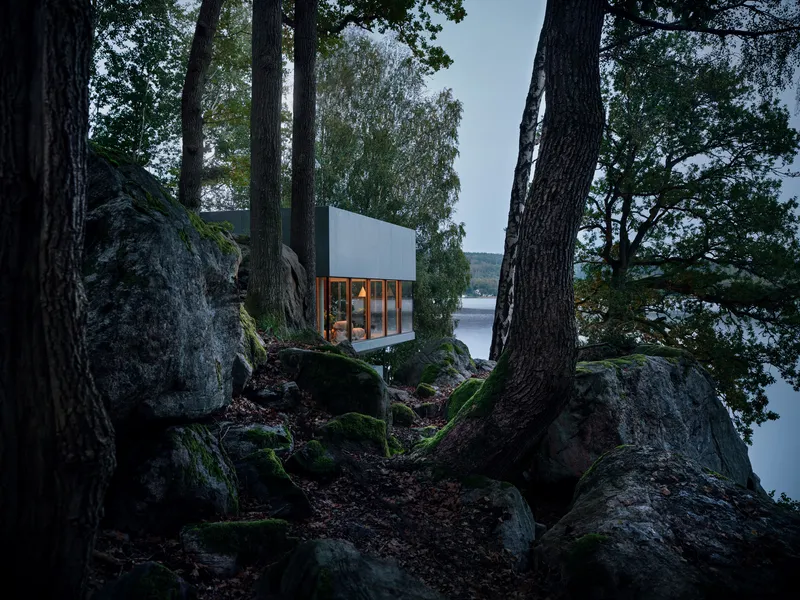
The material palette is deliberately short: galvanized steel left untreated to oxidize and develop its own patina over time, floor-to-ceiling glass, and a warm timber lining for the inner core. The zinc cladding will shift from bright metallic to a matte grey that echoes the granite boulders underfoot. Claesson Koivisto Rune call this an "honest" approach: no paint, no stain, no scheduled upkeep. For clients who come here to escape the obligations of daily life, a building that ages without asking for attention makes conceptual sense.
Concrete appears where structure meets ground, forming retaining walls and inclined supports that anchor each volume to the slope. Where glass meets zinc, the junction is clean and unornamented. The detailing is precise without being fussy, a quality that keeps these small buildings from feeling precious.
The Rotated Core
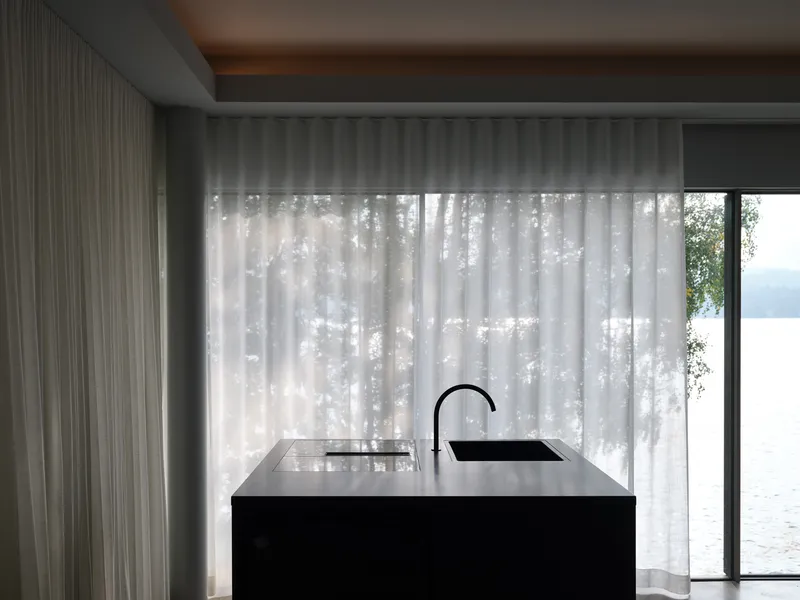
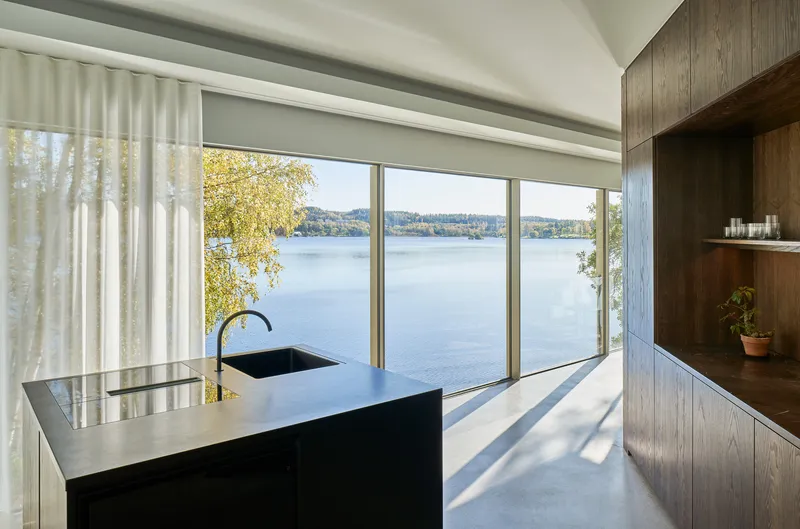
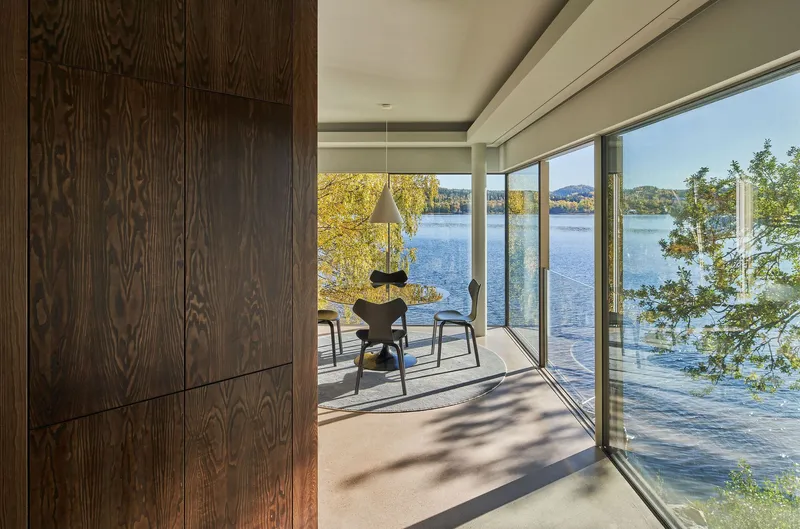
Inside the main house, a timber-clad cube sits rotated 45 degrees to the outer envelope. It contains the bathroom, kitchen, and storage: everything that needs plumbing and enclosure concentrated into one compact nucleus. The rotation creates four triangular zones around the core, each functioning as a separate room. You move from entrance and kitchen through a dining area and living room to the bedroom without ever encountering a corridor. At 65 square metres, there is no space to waste on circulation.
The kitchen itself is anchored by a black stone island with an integrated sink. Timber cabinetry wraps the core face behind it, while sheer curtains filter the lake light that pours through the surrounding glass. The effect is calm rather than dramatic. You are always aware of water and trees, but the interior holds its own warmth.
Living Between Trees and Water
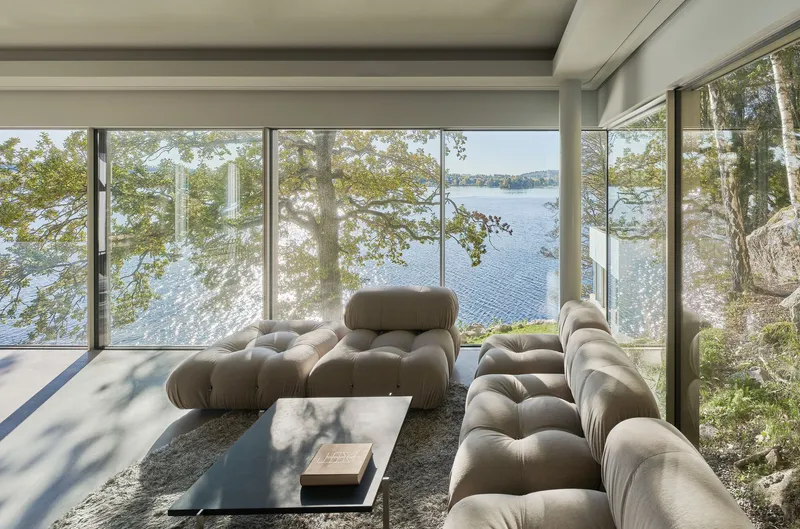
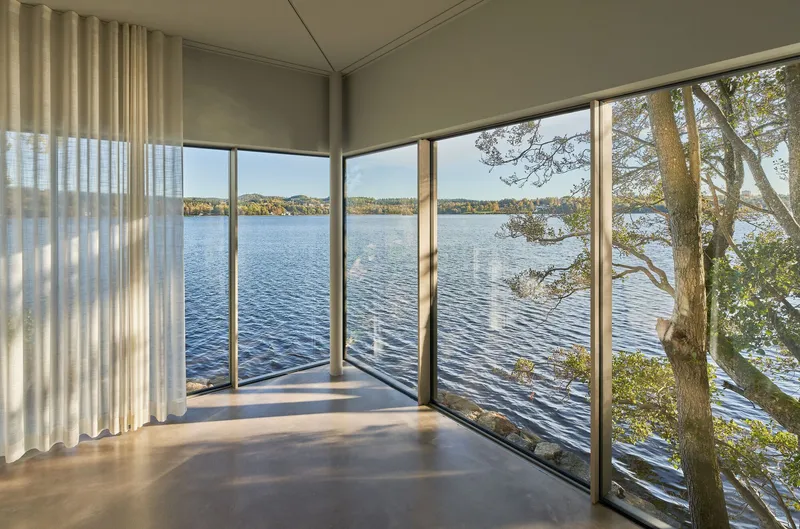
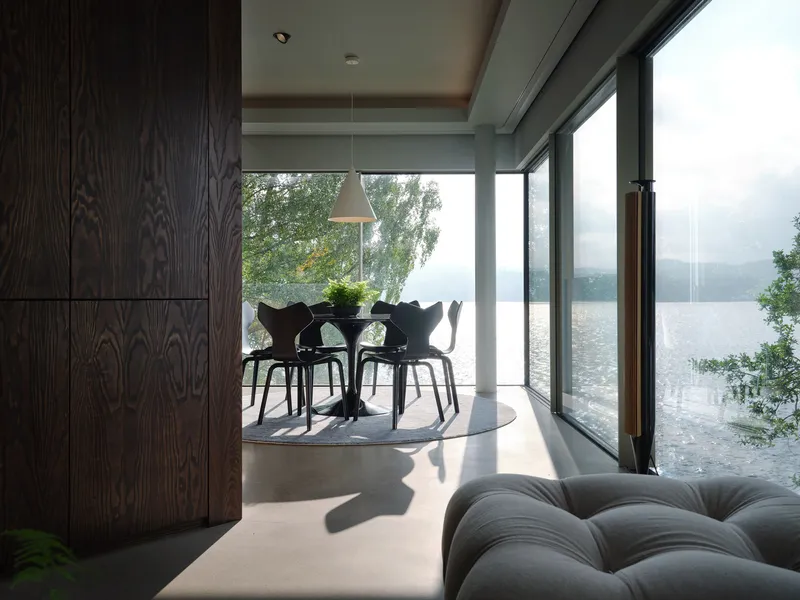
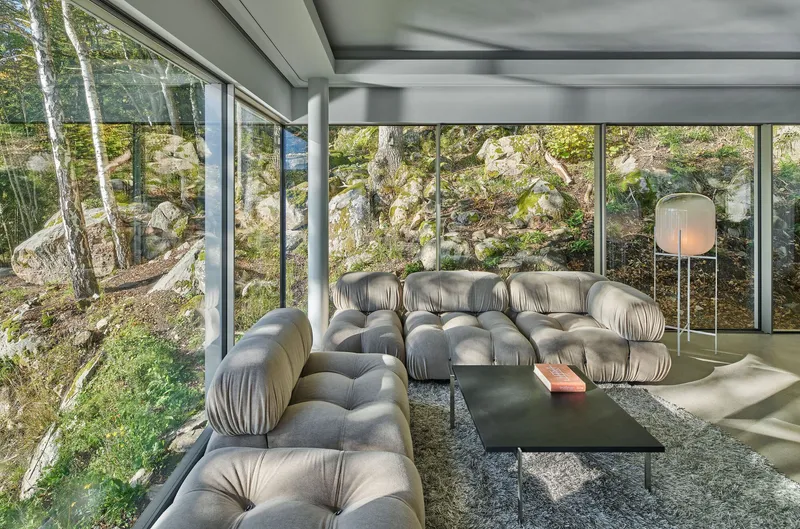
The full-height glazing does not simply frame a view; it dissolves the boundary between furniture and forest. In the living room, dappled shadows from overhanging oak branches play across the grey seating, shifting through the day as the sun arcs over the lake. The dining area captures morning mist rising off the water. The bedroom corner catches afternoon light filtered through birch canopy. Each of the four rooms around the rotated core has its own relationship with the landscape.
There is a risk with this much glass: the house could feel exposed, more aquarium than shelter. Claesson Koivisto Rune mitigate that by siting the volumes among boulders and mature trees that provide natural screening. The 45-degree rotation helps too, angling the glass faces away from the access road so privacy comes from geometry rather than curtains.
Sauna, Terrace, and the Satellite Buildings
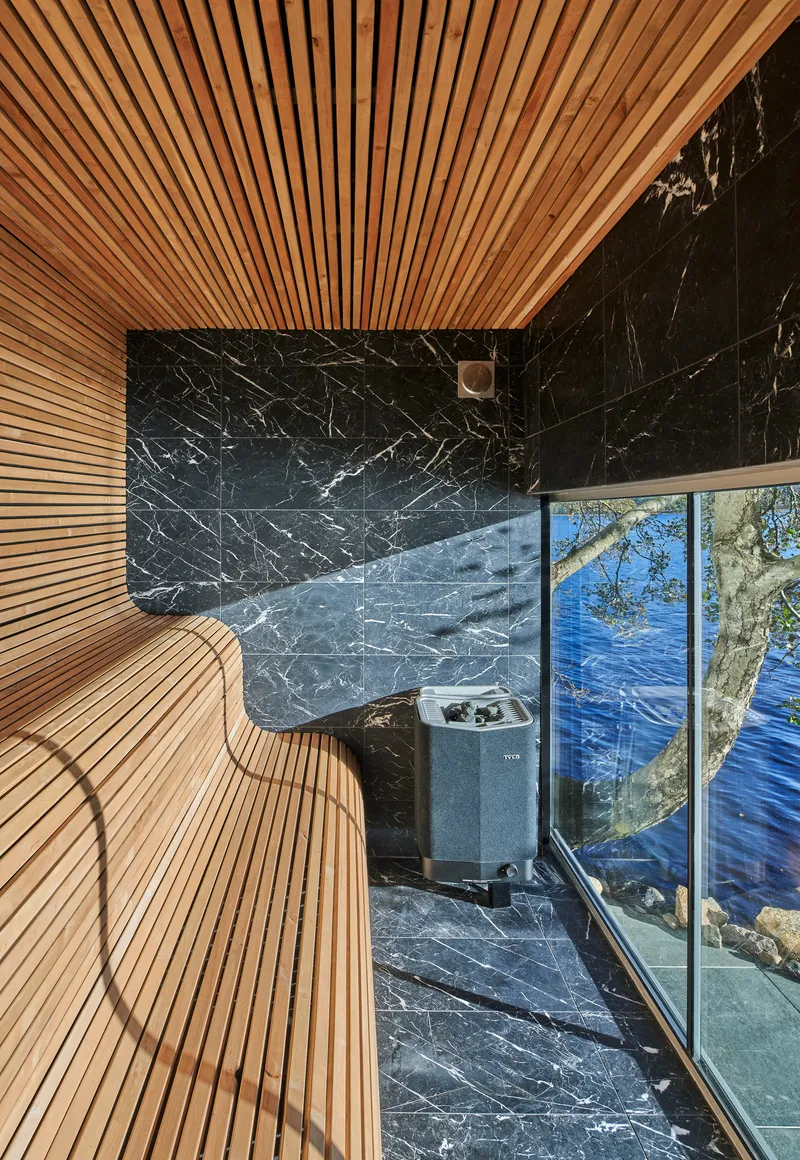
The sauna is its own building, lined with slatted timber on the ceiling and benches and backed by a wall of black veined marble that faces the water. It is a serious room, not a novelty. The twin-bedroom annex and carport complete the quartet, each volume maintaining the same cubic language and parallel orientation. Spreading the program across four structures rather than consolidating it into one allows each building to find its own perch on the uneven terrain and keeps the individual footprints small enough to slip between trees.
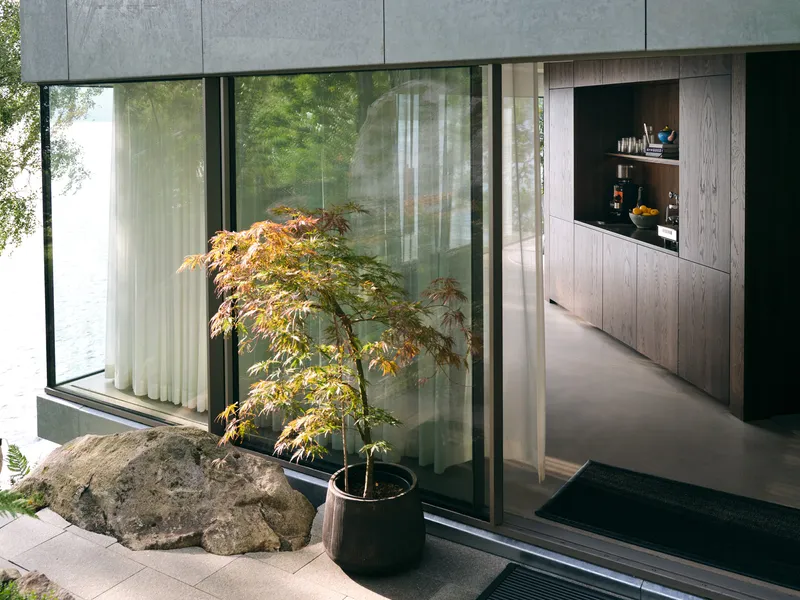
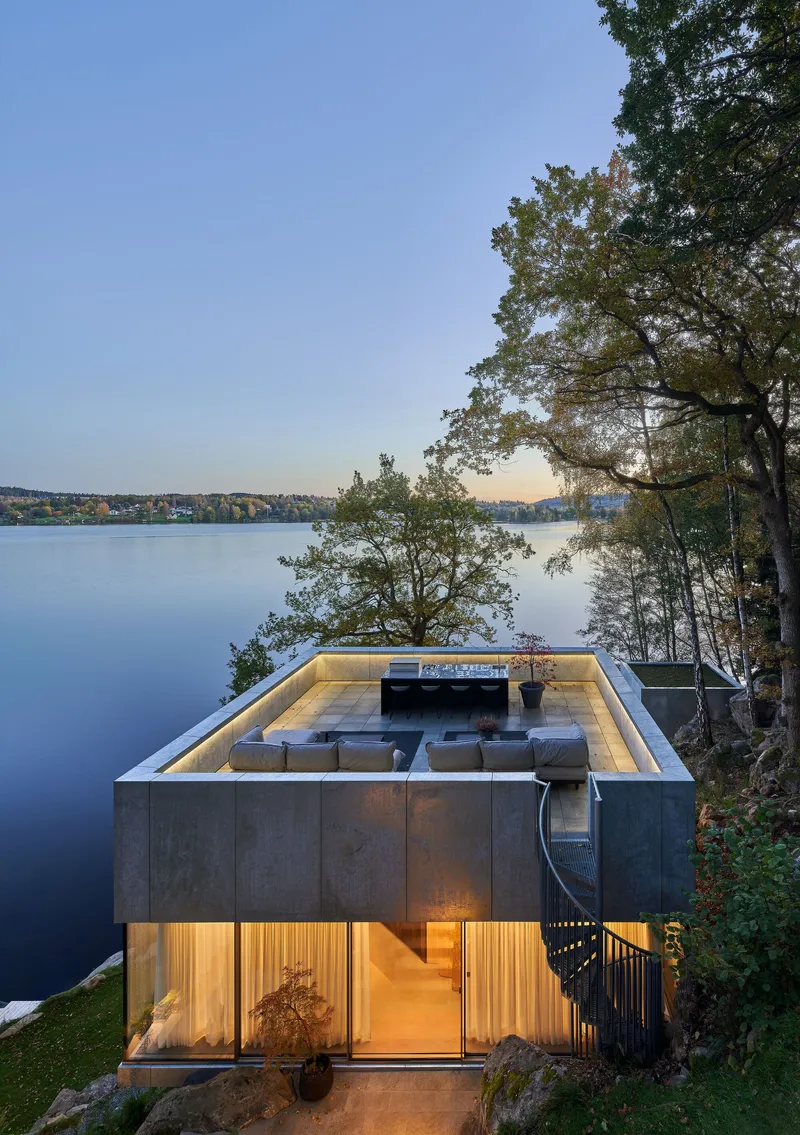
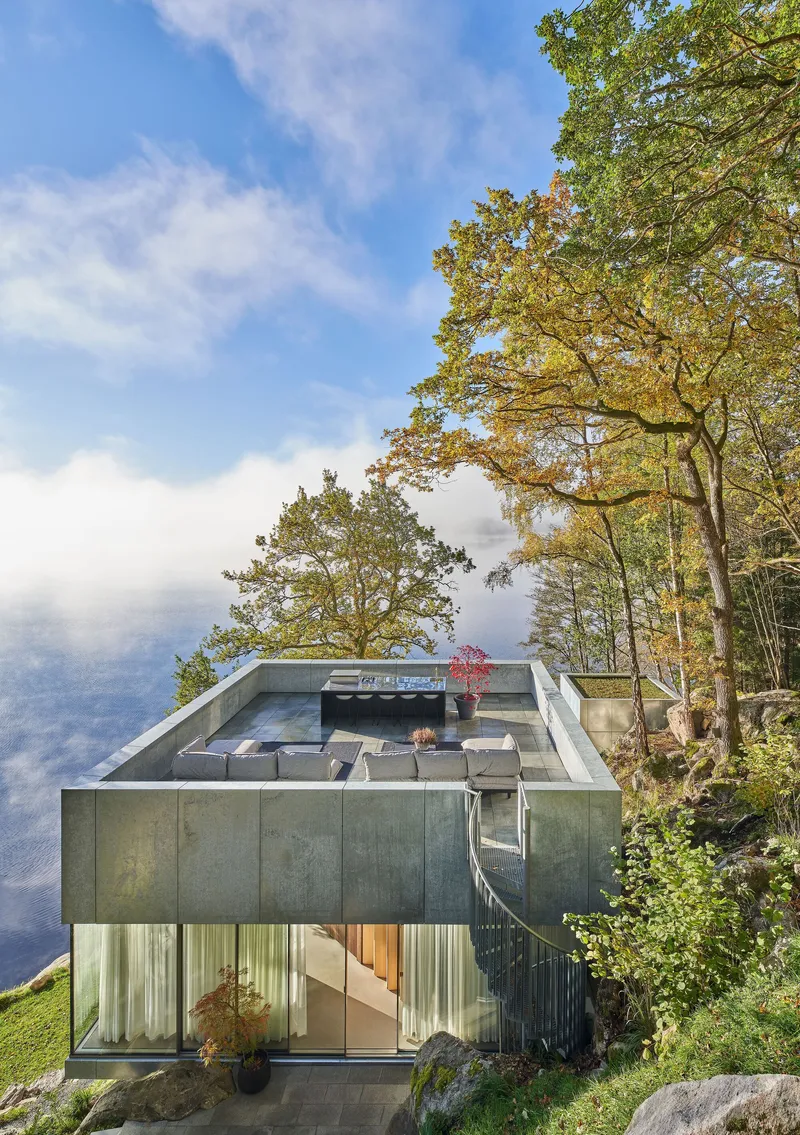
Outside, a terrace with a potted maple sits adjacent to the main house, offering a transitional zone between conditioned interior and wild granite slope. At dusk the roof terrace above the lower level becomes a viewing platform, the illuminated timber and glass walls below casting a warm glow onto the surrounding rock.
Marble, Timber, and Interior Precision
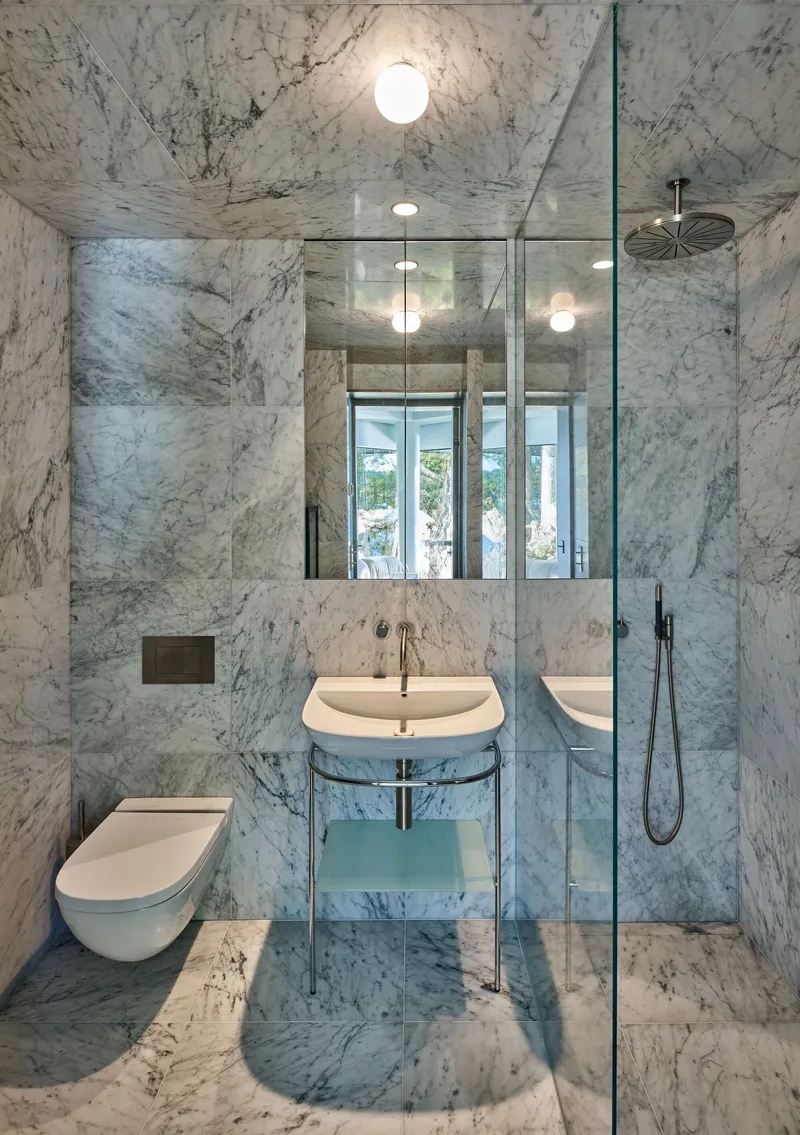
The bathroom is clad entirely in white veined marble, floor to ceiling, with a glass shower enclosure and a pair of globe pendant lights that hover like small moons. It is a deliberate contrast to the raw granite outside: polished stone against weathered stone, controlled geometry against geological chaos. The material choice elevates the compact bathroom into the most luxurious space in the house.
Throughout the interiors, the palette stays restrained. Grey upholstery, dark wood paneling on the core walls, and the ever-present glass envelope keep the visual noise low. Claesson Koivisto Rune call this "deluxe compact living," and the term fits. Nothing feels sacrificed; every surface earns its place.
Dusk and the Architecture of Escape
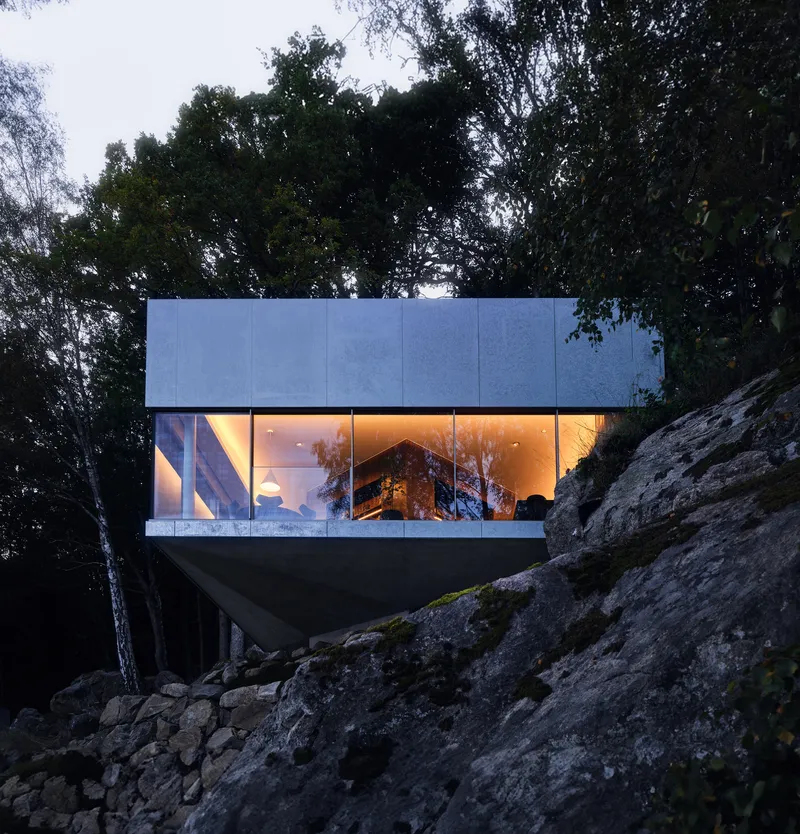
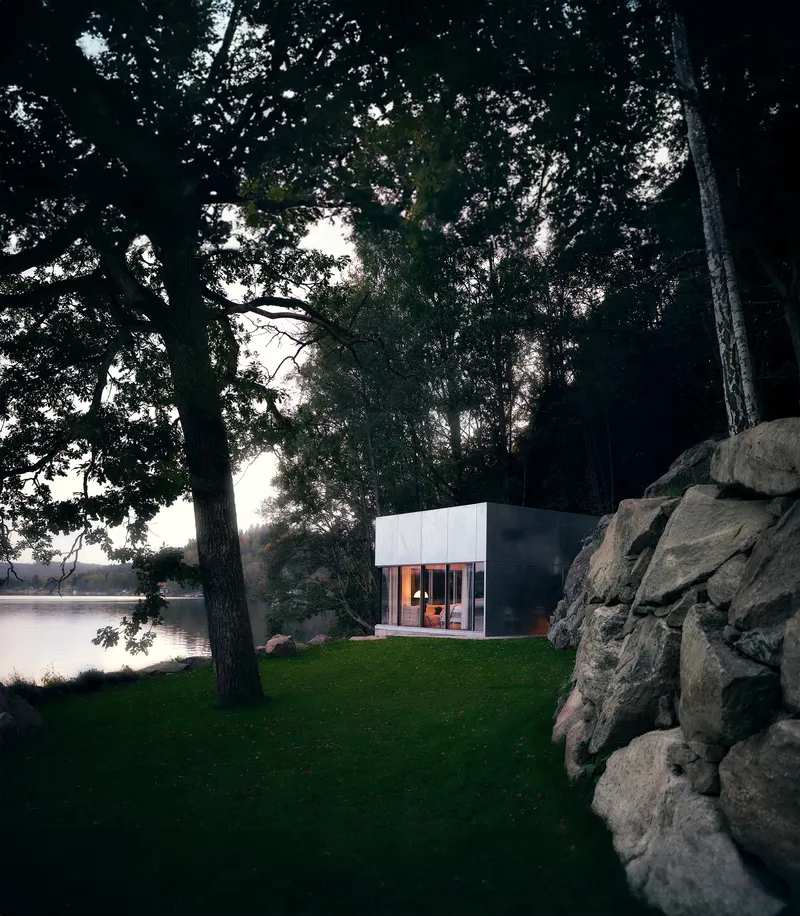
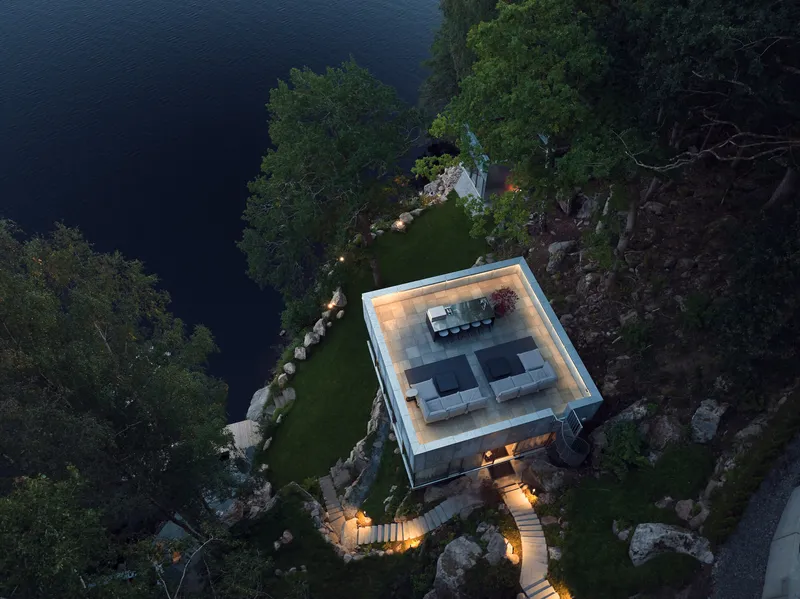
At twilight, the pavilions reveal their logic most clearly. The illuminated interiors turn each volume into a glowing box suspended above dark rock, the cantilever visible now as a shadow gap between building and ground. The aerial view confirms what the sections promise: these are flat-roofed glass objects dropped onto a terrain that has barely been altered to receive them. The lawn clearing between rocky outcrops is the only concession to domesticity.
The getaway house is a genre with deep roots in Scandinavian culture, but Claesson Koivisto Rune push it away from the red-painted timber cabin tradition toward something more crystalline and abstract. Whether that abstraction will age as gracefully as a weathered log wall remains to be seen. For now, the zinc is still bright and the boulders are still in charge.
Plans and Drawings
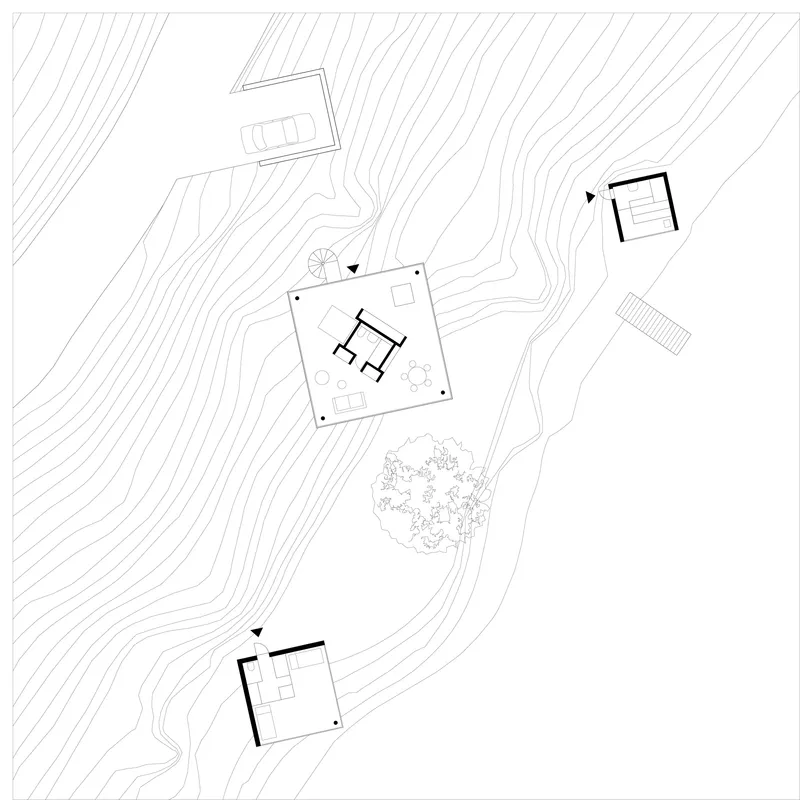
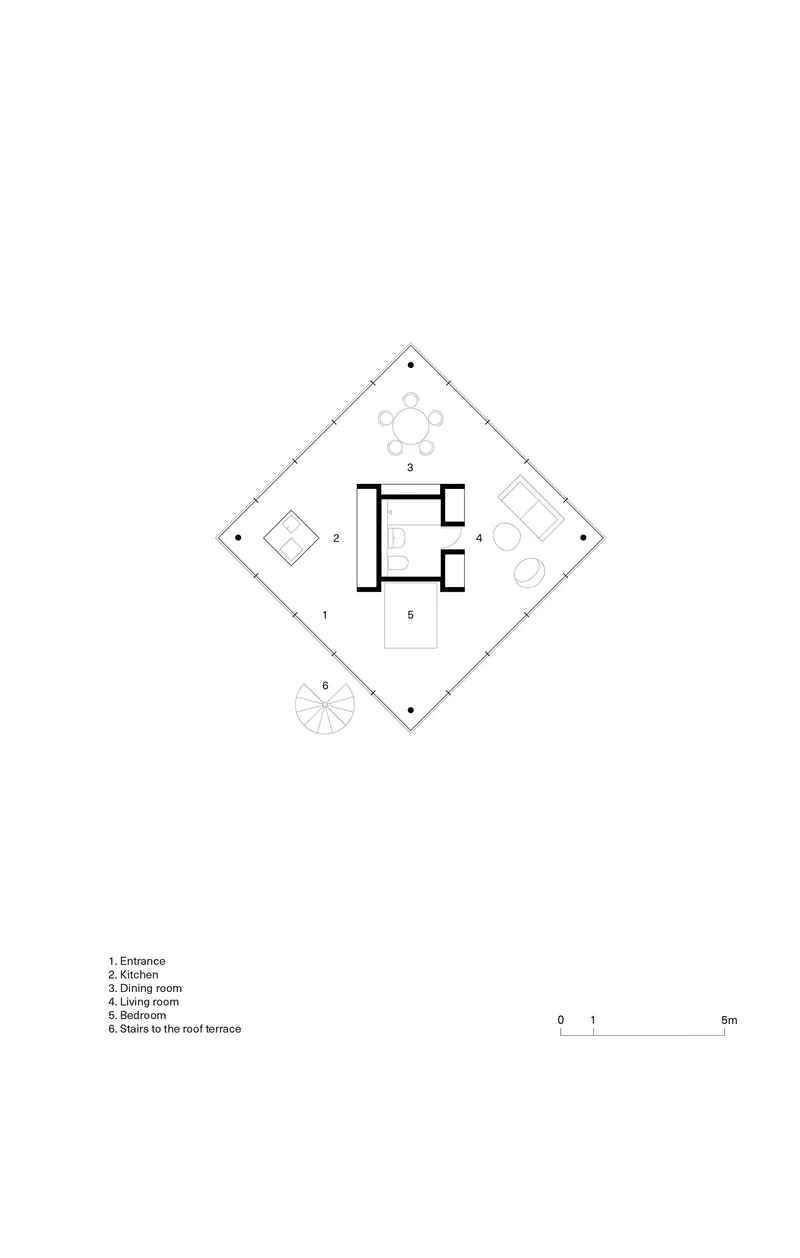
The site plan reveals how the four structures are distributed across the contour lines, each building slotted into the slope at the same 45-degree orientation. The floor plan of the main house makes the rotated-core strategy legible: a diamond shape inscribed within the rectangular envelope, its four faces generating the entrance, dining, living, and sleeping zones. The economy of the diagram is striking. One rotation resolves structure, program, and spatial sequence in a single move.
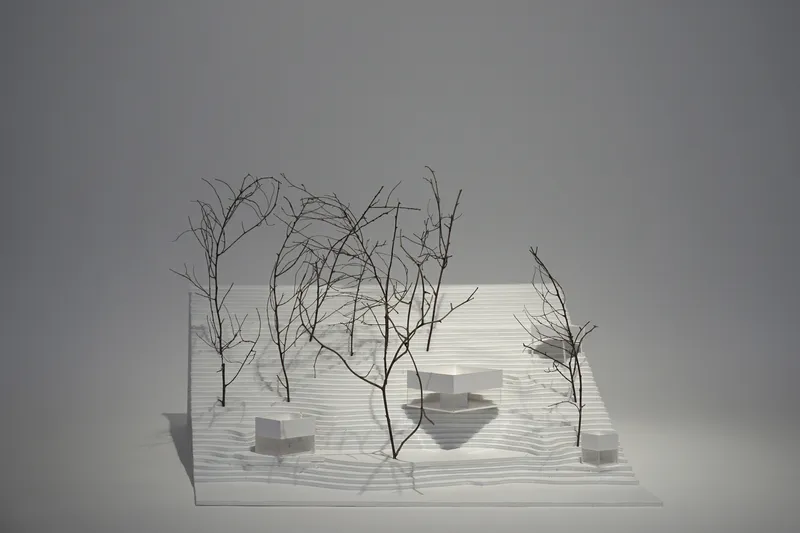
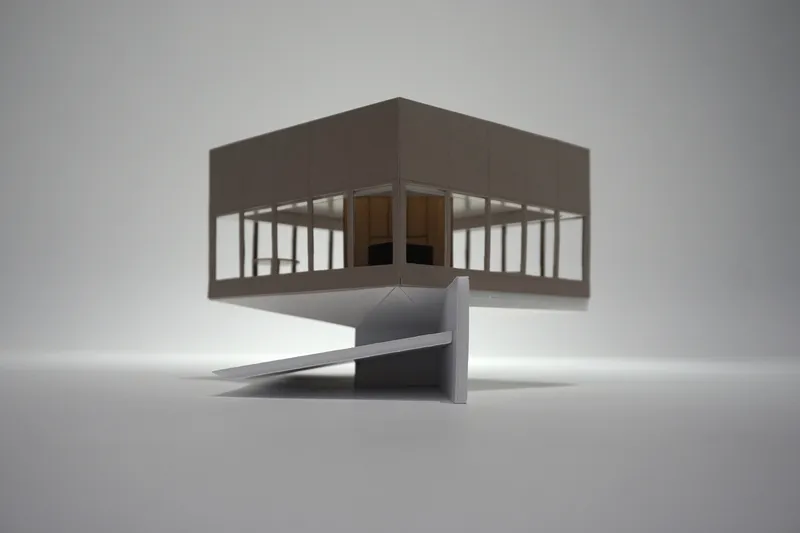
The physical models reinforce the sectional ambition. Layered white platforms evoke the terraced rock shelf, while the elevated pavilion model shows the concrete pedestal and folded access ramp that get occupants from road level down to the house. These are study models, not presentation renders, and they communicate the structural idea with a directness the photographs sometimes obscure.
Why This Project Matters
The Borås Getaway House is a case study in what happens when a firm known for refined minimalism meets a site that is anything but minimal. The rocky, sloping, forested shore could have produced either a timid cabin tucked behind trees or an aggressive glass box imposed on the landscape. Claesson Koivisto Rune found a third path: a set of small, precise volumes that engage the terrain through geometry and structural ingenuity rather than mass. The mushroom-stalk foundation, the rotated inner core, the 45-degree site alignment: each decision solves multiple problems at once, which is the mark of a well-resolved project.
At a moment when the Swedish housing conversation increasingly revolves around density and urban infill, a 65-square-metre lakeside retreat might seem like an indulgence. But compact buildings on difficult sites are their own kind of discipline. Every square metre here is accounted for, every material chosen to require nothing from its owner over time. If escape is the brief, maintenance-free honesty is a credible answer.
Borås Getaway House by Claesson Koivisto Rune, lead architect Mårten Claesson. Borås, Sweden. 65 m². Completed 2024. Photography by Patrik Johäll and Åke E-son Lindman.
About the Studio
Share Your Own Work on uni.xyz
If projects like this are the kind of work you want to make, uni.xyz is a place to publish your own, find collaborators, and enter design competitions.



Popular Articles
Popular articles from the community


The Ocean Hive: Sustainable Architecture for a Self-Sufficient Civilization at Sea
The Ocean Hive imagines sustainable architecture at sea, where modular habitats, algae, wave power and ocean waste sustain a growing colony.

Riyadh For All: Intergenerational Urban Design for Active Aging in Rabat
Riyadh For All reimagines urban design in Rabat with intergenerational co-living, adaptive courtyards, and Moroccan cultural exchange today.

Lunar Spiral: Space Architecture Shaped by the Mathematics of the Universe
Lunar Spiral reimagines space architecture through Fibonacci geometry, lunar regolith, levitating habitats, and self-sustaining Moon living.

Hill & Cross Opera: Sculptural Opera House Architecture Shaped by Tallinn’s Landscape and Identity
Hill & Cross Opera reimagines opera house architecture in Tallinn through its sculptural hill, civic plaza, glass wave and a luminous cross.


Similar Reads
You might also enjoy these articles

Bao Huynh Watercolor Atelier: A Serene Art Retreat in Hội An
Bao Huynh Watercolor Atelier in Hội An blends multifunctional art spaces, sustainable design, local materials, and family-friendly living in a serene environment.

Atelier Macri Concept Store Interior Design by CASE-REAL
Atelier Macri store features a "ko" counter, walnut wood details, cork displays, blending retail, gallery, and seamless customer experiences.

Manuel Vargas Izquierdo Stadium and High-Performance Sports Center: Architectural Excellence in Jalpa de Méndez
The Manuel Vargas Izquierdo Stadium blends sustainable design, inclusive sports facilities, and cultural-inspired architecture, revitalizing Jalpa de Méndez’s public spaces.

KAKR Buluh Awar Hall: Revitalizing Community and Ecology Through Bamboo Architecture
Community built bamboo hall revitalizes Buluh Awar village, empowering youth, restoring ecology, celebrating vernacular craftsmanship through sustainable architecture and culture.




Comments (0)
Please login or sign up to add comments
No comments yet. Be the first to comment!