
CLAY COOP Architects Weaves Kerala Tradition and Tropical Calm into a Double-Height Family Home
Inara House in Vaikom, India, channels the stack effect and sloping roofs of Kerala vernacular into a generous 295 m² courtyard residence.


Kerala's domestic architecture has always negotiated a delicate problem: how to stay cool, catch every breeze, and still maintain privacy on tight, palm-lined plots. CLAY COOP Architects confronts that problem head-on with Inara House, a 295 m² single-family residence in Vaikom, Kottayam District. The house is pushed to the far end of its east-facing site, a decision that opens the longest possible sightline from the street through to the garden behind while stacking living areas around a central courtyard that breathes.
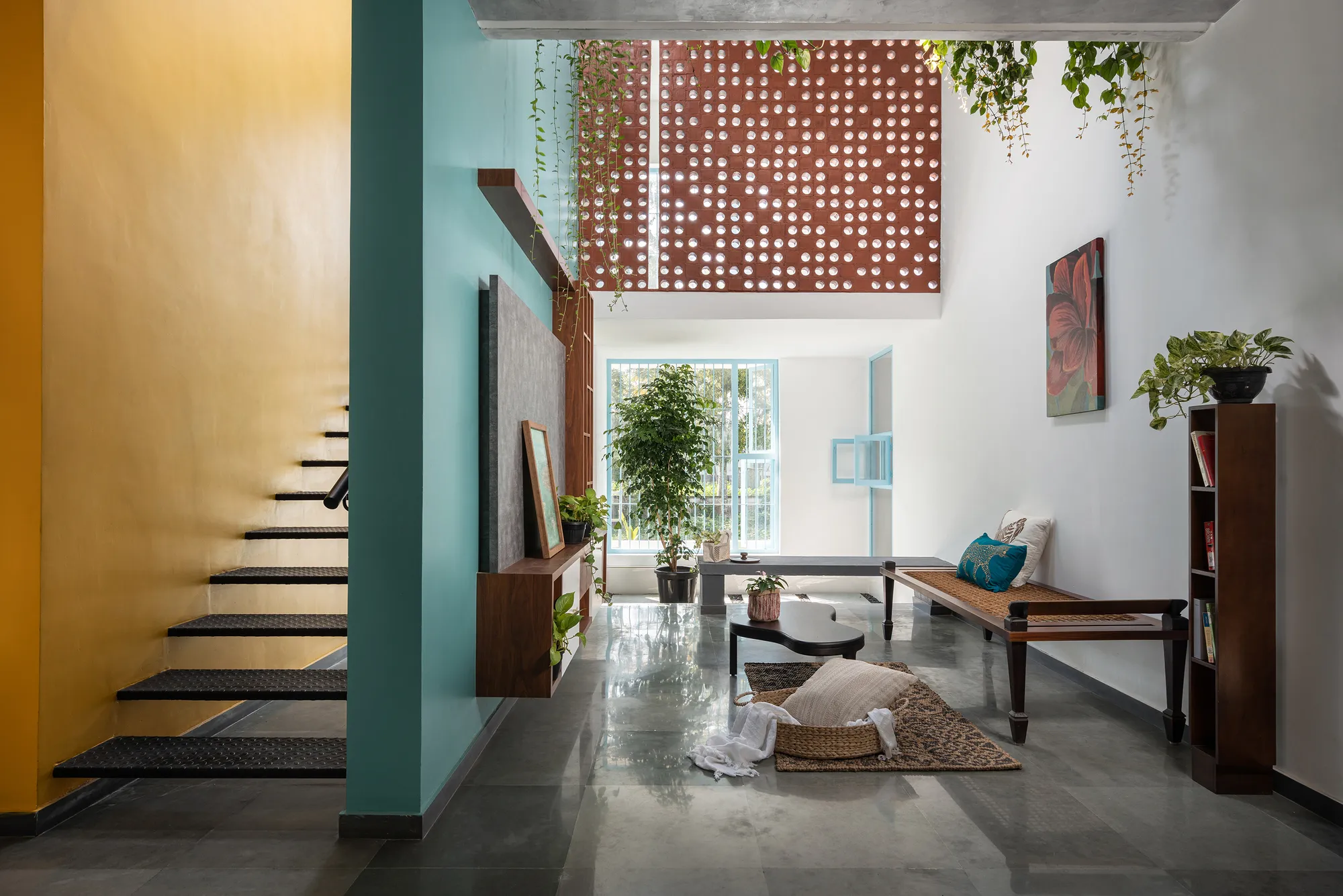
What makes the project worth studying is how it handles volume. A double-height family living space at the core acts as the social and environmental engine of the house, pulling warm air up through skylights and perforated brick jali screens while framing greenery that literally cascades from the upper level into the room below. The sloping terracotta roofs on the front facade nod to traditional Kerala house forms, but the concrete, Kota stone, and pastel blue steel frames underneath belong firmly to the present. It is a project that earns its calm rather than merely claiming it.
A Street Facade Rooted in Kerala Tradition
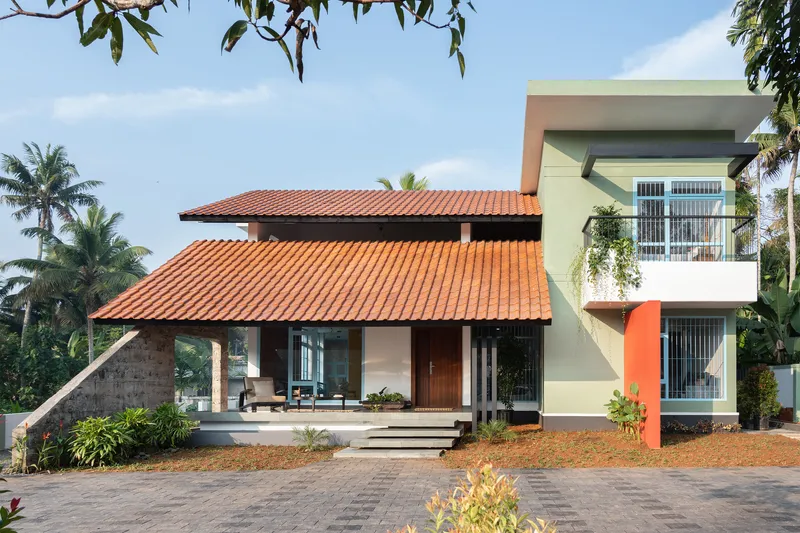
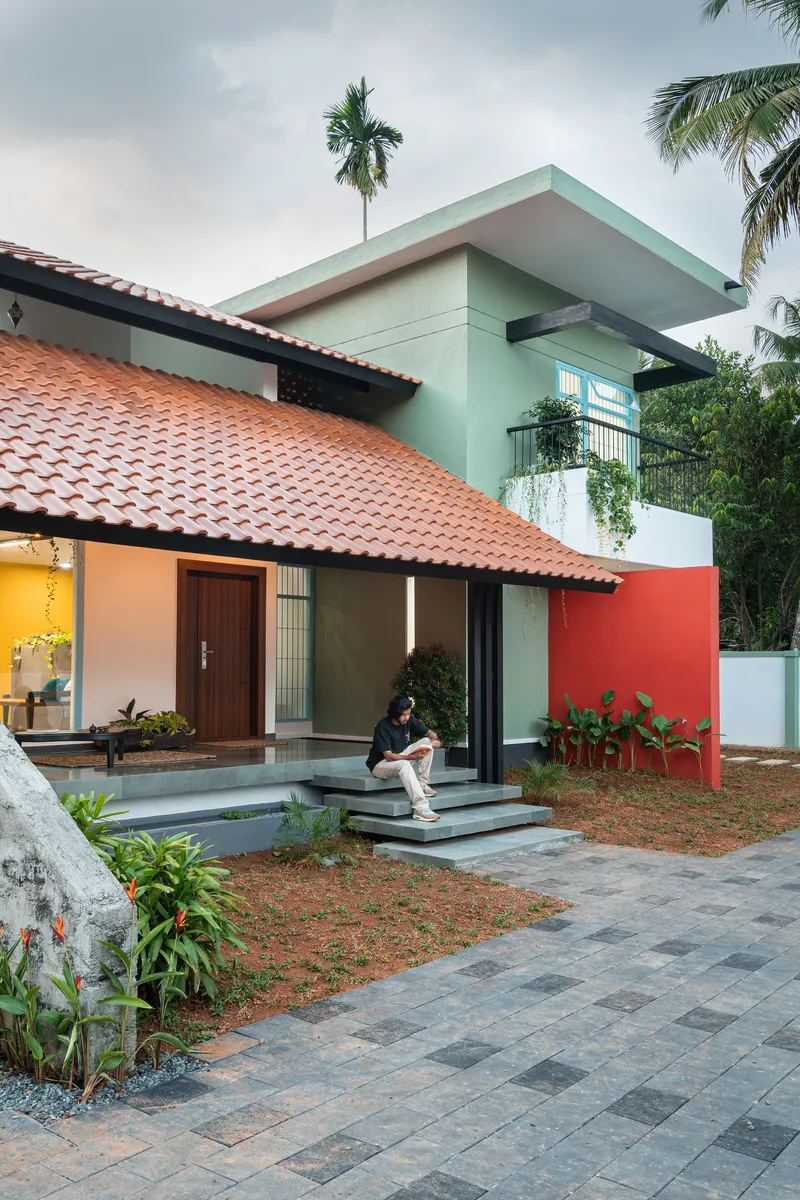
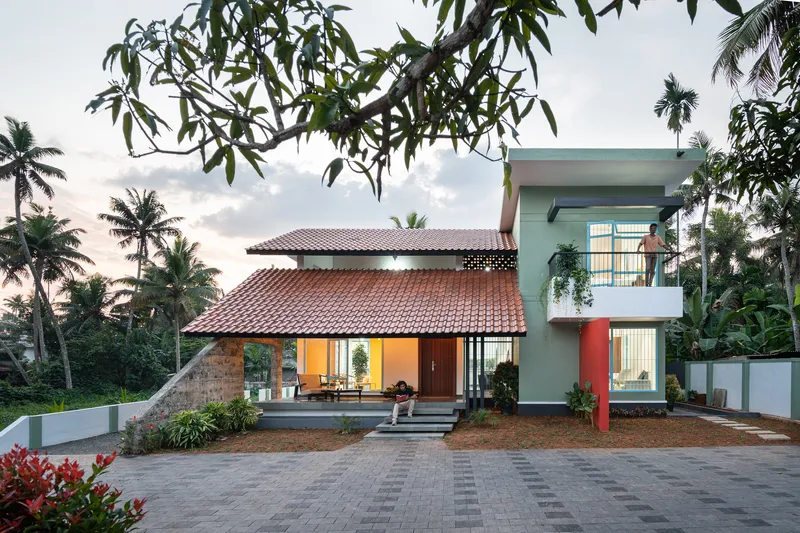
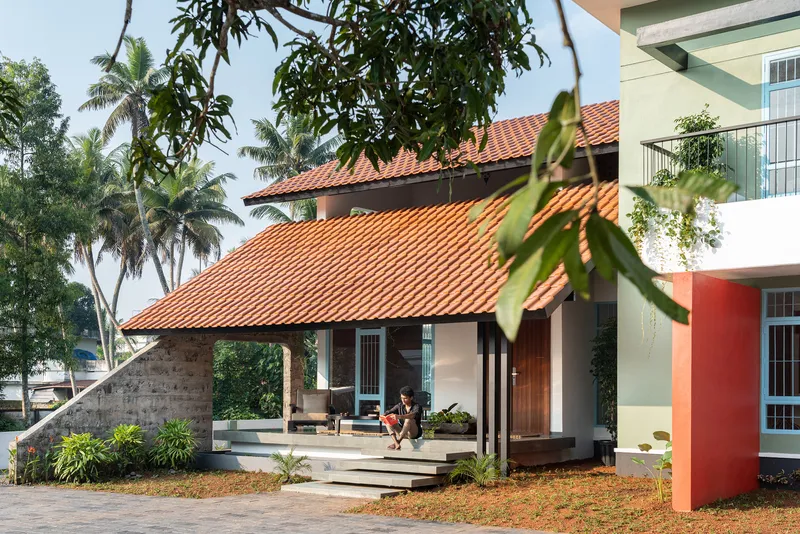
From the street, Inara House reads as a layered composition of sloping terracotta tile roofs, coral red wall planes, and coconut palms. The form is deliberately reminiscent of traditional Kerala residential architecture, where pitched roofs manage monsoon runoff and shade deep verandas. Two sloping roofs sit atop a prominent triangular wall of bare concrete, giving the facade a strong graphic silhouette that is both local and abstract.
The palette matters here. Terracotta, laterite stone, and exposed concrete are all materials that age gracefully under Kerala's heavy rains. The pastel green upper volume and coral red entry wall add personality without competing with the landscape, while the entrance steps and covered porch ground the arrival experience at a human scale. It is a facade that announces the home without shouting.
The Double-Height Core
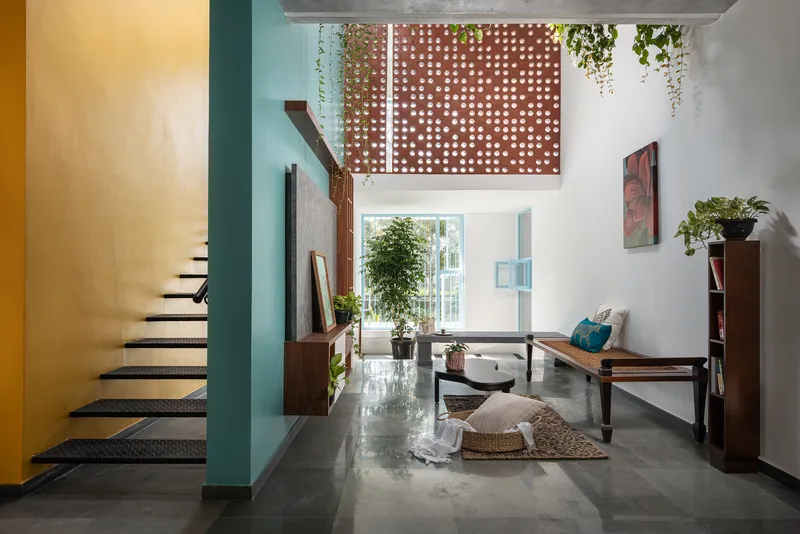
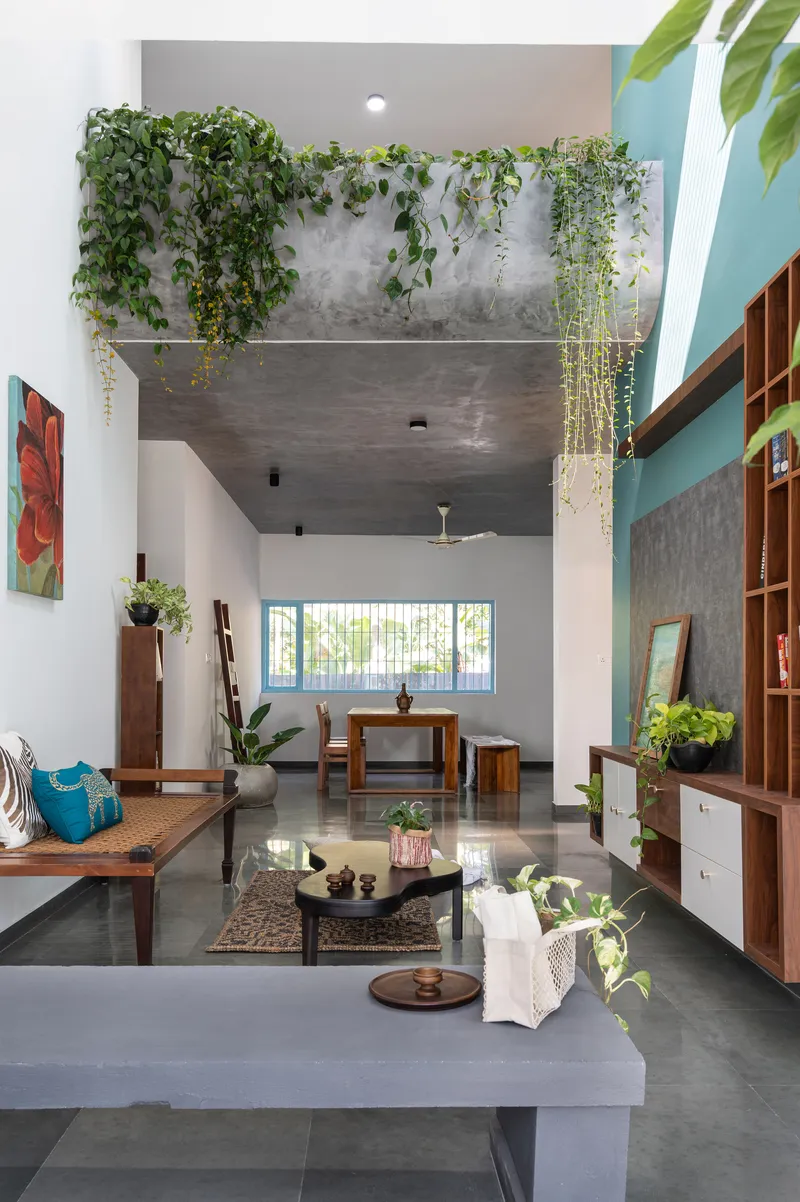
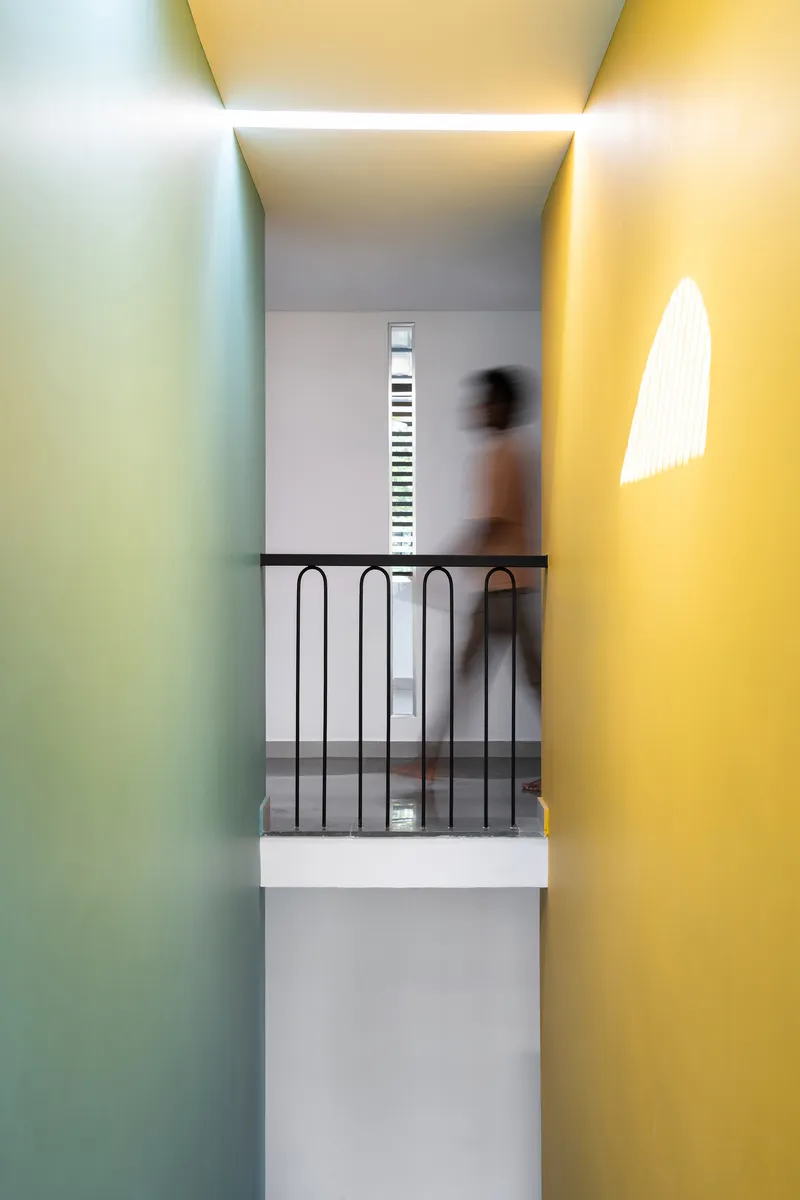
The heart of Inara House is a double-height family living space that connects the main active zones of the home. Bedrooms, dining, and formal living all overlook this volume or its adjacent courtyard. The staircase is set against a yellow ochre wall and serves as a soft divider between formal and informal zones, its minimal design preserving the visual transparency that CLAY COOP was clearly chasing.
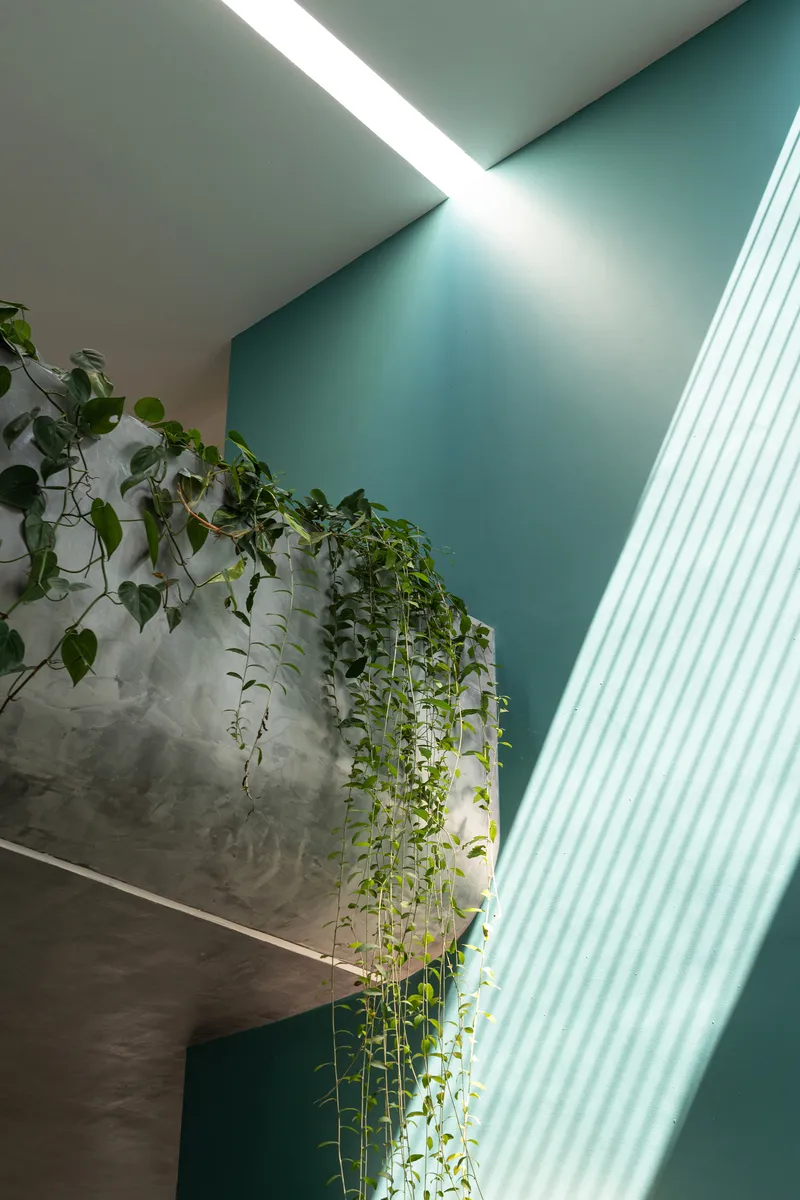
The most striking gesture is the trailing greenery. Vines descend from the upper-level reading area into the family living space through a recessed ceiling slot, turning the section into a vertical garden. Combined with a board-formed concrete ceiling and strategic skylights, the room feels simultaneously protected and open to the sky. The stack effect does real work here: warm air rises through the double height and exits via jali screens and skylight openings, pulling cooler air through the ground-floor living spaces below.
Light, Screen, and Ventilation
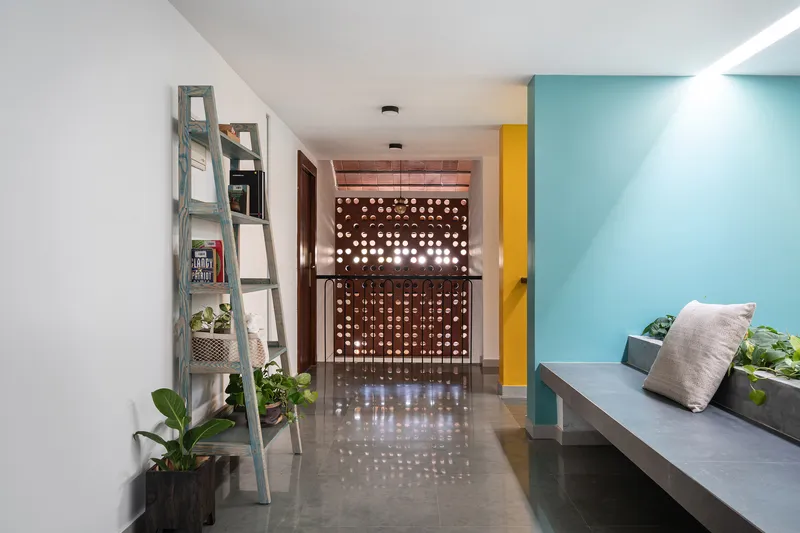
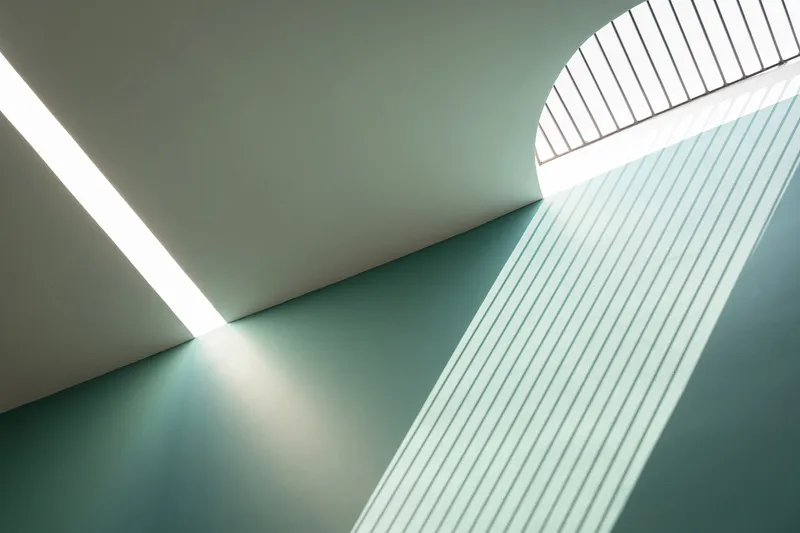
The perforated brick jali screen at the reading area above the courtyard is one of the project's defining details. It filters daylight into deep, polished Kota stone floors, creating shifting patterns that change with the sun's angle. The screen doubles as a passive ventilation device, allowing air to move laterally through the upper level while reducing direct solar gain.
Skylights are placed where they count: above the stairwell, where a shaft of light washes the yellow and green painted walls, and over the main living volume. The pale blue vertical slatted screen visible at the ceiling plane introduces yet another layer of control, modulating the quality of light before it reaches the spaces below. Large windows with blue metal frames connect interiors to the outdoors without compromising the sense of enclosure that a family home requires.
Material Honesty at Every Surface
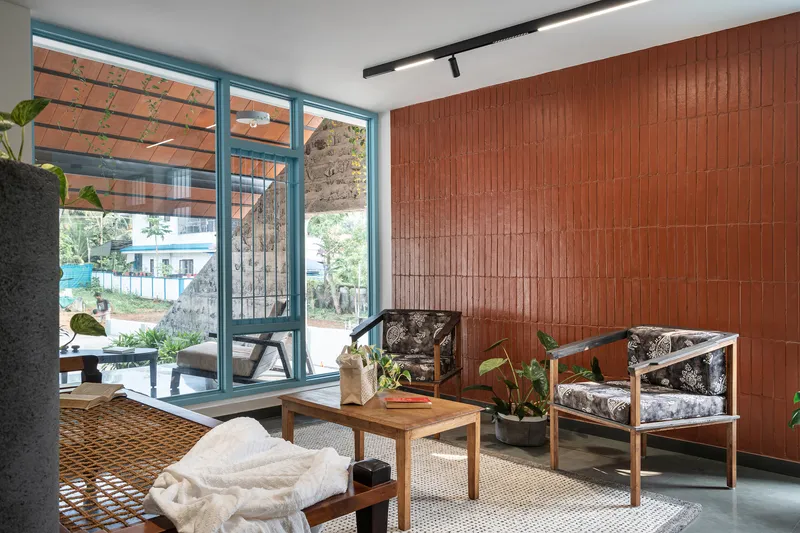
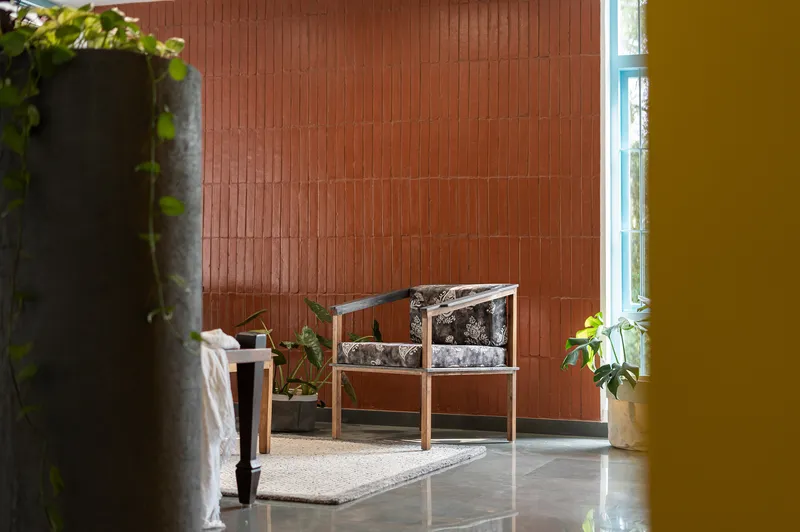
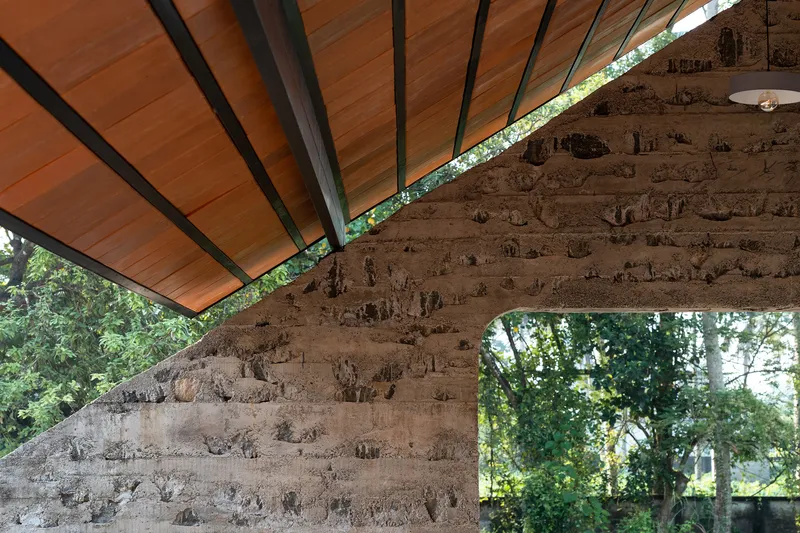
CLAY COOP's material palette is compact but well deployed. Terracotta tiles line interior walls in the living room and seating areas, their warm tones grounding the spaces against the cooler polished concrete floors. Laterite stone appears in columns and garden walls, tying the house to the local geology. Blue metal window and door frames punctuate the otherwise earthy scheme, acting as accent elements that draw the eye toward the courtyard or garden beyond.
The detail at the timber ceiling with exposed black steel rafters is worth noting. The junction of laterite wall, timber, and steel is clean and legible. Each material is left to express its own character rather than being concealed behind plaster. This kind of structural honesty is easy to talk about but difficult to execute in Kerala's humid climate, where maintenance demands are constant.
Threshold Spaces and Landscape Integration
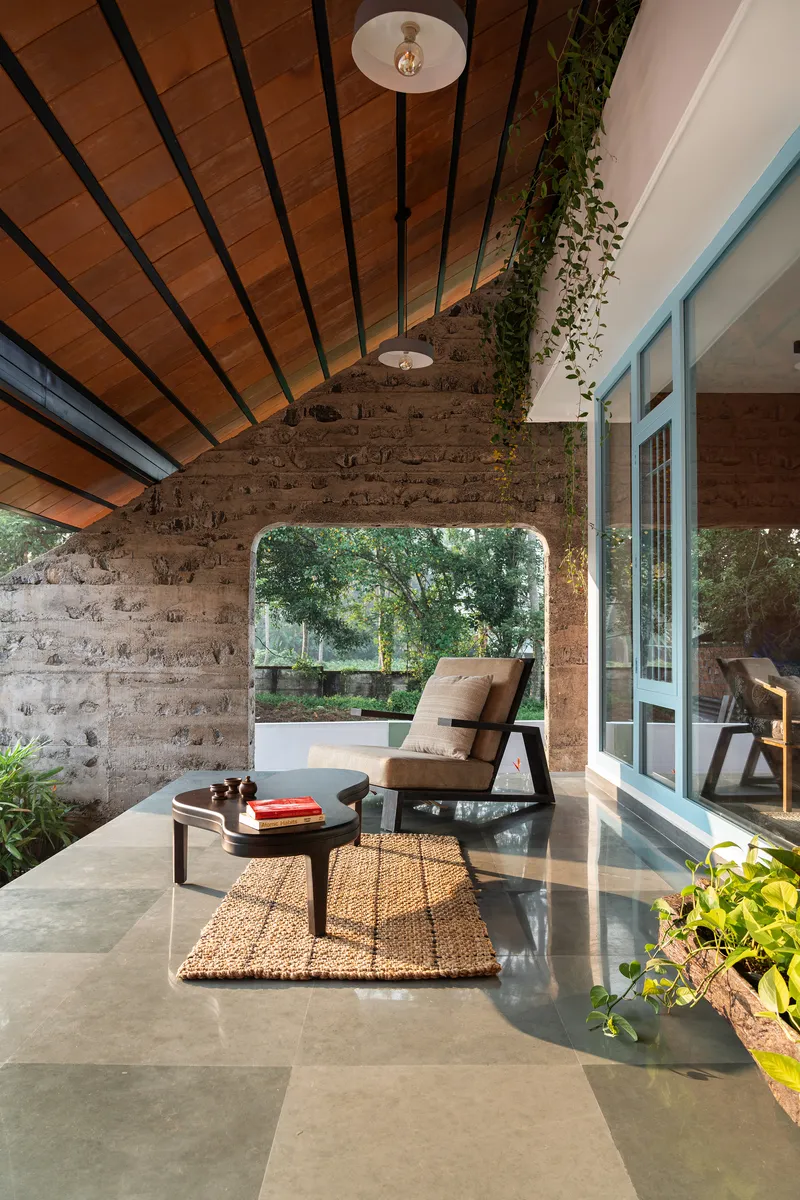
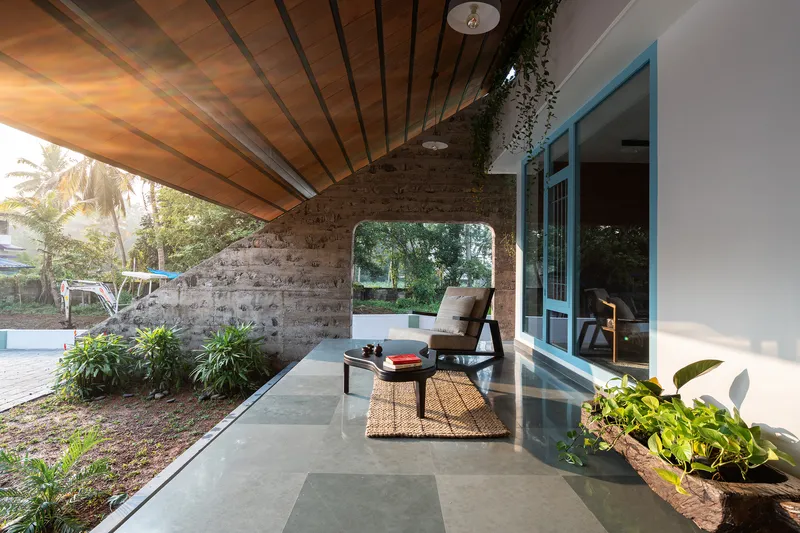
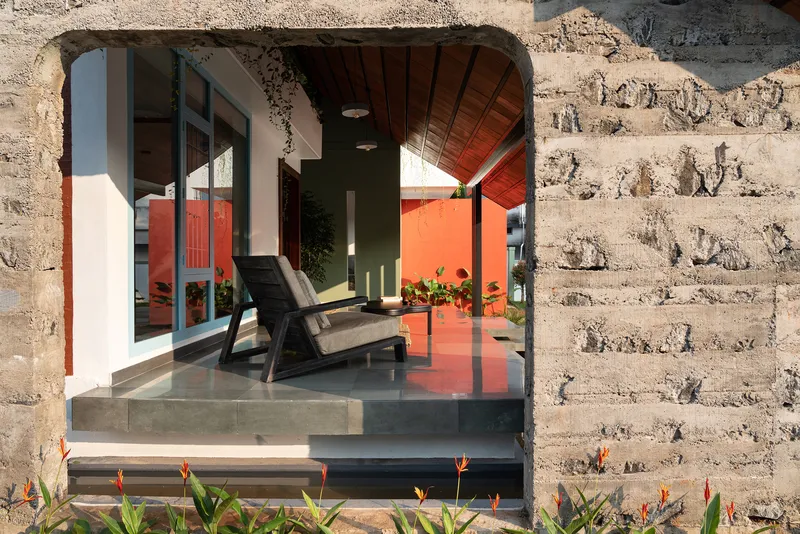
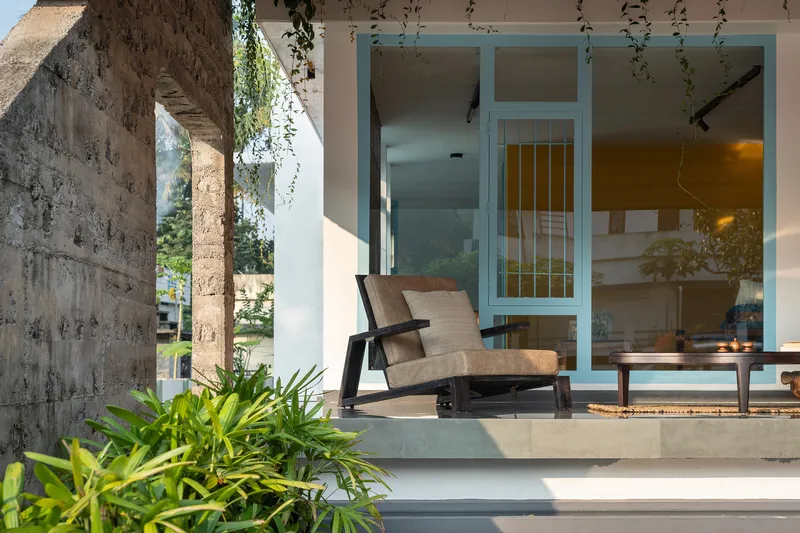
Inara House dissolves the boundary between interior and garden through a series of covered verandas, arched openings, and planted beds set flush with circulation paths. The arched opening in the laterite wall, framing a seating area with bird-of-paradise plantings, is one of the more memorable thresholds: it borrows the language of the courtyard house typology while giving it a sculptural twist.
The covered porch at the entrance, with its exposed wood ceiling and laterite walls, operates as a decompression zone between the public street and the private interior. Glass doors sit behind deep planted beds, so you always arrive through greenery. These in-between spaces do the heavy lifting for passive cooling, shading walls and glass from direct sun while allowing air movement through the plan.
Private Rooms and Outdoor Retreats
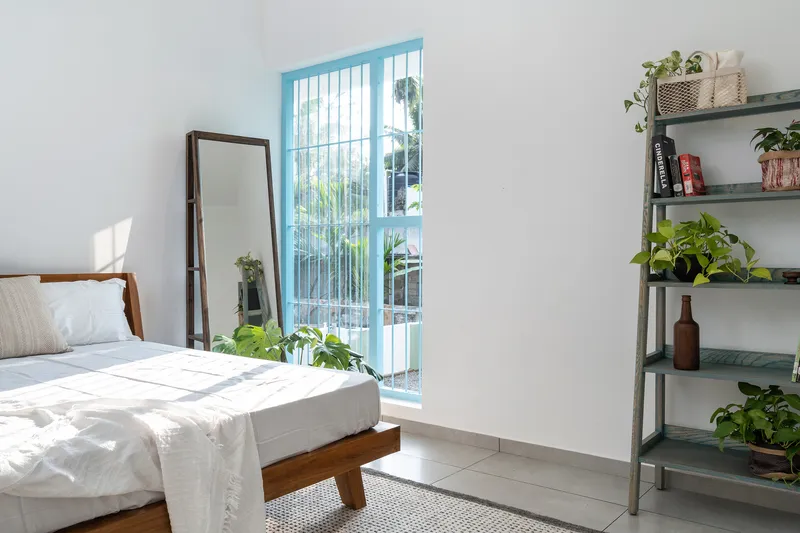
The bedrooms are quieter versions of the same material and spatial logic. Blue-framed doors open to small balconies, potted plants soften the sills, and sunlight falls across white bedding. There is nothing extravagant, just well-proportioned rooms that connect to the outdoors in a direct, uncomplicated way.
The concrete platform with a lounge chair beside blue-framed glazing and a laterite column captures the spirit of the whole project: dappled shade, honest materials, and a chair. The upper terrace, visible in the entrance shot with a resident under palm trees, extends the living space into the canopy. These outdoor rooms are not decorative additions; they are primary spaces in a climate that rewards being outside for most of the year.
Plans and Drawings
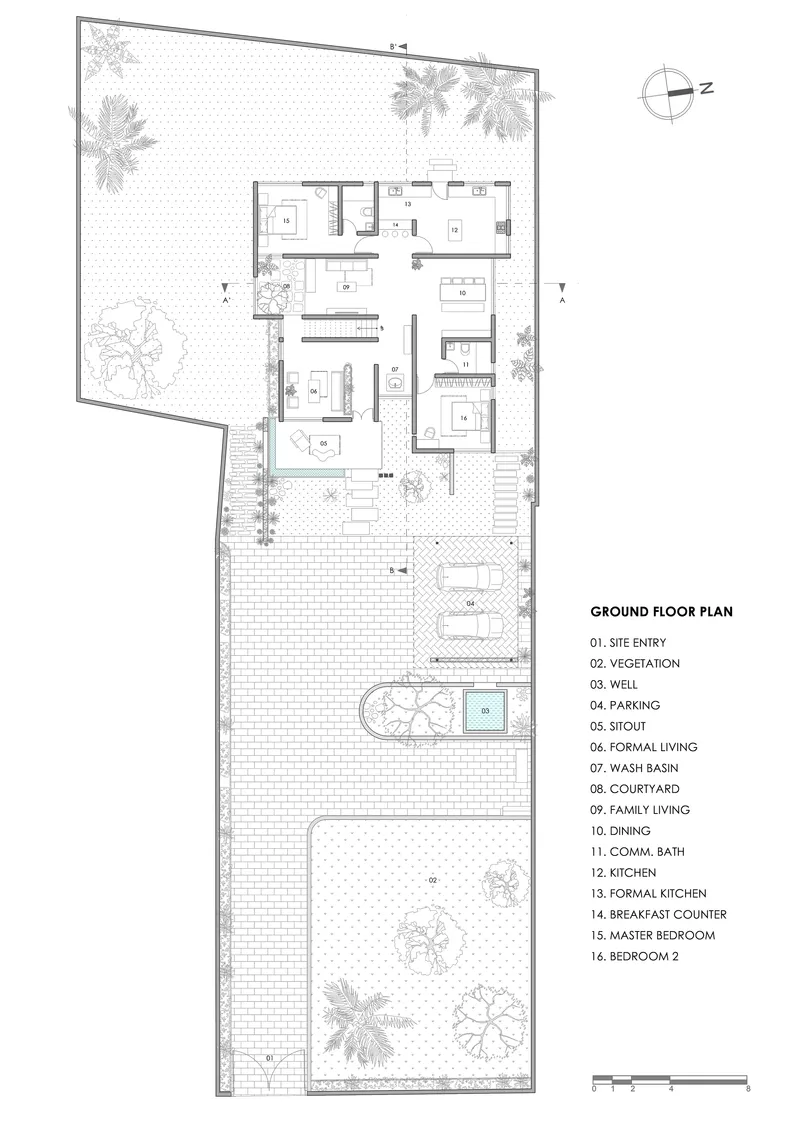
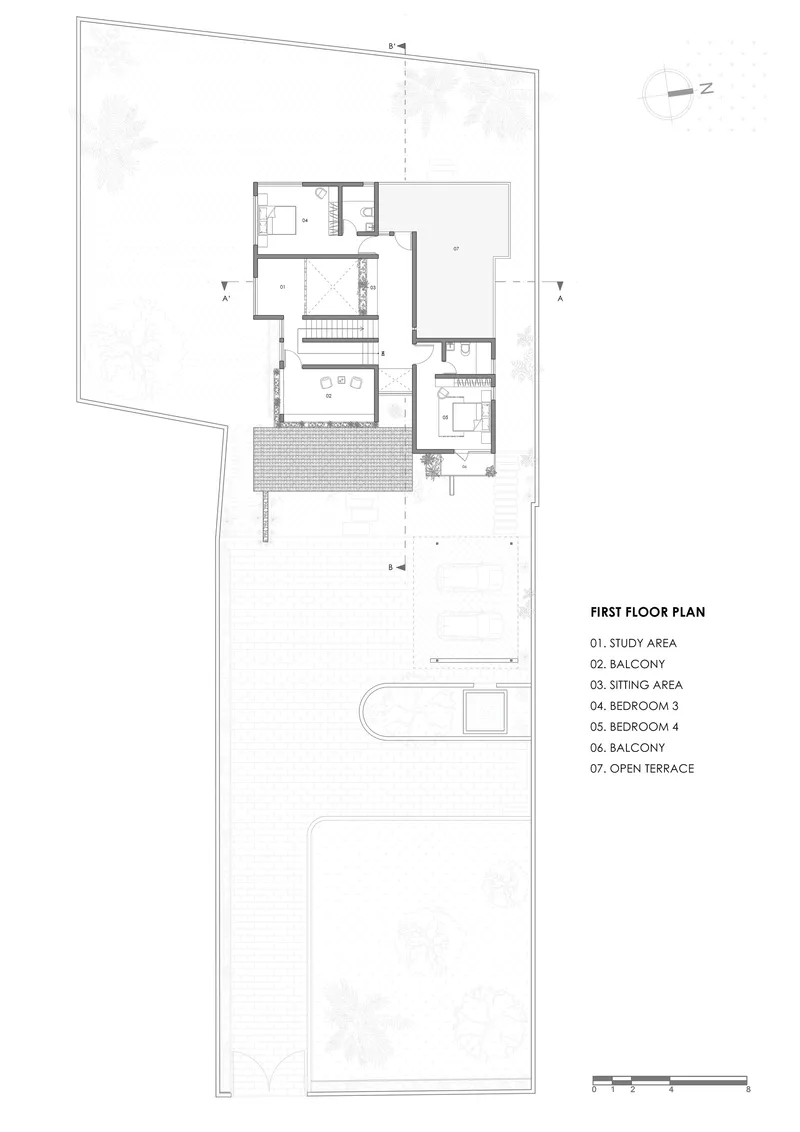
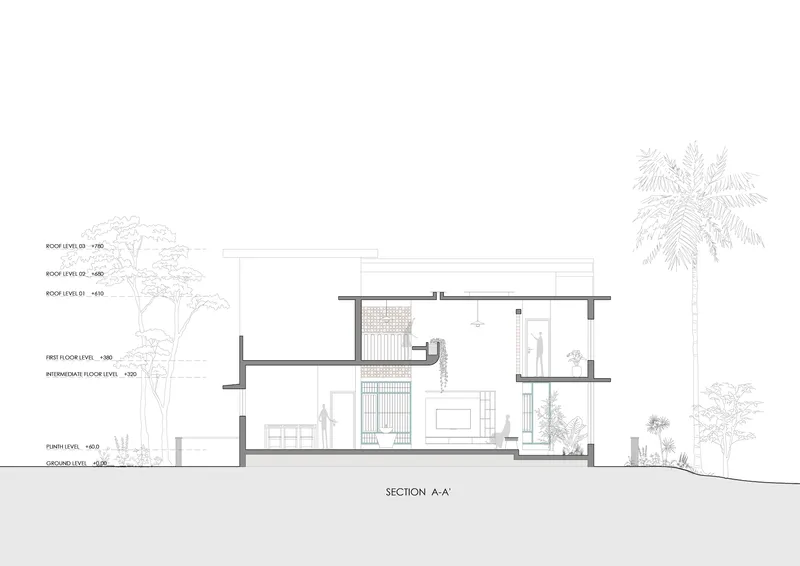
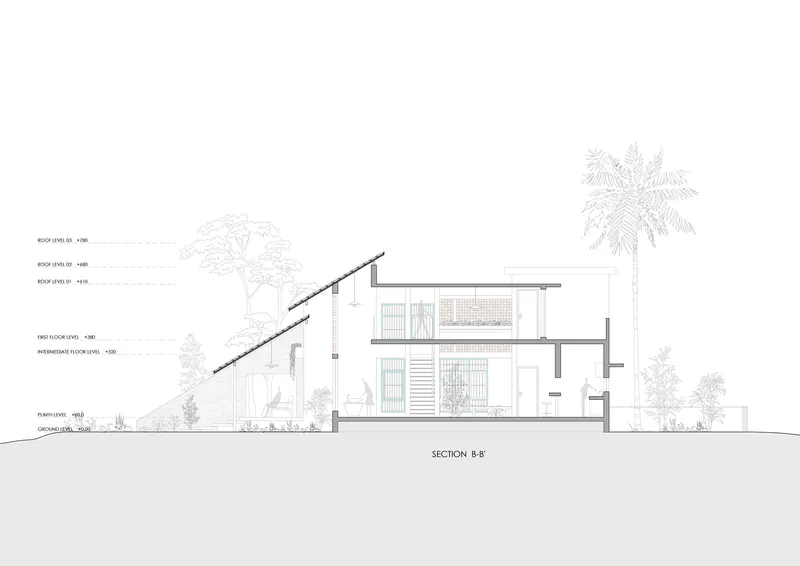
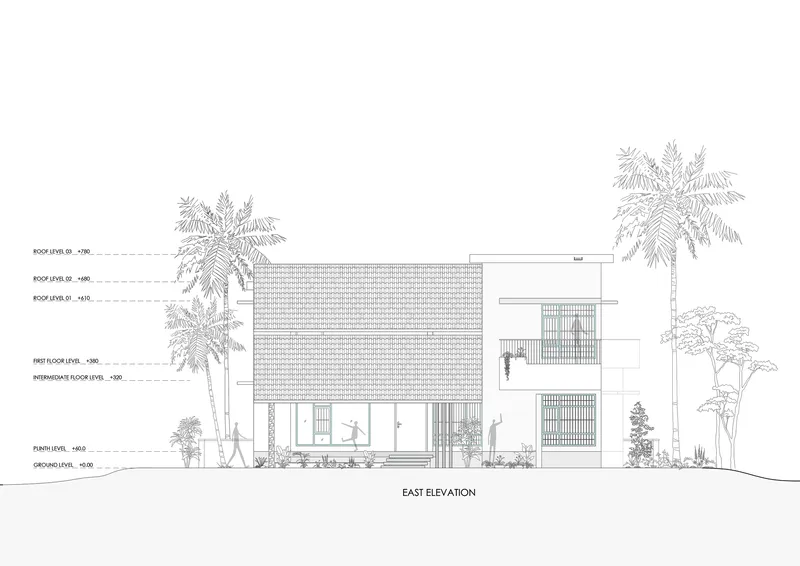
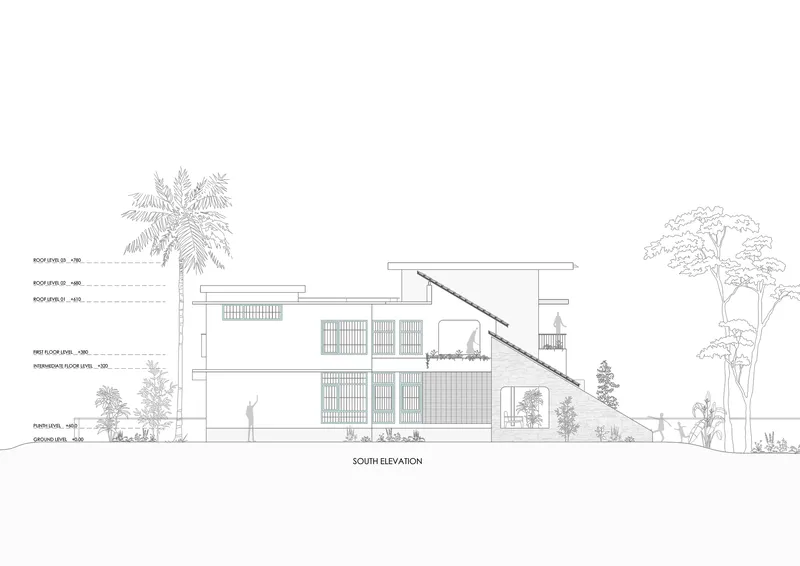
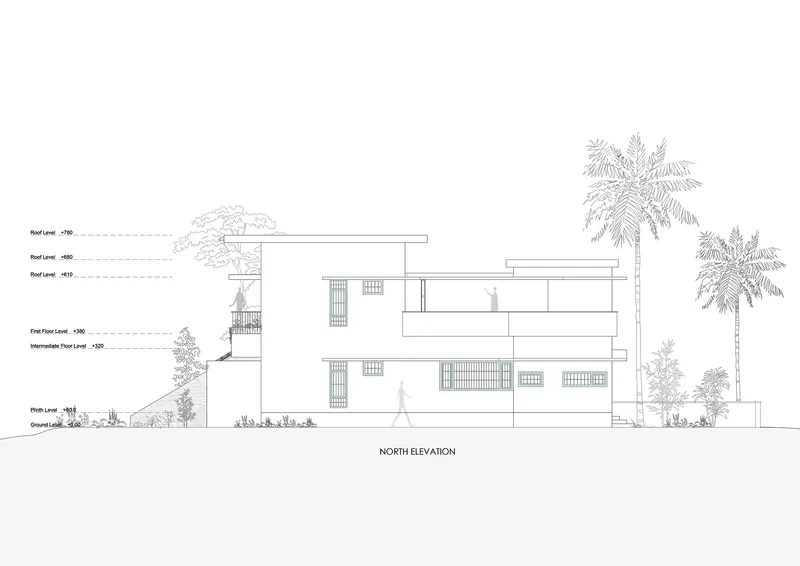
The ground floor plan reveals the strategy clearly: the house is pushed to the rear of the site with parking and a planted approach in front, while the courtyard sits at the center of the plan, linking living, dining, and circulation. The first floor redistributes the program around a study area and open terrace, keeping the double-height volume open below. The section drawings are particularly instructive, showing how the sloped roof planes channel rainwater while the stacked spatial volumes enable the stack effect that ventilates the house passively.
The east and south elevation drawings confirm the layered massing visible in the photographs, while the north elevation reveals a more horizontal, slab-like composition. The contrast is intentional: the public-facing side performs the sloped-roof Kerala identity, while the private rear elevation is quieter and more utilitarian. All three elevations show how deeply the coconut palms and tropical planting are woven into the architectural composition.
Why This Project Matters
Inara House is a useful case study in how to borrow from regional building traditions without reducing them to nostalgia. The sloping terracotta roofs, laterite walls, and courtyard plan all come from Kerala's domestic lineage, but CLAY COOP recombines them with exposed concrete, Kota stone, and steel framing to produce a house that performs better environmentally and offers spatial experiences, like the vine-draped double-height room, that a purely traditional plan would not support.
More importantly, the house demonstrates that passive design strategies can be architecturally generous rather than merely technical. The brick jali, the courtyard, the skylights, and the deep verandas are not compromises; they are the most enjoyable parts of the house. In a profession that sometimes treats sustainability and delight as separate conversations, Inara House makes a convincing argument that they are the same conversation.
Inara House by CLAY COOP Architects, Vaikom, Kottayam District, Kerala, India. 295 m². Completed 2022. Photography by Turtle Arts Photography.
About the Studio
Share Your Own Work on uni.xyz
If projects like this are the kind of work you want to make, uni.xyz is a place to publish your own, find collaborators, and enter design competitions.




Popular Articles
Popular articles from the community


Lunar Spiral: Space Architecture Shaped by the Mathematics of the Universe
Lunar Spiral reimagines space architecture through Fibonacci geometry, lunar regolith, levitating habitats, and self-sustaining Moon living.

Co-life: Sustainable Architecture for Age-Friendly Community Living
Co-life reimagines sustainable architecture for seniors through courtyards, rammed earth, shared gardens, and spaces designed for belonging.

The Earth Pod: 3D Printed Homes for Resilient Refugee Communities
The Earth Pod reimagines refugee housing through 3D printed homes made from clay, combining resilience, self-sufficiency, and rapid shelter.

Play: Fragments of Their World
Familiar architecture becomes modular playground design, creating safe spaces where displaced children can learn, connect, imagine and play.


Similar Reads
You might also enjoy these articles

Bao Huynh Watercolor Atelier: A Serene Art Retreat in Hội An
Bao Huynh Watercolor Atelier in Hội An blends multifunctional art spaces, sustainable design, local materials, and family-friendly living in a serene environment.

Atelier Macri Concept Store Interior Design by CASE-REAL
Atelier Macri store features a "ko" counter, walnut wood details, cork displays, blending retail, gallery, and seamless customer experiences.

Manuel Vargas Izquierdo Stadium and High-Performance Sports Center: Architectural Excellence in Jalpa de Méndez
The Manuel Vargas Izquierdo Stadium blends sustainable design, inclusive sports facilities, and cultural-inspired architecture, revitalizing Jalpa de Méndez’s public spaces.

KAKR Buluh Awar Hall: Revitalizing Community and Ecology Through Bamboo Architecture
Community built bamboo hall revitalizes Buluh Awar village, empowering youth, restoring ecology, celebrating vernacular craftsmanship through sustainable architecture and culture.


Explore Residential Building Competitions
Discover active competitions in this discipline



Challenge to design a portable theatre


Challenge to design a portable music platform


Challenge to design an open learning module for the elderly


Challenge to design mud housing for contemporary communities
Comments (0)
Please login or sign up to add comments
No comments yet. Be the first to comment!