
Clay Rise Home Grounds a New Practice in Old Soil
Templeton Ford's debut house in West Sussex pairs sweeping brick forms with an interior calibrated for change over decades.


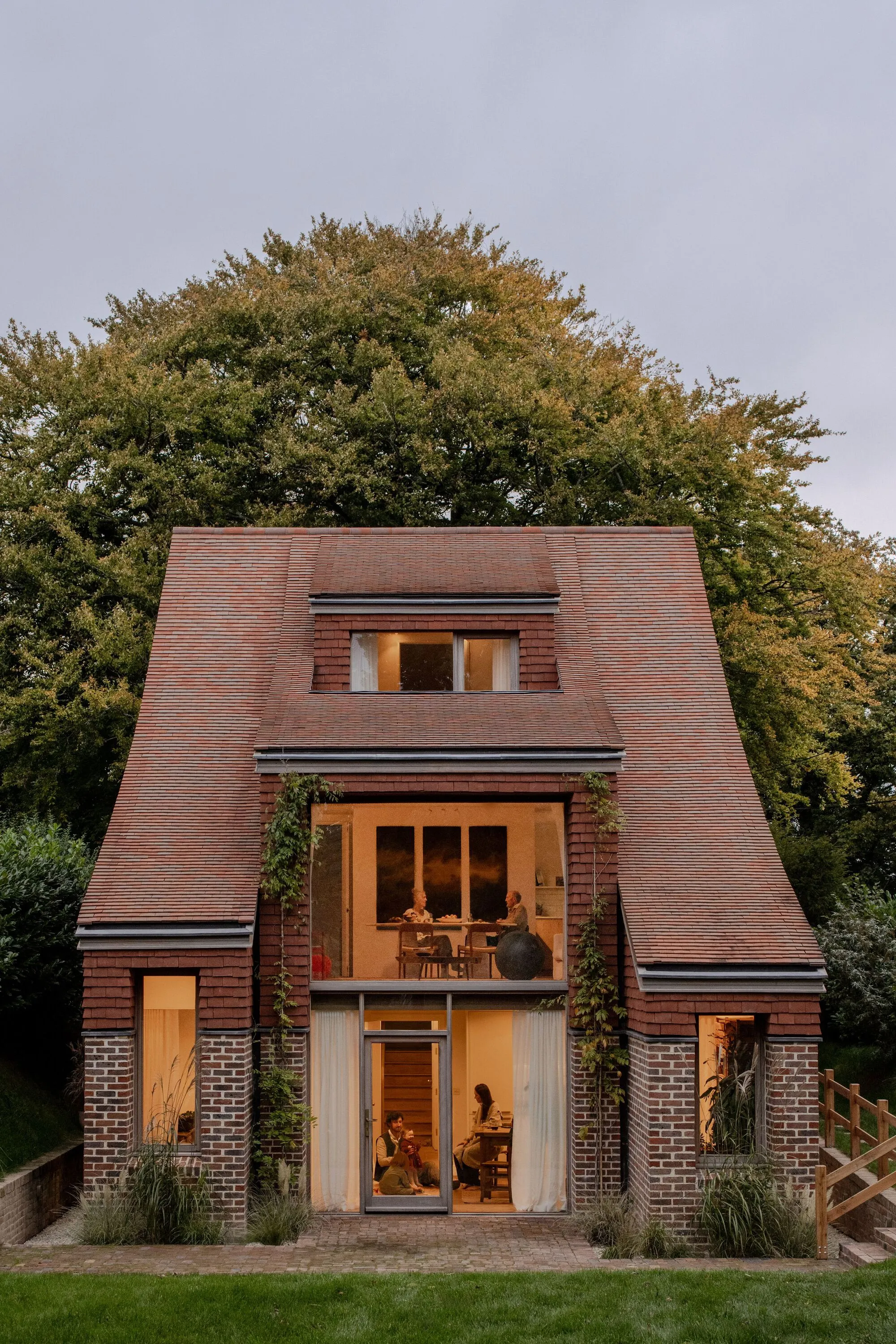
A debut project carries weight. It announces what a practice cares about, what it will fight for, and how it wants to be read. For Templeton Ford, that statement arrives in the form of Clay Rise Home, a 205 square metre house nestled into the rolling landscape of West Hoathly in West Sussex. The building is steeply gabled, warmly bricked, and threaded with timber. It looks like it has been there longer than it has, which is both a compliment and a strategy.
What makes the project genuinely interesting is not the nostalgia it evokes but the tension between its rooted, almost vernacular exterior and an interior plan that refuses to stay still. The house is designed to adapt: rooms shift in function, circulation doubles as living space, and thresholds between inside and outside dissolve through generously scaled openings. It is a home that trusts its occupants to inhabit it differently over time, and that trust is embedded in the architecture itself.
A Brick Presence in a Soft Landscape


Approached from the surrounding grassland and mature deciduous trees, Clay Rise reads as a series of pitched volumes stepping across the terrain. The steep gabled roofs, horizontal timber cladding in the upper register, and robust red brick base anchor the building firmly in the Wealden landscape tradition without resorting to pastiche. There is no single heroic facade. Instead, the house reveals itself incrementally, each angle offering a different silhouette against overcast skies and golden autumn foliage.
The material palette is deliberately limited. Brick handles the ground, timber handles the sky, and the roof pitches negotiate between the two. Dormer windows break the roofline just enough to signal habitation above, while the massing stays compact enough to defer to the trees around it. The building does not compete with its setting. It participates.
Golden Light and the Threshold Condition
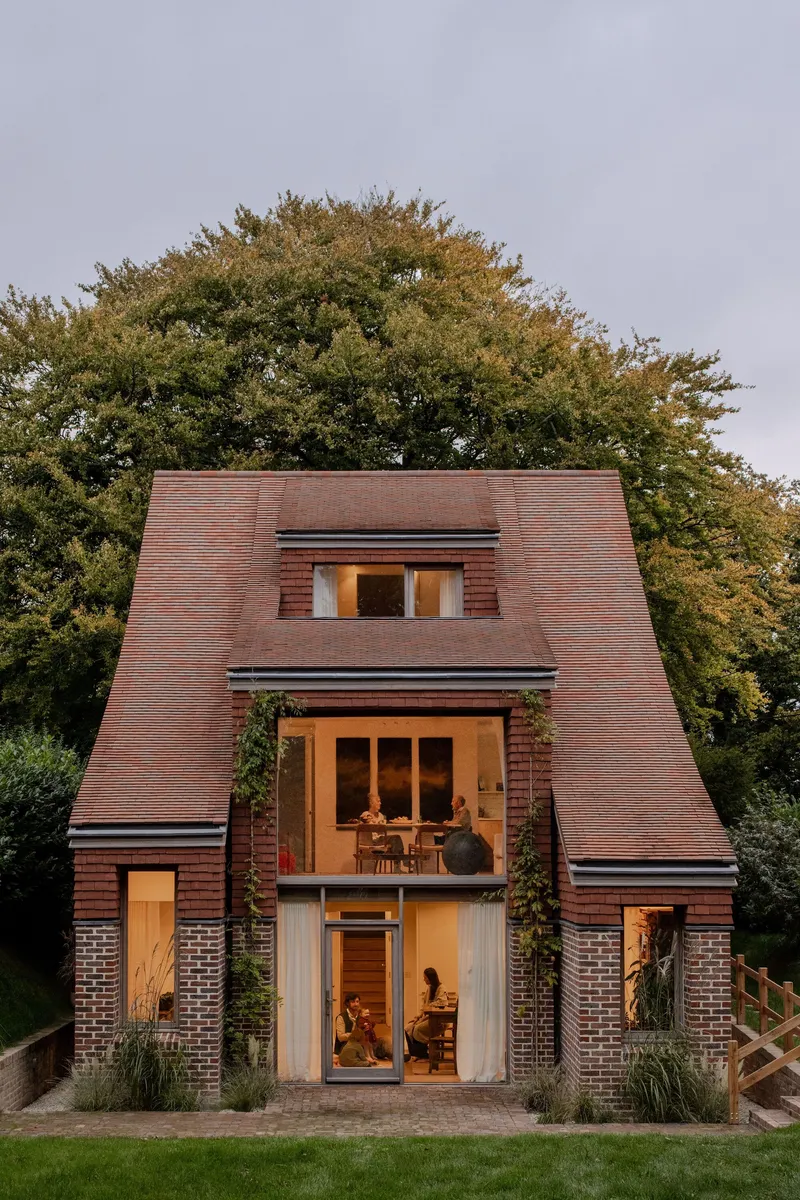

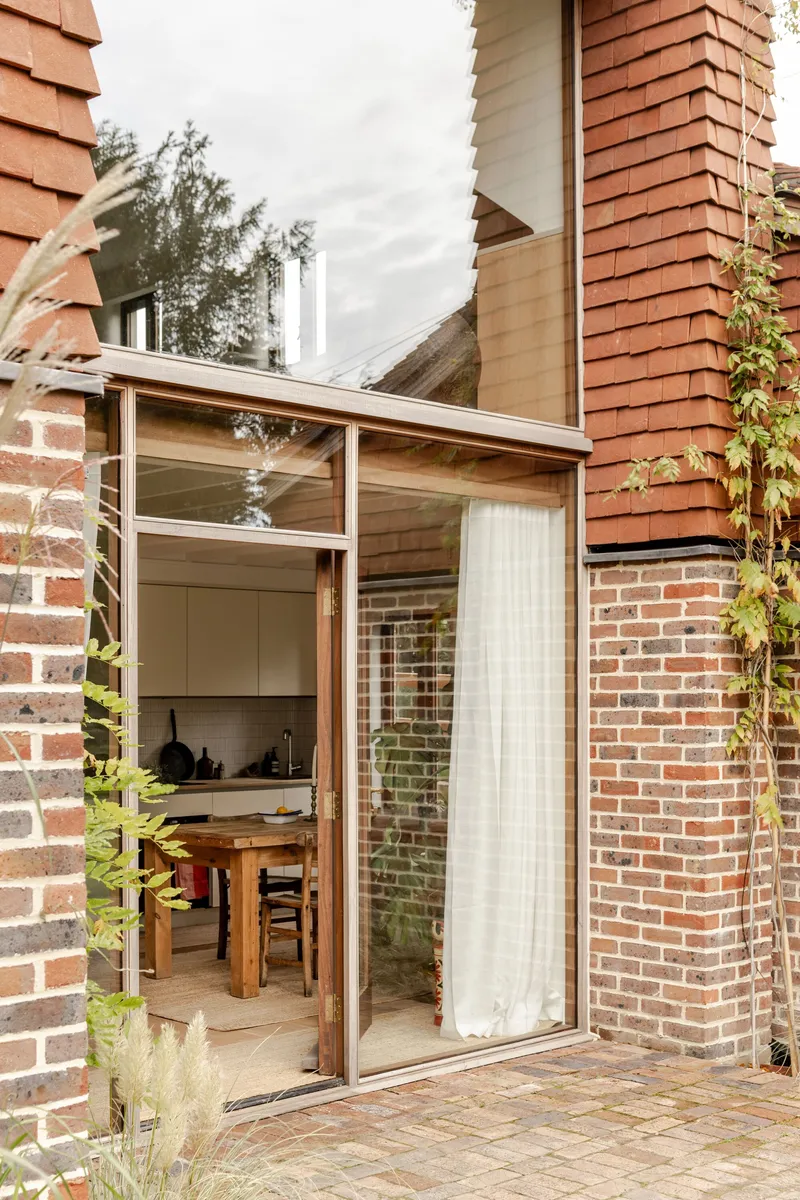
The most arresting quality of Clay Rise at dusk is the way light spills from its openings like something liquid. Large golden-hued apertures in the brick facade transform the house into a lantern, broadcasting warmth outward into the surrounding greenery. These are not token picture windows. They are calibrated thresholds, connecting interior rooms directly to the garden through wood-framed glass doors that swing open to dissolve the wall plane entirely.
Ivy climbing the adjacent walls, gravel underfoot, and the general softness of the planting reinforce the sense that the boundary between building and garden is more suggestion than rule. The glazed openings on the ground floor are proportioned to frame the body standing or seated, not to create panoramic spectacle. It is an architecture of invitation, not display.
The Courtyard Pavilion

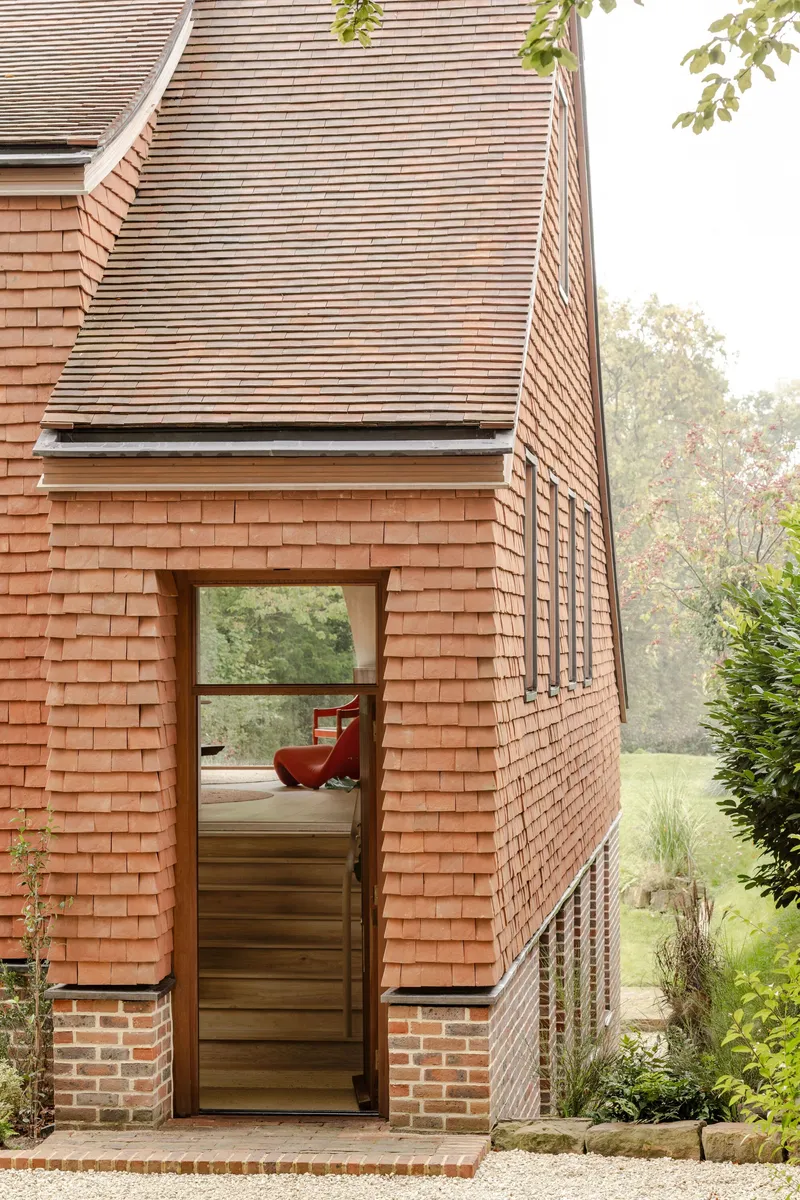
Set apart from the main house, a small brick and timber-clad building with a pyramidal roof occupies a gravel courtyard framed by mature hedging. It functions as an outbuilding, but its architectural treatment is equal to the main volume: the same red brick, the same cedar shingles, the same careful proportion of solid to void. A large glazed opening faces the courtyard, turning the small structure into a room that belongs as much to the garden as to the house.
This secondary volume is critical to understanding the project's ambitions. Templeton Ford is not designing a single object but a small compound, a cluster of forms that together define outdoor rooms and sheltered passages. The gravel courtyard between the two buildings becomes a space in its own right, activated by the architecture on both sides.
Interior Volumes: Vaults, Slopes, and Double Height


Inside, the steeply pitched roofs translate into a rich variety of ceiling conditions. A vaulted space on the upper level frames a large picture window overlooking the landscape, its curved ceiling amplifying the sense of shelter while directing the eye outward. Below, a galley-like room with a long wooden table and glass doors on either side establishes a cross-axis of light and movement, connecting opposite garden elevations through a single interior pass.
The kitchen and dining area captures this duality well: a circular table sits beneath a three-panel window, bathed in even, diffused light. Timber cabinetry wraps the lower walls, and the beige floor extends the palette of the exterior brick inward. There is no moment where the interior feels detached from the landscape beyond it.
Circulation as Living Space


The staircase at Clay Rise deserves its own discussion. Rising with curved white walls and wood treads, it reaches toward a timber-framed window and a skylight above. An integrated planter box runs along the railing, blurring the line between handrail and garden. At the upper level, the stairwell opens into an airy landing with views back down to the landscape, making the vertical passage a place to pause rather than simply transit.
This treatment of circulation is one of the project's strongest moves. In a house of only 205 square metres, every square centimetre of hallway or stair that can function as habitable space is a net gain. The planting shelves, the artwork walls, the generous natural light: all of it converts what might be residual space into the connective tissue of domestic life.
Bedrooms and the Roofline


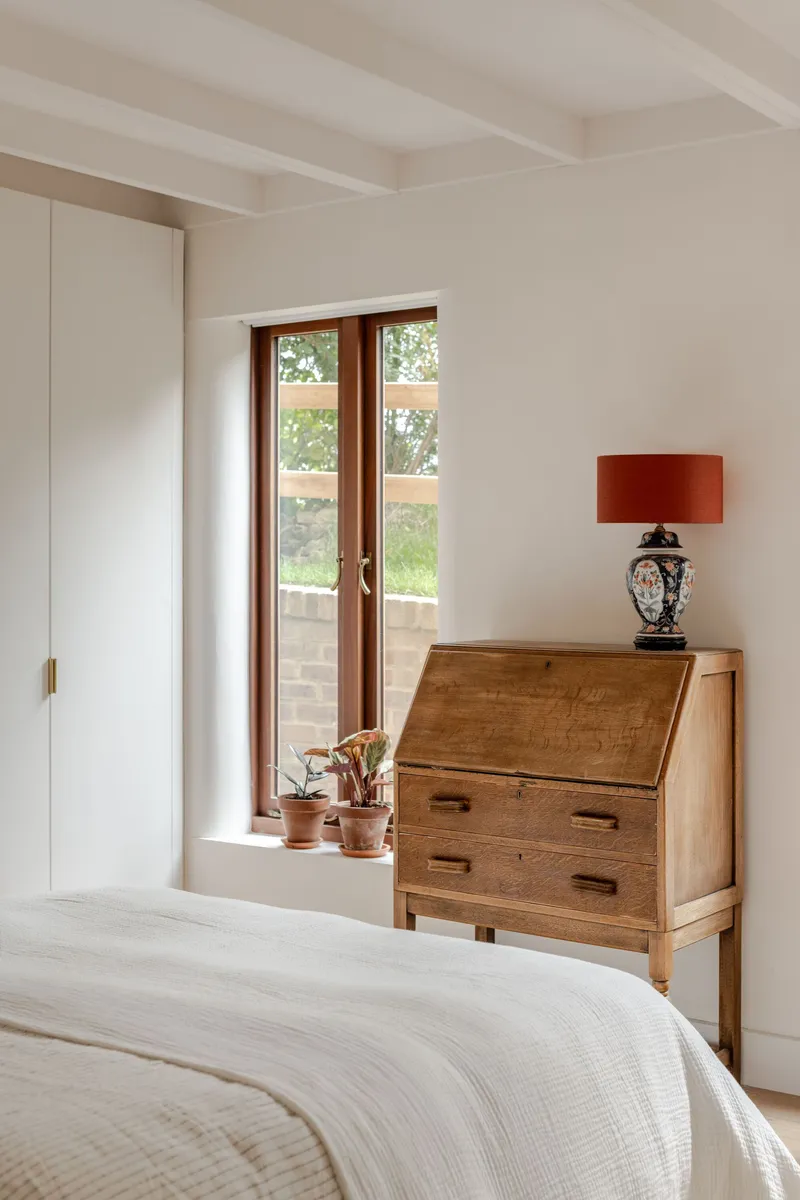
The upper level bedrooms sit under the sloped ceilings that the exterior roofline promises. A wood-lined sleeping nook with a large window overlooking greenery gives one bedroom the quality of a treehouse. Others rely on exposed ceiling beams, tall side windows, and carefully placed furniture to create intimacy without claustrophobia. The decision to keep these rooms relatively spare, with white walls and wood accents, lets the geometry of the roof do the work.
Narrow window openings with deep timber sills appear throughout, framing views of brick and foliage in tight, almost photographic compositions. These are not afterthoughts. They are moments of deliberate restraint in an otherwise generously glazed house, providing privacy and focus where the larger openings provide connection and panorama.
Materiality and Craft at Close Range
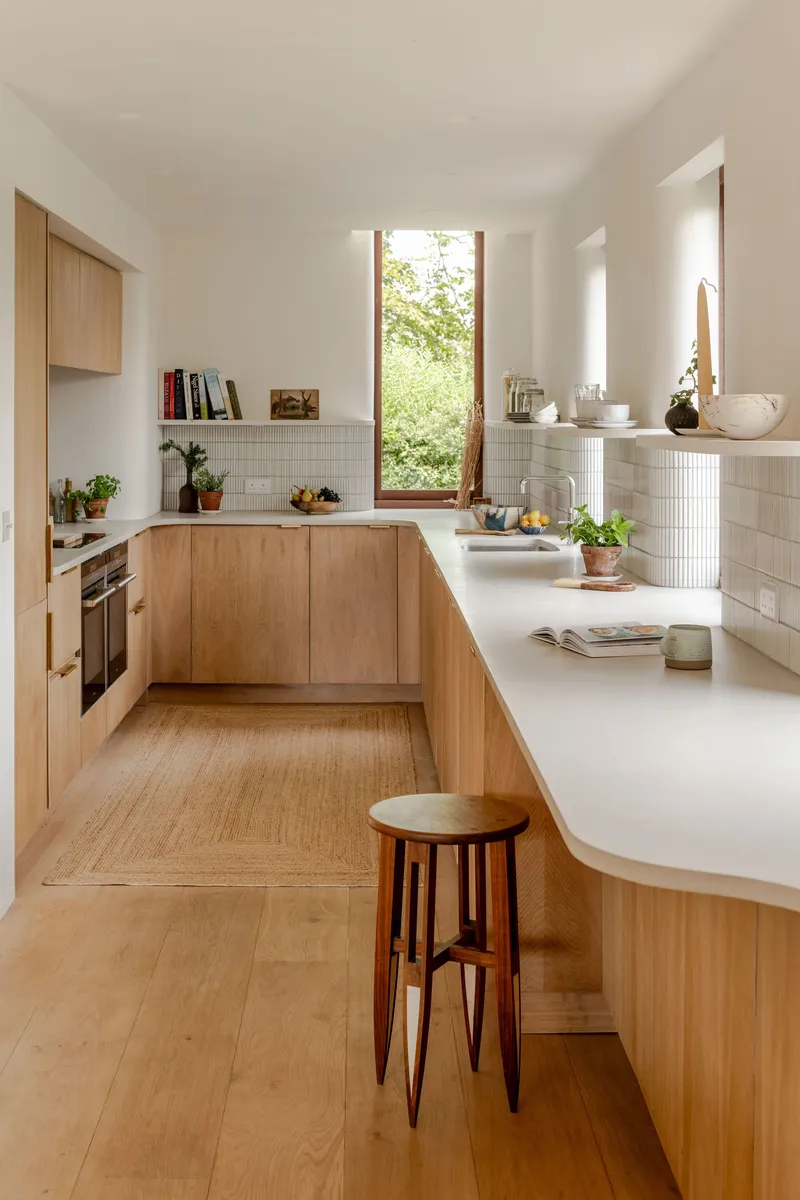


Zooming in, the material quality holds. The kitchen features light wood cabinetry with white countertops and white subway tile backsplashes, a combination that could read as generic but here feels purposeful against the warmth of the timber floors and the green foliage visible through tall windows. Open shelving replaces upper cabinets in places, keeping the walls light and the rooms feeling larger than they are.
In the bathroom, a stepped tub edge, a wooden ladder rack, and a hanging potted plant suggest a domestic atmosphere more relaxed than curated. The wood-framed door and consistent use of natural materials tie the space back to the rest of the house without imposing a rigid aesthetic system. The overall impression is of a building that was detailed with care but designed to absorb the mess and accumulation of real habitation.
A House in Use
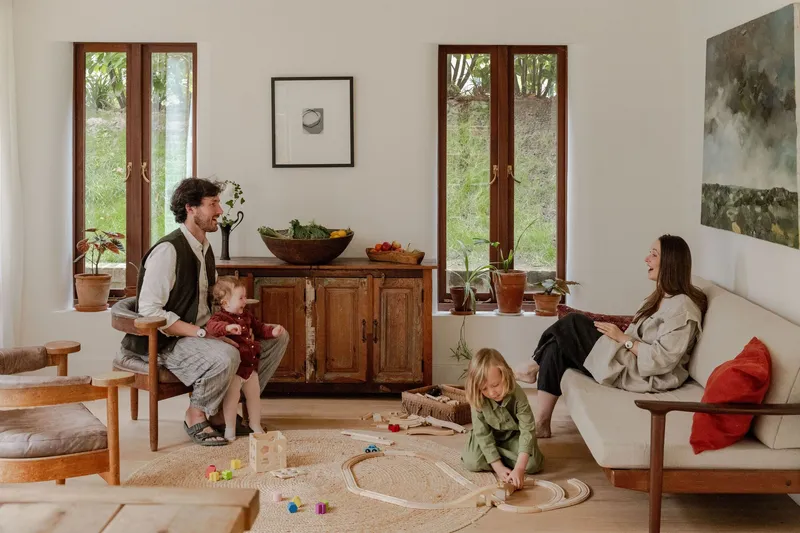
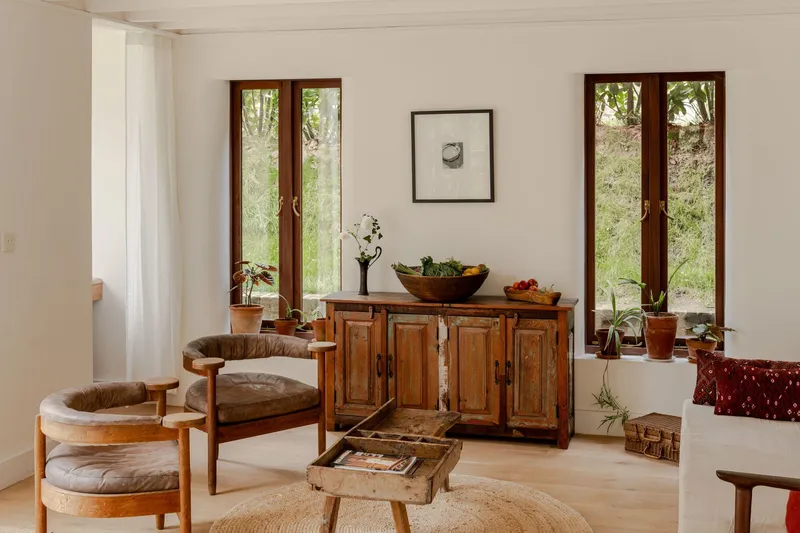
One image stands out: a living room with three adults, a child, toys on the floor, natural light from multiple tall windows, and wood furniture arranged with the casual logic of people who actually live there. It is a rare thing to see an architectural photograph that includes evidence of habitation rather than staging, and it confirms the house's core proposition. Clay Rise is not a showpiece. It is a framework for daily life.
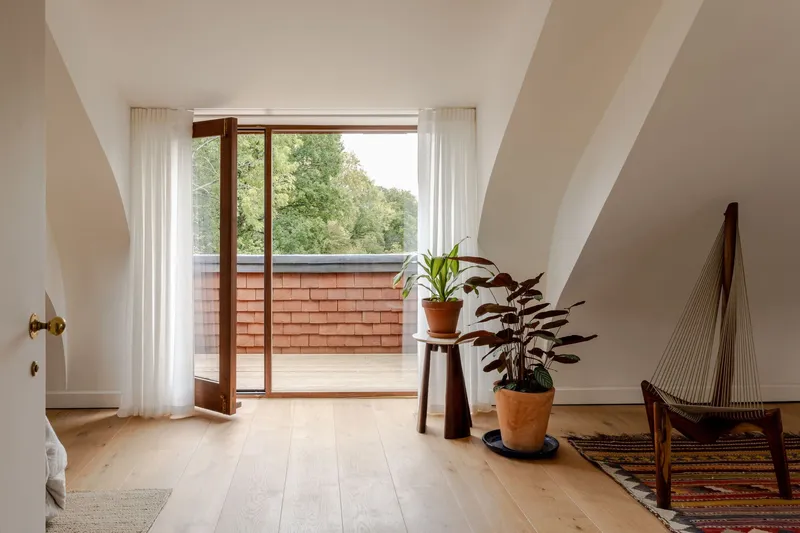
Elsewhere, arched white walls frame open double doors onto a cedar-shingled railing deck overlooking the green landscape. A bright room with pale walls, woven rugs, and glass doors opening to vegetation feels lived-in and generous at the same time. The house earns its adaptability claim not through movable partitions or clever gadgets but through proportional generosity and a plan that allows rooms to serve multiple purposes without losing their character.
Window Details and the View
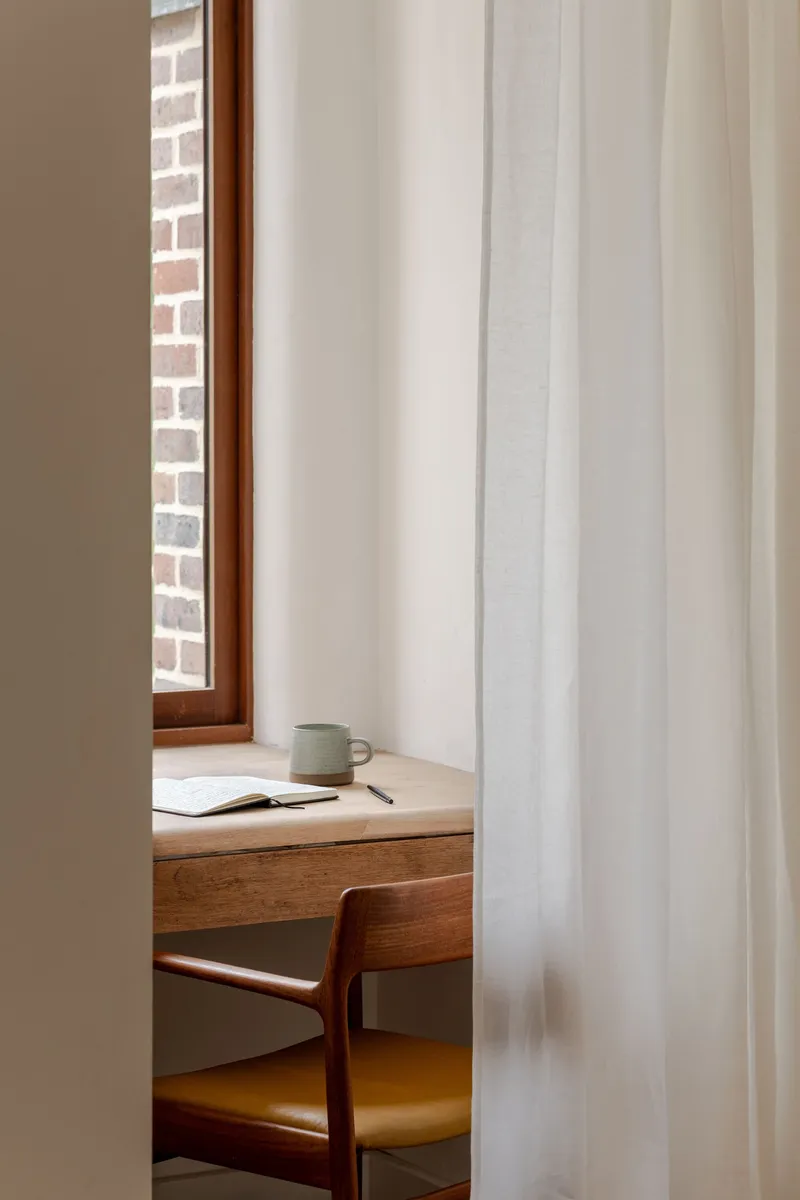

A narrow window opening with a white curtain, a wooden sill holding a cup and notebook, and brick visible beyond the frame: this is the house at its most intimate. These small apertures function as counterpoints to the larger glazed openings, creating moments of solitude within a plan that otherwise privileges openness and flow. The brick reveals visible at the edges remind you constantly that the walls have thickness, that you are enclosed in something substantial.
Plans and Drawings
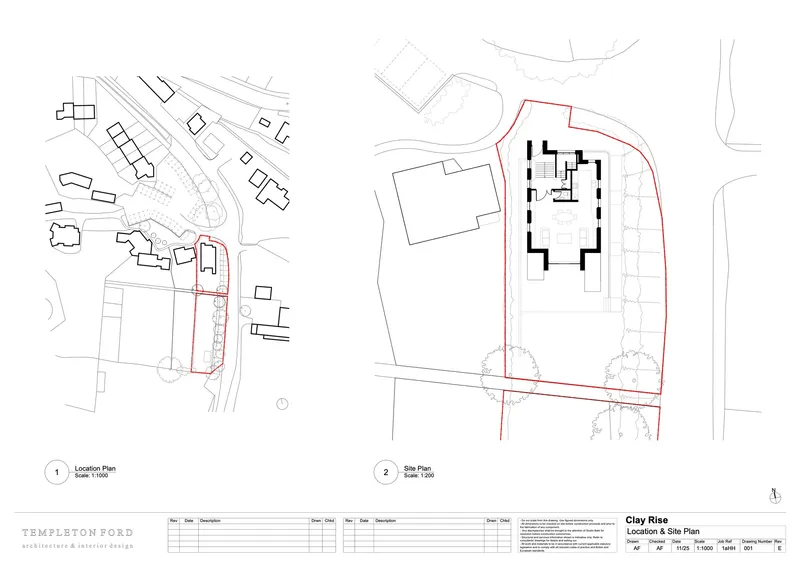

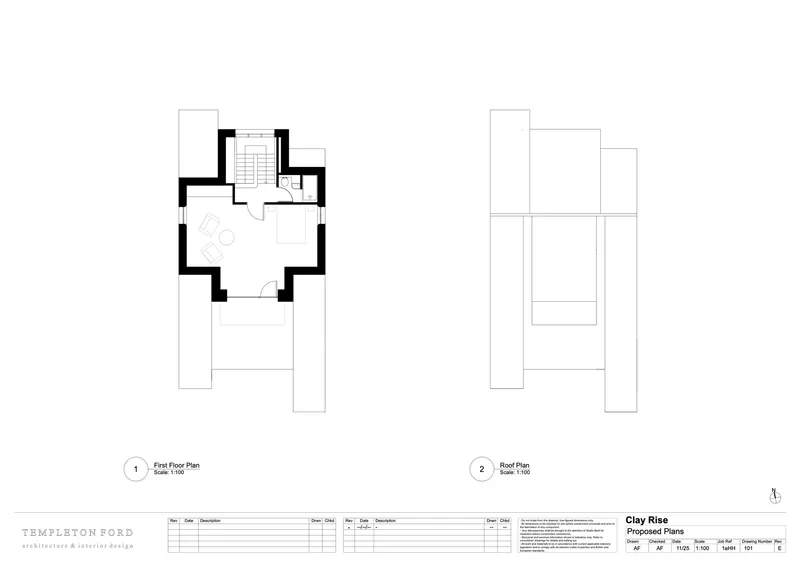
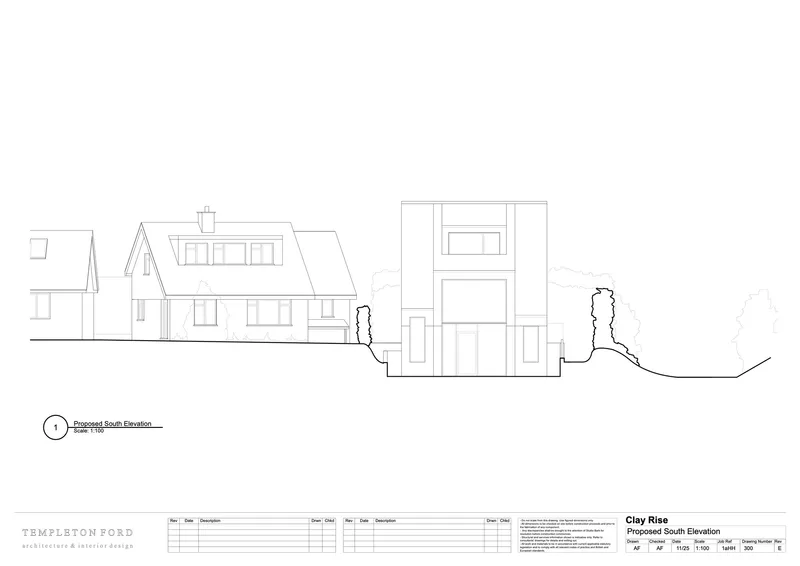
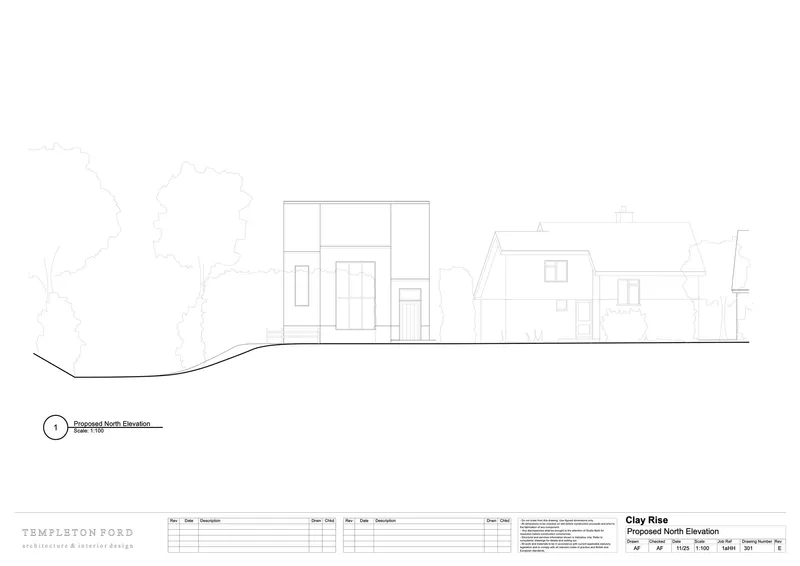


The site plan reveals the building's footprint within its property boundaries, confirming the compound-like arrangement of main house and outbuilding. Floor plans show a central cruciform space organizing the surrounding rooms, a move that gives the relatively modest plan an unexpected spatial complexity. The roof plan demonstrates how the multiple pitched forms come together, each peak corresponding to a distinct room or zone below.
The elevation drawings are revealing. The south elevation shows a pitched-roof house form transitioning into a rectangular multi-storey volume, while the north elevation presents a more restrained, regularly fenestrated face. East and west elevations expose the gable ends, and the long section cuts through the sequence of pitched forms at varying heights, confirming the interior variety promised by the roofline. The trees drawn flanking the section remind us that this architecture is conceived as part of a landscape, not imposed upon it.
Why This Project Matters
Clay Rise Home matters because it demonstrates that a debut project need not be a manifesto of formal invention. Templeton Ford has chosen instead to invest in something harder to achieve: a house that feels inevitable in its landscape, generous in its spatial offer, and honest about the way people actually live. The compound arrangement, the pitched roof variations, and the dissolving thresholds between inside and out are all familiar moves executed with uncommon precision and restraint.
In a moment when new practices often reach for visual shock to establish a profile, there is something quietly radical about building a 205 square metre house from brick and timber, setting it among old trees, and trusting it to speak for itself. Clay Rise does not shout. It settles in. And that confidence, for a first built project, suggests a practice worth watching closely.
Clay Rise Home by Templeton Ford. West Hoathly, United Kingdom. 205 m². Completed 2024. Photography by French + Tye.
About the Studio
Templeton Ford
Share Your Own Work on uni.xyz
If projects like this are the kind of work you want to make, uni.xyz is a place to publish your own, find collaborators, and enter design competitions.




Popular Articles
Popular articles from the community


The Ocean Hive: Sustainable Architecture for a Self-Sufficient Civilization at Sea
The Ocean Hive imagines sustainable architecture at sea, where modular habitats, algae, wave power and ocean waste sustain a growing colony.

The Musturak Paradise: Senior Living Architecture for a Connected Future in Temara, Morocco
The Musturak Paradise reimagines senior living architecture in Temara via private homes, social spaces, culture, community, and shared care.

EW PARK: Sustainable Architecture Reimagines the Future of Urban Parking
EW PARK reimagines city parking as a modular wooden tower combining automation, solar energy, electric mobility, and adaptable urban design.

Hill & Cross Opera: Sculptural Opera House Architecture Shaped by Tallinn’s Landscape and Identity
Hill & Cross Opera reimagines opera house architecture in Tallinn through its sculptural hill, civic plaza, glass wave and a luminous cross.


Similar Reads
You might also enjoy these articles

Bao Huynh Watercolor Atelier: A Serene Art Retreat in Hội An
Bao Huynh Watercolor Atelier in Hội An blends multifunctional art spaces, sustainable design, local materials, and family-friendly living in a serene environment.

Atelier Macri Concept Store Interior Design by CASE-REAL
Atelier Macri store features a "ko" counter, walnut wood details, cork displays, blending retail, gallery, and seamless customer experiences.

Manuel Vargas Izquierdo Stadium and High-Performance Sports Center: Architectural Excellence in Jalpa de Méndez
The Manuel Vargas Izquierdo Stadium blends sustainable design, inclusive sports facilities, and cultural-inspired architecture, revitalizing Jalpa de Méndez’s public spaces.

KAKR Buluh Awar Hall: Revitalizing Community and Ecology Through Bamboo Architecture
Community built bamboo hall revitalizes Buluh Awar village, empowering youth, restoring ecology, celebrating vernacular craftsmanship through sustainable architecture and culture.




Comments (0)
Please login or sign up to add comments
No comments yet. Be the first to comment!