
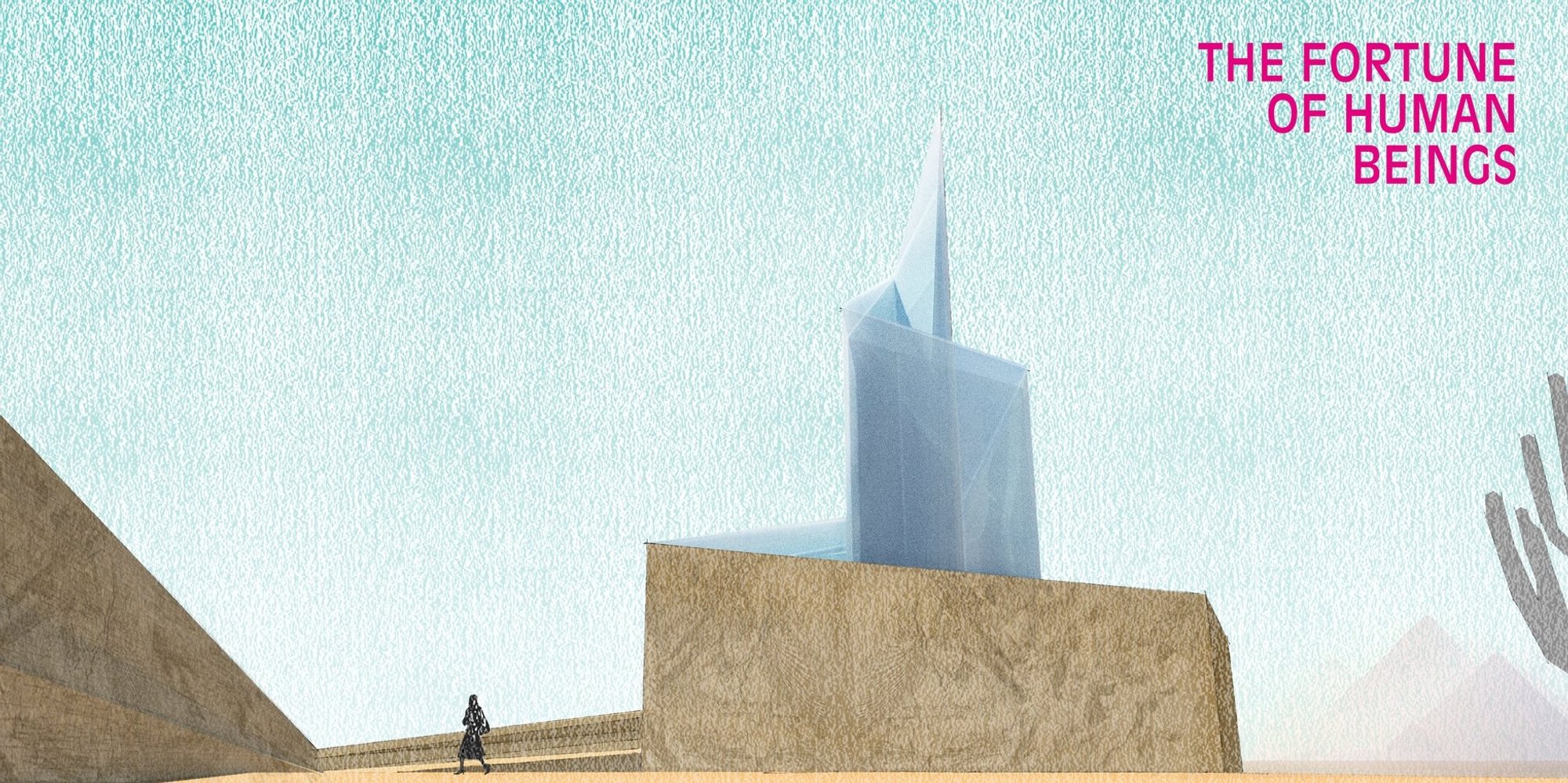
Climate Change Memorial Architecture: The Fortune of Human Beings
A climate change memorial in Egypt using phase-change materials to reveal pollution, transforming architecture into a living environmental warning.

Project by Juntong Hu
People’s Choice Award – Hourglass Competition
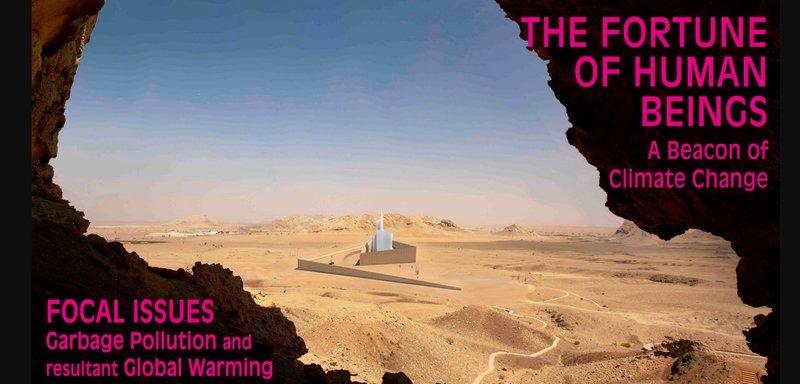
In the evolving discourse of climate change memorial architecture, The Fortune of Human Beings emerges as a compelling spatial narrative that transforms environmental data into lived experience. Located at the edges of the Western Desert near the Pyramids of Giza, this project is not merely a monument but a dynamic environmental indicator, addressing the urgent realities of garbage pollution and global warming.
The project positions architecture as an active medium of awareness rather than a passive structure. By integrating material intelligence, temporal storytelling, and symbolic geometry, the design constructs a powerful dialogue between human civilization and ecological consequence.
Site Strategy: Contextual Placement in Egypt’s Climatic Landscape
Strategically situated approximately 3.2 km from the Grand Egyptian Museum, the site leverages its proximity to one of the most historically significant landscapes in the world. This contextual positioning is deliberate. The desert, often perceived as timeless and immutable, becomes the backdrop for a narrative of environmental fragility.
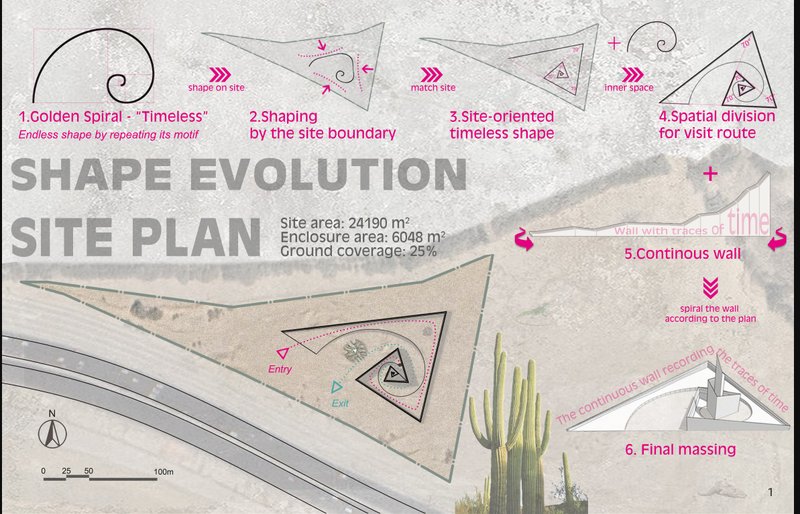
The project occupies a site area of 24,190 square meters with a controlled enclosure of 6,048 square meters and a ground coverage of 25%. The geometry responds directly to the site boundary, generating a triangular formation derived from the golden spiral principle. This establishes a formal continuity between natural growth patterns and architectural expression.
Form Development: The Timeless Geometry of the Golden Spiral
At the core of the design lies the concept of the “timeless” form, derived from a repeating golden spiral motif. This geometry undergoes a series of transformations:
- Initial spiral abstraction representing infinity and continuity
- Adaptation to site constraints forming a triangular boundary
- Spatial articulation into an experiential route
- Integration of a continuous wall system
- Final massing that culminates in a central beacon tower
This evolution is not purely formal. It encodes the idea of time, repetition, and irreversible accumulation, directly reflecting the long-term impact of environmental degradation.
Environmental Concept: Garbage Pollution and Global Warming
The project addresses a critical global issue: the accelerating accumulation of waste and its contribution to climate change. Current data indicates that over 2.01 billion metric tons of municipal solid waste are produced annually, with projections rising to 3.40 billion metric tons by 2050.
A significant portion of this waste, particularly plastics, exhibits extremely slow degradation cycles ranging from weeks to hundreds of years. The lifecycle of plastic products contributes heavily to greenhouse gas emissions through processes such as extraction, production, incineration, and landfill accumulation.
The memorial translates these abstract statistics into spatial experience, making invisible environmental processes perceptible.
Material Innovation: Phase-Change Material as an Architectural Interface
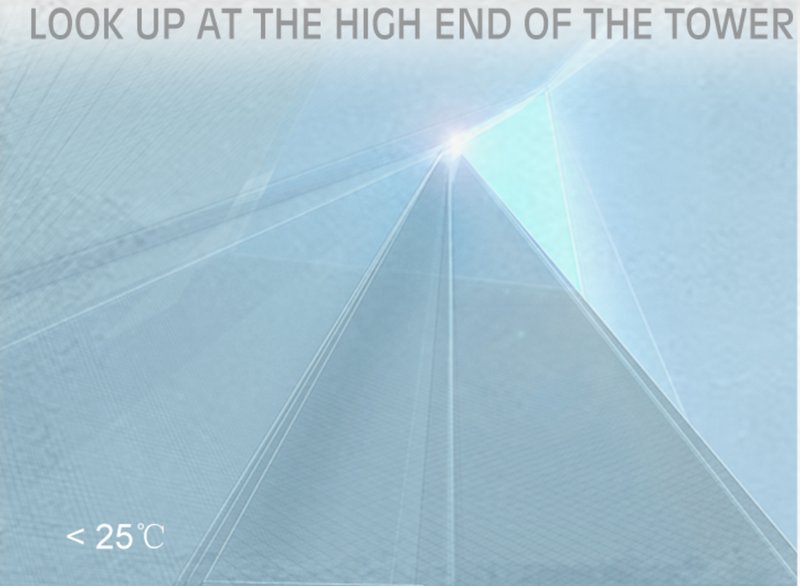
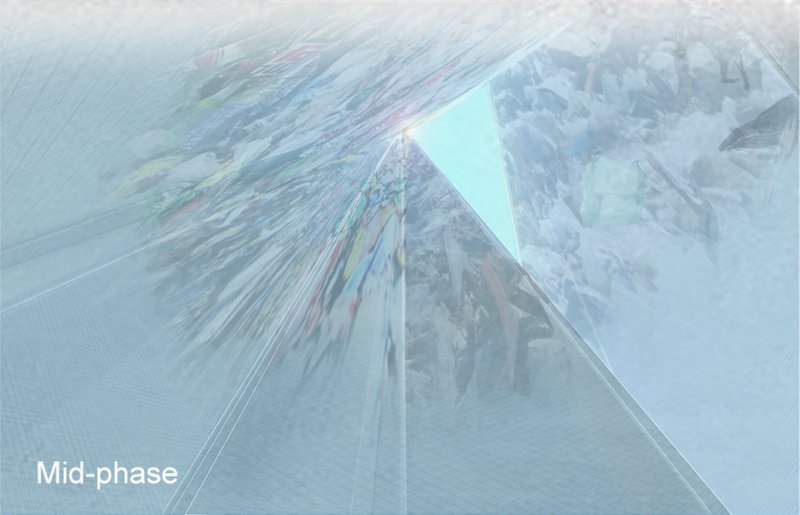
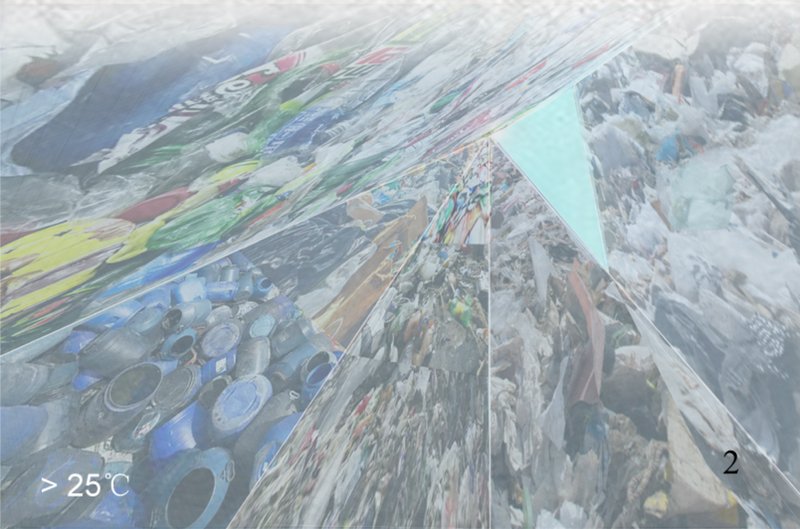
A defining feature of this climate change memorial architecture is the use of phase-change material (PCM). This material operates within a critical temperature range of approximately 25–29°C, enabling it to transition between opaque and transparent states.
This transformation becomes the central narrative device of the project:
- At lower temperatures, the wall appears clean and minimal
- As temperature rises, embedded waste materials gradually become visible
- The more waste revealed, the higher the environmental stress being indicated
This dynamic system converts the building envelope into a real-time environmental indicator, directly linking climatic conditions to visual perception.
Construction Logic: Recycled Materials and Local Techniques
The construction strategy reinforces the sustainability agenda through material selection and adaptability. The primary components include:
- Recycled glass blocks embedded with waste artifacts
- Local Egyptian mud-brick for structural and thermal performance
- Modular block systems allowing easy replacement and long-term maintenance
The combination of recycled and vernacular materials ensures both ecological responsibility and contextual relevance. The architecture is designed not as a static object but as an evolving system capable of adaptation over generations.
Spatial Experience: Journey Through Time and Extinction
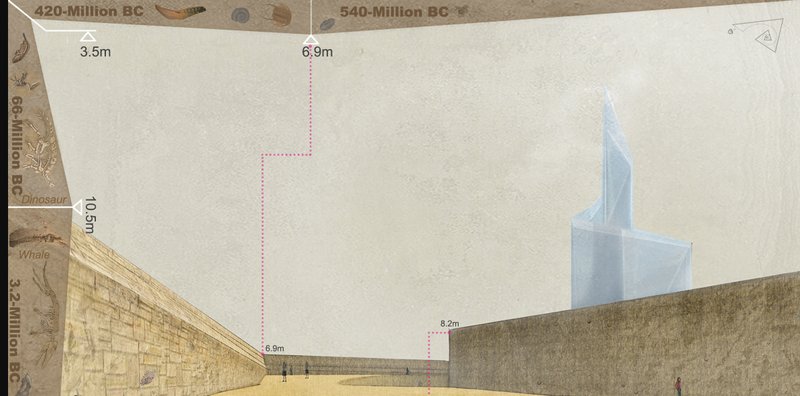
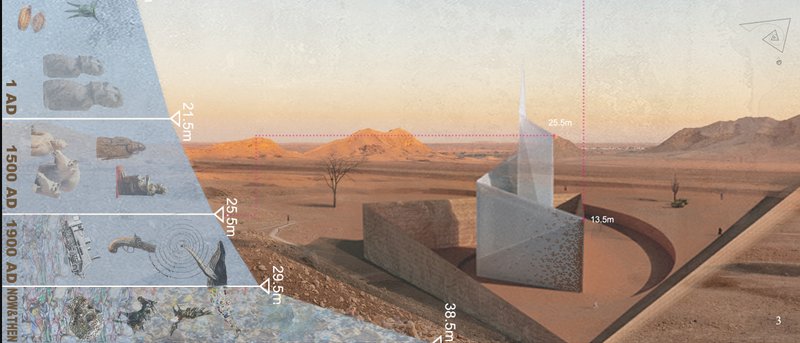
The visitor experience is carefully choreographed along a continuous wall that records the traces of time. Fossils, cultural relics, and waste materials are embedded sequentially, representing different historical eras from prehistoric life to the present.
As visitors move through the space:
- Early stages depict thriving ecosystems and biodiversity
- Mid-sections reveal the rise of human civilization
- Later stages expose the consequences of industrialization and waste accumulation
The spatial compression intensifies toward the central tower, creating a contemplative environment. This progression culminates in a powerful question: Will human beings be the next extinct species?
Climatic Performance: Responsive Architecture in Extreme Conditions
Egypt’s climatic conditions, particularly high solar radiation and temperature fluctuations, are integral to the project’s performance. Surface temperatures can increase by 5–10°C during peak daylight hours, frequently activating the phase-change cycle.
This ensures that the building remains responsive throughout most of the year, with the dynamic transformation occurring in approximately 95% of the operational period during tourist seasons.
The architecture, therefore, does not simulate environmental change but directly responds to it.
Symbolism and Meaning: The Beacon as a Global Indicator
The central tower functions as both a visual landmark and a symbolic beacon. Its crystalline form reflects the transformation of the wall material, appearing more refined as environmental conditions deteriorate.
However, this apparent beauty is deceptive. It signifies increasing temperature thresholds and escalating ecological crisis. The beacon thus operates as a paradox, where aesthetic clarity corresponds to environmental decline.
Universal Relevance: A Global Narrative of Shared Responsibility
While rooted in the Egyptian context, the project addresses a universally recognizable issue. Garbage pollution transcends geographical boundaries, making the narrative accessible to a global audience.
The use of fossils, cultural artifacts, and waste as embedded elements creates a shared timeline that resonates across cultures. Visitors from diverse backgrounds can interpret the installation through their own environmental experiences.
The Fortune of Human Beings redefines the role of memorial architecture in the context of the Anthropocene. It shifts the focus from commemorating the past to actively engaging with the present and projecting future consequences.
By integrating responsive materials, environmental data, and experiential storytelling, the project establishes a new paradigm where architecture becomes a living system of awareness. It challenges visitors not only to observe but to reflect, question, and act.
In an era defined by climate urgency, this project demonstrates how architecture can evolve into a critical instrument for environmental consciousness, transforming space into a medium of accountability and change.




Popular Articles
Popular articles from the community

Indiesalon Carves a Plywood Cave into a Seoul Bistro's Second Floor
Munhwa Bistro's second Seongsu branch wraps diners in a laminated timber vault laced with colored light and mirror illusions.
Constanti Architects Builds a Fortress of Privacy in Nicosia with House 345
A concrete and timber residence in Cyprus reinterprets the traditional introverted courtyard house for a new urban landscape.

Cyber Oyster: A Visionary Adaptive Reuse Architecture Project Transforming Abandoned Oil Rigs Through Oyster Bionics
An adaptive reuse architecture concept transforming abandoned offshore oil platforms into self-healing marine ecosystems inspired by oyster bionics.
Three Studios Build 200 Affordable Units for Tulum's Displaced Hospitality Workers
Casa Selva embeds dark concrete housing blocks into Yucatán rainforest, offering dignified shelter to those priced out by the tourism they serve.
Similar Reads
You might also enjoy these articles


Urban Forest: A Vertical Ecosystem for 5,000 Workers in Singapore's Changi Business Park
Radially stacked pods and layered green decks turn a 7-acre plot into 47 acres of ecological workspace projected for 2040.
interACT: A Wearable Transit Object That Turns Commuting Into Social Infrastructure
A backpack-mounted foldable device transforms walking, waiting, and riding into moments of shared comfort across Jakarta's transit network.
Lean On Barrier System: Where Traffic Safety Meets Chai Culture in Ahmedabad
A modular steel barrier doubles as informal seating and lean-on furniture at one of Ahmedabad's busiest intersections, keeping vendors in place.

The Black Bagh: A Living Monument Built from Water, Light, and Memory
On the banks of the Yamuna, two designers replace the myth of a marble mausoleum with a regenerative landscape of reflection and ritual.





Comments (0)
Please login or sign up to add comments
No comments yet. Be the first to comment!