

Co-owning Urban Farm Community: Shared Agriculture as Urban Infrastructure
Viktoriia Slynchuk proposes a modular framework where co-owned aquaponics farms, social housing, and cultural pavilions merge into one civic ecosystem.


What if the sharing economy that reshaped how we use cars and apartments could do the same for food production? The Co-owning Urban Farm Community takes that premise seriously, proposing a hybrid architectural framework where residents collectively invest in, manage, and harvest from aquaponics farms embedded within the fabric of a dense urban neighborhood. It is not a rooftop garden bolted onto an existing building. It is a ground-up organizational model where farming infrastructure, social housing, cultural food courts, and open laboratories share a single site plan, each program feeding the others.
The project is the work of Viktoriia Slynchuk, published on uni.xyz. It targets the megacity condition: millions of people consuming food they have no connection to, producing waste they never see, living in neighborhoods that offer no productive landscape. Slynchuk's response is a scalable, modular system designed for replication across climates and cultures, with a digital platform layer that lets co-owners monitor crops remotely, schedule drone deliveries, and book workshop sessions.
A Site Plan Organized Around Shared Production

The site plan reveals the project's core organizational logic. Aquaponics farm buildings, housing units, gardens, and food pavilions are arranged around a network of circulation paths that keep every program within walking distance of every other. There is no separation between "residential" and "productive" zones in the conventional planning sense. Instead, the farm is the center of gravity, with housing and cultural spaces orbiting it. This layout means that daily routines, from commuting to cooking, intersect with agricultural cycles. Residents do not visit the farm; they move through it.
The diagram also shows how the system could begin as a single farm unit with pavilions and expand incrementally as demand grows. That modularity is critical: it means the concept does not depend on a massive initial investment or a single political decision. A neighborhood cooperative could start small and prove the model before scaling.
Three Greenhouses, Green Roofs, and the Housing Below

The axonometric model clarifies the vertical relationship between programs. Three parallel greenhouse structures sit atop white residential volumes, their green roofs turning the productive landscape into a visible civic feature rather than something hidden behind walls. The housing below serves both permanent farm workers and timeshare participants, people who co-own a fraction of the farm and stay on-site during their farming rotations. This stacking of greenhouse over dwelling is more than a space-saving move. It ties the resident's daily experience to the biological rhythms of the crops growing directly overhead.
The surrounding context visible in the model suggests a dense urban setting where this intervention would register as a distinct new typology: neither park nor housing block nor commercial district, but all three at once. The parallel greenhouse forms create a strong architectural identity while leaving generous open ground between them for gardens and gathering.
Public Face: The Aquaponics Market and Reflecting Pool
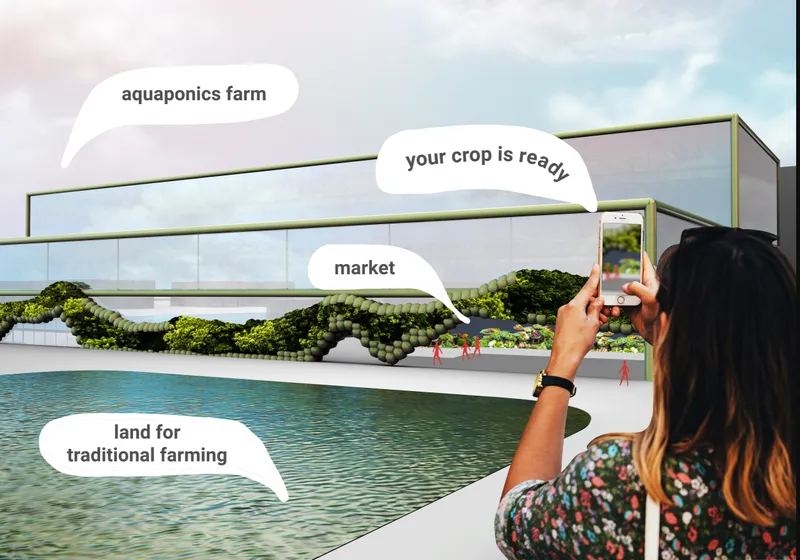
The rendering captures the project's ambition to be more than functional infrastructure. A visitor photographs the aquaponics greenhouse and market building from across a reflecting pool, a scene that positions the farm as a destination, a place worth traveling to and documenting. The water surface doubles the building's presence and softens the edge between public promenade and productive interior. Food courts inspired by Asian, European, African, and Latin American cuisines anchor the market, alongside art exhibitions and cultural pavilions that ensure the complex attracts visitors who may not have come for the lettuce.
Slynchuk's insight here is pragmatic: urban farming cannot survive on utility alone. It needs to generate cultural activity, social interaction, and the kind of atmospheric quality that makes people want to linger. The seasonal transformation of farm facades into festive or cultural backdrops reinforces this, turning the architecture into a calendar of events rather than a static enclosure.
Section: How Programs Stack and Breathe
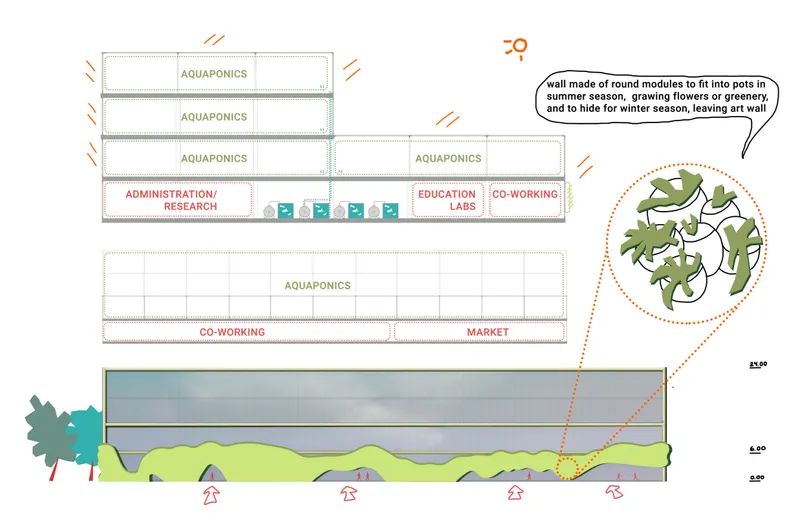
The section drawing cuts through the aquaponics halls, administration areas, and market space to reveal how the landscape negotiates multiple ground levels. The program distribution is legible: productive space occupies the largest volume, administrative and educational functions sit at intermediate levels, and the market opens directly to the public realm. Landscape steps down and up across the section, creating varied outdoor conditions, from intimate garden courts to open terraces, that support different modes of engagement with the farm.
What the section makes especially clear is that the aquaponics halls are not sealed technical rooms. They have spatial generosity, height, and light that make them readable as public interiors. Open laboratories and workshops plug into these volumes, allowing visitors to observe fish tanks and hydroponic racks as working demonstrations rather than hidden processes. The architecture makes the food system legible.
Why This Project Matters
The Co-owning Urban Farm Community matters because it treats food production not as an afterthought to urban design but as its organizing principle. Most sustainable architecture projects add green features to conventional programs. Slynchuk inverts the hierarchy: the farm comes first, and housing, culture, and commerce are shaped around it. The co-ownership model, supported by a digital platform for prepayment, crop monitoring, and drone delivery, addresses the economic fragility that sinks most urban agriculture proposals. Shared investment distributes risk and creates a constituency of people with real stakes in the farm's success.
More broadly, the project challenges the assumption that megacity residents must remain passive consumers. By placing aquaponics farms, workshops, and cultural food courts within the daily orbit of a residential community, the design reasserts the idea that architecture can shape habits, not just accommodate them. If scaled across multiple cities and adapted to local climates and food cultures as the designer envisions, this framework could redefine what productive urban land looks like in the 21st century.
View the Full Project
About the Designers
Designer: Viktoriia Slynchuk
Enter a Design Competition on uni.xyz
uni.xyz runs architecture and design competitions year-round that reward proposals with spatial conviction and real site intelligence.
Project credits: co-owned urban farm community by Viktoriia Slynchuk.




Popular Articles
Popular articles from the community


Co-Life: Senior Housing Design That Reconnects Older Adults With the City
Co-Life reimagines senior housing design through healing gardens, shared streets, workshops, and a sustainable community across generations.

Hill & Cross Opera: Sculptural Opera House Architecture Shaped by Tallinn’s Landscape and Identity
Hill & Cross Opera reimagines opera house architecture in Tallinn through its sculptural hill, civic plaza, glass wave and a luminous cross.

Lunar Spiral: Space Architecture Shaped by the Mathematics of the Universe
Lunar Spiral reimagines space architecture through Fibonacci geometry, lunar regolith, levitating habitats, and self-sustaining Moon living.

Conexión: Biophilic Design Reimagines High-Rise Living in Hong Kong
Conexión reimagines high-rise living in Hong Kong through biophilic design, green facades, shared spaces, daylight, water and nature within.

Similar Reads
You might also enjoy these articles
Lunar Spiral: Space Architecture Shaped by the Mathematics of the Universe
Lunar Spiral reimagines space architecture through Fibonacci geometry, lunar regolith, levitating habitats, and self-sustaining Moon living.
The Main Dream: Modular Architecture for Play, Learning, and Community
A modular playground turns recycled plastic into adaptable spaces where refugee children can play, build, learn, and reconnect.

Play: Fragments of Their World
Familiar architecture becomes modular playground design, creating safe spaces where displaced children can learn, connect, imagine and play.

Wadi Rum Observatory: Desert Architecture Designed for the Night Sky
Wadi Rum Observatory turns desert architecture into a quiet instrument for astronomy, hiding research spaces under Jordan's starlit terrain.

Explore Sustainable Urbanism Competitions
Discover active competitions in this discipline



Challenge to reimagine the Iron Throne


Photograph architecture without architects


Illustrate the lost glory of Angkor Wat - Render Challenge


Design challenge to reuse E-waste
Comments (0)
Please login or sign up to add comments
No comments yet. Be the first to comment!