
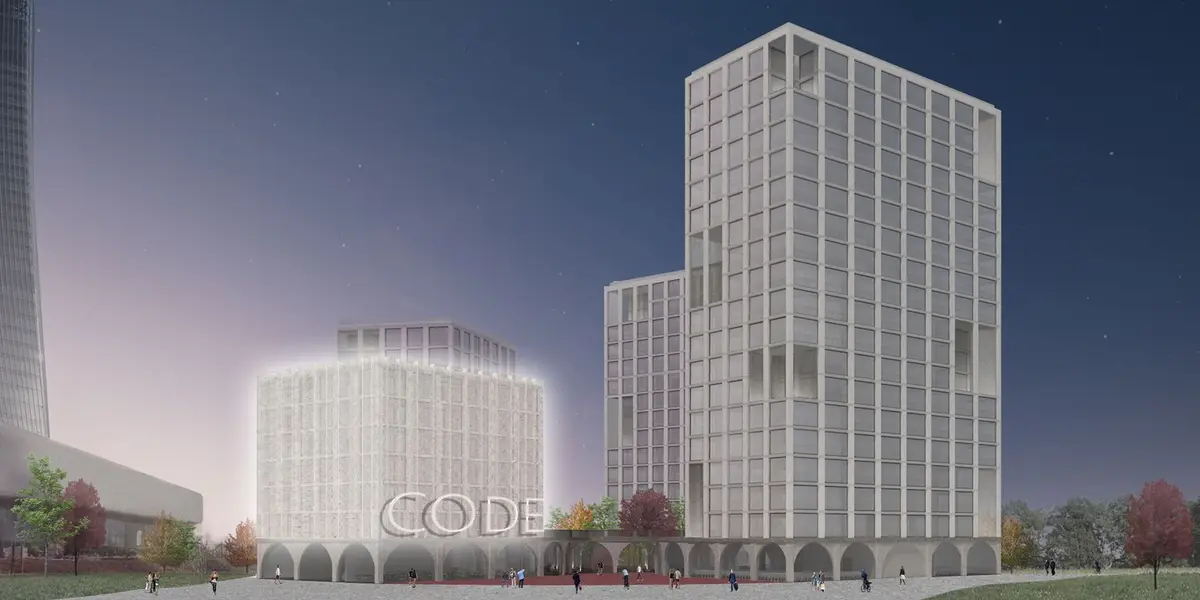
CODE: A Megastructure in Milan Designed to Evolve from Coworking into Housing
Four towers built on a flexible column grid anticipate a radical shift from shared workspaces to future residential use in Milan's urban core.


What if the coworking space you rent a desk in today becomes someone's apartment a decade from now? CODE takes that question seriously, proposing a four-tower megastructure in Milan where every floor, every facade, and every structural bay is designed for eventual conversion. It is not a building that happens to be adaptable; adaptability is the core architectural argument, baked into the column grid, the ceiling heights, and even a removable secondary facade on the shortest tower.
Designed by Anastasia Khech, Anastasia Kalmykova, and Alexandra Stepanova, CODE was a runner-up entry in the Co-design Milan 2020 competition. The brief asked designers to rethink coworking architecture for a post-pandemic, future-ready city. This team responded not with a sleek office interior but with an entire urban district: coworking zones, sport and relaxation facilities, educational spaces, a food court, conference halls, yoga rooms, communal kitchens, and green roof parks, all accessible 24/7.
Arched Ground Floors That Blur Indoor and Outdoor Life
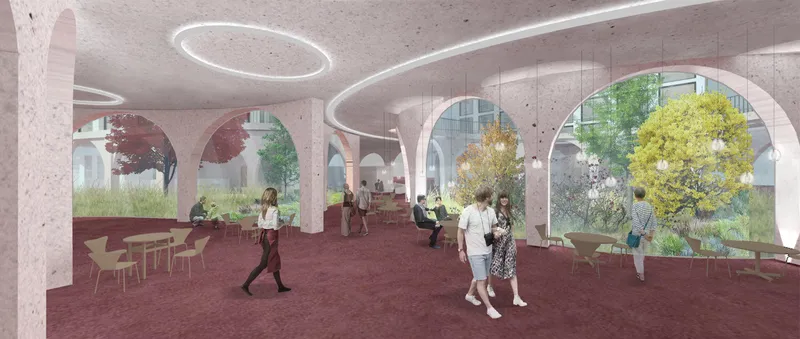
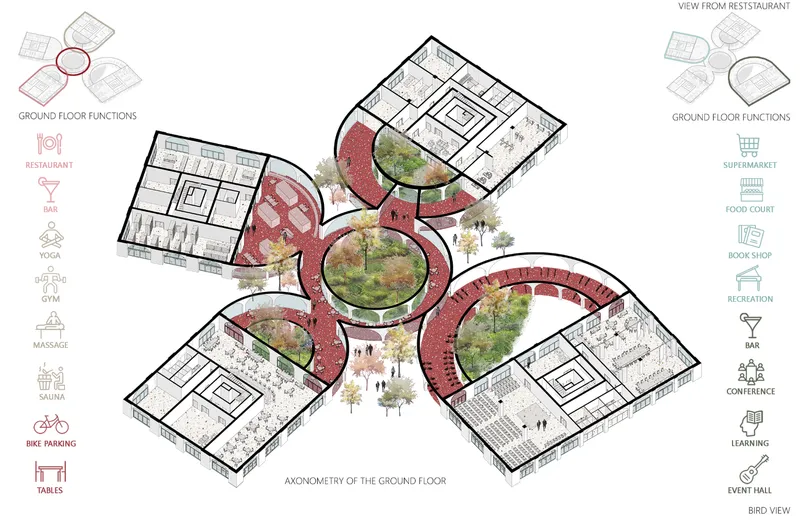
The interior rendering reveals an arched colonnade framing planted courtyards, circular ceiling lights punctuating a generous double-height space, and people moving freely between greenery and seating areas. There is no lobby in the conventional sense. Instead, the ground floor operates as a continuous public landscape where knowledge-sharing platforms, sport zones, dining, relaxation, and social meeting hubs overlap. The axonometric drawing makes the organizational logic legible: lobed volumes with planted courtyards sit at the center, while rectangular wings extend outward to form the tower footprints. The result is a plan that reads more like a park with buildings growing out of it than a complex with landscaping applied after the fact.
This ground plane is deliberately overscaled relative to the towers above. The generous open areas leave room for green spaces, play areas, and amenities that can shift in character as the building's population evolves. If CODE's towers one day house families rather than freelancers, the ground floor already has the spatial DNA to support that transition.
A Courtyard Calibrated to the Sun
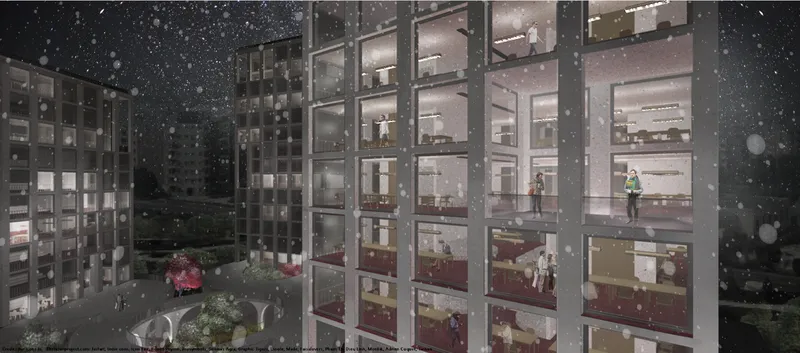
The nighttime courtyard rendering is atmospheric: snow falling past exposed residential-scale units, warm light spilling from inhabited frames. But the real story is in the masterplan logic behind this scene. The plot was selected to maximize sunlight penetration into the central courtyard. The lowest tower sits on the eastern side so that visitors entering from that direction get an unobstructed view of the full ensemble. The remaining buildings rise progressively toward the north, where the tallest tower stands, ensuring that the courtyard receives ample daylight throughout the day rather than spending half of it in shadow.
The central park is not merely decorative. It hosts classes, workshops, lectures, and culinary events, serving as a social connector between coworkers, local residents, and visitors. Rooftop bars and event spaces on the upper levels extend this public life vertically, but the courtyard remains the gravitational center of the project.
Structure as Strategy: Column Grids and Removable Facades
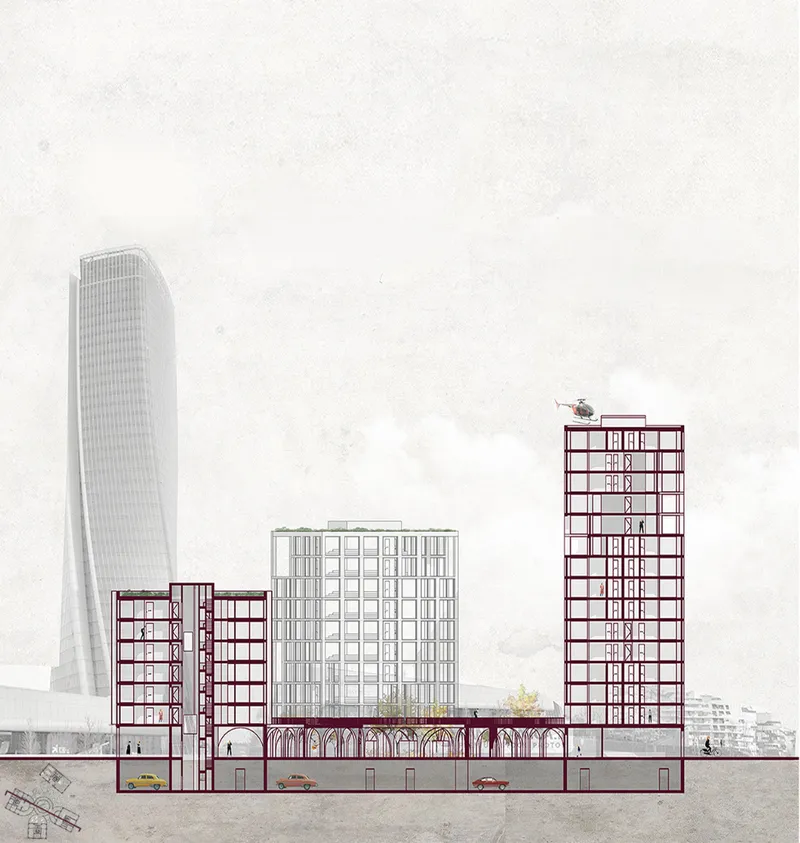
The section drawing is where CODE's future-proofing agenda becomes most convincing. All four towers share a column-grid structural system that keeps interior partitions non-loadbearing, allowing wholesale reconfiguration of floor plans without touching the primary structure. High ceilings, balconies, and underground garages are legible in the section, each reinforcing the idea that these are not office buildings but frameworks awaiting their next program.
The most provocative detail: the lowest tower could be converted into a residential building simply by removing its secondary facade. That single move, stripping one layer of enclosure, would transform the unit typology from open-plan coworking into apartment-scaled rooms. It is an elegant argument that adaptability does not require expensive or complex interventions when the right structural and envelope decisions are made from the start. Each of the four towers features a unique coworking space typology, with dedicated small kitchens and quiet zones, but the underlying grid remains consistent, keeping all future options open.
Workspace Interiors Built Around Wellbeing, Not Efficiency
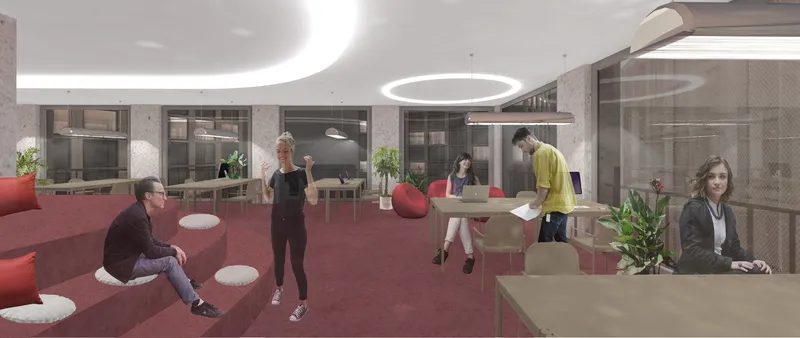
The shared workspace rendering shows a space that feels closer to a botanical library than a hot-desking floor. Circular ceiling lights cast even illumination over clusters of people working at tables surrounded by potted plants and timber furnishings. The design philosophy is rooted in the belief that creativity thrives in environments fostering open communication and diversity of experience. Yoga rooms, communal kitchens, and green roof parks reinforce this position: productivity is treated as a byproduct of emotional wellbeing, not the other way around.
Rental options vary across towers, from individual desks to full rooms, making the complex financially accessible to solo freelancers and small companies alike. This economic flexibility mirrors the spatial flexibility embedded in the structure: CODE is designed so that no single user group, income level, or program can monopolize its capacity.
Why This Project Matters
Most coworking proposals optimize for the present: better desks, better coffee, better Wi-Fi. CODE operates on a longer timeline, asking what happens to all that real estate when work habits shift again, when cities face housing shortages, when the next generation needs homes more than it needs hot desks. By embedding convertibility into the structural system and the facade logic, Khech, Kalmykova, and Stepanova propose a model where construction waste is minimized and buildings gain value over time instead of becoming obsolete.
The project also makes a spatial argument that is easy to overlook: by placing a genuine public park at the center of a commercial development and calibrating tower heights to solar geometry, CODE insists that coworking architecture has civic responsibilities beyond its membership base. It is a runner-up entry that reads like a manifesto, and the questions it raises about building longevity, programmatic fluidity, and urban generosity deserve attention well beyond the scope of this competition.
View the Full Project
About the Designers
Designers: Anastasia Khech, Anastasia Kalmykova, Alexandra Stepanova
Enter a Design Competition on uni.xyz
uni.xyz runs architecture and design competitions year-round that reward proposals with spatial conviction and real site intelligence.
Project credits: CODE by Anastasia Khech, Anastasia Kalmykova, Alexandra Stepanova Co-design Milan 2020 (uni.xyz).


Popular Articles
Popular articles from the community


Temporary Home for Dogs: A Reversed Zoo Rethinks Animal Shelter Architecture
In Bucharest, a sinuous corridor and freed landscape flip the logic of containment, designing a shelter that works to make itself unnecessary.

Opera on the Sea: Driftwood Logic Shapes a Timber Opera House on Estonia's Coast
Trevor Orgill's opera house translates the entangled drift of floating timber into a civic building where wood, water, and music converge.

Manzana Morphosis: Stretching Barcelona's Grid into a Living Landscape for 2050
A radical reworking of the Eixample manzana turns density into a tool for generous public space, vertical ecology, and environmental performance.
Opera by the Sea Estonia: Three Shells Dissolving Architecture into Tallinn's Coastline
A winning opera house proposal replaces monumental form with interconnected shells that blur the boundary between building, park and Baltic Sea.

Similar Reads
You might also enjoy these articles

Day and Night Park: A Time-Based Urban Newsstand in Beijing
A temporary urban newsstand in Beijing blending travel, light, and reading through poetic colors, compact form, and community-focused design.

Modernist Patio Renovation in El Masnou, Barcelona by Oliver Segura Arquitectura + Cebrià Arquitectura
Modernist patio renovation blending tradition and innovation with a movable pool, leveled floors, and Catalan materials in El Masnou.

Alto Residencial Coop: Cooperative Housing Development in Santiago de Compostela by Carbajo Barrios Arquitectos
A linear cooperative housing complex blending white volumes and perforated metal façades, enhancing community living, natural light, privacy, and urban integration.
Vil Genis School by BPA ARCHITECTURE – Massy, France
Vil Genis School in Massy, France, features sustainable design, south-facing classrooms, community integration, accessible spaces, and modern educational architecture.

Comments (0)
Please login or sign up to add comments
No comments yet. Be the first to comment!