
324PRAXIS Turns an Abandoned House in Saigon into a Café Built from Thresholds
A Collage of Outcasts rethinks walls, columns, and canopies as porous boundaries in flood-prone Thao Dien, Ho Chi Minh City.


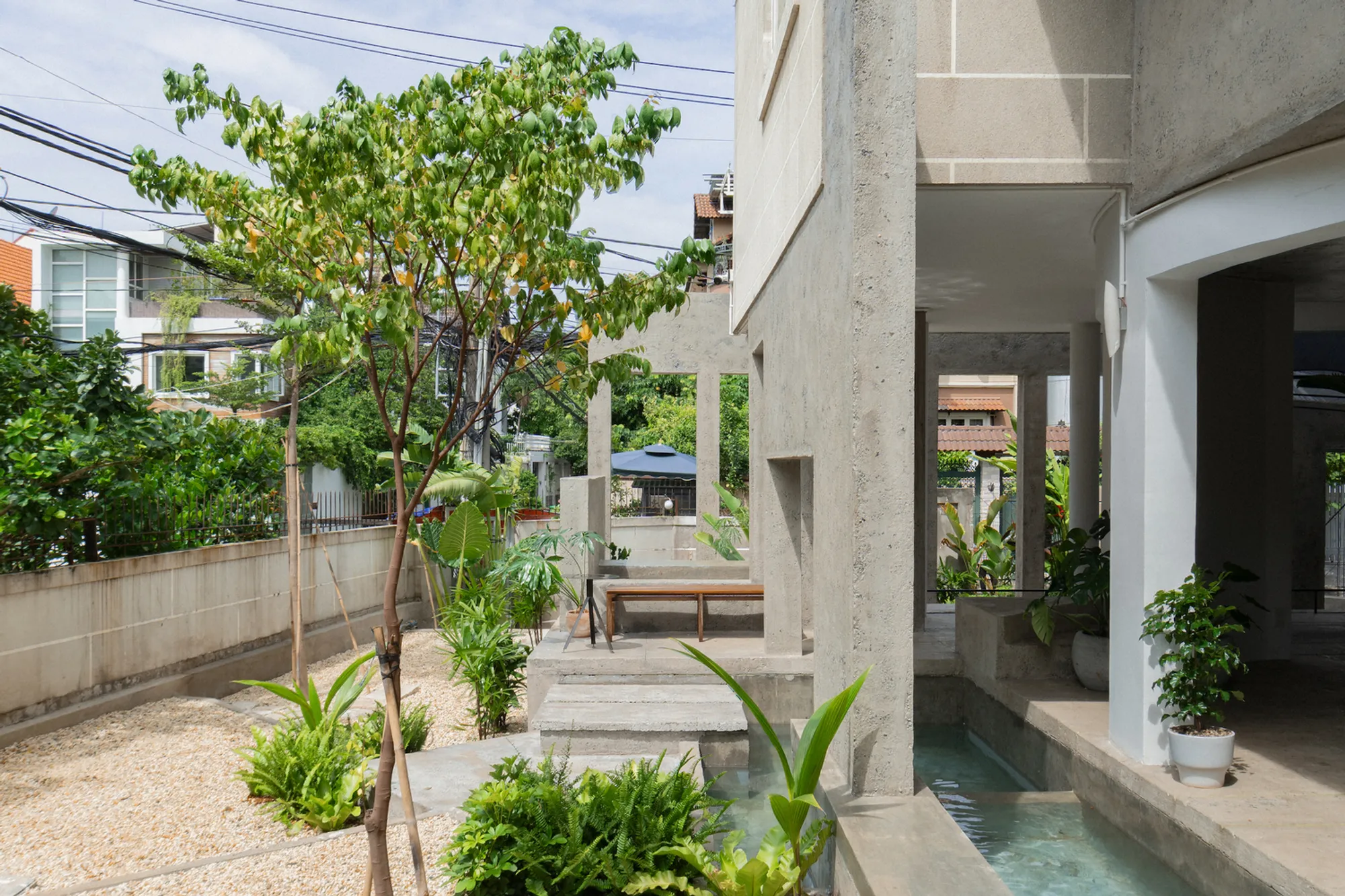
For five years, a house in Thao Dien sat empty. Elevated 1,100 millimeters above street level to dodge the tidal floods that regularly swamp this Ho Chi Minh City district, the building had the bones of a defensive object: high perimeter walls, sealed facades, the standard introverted posture of a neighborhood where privacy runs to 2.6-meter-tall boundary enclosures. When 324PRAXIS, led by Dat Dinh with Nguyen Cao Hoai Nam, took on the renovation, they kept the elevation but junked everything the old house believed about shutting out the world.
The result, A Collage of Outcasts, is an 810-square-meter café and office that treats every architectural element (column, canopy, opening, pool) as a threshold rather than a barrier. Circular columns sit at the building's perimeter while square columns pull back into shadow. Corrugated metal canopies hover on steel cables. Water channels run between piers. Gravel courtyards host monstera and tropical trees. It is a building that refuses to draw a hard line between inside and outside, preferring instead to stack a dozen soft ones.
The Colonnade as Public Room
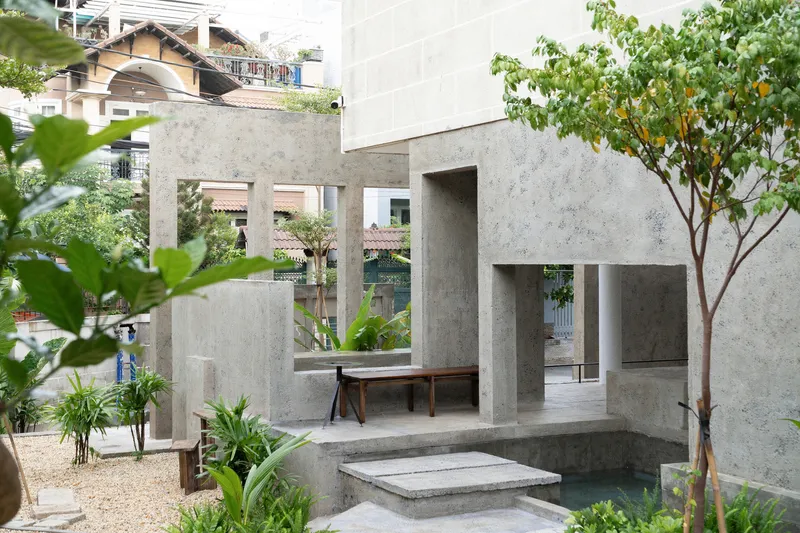
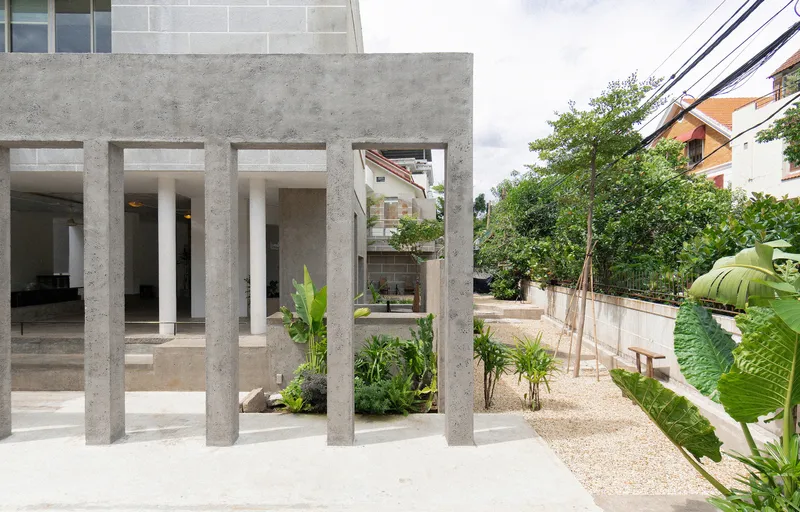
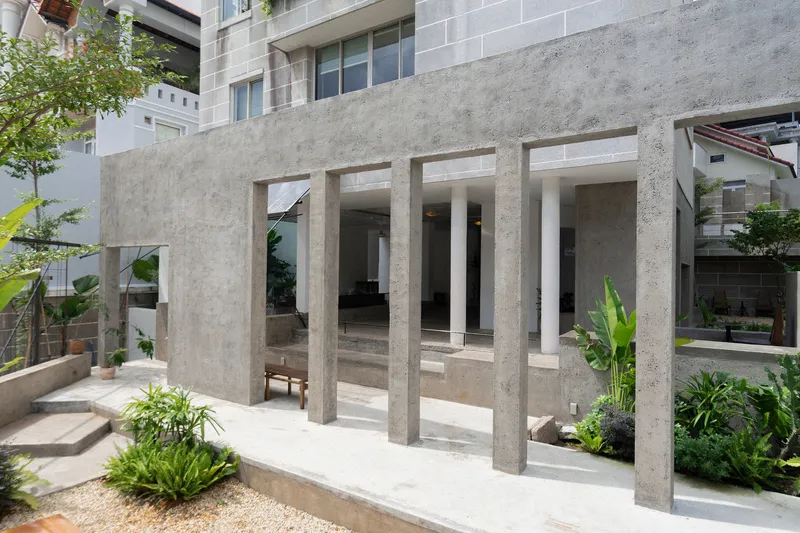
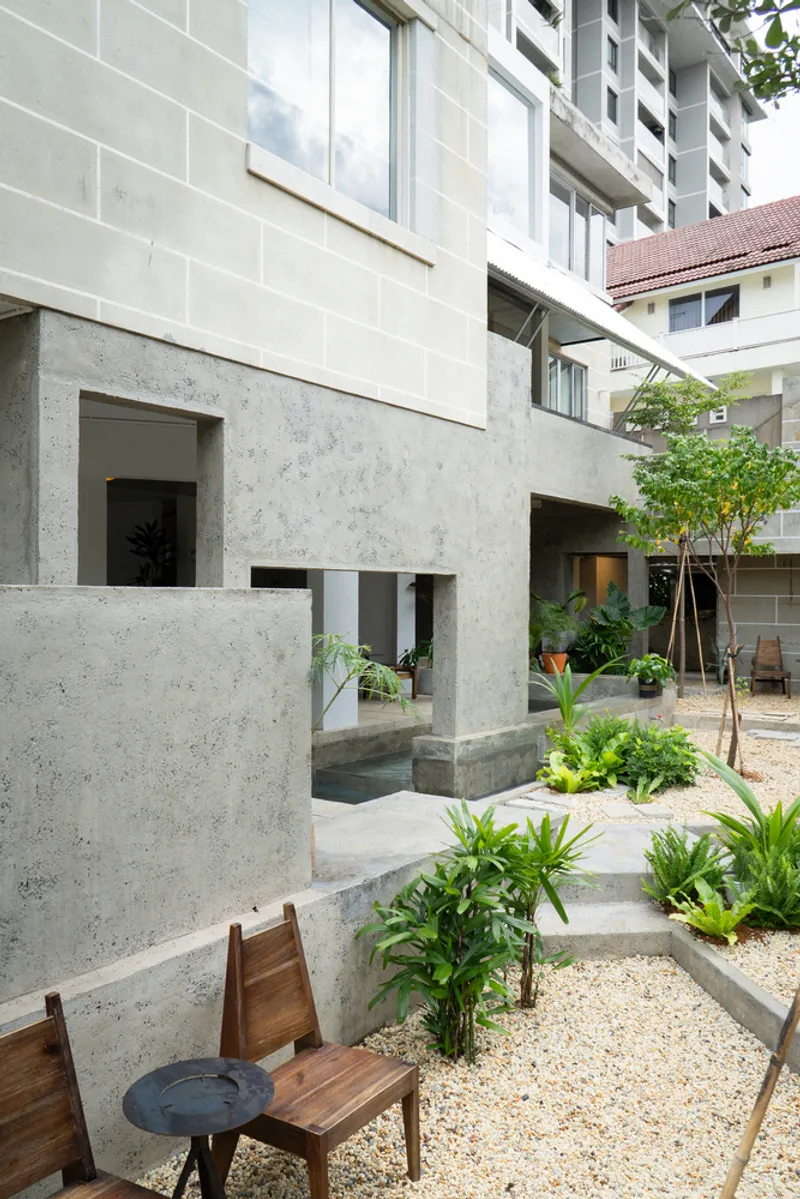
The ground level reads less like a building entrance and more like a covered public garden. Slender concrete columns march in a rhythm loose enough to avoid the formality of a classical peristyle but tight enough to define edges. Gravel beds and young trees occupy the spaces between piers, turning what could be a parking structure into something closer to a temple grove. The scale of the columns relative to the roof they carry is deliberately generous: these are structural members doing more work as spatial dividers than as load paths.
What makes this colonnade unusual is its double duty. From the street, the row of piers signals a semi-public threshold, inviting passersby to step onto the elevated platform. From inside the café, the same columns frame views outward into the neighborhood, reversing the typical Thao Dien condition where walls block every sightline. The building's 1,100mm lift above the sidewalk, originally a flood-mitigation strategy, becomes an observation deck in disguise.
Canopies That Float
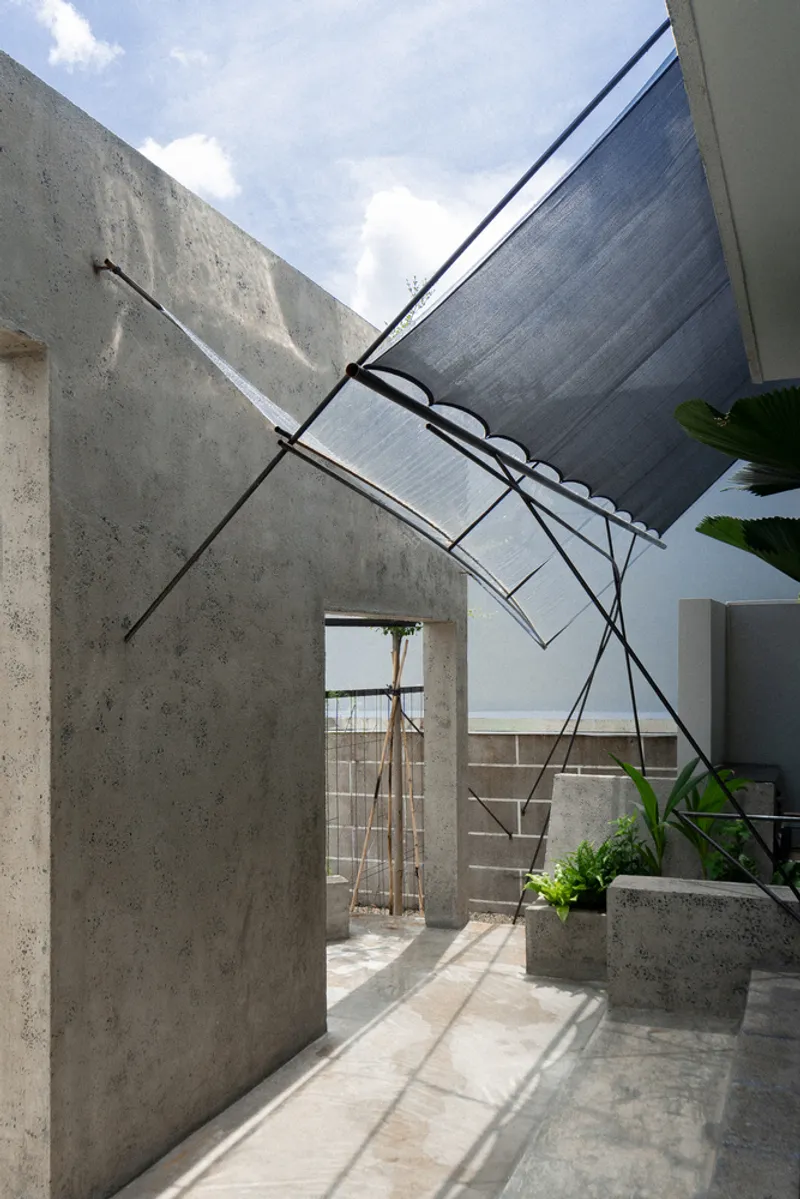
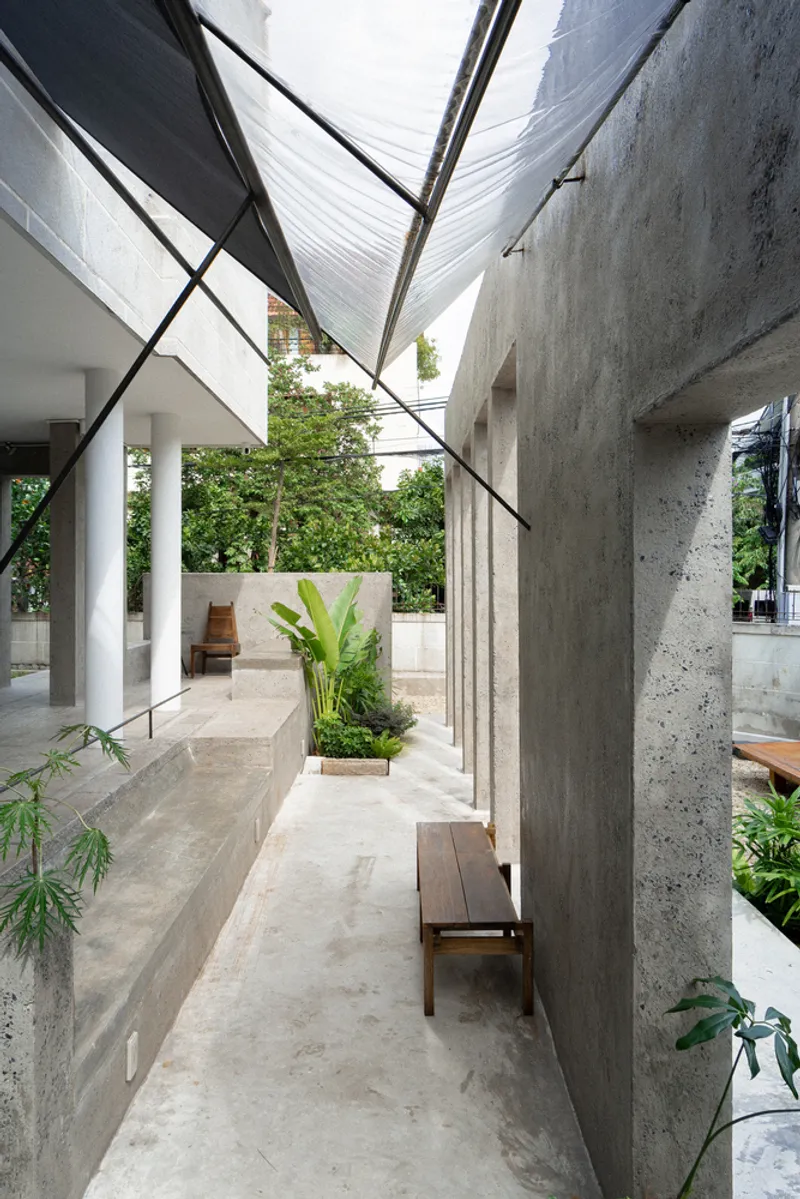
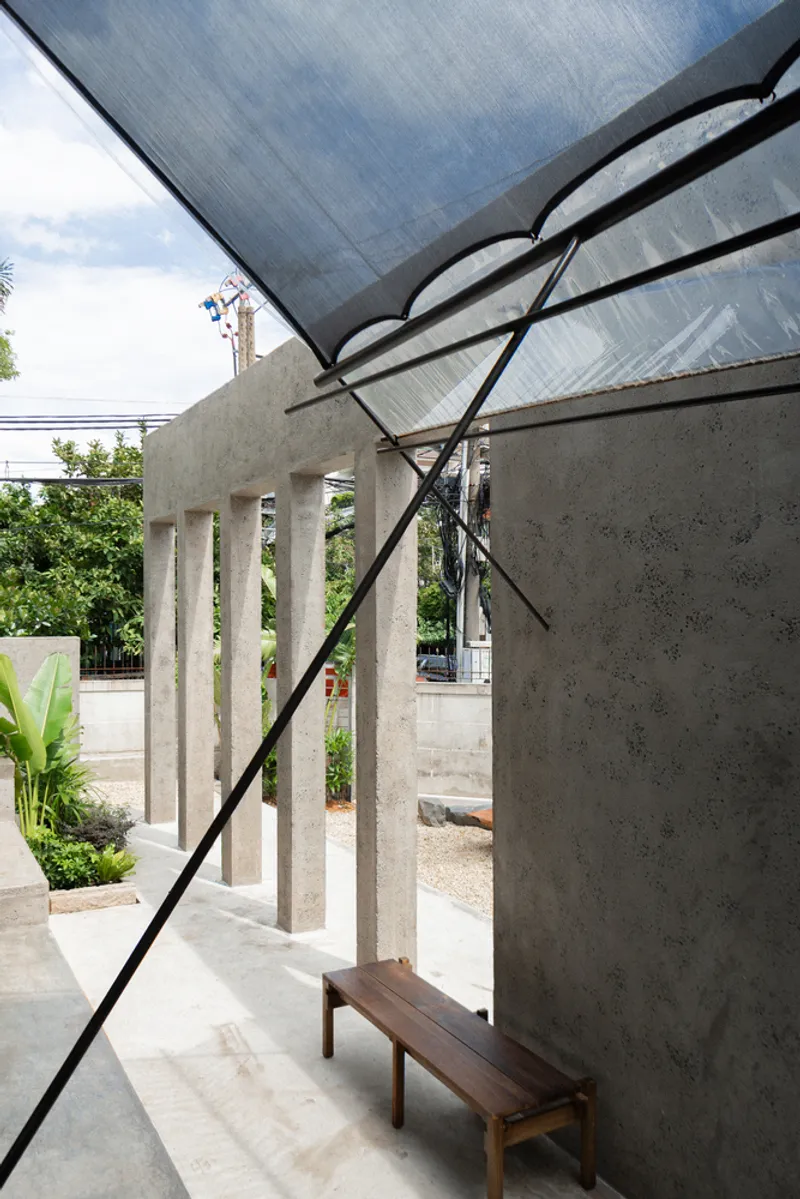
324PRAXIS layers several distinct roof systems across the project. Corrugated metal canopies, suspended on black steel frames and tensile cables, hover above open courtyards without touching the concrete walls below. A translucent fabric canopy stretches along a narrow walkway, filtering midday sun into a milky glow. Each overhead element is visually separated from the structure it shelters, so the roof never feels like a lid. Air, light, and rain all find partial entry.
The variety of canopy types gives each zone a specific character without requiring partition walls. Under the corrugated metal, you get hard shadow and industrial grit. Under the tensile fabric, the light softens. Under the exposed concrete ceiling of the interior, weight and permanence return. Moving through the building means moving through atmospheres, each calibrated by what hangs overhead.
Water as Interior Furniture
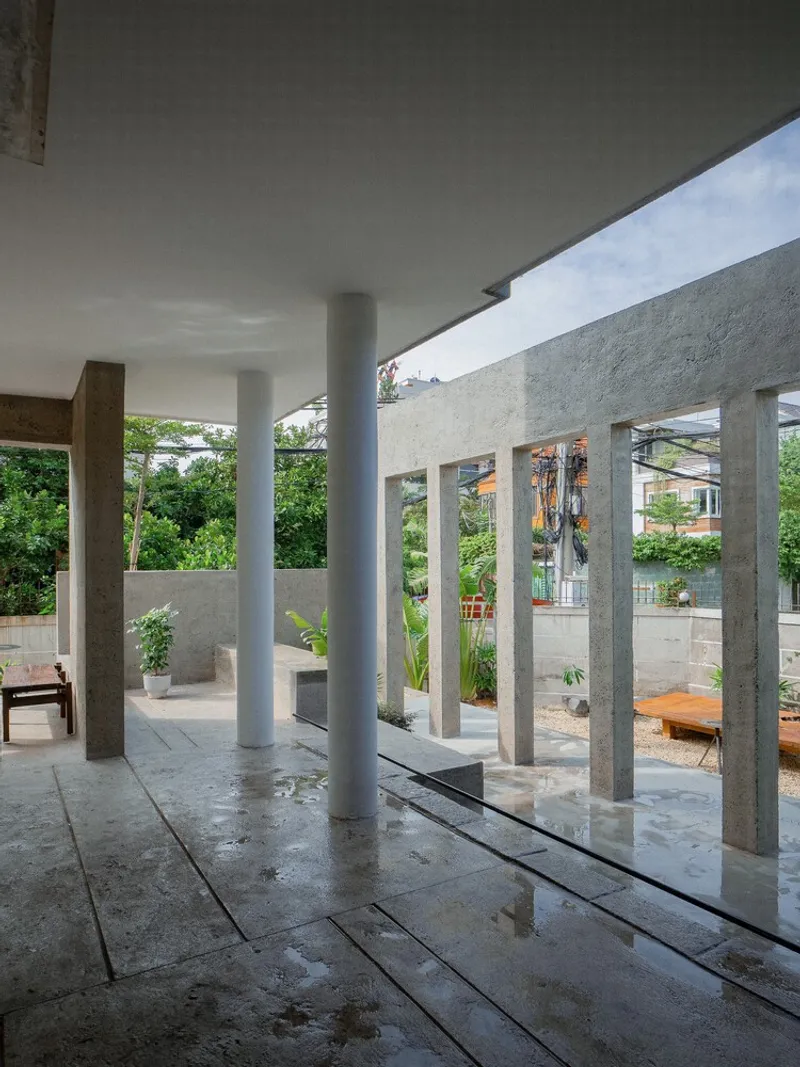
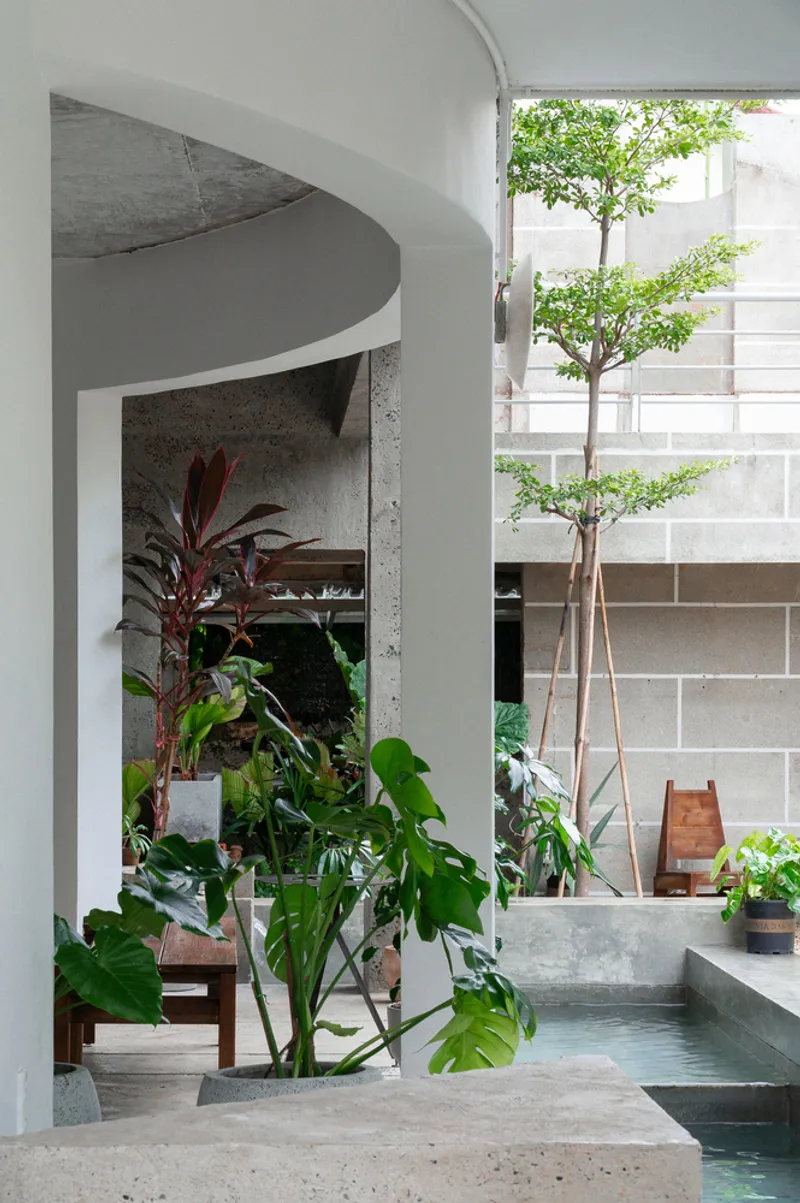
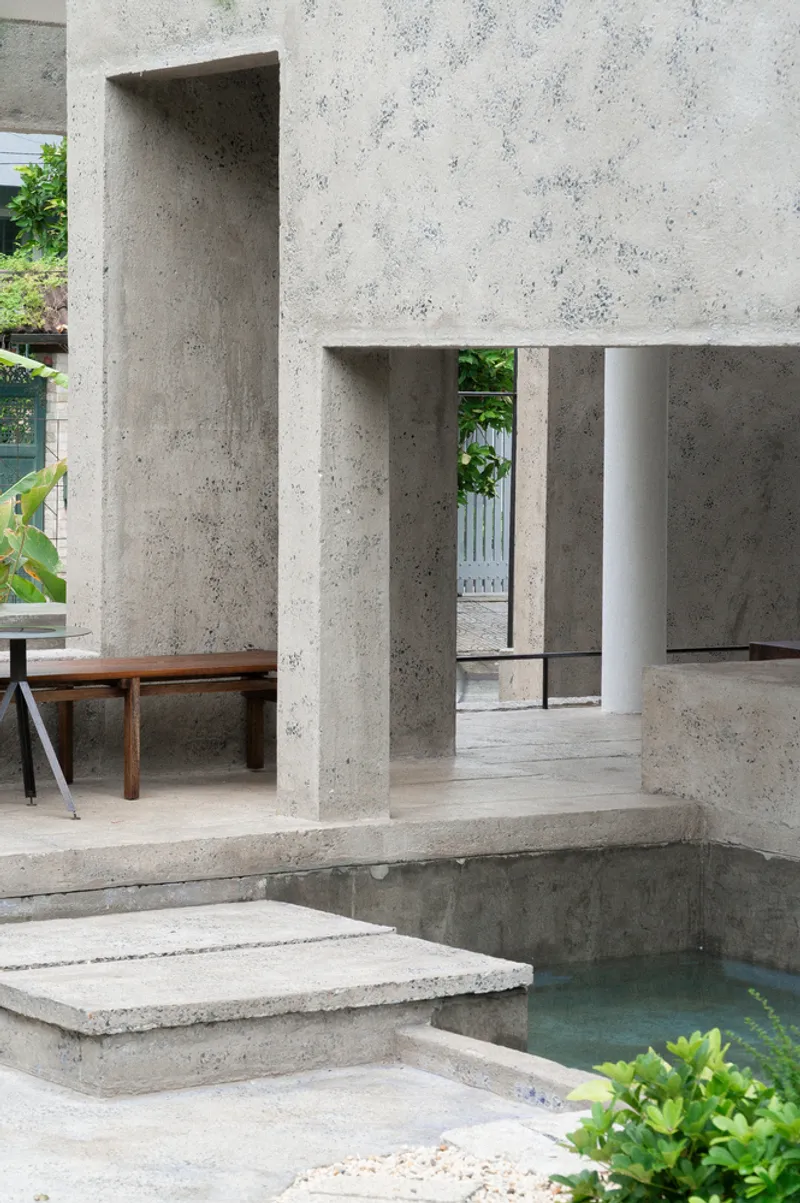
In a district plagued by tidal flooding, making water a decorative feature is a pointed choice. Shallow pools and linear channels run between columns and along terrace edges, turning the threat of inundation into a controlled amenity. A concrete pool framed by an arched opening becomes a kind of picture window in reverse: you look through the arch not at a view but at water, plants, and reflected sky.
The water features also function acoustically. In a café where conversation competes with street noise and coffee-grinder hum, the low murmur of a shallow channel does more atmospheric work than a playlist. It is a quiet, material decision that rewards visitors who sit still long enough to notice it.
Framed Light and Carved Shadow
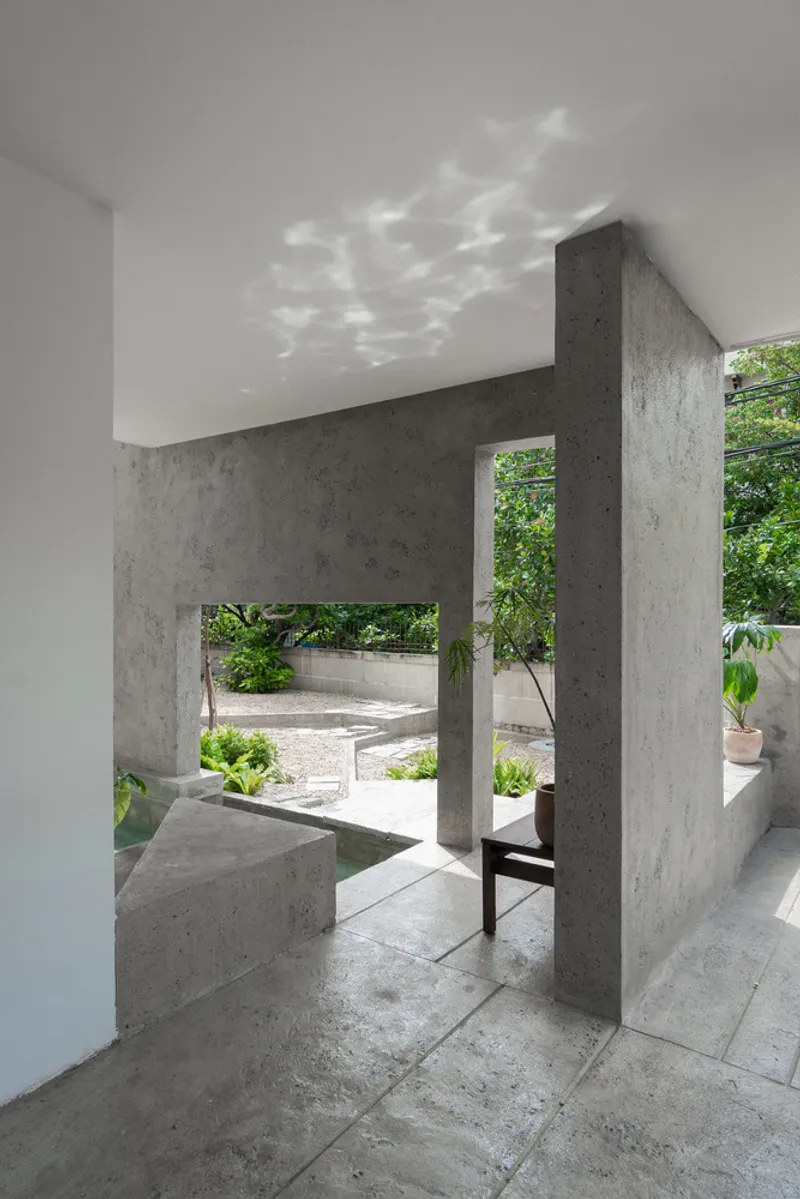
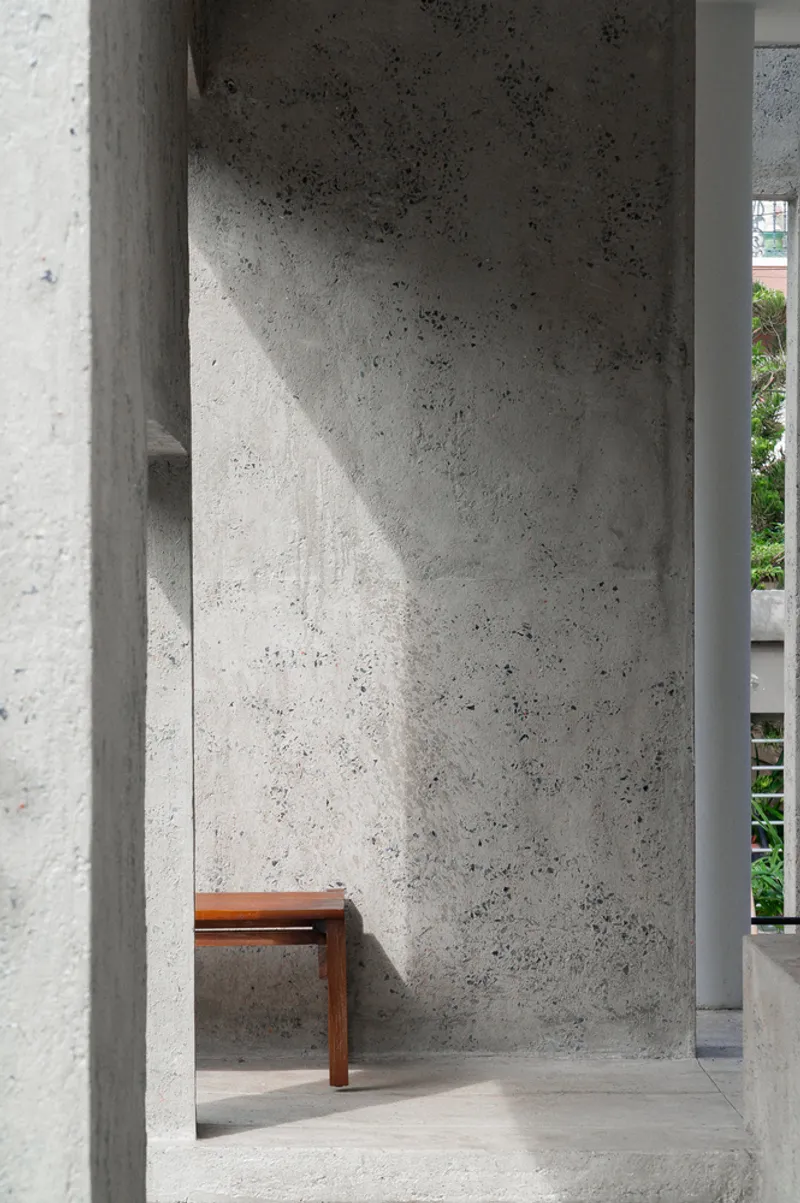
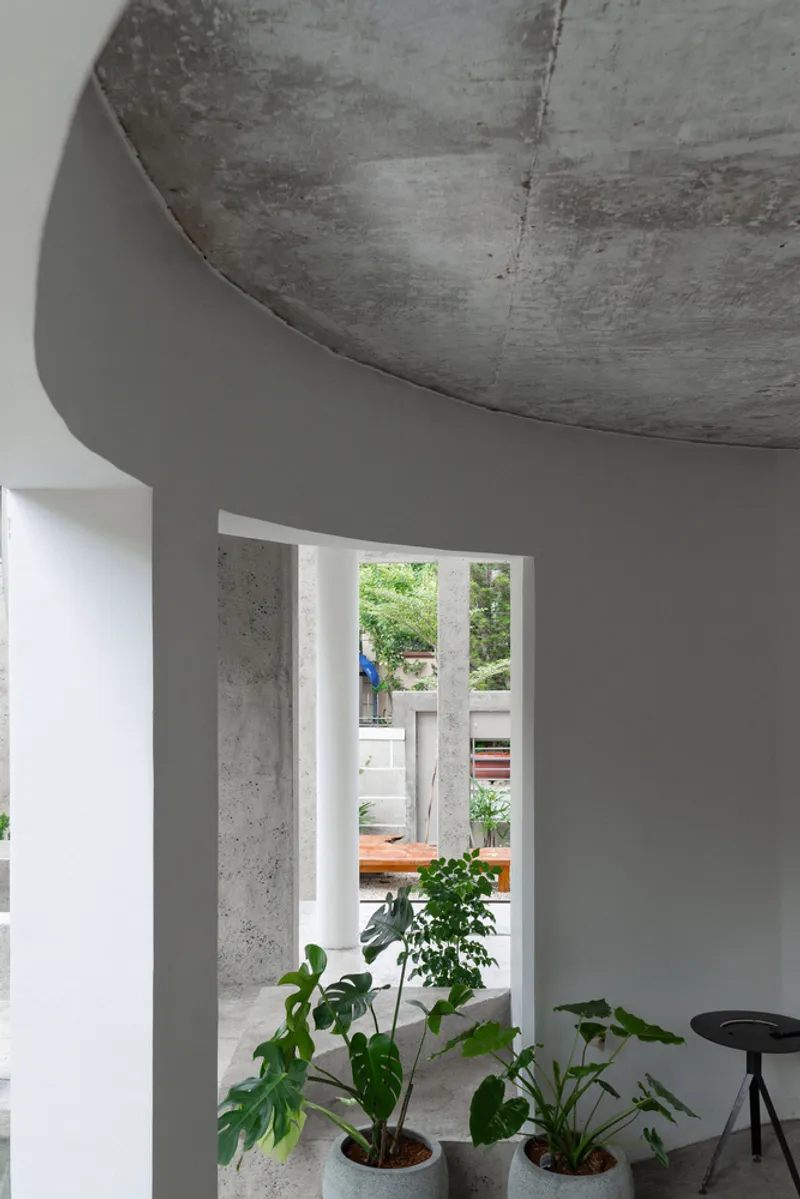
Some of the project's strongest moments happen where concrete walls punch horizontal slots or deep recesses that catch angled sunlight. A narrow alcove with a timber bench receives a single diagonal shaft of afternoon light, turning a residual space into the most photogenic seat in the house. Elsewhere, portal frames with horizontal openings filter dappled courtyard light into interior corridors, creating patterns that shift by the hour.
The interplay between the building's square columns, which 324PRAXIS sets deep enough to live in shadow, and the circular perimeter columns, which catch full sun, gives the plan a tonal gradient. Edges are bright, centers are dark, and the transition between the two is never abrupt. For a café interior, this gradient matters: it lets guests self-select their level of exposure, from the glare of the courtyard to the cave-like calm of an inner bench.
Interior Logic: Columns, Ceilings, and Open Plan
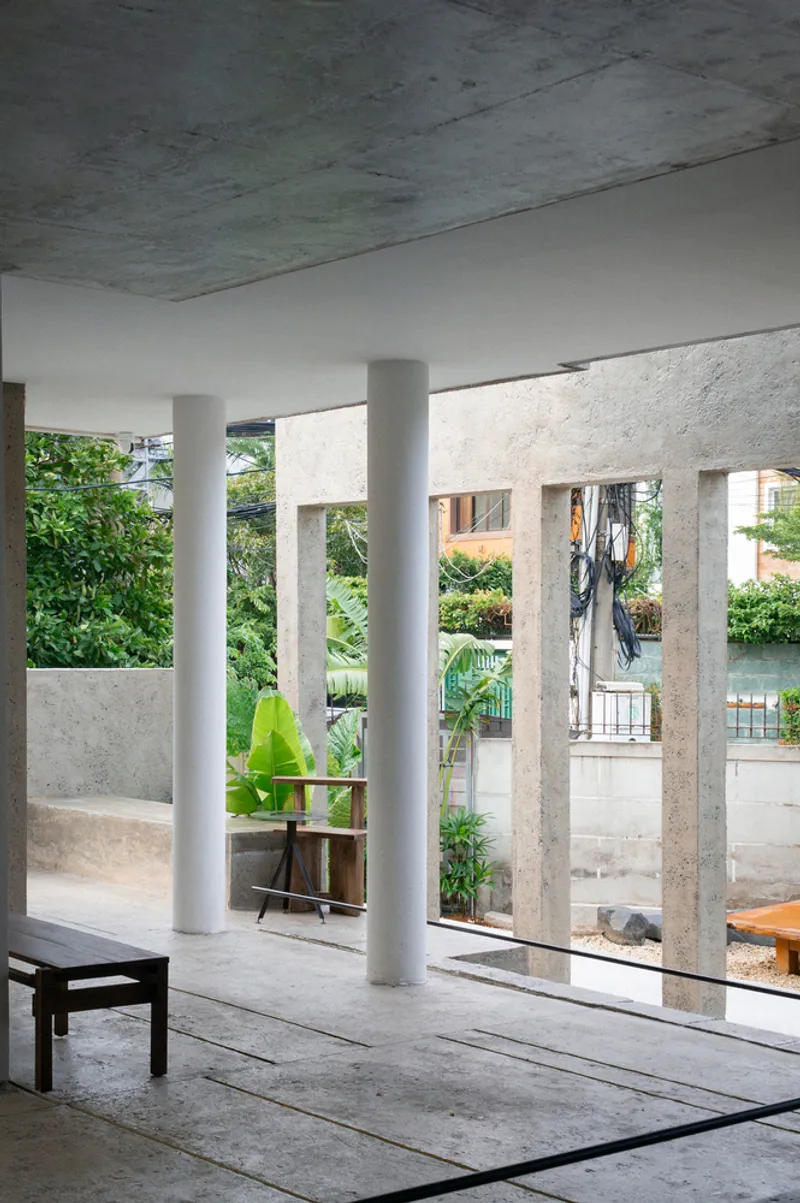
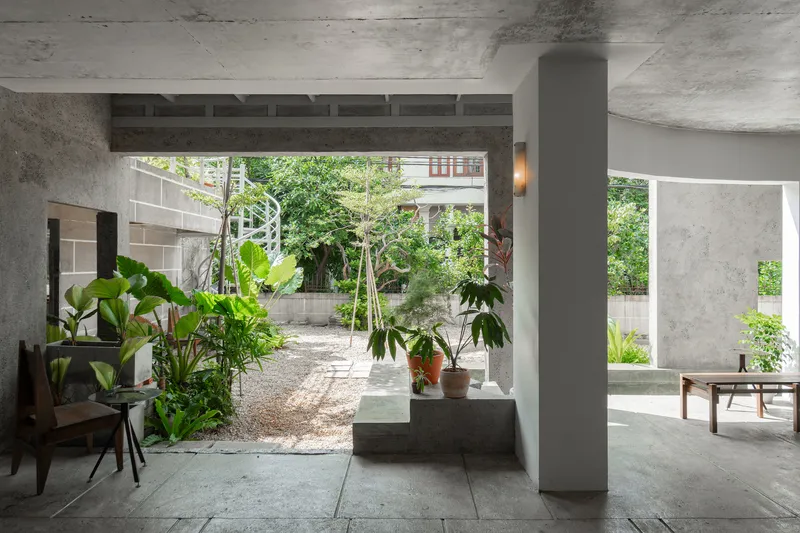
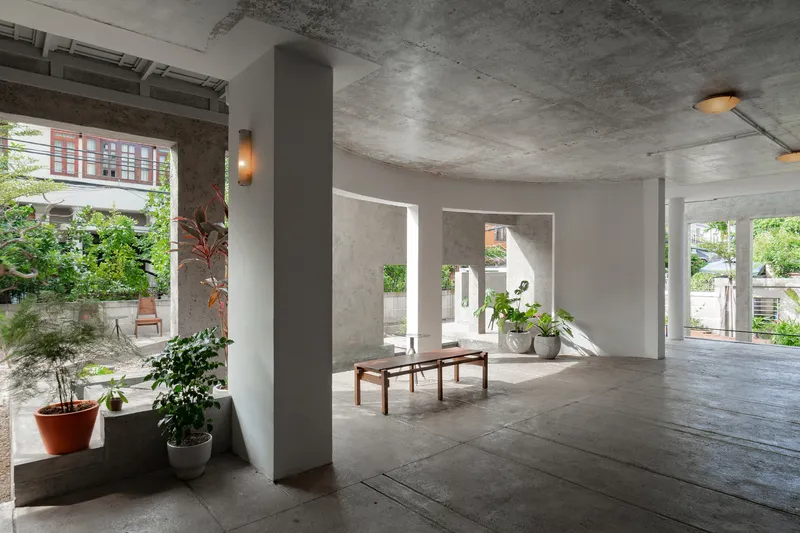
Inside, the café operates as an open floor plate structured by round white columns and an exposed concrete ceiling. There are no partition walls separating seating zones; instead, columns and shifts in ceiling height do the organizational work. Views to the planted gravel courtyard are available from nearly every seat, which keeps the interior from feeling bunker-like despite the heavy concrete overhead.
The decision to leave ceilings exposed rather than applying a plaster finish is consistent with the project's refusal to polish away evidence of construction. Pendant lights hang on simple cords. Potted plants sit directly on concrete floors. Timber benches rest against columns without fussy joinery. The material palette is honest to the point of austerity, and the building is better for it.
Terraces and the Elevated Garden
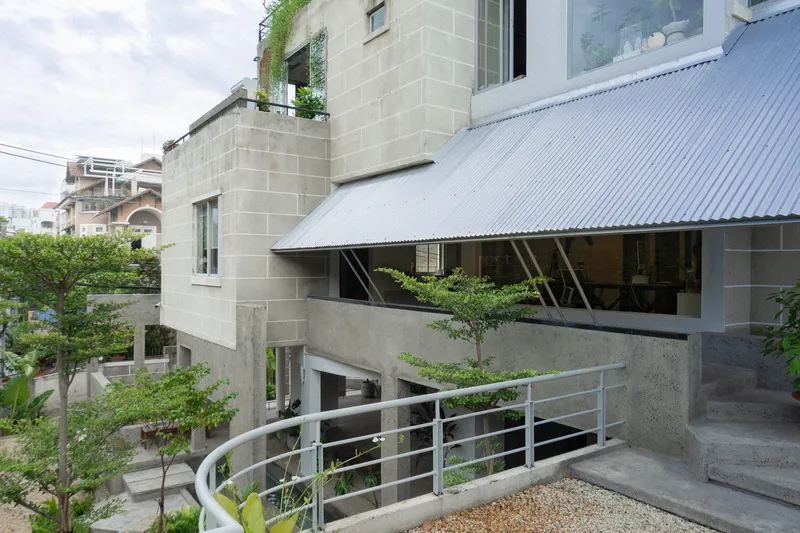
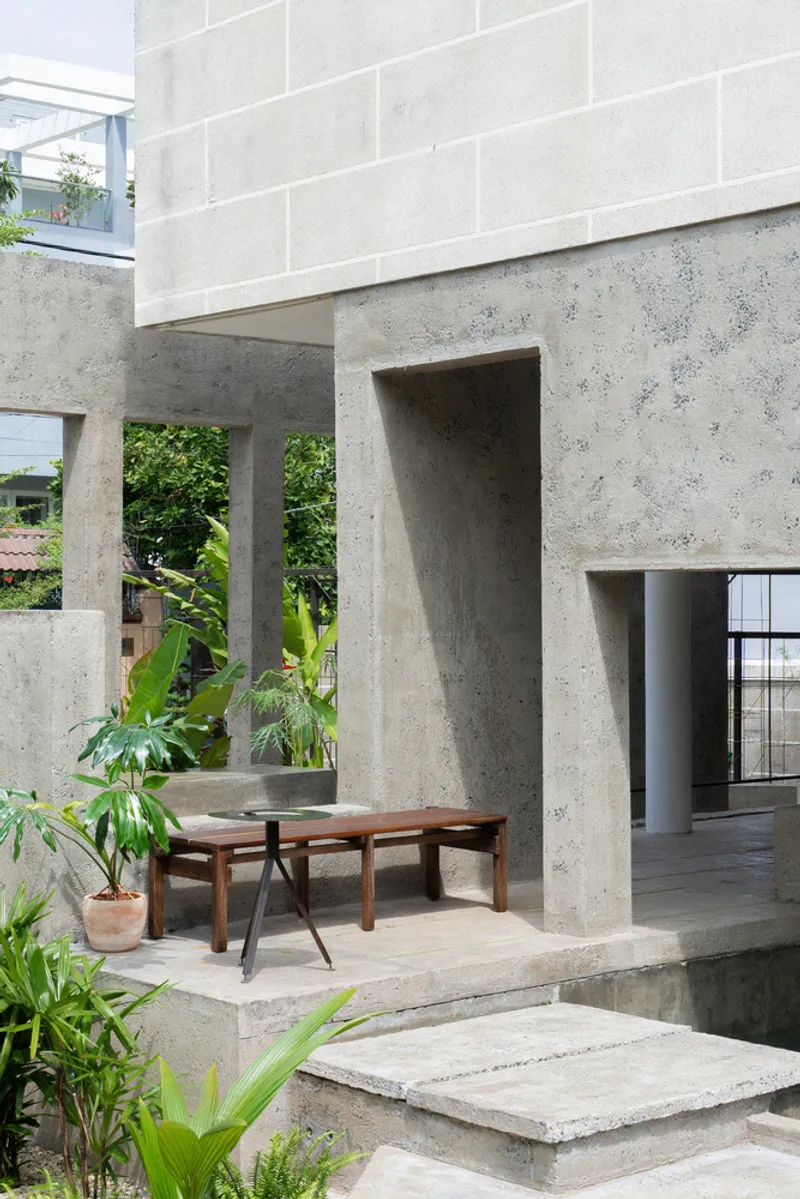
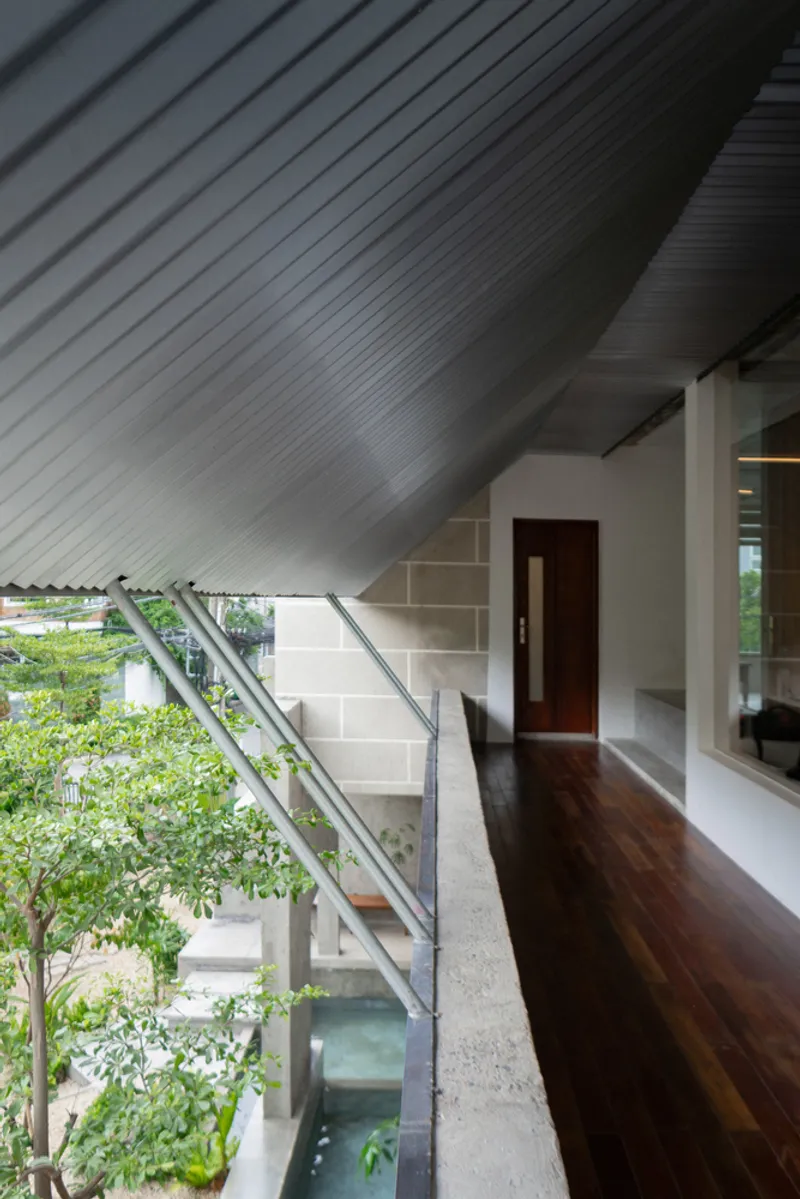
The upper levels push the café program outdoors onto terraces framed by concrete block facades, curved steel railings, and rooftop plantings. A terrazzo staircase rises beneath a corrugated metal soffit, offering glimpses down to an interior pool and foliage below. Heavy piers and textured walls define covered porch zones where timber benches invite lingering. These are not token balconies tacked onto a facade; they are genuine rooms that happen to lack a fourth wall.
The elevated garden concept is what ties the flood-mitigation logic to the social ambition of the project. By lifting the entire building above street level and then stacking gardens on top of it, 324PRAXIS creates a vertical landscape that offers neighborhood views ordinarily blocked by Thao Dien's tall perimeter walls. The café becomes, in effect, a lookout post for a community that has walled itself in.
Intimate Moments: Benches, Alcoves, Curves
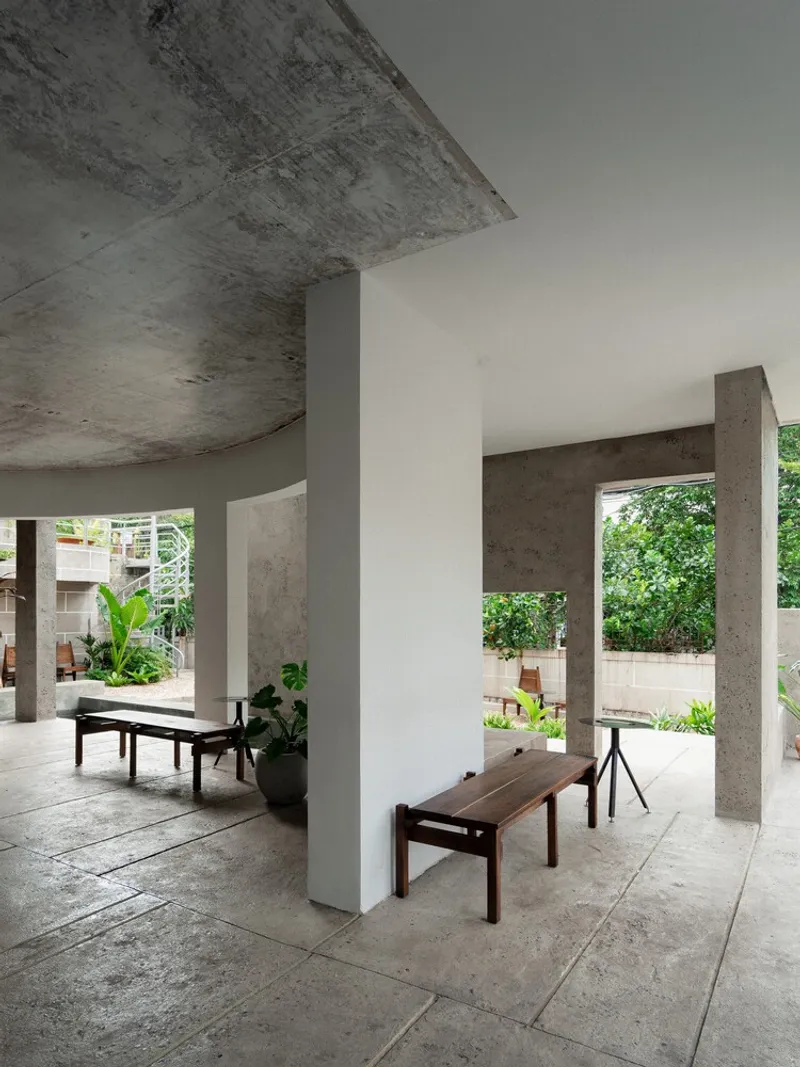
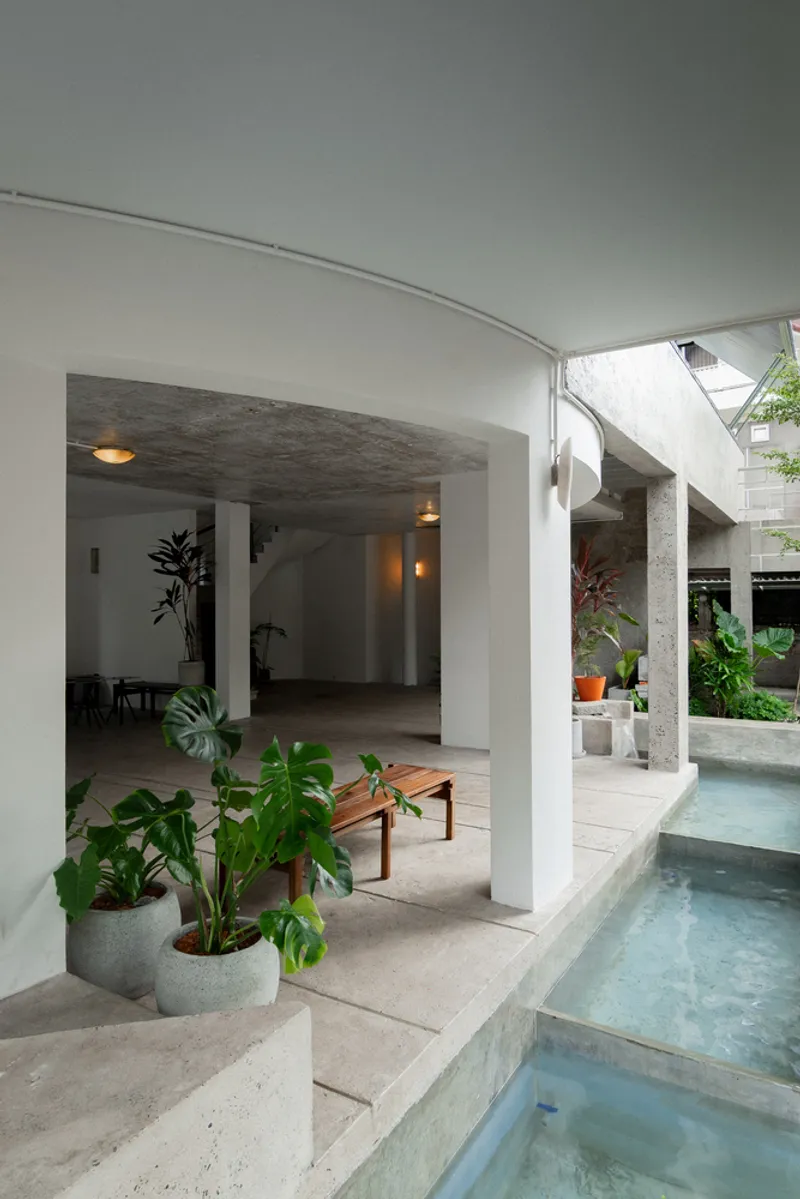
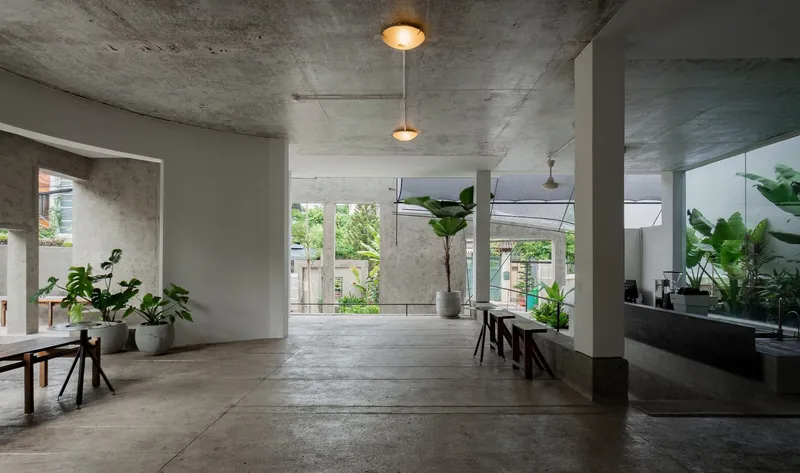
For all its structural bravado, the project's most persuasive quality is its attention to small-scale comfort. A timber bench tucked beside a white column under a curved concrete soffit is a complete spatial experience in a footprint of two square meters. A stepped concrete pool with flanking plants and another bench creates a pocket garden where one person could sit for hours. These moments are not accidental. They are the product of architects who understand that a café lives or dies by the quality of its individual seats.
The curved soffits deserve particular mention. In a building dominated by right angles and rectilinear frames, the occasional curve introduces softness without sentimentality. It also modulates acoustics: a curved ceiling diffuses sound differently than a flat one, which matters in a space designed for both focused work and casual socializing.
Plans and Drawings
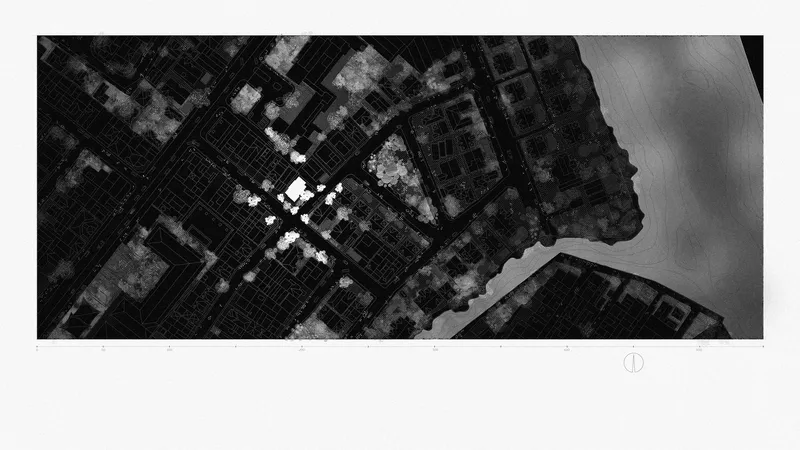
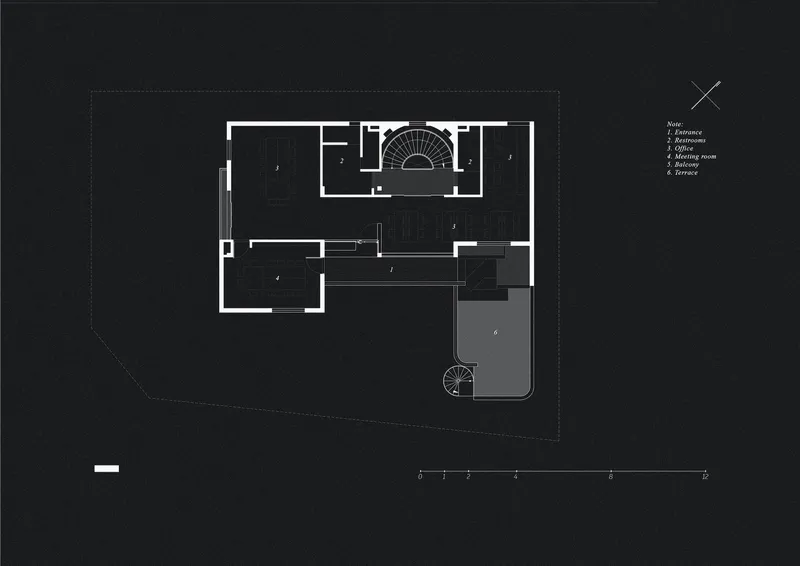
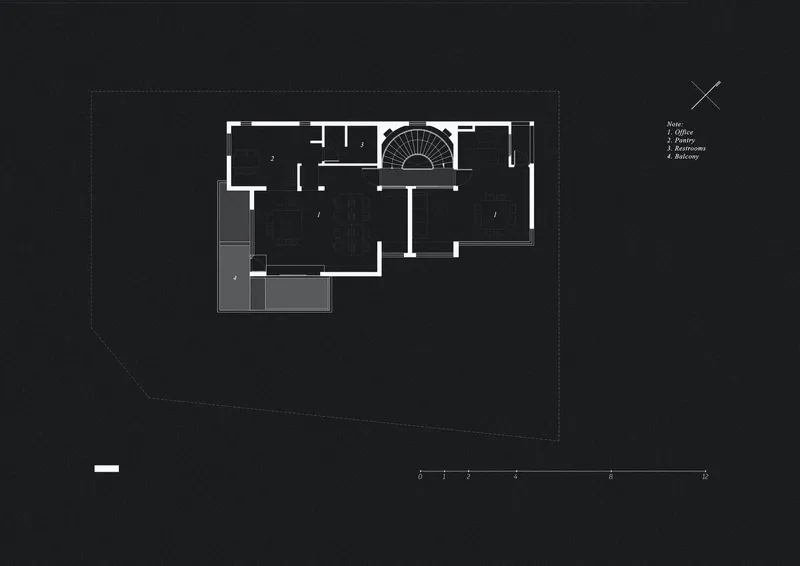
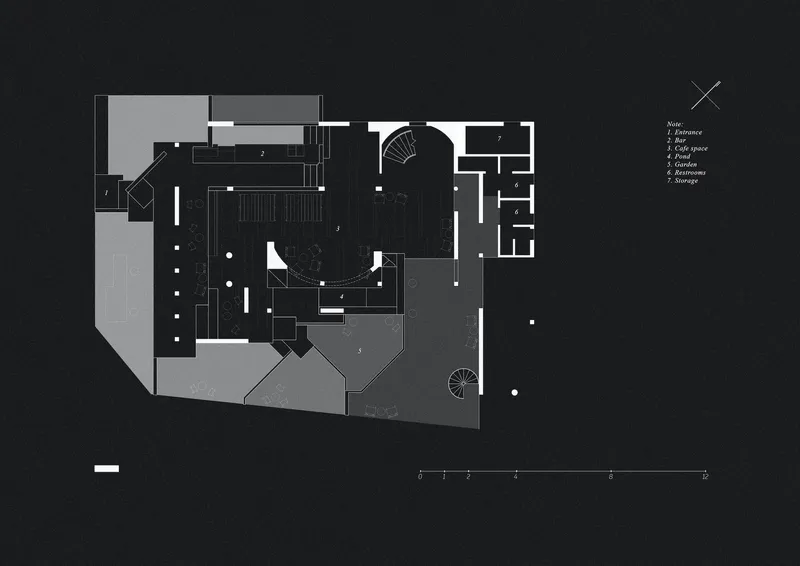
The site plan reveals how the building sits within its urban block: a cluster of volumes and courtyards that avoids reading as a single mass. The ground floor plan shows the spiral staircase anchoring circulation at the building's core, with the outdoor pool area occupying the lower right quadrant. The first floor redistributes rooms around the same staircase, while the roof plan maps the varied terraces and covered volumes that give the building its layered silhouette. What the drawings make clear is that the project's porosity is not improvised. Every opening, every gap, every offset between volumes is plotted to control sight, light, and movement.
Why This Project Matters
Café architecture, especially in Southeast Asia, tends to oscillate between two poles: the Instagram-optimized set piece and the austere minimalist box. A Collage of Outcasts occupies neither camp. Its material austerity borrows from the minimalist tradition, but its spatial complexity, its willingness to proliferate thresholds rather than simplify them, pulls it into territory that is genuinely experimental. The project takes a pragmatic constraint (flood elevation) and a cultural condition (defensive privacy walls) and flips both into architectural opportunities.
More broadly, the project makes a case for renovation as a form of urban activism. Thao Dien's residential fabric is increasingly homogenous: tall walls, sealed compounds, air-conditioned interiors. By cracking open an abandoned house and rebuilding it as a porous, elevated, semi-public landscape, 324PRAXIS suggests that the neighborhood's infrastructure of isolation can be repurposed into something communal. It is a small building with a large argument.
A Collage of Outcasts by 324PRAXIS. Located in Thao Dien, Ho Chi Minh City, Vietnam. 810 m². Completed 2024.
About the Studio
Share Your Own Work on uni.xyz
If projects like this are the kind of work you want to make, uni.xyz is a place to publish your own, find collaborators, and enter design competitions.



Popular Articles
Popular articles from the community


Hill & Cross Opera: Sculptural Opera House Architecture Shaped by Tallinn’s Landscape and Identity
Hill & Cross Opera reimagines opera house architecture in Tallinn through its sculptural hill, civic plaza, glass wave and a luminous cross.

Co-Life: Senior Housing Design That Reconnects Older Adults With the City
Co-Life reimagines senior housing design through healing gardens, shared streets, workshops, and a sustainable community across generations.

The Musturak Paradise: Senior Living Architecture for a Connected Future in Temara, Morocco
The Musturak Paradise reimagines senior living architecture in Temara via private homes, social spaces, culture, community, and shared care.

Conexión: Biophilic Design Reimagines High-Rise Living in Hong Kong
Conexión reimagines high-rise living in Hong Kong through biophilic design, green facades, shared spaces, daylight, water and nature within.
Similar Reads
You might also enjoy these articles


Hodi-Mandai Geram
Project Function: Preservation and revitalization of the Intangible heritage and socio-spatial identity of the Hodi by Housing, Cultural Memory Center, Sacred Grove, landscape, local tourism economy


Olio Towers: A Mid-Rise for Performers That Fuses Housing, Rehearsal, and Stage
Located blocks from Houston's Theater District, this modular tower stacks living units around a central performance atrium.

Oasis: Modular Green Housing Carved into Dhaka's Urban Fabric
A shortlisted Plugin Housing entry reclaims unauthorized settlements in Dhaka with stepped concrete volumes, green roofs, and ventilation-driven design.

Black Hole: A Floating Megastructure for the Post-Physical Era
Emiliano Mazzarotto envisions a spherical, self-scaling arena where e-sports, digital hotels, and holographic stadiums replace traditional public space.


Explore Coffee Shop Competitions
Discover active competitions in this discipline



Challenge to reimagine the Iron Throne


Photograph architecture without architects


Illustrate the lost glory of Angkor Wat - Render Challenge


Design challenge to reuse E-waste
Comments (0)
Please login or sign up to add comments
No comments yet. Be the first to comment!