

Collective Reticulárea: Communal Cartographies by LA ESCUELA___
Collective Reticulárea reimagines Gego’s legacy through participatory modules, fostering collaborative learning, communal cartographies, and immersive spatial experiences in Caracas, Venezuela.


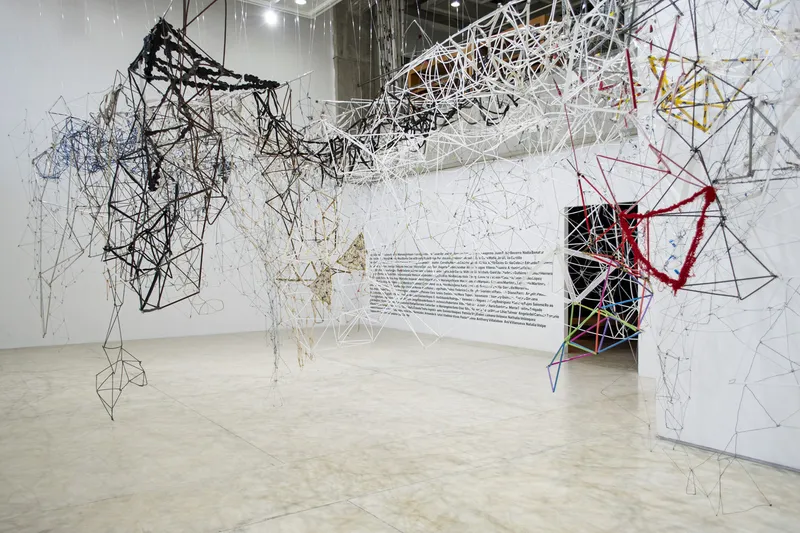
Collective Reticulárea: Communal Cartographies reinterprets the artistic and pedagogical legacy of Venezuelan-German artist Gego in a contemporary context. Conceived by Miguel Braceli and developed by LA ESCUELA___ in partnership with Fundación Gego and Sala Mendoza, this participatory project engages a network of international artists, educators, and students across Venezuela. The installation was displayed at Sala Mendoza, Caracas, from April 11 to June 1, 2024, offering visitors a spatial experience shaped by collective creativity.
This initiative emphasizes the intersection of art, education, and social practice, transforming the museum space into a living laboratory of collaborative knowledge. By approaching the Reticulárea through communal cartographies, the project moves beyond mere homage to Gego, highlighting the social and educational dimensions of her geometric abstraction.

A Platform for Collective Learning and Artistic Exchange
Curated under the larger “Emeritus: Gego” program, Collective Reticulárea commemorates the 30th anniversary of Gego’s passing. The project explores collaborative artistic practices, addressing questions of mobility, diaspora, and regional bonds through affective ties woven between art and territory.
LA ESCUELA___ serves as a dynamic platform for public engagement, co-creation, and interdisciplinary learning. Founded by Miguel Braceli alongside the Siemens Stiftung, the platform builds on the foundation’s Latin American cultural initiatives while advancing Braceli’s focus on socially engaged art and public interventions.


From Modules to Communal Cartographies
The project’s development began in December 2023 with an international open call, inviting artists, educators, and collaborators linked to Gego’s work. Modules and pieces were created from diverse materials and contexts, reflecting the participants’ local conditions and creative interpretations.
These fragments were integrated into spatial constructions developed by university students from:
- Universidad Central de Venezuela, Caracas – led by Professor Diego González
- Universidad de Los Andes, Mérida – led by Professor Analy Trejo
- University of Margarita – led by Professors Gustavo Izarra and Amanda Soriano
Through this interdisciplinary and participatory approach, each module became a node within a broader communal cartography, symbolizing both artistic exchange and collaborative learning. Braceli explains that the Reticulárea is approached not as a mimicry but as a symbolic network of expansive forms, where each node functions as a meeting point for dialogue, experimentation, and knowledge-sharing.


Collaborative, Educational, and Social Dimensions
Highlighting Gego’s lesser-known educational and collaborative legacy, the project transforms the Reticulárea into a living social space. By connecting artists and students, both locally and internationally, the installation fosters shared histories, practical engagement, and conceptual learning. Pieces collected through the Goethe-Institut Venezuela and contributions from the Venezuelan diaspora enrich the installation, creating a dynamic network of collective memory and spatial experimentation.
The final installation at Sala Mendoza becomes more than a visual artwork: it represents a communal experience, where learning, creativity, and social bonds converge. Visitors encounter an immersive spatial narrative that celebrates Venezuelan contemporary art, collaborative pedagogy, and public art interventions.

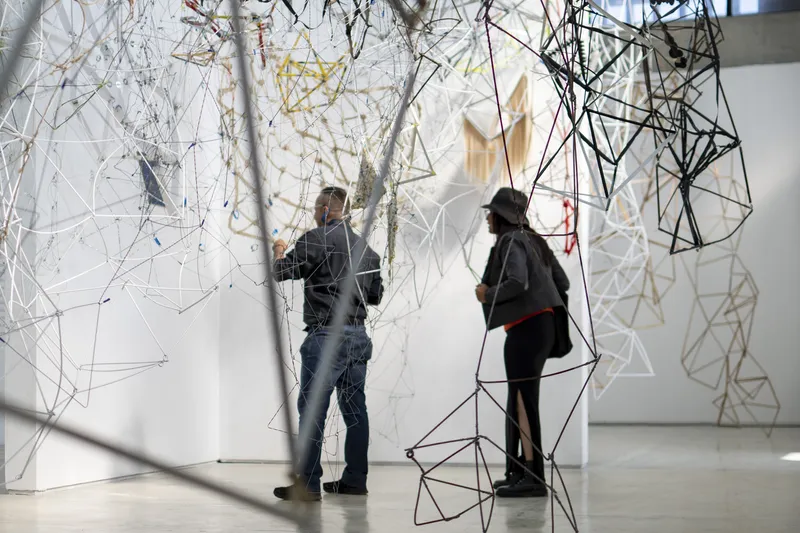
All photographs are works of
Josseline Chalbaud


Popular Articles
Popular articles from the community


Jaramillo Van Sluys Arquitectura and Urbanismo Turn a Demolished Registry Lot in Quito into an Orchard Plaza
In Quito's Centro Histórico, a 2,800 m² plaza exposes the San Agustín convent wall and redraws its lost Augustinian orchard in volcanic stone.

LT2A and OPEN Architectes Thread a Brick and Glass High School Through a Wooded Belgian Campus
In Braine-l'Alleud, a 3,000 m² wing for Collège Cardinal Mercier pairs pale brick with a glazed colonnade, deferring to a small chapel and a dense wood.

David Ortega Stacks a Two-Story Mexico City Penthouse Around a Steel Stair and a Pergola-Shaded Roof Terrace
In Colonia Roma, a 300 m² penthouse uses oak joinery, a planted steel stair and a slatted roof pergola to make a new-build apartment feel like a house.

U.GA Architects Wraps an Oval Rooftop Pool in Curved Board-Formed Concrete on Busan's Jeollidan-gil
In Busan's Jeonpo-dong, a 454 m² mixed-use block stacks a neighborhood facility, guest rooms and an oval rooftop pool inside spiraling concrete walls.

Similar Reads
You might also enjoy these articles

Bamboo Housing Challenge 2026: Design Affordable, Sustainable Homes Using Bamboo
An international design competition by Bamboo U and IBUKU inviting architects and designers to reimagine affordable housing using bamboo — with the winning design built full-scale in Bali.

Computational Design & Education: Beegraphy Design Awards Introduces 7th Category (Featuring Jiyun's Innovative Approach)
Dive into Beegraphy’s 7th Design Awards category, where computational design meets education to create immersive, interactive learning tools, inspired by Jiyun’s work.
From Parametric Lighting to Urban Furniture: Join the 2nd Workshop in Beegraphy’s Computational Design Series
Dive into Cutting-Edge Design Techniques and Practical Applications with Industry Experts

Last Call: Unleash Your Architectural Genius in SHAK's Kindergarten Design Competition
Urgent call for architects to join SHAK's kindergarten design competition before the looming deadline

Explore Installations Competitions
Discover active competitions in this discipline

Challenge to design a portable theatre

Challenge to design a portable music platform

Challenge to design an open learning module for the elderly

Challenge to reimagine the Iron Throne
Comments (0)
Please login or sign up to add comments
No comments yet. Be the first to comment!