
COMMON GROUND FOR MASS TIMBER HOUSE
Thinking spaces with engineered wood

Construction is currently one of the main sectors responsible for the high emission of gases that aggravate the greenhouse effect and the intense depletion of natural resources. In this scenario, wood presents itself as a material suitable for climate change and resource use. This is because this material, in its growth process, is capable of incorporating CO2 into its structure, which, in some cases, guarantees a negative emission of this gas. Its environmental sustainability can also be increased if techniques of disassembly and reuse of wooden parts are applied, ensuring a longer useful life of the material even if its use in civil construction has disappeared.
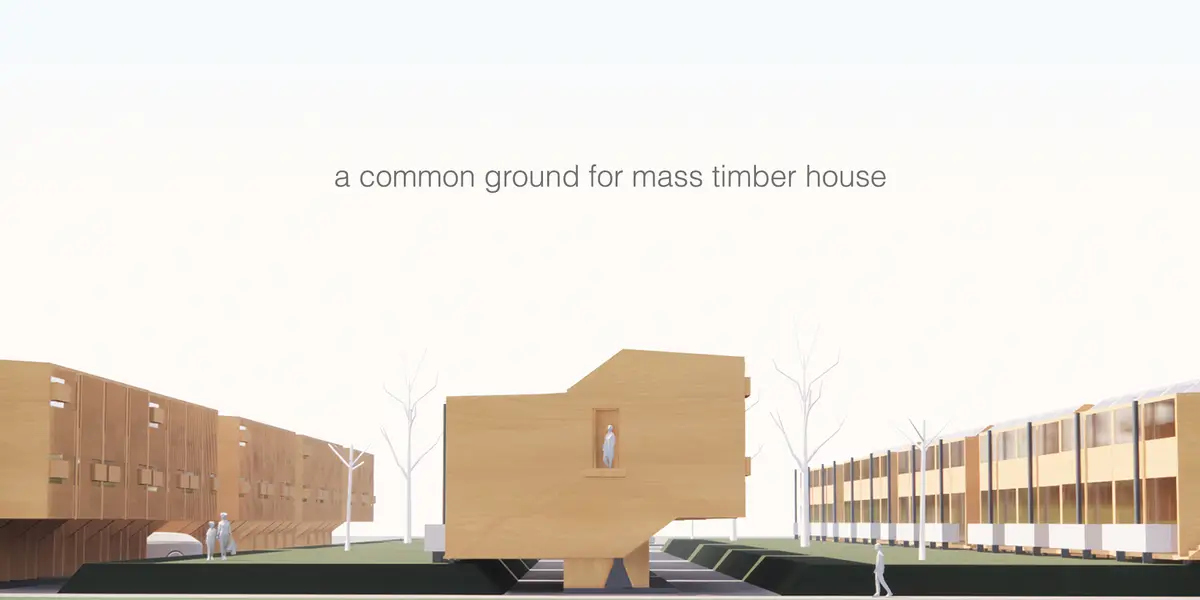
It was based on this key element, sustainability, the project developed, valuing such a feature of wood and exploiting it at other levels, as in the architecture design, implantation on the ground, and dialogue with the city. For both were drawn guiding points of the design process: direct sunlight in every room, use of concrete only in necessary items, passive thermal insulation, and enhancement of walking. The use of insolation software for investigation proved to be satisfactory to understand the country's solar trajectory, which is 8 hours of sun in winter, and to determine the distance between the units in order to guarantee the minimum 200 housing units so that all had the same orientation and sunstroke.
Starting from the implantation, the units are seated on a level that creates a gap between the paved path, 0.00 m, and the unpaved area, +1.00 m. This soil movement enabled spaces for inter-residence coexistence to be privileged, keeping garages and warehouses below the level of vision and on the north face of the unit.
The program for the two proposed typologies is similar to each other, being arranged in a half-level design to take advantage of the maximum height required of 8 meters. The single-family units, with 2 bedrooms, is 80 m² divided into 2 sub-floors: entrance hall, living room, kitchen/dining room, bedroom, and the suite. The 1-bedroom units, measuring 40 m², are divided into 2 sub-floors that comprise the living room, kitchen, bathroom, and bedroom.
The 1-bedroom units can be stacked, ensuring the vertical expansion of the project; the same does not occur in the other typology, since direct sunlight was preferred in this one's rooms. The horizontal expansion is guided by a set of 2 single-family units and 4 multi-family units, allowing for a variable distance between them to ensure landscape quality.
The main material used, engineered wood, forms not only the envelope of all the units but also constitutes the main structure in Dowel Laminated Timber (DLT) panels. Beyond that, it is possible to notice several structural elements such as braced beams as space organizers and defining elements of facades. In this way, concrete can be reduced to essential functions in the design, foundation, and fireplace box. And, to keep all the mass timber components together, it is fundamental to remember about the steel connections all over the building.

Popular Articles
Popular articles from the community


Faces of the Soviet Avant-Garde: Turning Moscow's Street Names into an Open-Air Museum
A network of sculptural installations across a Moscow residential district transforms forgotten architect names into spatial encounters with cultural memor
Cloaked Colonization: A Mobile Underwater Habitat That Moves Like a Fish
Micah Abaya's shortlisted EHC Pacific entry reimagines ocean settlement as a dispersed network of self-sustaining architectural organisms.
Manzana Morphosis: Stretching Barcelona's Grid into a Living Landscape for 2050
A radical reworking of the Eixample manzana turns density into a tool for generous public space, vertical ecology, and environmental performance.

The Amber Palace Opera: A Geological Fiction Surfaces on Tallinn's Baltic Waterfront
Pierre Brillard reimagines a Baltic legend as a public landscape, opera house, and waterfront promenade rooted in Tallinn's coastal identity.

Similar Reads
You might also enjoy these articles

Shakur's House: Exposed Brick as an Interior Organiser in a 168 m² Mashhad Residence
Brick moves indoors in this Mashhad residence, where masonry walls, glass partitions and teal planes sequence a compact home without closing it off.

Day and Night Park: A Time-Based Urban Newsstand in Beijing
A temporary urban newsstand in Beijing blending travel, light, and reading through poetic colors, compact form, and community-focused design.

Modernist Patio Renovation in El Masnou, Barcelona by Oliver Segura Arquitectura + Cebrià Arquitectura
Modernist patio renovation blending tradition and innovation with a movable pool, leveled floors, and Catalan materials in El Masnou.
Alto Residencial Coop: Cooperative Housing Development in Santiago de Compostela by Carbajo Barrios Arquitectos
A linear cooperative housing complex blending white volumes and perforated metal façades, enhancing community living, natural light, privacy, and urban integration.

Comments (0)
Please login or sign up to add comments
No comments yet. Be the first to comment!