

CIMBRA Builds a 45 m² Community Center with the Guarani Using Earth, Cane, and Indigenous Knowledge
In Caimancito, Argentina, a participatory project rooted in Guarani construction traditions redefines what sustainability looks like at the smallest scale.


At 45 square meters, the Community Added Value Center in Caimancito, Jujuy province, is one of the smallest buildings we have featured. It is also one of the most ideologically precise. Designed and built by CIMBRA in collaboration with the Guarani community Arete Guazú, the project operates simultaneously as a processing facility for agroecological produce, a water harvesting station, a wastewater treatment system, and a demonstration of how indigenous construction knowledge can form the basis of contemporary architecture. The program alone is impressive for its density of purpose. What makes the building genuinely compelling is the way it refuses to separate construction method from cultural identity.
The center draws on the Culata Jovai typology, a regional arrangement of facing rooms unified under a single roof, and the column-horcón post system found across Chaco countryside ranches. Its vertical sunshades are not decorative screens but direct reinterpretations of Guarani "envarillados" fences, resolved through frameworks of wood and cane. The result is a building that feels both ancient and sharply contemporary: filtered light, layered depth, and a structural logic that anyone familiar with the region's vernacular will recognize instantly.
Screens as Architecture
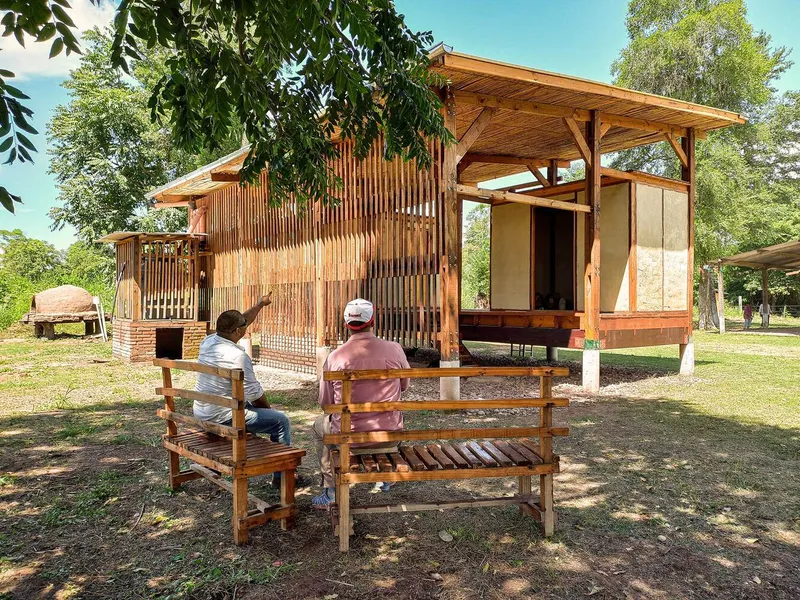
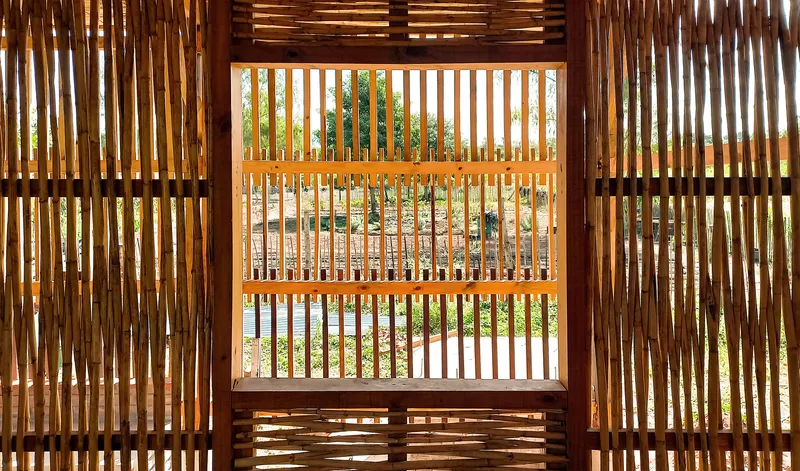
The vertical timber slat screens are the building's most visible gesture, and they carry the heaviest conceptual load. Inspired by the wattle and daub technique and the envarillados characteristic of Guarani fences, these frameworks do far more than shade the interior. They expand the building's spatiality outward, creating a zone of filtered light and partial enclosure that blurs the boundary between inside and garden. From the exterior, the screens read as a continuous textured surface. From within, they frame views of the surrounding landscape in narrow vertical slices, controlling solar radiation while inviting cross-ventilation.
The layering visible in these two images is worth studying carefully. There is no single moment where the building begins or ends. The screens produce graduated thresholds of shade, privacy, and air movement, a spatial strategy that owes nothing to mechanical systems and everything to an understanding of how bodies move through heat.
Interior Life Under Cane and Earth
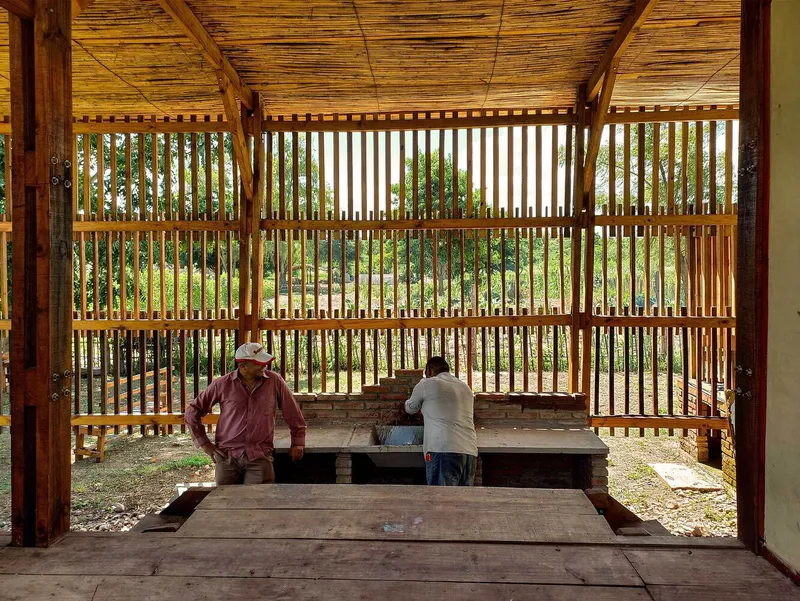

The interior tells you everything about the building's material hierarchy. Bamboo and cane form the ceiling plane, their repetitive linear rhythm acting as a natural acoustic and thermal buffer. The masonry bench along one wall anchors the washing and processing functions, while the slatted screen wall behind it maintains the connection to the garden beyond. Light enters in narrow bands, keeping the space cool without making it dark. The quincha technique, a wooden framework supporting a cane lattice finished with earth mortar, exploits the hygroscopic capacity of earthen walls: they absorb and release moisture, passively regulating indoor humidity in a subtropical climate.
The gathering image reveals another dimension of the project. A painted wall in pink and turquoise introduces bold color against the natural palette of timber and earth, a decision that reads as distinctly communal rather than architect-imposed. The benches and the social space they create are central to the building's identity. CIMBRA designed this through participatory workshops, and you can feel that process in the informality and warmth of the result.
Garden, Landscape, and Food Sovereignty
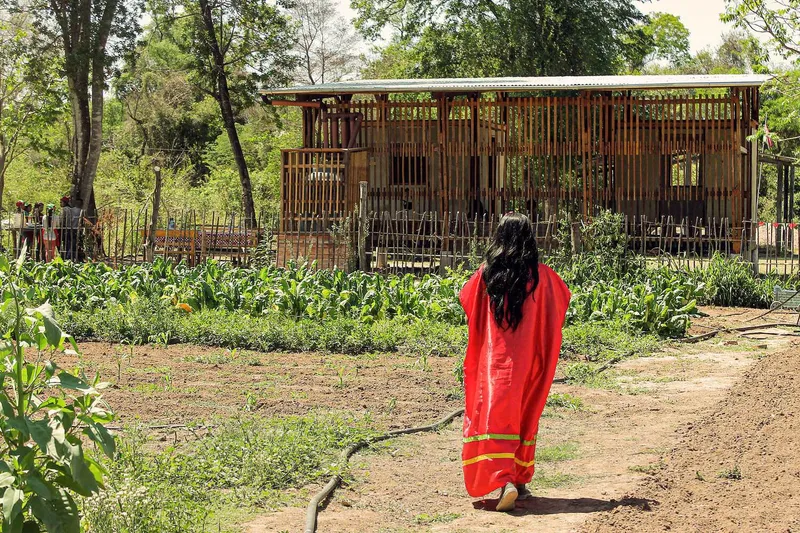
The figure in red walking through rows of young vegetable plants toward the slatted facade is perhaps the most revealing image of the project's ambition. The Community Added Value Center is not an isolated building. It belongs to a comprehensive proposal linking habitat and food generation, with agroecological gardens and planned agroforestry spaces forming the site's productive landscape. The center exists to serve these gardens: its washing facilities and processing spaces are designed to add value to what the community grows, closing the loop between cultivation and market.
Water harvesting from the shade roof feeds a reserve tank, and ecological wastewater treatment systems ensure that the building's resource cycle remains as tight as its footprint. At 45 m², the architecture has to justify every square centimeter, and it does so by functioning as infrastructure rather than mere enclosure.
Plans and Drawings
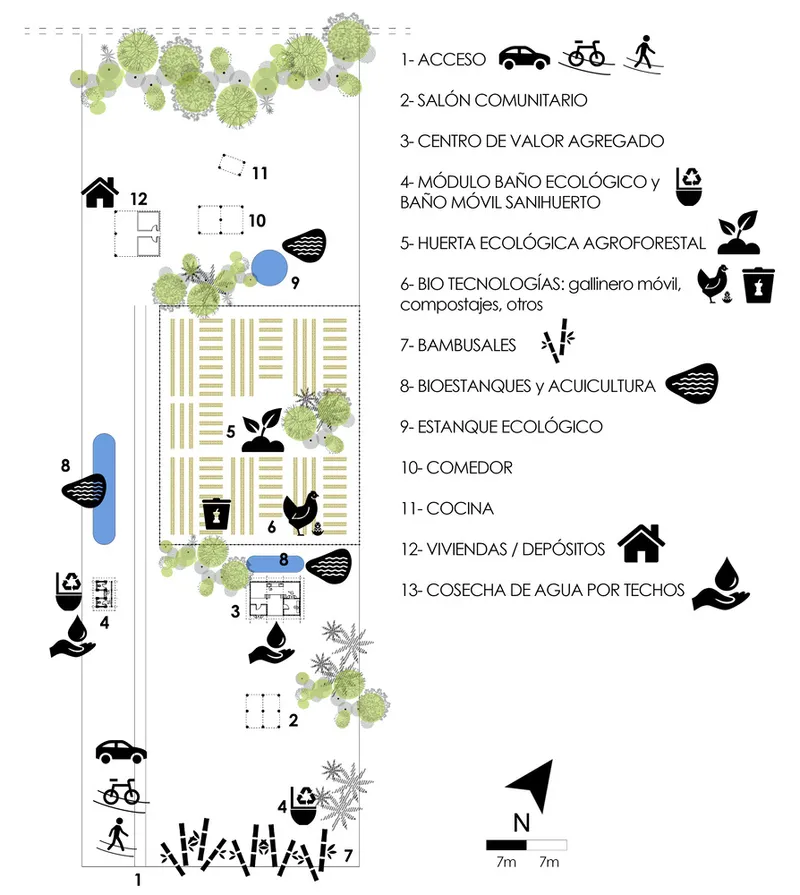
The site plan makes legible what the photographs can only hint at. Numbered buildings, garden beds, water features, and circulation paths are organized according to an icon key that maps the project's full scope. The center sits within a larger ecosystem of productive and social spaces, and the drawing reveals the deliberate relationships between water collection, planting, and covered gathering areas. What strikes you is the density of program distributed across an apparently simple layout. Every path and bed is purposeful, reflecting the participatory design process that drove the project from its earliest stages.
Why This Project Matters
There is a tendency in contemporary architecture to treat vernacular techniques as aesthetic references, surface treatments borrowed to signal locality without engaging with the material logic underneath. CIMBRA's work in Caimancito resists that impulse entirely. The quincha walls, the horcón columns, the envarillados screens: these are not stylistic choices but structural and climatic decisions rooted in centuries of Guarani and Chaco construction knowledge. The architects' role was not to import a solution but to facilitate a dialogue of knowledge, amplifying what the community already understood about building in this landscape.
At 45 m², the project also challenges the assumption that meaningful architecture requires significant scale. The Community Added Value Center is small, low-cost, and built from earth, wood, and cane. It harvests its own water, treats its own waste, and supports the food sovereignty of the people who built it. If architecture's purpose is to produce resilient, dignified environments from the resources at hand, this building is a more rigorous answer than most projects ten times its size.
Community Added Value Center by CIMBRA. Caimancito, Jujuy, Argentina. 45 m². Completed 2022. Photography by XhARA.
About the Studio
Share Your Own Work on uni.xyz
If projects like this are the kind of work you want to make, uni.xyz is a place to publish your own, find collaborators, and enter design competitions.


Popular Articles
Popular articles from the community


Singing Woman: An Opera House That Performs Before the Curtain Rises
Ovidiu Cristian Pavel's conceptual opera house translates Estonia's choral identity into a sculpted waterfront landmark facing the Baltic Sea.

Aquadapt: An Underwater Habitat That Rewrites Its Rooms by the Hour
Curved modules ring the seabed while one shell shifts from breakfast room to cinema, farm and football pitch as residents' needs change.


Cube Design Draws an Ecological Corridor Between Two Shenzhen Hills with the Nankai Building
Beside Shenzhen's container docks, the Nankai Building pairs stacked balconies with a climbing green screen to connect two hillsides across its height.
Opera on the Sea: Driftwood Logic Shapes a Timber Opera House on Estonia's Coast
Trevor Orgill's opera house translates the entangled drift of floating timber into a civic building where wood, water, and music converge.

Similar Reads
You might also enjoy these articles


Hodi-Mandai Geram
Project Function: Preservation and revitalization of the Intangible heritage and socio-spatial identity of the Hodi by Housing, Cultural Memory Center, Sacred Grove, landscape, local tourism economy


Olio Towers: A Mid-Rise for Performers That Fuses Housing, Rehearsal, and Stage
Located blocks from Houston's Theater District, this modular tower stacks living units around a central performance atrium.

Oasis: Modular Green Housing Carved into Dhaka's Urban Fabric
A shortlisted Plugin Housing entry reclaims unauthorized settlements in Dhaka with stepped concrete volumes, green roofs, and ventilation-driven design.

Black Hole: A Floating Megastructure for the Post-Physical Era
Emiliano Mazzarotto envisions a spherical, self-scaling arena where e-sports, digital hotels, and holographic stadiums replace traditional public space.
Explore Community Architecture Competitions
Discover active competitions in this discipline

Challenge to reimagine the Iron Throne

Photograph architecture without architects

Illustrate the lost glory of Angkor Wat - Render Challenge

Design challenge to reuse E-waste
Comments (0)
Please login or sign up to add comments
No comments yet. Be the first to comment!