

11ARCHITECTURE Turns an Overlooked Ramp into a Community Living Room for 30,000 Midea Employees in Foshan
A two-story bookstore, cafe, and terraced garden transform the entrance to Midea's corporate town in Shunde, Foshan, into a genuine civic anchor.


Across the road from Tadao Ando's He Art Museum in Shunde, Foshan, sits a corporate town that Midea built for its workforce: apartment towers, sports courts, commercial podiums, and the kind of well-meaning amenities that often read as transactional perks rather than genuine public space. 11ARCHITECTURE was handed a corner site at the block's entrance, 650 square meters of interior plus an outdoor ramp that nobody used because a pair of public elevators had rendered it redundant. The brief was OWSPACE, a bookstore brand now in its third generation, pivoting away from street-level retail toward embedding itself in residential communities. What the architects delivered is not really a bookstore at all. It is a living room scaled to a neighborhood of thirty thousand people.
The interesting move here is restraint. 11ARCHITECTURE chose not to touch the existing structure. Instead, they invested their energy in two categories of intervention: five oversized furniture pieces they call "Monsters of Wisdom" and a terraced landscape carved from the disused ramp. One is interior spectacle; the other is public infrastructure. Together they reframe a generic corporate podium as a place where people actually linger, and the evidence in the photographs suggests it is working.
A Garden Nobody Expected
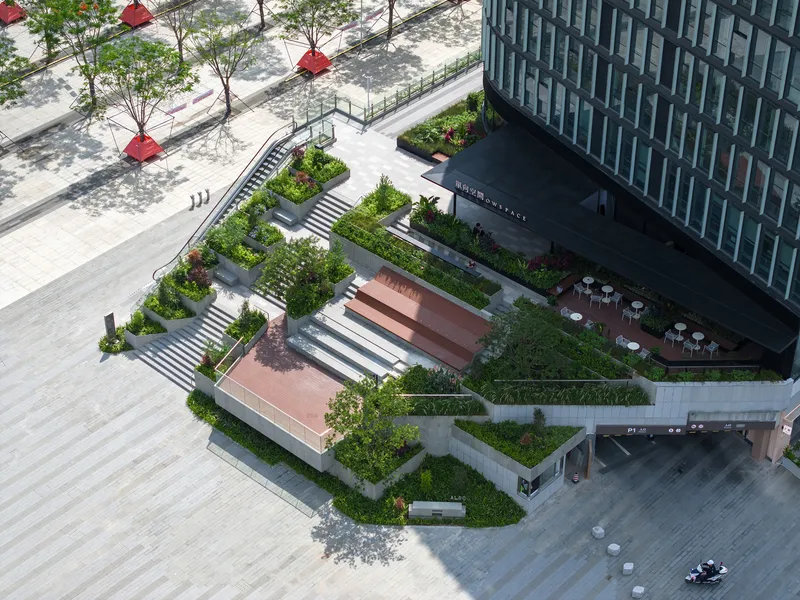
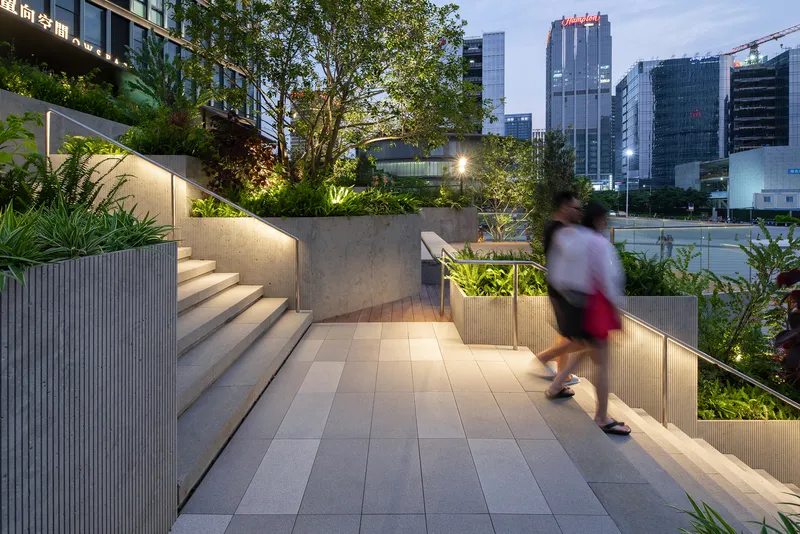
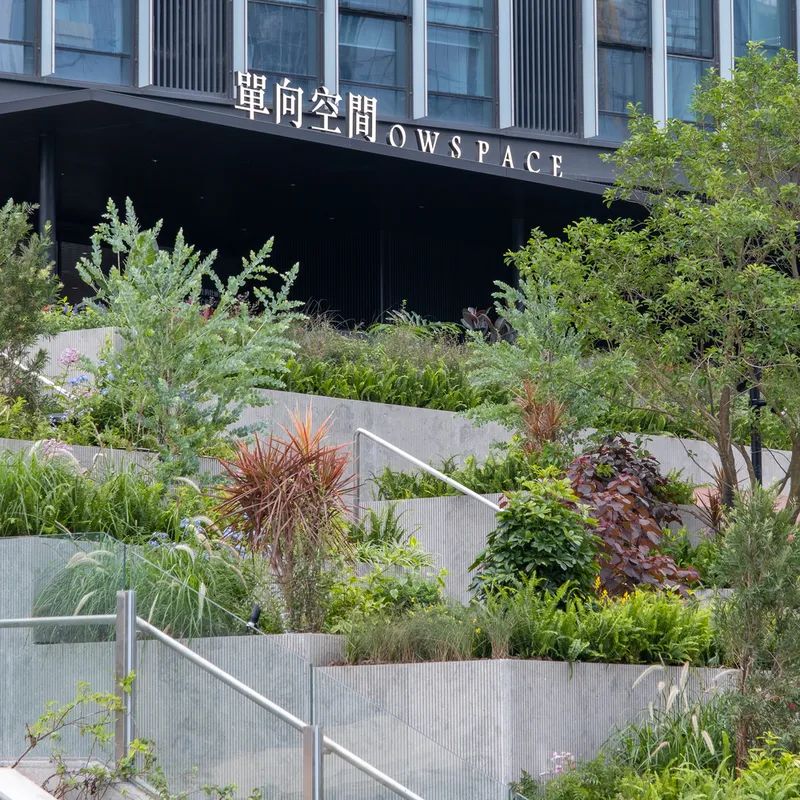
The outdoor ramp turns six times across a total length of 90 meters, and before the project it was dead circulation, a concrete switchback everyone skipped in favor of the elevator. 11ARCHITECTURE left the ramp's bones intact and layered a terrace-style community garden on top. Prefabricated cement boards clad the raised flower beds, deliberately matching the off-white granite of the surrounding plaza so the garden reads as an extension of the public ground rather than a private amenity. Outdoor bamboo panels surface the upper deck where visitors can recline on angled backrests.
The planting strategy is calibrated for southern China: dense, mixed vegetation that tolerates humidity and provides shade without maintenance headaches. It is a compact landscape, but the terracing gives it depth and variety. Walking the ramp becomes a sequence of views rather than a commute.
The Ramp as Amphitheater
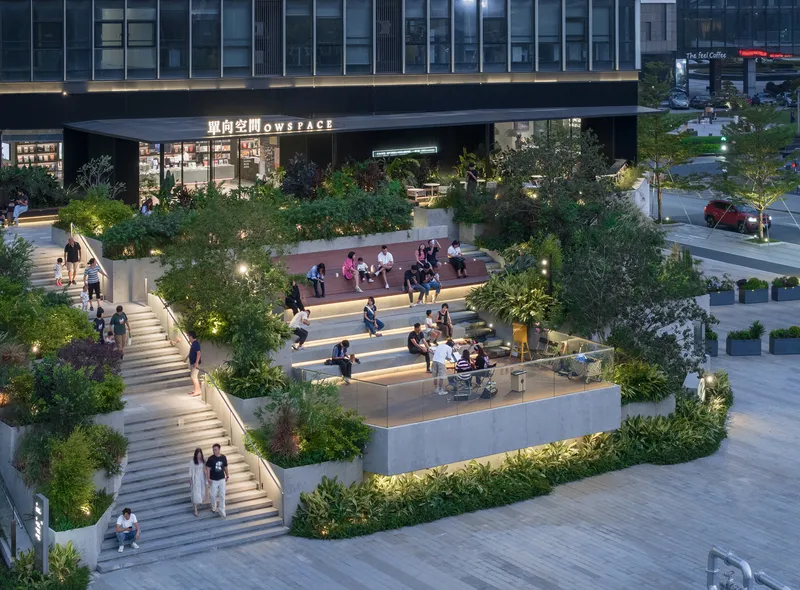
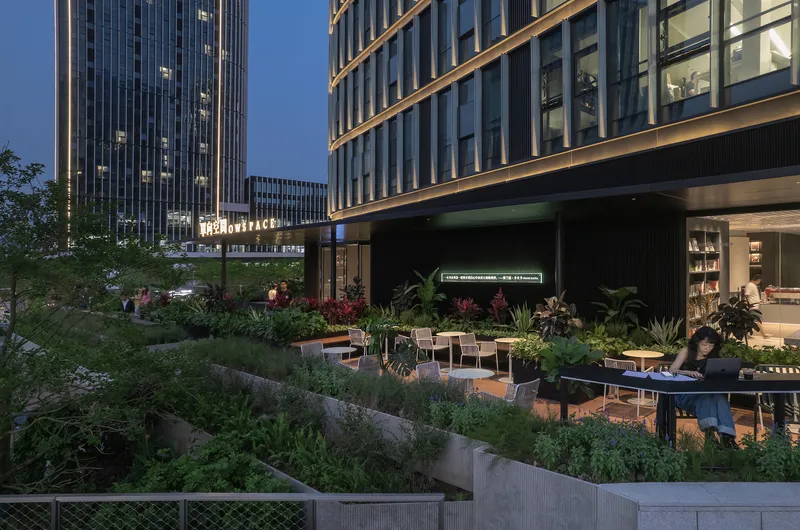
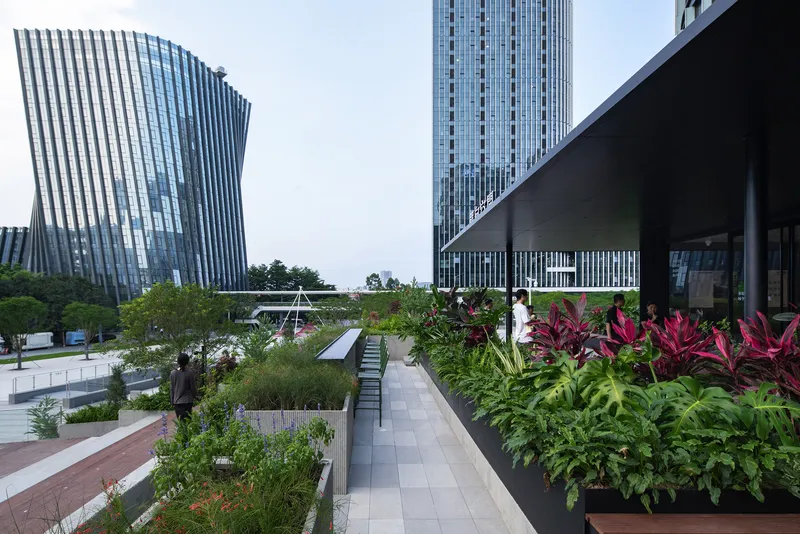
At dusk the stepped sections of the ramp fill with people, and the photographs make it clear this is not staged. A small stage tucked into the garden's lower level hosts music performances and informal gatherings. The stepped planters double as seating, and the surrounding tower facades form a backdrop that is frankly cinematic. It is a clever piece of programming: by day the garden is a walking destination; by evening it becomes an amphitheater that activates the entrance to the entire block.
What makes this work is the deliberate blurring of boundary between OWSPACE's commercial territory and the public realm. The vitality of the bookstore overflows into the landscape, and the landscape draws foot traffic back toward the entrance. It is a feedback loop, and for a corporate town that could easily feel hermetic, that porosity matters.
Black Corrugated Aluminum and the Brand Threshold
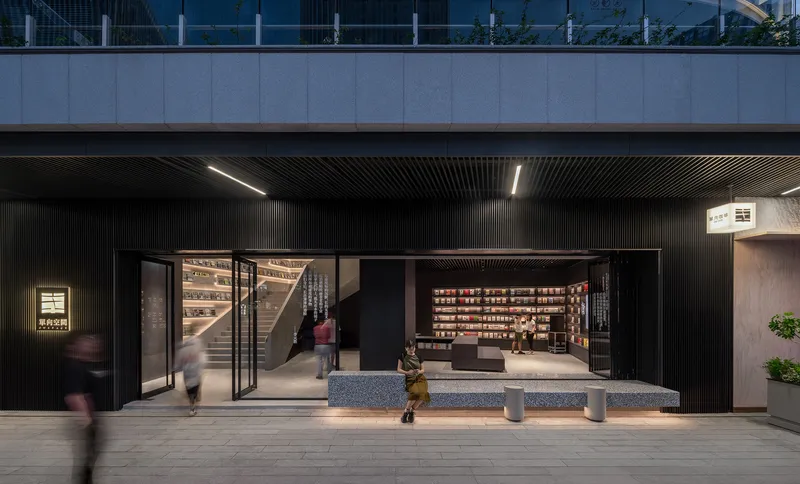
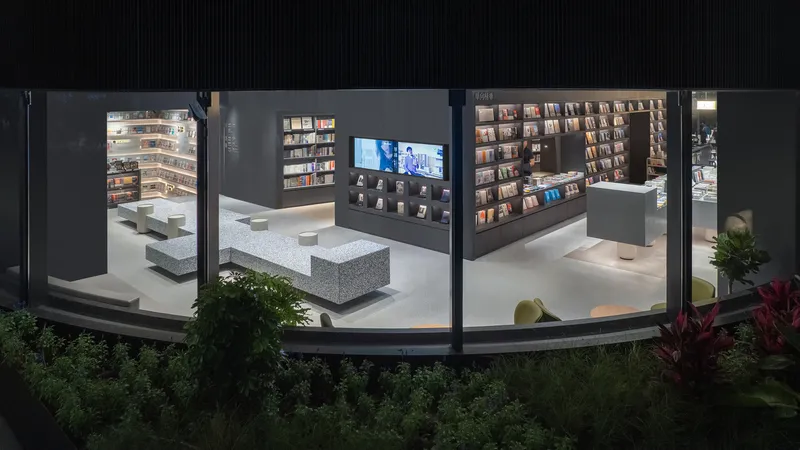
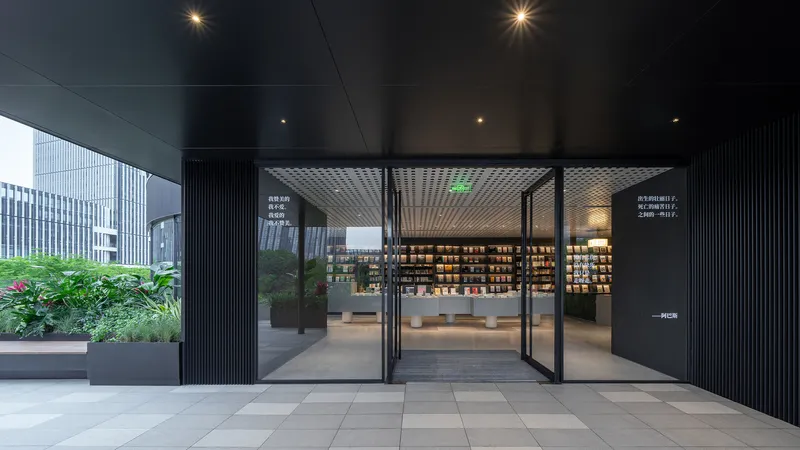
OWSPACE's identity has always leaned monochrome, and 11ARCHITECTURE respects that with a black corrugated aluminum exterior wall that signals the brand without shouting. The storefront glazing at night turns the interior into a display case: terrazzo seating cubes, full-height bookshelves, and warm light spilling through the perforated ceiling. It is restrained retail theater, and it does the job of pulling people off the plaza.
The entrance threshold deserves attention. Pivoting glass doors sit between planted beds and a perforated metal ceiling soffit, creating a transitional zone that is neither fully indoors nor outdoors. In a subtropical climate, that ambiguity is practical: it provides shade, channels airflow, and cushions the temperature shift before you step into the conditioned interior.
The 16-Meter Wall That Organizes Everything
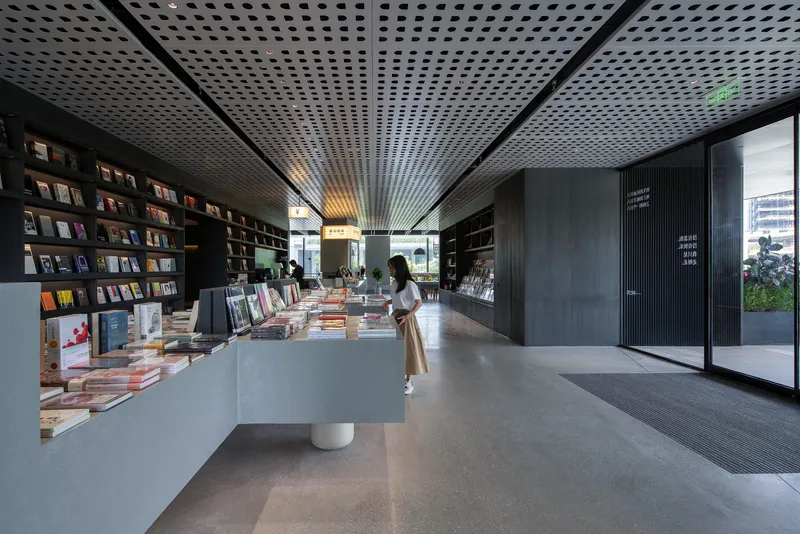
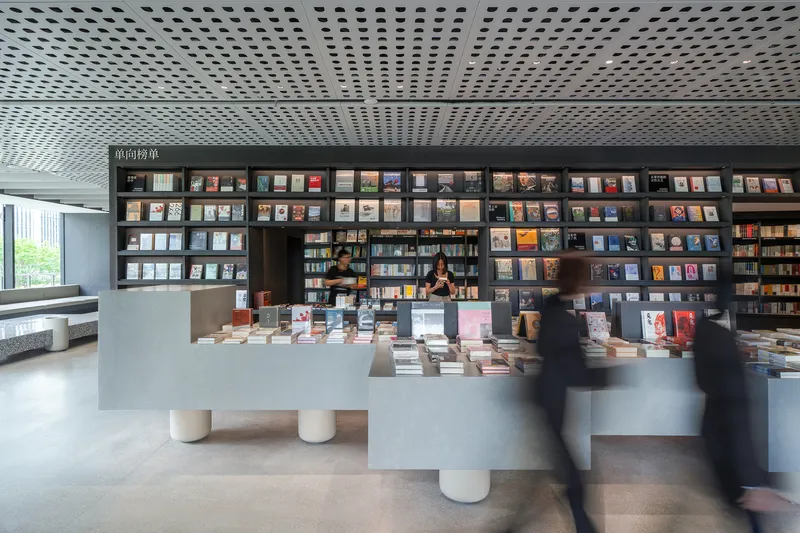
On the second floor, a 16-meter-long bookshelf display wall acts as the building's organizational spine. To its right: the cafe. To its left: the community living room. Behind it: a quieter reading zone set one step off the main circulation path to buffer noise. The wall is not just storage; it is architecture. It divides the 500-square-meter floor plate into three distinct atmospheres without solid partitions, preserving sightlines and allowing natural light from the south-facing glass wall to reach deep into the plan.
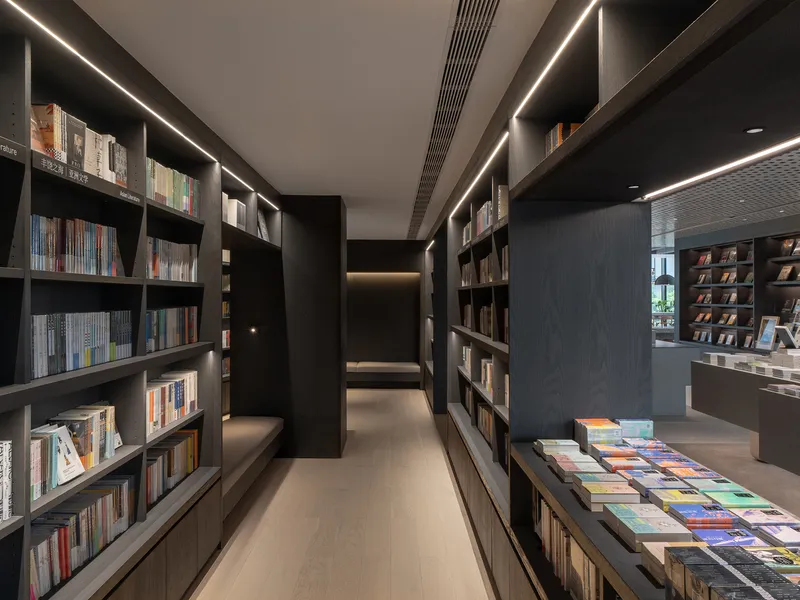
The bookshelf aisle itself has a contemplative quality. Tall dark timber shelves flanked by recessed LED strips create a narrow, focused corridor that contrasts sharply with the open cafe and terrace. It is a deliberate deceleration, and it gives the reading experience spatial dignity in a building that could easily have prioritized the cafe's Instagram appeal.
Monsters of Wisdom
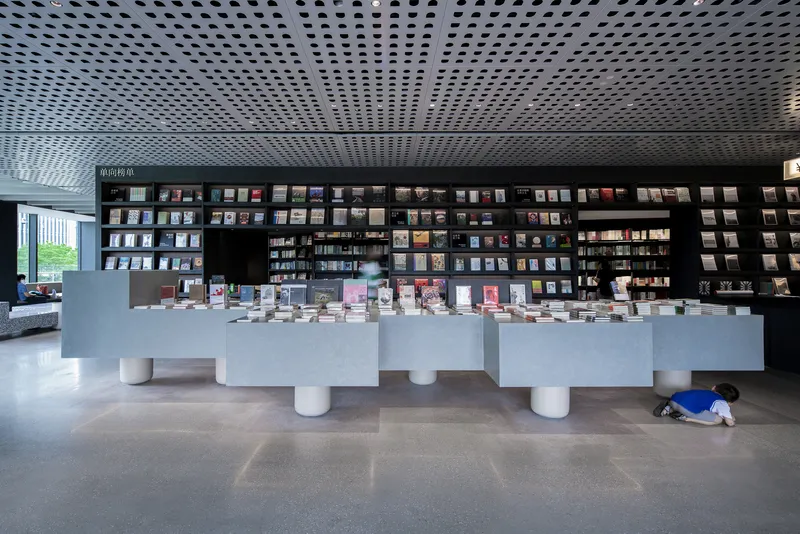
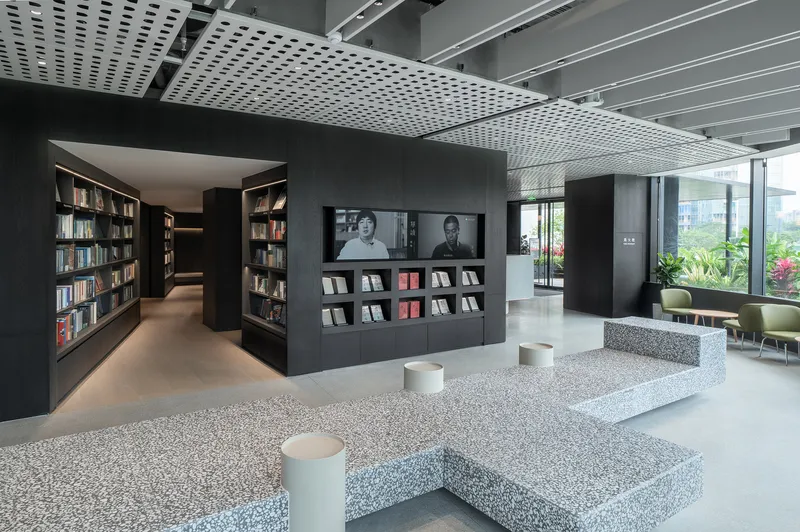
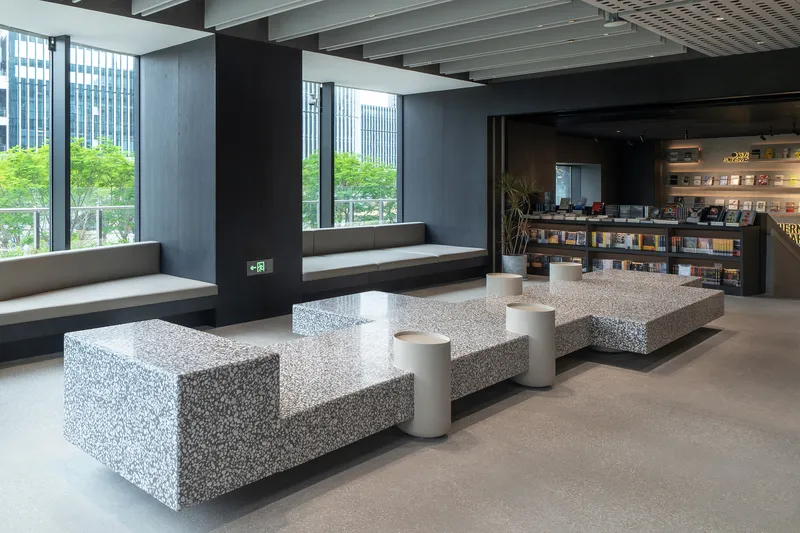
The five large-scale furniture pieces that 11ARCHITECTURE calls "Monsters of Wisdom" are the project's signature gesture. A seven-meter display table for books and goods stands on three steel legs arranged in a single row, giving it an animated, creature-like posture. A terrazzo bench seats twenty people simultaneously. Cylindrical stools cluster beneath floor-to-ceiling windows. Each piece is deliberately oversized, occupying the room the way a sofa dominates a living room rather than the way a retail fixture disappears into a grid.
The name is a bit much, but the idea behind it is sound. These objects set the social tone. They invite sharing, not private consumption. A bench for twenty people is a political statement as much as a design decision: it says this space belongs to the group, not the individual shopper. Paired with the terrazzo materiality and the stubby steel legs, they give the interior a warmth and eccentricity that the perforated aluminum ceiling alone would not achieve.
Cafe, Terrace, and the South-Facing Glass Wall
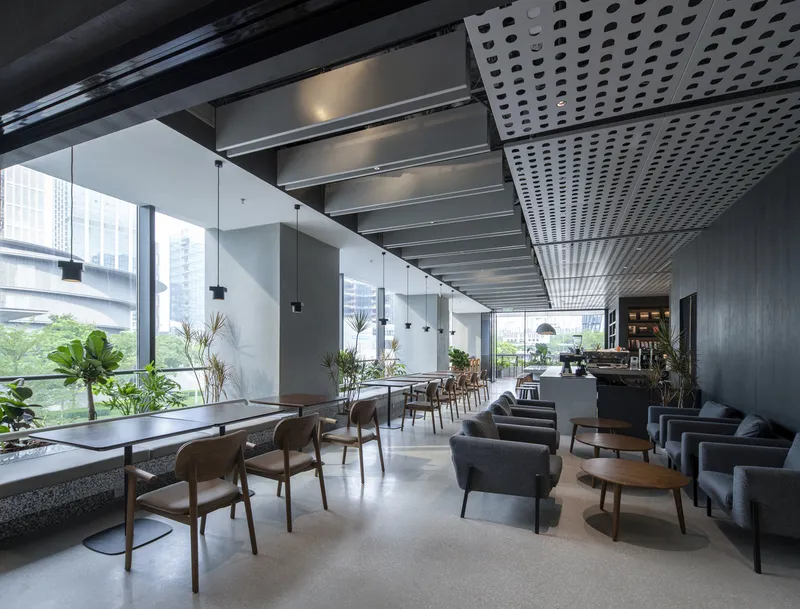
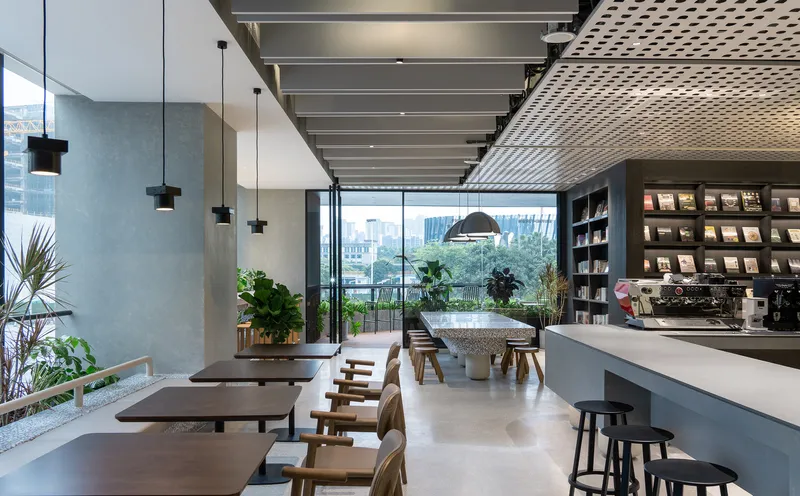
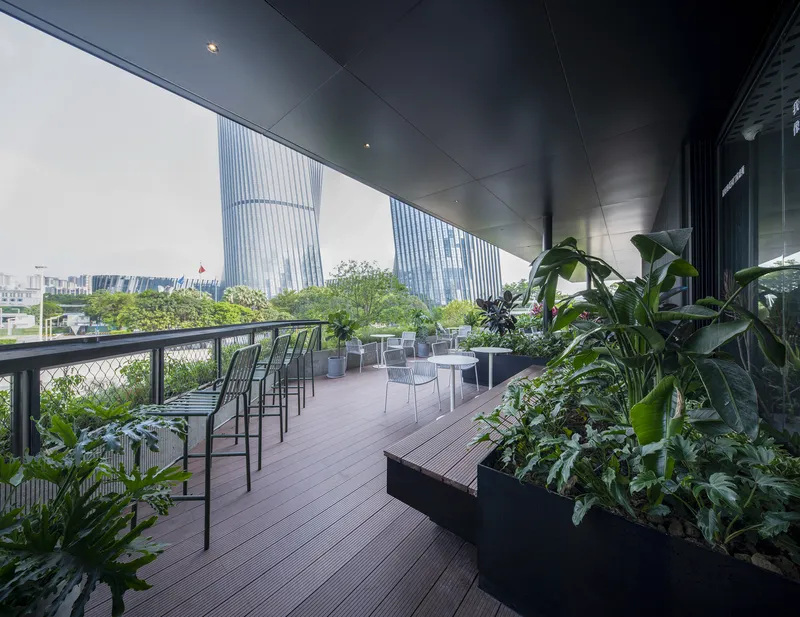
The entire south side of the second floor is lined with continuous large glass windows, flooding the cafe and reading areas with daylight. Green planters, seats, and a bar run along the low window sill, creating an inhabited edge that mediates between the conditioned interior and the terrace beyond. A large eave extends over the outdoor deck, providing shade from both sun and rain, which is non-negotiable in Foshan's humid subtropical climate.
The cafe extends seamlessly onto this covered terrace, and the transition is handled simply: composite decking, metal railings, planting boxes, all under a paneled soffit that continues the ceiling language from indoors. Views from the terrace include Midea's twin towers, giving the cafe a sense of prospect that its modest 500-square-meter footprint would not otherwise suggest. It is borrowed grandeur, deployed well.
The Atrium and Ground Floor Event Space
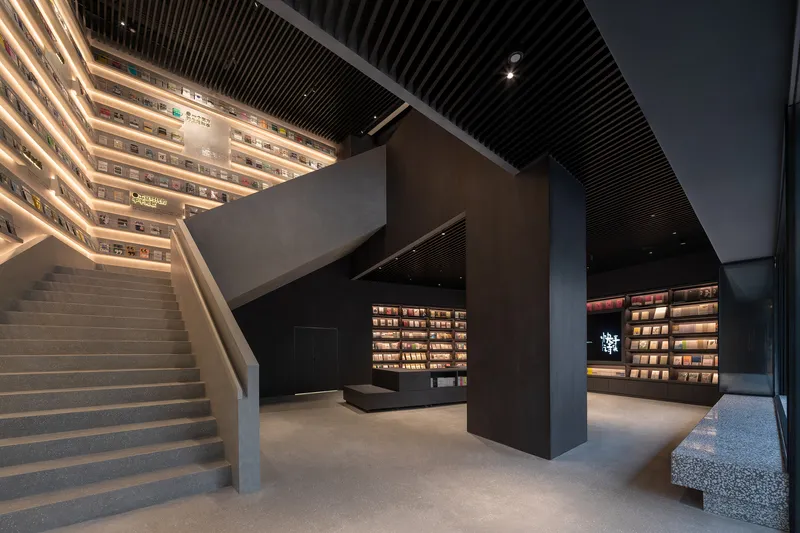
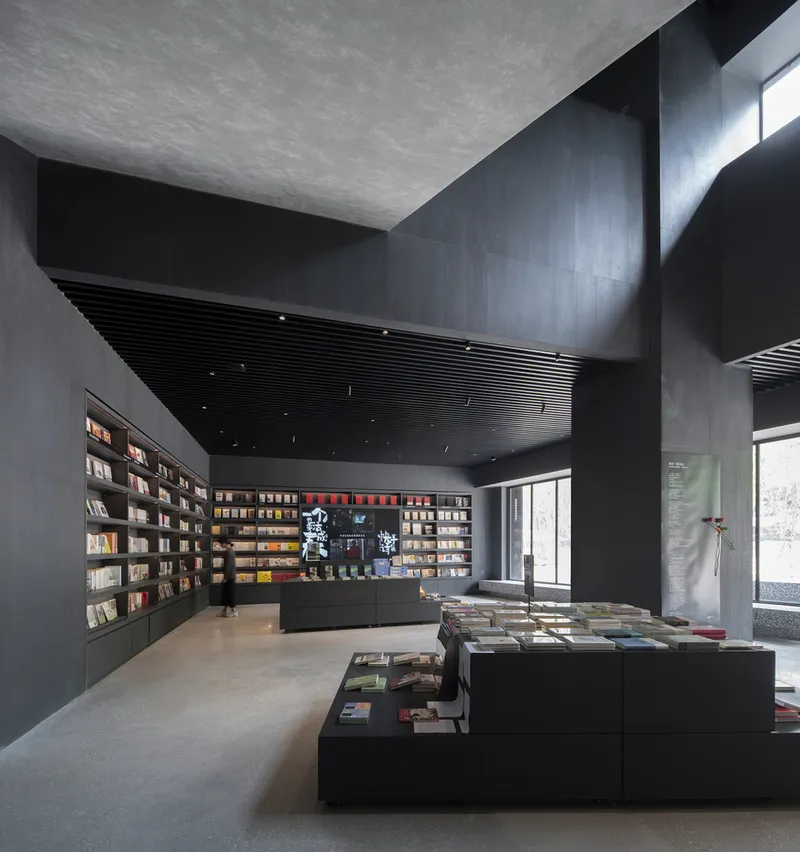
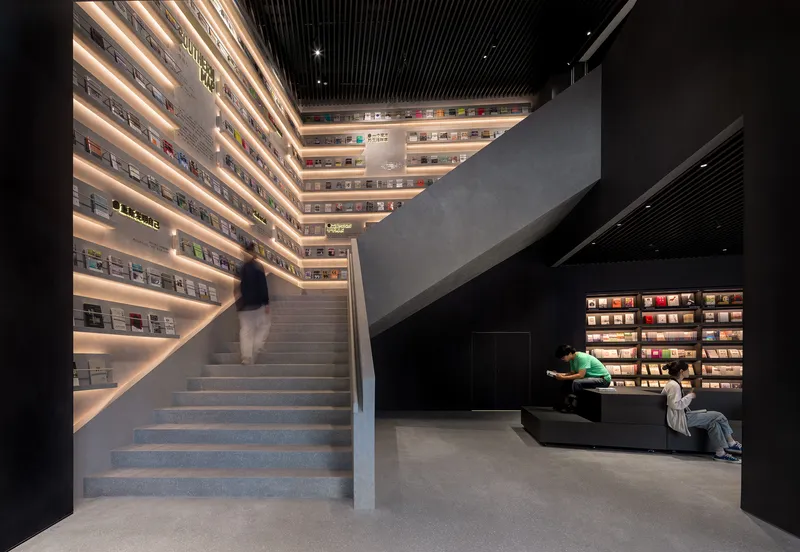
The interior's deepest section opens into a double-height atrium connecting both floors, with illuminated bookshelf walls rising alongside terrazzo stairs. The volume is theatrical: ribbed black ceiling panels, concrete walls, and clerestory windows that wash the space with controlled natural light. A literary map titled "SOUTHERN MAP," developed in collaboration with the OWSPACE team, lines the stair walls, turning the vertical circulation into a curated experience.
Below, the 150-square-meter ground floor functions as a flexible event space. Movable exhibition stands can be cleared to accommodate 100 chairs for lectures or screenings. The stage from the outdoor amphitheater finds its indoor counterpart here, and together the two venues give OWSPACE the capacity to program cultural events at a scale that a conventional bookstore could never support. For a community of young Midea employees, many of them transplants to Shunde, this kind of infrastructure is not a luxury. It is a social anchor.
Quiet Corners and the Built-In Couch
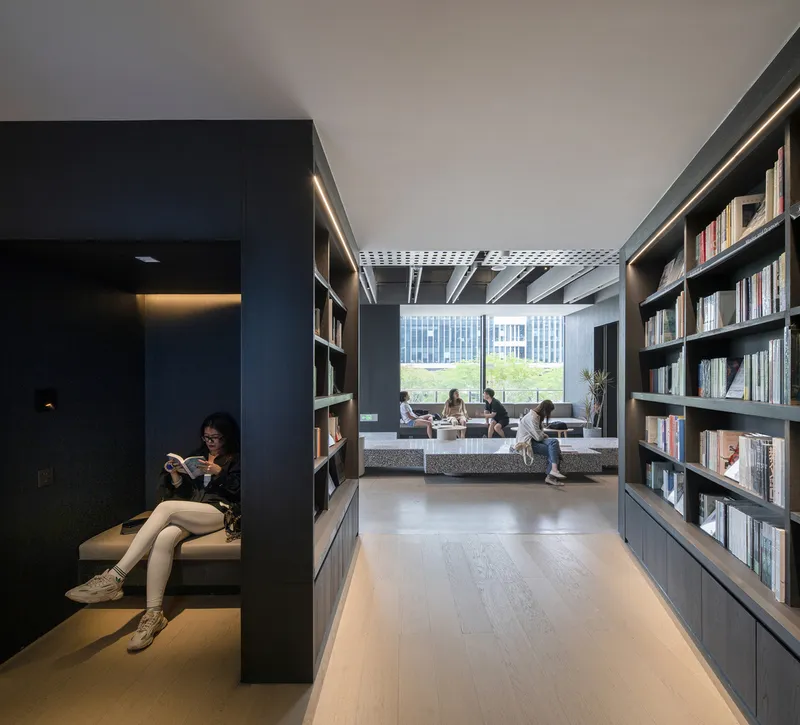
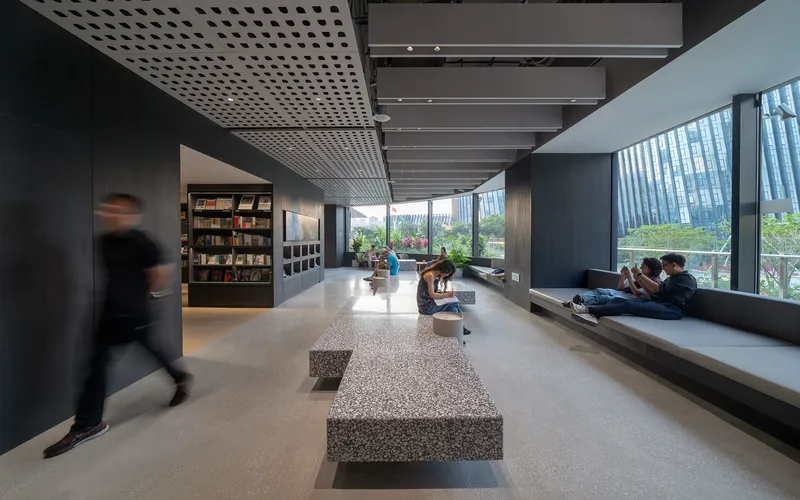
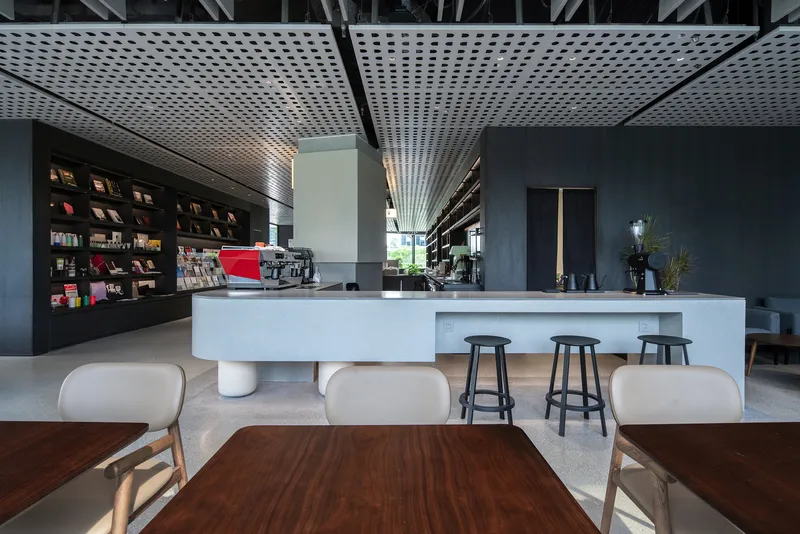
Not everything in the project is communal. A reading alcove with a built-in couch one meter deep offers a place to disappear with a book. Terrazzo benches along the glazed corridor seat solitary readers who want proximity to light without proximity to conversation. The perforated ceiling panels above these quieter zones soften acoustics, absorbing the ambient noise of the cafe without requiring physical enclosure.
This gradient from public to private is what separates a genuinely useful community space from a branded lounge. 11ARCHITECTURE understood that a living room needs both the couch and the corner, both the gathering and the retreat. The modest ceiling height could have been a liability, but the perforated aluminum overhead, with its integrated lighting and radiating pattern, creates a sense of lift that keeps the low spaces from feeling compressed.
Plans and Drawings
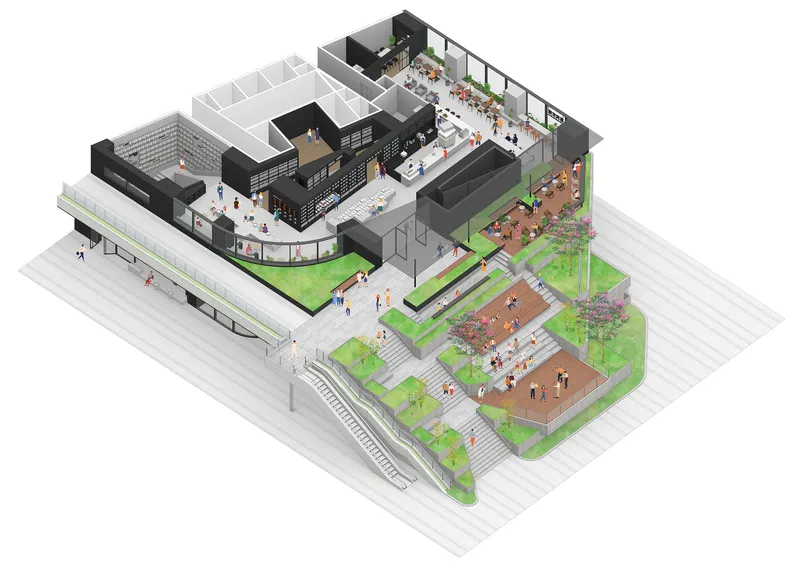
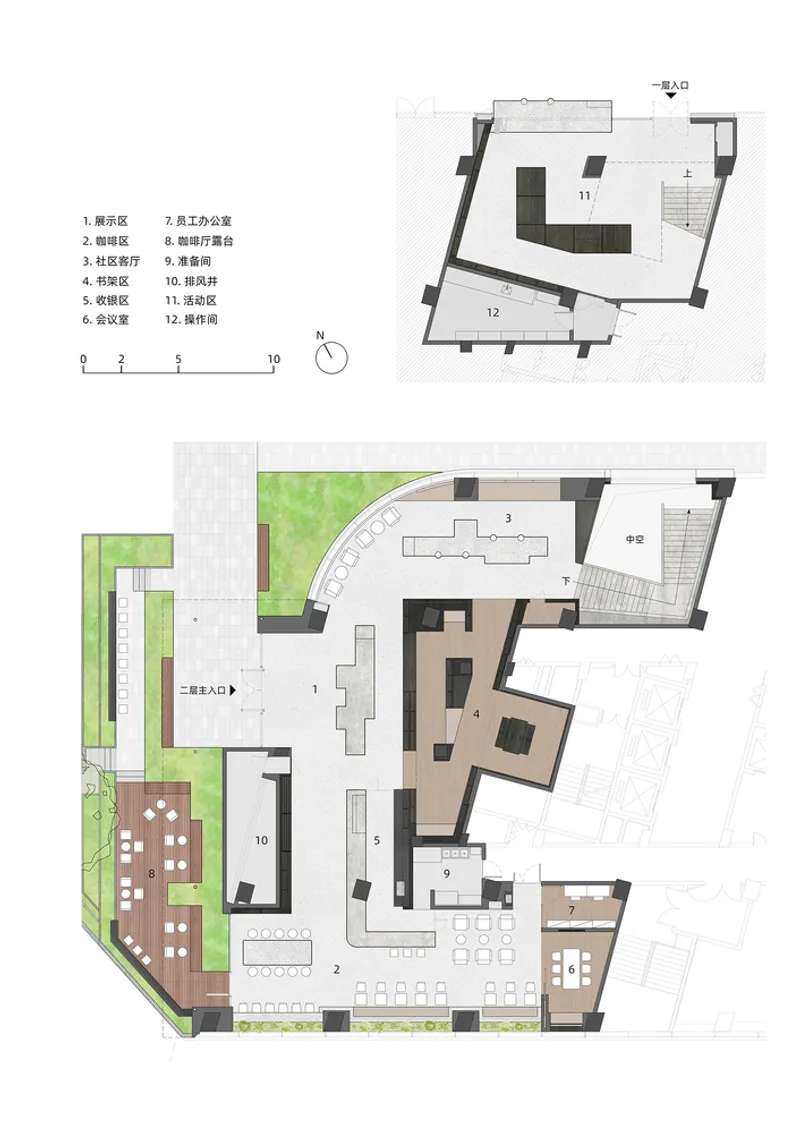
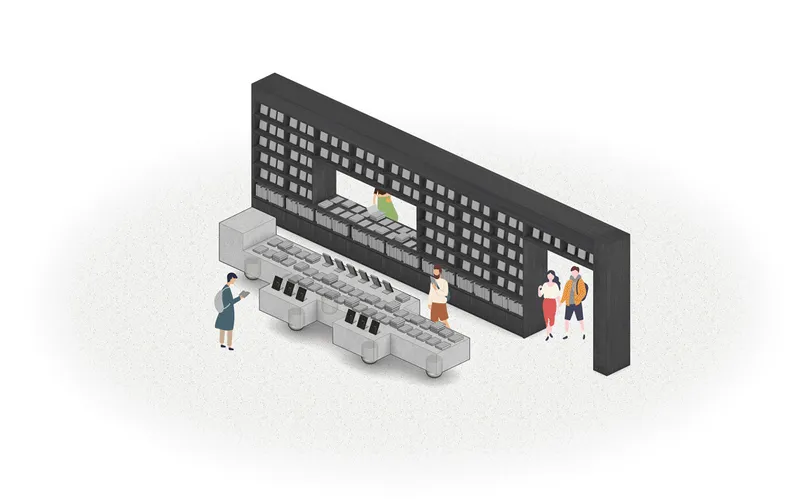
The axonometric drawing reveals the project's dual identity most clearly: the interior reading spaces and the exterior terrace with planted zones are given equal graphic weight, reinforcing the idea that the garden is not an afterthought but a co-equal half of the program. The floor plans show how the 16-meter bookshelf wall anchors the second floor's spatial logic, while the ground floor remains deliberately open and reconfigurable. The service counter isometric details the perforated screen wall and queuing zone, a small moment that nonetheless demonstrates the level of furniture-scale design thinking that runs through the entire project.
Why This Project Matters
Corporate towns tend to produce architecture that serves the company first and the community second. The amenities look good in recruitment brochures but feel hollow on a Tuesday evening. What 11ARCHITECTURE has done in Foshan is invert that hierarchy. By taking an underused ramp and a modest two-story retail shell and transforming them into a bookstore, cafe, event space, and public garden, they have created the kind of place that earns repeat visits, not because the brand compels it, but because the space is genuinely comfortable and socially generous.
The broader lesson is about ambition at small scale. The total indoor area is 650 square meters. The landscape is 620. This is not a civic monument; it is a neighborhood intervention. But the terraced garden, the oversized furniture, the double-height atrium, and the flexible ground floor collectively punch well above that modest footprint. OWSPACE's third-generation model, embedding cultural programming within residential communities rather than high streets, needed architecture that could hold that ambition. 11ARCHITECTURE delivered exactly that.
Foshan OWSPACE and Community Garden by 11ARCHITECTURE. Located in Midea Corporate Town, Shunde, Foshan, China. 1,270 m² (650 m² indoor, 620 m² landscape). Completed 2023. Photography by Siming WU and Chao Zhang.
About the Studio
Share Your Own Work on uni.xyz
If projects like this are the kind of work you want to make, uni.xyz is a place to publish your own, find collaborators, and enter design competitions.


Popular Articles
Popular articles from the community


The Amber Palace Opera: A Geological Fiction Surfaces on Tallinn's Baltic Waterfront
Pierre Brillard reimagines a Baltic legend as a public landscape, opera house, and waterfront promenade rooted in Tallinn's coastal identity.
Opera on the Sea: Driftwood Logic Shapes a Timber Opera House on Estonia's Coast
Trevor Orgill's opera house translates the entangled drift of floating timber into a civic building where wood, water, and music converge.

Cloaked Colonization: A Mobile Underwater Habitat That Moves Like a Fish
Micah Abaya's shortlisted EHC Pacific entry reimagines ocean settlement as a dispersed network of self-sustaining architectural organisms.

Manzana Morphosis: Stretching Barcelona's Grid into a Living Landscape for 2050
A radical reworking of the Eixample manzana turns density into a tool for generous public space, vertical ecology, and environmental performance.

Similar Reads
You might also enjoy these articles


FAMM Arquitectura Organizes Ten Villas Around Courtyards and Jungle in Nosara, Costa Rica
El Molino pairs two elongated volumes with deep overhangs and timber louvers to build a compact coastal community five minutes from the beach.

Oscar Niemeyer's Ibirapuera Park Pavilions Define São Paulo's Cultural Identity in Concrete and Curve
A constellation of modernist volumes set within São Paulo's most important urban park, conceived for the city's 400th anniversary in 1954.

Sanjay Puri Architects Wraps a Jaipur Office Tower in Capsule-Shaped Green Buffers
A nine-level climate-responsive workplace near Jaipur Airport uses stacked planter terraces and aluminium screens to fight 40°C heat.
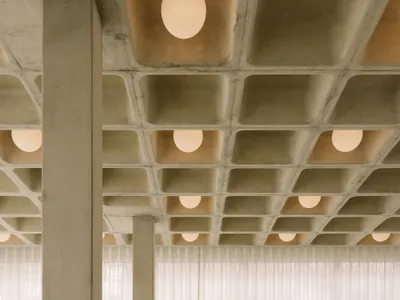
RHO Converts a Berlin Spree-Side Industrial Courtyard into Enkime's 1,000 m² Agency Headquarters
A social media agency's new home in Charlottenburg trades glossy branding for concrete waffle ceilings, glazed tile, and sheer curtains.

Explore Collaborative Space Competitions
Discover active competitions in this discipline

Challenge to reimagine the Iron Throne

Photograph architecture without architects

Illustrate the lost glory of Angkor Wat - Render Challenge

Design challenge to reuse E-waste
Comments (0)
Please login or sign up to add comments
No comments yet. Be the first to comment!