

Communiversity: Replacing Prison Cells with a Four-Stage Campus for Reintegration
A runner-up entry in Switching Prisons reimagines incarceration as a progressive educational campus spanning cottage, cluster, campus, and community.


What if the most effective prison looked nothing like a prison at all? Communiversity proposes a spatial sequence that moves incarcerated people through four distinct architectural typologies, from high-density cottage dorms to open community workspaces embedded in the urban fabric. Rather than enforcing punishment through isolation, the design treats rehabilitation as a curriculum delivered through architecture itself: layered thresholds, landscaped courtyards, and real-world simulations replace cell blocks and concrete yards.
Developed by Russell Harding, Andrew Duffin, Anthea Doyle, Ewan Saunders, Mario Notaro, and Kolo Chen, the project was selected as a runner-up in the Switching Prisons competition. Working under the banner of NBRS Architecture, the team presents a civic typology that frames the prison not as a facility but as a campus, one whose spatial logic is organized entirely around progressive reintegration into public life.
Timber, Daylight, and Planted Interiors That Dissolve the Institutional Edge
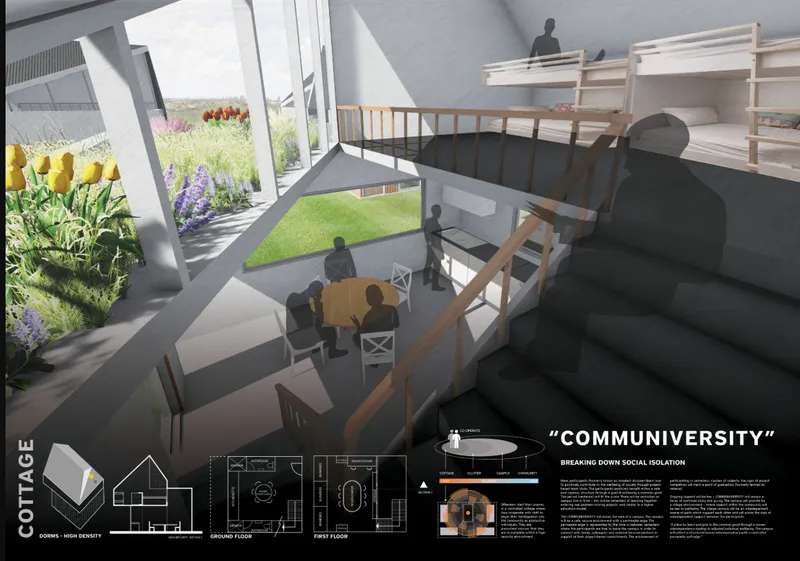
The interior rendering reveals a double-height communal space flooded with natural light, where a timber staircase connects levels while a planted courtyard pushes greenery directly into the living quarters. Seated figures occupy the space casually, without the rigid behavioral cues that typify carceral interiors. The material palette, dominated by exposed timber and soft planting, deliberately suppresses the visual language of incarceration. Natural surveillance is built into the open-plan section: sight lines extend across multiple levels without resorting to observation booths or panoptic corridors.
This is not decorative softening. The design embeds layered privacy and transitional thresholds into the architecture so that security requirements coexist with a sense of agency. Residents can choose between social engagement in the communal zone and retreat into quieter edges, a spatial negotiation that mirrors the psychological work of rehabilitation.
Courtyards as Social Infrastructure Between Cluster and Campus
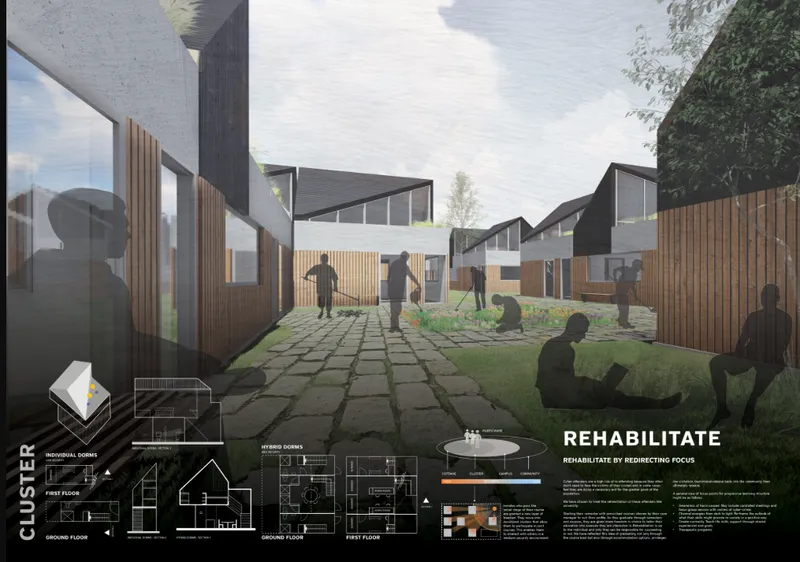
The courtyard view captures the Cluster phase of the Communiversity model, where medium-security hybrid dorms open onto a landscaped ground plane of paved grid pathways and open grass. Vertical timber cladding wraps the volumes, giving the buildings a domestic grain rather than an institutional one. Figures gather on the lawn under open sky, their informal groupings suggesting a social environment shaped by choice rather than coercion.
The four-stage spatial sequence is central to the entire proposal. Cottage provides high-density dorms that establish routine and collaborative responsibility. Cluster introduces collective engagement within these shared courtyards. Campus shifts the focus to academic and vocational programs in layouts modeled on higher education environments. Community, the final stage, connects participants to the outside world through workspaces, stores, and civic programs woven into the urban grain. Each typology loosens the boundary between inside and outside, both literally and socially.
Sawtooth Roofs and Site Planning That Read as Village, Not Institution
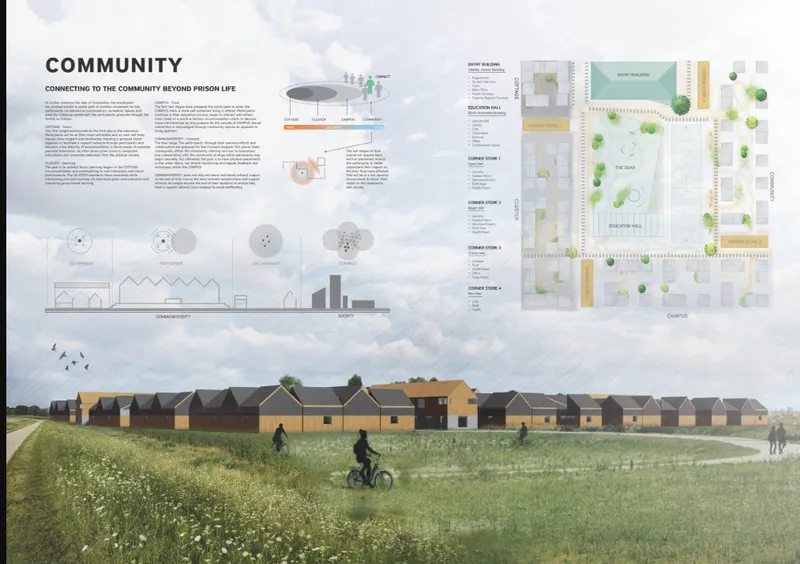
The site plan and elevation drawings reveal a collection of sawtooth-roofed volumes distributed across a grassy field, their massing deliberately fragmented to avoid the monolithic footprint of a conventional prison. The sawtooth profile does double duty: it provides consistent, diffused natural light to interior spaces while giving the complex a productive, workshop-like silhouette. From the rendered perspective, the ensemble reads closer to a rural educational campus than any recognizable correctional facility.
By breaking the program into discrete pavilions connected by landscape, the design resists the totalizing enclosure that defines most prison typologies. Green space is not residual but structural, functioning as buffer, meeting ground, and psychological relief. The site strategy reinforces the Communiversity's core argument: that architecture shaped by dignity and purpose produces better outcomes than architecture shaped by control.
Education as Spatial Foundation, Not Afterthought
What distinguishes Communiversity from other reformist prison proposals is the depth of its programmatic commitment. Education is not layered on top of a conventional plan; it is the organizing logic of the entire spatial sequence. Real-world simulations, from community stores to classrooms, are designed into the architecture so that participants practice civic participation before they leave. Counseling, skill-building, and vocational training are distributed across the four typologies, calibrated to each stage of reintegration.
The team positions this not as an idealized one-off but as a replicable civic typology, a blueprint that could be adapted to different sites and scales. The progressive curriculum of redemption, as the designers frame it, turns routine into responsibility and confinement into connection. The architecture is the delivery mechanism.
Why This Project Matters
Prison design remains one of architecture's most ethically charged territories, and most proposals either aestheticize reform or ignore it entirely. Communiversity succeeds because it ties every spatial decision to a specific phase of human transformation. The four-stage progression from Cottage to Community is not a diagram; it is an architectural argument that each increment of freedom must be accompanied by a corresponding spatial generosity.
By treating incarceration as a design problem inseparable from education, landscape, and urban integration, Harding, Duffin, Doyle, Saunders, Notaro, and Chen offer a model that challenges the profession to take correctional architecture seriously. The Switching Prisons competition asked entrants to rethink what a prison could be. Communiversity answers with a campus that earns its name: a place where community and learning are not rewards for good behavior but the very structure of rehabilitation.
View the Full Project
About the Designers
Designers: Russell Harding, Andrew Duffin, Anthea Doyle, Ewan Saunders, Mario Notaro, Kolo Chen
Enter a Design Competition on uni.xyz
uni.xyz runs architecture and design competitions year-round that reward proposals with spatial conviction and real site intelligence.
Project credits: Communiversity by Russell Harding, Andrew Duffin, Anthea Doyle, Ewan Saunders, Mario Notaro, Kolo Chen Switching Prisons (uni.xyz).


Popular Articles
Popular articles from the community


Opera on the Sea: Driftwood Logic Shapes a Timber Opera House on Estonia's Coast
Trevor Orgill's opera house translates the entangled drift of floating timber into a civic building where wood, water, and music converge.


FCC Arquitectura Expands a Portuguese Granite House with a Board-Marked Concrete Wing
In Portugal, JV House pairs a cleaned-up whitewashed and granite dwelling with a timber-shuttered concrete extension, courtyards and a garden pool.

Cube Design Draws an Ecological Corridor Between Two Shenzhen Hills with the Nankai Building
Beside Shenzhen's container docks, the Nankai Building pairs stacked balconies with a climbing green screen to connect two hillsides across its height.

graciastudio Turns a Viewless Tijuana Lot Inward Around a Courtyard of Concrete, Timber and Trees
In Tijuana, Jorge Gracia's GA2 House stacks a timber-clad private floor over exposed concrete and replaces a missing view with a planted interior patio.

Similar Reads
You might also enjoy these articles
Cube Design Draws an Ecological Corridor Between Two Shenzhen Hills with the Nankai Building
Beside Shenzhen's container docks, the Nankai Building pairs stacked balconies with a climbing green screen to connect two hillsides across its height.

Praksis A and Studio Sted Bend a Red Timber Cabin Across the Granite of Norway's Southern Coast
On the southern Norwegian coast, a 105 m² cabin follows the rock on slender posts, pairing red cladding outside with pine, brick and plywood within.

David Ortega Stacks a Two-Story Mexico City Penthouse Around a Steel Stair and a Pergola-Shaded Roof Terrace
In Colonia Roma, a 300 m² penthouse uses oak joinery, a planted steel stair and a slatted roof pergola to make a new-build apartment feel like a house.

PARALELA and LB2 Thread a Public Walkway Through the Base of a Las Condes Residential Tower
In Las Condes, Santiago, the Hamlet Building gives its fenceless ground floor to a 70-metre wooded passage linking two streets and the metro.

Comments (0)
Please login or sign up to add comments
No comments yet. Be the first to comment!