

Park Associati Converts a 1940s Milan Agricultural Depot into Housing for 700 Students
A former industrial consortium on Via Ripamonti becomes a color-rich student campus with a rooftop basketball court and courtyard agora.


Milan's Via Ripamonti corridor, wedged between the old Porta Romana rail yards and the southern ring, is not an obvious address for student life. Yet it is exactly the kind of place where adaptive reuse can flip a neighborhood's trajectory. Park Associati has taken a bulky 1940s Consorzio Agrario, the former Provincial Agricultural Consortium, and turned its 32,000 square meters into Aparto Ripamonti: a campus that houses more than 700 residents in cluster apartments, wraps them in shared amenities from basement cinema rooms to a fourth-floor basketball court, and keeps the old building's industrial skeleton legible throughout.
What makes the project worth examining is the tightrope it walks between preservation and insertion. The corner building at Ripamonti and Viale Isonzo has been recovered rather than gutted, its grey plaster walls and sandstone base retained as the public face. Behind and above it, a new five-story volume in prefabricated fiber cement panels rises with a distinctly different register, and the gap between old and new is held open as a central courtyard that functions as the campus's social spine. The architecture does not try to reconcile these two identities; it stages their contrast, and the project is better for it.
Old Skin, New Volume
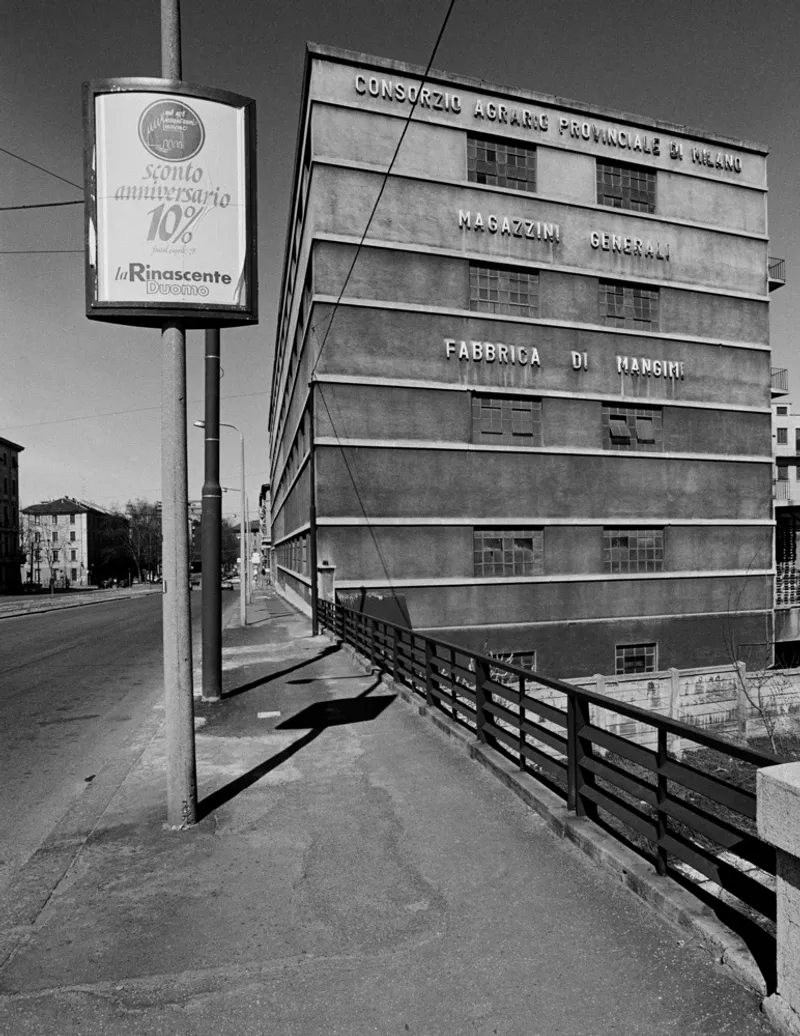
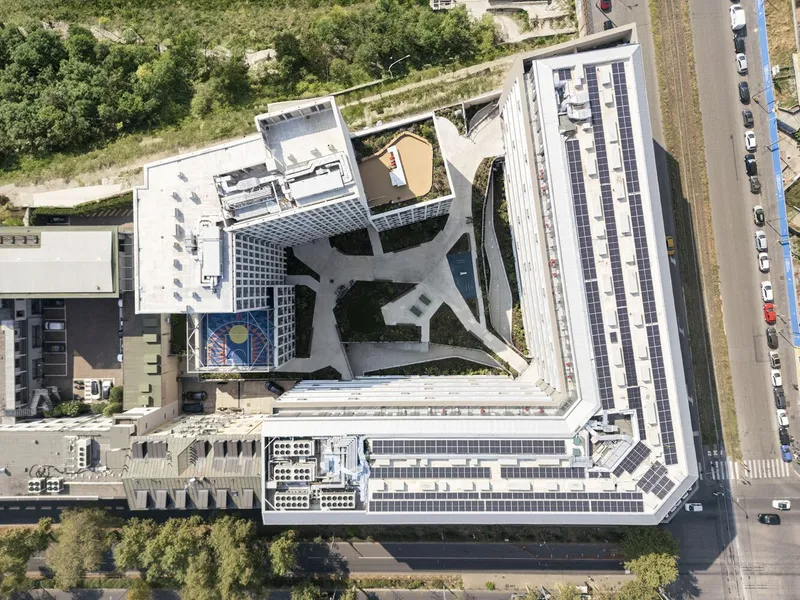
At street level the original horizontal banding and painted lettering of the consortium building still read clearly, grounding the project in the utilitarian language of mid-century Milanese industry. Walk past the sidewalk hoarding and you begin to understand the scale of what sits behind: a second building joined to the first by a central open court, with rooftop solar arrays and steel-framed amenity structures crowning the composition. The deliberate mismatch between the street-facing masonry and the lighter, more modular new construction is the project's most legible design decision. Park Associati treat the old facade as a found object, neither restored to showroom perfection nor stripped back to raw structure, and let the addition announce itself without apology.
A Basketball Court in the Sky
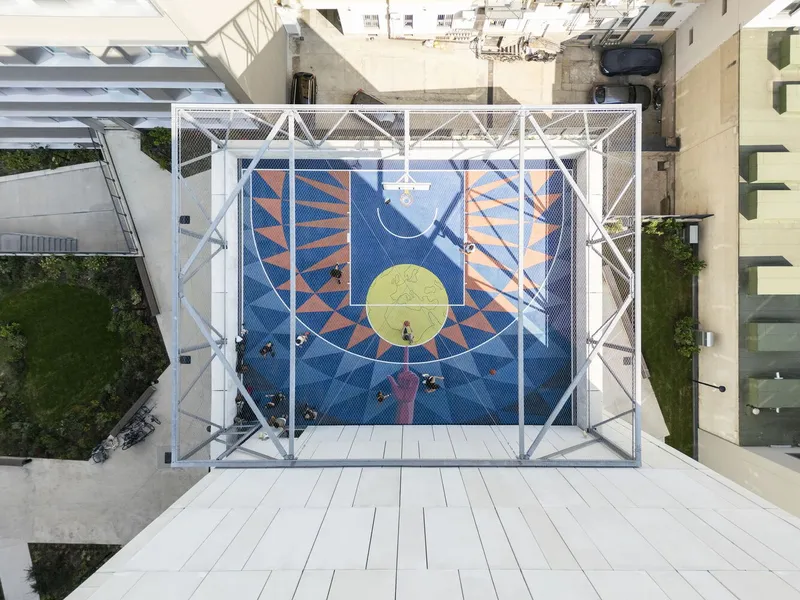
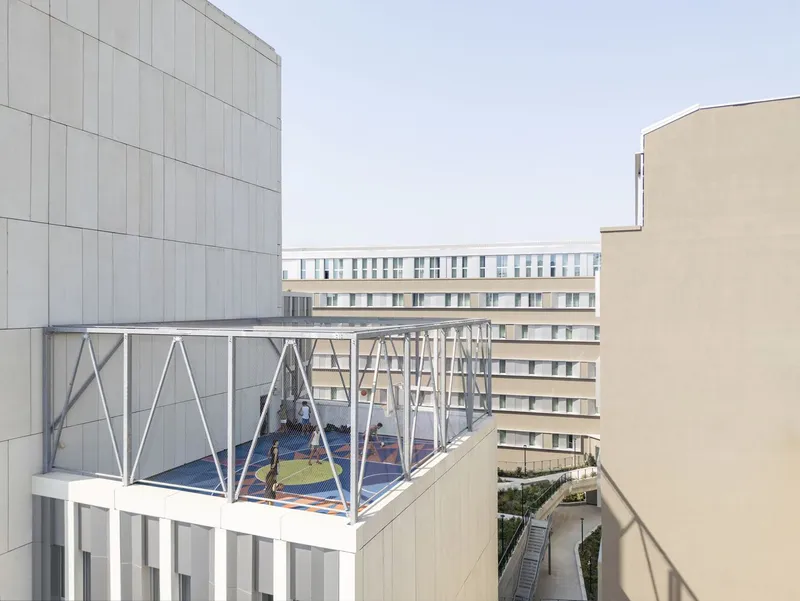
The most photographed element of the scheme is also its most programmatically bold: a full basketball court perched on the fourth floor of the new building, caged in a white steel structural frame and open to the sky. Seen from above, players move against the synthetic blue surface like figures on a Mondrian canvas; seen from street level, the steel cage reads as an inhabited crown that signals the building's communal ambitions to the neighborhood.
Rooftop sport courts in residential buildings are not new, but placing one this prominently between two residential blocks, visible from communal terraces on adjacent floors, collapses the distance between spectator and participant. It turns recreation into spectacle and spectacle into a reason to step outside your room. For a project that aims to balance privacy with exchange, the court is the single most effective spatial argument.
Color as Wayfinding, Color as Identity

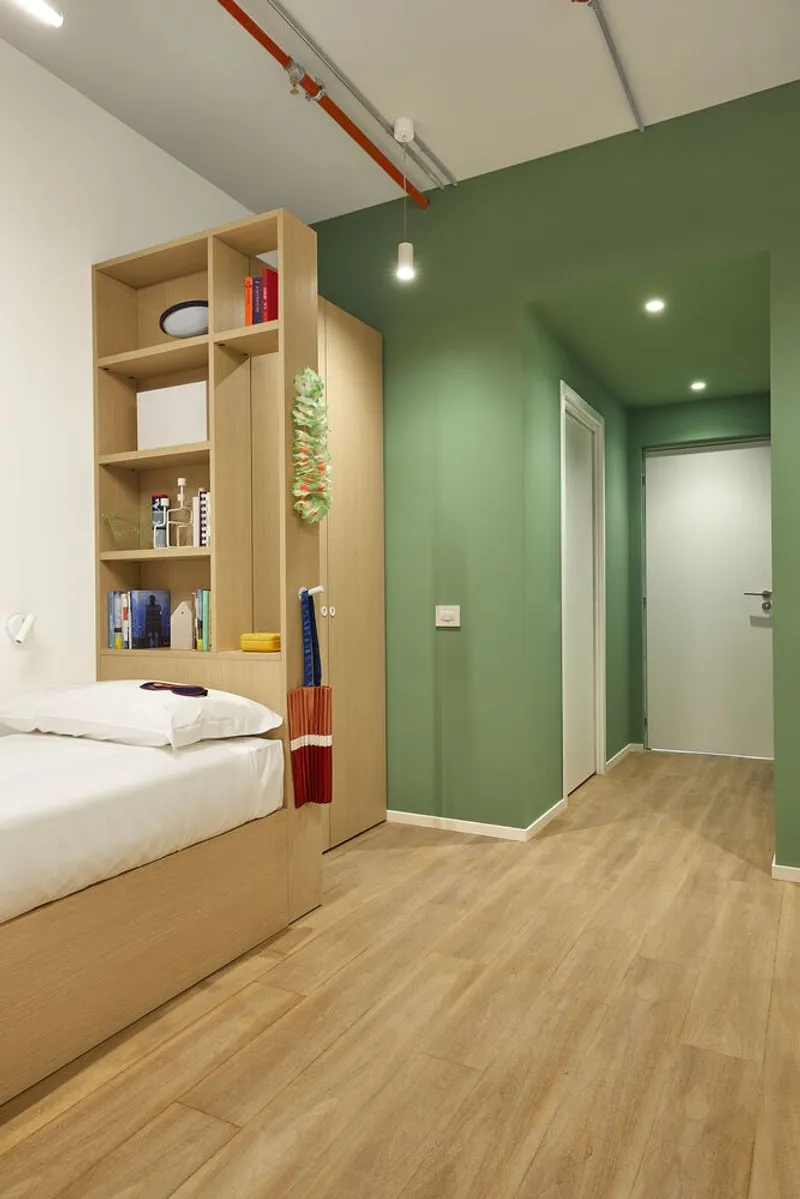
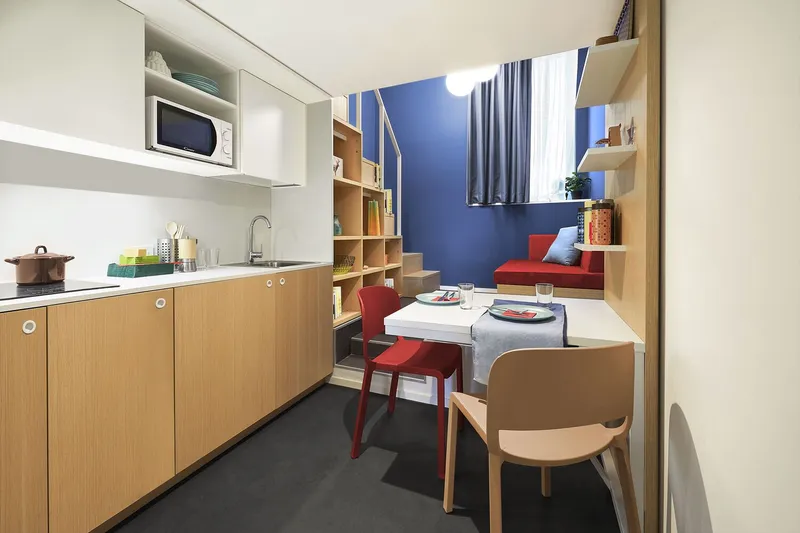
Inside the cluster apartments, Park Associati deploy a palette of saturated tones that do far more than decorative work. A terracotta-painted ceiling in one bedroom, sage green walls in another, a vivid blue alcove framing a kitchenette: each color assignment differentiates room types and shared zones without signage, giving students an intuitive sense of where they are within an otherwise repetitive floor plate. The approach recalls the color-coded corridors of Le Corbusier's Unité, updated for a generation that expects domestic warmth alongside institutional scale.
Materiality reinforces the strategy. Birch plywood shelving, blonde wood platform beds, and concrete-effect flooring establish a neutral base against which the painted surfaces pop. Sound-absorbing panels in mineralised wood handle acoustics without the visual deadness of standard ceiling tiles. The rooms are compact, as student housing must be, but they avoid feeling like cells because every surface carries a deliberate finish.
Cluster Living and the Social Equation
The cluster apartment model, grouping eight to twelve private bedrooms around shared kitchenettes and living areas, is Aparto Ripamonti's primary social unit. It sits between the solitude of a studio flat and the enforced togetherness of a traditional dormitory, and it is increasingly favored by operators like the client, Hines Italia, because it drives higher occupancy without sacrificing perceived quality of life. Park Associati have used the old building's rigid structural grid as a constraint that actually helps: the existing column spacing produces room widths that accommodate mezzanine levels and double-height configurations, giving variety to units that would otherwise feel identical.
The shared kitchenettes, like the blue-walled example with its red dining chairs, are designed to be both functional and inviting enough to pull residents out of their rooms. Daylight enters from generous openings, and the furniture scale suggests a domestic kitchen rather than an institutional canteen. Whether students actually cook together or simply pass through is beside the point; the space exists as an invitation, and the architecture does not force the encounter.
Why This Project Matters
Adaptive reuse in Milan tends to gravitate toward luxury lofts and branded offices. Aparto Ripamonti redirects that energy toward a user group, students, whose spatial needs are real but whose budgets are not. By converting a building type that no longer serves its original purpose into one that addresses a genuine housing shortage, Park Associati demonstrate that preservation and social utility are not competing agendas. The LEED certification and the solar array on the roof are important, but the project's most sustainable act is simply keeping a large building standing and filling it with life.
The scheme also offers a template for how contrast can substitute for consensus in heritage projects. Rather than cladding the new addition in materials that mimic the old, the architects let the two volumes speak different languages and trust the courtyard to mediate. The result is a campus that feels layered rather than uniform, historical rather than historicist. For a city racing to densify its southern fringe ahead of the 2026 Olympics, Aparto Ripamonti is a useful proof of concept: the bones are already there, and they are stronger than you think.
Aparto Ripamonti by Park Associati. Via Ripamonti, Milan, Italy. 32,000 m². Completed 2024. Photography by Nicola Colella and Gabriele Basilico.
About the Studio
Share Your Own Work on uni.xyz
If projects like this are the kind of work you want to make, uni.xyz is a place to publish your own, find collaborators, and enter design competitions.


Popular Articles
Popular articles from the community

Tsunami Convergenics: Turning Catastrophic Ocean Forces into Underwater Housing Infrastructure
A speculative underwater settlement off the coast of Onagawa, Japan, treats tsunamis and typhoons as energy sources rather than threats.

Temporary Home for Dogs: A Reversed Zoo Rethinks Animal Shelter Architecture
In Bucharest, a sinuous corridor and freed landscape flip the logic of containment, designing a shelter that works to make itself unnecessary.

Opera by the Sea Estonia: Three Shells Dissolving Architecture into Tallinn's Coastline
A winning opera house proposal replaces monumental form with interconnected shells that blur the boundary between building, park and Baltic Sea.

Singing Woman: Contemporary Architecture Inspired by Estonia’s Voice and the Sea
Singing Woman turns Estonia’s song culture into flowing opera house architecture, blending public life, landscape, sea, and national memory.

Similar Reads
You might also enjoy these articles


Hodi-Mandai Geram
Project Function: Preservation and revitalization of the Intangible heritage and socio-spatial identity of the Hodi by Housing, Cultural Memory Center, Sacred Grove, landscape, local tourism economy


Olio Towers: A Mid-Rise for Performers That Fuses Housing, Rehearsal, and Stage
Located blocks from Houston's Theater District, this modular tower stacks living units around a central performance atrium.

Oasis: Modular Green Housing Carved into Dhaka's Urban Fabric
A shortlisted Plugin Housing entry reclaims unauthorized settlements in Dhaka with stepped concrete volumes, green roofs, and ventilation-driven design.

Black Hole: A Floating Megastructure for the Post-Physical Era
Emiliano Mazzarotto envisions a spherical, self-scaling arena where e-sports, digital hotels, and holographic stadiums replace traditional public space.

Explore Domus Academy Milano Competitions
Discover active competitions in this discipline

Challenge to reimagine the Iron Throne

Photograph architecture without architects

Illustrate the lost glory of Angkor Wat - Render Challenge

Design challenge to reuse E-waste
Comments (0)
Please login or sign up to add comments
No comments yet. Be the first to comment!