

Container Skyscraper at Dharavi: Recycled Shipping Containers Stacked into Vertical Affordable Housing
A hybrid concrete and steel frame holds modular shipping container homes above Dharavi, freeing the ground for markets and shared community life.


The shipping container is one of the most familiar objects in a port city like Mumbai, yet it rarely becomes a home. This proposal asks a pointed question: can the steel box that moves the world's goods also house the people who live closest to the city's economic engine? The answer here is a tower of recycled containers, stacked within a structural frame and tuned for light, air and neighbourliness, set against the low, dense roofscape of Dharavi.
Designed by Rishabh Sharma, the Container Skyscraper at Dharavi tackles extreme density and poor living conditions in one of Asia's most studied informal settlements. Dharavi is often described as a city within a city, home to millions in tightly packed dwellings with limited access to daylight, ventilation, infrastructure and dignified housing. Sharma's argument is that conventional redevelopment fails here because it ignores the social and economic ties woven into the settlement. His response is to build up, minimize land take, and return the ground to the markets and gathering spaces that sustain daily life.
A Yellow Tower That Gives the Ground Back

The opening render sets up the project's central contrast: a vertical stack of yellow containers on a steel frame rising above the horizontal grain of Dharavi's rooftops. The colour is a deliberate signal. Rather than disguising the container, the scheme celebrates its industrial origin and makes the reuse legible from street level.
More important than the image of the tower is what happens beneath it. By concentrating housing vertically, the design frees ground-level space for public amenities, markets and community interaction. In a neighbourhood where the street doubles as workshop, shopfront and living room, keeping that ground plane open matters more than any facade gesture.
Sky Gardens Break Up the Stack

The elevations and sections reveal that this is not a monolithic pile of boxes. Floor levels are interrupted by sky gardens, and the units are arranged in clusters that allow cross-ventilation, daylight penetration and visual connection through the block. These voids do the environmental work that Dharavi's tight lanes cannot.
Circulation follows the same social logic. Shared corridors, terraces and semi-open communal spaces link residents both horizontally and vertically, an attempt to translate the porous, overlapping life of the settlement into a high-rise format instead of sealing families behind identical doors on a double-loaded corridor.
Homes Assembled One Box at a Time
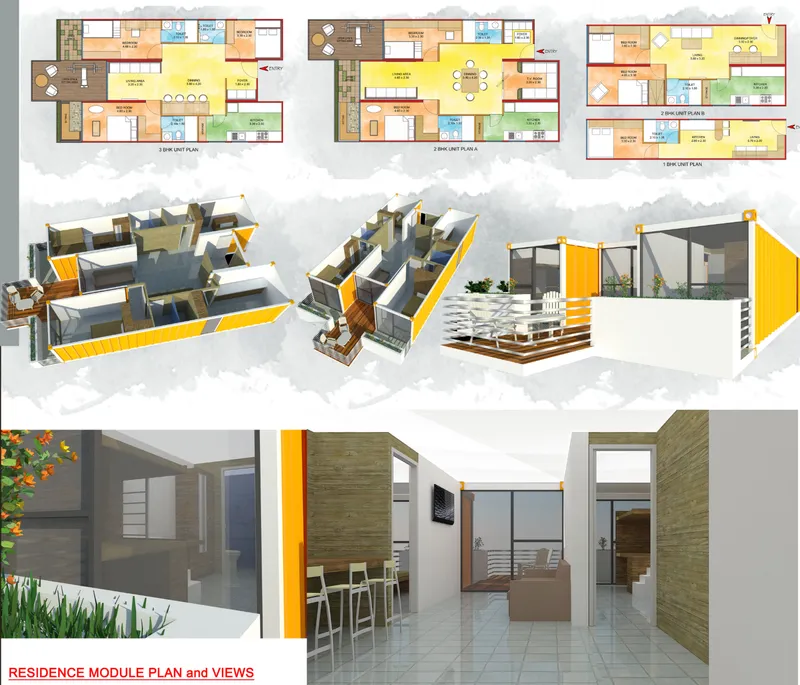
The presentation sheet zooms into the unit. Coloured floor plans and cutaway axonometrics show how individual containers are modified with insulation, glazing and services while keeping their structural integrity. The interior view toward a balcony is a useful corrective to the assumption that container living must feel cramped and sealed.
The modular logic is the project's strongest practical idea. Containers can be combined horizontally or vertically to form larger apartments, accommodating households of different sizes. Sharma cites their structural strength, standard dimensions and global availability as reasons for the choice, and the approach supports phased construction, reduced material waste and faster on-site assembly, all critical where residents cannot simply be displaced for years during a rebuild.
Concrete Columns Carry the Load, Containers Carry the Life

This close-up is where the structural honesty of the scheme becomes clear. Yellow modules with glazed ends and railed balconies sit between concrete columns and white cantilevered slabs. The containers act only as semi-structural modules; primary loads travel through a reinforced concrete and steel hybrid system made up of a robust core and external framing.
That decision addresses the most common critique of container towers, namely that stacked boxes alone cannot handle height or lateral forces. Sharma prioritizes seismic stability, which is essential for a high-rise in Mumbai. Vertical fixing systems keep the stacked containers aligned and transferring load, while standardized joints and connection details make the kit adaptable and replicable on other sites.
A Facade Built for Mumbai's Heat and Rain

The final render places gridded windowed units alongside a column of solid corrugated containers and white projecting slabs, showing how the facade alternates between openness and closure. Steel boxes in a tropical climate are a known thermal risk, and the project responds with passive strategies: shaded facades, operable openings and internal courtyards that cut heat gain and dependence on mechanical cooling.
The sustainability agenda extends past material reuse. Solar panels on rooftops and exposed facades supplement energy demand, while rainwater harvesting, greywater recycling and decentralized waste management are distributed across multiple levels of the building. Spreading these systems through the tower, rather than leaving them in a basement plant room, reinforces the idea of the building as a set of self-sufficient vertical neighbourhoods.
Why This Project Matters
Container architecture has often been treated as a novelty, a pop-up café or a temporary studio. Sharma pushes it into the harder territory of high-rise affordable housing and, crucially, does not ask the container to do everything. Delegating structure to a concrete and steel frame and letting the modules serve as flexible, replaceable homes is a mature division of labour that makes the proposal more credible than many of its precedents.
The bigger lesson lies in its reading of Dharavi. By keeping the ground open for markets and community life and building shared terraces and sky gardens into the section, the project recognizes that redevelopment fails when it treats informal settlements as only a housing shortage. Questions of cost, ownership and resident participation remain open, but as a provocation about how prefabrication, reuse and social space can work together at density, this tower deserves a close look.
View the Full Project
About the Designers
Designer: Rishabh Sharma
Enter a Design Competition on uni.xyz
uni.xyz runs architecture and design competitions year-round that reward proposals with spatial conviction and real site intelligence.
Project credits: Container Skyscraper at Dharavi, Mumbai by Rishabh Sharma.


Popular Articles
Popular articles from the community


The Amber Palace Opera: A Geological Fiction Surfaces on Tallinn's Baltic Waterfront
Pierre Brillard reimagines a Baltic legend as a public landscape, opera house, and waterfront promenade rooted in Tallinn's coastal identity.
Temporary Home for Dogs: A Reversed Zoo Rethinks Animal Shelter Architecture
In Bucharest, a sinuous corridor and freed landscape flip the logic of containment, designing a shelter that works to make itself unnecessary.

Singing Woman: An Opera House That Performs Before the Curtain Rises
Ovidiu Cristian Pavel's conceptual opera house translates Estonia's choral identity into a sculpted waterfront landmark facing the Baltic Sea.

Tsunami Convergenics: Turning Catastrophic Ocean Forces into Underwater Housing Infrastructure
A speculative underwater settlement off the coast of Onagawa, Japan, treats tsunamis and typhoons as energy sources rather than threats.

Similar Reads
You might also enjoy these articles

Healing Façade: A Modular Chapel System That Restores Ethiopia's Sacred Forests
Winner of the Eco-Chapel competition, this circular timber façade collects water from air to rebuild soil and reforest degraded Ethiopian landscapes.
Kaffeebühnen: Where Coffee Shop Architecture Becomes a Civic Stage in Vienna
A linear sequence of timber boxes, transparent shells, and open yards turns the Viennese café tradition into a public performance space.
Eco Chapel: A Modular Forest Pavilion That Grows Like the Landscape It Protects
Hexagonal timber modules weave through existing trees, turning a chapel into a living system for prayer, education, and reforestation.


Urban Forest: A Vertical Ecosystem for 5,000 Workers in Singapore's Changi Business Park
Radially stacked pods and layered green decks turn a 7-acre plot into 47 acres of ecological workspace projected for 2040.

Explore Container City Competitions
Discover active competitions in this discipline

Challenge to reimagine the Iron Throne

Photograph architecture without architects

Illustrate the lost glory of Angkor Wat - Render Challenge

Design challenge to reuse E-waste
Comments (0)
Please login or sign up to add comments
No comments yet. Be the first to comment!