

Contemporary Mediterranean House Design in Crete: Meraki House by Sigurd Larsen
Meraki House redefines contemporary Mediterranean house design by blending modern forms with Crete’s natural and cultural landscape.


A Modern Interpretation of Mediterranean Living in the Heart of Crete
Perched on a hillside above the Meraki Hotel in Crete, Greece, Meraki House by Sigurd Larsen redefines contemporary Mediterranean house design with a minimalist yet grounded architectural language. Completed in 2025, the house integrates harmoniously with the terraced landscape of central Crete, offering expansive views through ancient olive trees and over rugged mountains.


Rooted in the Greek term "Meraki," meaning to do something with soul, creativity, and love, the design reflects a passion for place, material, and people. It merges modern architectural form with traditional Mediterranean values of light, climate responsiveness, and connection to nature.


A Concrete Grid Inspired by Natural Rock
The structure of Meraki House is defined by a bold concrete skeleton, crafted with orthogonal precision yet evoking the essence of hewn rock. This expressive grid serves as both the architectural and conceptual backbone of the residence, adapting fluidly to the site’s natural slope. The use of locally sourced stone ensures that the building stays cool in the Mediterranean sun, offering natural thermal comfort without sacrificing material honesty.


Over time, the concrete frame will weather and evolve. Lichen and other native vegetation will settle on its surface, allowing the house to further embed itself into the landscape. This approach embodies a quiet respect for place, where architecture becomes part of the terrain rather than an imposition on it.


Indoor-Outdoor Fluidity and Layered Living
The design of Meraki House emphasizes a seamless transition between indoor and outdoor living. Shutters and pergolas respond to the changing position of the sun throughout the day, casting varying degrees of shade and offering dynamic interaction with the elements. This passive strategy reflects the essence of contemporary Mediterranean house design, where architecture works with nature rather than against it.


On the lower level, the house revolves around an internal courtyard that binds private and semi-public spaces together. This spatial configuration supports both family life and guest hospitality, reflecting the dual purpose of the residence as a home and an extension of the Meraki Hotel experience.


Above, the upper level opens to panoramic views across the Cretan mountains, offering a meditative perch among the trees. The form is deliberately modest, allowing the dramatic natural context to take center stage.


Material Honesty and Vernacular Sensitivity
Meraki House is a study in restraint. The material palette—concrete, wood, and stone—celebrates the textures and tones of Crete itself. The building doesn’t compete with its environment but reflects it. Locally sourced materials were chosen not just for aesthetics but for their ecological and climatic suitability.


This sensitivity extends to the garden, where the existing landscape of olive groves, small forests, and meadows has been carefully preserved. Rather than reconfiguring the land, the architecture flows with its natural rhythm. It becomes a dwelling that feels both ancient and modern, rooted in tradition yet expressive of contemporary ideals.


Architecture with Soul and Spirit
Sigurd Larsen’s Meraki House is more than just a dwelling—it’s a tribute to the cultural richness and resilience of Crete. By designing with intention, context, and respect for natural rhythms, the house captures the very essence of contemporary Mediterranean house design.


Every space, from the shaded terrace to the central courtyard, reflects a lifestyle that values connection—to the land, to community, and to the quiet beauty of everyday life. It is an architectural manifestation of “meraki,” where every line, material, and gesture has meaning. In this way, Meraki House is not just built—it is lived.


All Photographs are works of Kkrom Services


Popular Articles
Popular articles from the community


Juan García Correa, John González and Claudia Rueda Sink a Circular Amphitheater into a Manizales Engineering Building
On the La Nubia campus in Manizales, Colombia, the S1 Building folds labs and offices into a hillside of ramped lawns that double as a campus route.

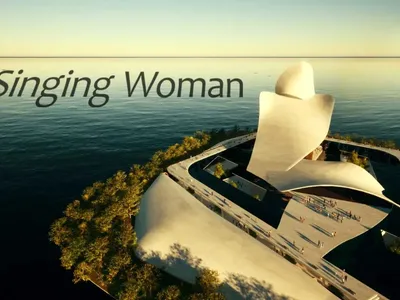
Singing Woman: An Opera House That Performs Before the Curtain Rises
Ovidiu Cristian Pavel's conceptual opera house translates Estonia's choral identity into a sculpted waterfront landmark facing the Baltic Sea.

Cube Design Draws an Ecological Corridor Between Two Shenzhen Hills with the Nankai Building
Beside Shenzhen's container docks, the Nankai Building pairs stacked balconies with a climbing green screen to connect two hillsides across its height.

graciastudio Turns a Viewless Tijuana Lot Inward Around a Courtyard of Concrete, Timber and Trees
In Tijuana, Jorge Gracia's GA2 House stacks a timber-clad private floor over exposed concrete and replaces a missing view with a planted interior patio.

Similar Reads
You might also enjoy these articles
Juan García Correa, John González and Claudia Rueda Sink a Circular Amphitheater into a Manizales Engineering Building
On the La Nubia campus in Manizales, Colombia, the S1 Building folds labs and offices into a hillside of ramped lawns that double as a campus route.

Arealis Brasil Wraps a São Paulo Office for Everis's Creative Arm Around a Glowing Curved Counter
In Brooklin Paulista, a 300 m² office for the creative agency Chazz uses timber, metal mesh and ribbed green glass to blur workspace and pub.

LT2A and OPEN Architectes Thread a Brick and Glass High School Through a Wooded Belgian Campus
In Braine-l'Alleud, a 3,000 m² wing for Collège Cardinal Mercier pairs pale brick with a glazed colonnade, deferring to a small chapel and a dense wood.

Atelier Diving Bell Stitches a Hangzhou Food Court Together with a Louvered Steel Canopy
In Hangzhou's Liangzhu Culture Village, a 1,400 m² food court renewal uses canopies, tree benches and props to turn a passage into a place.

Explore Architecture Competitions
Discover active competitions in this discipline

Challenge to reimagine the Iron Throne

Photograph architecture without architects

Illustrate the lost glory of Angkor Wat - Render Challenge

Design challenge to reuse E-waste
Comments (0)
Please login or sign up to add comments
No comments yet. Be the first to comment!