
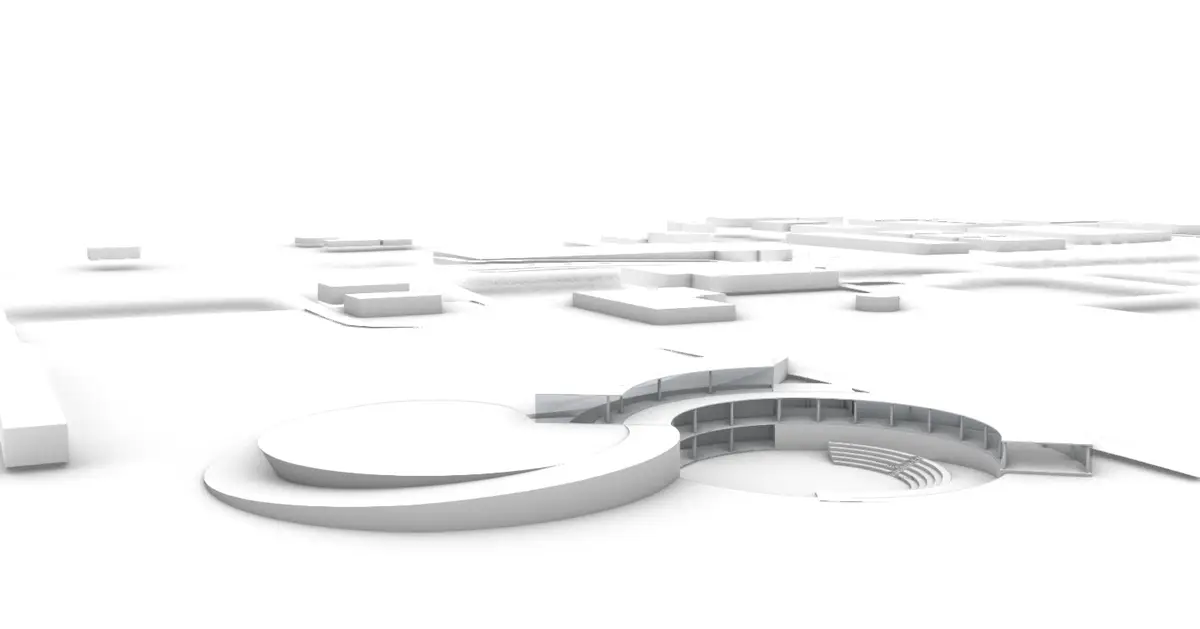
CONTINUUM
-

1. Introduction: From Discontinuity to Continuity
Our starting point for the project was the fact that e-sports structures were designed for limited-time events. Typically, these structures are only active on tournament days and become idle the rest of the time. However, at such a large scale, a high-tech structure that is not used for most of the day creates serious organizational inefficiency.
We approached this problem not only as a “usage schedule” issue but also as a “spatial organization” problem. We believed that instead of functioning like a single hall, the structure should be a fluid system operating at different intensities during different time periods. Thus, our project “Continuum” emerged: a seamless, flowing experience space hosting different scenarios spread over 30 days.
2. Conceptual Framework: Flow, Density, Participation
The fundamental concept of the design process was “flow.” An experience was designed where the user does not remain stationary but is always in motion. This idea of flow was reflected in both physical circulation and program flow. The user is involved in activities not only as a spectator but as an active participant.
Other concepts supporting this idea of flow:
* Continuity: Establishing a living system despite temporal gaps in the structure.
* Multiple Perspectives: Different users can experience the same event from different locations.
* Participation: The space is not only consumed but also a place where the experience is co-created.
Within this framework, different user scenarios spread over 30 days became a fundamental layer influencing the organization of the space.
3. Site and Orientation Decisions
The building is located in Toronto's post-industrial waterfront area undergoing transformation. The site featured a north-south circulation line and a pedestrian axis connecting it to the city.
We transformed this existing line into a circulation route, integrating the arena, gaming hub, social areas, and administrative units along this route. This approach ensured that the building was not just a concentrated structure at a single point, but rather an experience spread across the site.
4. Design Decisions: Ramp-Spine and Modular Layout
The spatial layout is built upon a ramped spine that rises and falls. This spine:
• Facilitates transitions between levels,
• Guides visitors through the space,
• Provides the structure with temporal and functional continuity.
The Arena is located at the lowest point of the spine, while the Gaming Hub and social areas are attached to this ramp. Rather than being separated by walls, the spaces are defined by surface transitions. This creates a permeable, fluid structure with undefined boundaries.
The programs within the structure are grouped into three main categories:
• Public Areas: Social area, exhibition, open amphitheater, café
• Semi-Public Areas: Gaming Hub, observation ramps
• Private Areas: Player preparation room, broadcast room, technical offices
5. 30-Day Scenario: Same Structure, Different Lives
Each day of the structure was reimagined for different uses. Some days:
• The main arena serves as a tournament center,
• Other days it becomes an exhibition hall or collective workshop.
At times:
• The viewing ramps function for passive observation,
• At other times, they offer individual experiences.
This allows the structure to be redefined solely through the surface–time relationship, without having fixed functions.
6. Material and Structural Decisions
The main structural element is reinforced concrete, but lightweight steel was used for the ramps. The principle of transparency was adopted for the facades: the aim was to enable activities to be experienced from all angles and to increase public visibility.
• Outer shell: Light gray precast panels
• Interior surfaces: Modular partition systems
• Floors: Light-colored concrete surfaces, creating a continuous “floor language”
7. Public Access and Accessibility
There are two different entry points in the structure:
• Public entrance: Opens directly onto the street. For everyday use.
• Technical entrance: Reserved for broadcasting, performer preparation, and special use.
This distinction regulates the flow of user profiles while also enabling the space to operate simultaneously for different scenarios.
8. Design Process and Trials
We followed these steps when starting the design:
1. We analyzed usage inefficiencies.
2. We tested the layered circulation and ramp system.
3. We created spatial density maps for each scenario.
4. We optimized flow/density/circulation relationships.
9. Future Scenarios: Adaptable Space
Continuum is designed not only to meet today's e-sports needs but also to adapt to changing user behaviors in the future.
• Modular surfaces can be easily transformed.
• Ramps are optimized for disabled access and logistics.
• Public spaces can be used differently in summer and winter.
Additionally, the structure can evolve into a community center over time, serving as a hub for education, exhibitions, and social events.
10. Continuum aims to be more than just a gym. It is a spatial system that evolves over time, transforms, and adapts to the user. Built on the principle of flow, this structure emphasizes that architecture is not just about form, but also about the relationship it builds over time.
“The same structure, a different experience every day.”

Popular Articles
Popular articles from the community


Opera by the Sea Estonia: Three Shells Dissolving Architecture into Tallinn's Coastline
A winning opera house proposal replaces monumental form with interconnected shells that blur the boundary between building, park and Baltic Sea.

Tsunami Convergenics: Turning Catastrophic Ocean Forces into Underwater Housing Infrastructure
A speculative underwater settlement off the coast of Onagawa, Japan, treats tsunamis and typhoons as energy sources rather than threats.

Opera on the Sea: Driftwood Logic Shapes a Timber Opera House on Estonia's Coast
Trevor Orgill's opera house translates the entangled drift of floating timber into a civic building where wood, water, and music converge.
Faces of the Soviet Avant-Garde: Turning Moscow's Street Names into an Open-Air Museum
A network of sculptural installations across a Moscow residential district transforms forgotten architect names into spatial encounters with cultural memor

Similar Reads
You might also enjoy these articles

Day and Night Park: A Time-Based Urban Newsstand in Beijing
A temporary urban newsstand in Beijing blending travel, light, and reading through poetic colors, compact form, and community-focused design.

Modernist Patio Renovation in El Masnou, Barcelona by Oliver Segura Arquitectura + Cebrià Arquitectura
Modernist patio renovation blending tradition and innovation with a movable pool, leveled floors, and Catalan materials in El Masnou.

Alto Residencial Coop: Cooperative Housing Development in Santiago de Compostela by Carbajo Barrios Arquitectos
A linear cooperative housing complex blending white volumes and perforated metal façades, enhancing community living, natural light, privacy, and urban integration.
Vil Genis School by BPA ARCHITECTURE – Massy, France
Vil Genis School in Massy, France, features sustainable design, south-facing classrooms, community integration, accessible spaces, and modern educational architecture.

Explore Architecture Of Time Competitions
Discover active competitions in this discipline


Challenge to visualize a collision of the future and past

Challenge to visualize future spaces of waste

Challenge to visualize slums of 2080

Challenge to illustrate the ruins of Petra
Comments (0)
Please login or sign up to add comments
No comments yet. Be the first to comment!