

Coral Commune: Where Architecture Dissolves into the Ocean Floor
A subaquatic commune of ribbed glass tubes and arched chambers reimagines how humans might inhabit the space between sea and sky.


Most underwater architecture proposals treat the ocean as a problem to be sealed out. Coral Commune does something rarer: it treats the water as a co-author, letting marine ecosystems infiltrate the spatial logic of the building itself. The result is a series of ribbed glass tubes, arched galleries, and curved viewing chambers that feel less like a submersible bunker and more like a coral organism that happens to accommodate human life.
Designed by Joel Colunga, Hector Garcia, and Tri Nguyen, Coral Commune was submitted to the Underwater Web competition on uni.xyz. The brief called for speculative visions of subaquatic habitation, and this team responded not with a sealed capsule but with a porous, multi-chambered commune whose structure blurs the boundary between built form and reef.
An Exploded Anatomy of the Deep
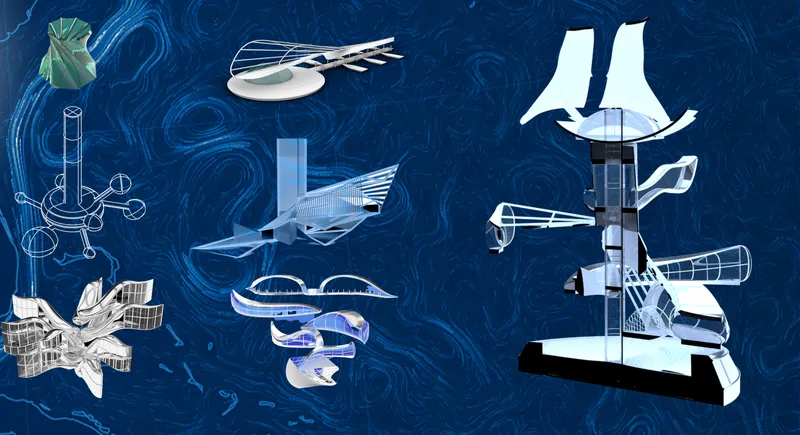

The exploded axonometric drawing reveals the project's organizational DNA. Multiple sculptural forms, each with a distinct geometric character, are stacked and dispersed across a topographic seabed. Some read as bulbous pods, others as elongated tubes. None resemble conventional architectural typologies. The wireframe elevation clarifies the structural ambition: curved transparent shells sit atop tubular elements that act as both circulation spines and structural ribs, hovering above flowing water patterns that suggest tidal forces shaping the design.
What stands out is the deliberate fragmentation. Rather than proposing a monolithic underwater station, the designers scatter program across discrete but connected volumes. This approach mirrors the logic of a coral reef, where individual polyps form a collective organism. It is a smart structural metaphor, but it also has practical implications: modular components could theoretically be deployed, repaired, or expanded independently.
Ribbed Corridors That Breathe Like Gills

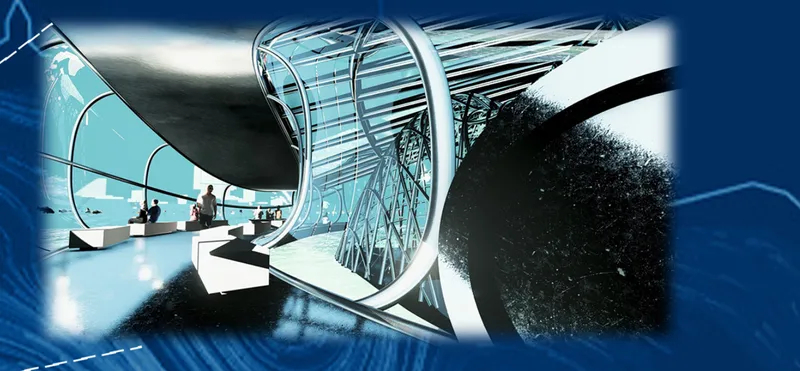
The interior corridors are the project's most arresting spatial invention. Ribbed transparent tubes form the primary circulation network, bathing occupants in diffused aquamarine light. Figures walk through these passages as if traversing the throat of some vast marine creature. The structural ribs are not decorative; they establish rhythm, frame views of the surrounding water, and provide lateral bracing against hydrostatic pressure. The diagonal walkway in one tube introduces a subtle topographic variation that prevents the corridors from becoming monotonous tunnels.
The material palette is restrained but effective. Glass dominates, paired with what appears to be a dark composite or reinforced polymer for the structural skeleton. The contrast between transparency and solidity creates legible spatial hierarchies: you always know whether you are in a passage (light, exposed, tubular) or a destination (dark, enclosed, vaulted).
Thresholds Between Observation and Immersion
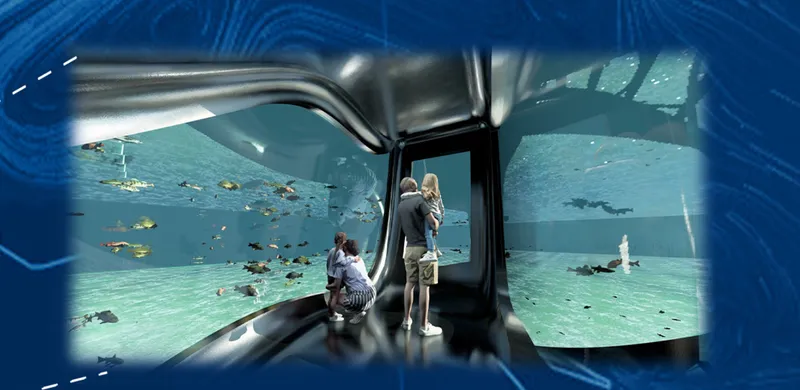
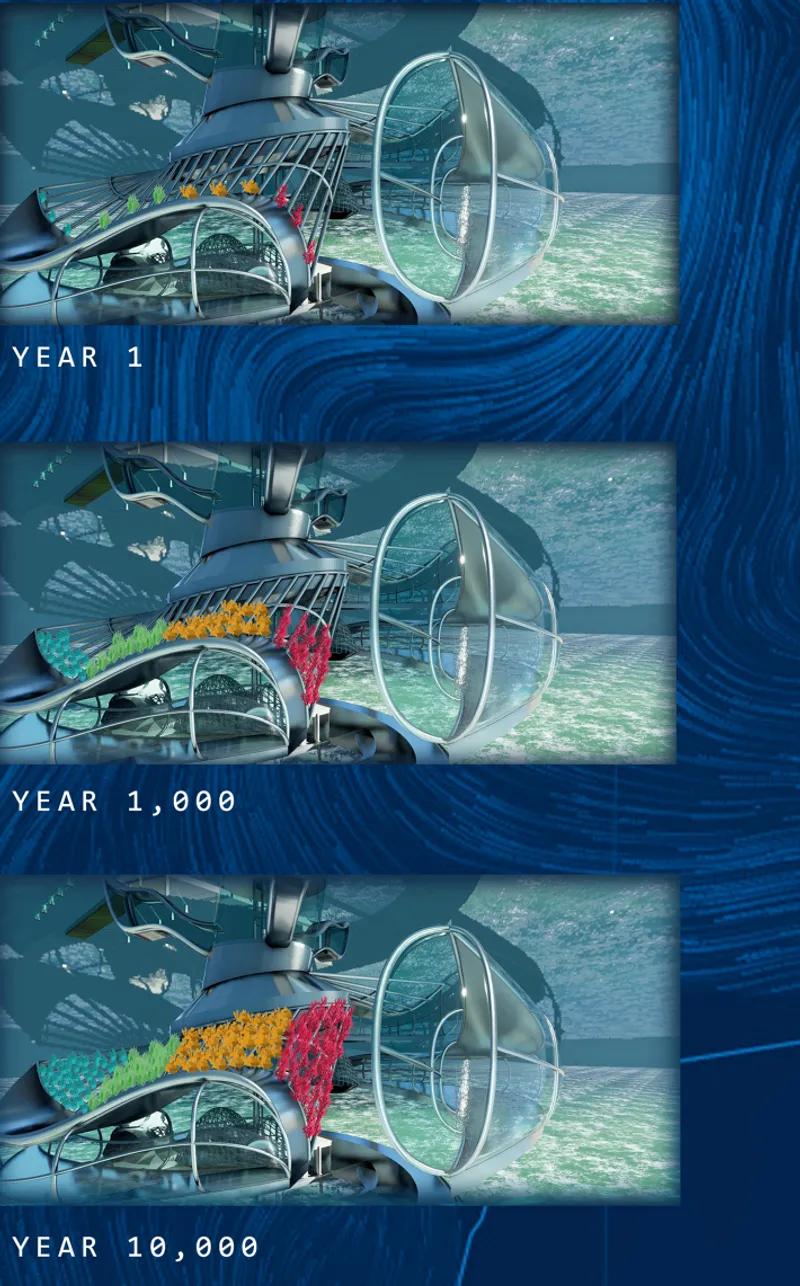
The underwater viewing chamber is where the project's experiential argument crystallizes. Curved glass walls wrap visitors in a panoramic aquarium-in-reverse, placing humans inside the exhibit while fish and rays cruise past unbothered. The turquoise light is not artificial; it is the filtered glow of the ocean itself, modulated by depth and the curvature of the enclosure. The sectional rendering confirms that these viewing moments are choreographed across three distinct stages of descent, each offering a different relationship to water depth, light quality, and marine life density.
This staged sequence is critical. Rather than delivering one spectacular reveal, the designers build anticipation through graduated thresholds. Arched spaces transition into tubular glazed corridors, which in turn open into the panoramic chambers. The journey downward becomes a spatial narrative, not merely a logistical problem of getting people to depth.
Dark Galleries and the Drama of Enclosure
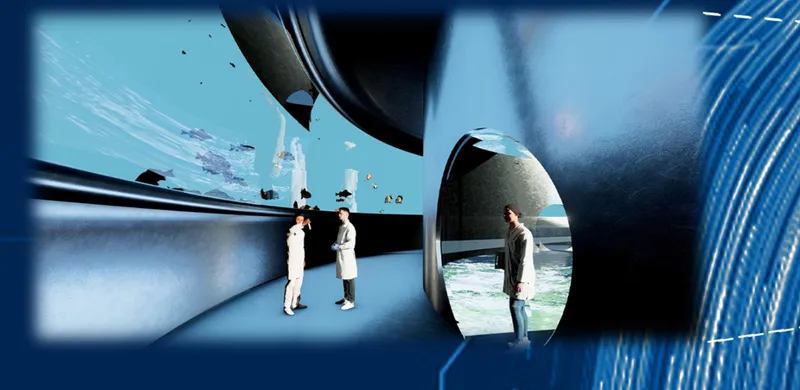
Not every space in Coral Commune is transparent. The gallery interior deploys curved black walls and circular openings to create a compressed, contemplative atmosphere. Visitors here are removed from the constant visual stimulus of the ocean and instead confront projected marine scenes, a deliberate inversion where the sea becomes mediated image rather than direct experience. The circular apertures function as portals, framing controlled glimpses of adjacent spaces and establishing a dialogue between darkness and the luminous corridors beyond.
This tonal shift is sophisticated. By oscillating between full immersion and curated remove, the designers avoid sensory fatigue and create the kind of spatial tension that sustains a longer visit. It suggests an understanding that architecture is not just about spectacular views but about the pacing of revelation and concealment.
Why This Project Matters
Underwater architecture competitions often produce sleek pods that look compelling in a single hero render but collapse under spatial scrutiny. Coral Commune earns attention because it is designed as a sequence of experiences, not a single image. The progression from ribbed corridors to dark galleries to panoramic chambers demonstrates that the team thought seriously about how bodies move through pressure-differentiated environments, and how light, enclosure, and transparency can be orchestrated to make that movement meaningful.
Joel Colunga, Hector Garcia, and Tri Nguyen have proposed something that sits between speculative fiction and buildable prototype. The structural logic is clear, the material choices are defensible, and the experiential choreography is genuinely inventive. In a competition field that rewards spectacle, Coral Commune stands out by rewarding attention.
View the Full Project
About the Designers
Designers: Joel Colunga, Hector Garcia, Tri Nguyen
Enter a Design Competition on uni.xyz
uni.xyz runs architecture and design competitions year-round that reward proposals with spatial conviction and real site intelligence.
Project credits: Coral Commune by Joel Colunga, Hector Garcia, Tri Nguyen Underwater Web (uni.xyz).


Popular Articles
Popular articles from the community


Aquadapt: An Underwater Habitat That Rewrites Its Rooms by the Hour
Curved modules ring the seabed while one shell shifts from breakfast room to cinema, farm and football pitch as residents' needs change.


FCC Arquitectura Expands a Portuguese Granite House with a Board-Marked Concrete Wing
In Portugal, JV House pairs a cleaned-up whitewashed and granite dwelling with a timber-shuttered concrete extension, courtyards and a garden pool.

The Amber Palace Opera: A Geological Fiction Surfaces on Tallinn's Baltic Waterfront
Pierre Brillard reimagines a Baltic legend as a public landscape, opera house, and waterfront promenade rooted in Tallinn's coastal identity.
Manzana Morphosis: Stretching Barcelona's Grid into a Living Landscape for 2050
A radical reworking of the Eixample manzana turns density into a tool for generous public space, vertical ecology, and environmental performance.

Similar Reads
You might also enjoy these articles

Vereda Arquitetos Renovates a 40-Square-Meter Apartment Inside Niemeyer's Copan Building
A compact unit in São Paulo's most iconic residential tower gets a material overhaul that pairs exposed concrete with bold blue Formica.

Shakur's House: Exposed Brick as an Interior Organiser in a 168 m² Mashhad Residence
Brick moves indoors in this Mashhad residence, where masonry walls, glass partitions and teal planes sequence a compact home without closing it off.

Day and Night Park: A Time-Based Urban Newsstand in Beijing
A temporary urban newsstand in Beijing blending travel, light, and reading through poetic colors, compact form, and community-focused design.

Modernist Patio Renovation in El Masnou, Barcelona by Oliver Segura Arquitectura + Cebrià Arquitectura
Modernist patio renovation blending tradition and innovation with a movable pool, leveled floors, and Catalan materials in El Masnou.

Comments (0)
Please login or sign up to add comments
No comments yet. Be the first to comment!