
Corpo Atelier Peels Back the Plaster of a Faro House to Reveal Its Hidden Skeleton
A traditional Portuguese dwelling in Faro is stripped, cut, and scattered with pink limestone to blur the line between ruin and renovation.


Renovation in southern Portugal often defaults to one of two modes: the faithful restoration or the full gut job. Corpo Atelier refuses both. Their reworking of a small traditional house on a quiet street in Faro treats the existing structure not as something to preserve or discard but as a body to selectively expose. Ceilings are sliced open to show timber beams. Pink limestone fragments are scattered across three of the four white facades with no apparent logic, landing on corners, lintels, and window frames like architectural Rorschach blots. The project's unwieldy name, Cut Ceilings and Dyslexic Ornaments House, is not whimsy for its own sake. It is a precise description of the two operations that define the entire intervention.
What makes the project genuinely interesting is how those two gestures, the ceiling cuts and the stone scattering, create an atmosphere that is neither polished nor ruined but somewhere in between. Corpo Atelier, led by Filipe Paixão and Susana Café, seems to want the house to feel as though it was discovered rather than designed. The whiteness is relentless, the kind of blank that makes you hyper-aware of every interruption: a timber beam exposed above, a chunk of pink stone framing a doorway below. The result is a house that reads as a meditation on ornament, on what happens when decoration is freed from symmetry, pattern, and expectation.
White Walls, Scattered Stone
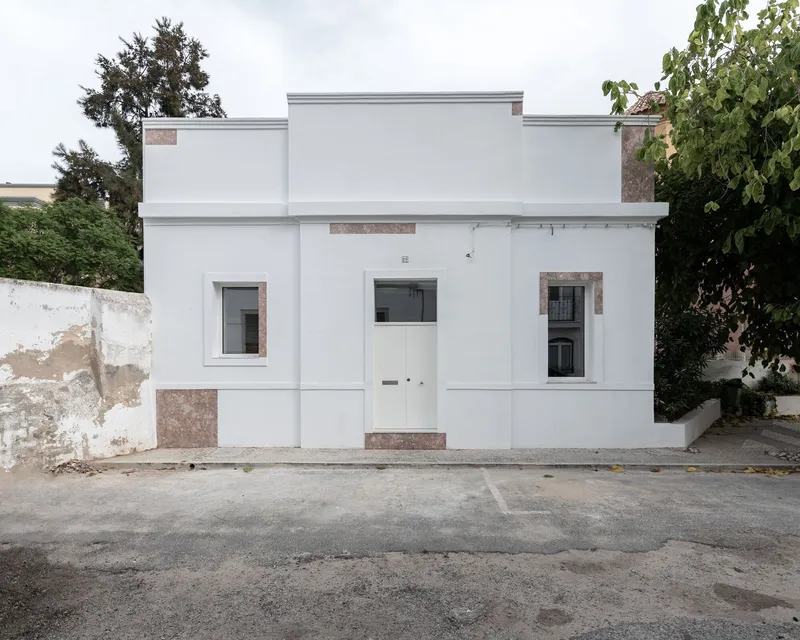
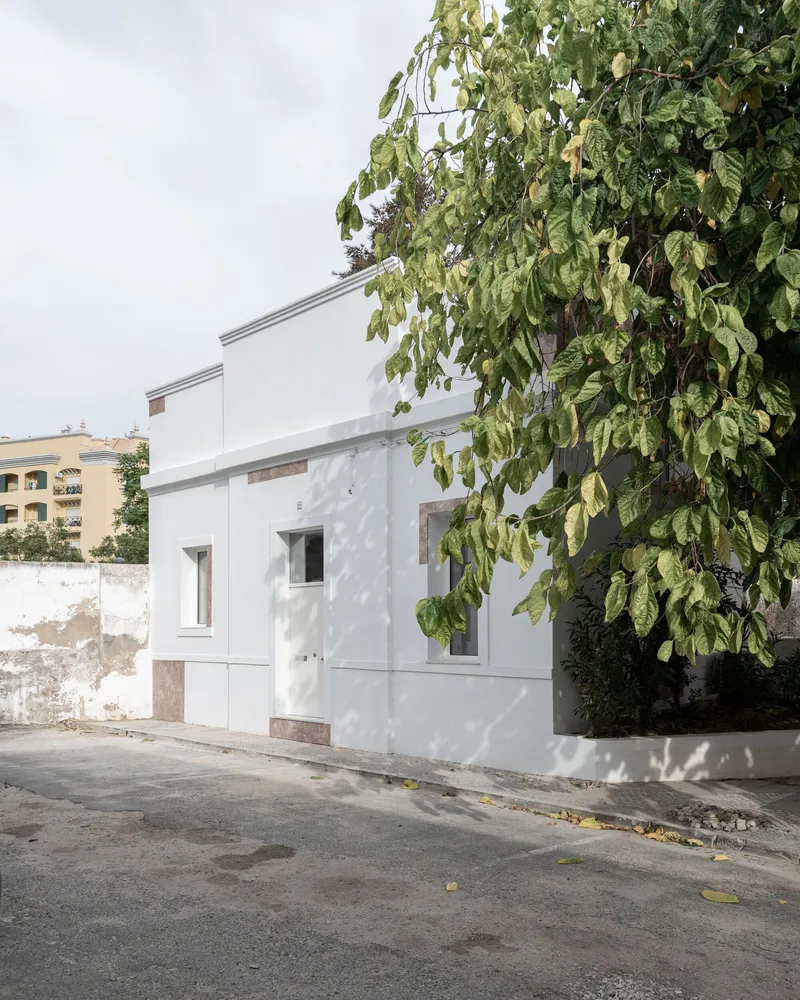

From the street, the house reads as an almost featureless white volume, the kind of quiet, plastered facade that lines hundreds of streets in the Algarve. The disruptions are subtle at first: pieces of pink limestone appear at corners and around openings, but they follow no discernible pattern. One window gets a full stone surround; another gets a single fragment at its base. Corpo Atelier describes these as "dyslexic ornaments," and the term is apt. Ornament in classical architecture depends on repetition, hierarchy, and legibility. Here, the limestone pieces are scattered as if a decorative program was dropped and the pieces landed where they fell.
The adjacent octagonal tower, topped with terracotta tiles, adds another layer of formal oddity. It sits alongside the renovated white volumes not as a stylistic match but as a companion from a different era. The overall impression is of a building that has accumulated its identity through time rather than through a single design act, even though, of course, every placement was deliberate.
The Cross and the Circle
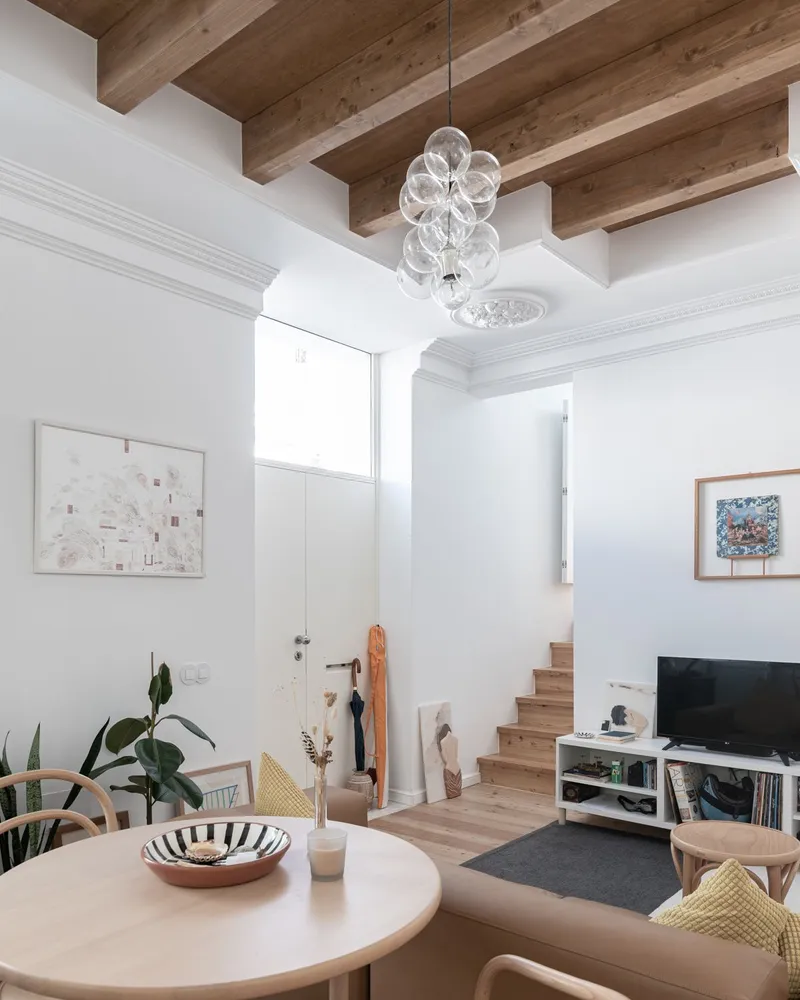

Inside, the two types of ceiling cuts organize the entire spatial experience. On the ground floor, the social areas are defined by a cross-shaped opening that peels back the white plaster to reveal the timber beam structure above. It is a bold, almost sacral gesture: the cross form reads as a skylight of sorts, except it looks not at the sky but at the bones of the house itself. The living and dining space below feels tall and luminous, with a glass bubble chandelier floating beneath the exposed structure.
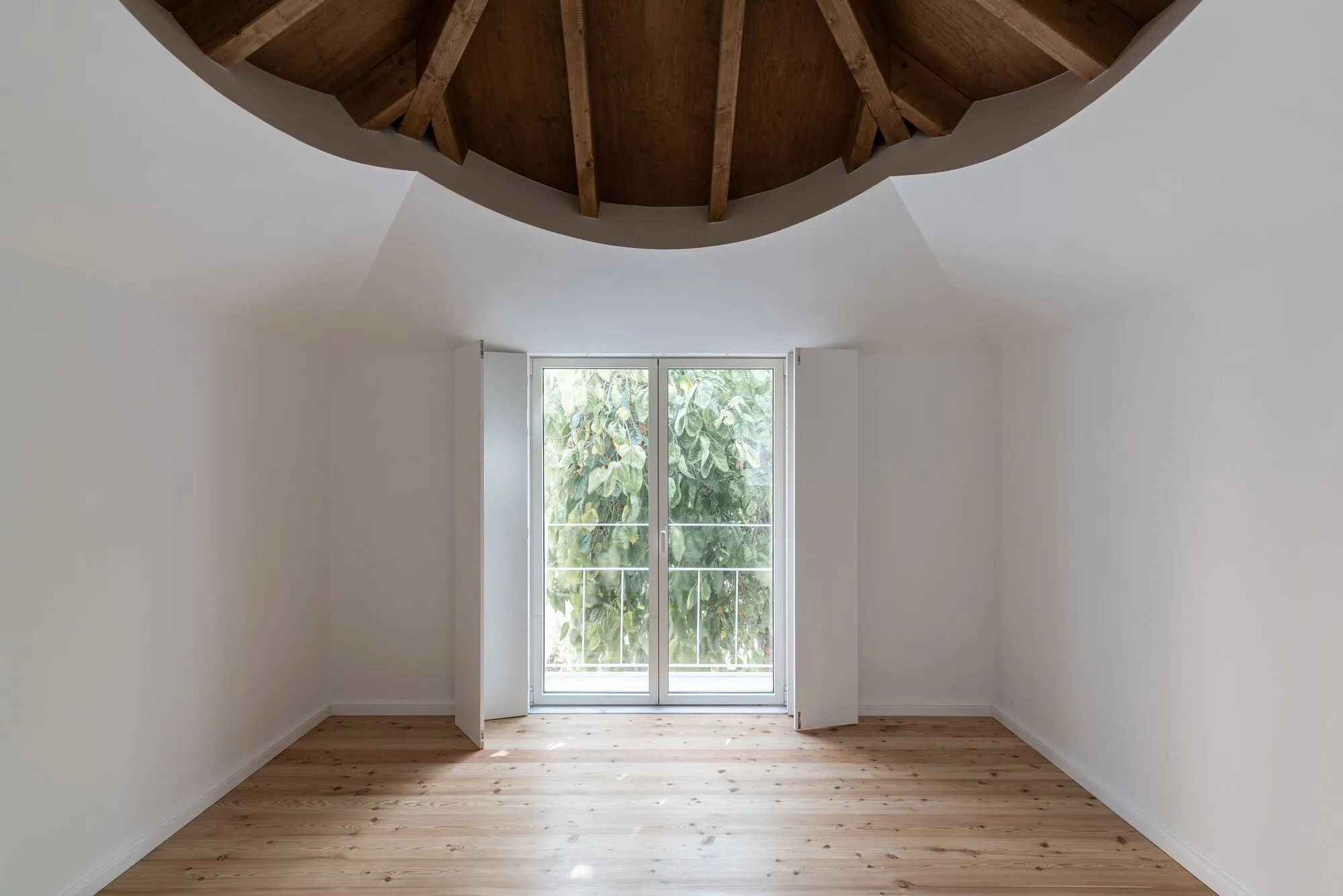
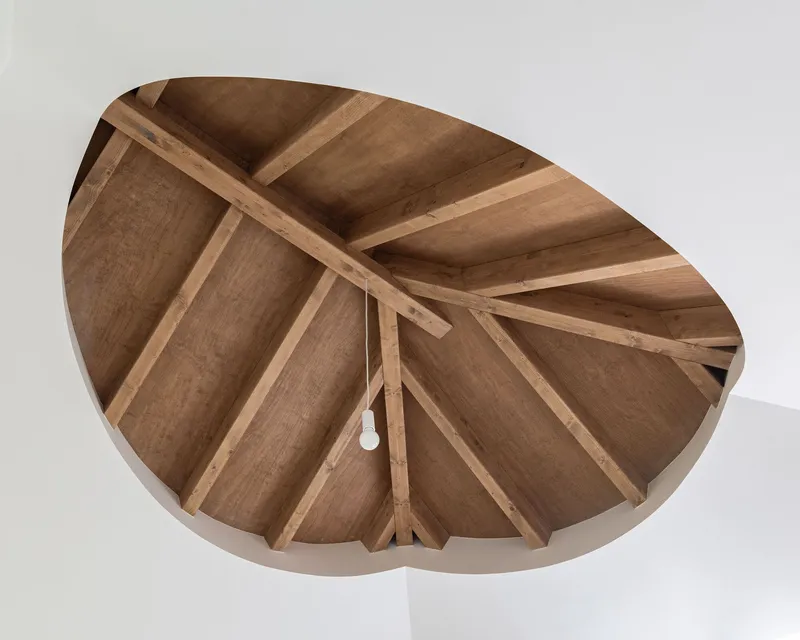
Upstairs, the bedroom area is marked by a circular ceiling cut. The radial timber beam structure fans outward from a central point, creating a geometry that is part tent, part wheel, part sunburst. Seen from below, the pattern is mesmerizing: the beams converge on a single pendant light as if the entire structure were generating that one point of illumination. These two forms, the cross and the circle, function as spatial centers of gravity. They tell you, without any signage or spatial partitioning, exactly where you stand in the house's program.
Timber as Revelation
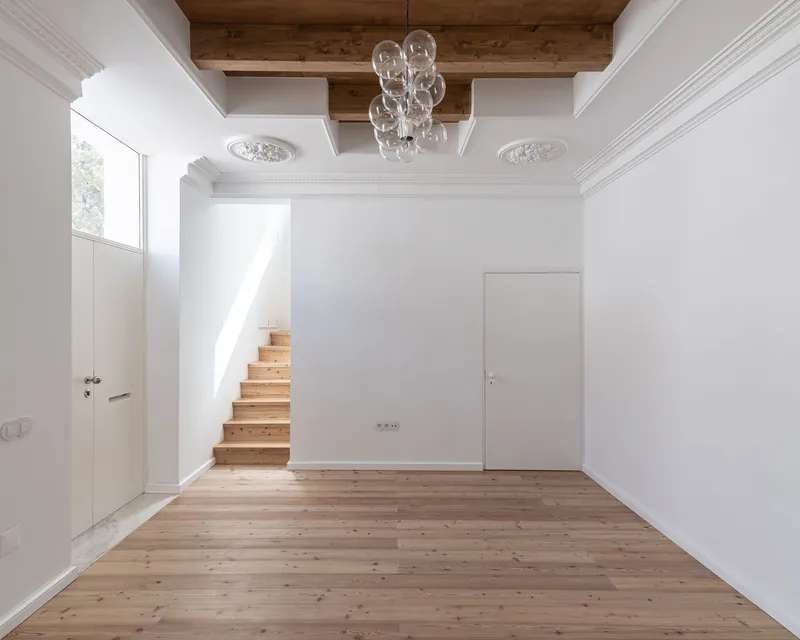


The timber beams that the ceiling cuts expose are not decorative additions. They are the actual wood structure that holds the first floor and the roof. Corpo Atelier simply chose to stop applying plaster at certain points, letting the raw construction remain visible. The staircase follows the same logic: it emerges from the white wall as a clean timber element, its warm tone a sharp contrast to the surrounding blankness.
In the attic bedroom, curved timber beams arc overhead beneath the gable, and built-in white storage cabinets tuck into the low walls. The octagonal room offers a more dramatic version of the same move: a glazed door frames dense greenery outside while the ceiling structure radiates above like a wooden parasol. Throughout the house, the message is consistent. Wood is the truth behind the white mask, and the ceiling cuts are the architect's way of pulling that mask aside just enough.
Interior Courtyards and Green Intrusions

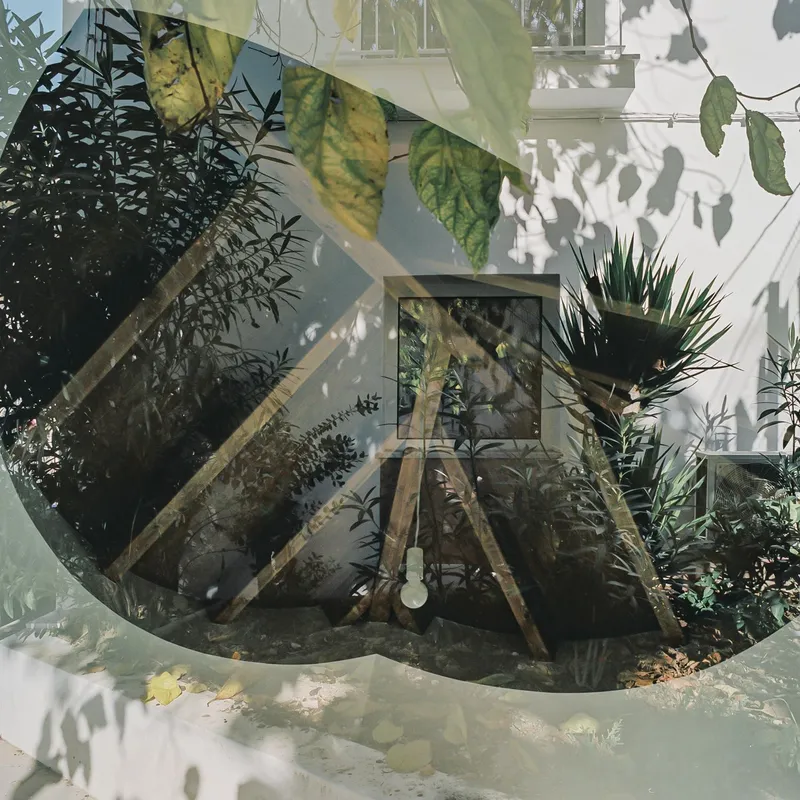
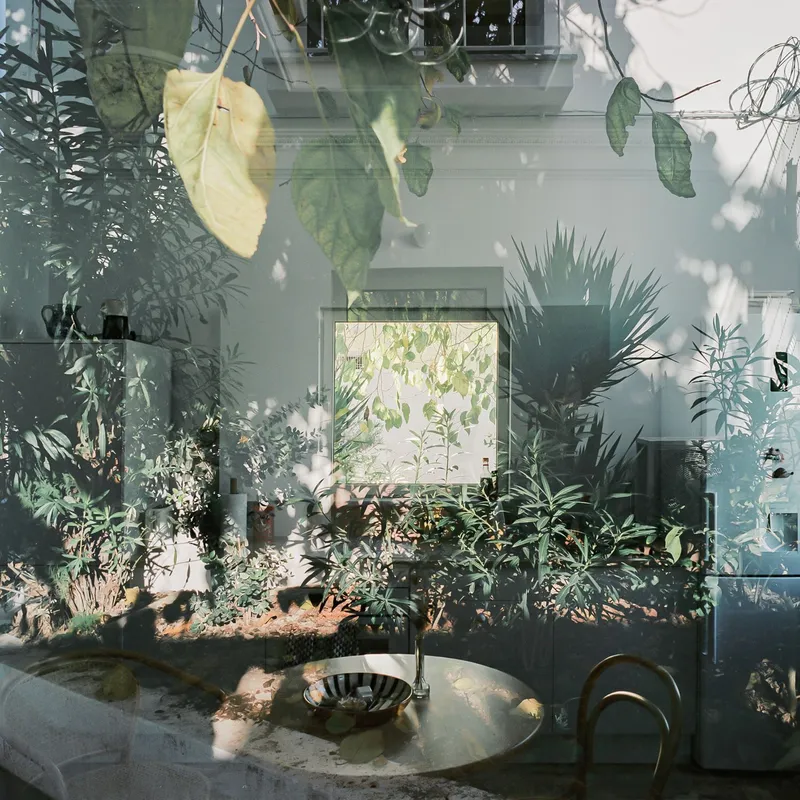
The house wraps around planted courtyards that blur the boundary between inside and out. Citrus trees and dense shrubs press against white stucco walls, their leaves casting moving shadows that become the only decoration on otherwise blank surfaces. One interior courtyard is so thick with banana leaves and climbing plants that it reads less like a garden and more like a controlled jungle.
The kitchen pushes this blurring furthest. A round table and steel sink sit directly beside planted beds, with suspended greenery hanging from above. The effect is somewhere between a domestic kitchen and a potting shed, and it is one of the most charming moments in the house. Corpo Atelier treats vegetation not as landscaping but as another material, as natural and structural as the exposed timber above.
Ornament Without Rules
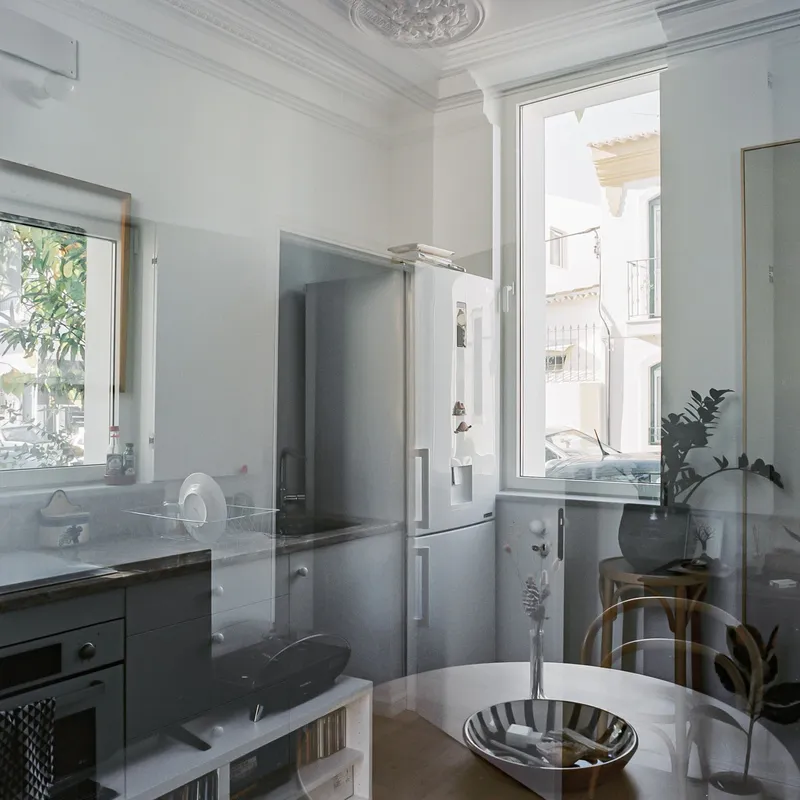

The kitchen ceiling carries a plasterwork medallion that might be original to the house, a classical ornamental detail that sits in sharp contrast to the stripped-back aesthetic elsewhere. Corpo Atelier does not hide it or restore it to full glory. It simply leaves it in place, a relic of a decorative language the rest of the house has consciously abandoned. The juxtaposition is pointed: here is what ornament used to be, and here is what this house does instead.
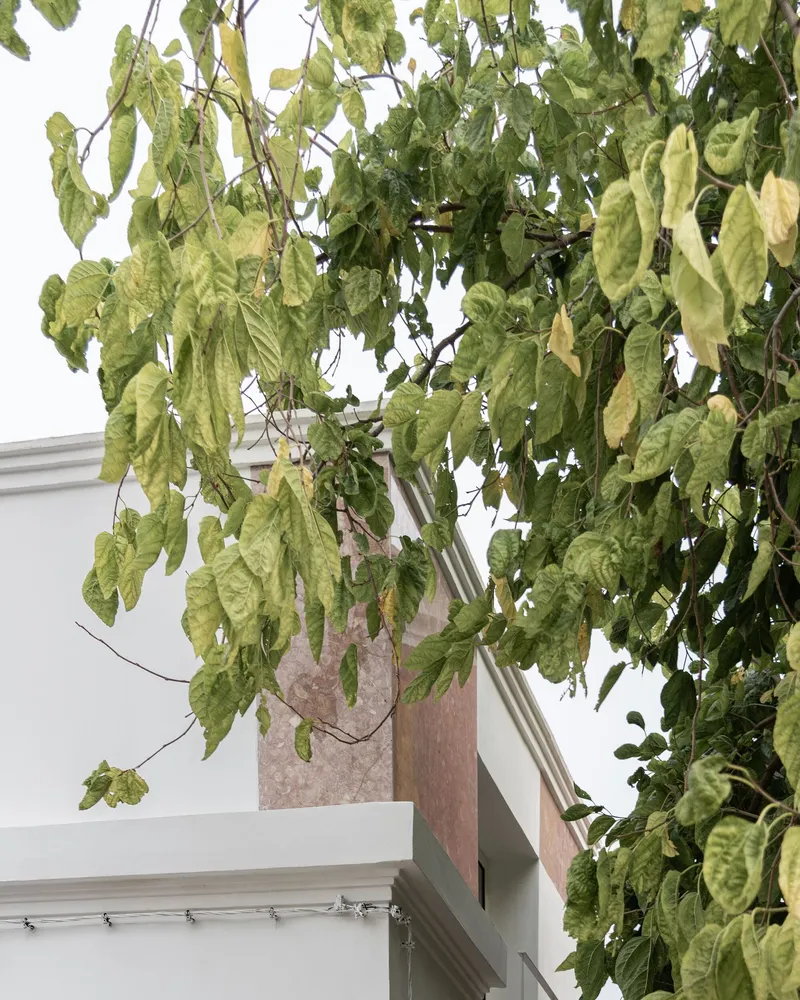
Outside, a metal railing and grey column support climbing vines against a pink wall, a moment that feels almost Mediterranean in its casualness. Hanging branches with yellowing leaves drape against a white surface beside a painted canvas. These incidental compositions reinforce the project's central idea: ornament does not have to follow rules to create beauty. It can be random, organic, even accidental, and still produce spaces that feel deeply considered.
Plans and Drawings
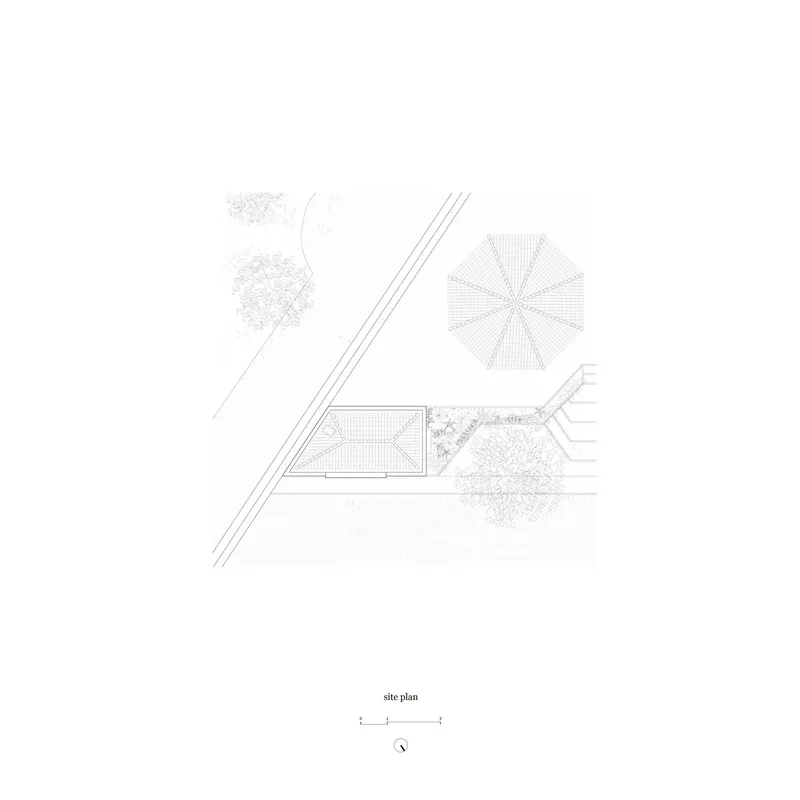
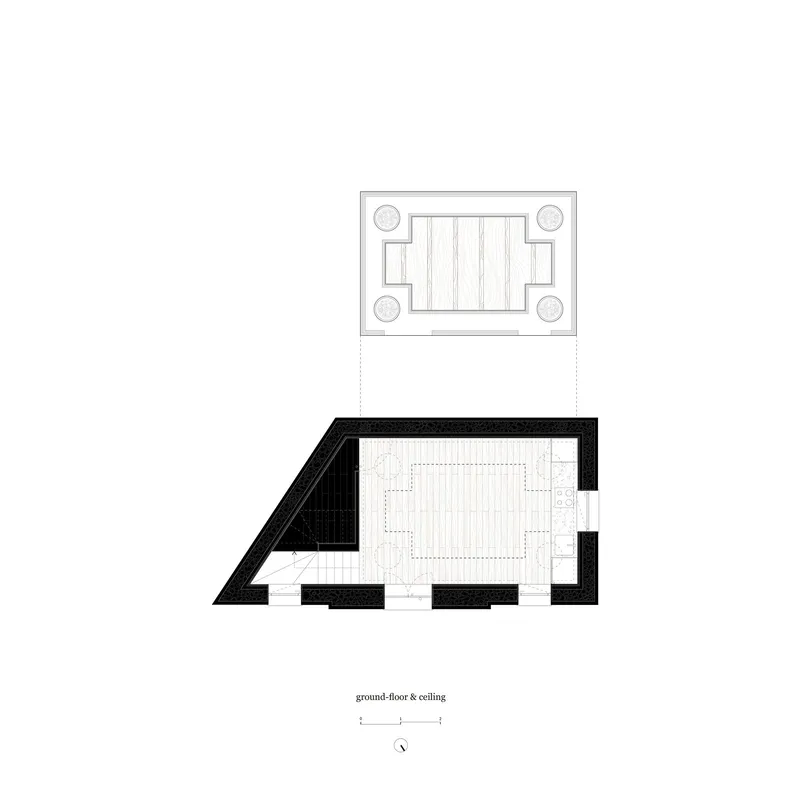
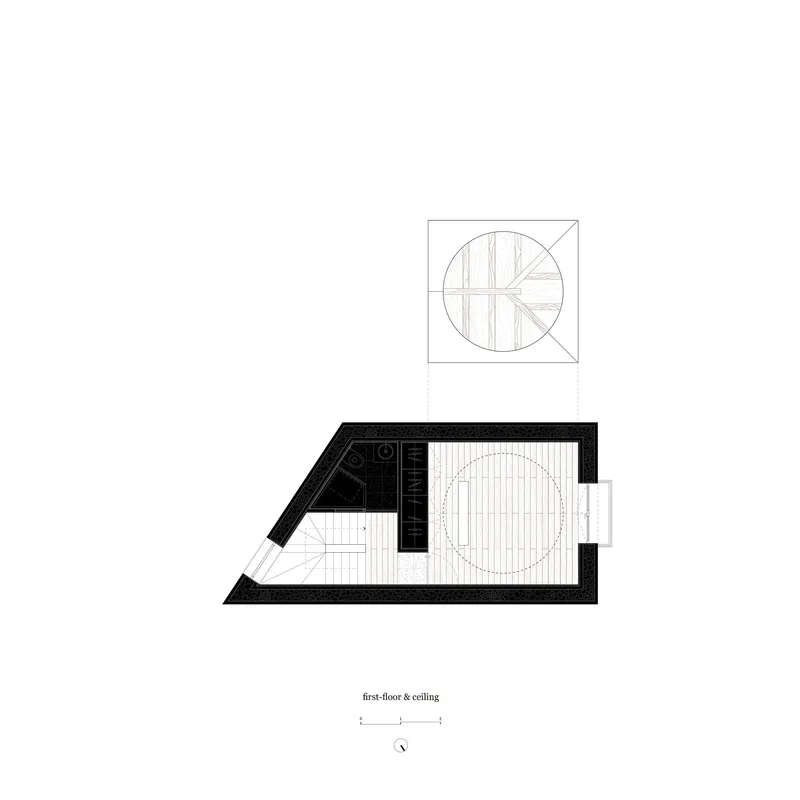
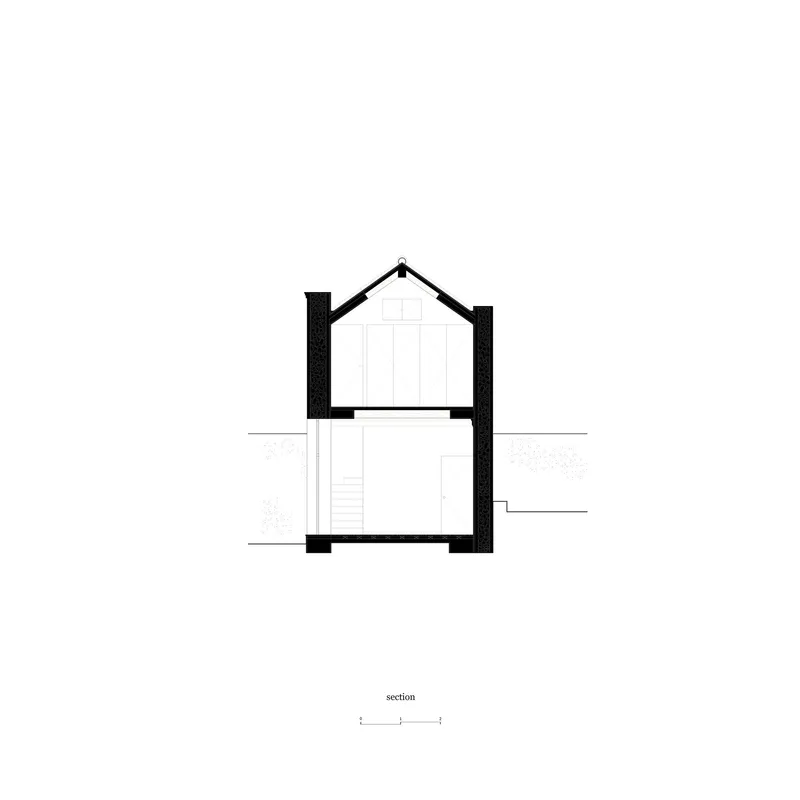

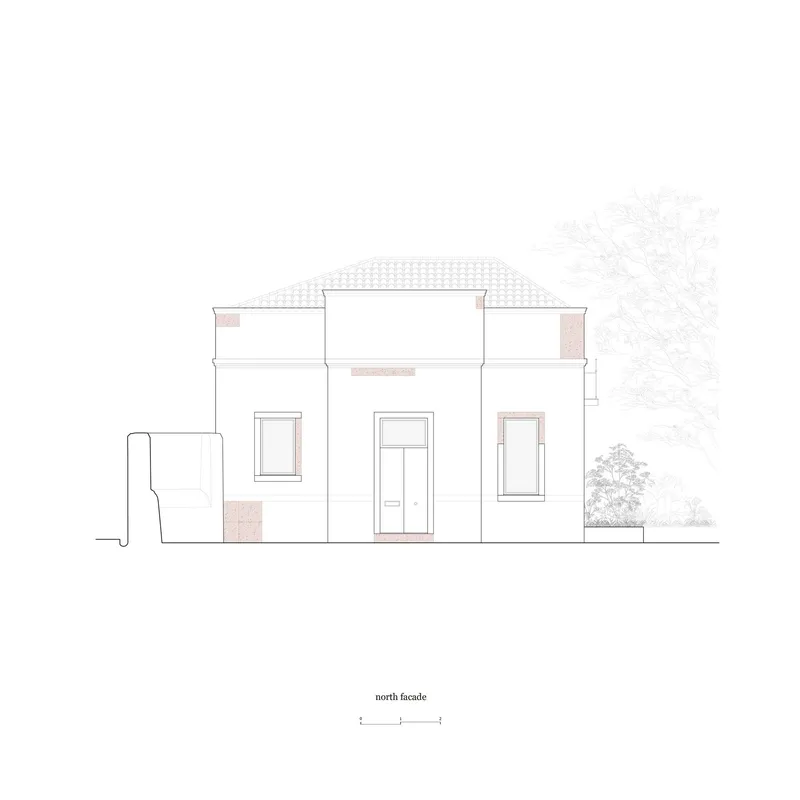


The drawings confirm what the photographs suggest: the house is organized around two clearly defined spatial centers, one cross-shaped and one circular, embedded within a conventional rectangular footprint. The site plan reveals the octagonal structure and a pool set among trees, while the sections show how the two-story volume accommodates the dramatic ceiling geometries within a modest pitched roof. The floor plans layer ceiling patterns over room layouts, making the relationship between structure and spatial experience legible in a single drawing.
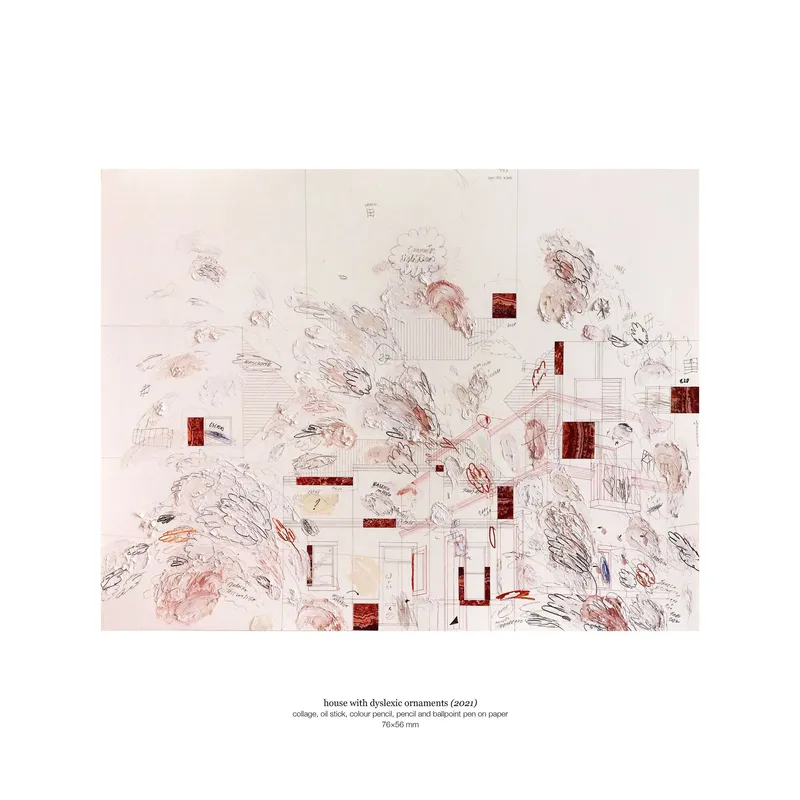
The physical sectional model and the collage drawing are particularly revealing. The model exposes the ceiling coffers as deep, inhabited voids within the roof structure, while the collage combines plan fragments with gestural sketches and red annotations in a way that feels closer to an artist's notebook than an architectural drawing set. Both documents suggest a design process that was intuitive and exploratory, not purely systematic, which aligns perfectly with the "dyslexic" logic of the finished building.
Why This Project Matters
The Cut Ceilings and Dyslexic Ornaments House matters because it proposes a genuinely alternative relationship between renovation and ornament. In a discipline that typically treats decoration as either something to faithfully restore or something to eliminate entirely, Corpo Atelier offers a third path: scatter it, scramble it, let it land where it lands. The pink limestone fragments on the facade are not restoration and they are not minimalism. They are a new category of decorative intervention, one that borrows the materials of tradition while rejecting its compositional rules.
The ceiling cuts are equally radical in their simplicity. By selectively removing plaster to expose structure, the architects turn a standard renovation technique (exposing beams) into a geometric and symbolic act. The cross marks the communal life of the ground floor; the circle marks the private retreat above. These are not arbitrary shapes. They are ancient spatial archetypes deployed with surgical precision inside a modest Algarve house. The project proves that even the smallest domestic renovation can carry big ideas if the architect is willing to look at what is already there and decide, very carefully, what to take away.
Cut Ceilings and Dyslexic Ornaments House by Corpo Atelier. Faro, Portugal, 2022. Photography by Frederico Martinho.
About the Studio
Share Your Own Work on uni.xyz
If projects like this are the kind of work you want to make, uni.xyz is a place to publish your own, find collaborators, and enter design competitions.




Popular Articles
Popular articles from the community


Co-Life: Senior Housing Design That Reconnects Older Adults With the City
Co-Life reimagines senior housing design through healing gardens, shared streets, workshops, and a sustainable community across generations.

Conexión: Biophilic Design Reimagines High-Rise Living in Hong Kong
Conexión reimagines high-rise living in Hong Kong through biophilic design, green facades, shared spaces, daylight, water and nature within.

AL-JANNAH: Sustainable Architecture and Permaculture for Afghan Widows
AL-JANNAH uses sustainable architecture and permaculture to create resilient oasis of housing, learning, work and renewal for Afghan widows.

The Earth Pod: 3D Printed Homes for Resilient Refugee Communities
The Earth Pod reimagines refugee housing through 3D printed homes made from clay, combining resilience, self-sufficiency, and rapid shelter.


Similar Reads
You might also enjoy these articles

Bao Huynh Watercolor Atelier: A Serene Art Retreat in Hội An
Bao Huynh Watercolor Atelier in Hội An blends multifunctional art spaces, sustainable design, local materials, and family-friendly living in a serene environment.

Atelier Macri Concept Store Interior Design by CASE-REAL
Atelier Macri store features a "ko" counter, walnut wood details, cork displays, blending retail, gallery, and seamless customer experiences.

Manuel Vargas Izquierdo Stadium and High-Performance Sports Center: Architectural Excellence in Jalpa de Méndez
The Manuel Vargas Izquierdo Stadium blends sustainable design, inclusive sports facilities, and cultural-inspired architecture, revitalizing Jalpa de Méndez’s public spaces.

KAKR Buluh Awar Hall: Revitalizing Community and Ecology Through Bamboo Architecture
Community built bamboo hall revitalizes Buluh Awar village, empowering youth, restoring ecology, celebrating vernacular craftsmanship through sustainable architecture and culture.


Explore Residential Building Competitions
Discover active competitions in this discipline


Challenge to design mud housing for contemporary communities


Challenge to reimagine the Iron Throne


Photograph architecture without architects


Illustrate the lost glory of Angkor Wat - Render Challenge
Comments (0)
Please login or sign up to add comments
No comments yet. Be the first to comment!